


Acts 19:11
- δυνάμειςdunameisMiraclesG1411N-APFNoun Accusative Plural Feminine
- τεtethenG5037CONJConjunction
- οὐounotG3756PRT-NNegative Particle Negative
- τὰςtas<the>G3588T-APFDefinite article Accusative Plural Feminine
- τυχούσαςtuchousasbeing ordinaryG5177V-2AAP-APFVerb 2nd Aorist Active Participle Accusative Plural Feminine
- ὁho<the>G3588T-NSMDefinite article Nominative Singular Masculine
- θεὸςtheosGodG2316N-NSM-TNoun Nominative Singular Masculine Title
- ἐποίειepoieiwas doingG4160V-IAI-3SVerb Imperfect Active Indicative 3rd Singular
- διὰdiathroughG1223PREPPreposition
- τῶνtōntheG3588T-GPFDefinite article Genitive Plural Feminine
- χειρῶνcheirōnhandsG5495N-GPFNoun Genitive Plural Feminine
- ΠαύλουPaulouof PaulG3972N-GSM-PNoun Genitive Singular Masculine Individual
English is a literal word-by-word gloss of the Greek, not the KJV's wording. Why?
This is the original text the KJV's translators worked from — each Greek word with its own literal English meaning in this verse, prepared by scholars at Tyndale House, Cambridge. The KJV translates whole sentences, not word by word, so its wording differs: one Greek word can become several English words, and the KJV may choose “charity” where the gloss reads “love”. Both are faithful — they answer different questions. For the KJV's own rendering, switch to the KJV text.
Details
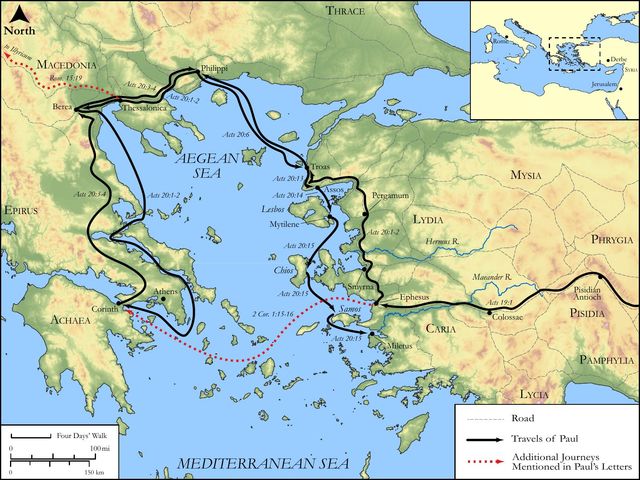
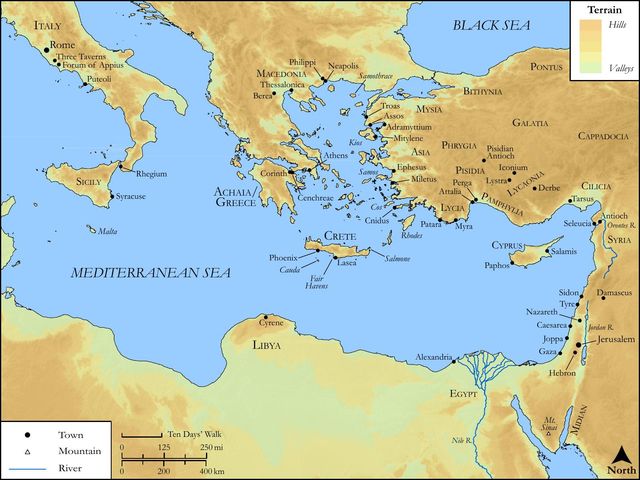
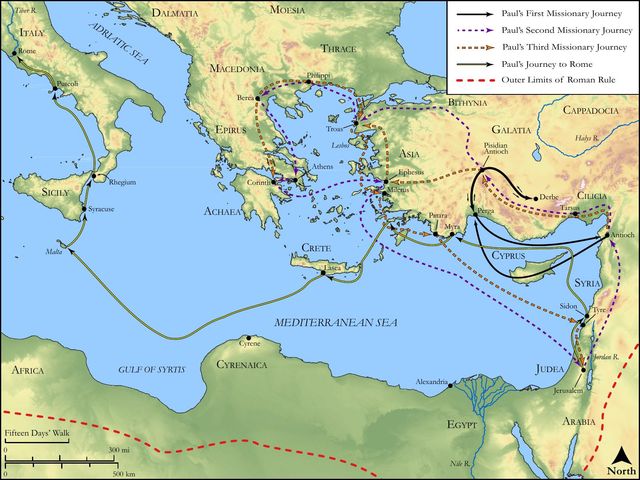
See on the biblical-era map
Study this verse
Public-domain commentary
Matthew Henry
From his Commentary on the Whole Bible. Henry comments on passages, not single verses — this entry covers Acts 19:8–12. His four-level outline is real structure in the source text, so it is rendered as structure.
Paul is here very busy at Ephesus to do good.
I.He begins, as usual, in the Jews' synagogue, and makes the first offer of the gospel to them, that he might gather in the lost sheep of the house of Israel, who were now scattered upon the mountains. Observe,
1.Where he preached to them: in their synagogue (Act 19:8), as Christ used to do. He went and joined them in their synagogue-worship, to take off their prejudices against him, and to ingratiate himself with them, while there was any hope of winning upon them. Thus he would bear his testimony to public worship on sabbath days. Where there were no Christian assemblies yet formed, he frequented the Jewish assemblies, while the Jews were not as yet wholly cast off. Paul went into the synagogue, because there he had them together, and had them, it might be hoped, in a good frame.
2.What he preached to them: The things concerning the kingdom of God among men, the great things which concerned God's dominion over all men and favour to them, and men's subjection to God and happiness in God. He showed them their obligations to God and interest in him, as the Creator, by which the kingdom of God was set up, - the violation of those obligations, and the forfeiture of that interest, by sin, by which the kingdom of God was pulled down, - and the renewing of those obligations and the restoration of man to that interest again, by the Redeemer, whereby the kingdom of God was again set up. Or, more particularly, the things concerning the kingdom of the Messiah, which the Jews were in expectation of, and promised themselves great matters from; he opened the scriptures which spoke concerning this, gave them a right notion of this kingdom, and showeth them their mistakes about it.
3.How he preached to them.
(1.)He preached argumentatively: he disputed; gave reasons, scripture-reasons, for what he preached, and answered objections, for the convincing of men's judgments and consciences, that they might not only believe, but might see cause to believe. He preached dialegomenos - dialogue-wise; he put questions to them and received their answers, gave them leave to put questions to him and answered them.
(2.)He preached affectionately: he persuaded; he used not only logical arguments, to enforce what he said upon their understandings, but rhetorical motives, to impress what he said upon their affections, showing them that the things he preached concerning the kingdom of God were things concerning themselves, which they were nearly concerned in, and therefore ought to concern themselves about, Co2 5:11, We persuade men. Paul was a moving preacher, and was a master of the art of persuasion.
(3.)He preached undauntedly, and with a holy resolution: he spoke boldly, as one that had not the least doubt of the things he spoke of, nor the least distrust of him he spoke fRom. nor the least dread of those he spoke to.
4.How long he preached to them: For the space of three months, which was a competent time allowed them to consider of it; in that time among them that belonged to the election of grace were called in, and the rest were left inexcusable. Thus long Paul preached the gospel with much contention (Th1 2:2), yet he did not fail, nor was discouraged.
5.What success his preaching had among them.
(1.)There were some that were persuaded to believe in Christ; some think this is intimated in the word persuading - he prevailed with them. But,
(2.)Many continued in their infidelity, and were confirmed in their prejudices against Christianity. When Paul called on them before, and preached only some general things to them, they courted his stay among them (Act 18:20); but now that he settled among them, and his word came more closely to their consciences, they were soon weary of him.
[1.]They had an invincible aversion to the gospel of Christ themselves: they were hardened, and believed not; they were resolved they would not believe, though the truth shone in their faces with ever such a convincing light and evidence. Therefore they believed not, because they were hardened.
[2.]They did their utmost to raise and keep up in others an aversion to the gospel; they not only entered not into the kingdom of God themselves, but neither did they suffer those that were entering to go in; for they spoke evil of that way before the multitude, to prejudice them against it. Though they could not show any manner of evil in it, yet they said all manner of evil concerning it. These sinners, like the angels that sinned, became Satans, adversaries and devils, false accusers.
II.When he had carried the matter as far as it would go in the synagogue of the Jews, and found that their opposition grew more obstinate, he left the synagogue, because he could not safely, or rather because he could not comfortably and successfully, continue in communion with them. Though their worship was such as he could join in, and they had not silenced him, nor forbidden him to preach among them, yet they drove him from them by their railing at those things which he spoke concerning the kingdom of God: they hated to be reformed, hated to be instructed, and therefore he departed from them. Here we are sure there was a separation and no schism; for there was a just cause for it and a clear call to it. Now observe,
1.When Paul departed from the Jews he took the disciples with him, and separated them, to save them from that untoward generation (according to the charge Peter gave to his new converts, Act 2:40); lest they should be infected with the poisonous tongues of those blasphemers, he separated those who believed, to be the foundation of a Christian church, now that they were a competent number to be incorporated, that others might attend with them upon the preaching of the gospel, and might, upon their believing, be added to them. When Paul departed there needed no more to separate the disciples; let him go where he will, they will follow him.
2.When Paul separated from the synagogue he set up a meeting of his own, he disputed daily in the school of one Tyrannus. He left the synagogue of the Jews, that he might go on with the more freedom in his work; still he disputed for Christ and Christianity, and was ready to answer all opponents whatsoever in defence of them; and he had by this separation a double advantage.
(1.)That now his opportunities were more frequent. In the synagogue he could only preach every sabbath day (Act 13:42), but now he disputed daily, he set up a lecture every day, and thus redeemed time: those whose business would not permit them to come one day might come another day; and those were welcome who watched daily at these gates of wisdom, and waited daily at the posts of her doors.
(2.)That now they were more open. To the synagogue of the Jews none might come, nor could come, but Jews or proselytes; Gentiles were excluded; but, when he set up a meeting in the school of Tyrannus, both Jews and Greeks attended his ministry, v. 10. Thus, as he describes this gate of opportunity at Ephesus (Co1 16:8, Co1 16:9), a wide door and an effectual was opened to him, though there were many adversaries. Some think this school of Tyrannus was a divinity-school of the Jews, and such a one they commonly had in their great cities besides their synagogue; they called it Bethmidrash, the house of enquiry, or of repetition; and they went to that on the sabbath day, after they had been in the synagogue. They go from strength to strength, from the house of the sanctuary to the house of doctrine. If this was such a school, it shows that though Paul left the synagogue he left it gradually, and still kept as near it as he could, as he had done, Act 18:7. But others think it was a philosophy-school of the Gentiles, belonging to one Tyrannus, or a retiring place (for so the word scholē sometimes signifies) belonging to a principal man or governor of the city; some convenient place it was, which Paul and the disciples had the use of, either for love or money.
3.Here he continued his labours for two years, read his lectures and disputed daily. These two years commence from the end of the three months which he spent in the synagogue (Act 19:8); after they were ended, he continued for some time in the country about, preaching; therefore he might justly reckon it in all three years, as he does, Act 20:31.
4.The gospel hereby spread far and near (Act 19:10): All those that dwelt in Asia heard the word of the Lord Jesus; not only all that dwelt in Ephesus, but all that dwelt in that large province called Asia, of which Ephesus was the head city - Asia the Less it was called. There was great resort to Ephesus from all parts of the country, for law, traffic, religion, and education, which gave Paul an opportunity of sending the report of the gospel to all the towns and villages of that country. They all heard the word of the Lord Jesus. The gospel is Christ's word, it is a word concerning Christ. This they heard, or at least heard of it. Some of all sects, some out of all parts both in city and country, embraced this gospel, and entertained it, and by them it was communicated to others; and so they all heard the word of the Lord Jesus, or might have heard it. Probably Paul sometimes made excursions himself into the country, to preach the gospel, or sent his missionaries or assistants that attended him, and thus the word of the Lord was heard throughout that region. Now those that sat in darkness saw a great light.
III.God confirmed Paul's doctrine by miracles, which awakened people's enquiries after it, fixed their affection to it, and engaged their belief of it, Act 19:11, Act 19:12. I wonder we have not read of any miracle wrought by Paul since the casting of the evil spirit out of the damsel at Philippi; why did he not work miracles at Thessalonica, Berea, and Athens? Or, if he did, why are they not recorded? Was the success of the gospel, without miracles in the kingdom of nature, itself such a miracle in the kingdom of grace, and the divine power which went along with it such a proof of its divine original, that there needed no other? It is certain that at Corinth he wrought many miracles, though Luke has recorded none, for he tells them (Co2 12:12) that the signs of his apostleship were among them, in wonders and mighty deeds. But here at Ephesus we have a general account of the proofs of this kind which he gave his divine mission.
1.They were special miracles - Dunameis ou tuchousas. God exerted powers that were not according to the common course of nature: Virtutes non vulgares. Things were done which could by no means be ascribed either to chance or second causes. Or, they were not only (as all miracles are) out of the common road, but they were even uncommon miracles, such miracles as had not been wrought by the hands of any other of the apostles. The opposers of the gospel were so prejudiced that any miracles would not serve their turn; therefore God wrought virtutes non quaslibet (so they render it), something above the common road of miracles.
2.It was not Paul that wrought them (What is Paul, and what is Apollos?) but it was God that wrought them by the hand of Paul. He was but the instrument, God was the principal agent.
3.He not only cured the sick that were brought to him, or to whom he was brought, but from his body were brought to the sick handkerchiefs or aprons; they got Paul's handkerchiefs, or his aprons, that is, say some, the aprons he wore when he worked at his trade, and the application of them to the sick cured them immediately. Or, they brought the sick people's handkerchiefs, or their girdles, or caps, or head-dresses, and laid them for awhile to Paul's body, and then took them to the sick. The former is more probable. Now was fulfilled that word of Christ to his disciples, Greater works than these shall you do. We read of one that was cured by the touch of Christ's garment when it was upon him, and he perceived that virtue went out of him; but here were people cured by Paul's garments when they were taken from him. Christ gave his apostles power against unclean spirits and against all manner of sickness (Mat 10:1), and accordingly we find here that those to whom Paul sent relief had it in both those cases: for the diseases departed from them and the evil spirits went out of them, which were both significant of the great design and blessed effect of the gospel, and the healing of spiritual disease, and freeing the souls of men from the power and dominion of Satan.
Historical interpretation
Historical reception
1 surviving comment on this verse from the historical church.
"And God wrought special miracles by the hands of Paul: so that from his body were brought unto the sick handkerchiefs or aprons, and the diseases departed from them, and the evil spirits went out of them." Not touched the wearer only and so were healed, but also receiving them, they laid them upon the sick and so healed them. "He that believeth on Me," saith Christ, "doeth greater works than those which I do." This, and the miracle of the shadows is what He meant in those words. And look, no sooner is the trial from those without over, than this from the demons begins. Mark the infatuated Jewish hardness. Having seen his garments working miracles, they paid no heed to it. What could be greater than this? But, on the contrary, it resulted in just the opposite effect. If any of the heathens believe not, having seen the very dust working these effects, let him believe.
Continue studying Acts 19:11 across the web’s major study libraries — every link below opens this exact verse, chapter, or book on the destination site.
Read & Compare
 BibleGatewayThis verse in more than 200 translations and 70 languages.
 Bible.comThe YouVersion reader — hundreds of translations, reading plans, and highlights.
 ESV.orgCrossway's official English Standard Version reader.
 NET BibleThe NET translation with 60,000+ translators' notes on every rendering decision.
 STEP BibleTyndale House's free study tool — original text, vocabulary, and scholarly resources.
 BibliaLogos Bible Software's free web reader.
 USCCBThe New American Bible (Revised Edition) with the U.S. bishops' study notes.
Commentaries
 BibleHub CommentariesDozens of classic commentaries on this verse, gathered on one page.
 StudyLightMore than 100 commentary sets — the largest collection on the web.
 BibleRefPlain-English commentary on what this verse means, verse by verse.
 Enduring WordDavid Guzik's free commentary on this chapter, widely used by Bible teachers.
 Bible Study ToolsVerse commentary alongside Greek and Hebrew study aids.
Original Language & Research
- BibleHub InterlinearThe verse word by word — original language, transliteration, and English.
- BibleHub LexiconEvery word's original-language definition and Strong's entry.
 Blue Letter BibleDeep-study tools — Strong's numbers, concordance, and word studies.
 CNTR CollationThe earliest Greek manuscripts of this verse, collated letter by letter.
Sermons, Hymns & Audio


TrulyRandomVerse is not affiliated with these sites and doesn’t control their content. They’re linked because they’re genuinely useful.
Summary
Acts 19:11 reveals God's extraordinary intervention through the Apostle Paul during his impactful ministry in Ephesus, a city steeped in idolatry and sorcery. This verse highlights that the powerful, unusual miracles performed were not of human origin but were divinely "wrought," emphasizing God's sovereign power actively validating Paul's apostolic mission and the truth of the gospel in a spiritually hostile environment.
Context
ShowHideLiterary Context
This verse is strategically placed within the account of Paul's two-year ministry in Ephesus, as detailed in Acts 19. Having initially taught in the synagogue for three months, Paul moved his base of operations to the lecture hall of Tyrannus for an extended period after some became hardened and spoke evil of the Way (Acts 19:8-9). The "special miracles" mentioned here serve as a powerful divine authentication of Paul's message, preceding and setting the stage for the dramatic confrontation with the occult, epitomized by the failed exorcism attempt by the sons of Sceva (Acts 19:13-16) and the subsequent public burning of magic books by new believers (Acts 19:19).
Historical & Cultural Context
Ephesus was a prominent Roman city and the capital of the province of Asia, renowned for its magnificent Temple of Artemis (Diana), one of the Seven Wonders of the Ancient World. This city was a major center for pagan worship, magic, and occult practices, with "Ephesian letters" (charms and incantations) being widely known and used. The spiritual atmosphere was heavily influenced by superstition and demonic activity. In such a context, God's decision to perform "special miracles" through Paul was not merely a display of power but a direct, undeniable challenge to the prevalent false gods and spiritual forces, demonstrating the supremacy of the one true God over all rival powers.
Key Themes
ShowHideActs 19:11 contributes significantly to several overarching themes in the book of Acts and Paul's ministry. Firstly, it underscores the Divine Agency in the spread of the gospel, clearly stating that "God wrought" the miracles, positioning Paul as a mere instrument. This reinforces the Sovereignty of God over all circumstances and spiritual opposition. Secondly, the phrase "special miracles" highlights the Extraordinary Manifestations of God's power, which served as undeniable Validation of Ministry for Paul and the nascent Christian movement in a culture that valued signs and wonders. These miracles directly contributed to the Confrontation with Darkness, leading to the triumph of the gospel over idolatry and occult practices in Ephesus, as evidenced by the widespread conversions and the public renunciation of magic by many (Acts 19:17-20).
Exposition and Analysis
ShowHideKey Word Analysis
ShowHideThis word, G2316, refers to the supreme Divinity. Its presence here is crucial, emphasizing that the source and initiator of these extraordinary events was not Paul, nor any human or pagan deity, but the one true God. This highlights the divine origin and authority behind the miracles, underscoring His sovereignty and active involvement in the expansion of His kingdom.
The verb G4160, poiéō, signifies to "make" or "do" in a very wide and active sense. Here, it denotes God's energetic, purposeful, and effective working. It's not a passive allowance but an active, intentional exertion of power by God through Paul, indicating a deliberate and powerful intervention.
dýnamis, refers to force, power, or ability, specifically miraculous power, often implying a miracle itself. Coupled with the Greek words G3756 (ou, "not") and G5177 (tynchánō, "to happen" or "to be ordinary"), the phrase "special miracles" (literally "not ordinary miracles" or "unusual powers") signifies that these were exceptionally powerful and unique demonstrations of God's might, distinguishing them from common occurrences or the deceptive practices of sorcerers.
Verse Breakdown
ShowHide"And God wrought"
This opening clause immediately establishes the divine agency behind the events. It is God Himself who is the active subject, the ultimate source of power and the one performing these mighty acts. Paul is merely the chosen vessel, underscoring that the glory and efficacy belong solely to God.
"special miracles"
This phrase describes the nature of the signs God performed. The Greek indicates these were "not ordinary" or "unusual" miracles, setting them apart from commonplace events or even other miraculous occurrences. They were distinct, perhaps in their intensity, their specific manifestation (as seen in Acts 19:12), or their direct confrontation with the pervasive magic and idolatry of Ephesus, serving as undeniable proof of God's unique power.
"by the hands of Paul"
This final clause clarifies the instrumentality. Paul's hands represent his person and ministry as the channel through which God's power flowed. It emphasizes that while God was the ultimate worker, He chose to operate through a human agent, validating Paul's apostolic authority and demonstrating His willingness to use yielded individuals to accomplish His divine purposes.
Literary Devices
ShowHideThe verse effectively employs Divine Agency by explicitly naming "God" as the one who "wrought" the miracles, immediately establishing the ultimate source of power and authority. This direct attribution prevents any misattribution of power to Paul himself. Furthermore, Synecdoche (or a form of Metonymy) is present in the phrase "by the hands of Paul," where "hands" represent Paul's entire person and ministry as the instrument of God's work. This highlights the physical means through which God's power was manifested without implying Paul was the source. The description "special miracles" employs Emphasis to convey the extraordinary and unique nature of these divine acts, setting them apart from the ordinary and underscoring their profound impact in the Ephesian context.
Theological and Thematic Connections
ShowHideActs 19:11 profoundly illustrates God's active involvement in the advancement of His kingdom, particularly through the authentication of His messengers. It underscores the theological truth that while God uses human instruments, the power and efficacy of spiritual breakthroughs originate solely from Him. In a world saturated with spiritual deception and idolatry, God's "special miracles" served as irrefutable evidence of His supremacy, validating the gospel message and demonstrating His power to overcome all forces of darkness. This principle remains relevant today, reminding us that God continues to work powerfully through His Spirit to confirm His word and establish His truth, often in ways that transcend human ability or expectation.
Reflection and Application
ShowHideActs 19:11 serves as a powerful reminder that God is not limited by human capabilities or the spiritual darkness of any environment. Just as He "wrought special miracles" through Paul, He desires to work supernaturally through His yielded servants today. While the specific manifestations of divine power may differ across contexts and dispensations, the underlying principle remains: God's power is limitless, and He can use ordinary people to accomplish extraordinary things for His glory. This verse encourages believers to cultivate a deep dependence on God, recognizing that true spiritual impact comes not from human strength or cleverness, but from God's active working through us. It challenges us to pray for and expect God's powerful intervention in our lives and ministries, trusting Him to validate His truth and overcome the spiritual strongholds in our communities, just as He did in Ephesus. Our role is to be available and faithful vessels, allowing God's power to flow through us for His purposes.
Questions for Reflection
ShowHideFAQ
ShowHideWhat made these miracles "special" compared to other miracles in the Bible?
ShowHideThe Greek phrase ou tychousas (G3756 + G5177) literally means "not ordinary" or "unusual," indicating that these miracles were distinct and remarkable even among other divine manifestations. While the Bible records many miracles, the "special" nature in Ephesus likely refers to their unique intensity, frequency, or specific form. Acts 19:12 provides an example: "So that from his body were brought unto the sick handkerchiefs or aprons, and the diseases departed from them, and the evil spirits went out of them." This particular mode of healing was unusual and powerfully demonstrated God's supremacy over the prevalent magical arts and demonic influences in Ephesus, directly challenging the local occult practices and validating the gospel message in a uniquely undeniable way.
Christ-Centered Fulfillment
ShowHideActs 19:11, detailing God's "special miracles" through Paul, finds its ultimate Christ-centered fulfillment in the person and work of Jesus Himself. Jesus was the quintessential "hand" through whom God wrought extraordinary miracles, demonstrating His divine power and authenticating His messianic claims throughout His earthly ministry (John 2:11 records His first sign). The power Paul exercised in Ephesus was not his own, but the power of the resurrected Christ, who, having ascended to the right hand of God, continues to work through His Spirit in His church (Acts 1:8). These "special miracles" in Ephesus were a continuation of Christ's victory over sin, sickness, and spiritual darkness, foreshadowing His ultimate triumph over all principalities and powers (Colossians 2:15). Thus, Paul's ministry of signs and wonders served as a powerful testament to the living, active, and sovereign Lord Jesus, whose kingdom was advancing even in the heart of paganism, demonstrating that all true power and salvation reside in Him alone.