


Acts 5:15
Bible text: King James Version (1769 Blayney text) · Public domain
Bible text: King James Version with Strong's numbers · Public domain
Bible text: Berean Standard Bible · Public domain
Bible text: American Standard Version (1901) · Public domain
Bible text: World English Bible, Messianic edition · Public domain
Bible text: Geneva Bible (1599) · Public domain
Bible text: Young's Literal Translation · Public domain
- ὥστεhōsteso asG5620CONJConjunction
- εἰςeisintoG1519PREPPreposition
- τὰςtastheG3588T-APFDefinite article Accusative Plural Feminine
- πλατείαςplateiasstreetsG4116N-APFNoun Accusative Plural Feminine
- ἐκφέρεινekphereinto bring outG1627V-PANVerb Present Active Infinitive
- τοὺςtoustheG3588T-APMDefinite article Accusative Plural Masculine
- ἀσθενεῖςastheneissickG772A-APMAdjective Accusative Plural Masculine
- καὶkaiandG2532CONJConjunction
- τιθέναιtithenaito put [them]G5087V-PANVerb Present Active Infinitive
- ἐπὶepionG1909PREPPreposition
- κλιναρίωνklinariōncotsN-GPNNoun Genitive Plural Neuter
- καὶkaiandG2532CONJConjunction
- κραβάττωνkrabattōnmatsG2895N-GPMNoun Genitive Plural Masculine
- ἵναinathatG2443CONJConjunction
- ἐρχομένουerchomenouwhen is comingG2064V-PNP-GSMVerb Present Middle Or Passive Deponent Participle Genitive Singular Masculine
- ΠέτρουPetrouPeterG4074N-GSM-PNoun Genitive Singular Masculine Individual
- κἂνkanat leastG1437CONJ + G1437=COND
- ἡhētheG3588T-NSFDefinite article Nominative Singular Feminine
- σκιὰskiashadowG4639N-NSFNoun Nominative Singular Feminine
- ἐπισκιάσῃepiskiasēshall envelopG1982V-AAS-3SVerb Aorist Active Subjunctive 3rd Singular
- τινὶtinisomeG5100X-DSMIndefinite pronoun Dative Singular Masculine
- αὐτῶνautōnof themG846P-GPMPersonal pronoun Genitive Plural Masculine
English is a literal word-by-word gloss of the Greek, not the KJV's wording. Why?
This is the original text the KJV's translators worked from — each Greek word with its own literal English meaning in this verse, prepared by scholars at Tyndale House, Cambridge. The KJV translates whole sentences, not word by word, so its wording differs: one Greek word can become several English words, and the KJV may choose “charity” where the gloss reads “love”. Both are faithful — they answer different questions. For the KJV's own rendering, switch to the KJV text.
Details
See on the biblical-era maps
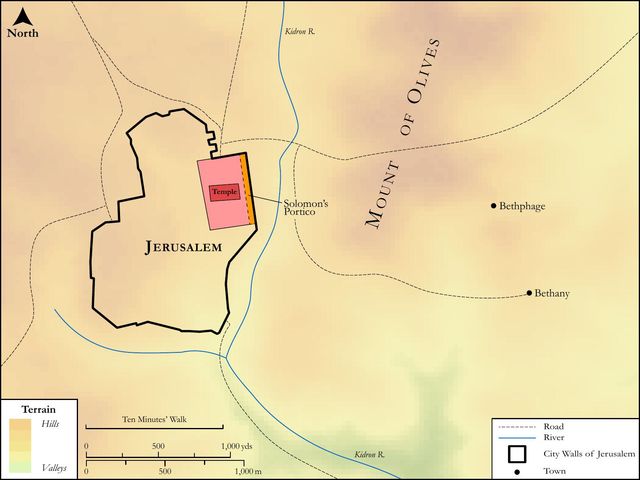
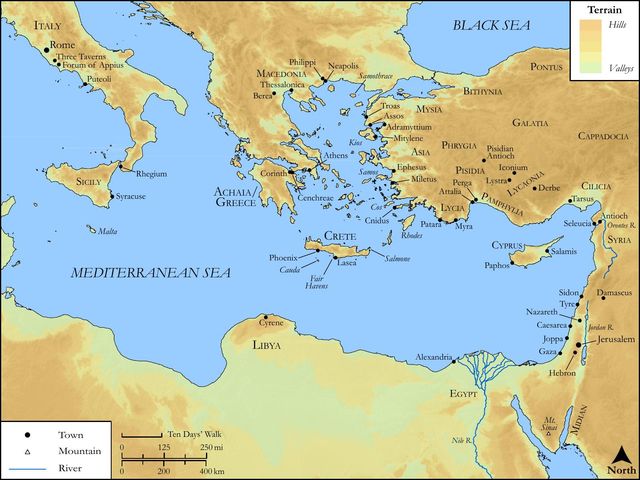
Study this verse
Public-domain commentary
Matthew Henry
From his Commentary on the Whole Bible. Henry comments on passages, not single verses — this entry covers Acts 5:12–16. His three-level outline is real structure in the source text, so it is rendered as structure.
We have here an account of the progress of the gospel, notwithstanding this terrible judgment inflicted upon two hypocrites.
I.Here is a general account of the miracles which the apostles wrought (Act 5:12):
By the hands of the apostles were many signs and wonders wrought among the people, many miracles of mercy for one of judgment. Now the gospel power returned to its proper channel, which is that of mercy and grace. God had come out of his place to punish, but now returns to his place, to his mercy-seat again. The miracles they wrought proved their divine mission. They were not a few, but many, of divers kinds and often repeated; they were signs and wonders, such wonders as were confessedly signs of a divine presence and power. They were not done in a corner, but among the people, who were at liberty to enquire into them, and, if there had been any fraud or collusion in them, would have discovered it.
II.We are here told what were the effects of these miracles which the apostles wrought.
1.The church was hereby kept together, and confirmed in its adherence both to the apostles and to one another: They of the church were all with one accord in Solomon's porch.
(1.)They met in the temple, in the open place that was called Solomon's porch. It was strange that the rulers of the temple suffered them to keep their meeting there. But God inclined their hearts to tolerate them there awhile, for the more convenient spreading of the gospel; and those who permitted buyers and sellers could not for shame prohibit such preachers and healers there. They all met in public worship; so early was the institution of religious assemblies observed in the church, which must by no means be forsaken or let fall, for in them a profession of religion is kept up.
(2.)They were there with one accord, unanimous in their doctrine, worship, and discipline; and there was no discontent nor murmuring about the death of Ananias and Sapphira, as there was against Moses and Aaron about the death of Korah and his company: You have killed the people of the Lord, Num 16:41. The separation of hypocrites, by distinguishing judgments, should make the sincere cleave so much the closer to each other and to the gospel ministry.
2.It gained the apostles, who were the prime ministers in Christ's kingdom, very great respect.
(1.)The other ministers kept their distance: Of the rest of their company durst no man join himself to them, as their equal or an associate with them; though others of them were endued with the Holy Ghost, and spoke with tongues, yet none of them at this time did such signs and wonders as the apostles did: and therefore they acknowledged their superiority, and in every thing yielded to them.
(2.)All the people magnified them, and had them in great veneration, spoke of them with respect, and represented them as the favourites of Heaven, and unspeakable blessings to this earth. Though the chief priests vilified them, and did all they could to make them contemptible, this did not hinder the people from magnifying them, who saw the thing in a true light. Observe, The apostles were far from magnifying themselves; they transmitted the glory of all they did very carefully and faithfully to Christ, and yet the people magnified them; for those that humble themselves shall be exalted, and those honoured that honour God only.
3.The church increased in number (Act 5:14): Believers were the more added to the Lord, and no doubt joined themselves to the church, when they saw that God was in it of a truth, even multitudes both of men and women. They were so far from being deterred by the example that was made of Ananias and Sapphira that they were rather invited by it into a society that kept such a strict discipline. Observe,
(1.)Believers are added to the Lord Jesus, joined to him, and so joined to his mystical body, from which nothing can separate us and cut us off, but that which separates us and cuts us off from Christ. Many have been brought to the Lord, and yet there is room for others to be added to him, added to the number of those that are united to him; and additions will still be making till the mystery of God shall be finished, and the number of the elect accomplished.
(2.)Notice is taken of the conversion of women as well as men; more notice than generally was in the Jewish church, in which they neither received the sign of circumcision nor were obliged to attend the solemn feasts; and the court of the women was one of the outer courts of the temple. But, as among those that followed Christ while he was upon earth, so among those that believed on him after he went to heaven, great notice was taken of the good women.
4.The apostles had abundance of patients, and gained abundance of reputation both to themselves and their doctrine by the cure of them all, Act 5:15, Act 5:16. So many signs and wonders were wrought by the apostles that all manner of people put in for the benefit of them, both in city and country, and had it.
(1.)In the city: They brought forth their sick into the streets; for it is probable that the priests would not suffer them to bring them into the temple to Solomon's porch, and the apostles had not leisure to go to the houses of them all. And they laid them on beds and couches (because they were so weak that they could neither go nor stand), that at the least the shadow of Peter, passing by, might overshadow some of them, though it could not reach them all; and, it should seem, it had the desired effect, as the woman's touch of the hem of Christ's garment had; and in this, among other things, that word of Christ was fulfilled, Greater works than these shall you do. God expresses his care of his people, by his being their shade on their right hand; and the benign influences of Christ as a king are compared to the shadow of a great rock. Peter comes between them and the sun, and so heals them, cuts them off from a dependence upon creature sufficiency as insufficient, that they may expect help only from that Spirit of grace with whom he was filled. And, if such miracles were wrought by Peter's shadow, we have reason to think they were so by the other apostles, as by the handkerchiefs from Paul's body (Act 19:12), no doubt both being with an actual intention in the minds of the apostles thus to heal; so that it is absurd to infer hence a healing virtue in the relics of saints that are dead and gone; we read not of any cured by the relics of Christ himself, after he was gone, as certainly we should if there had been any such thing.
(2.)In the country towns: Multitudes came to Jerusalem from the cities round about, bringing sick folks that were afflicted in body, and those that were vexed with unclean spirits, that were troubled in mind, and they were healed every one; distempered bodies and distempered minds were set to rights. Thus opportunity was given to the apostles, both to convince people's judgments by these miracles of the heavenly origin of the doctrine they preached, and also to engage people's affections both to them and it, by giving them a specimen of its beneficial tendency to the welfare of this lower world.
Historical interpretation
Three Centuries of Reception
4 surviving comments on this verse. Each one is dated, so this reads as a timeline rather than a list.
Select a marker to jump to its quote. Markers stagger vertically where authors wrote within a few decades of each other.
For had they not borne a king's image and their radiance been unapproachable, their garments and shadows had not wrought so mightily. For the garments of a king are terrible even to robbers. Would you see this beaming even through the body? "Looking steadfastly," he said, "upon the face of Stephen, they saw it as if it were the face of an angel." But this was nothing to the glory flashing within.
"Insomuch that they brought out into the streets their impotent folk, and laid them upon couches and beds, that at the least the shadow of Peter passing by might overshadow some of them." For Peter was the wonderful one, and he to whom they more gave heed both because of his public harangue, the first and the second and the third, and because of the miracle; for he it was that wrought the miracle, the first, the second, the third: for the present miracle was twofold: first, the convicting the thoughts of the heart, and next the inflicting of death at his word of command. "That at the least the shadow of Peter passing by," etc. This had not occurred in the history of Christ; but see here what He had told them actually coming to pass, that "they which believe on Me, the works that I do shall they do also; and greater works than these shall they do."
Great faith, surpassing what had been shown in the case of Christ. How comes this? Because Christ declared: "And greater works than these shall he do, because I go unto My Father." And these things the people do, while the Apostles remain there, and are not moving about from place to place: also from other places they were all bringing their sick on beds and couches: and from all quarters accrued to them fresh tribute of wonder; from them that believed, from them that were healed, from him that was punished; from their boldness of speech towards those their adversaries, from the virtuous behavior of the believers: for certainly the effect produced was not owing to the miracles only.
We dwell in the church on earth, which, no one may doubt, signifies a heavenly [church]; but that is more truly [the church] which, at rest above the stars, is called celestial and high. This [earthly church], which is seen in the brief career of an uncertain world, is appointed as the way of life and in this [present] time directs to the eternal [church] those whom it gathers, and to those found acceptable it is the road for going from here to heavenly things. Peter rules both armies, and for their lot he gives the stars to those squadrons led from here, as has been revealed by the words of God, “What you have loosed,” he said, “and what you bind on earth thus remain bound or loosed in heaven.” This [church] that we see cultivated on soil, therefore, will be a type; what the clouds carry is firm. Peter, ruling both, designs there the body and here the shadow, in order that those sick people whom he freed from vices and offenses might be led unharmed to it [the church above], which endures in heaven [and] will receive the holy throngs cleansed by this [earthly church].
So that as Peter came along, at least his shadow might fall on some of them and they would be healed. At that time, Peter visibly raised the sick with the shadow of his body, and even now he does not cease to strengthen the infirmities of the faithful with the invisible shadow of his intercession. And since Peter is the type of the Church, he indeed walks upright himself, but by his shadow accompanying him he raises those that lie down, because the Church, with its mind and love intending towards heavenly things, seemingly runs through the earth shadow-like, and here renews those by temporal sacraments and figures of heavenly things, whom it rewards there with perpetual gifts. Some connect to this place what the Lord said in the Gospel: He who believes in me will do the works that I do, and greater works than these will he do (John 14).
Continue studying Acts 5:15 across the web’s major study libraries — every link below opens this exact verse, chapter, or book on the destination site.
Read & Compare
 BibleGatewayThis verse in more than 200 translations and 70 languages.
 Bible.comThe YouVersion reader — hundreds of translations, reading plans, and highlights.
 ESV.orgCrossway's official English Standard Version reader.
 NET BibleThe NET translation with 60,000+ translators' notes on every rendering decision.
 STEP BibleTyndale House's free study tool — original text, vocabulary, and scholarly resources.
 BibliaLogos Bible Software's free web reader.
 USCCBThe New American Bible (Revised Edition) with the U.S. bishops' study notes.
Commentaries
 BibleHub CommentariesDozens of classic commentaries on this verse, gathered on one page.
 StudyLightMore than 100 commentary sets — the largest collection on the web.
 BibleRefPlain-English commentary on what this verse means, verse by verse.
 Enduring WordDavid Guzik's free commentary on this chapter, widely used by Bible teachers.
 Bible Study ToolsVerse commentary alongside Greek and Hebrew study aids.
Original Language & Research
- BibleHub InterlinearThe verse word by word — original language, transliteration, and English.
- BibleHub LexiconEvery word's original-language definition and Strong's entry.
 Blue Letter BibleDeep-study tools — Strong's numbers, concordance, and word studies.
 CNTR CollationThe earliest Greek manuscripts of this verse, collated letter by letter.
Sermons, Hymns & Audio


TrulyRandomVerse is not affiliated with these sites and doesn’t control their content. They’re linked because they’re genuinely useful.
Summary
Vividly portrays the fervent faith and desperate hope of the early Jerusalem community, who, witnessing the apostles' miraculous works, brought their sick into the public streets. Their profound expectation was that even the mere shadow of Peter, as he passed by, might fall upon the afflicted and bring about healing, underscoring the extraordinary divine power at work through the apostles and the burgeoning spiritual influence of the nascent church.
Context
ShowHideLiterary Context
This verse is situated within a remarkable period of growth and divine manifestation for the early church, immediately following the dramatic judgment of Ananias and Sapphira in Acts 5:1-11. This severe divine discipline, though terrifying, served to purify the community and instill a profound reverence for God and His apostles. Consequently, "great fear came upon all the church, and upon all who heard these things" (Acts 5:11). Directly preceding Acts 5:15, Acts 5:12-14 explicitly states that "many signs and wonders were done among the people by the hands of the apostles," leading to a significant increase in the number of believers, both men and women. The scene described in Acts 5:15 is a direct consequence of this widespread miraculous activity and the resulting public awe and desperation for divine intervention.
Historical & Cultural Context
First-century Jerusalem was a city deeply rooted in Jewish tradition, where belief in divine intervention and miraculous healing was not uncommon, especially in connection with prophets or men of God. The Jewish people were familiar with the concept of God working through individuals, as seen in the ministries of Elijah and Elisha. However, the scale and nature of the apostles' miracles, particularly those attributed to Peter, were unprecedented. Public streets in ancient cities were central hubs for daily life, commerce, and social interaction. Laying the sick in such visible locations was a common practice for beggars and those seeking alms or medical attention, but here it takes on a new dimension as a public demonstration of faith and a collective appeal for divine healing. The act of bringing the sick out into the open also highlights the communal nature of suffering and the desperate hope for relief in a society with limited medical resources.
Key Themes
ShowHideActs 5:15 powerfully contributes to several overarching themes within the book of Acts. Firstly, it emphasizes the Divine Power at Work through the apostles, clearly demonstrating that the miracles were not of human origin but were God's authentication of the apostles' message and authority. Secondly, it showcases the Authority and Influence of the Apostles, particularly Peter, who were seen as direct conduits of God's power, leading to immense public reverence and trust. This is part of the broader theme of the Holy Spirit empowering the church to fulfill its mission, as promised in Acts 1:8. Thirdly, the verse underscores the Faith and Expectation of the People, illustrating a powerful atmosphere of belief that even indirect contact with an apostle could bring healing. This collective faith, though perhaps tinged with superstition, became a catalyst for God's miraculous intervention. Finally, it subtly highlights God's Compassion for the Suffering, as the numerous healings brought tangible relief and hope to those afflicted by various ailments, reflecting the compassionate nature of the gospel message itself.
Exposition and Analysis
ShowHideKey Word Analysis
ShowHideFrom ἐκ and φέρω; to bear out (literally or figuratively):--bear, bring forth, carry forth (out). This verb signifies an active, deliberate action of moving the sick from their homes into the public sphere. It highlights the communal effort and the desperate urgency of the people, who were actively seeking out the apostles, rather than passively waiting for them. The word conveys a sense of public display and accessibility, underscoring the widespread nature of the people's faith and the apostles' public ministry.
Apparently a primary word; "shade" or a shadow (literally or figuratively (darkness of error or an adumbration)):--shadow. In this context, the shadow is more than a mere physical phenomenon. It functions as a metonymy, where a closely associated attribute (the shadow) stands for the person or, more profoundly, the divine power emanating through the person. The belief that a shadow could heal elevates it beyond its natural properties, implying a spiritual efficacy attributed to Peter's presence and the Holy Spirit's power working through him.
From ἐπί and a derivative of σκιά; to cast a shade upon, i.e. (by analogy) to envelop in a haze of brilliancy; figuratively, to invest with preternatural influence:--overshadow. This is a crucial term. Its use here echoes Luke 1:35, where the Holy Spirit "overshadowed" Mary, leading to the miraculous conception of Jesus. This linguistic parallel strongly suggests that the "overshadowing" by Peter's shadow was not a mere physical event, but a supernatural act, a divine "enveloping" or "investing with preternatural influence" by the Holy Spirit, making the shadow a conduit for God's miraculous power.
Verse Breakdown
ShowHide"Insomuch that they brought forth the sick into the streets"
This clause reveals the profound impact of the apostles' ministry. The extent of their miraculous works led the community to take extraordinary measures, actively carrying their sick, who were too weak to move themselves, out of their homes and into the public thoroughfares. This signifies a widespread, public demonstration of faith and desperation.
"and laid [them] on beds and couches"
This detail emphasizes the severity of the illnesses. The sick were not merely infirm but required specialized resting places, indicating their inability to stand or walk. The act of laying them down suggests a posture of waiting and expectation, a collective act of positioning themselves to receive healing.
"that at the least the shadow of Peter passing by might overshadow some of them"
This is the climax of the verse, articulating the people's specific hope. The phrase "at the least" conveys a humble yet fervent expectation, believing that even the most minimal, indirect contact—Peter's shadow—would be sufficient for divine power to be transmitted. The use of "overshadow" (Greek: episkiázō) is highly significant, implying a supernatural, rather than merely physical, influence.
Literary Devices
ShowHideActs 5:15 employs several powerful literary devices to convey its message. The most prominent is Symbolism, where Peter's "shadow" is not merely a physical absence of light but becomes a profound symbol and conduit of divine power. It represents the active, tangible presence of the Holy Spirit working through Peter, so potent that even its indirect touch brings healing. This is further reinforced by the use of the Greek word episkiázō ("overshadow"), which carries connotations of divine presence and miraculous conception (as in Luke 1:35). Another device at play is Hyperbole, or perhaps a form of Synecdoche, where the people's belief in the shadow's efficacy, while rooted in genuine faith, expresses an extreme level of expectation regarding the apostles' divine empowerment. The "shadow" stands for the entirety of Peter's Spirit-filled presence and the power of God flowing through him. The scene itself is a vivid Imagery, painting a picture of desperate crowds, sick individuals, and the apostle moving through them, creating a powerful visual of the early church's impact.
Theological and Thematic Connections
ShowHideActs 5:15 is a powerful testament to the extraordinary presence of God's power in the early church, demonstrating that the Holy Spirit was not merely an abstract concept but an active, tangible force working through human vessels. It underscores the truth that divine healing is ultimately God's work, not a human ability, and that He chooses to manifest His power through His chosen instruments, often in ways that transcend natural understanding. The people's faith, though perhaps mixed with a degree of superstition, was a catalyst for God's compassionate intervention, highlighting that God often responds to desperate and earnest seeking. This passage also serves as an affirmation of the apostolic authority, validating their ministry as truly from God and establishing their unique role in the foundational period of the church.
Reflection and Application
ShowHideActs 5:15, while describing a unique historical phenomenon, offers timeless principles for believers today. It challenges us to consider the depth of our faith and expectation in God's ability to act, even in seemingly impossible situations. While we may not witness "shadow healings," the underlying truth remains: God is sovereign, powerful, and compassionate, and He desires to work through His people. This passage calls us to be channels of God's grace and power in our own contexts, recognizing that our effectiveness comes not from our own strength or charisma, but from the Holy Spirit working through us. It encourages us to cultivate a life yielded to God, so that His presence might be so evident in us that others are drawn to Him for healing, hope, and salvation. We are reminded that God's compassion for the suffering is unwavering, and the church is called to be a beacon of hope and practical care for those in need, demonstrating the tangible love of Christ to a hurting world.
Questions for Reflection
ShowHideFAQ
ShowHideWas it Peter's power that healed the sick, or God's?
ShowHideIt was unequivocally God's power, not Peter's inherent ability. The book of Acts consistently attributes all miraculous works to God working through His apostles. Peter himself, in Acts 3:12, explicitly denies that the healing of the lame man at the Beautiful Gate was by his own power or godliness, stating, "Why look so intently at us, as if by our own power or piety we had made him walk?" The "shadow" was merely a conduit, a point of contact through which God chose to manifest His healing power, validating the apostles' message and ministry.
Why would God use a "shadow" for healing?
ShowHideThe use of Peter's "shadow" for healing is a powerful demonstration of God's extraordinary and sometimes unconventional methods of displaying His power and sovereignty. It emphasizes that God is not limited by conventional means and can use even the most indirect or seemingly insignificant things to accomplish His purposes. The specific Greek word for "overshadow" (episkiázō) also carries theological weight, connecting this event to the divine "overshadowing" of Mary by the Holy Spirit in Luke 1:35, suggesting a supernatural presence rather than a mere physical phenomenon. It highlights the immense spiritual authority and anointing on Peter, making even his presence (symbolized by his shadow) a channel for divine intervention.
Christ-Centered Fulfillment
ShowHideActs 5:15, with its account of Peter's shadow bringing healing, finds its ultimate Christ-centered fulfillment in Jesus Christ Himself, the true source of all healing and divine power. Peter's ministry, like that of all the apostles, was a continuation and extension of the healing ministry initiated by Jesus during His earthly life, as seen throughout the Gospels (e.g., Matthew 4:23-24). While Peter's shadow was a conduit for God's power, Jesus did not need a shadow; His very touch, His word, or even His garment was sufficient to bring healing, as demonstrated by the woman who touched the hem of His cloak and was healed (Mark 5:25-34). The "overshadowing" of Peter's shadow points to the greater reality of Christ's pervasive and all-encompassing presence and power, which is not limited by physical proximity or a mere shadow. Ultimately, Jesus is the "Sun of Righteousness" (Malachi 4:2), whose light brings healing, and He is the one who "takes away the sin of the world!" (John 1:29), offering not just physical healing but eternal spiritual restoration. The extraordinary power flowing through Peter was a testimony to the resurrected Christ, who continues to work through His Spirit in His church, demonstrating His ongoing Lordship and compassion for humanity (Hebrews 13:8).