


Acts 5:14
Bible text: King James Version (1769 Blayney text) · Public domain
Bible text: Berean Standard Bible · Public domain
Bible text: American Standard Version (1901) · Public domain
Bible text: World English Bible, Messianic edition · Public domain
Bible text: Geneva Bible (1599) · Public domain
Bible text: Young's Literal Translation · Public domain
- μᾶλλονmallonmoreG3123ADVAdverb
- δὲdenowG1161CONJConjunction
- προσετίθεντοprosetithentowere addedG4369V-IPI-3PVerb Imperfect Passive Indicative 3rd Plural
- πιστεύοντεςpisteuontesbelievingG4100V-PAP-NPMVerb Present Active Participle Nominative Plural Masculine
- τῷtōin theG3588T-DSMDefinite article Dative Singular Masculine
- κυρίῳkuriōLordG2962N-DSM-TNoun Dative Singular Masculine Title
- πλήθηplēthēmultitudesG4128N-NPNNoun Nominative Plural Neuter
- ἀνδρῶνandrōnof menG435N-GPMNoun Genitive Plural Masculine
- τεtebothG5037CONJConjunction
- καὶkaiandG2532CONJConjunction
- γυναικῶνgunaikōnwomenG1135N-GPFNoun Genitive Plural Feminine
English is a literal word-by-word gloss of the Greek, not the KJV's wording. Why?
This is the original text the KJV's translators worked from — each Greek word with its own literal English meaning in this verse, prepared by scholars at Tyndale House, Cambridge. The KJV translates whole sentences, not word by word, so its wording differs: one Greek word can become several English words, and the KJV may choose “charity” where the gloss reads “love”. Both are faithful — they answer different questions. For the KJV's own rendering, switch to the KJV text.
Details
See on the biblical-era maps
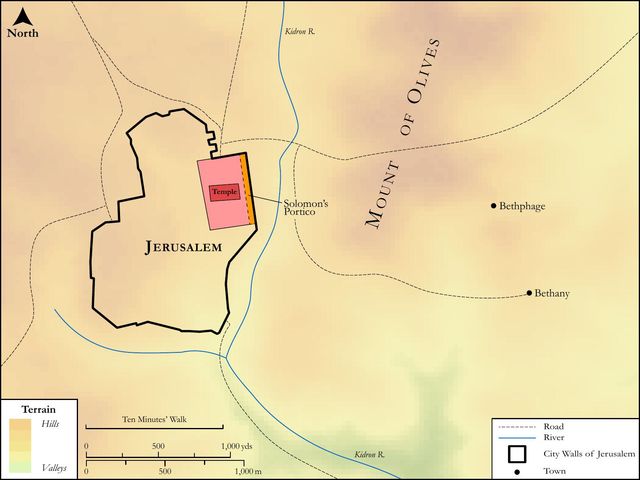
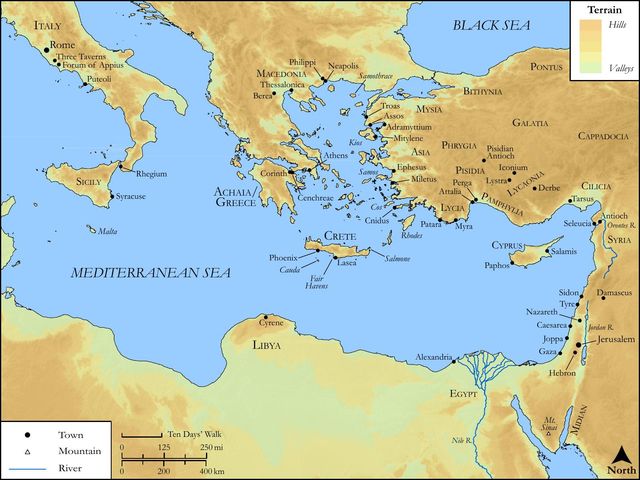
Study this verse
Public-domain commentary
Matthew Henry
From his Commentary on the Whole Bible. Henry comments on passages, not single verses — this entry covers Acts 5:12–16. His three-level outline is real structure in the source text, so it is rendered as structure.
We have here an account of the progress of the gospel, notwithstanding this terrible judgment inflicted upon two hypocrites.
I.Here is a general account of the miracles which the apostles wrought (Act 5:12):
By the hands of the apostles were many signs and wonders wrought among the people, many miracles of mercy for one of judgment. Now the gospel power returned to its proper channel, which is that of mercy and grace. God had come out of his place to punish, but now returns to his place, to his mercy-seat again. The miracles they wrought proved their divine mission. They were not a few, but many, of divers kinds and often repeated; they were signs and wonders, such wonders as were confessedly signs of a divine presence and power. They were not done in a corner, but among the people, who were at liberty to enquire into them, and, if there had been any fraud or collusion in them, would have discovered it.
II.We are here told what were the effects of these miracles which the apostles wrought.
1.The church was hereby kept together, and confirmed in its adherence both to the apostles and to one another: They of the church were all with one accord in Solomon's porch.
(1.)They met in the temple, in the open place that was called Solomon's porch. It was strange that the rulers of the temple suffered them to keep their meeting there. But God inclined their hearts to tolerate them there awhile, for the more convenient spreading of the gospel; and those who permitted buyers and sellers could not for shame prohibit such preachers and healers there. They all met in public worship; so early was the institution of religious assemblies observed in the church, which must by no means be forsaken or let fall, for in them a profession of religion is kept up.
(2.)They were there with one accord, unanimous in their doctrine, worship, and discipline; and there was no discontent nor murmuring about the death of Ananias and Sapphira, as there was against Moses and Aaron about the death of Korah and his company: You have killed the people of the Lord, Num 16:41. The separation of hypocrites, by distinguishing judgments, should make the sincere cleave so much the closer to each other and to the gospel ministry.
2.It gained the apostles, who were the prime ministers in Christ's kingdom, very great respect.
(1.)The other ministers kept their distance: Of the rest of their company durst no man join himself to them, as their equal or an associate with them; though others of them were endued with the Holy Ghost, and spoke with tongues, yet none of them at this time did such signs and wonders as the apostles did: and therefore they acknowledged their superiority, and in every thing yielded to them.
(2.)All the people magnified them, and had them in great veneration, spoke of them with respect, and represented them as the favourites of Heaven, and unspeakable blessings to this earth. Though the chief priests vilified them, and did all they could to make them contemptible, this did not hinder the people from magnifying them, who saw the thing in a true light. Observe, The apostles were far from magnifying themselves; they transmitted the glory of all they did very carefully and faithfully to Christ, and yet the people magnified them; for those that humble themselves shall be exalted, and those honoured that honour God only.
3.The church increased in number (Act 5:14): Believers were the more added to the Lord, and no doubt joined themselves to the church, when they saw that God was in it of a truth, even multitudes both of men and women. They were so far from being deterred by the example that was made of Ananias and Sapphira that they were rather invited by it into a society that kept such a strict discipline. Observe,
(1.)Believers are added to the Lord Jesus, joined to him, and so joined to his mystical body, from which nothing can separate us and cut us off, but that which separates us and cuts us off from Christ. Many have been brought to the Lord, and yet there is room for others to be added to him, added to the number of those that are united to him; and additions will still be making till the mystery of God shall be finished, and the number of the elect accomplished.
(2.)Notice is taken of the conversion of women as well as men; more notice than generally was in the Jewish church, in which they neither received the sign of circumcision nor were obliged to attend the solemn feasts; and the court of the women was one of the outer courts of the temple. But, as among those that followed Christ while he was upon earth, so among those that believed on him after he went to heaven, great notice was taken of the good women.
4.The apostles had abundance of patients, and gained abundance of reputation both to themselves and their doctrine by the cure of them all, Act 5:15, Act 5:16. So many signs and wonders were wrought by the apostles that all manner of people put in for the benefit of them, both in city and country, and had it.
(1.)In the city: They brought forth their sick into the streets; for it is probable that the priests would not suffer them to bring them into the temple to Solomon's porch, and the apostles had not leisure to go to the houses of them all. And they laid them on beds and couches (because they were so weak that they could neither go nor stand), that at the least the shadow of Peter, passing by, might overshadow some of them, though it could not reach them all; and, it should seem, it had the desired effect, as the woman's touch of the hem of Christ's garment had; and in this, among other things, that word of Christ was fulfilled, Greater works than these shall you do. God expresses his care of his people, by his being their shade on their right hand; and the benign influences of Christ as a king are compared to the shadow of a great rock. Peter comes between them and the sun, and so heals them, cuts them off from a dependence upon creature sufficiency as insufficient, that they may expect help only from that Spirit of grace with whom he was filled. And, if such miracles were wrought by Peter's shadow, we have reason to think they were so by the other apostles, as by the handkerchiefs from Paul's body (Act 19:12), no doubt both being with an actual intention in the minds of the apostles thus to heal; so that it is absurd to infer hence a healing virtue in the relics of saints that are dead and gone; we read not of any cured by the relics of Christ himself, after he was gone, as certainly we should if there had been any such thing.
(2.)In the country towns: Multitudes came to Jerusalem from the cities round about, bringing sick folks that were afflicted in body, and those that were vexed with unclean spirits, that were troubled in mind, and they were healed every one; distempered bodies and distempered minds were set to rights. Thus opportunity was given to the apostles, both to convince people's judgments by these miracles of the heavenly origin of the doctrine they preached, and also to engage people's affections both to them and it, by giving them a specimen of its beneficial tendency to the welfare of this lower world.
Historical interpretation
Historical reception
1 surviving comment on this verse from the historical church.
"There were," however, "the more added unto the Lord, believers, multitudes both of men and of women."
"Believers were the more added unto the Lord, multitudes both of men and of women." Observe, how he now no longer tells the number of them that believe; at such a rate was the faith making way even to an immense multitude, and so widely was the Resurrection proclaimed. So then "the people magnified them:" but they were now no longer lightly to be despised as once they were: for in a little moment, at a single turn of the scale, such have been the effects produced by the fisherman and by the publican! Earth was become a heaven, for manner of life, for boldness of speech, for wonders, for all besides; like Angels were they looked upon with wonder: all unconcerned for ridicule, for threats, for perils: compassionate were they, and beneficent; some of them they succoured with money, and some with words, and some with healing of their bodies and of their souls; no kind of healing but they accomplished.
Continue studying Acts 5:14 across the web’s major study libraries — every link below opens this exact verse, chapter, or book on the destination site.
Read & Compare
 BibleGatewayThis verse in more than 200 translations and 70 languages.
 Bible.comThe YouVersion reader — hundreds of translations, reading plans, and highlights.
 ESV.orgCrossway's official English Standard Version reader.
 NET BibleThe NET translation with 60,000+ translators' notes on every rendering decision.
 STEP BibleTyndale House's free study tool — original text, vocabulary, and scholarly resources.
 BibliaLogos Bible Software's free web reader.
 USCCBThe New American Bible (Revised Edition) with the U.S. bishops' study notes.
Commentaries
 BibleHub CommentariesDozens of classic commentaries on this verse, gathered on one page.
 StudyLightMore than 100 commentary sets — the largest collection on the web.
 BibleRefPlain-English commentary on what this verse means, verse by verse.
 Enduring WordDavid Guzik's free commentary on this chapter, widely used by Bible teachers.
 Bible Study ToolsVerse commentary alongside Greek and Hebrew study aids.
Original Language & Research
- BibleHub InterlinearThe verse word by word — original language, transliteration, and English.
- BibleHub LexiconEvery word's original-language definition and Strong's entry.
 Blue Letter BibleDeep-study tools — Strong's numbers, concordance, and word studies.
 CNTR CollationThe earliest Greek manuscripts of this verse, collated letter by letter.
Sermons, Hymns & Audio


TrulyRandomVerse is not affiliated with these sites and doesn’t control their content. They’re linked because they’re genuinely useful.
Summary
Acts 5:14 offers a profound summary of the early church's remarkable expansion in Jerusalem, asserting that genuine believers, both men and women, were increasingly being added to the Lord. This verse highlights not merely a demographic increase but a divinely orchestrated spiritual growth, underscoring God's sovereign hand in drawing people into a saving relationship with Jesus Christ, even amidst trials and acts of divine judgment.
Context
ShowHideLiterary Context
Acts 5:14 follows immediately after the severe judgment on Ananias and Sapphira for their deception, an event that instilled "great fear" in the entire church and all who heard about it (Acts 5:1-11). This purification of the community underscored the holiness and seriousness of commitment required within the nascent church. Following this, the apostles continued to perform many signs and wonders among the people, gathering in Solomon's Porch, which fostered great respect and awe from the general populace, though outsiders were hesitant to join them directly (Acts 5:12-13). It is against this backdrop of both divine discipline and powerful apostolic ministry that verse 14 presents a renewed surge of growth, indicating that the fear instilled by God's judgment did not deter true faith but rather purified the community, making it a more compelling witness.
Historical & Cultural Context
The early church in Jerusalem operated within a predominantly Jewish society, still deeply rooted in Temple worship and Mosaic Law. The "Lord" in this context refers to Jesus Christ, a radical claim for many Jews who viewed Him as a crucified criminal rather than the Messiah or God. The growth described in Acts 5:14 occurred despite significant opposition from the Jewish religious authorities, who had already arrested Peter and John (Acts 4:1-3) and would soon do so again (Acts 5:17-18). The mention of "multitudes both of men and women" is culturally significant, as women often held a secondary status in public life in that day. Their inclusion as "believers...added to the Lord" demonstrates the inclusive and transformative nature of the Gospel, which broke down societal barriers and offered equal spiritual standing to all who believed.
Key Themes
ShowHideThis verse powerfully contributes to several overarching themes in Acts. Firstly, it emphasizes Divine Growth, illustrating that the church's expansion is not merely a human endeavor but a supernatural work of God. The phrase "added to the Lord" highlights that conversion is a direct spiritual allegiance to Christ, not just joining a social group. This echoes earlier accounts of growth where the Lord Himself "added to their number daily those who were being saved" (Acts 2:47). Secondly, it reinforces the theme of Authenticity and Purity. The judgment on Ananias and Sapphira, immediately preceding this verse, served to purify the church, establishing a clear standard of truthfulness and holiness. This purity, coupled with the undeniable power of the apostles' miracles (Acts 5:12), created a compelling witness that drew genuine seekers. Finally, the verse underscores the Universal Appeal of the Gospel, as "multitudes both of men and women" were added, demonstrating that the message of Christ transcended gender, social status, and other human distinctions, building on the significant increase in believers noted in Acts 4:4.
Exposition and Analysis
ShowHideKey Word Analysis
ShowHideMeaning "to have faith (in, upon, or with respect to, a person or thing), i.e. credit; by implication, to entrust (especially one's spiritual well-being to Christ)." In Acts 5:14, the participle form (often translated as "those believing" or "believers") signifies individuals who have actively placed their trust and allegiance in Jesus Christ. Their addition to the community is predicated on this foundational act of faith, distinguishing them from mere observers or those who were simply curious.
Meaning "to place additionally, i.e. lay beside, annex, repeat." The passive voice ("were...added") is crucial here, indicating that this growth was not primarily due to human evangelistic efforts or recruitment strategies, but was something divinely accomplished. It emphasizes God's sovereign agency in drawing people to Himself and incorporating them into the body of believers. This divine action highlights that true church growth is a supernatural phenomenon, a work of God.
Meaning "supreme in authority, i.e. (as noun) controller; by implication, Master (as a respectful title):--God, Lord, master, Sir." The phrase "added to the Lord" is profoundly significant. It means these new converts were not merely joining a social club or a new religious sect, but were entering into a personal, saving relationship with Jesus Christ, acknowledging His ultimate authority and sovereignty over their lives. This term asserts Jesus' divine status and His position as the ultimate object of faith and allegiance.
Verse Breakdown
ShowHide"And believers"
This opening phrase, connected by the conjunction "And" (G1161, dé), signals a continuation of the narrative, yet with a renewed emphasis on the positive outcome following the preceding events of judgment and apostolic power. "Believers" (G4100) specifically identifies those who have placed their faith in Jesus Christ, distinguishing them from the general populace who merely held the apostles in high regard.
"were the more added to the Lord,"
This central clause describes the dynamic of growth. The passive voice of "were added" (G4369) strongly implies divine agency; God Himself was the one bringing these individuals into the community of faith. The phrase "the more" (G3123, mâllon) indicates an increasing degree or intensity of this addition, suggesting a sustained and accelerating growth. Crucially, they were "added to the Lord" (G2962), signifying a spiritual allegiance and personal commitment to Jesus Christ as their sovereign Master, rather than simply joining a human organization.
"multitudes both of men and women.)"
This concluding phrase specifies the scope and diversity of the new converts. "Multitudes" (G4128, plēthos) emphasizes the sheer number, indicating a significant and widespread movement. The explicit mention of "both of men and women" (G435, anḗr and G1135, gynḗ) highlights the inclusive nature of the Gospel, which transcended the societal and gender distinctions of the time, drawing people from all walks of life into the nascent Christian community.
Literary Devices
ShowHideActs 5:14 employs several literary devices to convey its powerful message. The use of Passive Voice in "were...added" subtly but effectively highlights divine agency, emphasizing that the growth of the church was not primarily a human achievement but a supernatural work of God. The term "multitudes" functions as Hyperbole or Exaggeration, not necessarily implying an exact count, but rather conveying the overwhelming and impressive scale of the church's expansion. This serves to underscore the power and effectiveness of the Holy Spirit's work. Furthermore, the verse acts as a Summary Statement, concisely encapsulating the ongoing and widespread growth of the early Christian community after a period of both divine judgment and miraculous demonstration, providing a concise report of the spiritual vitality of the movement.
Theological and Thematic Connections
ShowHideActs 5:14 is a profound theological statement on the nature of church growth, asserting that true expansion is fundamentally a divine work. The phrase "added to the Lord" shifts the focus from human evangelistic efforts to God's sovereign initiative in drawing individuals into a saving relationship with Jesus Christ. This highlights the theological truth that conversion is not merely a change of affiliation but a spiritual transformation and allegiance to Christ as Lord. It underscores that the church is not a human institution built by human hands, but a divine organism, the body of Christ, supernaturally expanded and sustained by God's power. This divine agency ensures the purity and authenticity of the church, as it is God who discerns and adds genuine believers, a truth made starkly clear by the preceding judgment on Ananias and Sapphira.
Reflection and Application
ShowHideActs 5:14 serves as a powerful reminder that genuine church growth is ultimately God's work, not ours. While we are called to faithfully proclaim the Gospel, live out its truths, and serve others, it is the Lord who draws hearts, convicts minds, and adds individuals to His body. This verse challenges contemporary believers and churches to prioritize spiritual purity, as the judgment on Ananias and Sapphira (immediately preceding this verse) demonstrates God's commitment to the holiness of His church. When the church lives authentically and powerfully, demonstrating God's presence through word and deed, it becomes a compelling witness that God uses to draw "multitudes." Our focus should be on faithfulness to Christ and dependence on the Holy Spirit, trusting that He will bring the increase. This perspective frees us from the burden of human-driven metrics and reorients us to God's sovereign power in building His kingdom.
Questions for Reflection
ShowHideFAQ
ShowHideWhat does "added to the Lord" specifically mean in this context?
ShowHide"Added to the Lord" means that new converts were not merely joining a social club or a human organization, but were entering into a personal, saving relationship with Jesus Christ, acknowledging His divine authority and sovereignty over their lives. It signifies a spiritual transformation and allegiance to Christ as their Master and God. This phrase emphasizes that the growth was a supernatural work of God, drawing people directly into His kingdom and relationship with Him, rather than simply increasing the number of attendees at a gathering. It highlights genuine conversion and commitment to Jesus as the central figure of their faith, as seen in other passages where the Lord Himself adds to the church, such as Acts 2:47.
Christ-Centered Fulfillment
ShowHideActs 5:14, with its declaration that "believers were the more added to the Lord," finds its Christ-centered fulfillment in the ongoing work of Jesus through His Holy Spirit to build His church, which is His body. The "Lord" to whom these multitudes are added is none other than the resurrected Christ, who, having ascended to the right hand of God, continues to exercise His supreme authority over all creation and specifically over His church (Ephesians 1:22-23). This verse is a direct manifestation of Christ's promise to Peter, "I will build my church, and the gates of hell shall not prevail against it" (Matthew 16:18). The growth described here is not merely an increase in numbers but the expansion of Christ's spiritual kingdom on earth, as He, the Good Shepherd, continues to gather His sheep, bringing them into His one flock (John 10:16). The Holy Spirit, poured out by Christ at Pentecost, is the active agent in this process, convicting the world of sin, righteousness, and judgment (John 16:8), regenerating hearts (Titus 3:5), and incorporating new believers into the body of Christ (1 Corinthians 12:13). Thus, Acts 5:14 is a testament to the living, reigning Christ's continued mission to redeem and gather His people from every nation, fulfilling the Great Commission He gave before His ascension (Matthew 28:19-20).