


Acts 19:20
“Miracles and the Sons of Sceva”Acts 19:11–20
Bible text: King James Version (1769 Blayney text) · Public domain
Bible text: Berean Standard Bible · Public domain
Bible text: American Standard Version (1901) · Public domain
Bible text: World English Bible, Messianic edition · Public domain
Bible text: Geneva Bible (1599) · Public domain
Bible text: Young's Literal Translation · Public domain
- οὕτωςhoutōsthusG3779ADVAdverb
- κατὰkatawithG2596PREPPreposition
- κράτοςkratosmightG2904N-ASNNoun Accusative Singular Neuter
- τοῦtouof theG3588T-GSMDefinite article Genitive Singular Masculine
- κυρίουkuriouLordG2962N-GSM-TNoun Genitive Singular Masculine Title
- ὁhotheG3588T-NSMDefinite article Nominative Singular Masculine
- λόγοςlogoswordG3056N-NSMNoun Nominative Singular Masculine
- ηὔξανενēuxanenwas continuing to increaseG837V-IAI-3SVerb Imperfect Active Indicative 3rd Singular
- καὶkaiandG2532CONJConjunction
- ἴσχυενischuenwas prevailingG2480V-IAI-3SVerb Imperfect Active Indicative 3rd Singular
English is a literal word-by-word gloss of the Greek, not the KJV's wording. Why?
This is the Greek text the KJV’s translators worked from, with each word given its own literal English meaning in this verse. The word-by-word meanings were prepared by scholars at Tyndale House, Cambridge. The KJV translates whole sentences rather than single words, so its wording often differs: one Greek word can become several English words, and the KJV may say “charity” where the word-by-word meaning reads “love”. The two are made for different purposes, and both are faithful to the Greek. To read the KJV’s own wording, switch to the KJV text.
Words in [ ] are added by the English.
Details
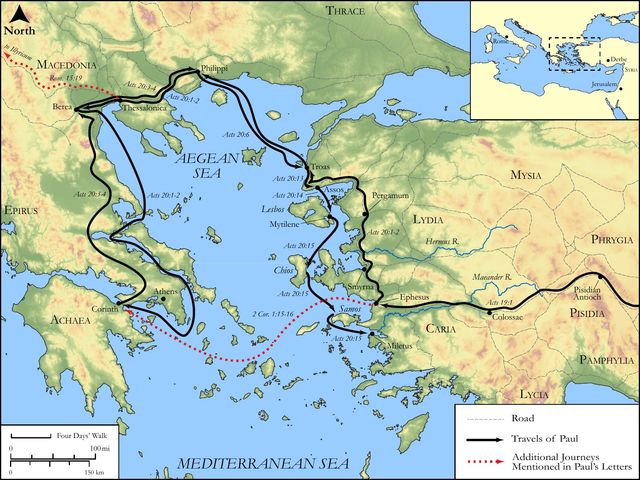
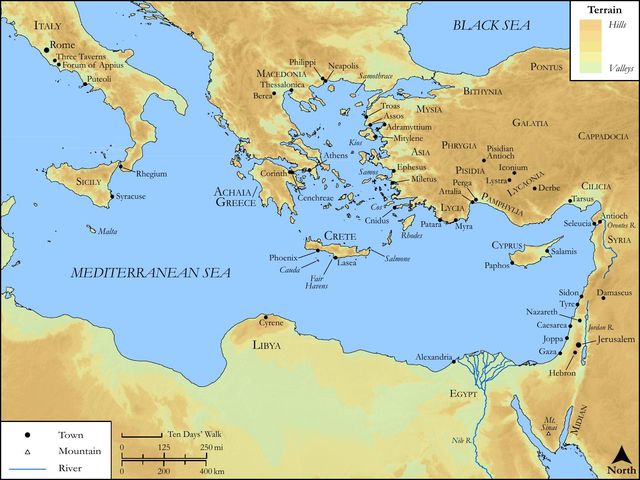
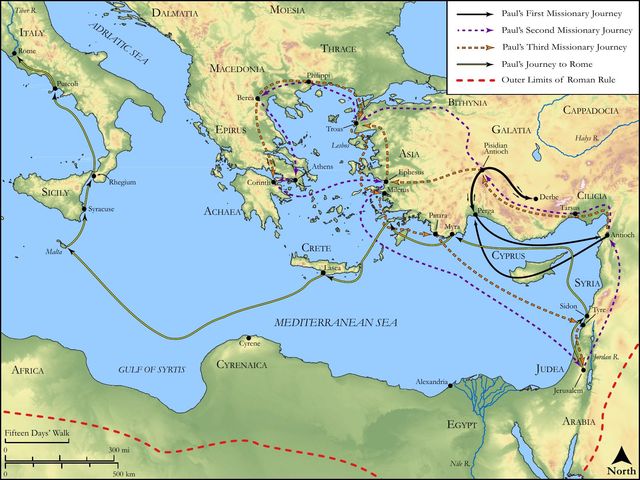
See on the biblical-era maps
Study this verse
Public-domain commentary
Matthew Henry
From his Commentary on the Whole Bible. Henry wrote on whole passages, and this entry covers Acts 19:13–20. He set out his notes in a three-level outline, kept here as he numbered it.
The preachers of the gospel were sent forth to carry on a war against Satan, and therein Christ went forth conquering and to conquer. The casting of evil spirits out of those that were possessed was one instance of Christ's victory over Satan; but, to show in how many ways Christ triumphed over that great enemy, we have here in these verses two remarkable instances of the conquest of Satan, not only in those that were violently possessed by him, but in those that were voluntarily devoted to him.
I.Here is the confusion of some of Satan's servants, some vagabond Jews, that were exorcists, who made use of Christ's name profanely and wickedly in their diabolical enchantments, but were made to pay dearly for their presumption. Observe,
1.The general character of those who were guilty of this presumption. They were Jews, but vagabond Jews, were of the Jewish nation and religion, but went about from town to town to get money by conjuring. They strolled about to tell people their fortunes, and pretended by spells and charms to cure diseases, and bring people to themselves that were melancholy or distracted. They called themselves exorcists, because in doing their tricks they used forms of adjuration, by such and such commanding names. The superstitious Jews, to put a reputation upon these magic arts, wickedly attributed the invention of them to Solomon. So Josephus (Antiq. 8.45-46) says that Solomon composed charms by which diseases were cured, and devils driven out so as never to return; and that these operations continued common among the Jews to his time. And Christ seems to refer to this (Matthew 12:27), By whom do your children cast them out?
2.A particular account of some at Ephesus that led this course of life and came thither in their travels; they were seven sons of one Sceva, a Jew, and chief of the priests, Acts 19:14. It is sad to see the house of Jacob thus degenerated, much more the house of Aaron, the family that was in a peculiar manner consecrated to God; it is truly sad to see any of that race in league with Satan. Their father was a chief of the priests, head of one of the twenty-four courses of priests. One would think the temple would find both employment and encouragement enough for the sons of a chief priest, if they had been twice as many. But probably it was a vain, rambling, rakish humour that led them to turn mountebanks, and wander all the world over to cure mad folks.
3.The profaneness they were guilty of: They took upon them to call over evil spirits the name of the Lord Jesus; not as those who had a veneration for Christ and a confidence in his name, as we read of some who cast out devils in Christ's name and yet did not follow with his disciples (Luke 9:49), whom he would not have to be discouraged; but as those who were willing to try all methods to carry on their wicked trade, and, it should seem, had this design: - If the evil spirits should yield to an adjuration in the name of Jesus by those that did not believe in him, they would say it was no confirmation of his doctrine to those that did; for it was all one whether they believed it or no. If they should not yield to it, they would say the name of Christ was not so powerful as the other names they used, to which the devils had often by collusion yielded. They said, We adjure you by Jesus whom Paul preaches; not, "whom we believe in, or depend upon, or have any authority fRom." but whom Paul preaches; as if they had said, "We will try what that name will do." The exorcists in the Romish church, who pretend to cast the devil out of melancholy people by spells and charms which they understand not, and which, not having any divine warrant, cannot be used in faith, are the followers of these vagabond Jews.
4.The confusion they were put to in their impious operations. Let them not be deceived, God is not mocked, nor shall the glorious name of Jesus be prostituted to such a vile purpose as this; what communion hath Christ with Belial?
(1.)The evil spirit gave them a sharp reply (Acts 19:15): "Jesus I know, and Paul I know; but who are you? I know that Jesus has conquered principalities and powers, and that Paul has authority in his name to cast out devils; but what power have you to command us in his name, or who gave you any such power? What have you to do to declare the power of Jesus, or to take his covenant and commands into your mouths, seeing you hate his instructions?" Psalm 50:16, Psalm 50:17. This was extorted out of the mouth of the evil spirit by the power of God, to gain honour to the gospel, and to put those to shame that made a bad use of Christ's name. Antichristian powers and factions pretend a mighty zeal for Jesus and Paul, and to have authority from them; but, when the matter comes to be looked into, it is a mere worldly secular interest that is to be thus supported; nay, it is an enmity to true religion: Jesus we know, and Paul we know; but who are you?
(2.)The man in whom the evil spirit was gave them a warm reception, fell foul upon them, leaped upon them in the height of his frenzy and rage, overcame them and all their enchantments, prevailed against them, and was every way too hard for them; so that they fled out of the house, not only naked, but wounded; their clothes pulled off their backs, and their heads broken. This is written for a warning to all those who name the name of Christ, but do not depart from iniquity. The same enemy that overcomes them with his temptations will overcome them with his terrors; and their adjuring him in Christ's name to let them alone will be no security to them. If we resist the devil by a true and lively faith in Christ, he will flee from us; but if we think to resist him by the bare using of Christ's name, or any part of his word, as a spell or charm, he will prevail against us.
5.The general notice that was taken of this, and the good impression it made upon many (Acts 19:17): This was known to all the Jews and Greeks also dwelling at Ephesus. It was the common talk of the town; and the effect of it was,
(1.)That men were terrified: fear fell on them all. In this instance they saw the malice of the devil whom they served, and the power of Christ whom they opposed; and both were awful considerations. They saw that the name of Christ was not to be trifled with, nor his religion compounded with pagan superstitions.
(2.)That God was glorified; the name of the Lord Jesus, by which his faithful servants cast out devils and cured diseases, without any resistance, was the more magnified; for now it appeared to be a name above every name.
II.Here is the conversion of others of Satan's servants, with the evidences of their conversion.
1.Those that had been guilty of wicked practices confessed them, Acts 19:18. Many that had believed and were baptized, but had not then been so particular as they might have been in the confession of their sins, were so terrified with these instances of the magnifying of the name of Jesus Christ that they came to Paul, or some of the other ministers that were with him, and confessed what evil lives they had led, and what a great deal of secret wickedness their own consciences charged them with, which the world knew not of - secret frauds and secret filthiness; they showed their deeds, took shame to themselves and gave glory to God and warning to others. These confessions were not extorted from them, but were voluntary, for the ease of their consciences, upon which the late miracles had struck a terror. Note, Where there is true contrition for sin there will be an ingenuous confession of sin to God in every prayer, and to man whom we have offended when the case requires it.
2.Those that had conversed with wicked books burnt them (Acts 19:19): Many also of those who used curious arts, ta perierga - impertinent things; multa nihil ad se pertinentia satagentes - busy bodies (so the word is used, 2 Thessalonians 3:11; 1 Timothy 5:13), that traded in the study of magic and divination, in books of judicial astrology, casting nativities, telling fortunes, raising and laying spirits, interpreting dreams, predicting future events, and the like, to which some think are to be added plays, romances, love-books, and unchaste and immodest poems - histrionica, amatoria, saltatoria. - Stres. These, having their consciences more awakened than ever to see the evil of those practices in which these books instructed them, brought their books together, and burnt them before all men. Ephesus was notorious for the use of these curious arts; hence spells and charms were called Literae Ephesiae. Here people furnished themselves with all those sorts of books, and, probably, had tutors to instruct them in those black arts. It was therefore much for the honour of Christ and his gospel to have such a noble testimony borne against those curious arts, in a place where they were so much in vogue. It is taken for granted that they were convinced of the evil of these curious arts, and resolved to deal in them no longer; but they did not think this enough unless they burnt their books.
(1.)Thus they showed a holy indignation at the sins they had been guilty of; as the idolaters, when they were brought to repentance, said to their idols, Get you hence (Isaiah 30:22), and cast even those of silver and gold to the moles and to the bats, Isaiah 2:20. They thus took a pious revenge on those things that had been the instruments of sin to them, and proclaimed the force of their convictions of the evil of it, and that those very things were now detectable to them, as much as ever they had been delectable.
(2.)Thus they showed their resolution never to return to the use of those arts, and the books which related to them, again. They were so fully convinced of the evil and danger of them that they would not throw the books by, within reach of a recall, upon supposition that it was possible they might change their mind; but, being stedfastly resolved never to make use of them, they burnt them.
(3.)Thus they put away a temptation to return to them again. Had they kept the books by them, there was danger lest, when the heat of the present conviction was over, they should have the curiosity to look into them, and so be in danger of liking them and loving them again, and therefore they burnt them. Note, Those that truly repent of sin will keep themselves as far as possible from the occasions of it.
(4.)Thus they prevented their doing mischief to others. If Judas had been by he would have said, "Sell them, and give the money to the poor;" or, "Buy Bibles and good books with it." But then who could tell into whose hands these dangerous books might fall, and what mischief might be done by them? it was therefore the safest course to commit them all to the flames. Those that are recovered from sin themselves will do all they can to keep others from falling into it, and will be much more afraid of laying an occasion of sin in the way of others.
(5.)Thus they showed a contempt of the wealth of this world; for the price of the books was cast up, probably by those that persuaded them not to burn them, and it was found to be fifty thousand pieces of silver, which some compute to be fifteen hundred pounds of our money. It is probable that the books were scarce, perhaps prohibited, and therefore dear. Probably they had cost them so much; yet, being the devil's books, though they had been so foolish as to buy them, they did not think this would justify them in being so wicked as to sell them again.
(6.)Thus they publicly testified their joy for their conversion from these wicked practices, as Matthew did by the great feast he made when Christ had called him from the receipt of custom. These converts joined together in making this bonfire, and made it before all men. They might have burnt the books privately, every one in his own house, but they chose to do it together, by consent, and to do it at the high cross (as we say), that Christ and his grace in them might be the more magnified, and all about them the more edified.
III.Here is a general account of the progress and success of the gospel in and about Ephesus (Acts 19:20):
So mightily grew the word of God, and prevailed. It is a blessed sight to see the word of God growing and prevailing mightily, as it did here.
1.To see it grow extensively, by the addition of many to the church. When still more and more are wrought upon by the gospel, and wrought up into a conformity to it, then it grows; when those that were least likely to yield to it, and that had been most stiff in their opposition to it, are captivated and brought into obedience to it, then it may be said to grow mightily.
2.To see it prevail extensively, by the advancement in knowledge and grace of those that are added to the church; when strong corruptions are mortified, vicious habits changed, evil customs of long standing broken off, and pleasant, gainful, fashionable sins are abandoned, then it prevails mightily; and Christ in it goes on conquering and to conquer.
Historical interpretation
Historical reception
1 surviving comment on this verse from the historical church.
"And many of them that practised curious arts, brought their books together, and burnt them in the presence of all men" - having seen that there was no more use of them now that the demons themselves do these things - "and reckoned up the price of them, and found the amount fifty thousand pieces of silver. So mightily grew the word of God and prevailed." And so he disputed in the school of one Tyrannus for two years: where were believers, and believers exceedingly advanced in the faith. Moreover Paul writes to them as to great men. Ephesus was famous for its sorcerers and magicians. The "curious arts" were arts connected with this sorcery and the books burned contained mysterious sentences and symbols which gave to them an extravagant worth in the eyes of the superstitious.
Continue studying Acts 19:20 across the web’s major study libraries — every link below opens this exact verse, chapter, or book on the destination site.
Read & Compare
 BibleGatewayThis verse in more than 200 translations and 70 languages.
 Bible.comThe YouVersion reader — hundreds of translations, reading plans, and highlights.
 ESV.orgCrossway's official English Standard Version reader.
 NET BibleThe NET translation with 60,000+ translators' notes on every rendering decision.
 STEP BibleTyndale House's free study tool — original text, vocabulary, and scholarly resources.
 BibliaLogos Bible Software's free web reader.
 USCCBThe New American Bible (Revised Edition) with the U.S. bishops' study notes.
Commentaries
 BibleHub CommentariesDozens of classic commentaries on this verse, gathered on one page.
 StudyLightMore than 100 commentary sets — the largest collection on the web.
 BibleRefPlain-English commentary on what this verse means, verse by verse.
 Enduring WordDavid Guzik's free commentary on this chapter, widely used by Bible teachers.
 Bible Study ToolsVerse commentary alongside Greek and Hebrew study aids.
Original Language & Research
- BibleHub InterlinearThe verse word by word — original language, transliteration, and English.
- BibleHub LexiconEvery word's original-language definition and Strong's entry.
 Blue Letter BibleDeep-study tools — Strong's numbers, concordance, and word studies.
 CNTR CollationThe earliest Greek manuscripts of this verse, collated letter by letter.
Sermons, Hymns & Audio


TrulyRandomVerse is not affiliated with these sites and does not control their content.
Written with AI assistance. Always check it against Scripture.
This verse
In this way the word of the Lord grew with might and prevailed in Ephesus.
“So mightily grew”
The word grew in this way, through all that the passage has told.
“the word of God”
The gospel Paul preached, called in the Greek “the word of the Lord”.
“and prevailed.”
It overcame the magic of Ephesus, by the strength of the Lord whose word it is.
Passage studyActs 19:11–20
The Name of the Lord Jesus Magnified in Ephesus
Summary
In Ephesus, a city famous for its magic, God worked unusual miracles through Paul, so that even cloths that had touched him were carried to the sick, and they were healed and set free from evil spirits. Seven sons of a Jewish chief priest named Sceva then tried to use “Jesus whom Paul preacheth” as a formula of their own, and the evil spirit answered, “Jesus I know, and Paul I know; but who are ye?” The man it held overpowered them all, and they ran from the house naked and wounded. The news went through the whole city. Fear fell on Jews and Greeks alike and the name of the Lord Jesus was magnified. Believers came forward to confess what they had done, and those who had practised magic burned their books in public, books worth fifty thousand pieces of silver. Luke closes the account with the word of God growing mightily and prevailing. The passage shows that the power is God’s, that the name of Jesus belongs to him and to those who are his, and that his word wins people out of darkness.
God Wrought Special Miracles by the Hands of Paul
Paul had been in Ephesus for some time when these things happened. He had found disciples there who knew only John’s baptism and taught them about the Holy Spirit (Acts 19:1–7). He had taught in the synagogue for three months, and when some hardened themselves and spoke evil of the Way, he moved to the school of Tyrannus and taught there daily for two years (Acts 19:8–10). Ephesus was a leading Roman city and port in the province of Asia, home to the great temple of Artemis, the Diana of the KJV, famed throughout all Asia. It was just as well known for magic. Charms and incantations called “Ephesian letters” (ephesia grammata) were known and used far and wide. In that city God showed his power where everyone could see it.
Luke names God as the one who acts: “God wrought”. The word theós is the common word for a deity, used in the New Testament even for the gods of the nations, and in a city crowded with gods it names here the living God whom Paul preached. The verb poiéō is the everyday word for making or doing, used in the widest way, and it says simply that God did these works. Paul was the means, “by the hands of Paul”, where his hands stand for Paul himself as the one through whom God worked.
Paul speaks of the things Christ had wrought through him by mighty signs and wonders and the power of the Spirit (Romans 15:19). Mark closes his Gospel with the Lord working with the apostles and confirming the word with signs following (Mark 16:20), and Hebrews says that God bore witness to the message with signs, wonders and miracles (Hebrews 2:4). That is what happened in Ephesus. The power Jesus promised his witnesses when the Holy Spirit came upon them (Acts 1:8) was at work, and these signs carried on the works of Jesus himself, who showed his glory in his first sign at Cana (John 2:11).
What made these miracles special?
The word for miracles, dýnamis, means power, and especially miraculous power, so that it can name a miracle itself. “Special” stands for a Greek phrase, ou tychousas, built from ou, “not”, and tynchánō, “to happen”. These were, literally, “not ordinary” miracles, unusual even among the works of God, and verse 12 shows what was unusual about them.
The two cloths in that verse have Latin names in the Greek. Handkerchiefs are soudárion, a sweat-cloth or towel for wiping the face, and aprons are simikínthion, a “half-girding”, a narrow covering tied round the waist. These were plain cloths of daily work. “From his body” uses chrṓs, the skin or surface of the body, so these were cloths that had been in contact with Paul. They “were brought” (epiphérō, to bear upon or carry to) to the sick, “and the diseases departed from them”. nósos is sickness or malady of any kind, and apallássō means to release or remove, so the sick were set free of their illnesses.
“And the evil spirits went out of them.” ponērós, evil, describes what is hurtful in its effect and influence. pneûma means breath or wind, and by extension a spirit of any kind, human, angelic, demonic or divine, and here it names the demons. God healed bodies and freed people from evil spirits, the very works Jesus named when he announced his ministry of healing and setting captives free (Luke 4:18–19).
Were the handkerchiefs and aprons a kind of magic?
The power was God’s, as verse 11 says, and the cloths had none of their own. The words “from his body were brought” read most naturally as the people’s own doing: they saw what God was doing through Paul and carried cloths from him to the sick, and God honoured their faith for his own purposes. In a city used to charms and to the idea that power passes through objects, God showed himself greater than every charm in Ephesus, in a way its people could understand. He had worked in the same way through Peter’s shadow (Acts 5:15), and through Jesus’ garment, which a sick woman touched in faith (Mark 5:28). Luke calls these works special, so he records them as something God chose to do in that place and time. Our trust rests in God himself, who heals and delivers, and the objects and the man were only the means he used.
The Sons of Sceva Borrow the Name of Jesus
Then come men who had watched Paul and wanted his results. “Vagabond” is periérchomai, to come all around, to stroll or wander, so these were travelling Jews who went from place to place. “Exorcists” is exorkistḗs, one who binds by an oath or a spell, a conjurer. Exorcism was a recognised trade in that world, and Jewish exorcists worked with incantations and with names they believed held power over demons, such as the name of Solomon. These men “took upon them”, that is, they undertook or set out, to call the name of the Lord Jesus over people who had evil spirits.
Their formula was “We adjure you by Jesus whom Paul preacheth.” To adjure, horkízō, is to put someone on oath or to charge them solemnly. They meant to bind the spirit by an oath sworn on a name. The way they named Jesus shows how far they stood from him. He was to them “Jesus whom Paul preacheth”, a Jesus they knew only as the subject of another man’s preaching. They treated his name as a strong new word to add to their incantations, useful for their trade or their reputation.
The name of Jesus stands for Jesus himself, with all his authority. God has given him the name above every name, and every knee shall bow to it (Philippians 2:9–11). Believers do all things in the name of the Lord Jesus, giving thanks to God through him (Colossians 3:17), because they belong to him. Jesus warned that many would call him “Lord, Lord” and even cast out devils in his name, and that he would tell them he never knew them (Matthew 7:21–23). The Gospels also tell of a man who cast out devils in Jesus’ name outside the company of the disciples, and Jesus said of him, “Forbid him not” (Mark 9:38–40, Luke 9:49–50). Jesus counted that man on his side, while these men in Ephesus had only borrowed the name.
Who was Sceva, the chief of the priests?
Seven sons of one Sceva did this. Skeuâs is apparently a Latin name, meaning left-handed. He was a Jew, Ioudaîos, a Judaean, one belonging to Judah, and “chief of the priests”, archiereús, the word for the high priest and, by extension, for the chief priests of the leading priestly families. Sceva appears in no other record, and no high priest of that name served in Jerusalem. He was most likely a prominent Jew in Ephesus, perhaps the head of a priestly family or a man who claimed priestly descent, with a name for religious authority in the Jewish community there. His standing gave his sons credit with the people of the city. In the house where they met the evil spirit, it was worth as little as their borrowed formula.
“Which did so” uses poiéō, the same verb as “wrought” in verse 11. God did special miracles through Paul, and the sons of Sceva did the same outward things, speaking the name of Jesus over the afflicted. What followed shows the difference.
“Jesus I Know, and Paul I Know; but Who Are Ye?”
“The evil spirit answered and said.” apokrínomai, to answer, and épō, to speak or say, together make the common Bible way of bringing in a reply. The spirit speaks through the man, and what it says is the line of this passage that everyone remembers.
Two different Greek verbs stand behind the English “know”. For Jesus the spirit uses ginṓskō, the common word for knowing, coming to know or perceiving. For Paul it uses epístamai, which means to put the mind upon a thing, to understand it or be acquainted with it. The change of verb may be simple variety, or it may set the Lord apart from his servant. Either way the spirit knew exactly who Jesus was, and it knew Paul as the man through whom Jesus’ power was at work in Ephesus. Evil spirits recognised Jesus all through his ministry and obeyed his word, so that people were amazed at his authority over unclean spirits (Mark 1:27). James says that the devils believe there is one God, and tremble (James 2:19).
Then comes “but who are ye?” The “but” is dé, the ordinary word for “and” or “but”, here setting the sons of Sceva against Jesus and Paul. “Who” is tís, and “are ye” is esté with hymeîs, the plain plural “you”. The spirit knew the Lord and it knew the Lord’s servant, and these men were strangers to it. The question exposed them in front of everyone in the house.
Why did the evil spirit know Jesus and Paul but not the sons of Sceva?
Paul belonged to Jesus and came with the authority Jesus gives to his own, while the sons of Sceva had only the sound of his name. Jesus gave his disciples power over all the power of the enemy, and when the seventy came back rejoicing that the devils were subject to them through his name, he told them to rejoice most that their names were written in heaven (Luke 10:17–20). That authority comes through belonging to Christ, as a branch abides in the vine, for he said, “without me ye can do nothing” (John 15:5). Paul says that our wrestling is against principalities and powers and spiritual wickedness (Ephesians 6:12), and John tells believers that he who is in them is greater than he who is in the world (1 John 4:4). The spirit could see that Sceva’s sons had none of this. They were using Jesus as a charm, and his name has its power with those who are his.
Naked and Wounded
The attack came from “the man in whom the evil spirit was”. ánthrōpos is a human being, so a man struck them, with the spirit’s power behind him. He “leaped on them”, ephállomai, to spring upon, a sudden and violent attack. He “overcame them”, katakyrieúō, to lord it over, to subdue and master, and he “prevailed against them”, where ischýō means to have and use strength. One man mastered all of them at once.
They “fled out of that house naked and wounded”. gymnós means naked, wholly or in part, so they may have been stripped of their outer clothes, and either way it was a public shame. traumatízō means to wound, and they left the house hurt and bleeding as well as disgraced. The verse shows how real and strong evil spirits are, and how dangerous it is to meddle with them using holy names as spells. Jesus binds the strong man and spoils his house (Matthew 12:29), and he cast out spirits with a word. The sons of Sceva came to bind a spirit and were themselves beaten and stripped.
Fear Fell on Them All, and the Name of the Lord Jesus Was Magnified
“This was known”, gnōstós, well known, notable. The story went through the whole city, to Jews and Greeks alike, everyone who lived in Ephesus. The Jews understood what it meant that sons of a chief priest had been routed, and the Greeks lived among magic and knew what exorcists claimed to do.
“Fear fell on them all.” phóbos is alarm, fright or terror, and here it is the dread and awe that come over people when God’s power has plainly been shown. It is the right response, for Proverbs calls the fear of the LORD the beginning of wisdom (Proverbs 9:10).
“And the name of the Lord Jesus was magnified.” megalýnō means to make or declare great, to extol. This is the same phrase, “the name of the Lord Jesus”, that the exorcists had tried to use in verse 13. Men had used his name as a spell, and God answered by making that name great in the whole city. Ephesus saw on a small scale what Paul says of the exalted Christ, that God has given him the name above every name (Philippians 2:9–11), and that on the cross Christ disarmed the principalities and powers and made a public spectacle of them, triumphing over them (Colossians 2:15).
Many That Believed Came and Confessed
“Many that believed came.” pisteúō means to believe or trust, to credit what is said or to rely on a person, and here it names those who had put their faith in Jesus. They came forward, most likely to Paul and the gathered believers, “and confessed”. exomologéō is formed from ek, out, and homologéō, to say the same, and it means to acknowledge openly, to agree fully. They spoke out and agreed with God about what they had done.
They also “shewed their deeds”. anangéllō, from aná and the base of ággelos, a messenger, means to announce in detail, to declare or report. prâxis is a practice, an act or deed. So they admitted their sin, and they also told plainly what their practices had been. In Ephesus those practices were above all the magic that verse 19 describes. It cost them something to say this in front of others, and it marked a clean break with the life they had left.
Scripture holds to the same pattern. Proverbs promises mercy to the one who confesses and forsakes his sins (Proverbs 28:13), and John writes, “If we confess our sins, he is faithful and just to forgive us our sins, and to cleanse us from all unrighteousness” (1 John 1:9). Christ came to destroy the works of the devil (1 John 3:8). He is the light of the world (John 8:12), and his light brings hidden deeds into the open to be forgiven. Those who confessed in Ephesus had been delivered from the power of darkness and brought into the kingdom of God’s dear Son, in whom we have redemption (Colossians 1:13–14).
Must believers confess their sins in public?
Confession is made first to God, who forgives all who confess to him. There are also times when confessing to others is right: when a sin has wronged them, when we need others to hold us to account, or when we keep falling into the same sin. James tells believers to confess their faults one to another and pray for one another (James 5:16). The public confession in Ephesus fitted a city where magic was practised in the open. What every believer shares with them is honesty about sin and a clear break with it, in whatever form that break needs to take.
The Books of Magic Burned Before All Men
“Many of them also which used curious arts” came next. “Many” is hikanós, considerable, a large number. “Used” is prássō, to practise, to do a thing again and again, so these people had made magic their habit, and for some it may have been their living. “Curious arts” is períergos, which means working all around, meddlesome, and in the neuter plural (períerga) means magic. It covered spells, incantations, charms and divination, the trade Ephesus was known for. The law of Moses had forbidden all such practices to God’s people (Deuteronomy 18:10–12).
They “brought their books together”, symphérō, to bear together or collect, so the books were gathered into one heap. A book, bíblos, was a scroll of writing (the word first meant the inner bark of the papyrus plant), and these were full of formulas and spells. They “burned them”, katakaíō, to burn down or consume wholly, so that nothing was left to use. And they did it “before all men”, enṓpion, in the face of, with pâs, all, where the whole city could watch.
How much were fifty thousand pieces of silver?
“They counted the price of them.” sympsēphízō means to reckon up together, and timḗ is the value or the money paid. The total was fifty thousand, in Greek pénte, five, and myriás, ten thousand, so five myriads of argýrion. That word means silver money, and especially a silver coin such as the drachma. If each piece was a drachma or denarius, about a day’s wage for a labourer, the books were worth fifty thousand days’ pay, over a hundred and thirty years of a working man’s wages. The sum shows how large and profitable the trade in magic was in Ephesus, and how much these believers gave up.
They counted the cost, as Jesus told the crowds his disciples must do, ready to forsake all that they had (Luke 14:25–33). Paul counted everything loss for Christ (Philippians 3:7–8), and Jesus told his hearers to lay up treasure in heaven, where their hearts would be also (Matthew 6:19–21). John the Baptist called for fruits worthy of repentance (Luke 3:8), and the fire in Ephesus was such fruit. All that silver was small beside the price of our own redemption, which Peter sets far above silver and gold, for we were redeemed with the precious blood of Christ (1 Peter 1:18–19).
Why did they burn the books?
Burning ended their part in magic once and for all. Had they sold the books, even for a good cause, they would have gone on profiting from the practices they had just confessed, as though those practices still held some worth. Fire made the break complete and public, and it declared these arts worthless beside Christ. Paul writes, “And have no fellowship with the unfruitful works of darkness, but rather reprove them” (Ephesians 5:11). For these believers the old things had passed away and all things had become new (2 Corinthians 5:17).
The Word of the Lord Grew Mightily and Prevailed
“So mightily grew the word of God and prevailed.” “So” is hoútō, in this way, looking back over all that has happened. “Mightily” is katá krátos, where katá is a preposition and krátos means strength, vigour, might or dominion, so the word grew “with might”. “Grew” is auxánō, to grow or increase, the word used of living things. The word, lógos, is something said, a message, and here it is the gospel Paul preached. Where the KJV has “word of God”, the Greek behind “God” in this verse is kýrios, “Lord”, so it reads “the word of the Lord”, the same Lord Jesus whose name was magnified in verse 17.
“And prevailed” is ischýō, to have and use strength, the same verb used in verse 16 of the man who “prevailed against” the sons of Sceva. The evil spirit prevailed over men who misused the name of Jesus, and the word of the Lord prevailed over the magic of a whole city.
Luke has written the same kind of summary before, when the word of God increased in Jerusalem (Acts 6:7) and when it grew and multiplied (Acts 12:24). From Pentecost on (Acts 2) the word goes out in the power of the Spirit, and the growth is God’s work, however faithfully Paul preached. The word of God is quick and powerful (Hebrews 4:12), and in John’s Gospel the Word himself is Christ, who was with God and was God (John 1:1). The rest of Acts 19 shows how far the word reached into the city’s life, for the silversmiths who made idols of Artemis soon rioted over the loss of their trade (Acts 19:23–41).
The Lord Who Triumphs over Every Power
Everything in this passage points to the Lord Jesus. God worked the miracles, and the name made great in Ephesus was the name of Jesus. All power is given to him in heaven and in earth (Matthew 28:18), and God has raised him far above all principality and power (Ephesians 1:20–22). By his death he destroyed the one who had the power of death and set free those who lived in fear of it (Hebrews 2:14–15). There is salvation in his name and in no other (Acts 4:12). Heaven sings that the Lamb who was slain is worthy to receive power (Revelation 5:12), and his people overcome the accuser by the blood of the Lamb (Revelation 12:11).
The sons of Sceva show that his name belongs to him and to those who are his, and that those who borrow it as a spell are put to shame. The believers of Ephesus show what that same name does for those who trust him. It frees them from sickness and evil spirits, brings their hidden deeds into the light to be forgiven, and gives them the courage to burn what once held them. The word that prevailed in Ephesus is the word we have, and it still grows by God’s own strength.
Acts 19:11
“And God wrought”
God is the one acting, and the glory of what follows is his.
“special miracles”
Literally “not ordinary” powers, unusual even among the miracles of Scripture.
“by the hands of Paul:”
The Greek preposition diá, through, marks Paul as the channel of God’s work.
Acts 19:12
“So that from his body were brought unto the sick”
“So that” ties this to verse 11 and shows what made the miracles unusual.
“handkerchiefs or aprons,”
A sweat-cloth and a work apron, the plainest things a man wore or carried.
“and the diseases departed from them,”
Sickness of every kind left the people who received the cloths.
“and the evil spirits went out of them.”
God’s power reached the spirit as well as the body.
Acts 19:13
“Then certain of the vagabond Jews, exorcists,”
A group of wandering Jewish exorcists, among them the sons of Sceva named in the next verse.
“took upon them”
They acted on their own initiative, copying what they had seen Paul do.
“to call over them which had evil spirits the name of the Lord Jesus,”
They spoke the name over the afflicted as a formula.
“saying, We adjure you by Jesus whom Paul preacheth.”
“Preacheth” is kērýssō, to herald like a public crier. The only Jesus they could name was the one Paul proclaimed.
Acts 19:14
“And there were seven sons of one Sceva,”
The verse names the best known of these exorcists, a whole family at the trade.
“a Jew, and chief of the priests,”
Their father’s rank gave them standing in the eyes of the city.
“which did so.”
They used the formula of verse 13.
Acts 19:15
“And the evil spirit answered and said,”
The spirit speaks for itself, a being able to hear and answer.
“Jesus I know, and Paul I know;”
The spirit recognises the Lord and the servant he sent.
“but who are ye?”
A question that strips the sons of Sceva of every claim before the blows of the next verse.
Acts 19:16
“And the man in whom the evil spirit was leaped on them,”
The attack was sudden, and it came on all of them at once.
“and overcame them, and prevailed against them,”
The two verbs together show how complete their defeat was.
“so that they fled out of that house naked and wounded.”
They came to master a spirit and left the house beaten and ashamed.
Acts 19:17
“And this was known to all the Jews and Greeks also dwelling at Ephesus;”
“Dwelling” is katoikéō, to reside, so the news reached the settled people of the whole city.
“and fear fell on them all,”
“Fell” is epipíptō, to seize, so fear took hold of them.
“and the name of the Lord Jesus was magnified.”
God himself honoured the name that had been misused.
Acts 19:18
“And many that believed came,”
They came forward of their own accord.
“and confessed,”
An open acknowledgment of their sin.
“and shewed their deeds.”
They named what they had done, practice by practice.
Acts 19:19
“Many of them also which used curious arts”
Those who had practised magic as a habit or a living.
“brought their books together, and burned them before all men:”
A shared, public act that left nothing of the books behind.
“and they counted the price of them, and found it fifty thousand pieces of silver.”
They knew exactly what they were giving up, and they burned it anyway.
Acts 19:20 This verse
“So mightily grew”
The word grew in this way, through all that the passage has told.
“the word of God”
The gospel Paul preached, called in the Greek “the word of the Lord”.
“and prevailed.”
It overcame the magic of Ephesus, by the strength of the Lord whose word it is.
Last revised