


Acts 19:13
- ἘπεχείρησανEpecheirēsanAttemptedG2021V-AAI-3PVerb Aorist Active Indicative 3rd Plural
- δέdenowG1161CONJConjunction
- τινεςtinessome ofG5100X-NPMIndefinite pronoun Nominative Plural Masculine
- καὶkaialsoG2532CONJConjunction
- τῶνtōnof theG3588T-GPMDefinite article Genitive Plural Masculine
- περιερχομένωνperierchomenōnitinerantG4022V-PNP-GPMVerb Present Middle Or Passive Deponent Participle Genitive Plural Masculine
- ἸουδαίωνIoudaiōnJewishG2453A-GPM-PGAdjective Genitive Plural Masculine Person Gentilic
- ἐξορκιστῶνexorkistōnexorcistsG1845N-GPMNoun Genitive Plural Masculine
- ὀνομάζεινonomazeinto invokeG3687V-PANVerb Present Active Infinitive
- ἐπὶepioverG1909PREPPreposition
- τοὺςtousthoseG3588T-APMDefinite article Accusative Plural Masculine
- ἔχονταςechontashavingG2192V-PAP-APMVerb Present Active Participle Accusative Plural Masculine
- τὰta<the>G3588T-APNDefinite article Accusative Plural Neuter
- πνεύματαpneumataspiritsG4151N-APNNoun Accusative Plural Neuter
- τὰta<the>G3588T-APNDefinite article Accusative Plural Neuter
- πονηρὰponēraevilG4190A-APNAdjective Accusative Plural Neuter
- τὸtotheG3588T-ASNDefinite article Accusative Singular Neuter
- ὄνομαonomanameG3686N-ASNNoun Accusative Singular Neuter
- τοῦtouof theG3588T-GSMDefinite article Genitive Singular Masculine
- κυρίουkuriouLordG2962N-GSM-TNoun Genitive Singular Masculine Title
- ἸησοῦIēsouJesusG2424N-GSM-PNoun Genitive Singular Masculine Individual
- λέγοντες·legontessayingG3004V-PAP-NPMVerb Present Active Participle Nominative Plural Masculine
- ὁρκίζωhorkizōI adjureG3726V-PAI-1SVerb Present Active Indicative 1st Singular
- ὑμᾶςhumasyouG4771P-2APPersonal pronoun Accusative 2nd Plural
- τὸνton<the>G3588T-ASMDefinite article Accusative Singular Masculine
- ἸησοῦνIēsoun[by] JesusG2424N-ASM-PNoun Accusative Singular Masculine Individual
- ὃνhonwhomG3739R-ASMRelative pronoun Accusative Singular Masculine
- ὁho<the>G3588T-NSMDefinite article Nominative Singular Masculine
- ΠαῦλοςPaulosPaulG3972N-NSM-PNoun Nominative Singular Masculine Individual
- κηρύσσειkērusseiproclaimsG2784V-PAI-3SVerb Present Active Indicative 3rd Singular
English is a literal word-by-word gloss of the Greek, not the KJV's wording. Why?
This is the original text the KJV's translators worked from — each Greek word with its own literal English meaning in this verse, prepared by scholars at Tyndale House, Cambridge. The KJV translates whole sentences, not word by word, so its wording differs: one Greek word can become several English words, and the KJV may choose “charity” where the gloss reads “love”. Both are faithful — they answer different questions. For the KJV's own rendering, switch to the KJV text.
Details
See on the biblical-era map
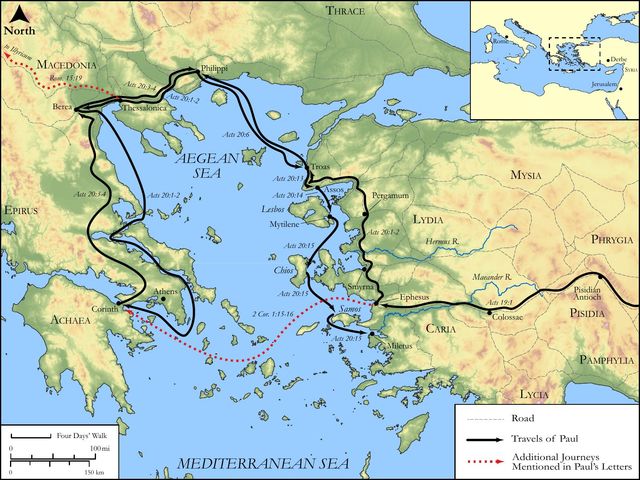
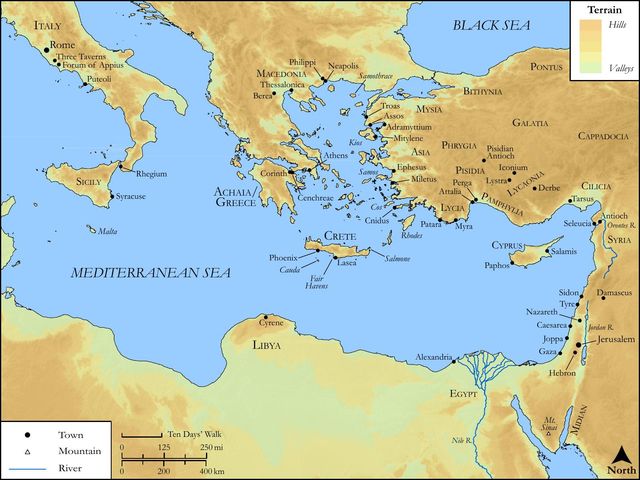
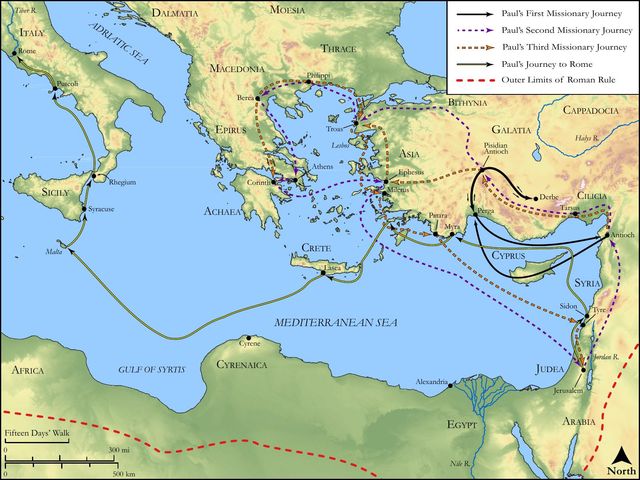
Study this verse
Public-domain commentary
Matthew Henry
From his Commentary on the Whole Bible. Henry comments on passages, not single verses — this entry covers Acts 19:13–20. His three-level outline is real structure in the source text, so it is rendered as structure.
The preachers of the gospel were sent forth to carry on a war against Satan, and therein Christ went forth conquering and to conquer. The casting of evil spirits out of those that were possessed was one instance of Christ's victory over Satan; but, to show in how many ways Christ triumphed over that great enemy, we have here in these verses two remarkable instances of the conquest of Satan, not only in those that were violently possessed by him, but in those that were voluntarily devoted to him.
I.Here is the confusion of some of Satan's servants, some vagabond Jews, that were exorcists, who made use of Christ's name profanely and wickedly in their diabolical enchantments, but were made to pay dearly for their presumption. Observe,
1.The general character of those who were guilty of this presumption. They were Jews, but vagabond Jews, were of the Jewish nation and religion, but went about from town to town to get money by conjuring. They strolled about to tell people their fortunes, and pretended by spells and charms to cure diseases, and bring people to themselves that were melancholy or distracted. They called themselves exorcists, because in doing their tricks they used forms of adjuration, by such and such commanding names. The superstitious Jews, to put a reputation upon these magic arts, wickedly attributed the invention of them to Solomon. So Josephus (Antiq. 8.45-46) says that Solomon composed charms by which diseases were cured, and devils driven out so as never to return; and that these operations continued common among the Jews to his time. And Christ seems to refer to this (Mat 12:27), By whom do your children cast them out?
2.A particular account of some at Ephesus that led this course of life and came thither in their travels; they were seven sons of one Sceva, a Jew, and chief of the priests, Act 19:14. It is sad to see the house of Jacob thus degenerated, much more the house of Aaron, the family that was in a peculiar manner consecrated to God; it is truly sad to see any of that race in league with Satan. Their father was a chief of the priests, head of one of the twenty-four courses of priests. One would think the temple would find both employment and encouragement enough for the sons of a chief priest, if they had been twice as many. But probably it was a vain, rambling, rakish humour that led them to turn mountebanks, and wander all the world over to cure mad folks.
3.The profaneness they were guilty of: They took upon them to call over evil spirits the name of the Lord Jesus; not as those who had a veneration for Christ and a confidence in his name, as we read of some who cast out devils in Christ's name and yet did not follow with his disciples (Luk 9:49), whom he would not have to be discouraged; but as those who were willing to try all methods to carry on their wicked trade, and, it should seem, had this design: - If the evil spirits should yield to an adjuration in the name of Jesus by those that did not believe in him, they would say it was no confirmation of his doctrine to those that did; for it was all one whether they believed it or no. If they should not yield to it, they would say the name of Christ was not so powerful as the other names they used, to which the devils had often by collusion yielded. They said, We adjure you by Jesus whom Paul preaches; not, "whom we believe in, or depend upon, or have any authority fRom." but whom Paul preaches; as if they had said, "We will try what that name will do." The exorcists in the Romish church, who pretend to cast the devil out of melancholy people by spells and charms which they understand not, and which, not having any divine warrant, cannot be used in faith, are the followers of these vagabond Jews.
4.The confusion they were put to in their impious operations. Let them not be deceived, God is not mocked, nor shall the glorious name of Jesus be prostituted to such a vile purpose as this; what communion hath Christ with Belial?
(1.)The evil spirit gave them a sharp reply (Act 19:15): "Jesus I know, and Paul I know; but who are you? I know that Jesus has conquered principalities and powers, and that Paul has authority in his name to cast out devils; but what power have you to command us in his name, or who gave you any such power? What have you to do to declare the power of Jesus, or to take his covenant and commands into your mouths, seeing you hate his instructions?" Psa 50:16, Psa 50:17. This was extorted out of the mouth of the evil spirit by the power of God, to gain honour to the gospel, and to put those to shame that made a bad use of Christ's name. Antichristian powers and factions pretend a mighty zeal for Jesus and Paul, and to have authority from them; but, when the matter comes to be looked into, it is a mere worldly secular interest that is to be thus supported; nay, it is an enmity to true religion: Jesus we know, and Paul we know; but who are you?
(2.)The man in whom the evil spirit was gave them a warm reception, fell foul upon them, leaped upon them in the height of his frenzy and rage, overcame them and all their enchantments, prevailed against them, and was every way too hard for them; so that they fled out of the house, not only naked, but wounded; their clothes pulled off their backs, and their heads broken. This is written for a warning to all those who name the name of Christ, but do not depart from iniquity. The same enemy that overcomes them with his temptations will overcome them with his terrors; and their adjuring him in Christ's name to let them alone will be no security to them. If we resist the devil by a true and lively faith in Christ, he will flee from us; but if we think to resist him by the bare using of Christ's name, or any part of his word, as a spell or charm, he will prevail against us.
5.The general notice that was taken of this, and the good impression it made upon many (Act 19:17): This was known to all the Jews and Greeks also dwelling at Ephesus. It was the common talk of the town; and the effect of it was,
(1.)That men were terrified: fear fell on them all. In this instance they saw the malice of the devil whom they served, and the power of Christ whom they opposed; and both were awful considerations. They saw that the name of Christ was not to be trifled with, nor his religion compounded with pagan superstitions.
(2.)That God was glorified; the name of the Lord Jesus, by which his faithful servants cast out devils and cured diseases, without any resistance, was the more magnified; for now it appeared to be a name above every name.
II.Here is the conversion of others of Satan's servants, with the evidences of their conversion.
1.Those that had been guilty of wicked practices confessed them, Act 19:18. Many that had believed and were baptized, but had not then been so particular as they might have been in the confession of their sins, were so terrified with these instances of the magnifying of the name of Jesus Christ that they came to Paul, or some of the other ministers that were with him, and confessed what evil lives they had led, and what a great deal of secret wickedness their own consciences charged them with, which the world knew not of - secret frauds and secret filthiness; they showed their deeds, took shame to themselves and gave glory to God and warning to others. These confessions were not extorted from them, but were voluntary, for the ease of their consciences, upon which the late miracles had struck a terror. Note, Where there is true contrition for sin there will be an ingenuous confession of sin to God in every prayer, and to man whom we have offended when the case requires it.
2.Those that had conversed with wicked books burnt them (Act 19:19): Many also of those who used curious arts, ta perierga - impertinent things; multa nihil ad se pertinentia satagentes - busy bodies (so the word is used, Th2 3:11; Ti1 5:13), that traded in the study of magic and divination, in books of judicial astrology, casting nativities, telling fortunes, raising and laying spirits, interpreting dreams, predicting future events, and the like, to which some think are to be added plays, romances, love-books, and unchaste and immodest poems - histrionica, amatoria, saltatoria. - Stres. These, having their consciences more awakened than ever to see the evil of those practices in which these books instructed them, brought their books together, and burnt them before all men. Ephesus was notorious for the use of these curious arts; hence spells and charms were called Literae Ephesiae. Here people furnished themselves with all those sorts of books, and, probably, had tutors to instruct them in those black arts. It was therefore much for the honour of Christ and his gospel to have such a noble testimony borne against those curious arts, in a place where they were so much in vogue. It is taken for granted that they were convinced of the evil of these curious arts, and resolved to deal in them no longer; but they did not think this enough unless they burnt their books.
(1.)Thus they showed a holy indignation at the sins they had been guilty of; as the idolaters, when they were brought to repentance, said to their idols, Get you hence (Isa 30:22), and cast even those of silver and gold to the moles and to the bats, Isa 2:20. They thus took a pious revenge on those things that had been the instruments of sin to them, and proclaimed the force of their convictions of the evil of it, and that those very things were now detectable to them, as much as ever they had been delectable.
(2.)Thus they showed their resolution never to return to the use of those arts, and the books which related to them, again. They were so fully convinced of the evil and danger of them that they would not throw the books by, within reach of a recall, upon supposition that it was possible they might change their mind; but, being stedfastly resolved never to make use of them, they burnt them.
(3.)Thus they put away a temptation to return to them again. Had they kept the books by them, there was danger lest, when the heat of the present conviction was over, they should have the curiosity to look into them, and so be in danger of liking them and loving them again, and therefore they burnt them. Note, Those that truly repent of sin will keep themselves as far as possible from the occasions of it.
(4.)Thus they prevented their doing mischief to others. If Judas had been by he would have said, "Sell them, and give the money to the poor;" or, "Buy Bibles and good books with it." But then who could tell into whose hands these dangerous books might fall, and what mischief might be done by them? it was therefore the safest course to commit them all to the flames. Those that are recovered from sin themselves will do all they can to keep others from falling into it, and will be much more afraid of laying an occasion of sin in the way of others.
(5.)Thus they showed a contempt of the wealth of this world; for the price of the books was cast up, probably by those that persuaded them not to burn them, and it was found to be fifty thousand pieces of silver, which some compute to be fifteen hundred pounds of our money. It is probable that the books were scarce, perhaps prohibited, and therefore dear. Probably they had cost them so much; yet, being the devil's books, though they had been so foolish as to buy them, they did not think this would justify them in being so wicked as to sell them again.
(6.)Thus they publicly testified their joy for their conversion from these wicked practices, as Matthew did by the great feast he made when Christ had called him from the receipt of custom. These converts joined together in making this bonfire, and made it before all men. They might have burnt the books privately, every one in his own house, but they chose to do it together, by consent, and to do it at the high cross (as we say), that Christ and his grace in them might be the more magnified, and all about them the more edified.
III.Here is a general account of the progress and success of the gospel in and about Ephesus (Act 19:20):
So mightily grew the word of God, and prevailed. It is a blessed sight to see the word of God growing and prevailing mightily, as it did here.
1.To see it grow extensively, by the addition of many to the church. When still more and more are wrought upon by the gospel, and wrought up into a conformity to it, then it grows; when those that were least likely to yield to it, and that had been most stiff in their opposition to it, are captivated and brought into obedience to it, then it may be said to grow mightily.
2.To see it prevail extensively, by the advancement in knowledge and grace of those that are added to the church; when strong corruptions are mortified, vicious habits changed, evil customs of long standing broken off, and pleasant, gainful, fashionable sins are abandoned, then it prevails mightily; and Christ in it goes on conquering and to conquer.
Historical interpretation
Four Centuries of Reception
3 surviving comments on this verse. Each one is dated, so this reads as a timeline rather than a list.
Select a marker to jump to its quote. Markers stagger vertically where authors wrote within a few decades of each other.
And the nature of all these deceits is obscure to those who are without the truth. For they think that those demons profit them when they cease to injure, whereas they have no power except to injure. Some one may perchance say that they are therefore to be worshipped, that they may not injure, since they have the power to injure. They do indeed injure, but those only by whom they are feared, whom the powerful and lofty hand of God does not protect, who are uninitiated in the mystery of truth. But they fear the righteous, that is, the worshippers of God, adjured by whose name they depart from the bodies of the possessed: for, being lashed by their words as though by scourges, they not only confess themselves to be demons, but even utter their own names—those which are adored in the temples—which they generally do in the presence of their own worshippers; not, it is plain, to the disgrace of religion, but to the disgrace of their own honour, because they cannot speak falsely to God, by whom they are adjured, nor to the righteous, by whose voice they are tortured. Therefore ofttimes having uttered the greatest howlings, they cry out that they are beaten, and are on fire, and that they are just on the point of coming forth: so much power has the knowledge of God, and righteousness!
"Then certain of the vagabond Jews, exorcists, took upon them to call over them which had evil spirits the name of the Lord Jesus, saying, We adjure you by Jesus whom Paul preacheth." So entirely did they do all by way of trade! Observe: vagabond, or, itinerant, Jewish exorcists. And to believe indeed, they had no mind; but by that Name they wished to cast out the demons. "By Jesus, whom Paul preacheth." Only see what a name Paul had got! Wonderful, how great the power of them that have believed! Both Simon for the sake of merchandise sought the grace of the Spirit, and these for this object did this. What hardness of heart! Why does not Paul rebuke them? It would have looked like envy, therefore it is so ordered.
However, certain itinerant Jewish exorcists attempted to invoke over those who, etc. Josephus reports that King Solomon devised and taught his people modes of exorcism, that is, adjurations, by which unclean spirits, once expelled from a person, might not dare to return. This sometimes happens even through reprobates, either for the condemnation of those who do such things or for the benefit of those who see and hear, so that although men may despise those who perform the signs, they nevertheless honor God, at whose invocation such great miracles are performed.
Continue studying Acts 19:13 across the web’s major study libraries — every link below opens this exact verse, chapter, or book on the destination site.
Read & Compare
 BibleGatewayThis verse in more than 200 translations and 70 languages.
 Bible.comThe YouVersion reader — hundreds of translations, reading plans, and highlights.
 ESV.orgCrossway's official English Standard Version reader.
 NET BibleThe NET translation with 60,000+ translators' notes on every rendering decision.
 STEP BibleTyndale House's free study tool — original text, vocabulary, and scholarly resources.
 BibliaLogos Bible Software's free web reader.
 USCCBThe New American Bible (Revised Edition) with the U.S. bishops' study notes.
Commentaries
 BibleHub CommentariesDozens of classic commentaries on this verse, gathered on one page.
 StudyLightMore than 100 commentary sets — the largest collection on the web.
 BibleRefPlain-English commentary on what this verse means, verse by verse.
 Enduring WordDavid Guzik's free commentary on this chapter, widely used by Bible teachers.
 Bible Study ToolsVerse commentary alongside Greek and Hebrew study aids.
Original Language & Research
- BibleHub InterlinearThe verse word by word — original language, transliteration, and English.
- BibleHub LexiconEvery word's original-language definition and Strong's entry.
 Blue Letter BibleDeep-study tools — Strong's numbers, concordance, and word studies.
 CNTR CollationThe earliest Greek manuscripts of this verse, collated letter by letter.
Sermons, Hymns & Audio


TrulyRandomVerse is not affiliated with these sites and doesn’t control their content. They’re linked because they’re genuinely useful.
Summary
Acts 19:13 introduces an intriguing episode during Paul's impactful ministry in Ephesus, where certain itinerant Jewish exorcists attempted to leverage the name of Jesus as a magical incantation to expel evil spirits. This incident starkly contrasts their superficial approach with the genuine spiritual authority demonstrated by Paul, setting the stage for a dramatic revelation of the unique and sovereign power inherent in the name of the Lord Jesus Christ.
Context
ShowHideLiterary Context
This verse is situated within the broader narrative of Paul's highly effective and miraculous ministry in Ephesus, as detailed in Acts 19. Luke has just described how God was performing "extraordinary miracles" through Paul, including the expulsion of evil spirits and the healing of the sick through contact with his garments (Acts 19:11-12). The success of Paul's Spirit-empowered ministry naturally drew attention, leading to attempts at imitation by those who observed his power but did not share his genuine faith or spiritual authority. Acts 19:13 specifically introduces the actors who will be central to the subsequent, more detailed account of the Sons of Sceva in Acts 19:14-16, serving as a crucial setup for the dramatic consequences of attempting to use Jesus' name without true spiritual backing.
Historical & Cultural Context
Ephesus was a major metropolitan center in the Roman province of Asia, renowned for its diverse religious practices, including the widespread worship of Artemis (Diana), magic, sorcery, and various forms of divination and exorcism. The city was a melting pot of Greek, Roman, and Eastern cults, where people frequently sought supernatural intervention for various ailments and misfortunes. Exorcism was a recognized practice, and Jewish exorcists were known to operate, often employing specific incantations, spells, and the names of revered figures (such as Solomon, believed to have power over demons) to perform their craft. In this environment, Paul's demonstrable power over evil spirits would have been particularly compelling, leading some, like these "vagabond Jews," to view his methods as a new, potent form of magic they could replicate for their own gain or reputation.
Key Themes
ShowHideThe incident in Acts 19:13 contributes significantly to several key themes in Acts and the broader New Testament. Foremost among these is the theme of Authenticity vs. Imitation, highlighting the stark difference between genuine spiritual power derived from a living relationship with Christ and a mere attempt to mimic spiritual authority or use sacred names as magical formulas. It powerfully underscores the Sovereignty and Unique Power of Jesus' Name, demonstrating that the name of Jesus is not a tool to be manipulated but represents the very person and authority of the risen Lord, accessible only through faith and submission to Him. Furthermore, the narrative touches upon the reality of Spiritual Warfare and the necessity of true divine empowerment to confront evil spirits, contrasting the inherent weakness of human attempts with the omnipotence of God. This episode also implicitly explores the Nature of True Ministry, emphasizing that effective ministry flows from a Spirit-filled life and a deep connection to Christ, rather than from borrowed influence or superficial rituals.
Exposition and Analysis
ShowHideKey Word Analysis
ShowHideMeaning "to come all around, i.e. stroll, vacillate, veer." This term describes these Jews as "itinerant" or "wandering about," suggesting they were not settled members of the Ephesian community but rather traveling practitioners of exorcism, perhaps seeking opportunities wherever they could find them. The term carries a connotation of aimlessness or lack of a fixed purpose beyond their craft, contrasting sharply with Paul's divinely appointed mission.
Meaning "one that binds by an oath (or spell), i.e. (by implication) an 'exorcist' (conjurer)." This word precisely identifies their profession. These individuals claimed the ability to expel demons, often by administering an oath to the spirit or binding it through a solemn command or incantation, typically invoking a higher power. Their practice was rooted in the belief that certain names or formulas held power over spiritual entities.
Meaning "to put on oath, i.e. make swear; by analogy, to solemnly enjoin." When the exorcists say, "We adjure you by Jesus whom Paul preacheth," they are attempting to place the evil spirits under a solemn oath or command, invoking Jesus' name as the authority by which they compel the spirits. This reveals their understanding of Jesus' name as a powerful, almost magical, entity to be wielded, rather than the personal, divine authority of the Son of God.
Verse Breakdown
ShowHide"Then certain of the vagabond Jews, exorcists, took upon them to call over them which had evil spirits the name of the Lord Jesus"
This clause introduces the subjects of the narrative: a group of itinerant Jewish practitioners of exorcism. They "took upon them" (undertook or attempted) to use a method they observed Paul employing. Their action was to "call over" or invoke "the name of the Lord Jesus" upon those afflicted by evil spirits. This indicates their recognition of the efficacy of Jesus' name in Paul's ministry, but their motivation appears to be one of imitation and exploitation, rather than genuine faith or a relationship with Christ. They saw Paul's success and sought to replicate it for their own purposes.
"saying, We adjure you by Jesus whom Paul preacheth."
This is the specific incantation or formula they used. By saying "We adjure you," they were attempting to solemnly command the evil spirits, binding them as if by an oath. Crucially, they identify the Jesus they are invoking not as the Christ whom they personally believe in, but as "Jesus whom Paul preacheth." This phrase underscores their detachment from a personal relationship with Jesus; they are merely borrowing His name based on Paul's reputation and apparent success, treating it as a powerful word rather than the living Lord.
Literary Devices
ShowHideLuke employs several literary devices in Acts 19:13 to set the scene for the subsequent events. Contrast is a primary device, immediately drawing a distinction between the genuine, Spirit-empowered ministry of Paul and the imitative, superficial attempts of the "vagabond Jews, exorcists." This contrast highlights the source of true spiritual authority. There is a strong element of Foreshadowing, as this verse directly sets up the dramatic and humiliating failure of the Sons of Sceva in the following verses, demonstrating the danger of misusing sacred power. Irony is also present: these exorcists attempt to use the name of Jesus, a name of ultimate power and authority, yet they do so without the necessary faith or relationship, leading to a spectacular failure that underscores the very power they sought to exploit. Finally, Luke's Characterization of these individuals as "vagabond" and "exorcists" immediately paints them as opportunistic and engaged in a craft, rather than being ministers of divine truth.
Theological and Thematic Connections
ShowHideActs 19:13 serves as a profound theological statement on the nature of spiritual authority and the unique power of the name of Jesus. It teaches that the name of Jesus is not a magical formula or a tool to be wielded by anyone, regardless of their spiritual standing. True authority to cast out demons or perform spiritual works flows directly from a genuine, living relationship with Jesus Christ, empowered by the Holy Spirit. The incident underscores that attempting to use God's name or spiritual practices for personal gain, reputation, or merely by imitation, without true faith and submission, is not only ineffective but can be dangerous. It highlights the sacredness of Christ's name and the necessity of authentic faith as the foundation for all spiritual engagement.
Reflection and Application
ShowHideThis verse offers a critical lesson for believers today: true spiritual power and effectiveness in ministry do not come from merely invoking the right words or mimicking successful spiritual practices. Instead, they flow from a genuine, personal, and deepening relationship with Jesus Christ, rooted in faith and obedience. We are called to authenticity in our faith, ensuring that our actions and words are consistent with a heart truly surrendered to God. Attempting to use God's name or spiritual principles for selfish motives, or without a true connection to Him, is not only futile but can lead to spiritual emptiness or even harmful consequences. This passage challenges us to examine the source of our spiritual confidence and to continually seek to abide in Christ, recognizing that our authority comes from who we are in Him, not from any formula or external display.
Questions for Reflection
ShowHideFAQ
ShowHideWho were the "vagabond Jews, exorcists" mentioned in this verse?
ShowHideThe "vagabond Jews, exorcists" were itinerant Jewish individuals who practiced exorcism, a common profession in the ancient world, particularly in places like Ephesus where belief in evil spirits and magic was prevalent. The term "vagabond" (Greek: periérchomai) suggests they were wanderers, moving from place to place, seeking opportunities to perform their craft. They were not followers of Jesus, nor were they sent by Him. Instead, they observed the extraordinary miracles God was performing through Paul, including successful exorcisms (Acts 19:11-12), and sought to replicate his success. Their motivation was likely professional or financial, seeing Jesus' name as a powerful new incantation to add to their repertoire, rather than recognizing Him as the divine Son of God who grants authority to His genuine followers. They attempted to use Jesus' name as a magical formula, detached from the person of Jesus and the faith required for true spiritual power.
Christ-Centered Fulfillment
ShowHideActs 19:13, though seemingly a negative example, powerfully underscores the unique and absolute authority of Jesus Christ, pointing to Him as the ultimate source of all spiritual power. The failure of the vagabond exorcists to wield Jesus' name effectively reveals that His name is not a mere incantation or a borrowed charm, but the very embodiment of His person, His divine authority, and His finished work on the cross. It is through His death and resurrection that Jesus triumphed over every principality and power, disarming them and making a public spectacle of them. Therefore, true spiritual power, including the authority to cast out demons, flows only from a genuine, Spirit-filled relationship with the risen Christ. This incident foreshadows the truth that all authority in heaven and on earth has been given to Jesus, and that His name is indeed the name above every name, before which every knee will bow. The episode in Ephesus thus serves as a vivid illustration that genuine spiritual victory is found not in human imitation or manipulation, but solely in the person and power of Jesus Christ, accessed through faith in Him.