


Acts 12:24
Bible text: King James Version (1769 Blayney text) · Public domain
Bible text: Berean Standard Bible · Public domain
Bible text: American Standard Version (1901) · Public domain
Bible text: World English Bible, Messianic edition · Public domain
Bible text: Geneva Bible (1599) · Public domain
Bible text: Young's Literal Translation · Public domain
- ὉHo<the>G3588T-NSMDefinite article Nominative Singular Masculine
- δὲdeButG1161CONJConjunction
- λόγοςlogosthe wordG3056N-NSMNoun Nominative Singular Masculine
- τοῦtou<the>G3588T-GSMDefinite article Genitive Singular Masculine
- θεοῦtheouof GodG2316N-GSM-TNoun Genitive Singular Masculine Title
- ηὔξανενēuxanenwas continuing to growG837V-IAI-3SVerb Imperfect Active Indicative 3rd Singular
- καὶkaiandG2532CONJConjunction
- ἐπληθύνετοeplēthunetowas being multipliedG4129V-IPI-3SVerb Imperfect Passive Indicative 3rd Singular
English is a literal word-by-word gloss of the Greek, not the KJV's wording. Why?
This is the original text the KJV's translators worked from — each Greek word with its own literal English meaning in this verse, prepared by scholars at Tyndale House, Cambridge. The KJV translates whole sentences, not word by word, so its wording differs: one Greek word can become several English words, and the KJV may choose “charity” where the gloss reads “love”. Both are faithful — they answer different questions. For the KJV's own rendering, switch to the KJV text.
Details
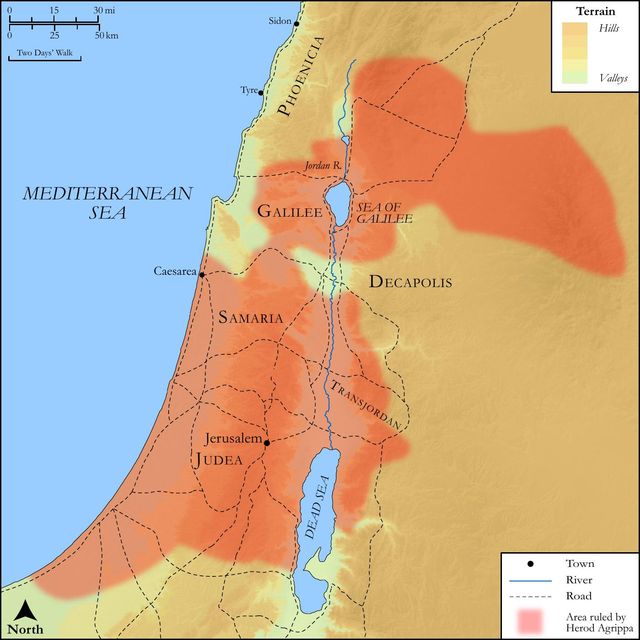
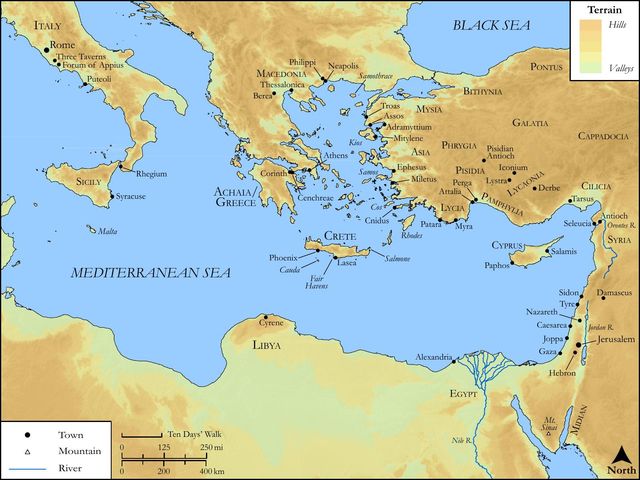
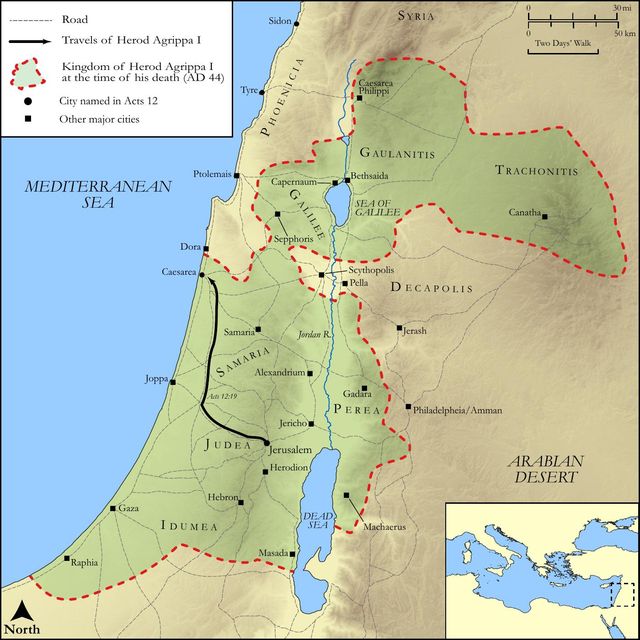
See on the biblical-era maps
Study this verse
Public-domain commentary
Matthew Henry
From his Commentary on the Whole Bible. Henry comments on passages, not single verses — this entry covers Acts 12:20–25. His four-level outline is real structure in the source text, so it is rendered as structure.
In these verses we have,
I.The death of Herod.
God reckoned with him, not only for his putting James to death, but for his design and endeavour to put Peter to death; for sinners will be called to an account, not only for the wickedness of their deeds, but for the wickedness of their endeavours (Psa 28:4), for the mischief they have done and the mischief they would have done. It was but a little while that Herod lived after this. Some sinners God makes quick work with. Observe,
1.How the measure of his iniquity was filled up: it was pride that did it; it is this that commonly goes more immediately before destruction, and a haughty spirit before a fall. Nebuchadnezzar had been a very bloody man, and a great persecutor; but the word that was in the king's mouth when the judgments of God fell upon him was a proud word: Is not this great Babylon that I have built? Dan 4:30, Dan 4:31. It is the glory of God to look on every one that is proud, and bring him low, Job 40:12. The instance of it here is very remarkable, and shows how God resists the proud.
(1.)The men of Tyre and Sidon had, it seems, offended Herod. Those cities were now under the Roman yoke, and they had been guilty of some misdemeanours which Herod highly resented, and was resolved they should feel his resentment. Some very small matter would serve such a proud imperious man as Herod was for a provocation, where he was disposed to pick a quarrel. He was highly displeased with this people, and they must be made to know that his wrath was as the roaring of a lion, as messengers of death.
(2.)The offenders truckled, being convinced, if not that they had done amiss, yet that it was in vain to contend with such a potent adversary, who, right or wrong, would be too hard for them; they submitted and were willing upon any terms to make peace with him. Observe,
[1.]The reason why they were desirous to have the matter accommodated: Because their country was nourished by the king's country. Tyre and Sidon were trading cities, and had little land belonging to them, but were always supplied with corn from the land of Canaan; Judah and Israel traded in their market, with wheat, and honey, and oil, Eze 27:17. Now if Herod should make a law to prohibit the exportation of corn to Tyre and Sidon (which they knew not but a man so revengeful as he might soon do, not caring how many were famished by it), their country would be undone; so that it was their interest to keep in with him. And is it not then our wisdom to make our peace with God, and humble ourselves before him, who have a much more constant and necessary dependence upon him than one country can have upon another? for in him we live, and move, and have our being.
[2.]The method they took to prevent a rupture: They made Blastus the king's chamberlain their friend, probably with bribes and good presents; that is usually the way for men to make courtiers their friends. And it is the hard fate of princes that they must have not only their affairs, but their affections too, governed by such mercenary tools; yet such men as Herod, that will not be governed by reason, had better be so governed than by pride and passion. Blastus had Herod's ear, and has the art of mollifying his resentments; and a time is fixed for the ambassadors of Tyre and Sidon to come and make a public submission, to beg his majesty's pardon, throw themselves upon his clemency, and promise never again to offend in the like manner; and that which will thus feed his pride shall serve to cool his passion.
(3.)Herod appeared in all the pomp and grandeur he had: He was arrayed in his royal apparel (Act 12:21), and sat upon his throne. Josephus gives an account of this splendid appearance which Herod made upon this occasion - Antiq. 19.344. He says that Herod at this time wore a robe of cloth of silver, so richly woven, and framed with such art, that when the sun shone it reflected the light with such a lustre as dazzled the eyes of the spectators, and struck an awe upon them. Foolish people value men by their outward appearance; and no better are those who value themselves by the esteem of such, who court it, and recommend themselves to it as Herod did, who thought to make up the want of a royal heart with his royal apparel; and sat upon his throne, as if that gave him a privilege to trample upon all about him as his footstool.
(4.)He made a speech to the men of Tyre and Sidon, a fine oration, in which, probably, after he had aggravated their fault, and commended their submission, he concluded with an assurance that he would pass by their offence and receive them into his favour again - proud enough that he had it in his power whom he would to keep alive, as well as whom he would to slay; and probably he kept them in suspense as to what their doom should be, till he made this oration to them, that the act of grace might come to them with the more pleasing surprise.
(5.)The people applauded him, the people that had a dependence upon him, and had benefit by his favour, they gave a shout; and this was what they shouted, It is the voice of a god, and not of a man, Act 12:22. God is great and good, and they thought such was Herod's greatness in his apparel and throne, and such his goodness in forgiving them, that he was worthy to be called no less than a god; and perhaps his speech was delivered with such an air of majesty, and a mixture of clemency with it, as affected the auditors thus. Or, it may be, it was not from any real impression made upon their minds, or any high or good thoughts they had indeed conceived of him; but, how meanly soever they thought of him, they were resolved thus to curry favour with him, and strengthen the new-made peace between him and them. Thus great men are made an easy prey to flatterers if they lend an ear to them, and encourage them. Grotius here observes that, though magistrates are called gods (Psa 82:1), yet kings or monarchs, that is, single persons, are not, lest countenance should thereby be given to the Gentiles, who gave divine honours to their kings alive and dead, as here; but they are a college of senators, or a bench of judges, that are called gods - In collegio toto senatorum non idem erat periculi; itaque eos, non autem reges, invenimus dictos elohim. Those that live by sense vilify God, as if he were altogether such a one as themselves, and deify men, as if they were gods; having their persons in admiration, because of advantage. This is not only a great affront to God, giving that glory to others which is due to him alone, but a great injury to those who are thus flattered, as it makes them forget themselves, and so puffs them up with pride that they are in the utmost danger possible of falling into the condemnation of the devil.
(6.)These undue praises he took to himself, pleased himself with them, and prided himself in them; and this was his sin. We do not find that he had given any private orders to his confidants to begin such a shout, or to put those words into the mouths of the people, nor that he returned them thanks for the compliment and undertook to answer their opinion of him. But his fault was that he said nothing, did not rebuke their flattery, nor disown the title they had given him, nor give God the glory (Act 12:23); but he took it to himself, was very willing it should terminate in himself, and that he should be thought a god and have divine honours paid him. Si populus vult decipi, decipiatur - if the people will be deceived, let them. And it was worse in him who was a Jew, and professed to believe in one God only, than it was in the heathen emperors, who had gods many and lords many.
2.How his iniquity was punished: Immediately (Act 12:23) the angel of the Lord smote him (by the order of Christ, for to him all judgment is committed), because he gave not God the glory (for God is jealous for his own honour, and will be glorified upon those whom he is not glorified by); and he was eaten of worms above ground, and gave up the ghost. Now he was reckoned with for vexing the church of Christ, killing James, imprisoning Peter, and all the other mischiefs he had done. Observe in the destruction of Herod,
(1.)It was no less than an angel that was the agent - the angel of the Lord, that angel that was ordered and commissioned to do it, or that angel that used to be employed in works of this nature, the destroying angel: or the angel, that is, that angel that delivered Peter in the former part of the chapter - that angel smote Herod. For those ministering spirits are the ministers either of divine justice or of divine mercy, as God is pleased to employ them. The angel smote him with a sore disease just at that instant when he was strutting at the applauses of the people, and adoring his own shadow. Thus the king of Tyre said in his pride, I am a god, I sit in the seat of God; and set his heart as the heart of God; but he shall be a man, and no God, a weak mortal man, in the hand of him that slayeth him (Eze 28:2-9), so Herod here. Potent princes must know, not only that God is omnipotent, but that angels also are greater in power and might than they. The angel smote him, because he gave not the glory to God; angels are jealous for God's honour, and as soon as ever they have commission are ready to smite those that usurp his prerogatives, and rob God of his honour.
(2.)It was no more than a worm that was the instrument of Herod's destruction: He was eaten of worms, genomenos skōlēkobrōtos - he became worm-eaten, so it must be read; rotten he was, and he became like a piece of rotten wood. The body in the grave is destroyed by worms, but Herod's body putrefied while he was yet alive, and bred the worms which began to feed upon it betimes; so Antiochum, that great persecutor, died. See here,
[1.]What vile bodies those are which we carry about with us; they carry about with them the seeds of their own dissolution, by which they will soon be destroyed whenever God does but speak the word. Surprising discoveries have of late been made by microscopes of the multitude of worms that there are in human bodies, and how much they contribute to the diseases of them, which is a good reason why we should not be proud of our bodies, or of any of their accomplishments, and why we should not pamper our bodies, for this is but feeding the worms, and feeding them for the worms.
[2.]See what weak and contemptible creatures God can make the instruments of his justice, when he pleases. Pharaoh is plagued with lice and flies, Ephraim consumed as with a moth, and Herod eaten with worms.
[3.]See how God delights not only to bring down proud men, but to bring them down in such a way as is most mortifying, and pours most contempt upon them. Herod is not only destroyed, but destroyed by worms, that the pride of his glory may be effectually stained. This story of the death of Herod is particularly related by Josephus, a Jew, Antiq. 19.343-350: "That Herod came down to Cesarea, to celebrate a festival in honour of Caesar; that the second day of the festival he went in the morning to the theatre, clothed with that splendid robe mentioned before; that his flatterers saluted him as a god, begged that he would be propitious to them; that hitherto they had reverenced him as a man, but now they would confess to be in him something more excellent than a mortal nature. That he did not refuse nor correct this impious flattery (so the historian expresses it); But, presently after, looking up, he saw an owl perched over his head, and was at the same instant seized with a most violent pain in his bowels, and gripes in his belly, which were exquisite from the very first; that he turned his eyes upon his friends, and said to this purpose: 'Now I, whom you called a god, and therefore immortal, must be proved a man, and mortal.' That his torture continued without intermission, or the least abatement, and then he died in the fifty-fourth year of his age, when he had been king seven years."
II.The progress of the gospel after this.
1.The word of God grew and multiplied, as seed sown, which comes up with a great increase, thirty, sixty, a hundred fold; wherever the gospel was preached, multitudes embraced it, and were added to the church by it, Act 12:24. After the death of James, the word of God grew; for the church, the more it was afflicted, the more it multiplied, like Israel in Egypt. The courage and comfort of the martyrs, and God's owning them, did more to invite people to Christianity, than their sufferings did to deter them from it. After the death of Herod the word of God gained ground. When such a persecutor was taken off by a dreadful judgment, many were thereby convinced that the cause of Christianity was doubtless the cause of Christ, and therefore embraced it.
2.Barnabas and Saul returned to Antioch as soon as they had despatched the business they were sent upon: When they had fulfilled their ministry, had paid in their money to the proper persons, and taken care about the due distribution of it to those for whom it was collected, they returned from Jerusalem. Though they had a great many friends there, yet at present their work lay at Antioch; and where our business is there we should be, and no longer from it than is requisite. When a minister is called abroad upon any service, when he has fulfilled that ministry, he ought to remember that he has work to do at home, which wants him there and calls him thither. Barnabas and Saul, when they went to Antioch, took with them John, whose surname was Mark, at whose mother's house they had that meeting for prayer which we read of Act 12:12. She was sister to Barnabas. It is probable that Barnabas lodged there, and perhaps Paul with him, while they were at Jerusalem, and it was that that occasioned the meeting there at that time (for wherever Paul was he would have some good work doing), and their intimacy in that family while they were at Jerusalem occasioned their taking a son of that family with them when they returned, to be trained up under them, and employed by them, in the service of the gospel. Educating young men for the ministry, and entering them into it, is a very good work for elder ministers to take care of, and of good service to the rising generation.
Historical interpretation
Historical reception
1 surviving comment on this verse from the historical church.
"And the word of God," it says, "grew," i.e. in consequence of this, "and multiplied." Do you mark God's providential management? A great refreshing granted to them, and the numberless benefits accruing from the vengeance inflicted upon him.
Continue studying Acts 12:24 across the web’s major study libraries — every link below opens this exact verse, chapter, or book on the destination site.
Read & Compare
 BibleGatewayThis verse in more than 200 translations and 70 languages.
 Bible.comThe YouVersion reader — hundreds of translations, reading plans, and highlights.
 ESV.orgCrossway's official English Standard Version reader.
 NET BibleThe NET translation with 60,000+ translators' notes on every rendering decision.
 STEP BibleTyndale House's free study tool — original text, vocabulary, and scholarly resources.
 BibliaLogos Bible Software's free web reader.
 USCCBThe New American Bible (Revised Edition) with the U.S. bishops' study notes.
Commentaries
 BibleHub CommentariesDozens of classic commentaries on this verse, gathered on one page.
 StudyLightMore than 100 commentary sets — the largest collection on the web.
 BibleRefPlain-English commentary on what this verse means, verse by verse.
 Enduring WordDavid Guzik's free commentary on this chapter, widely used by Bible teachers.
 Bible Study ToolsVerse commentary alongside Greek and Hebrew study aids.
Original Language & Research
- BibleHub InterlinearThe verse word by word — original language, transliteration, and English.
- BibleHub LexiconEvery word's original-language definition and Strong's entry.
 Blue Letter BibleDeep-study tools — Strong's numbers, concordance, and word studies.
 CNTR CollationThe earliest Greek manuscripts of this verse, collated letter by letter.
Sermons, Hymns & Audio


TrulyRandomVerse is not affiliated with these sites and doesn’t control their content. They’re linked because they’re genuinely useful.
Summary
Acts 12:24 serves as a powerful theological summary, standing in stark contrast to the preceding narrative of King Herod Agrippa I's persecution and subsequent divine judgment. This pivotal verse declares that despite the fierce opposition from human authorities, the "word of God"—representing the Gospel message and the burgeoning Christian movement—not only survived but experienced dynamic, organic growth and quantitative expansion, underscoring God's unstoppable sovereignty over human resistance and the flourishing of His kingdom.
Context
ShowHideLiterary Context
Acts 12:24 provides a dramatic theological counterpoint to the events of Acts 12:1-23. The preceding verses detail King Herod Agrippa I's severe persecution of the early church, including the execution of James, the brother of John (Acts 12:2), and the imprisonment of Peter, from which he was miraculously delivered (Acts 12:3-19). The climax of this narrative is Herod's public demise, struck down by an angel of the Lord for accepting divine homage from the people (Acts 12:20-23). The conjunction "But" (G1161, dé) at the beginning of verse 24 powerfully juxtaposes the fall of human power with the enduring triumph of God's divine purpose. It functions as a declarative statement, signaling a shift from the earthly machinations of a persecuting king to the unstoppable, supernatural progress of the Gospel.
Historical & Cultural Context
King Herod Agrippa I, grandson of Herod the Great, ruled Judea from A.D. 41-44. He was known for his efforts to appease his Jewish subjects, which included persecuting the nascent Christian movement, seen by many as a deviant sect within Judaism. His acceptance of the title "god" from the people of Tyre and Sidon, as described in Acts 12:22, was an act of profound hubris and blasphemy in the monotheistic Jewish context, leading to his swift and dramatic judgment. The concept of divine retribution for such acts was well understood among Jews and Gentiles alike, and Luke's account would have resonated with both audiences as a clear demonstration of divine justice. This historical backdrop highlights the immense pressure the early church faced and the miraculous nature of its continued expansion despite imperial and religious opposition.
Key Themes
ShowHideThis verse powerfully reinforces several overarching themes found throughout the Book of Acts. Firstly, it underscores Divine Sovereignty and Triumph, demonstrating that no human authority, regardless of its power or malicious intent, can ultimately thwart God's eternal plan. The demise of Herod serves as a vivid illustration that God is supreme, and His purposes will prevail, even in the face of intense persecution, as seen earlier when the church was scattered after Stephen's martyrdom, yet the Word continued to spread (Acts 8:1-4). Secondly, it functions as a Progress Report on the Growth of the Early Church, a recurring literary device in Acts that emphasizes the dynamic expansion of the Christian movement. Similar statements are found elsewhere, such as when the number of disciples multiplied greatly in Jerusalem (Acts 6:7) and when the word of the Lord grew mightily and prevailed in Ephesus (Acts 19:20). Finally, it highlights The Inherent Power of God's Word. The "word of God" (G3056, lógos) refers to the Gospel message—the authoritative revelation about Jesus Christ and His kingdom. It is not merely human speech but a living, active, and transformative force, capable of discerning thoughts and intentions (Hebrews 4:12), bringing about spiritual regeneration and numerical increase.
Exposition and Analysis
ShowHideKey Word Analysis
ShowHideFrom λέγω (legō), meaning "to say." This term signifies something said, including the thought, a topic, reasoning, or motive. In a theological context, especially with the article (as implied here, "the word of God"), it refers to the Divine Expression. Here, it encompasses the Gospel message, the teachings of Christ, and the authoritative revelation from God being proclaimed by the apostles. It is the active agent of God's communication and kingdom expansion.
A prolonged form of a primary verb, meaning "to grow" or "to wax," i.e., to enlarge. This verb suggests an organic, vital, and internal increase, much like a plant growing naturally. It implies a qualitative deepening and strengthening of the Christian faith and community, an internal vitality that cannot be suppressed.
From another form of πλῆθος (plēthos), meaning "a great number." This verb means "to increase" (transitively or intransitively) or "to multiply." It specifically denotes quantitative growth, indicating the rapid increase in the number of believers and the geographical spread of the Gospel message. Together with "grew," it paints a comprehensive picture of both internal spiritual vitality and external numerical expansion.
Verse Breakdown
ShowHide"But the word of God"
This opening phrase, introduced by the adversative conjunction "But," creates a stark contrast with the preceding account of Herod's demise. "The word of God" (ὁ λόγος τοῦ θεοῦ) is presented as the enduring, active, and unstoppable force. It refers not merely to a written text but to the living, dynamic message of the Gospel, the authoritative truth about Jesus Christ and His kingdom, being proclaimed and lived out by the early church. It is God's own message, carrying His divine power and authority.
"grew and multiplied"
These two verbs describe the dual nature of the Gospel's advancement. "Grew" (ηὔξανεν, imperfect tense of auxánō) suggests a continuous, organic, and qualitative increase in depth, understanding, and influence, like a seed taking root and developing. "Multiplied" (ἐπληθύνετο, imperfect passive of plēthýnō) indicates a continuous, quantitative increase in numbers—more people believing, more disciples being added, and the message spreading to more places. This phrase powerfully conveys the unstoppable, divinely orchestrated expansion of the Christian movement, demonstrating that God's work is not dependent on human favor but proceeds by His own power.
Literary Devices
ShowHideLuke masterfully employs several literary devices in Acts 12:24 to underscore its profound theological message. The most prominent is Contrast, as the verse immediately follows the dramatic account of King Herod Agrippa I's death. Herod, a powerful human persecutor, is struck down and consumed, while in stark opposition, the "word of God" flourishes. This juxtaposition highlights the transient nature of human power versus the eternal, unstoppable power of God's kingdom. Personification is also evident, as the abstract "word of God" is depicted with the active qualities of growth and multiplication, as if it were a living entity. This imbues the Gospel message with an inherent vitality and agency, emphasizing that its expansion is not merely a human endeavor but a divine work. Furthermore, Metonymy is at play, where "the word of God" stands in for the entire Christian movement, including the community of believers, their teachings, and their mission. The growth of the Word thus signifies the growth of the church and the spread of the Gospel throughout the world.
Theological and Thematic Connections
ShowHideActs 12:24 is a profound theological statement affirming God's ultimate sovereignty and the inherent vitality of His revealed truth. It teaches us that no human opposition, no matter how powerful or violent, can ultimately thwart God's purposes or suppress the spread of His kingdom. The "word of God" is presented as a living, active force that possesses its own internal power to grow and expand, independent of human efforts or resistance. This growth is both qualitative (deepening of faith and understanding) and quantitative (numerical increase of believers and geographical spread). It underscores the divine origin and unstoppable nature of the Gospel, providing immense encouragement that God's plan for redemption will always prevail.
Reflection and Application
ShowHideActs 12:24 offers timeless encouragement and a clear call to action for believers today. In a world where the church often faces various forms of opposition, skepticism, or apathy, this verse serves as a powerful reminder that the ultimate success of the Gospel does not depend on our strategies, resources, or political climate, but on the inherent power of God's Word itself. We are called to faithfully proclaim and embody this Word, trusting that God Himself will bring the increase. This truth should embolden us to share our faith without fear, knowing that the message we carry is not merely human opinion but the living, transforming truth of God. It encourages resilience in the face of adversity, reminding us that even when human powers rise against the church, God's kingdom continues its unstoppable advance, growing both in depth of faith among believers and in numerical reach across the globe. Our role is to be faithful conduits, allowing the Word to flow through us and bear fruit.
Questions for Reflection
ShowHideFAQ
ShowHideWhat does "the word of God" specifically refer to in this context?
ShowHideIn Acts 12:24, "the word of God" (Greek: ho lógos tou theoú) primarily refers to the Gospel message—the good news about Jesus Christ, His life, death, resurrection, and the salvation offered through Him. It encompasses the apostolic preaching, the teachings of Jesus, and the authoritative revelation from God that was being proclaimed and embraced by the early Christian community. It's not just a set of doctrines, but a living, dynamic message that carries God's power to transform lives and establish His kingdom. This "word" is the very instrument through which God's purposes are accomplished, as seen in the growth of the church throughout the Book of Acts, such as when Peter preached and three thousand were added.
What is the significance of the two verbs "grew" and "multiplied"?
ShowHideThe use of two distinct verbs, "grew" (Greek: auxánō) and "multiplied" (Greek: plēthýnō), is highly significant. "Grew" suggests an organic, qualitative, and internal increase—like a plant maturing and strengthening its roots. This implies a deepening of faith, spiritual maturity, and the internal vitality of the Christian community. "Multiplied," on the other hand, points to a quantitative, numerical increase—more people becoming believers and the message spreading geographically. Together, these verbs convey a comprehensive picture of the church's expansion: it was not just getting bigger, but also stronger and more deeply rooted, a pattern seen consistently in Acts, for example, when the church in Jerusalem experienced both numerical growth and spiritual unity (Acts 4:32-33).
Christ-Centered Fulfillment
ShowHideActs 12:24, declaring the unstoppable growth of "the word of God," finds its ultimate Christ-centered fulfillment in Jesus Himself, who is uniquely identified as "the Word" (Greek: ho Lógos) in the New Testament. John's Gospel opens by proclaiming, "In the beginning was the Word, and the Word was with God, and the Word was God." This Word, who "became flesh and dwelt among us" (John 1:14), is Jesus Christ. Therefore, the growth and multiplication of "the word of God" in Acts is fundamentally the expansion of Christ's kingdom and the spread of His redemptive work. The message that "grew and multiplied" was precisely the good news about Jesus—His life, death, resurrection, and ascension—and the call to follow Him. As the living Word, Christ is the source and substance of the Gospel. His Great Commission to "make disciples of all nations" ensures that His "word" will continue to grow and multiply until His return, demonstrating His ongoing sovereignty and the irresistible power of His presence through the Holy Spirit in the world. The flourishing of the early church, despite persecution, is a testament to the fact that the living Word, Jesus Christ, is indeed building His church, and "the gates of hell shall not prevail against it."