


Acts 12:2
- ἀνεῖλενaneilenHe executedG337V-2AAI-3SVerb 2nd Aorist Active Indicative 3rd Singular
- δὲdethenG1161CONJConjunction
- ἸάκωβονIakōbonJamesG2385N-ASM-PNoun Accusative Singular Masculine Individual
- τὸνtontheG3588T-ASMDefinite article Accusative Singular Masculine
- ἀδελφὸνadelphonbrotherG80N-ASMNoun Accusative Singular Masculine
- ἸωάννουIōannouof JohnG2491N-GSM-PNoun Genitive Singular Masculine Individual
- μαχαίρῃmachairēwith the swordG3162N-DSFNoun Dative Singular Feminine
English is a literal word-by-word gloss of the Greek, not the KJV's wording. Why?
This is the original text the KJV's translators worked from — each Greek word with its own literal English meaning in this verse, prepared by scholars at Tyndale House, Cambridge. The KJV translates whole sentences, not word by word, so its wording differs: one Greek word can become several English words, and the KJV may choose “charity” where the gloss reads “love”. Both are faithful — they answer different questions. For the KJV's own rendering, switch to the KJV text.
Details
See on the biblical-era map
Study this verse
Public-domain commentary
Matthew Henry
From his Commentary on the Whole Bible. Henry comments on passages, not single verses — this entry covers Acts 12:1–4. His three-level outline is real structure in the source text, so it is rendered as structure.
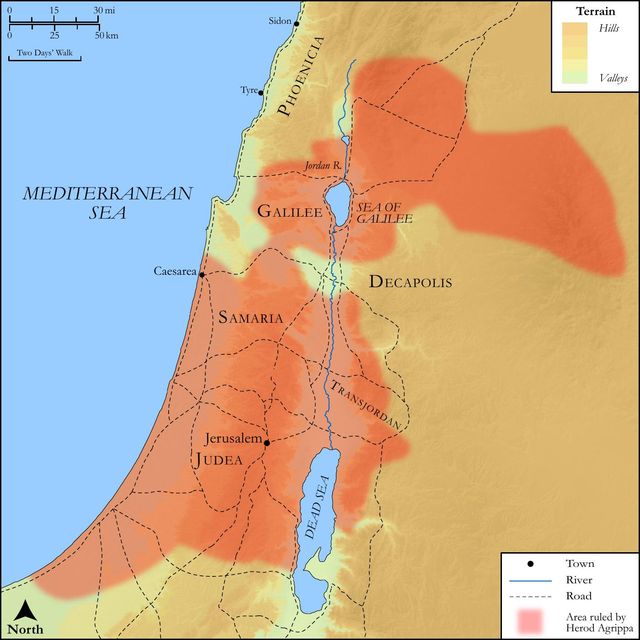
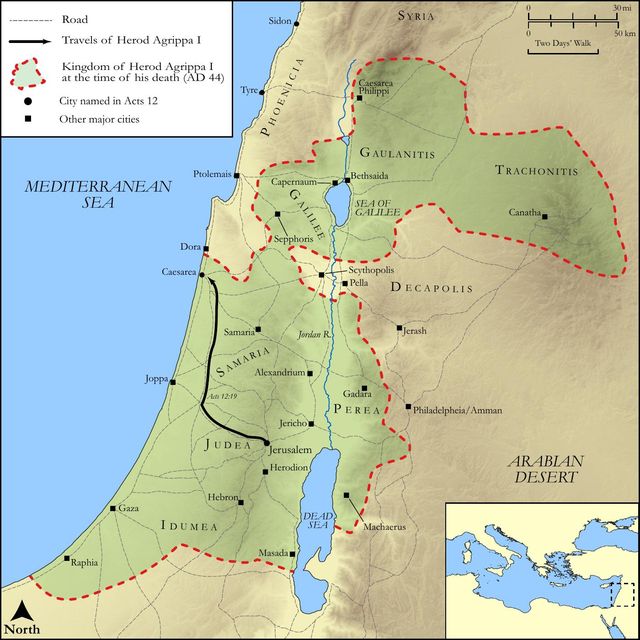
Ever since the conversion of Paul, we have heard no more of the agency of the priests in persecuting the saints at Jerusalem; perhaps that wonderful change wrought upon him, and the disappointment it gave to their design upon the Christians at Damascus, had somewhat mollified them, and brought them under the check of Gamaliel's advice - to let those men alone, and see what would be the issue; but here the storm arises from another point. The civil power, not now, as usual (for aught that appears) stirred up by the ecclesiastics, acts by itself in the persecution. But Herod, though originally of an Edomite family, yet seems to have been a proselyte to the Jewish religion; for Josephus says he was zealous for the Mosaic rites, a bigot for the ceremonies. He was not only (as Herod Antipas was) tetrarch of Galilee, but had also the government of Judea committed to him by Claudius the emperor, and resided most at Jerusalem, where he was at this time. Three things we are here told he did -
I.He stretched forth his hands to vex certain of the church, Act 12:1.
His stretching forth his hands to it intimates that his hands had been tied up by the restraints which perhaps his own conscience held him under in this matter; but now he broke through them, and stretched forth his hands deliberately, and of malice prepense. Herod laid hands upon some of the church to afflict them, so some read it; he employed his officers to seize them, and take them into custody, in order to their being prosecuted. See how he advances gradually.
1.He began with some of the members of the church, certain of them that were of less note and figure; played first at small game, but afterwards flew at the apostles themselves. His spite was at the church, and, with regard to those he gave trouble to, it was not upon any other account, but because they belonged to the church, and so belonged to Christ.
2.He began with vexing them only, or afflicting them, imprisoning them, fining them, spoiling their houses and goods, and other ways molesting them; but afterwards he proceeded to greater instances of cruelty. Christ's suffering servants are thus trained up by less troubles for greater, that tribulation may work patience, and patience experience.
II.He killed James the brother of John with the sword, Act 12:2. We are here to consider,
1.Who the martyr was: it was James the brother of John; so called to distinguish him from the other James the brother of Joses. This was called Jacobus major - James the greater; that, minor - the less. This who was here crowned with martyrdom was one of the first three of Christ's disciples, one of those that were the witnesses of his transfiguration and agony, whereby he was prepared for martyrdom; he was one of those whom Christ called Boanerges - Sons of thunder; and perhaps by his powerful awakening preaching he had provoked Herod, or those about him, as John Baptist did the other Herod, and that was the occasion of his coming into this trouble. He was one of those sons of Zebedee whom Christ told that they should drink of the cup that he was to drink of, and be baptized with the baptism that he was to be baptized with, Mat 20:23. And now those words of Christ were made good in him; but it was in order to his sitting at Christ's right hand; for if we suffer with him, we shall reign with him. He was one of the twelve who were commissioned to disciple all nations; and to take him off now, before he had removed from Jerusalem, was like Cain's killing Abel when the world was to be peopled, and one man was then more than many at another time. To kill an apostle now was killing he knew not how many. But why would God permit it? If the blood of his saints, much more the blood of apostles, is precious in his eyes, and therefore, we may be sure, is not shed but upon a valuable consideration. Perhaps God intended hereby to awaken the rest of the apostles to disperse themselves among the nations, and not to nestle any longer at Jerusalem. Or it was to show that though the apostles were appointed to plant the gospel in the world, yet if they were taken off God could do his work without them, and would do it. The apostle died a martyr, to show the rest of them what they must expect, that they might prepare accordingly. The tradition that they have in the Romish church, that this James had been before this in Spain, and had planted the gospel there, is altogether groundless; nor is there any certainty of it, or good authority for it.
2.What kind of death he suffered: He was slain with the sword, that is, his head was cut off with a sword, which was looked upon by the Romans to be a more disgraceful way of being beheaded than with an axe; so Lorinus. Beheading was not ordinarily used among the Jews; but, when kings gave verbal orders for private and sudden executions, this manner of death was used, as most expeditious; and it is probable that this Herod killed James, as the other Herod killed John Baptist, privately in the prison. It is strange that we have not a more full and particular account of the martyrdom of this great apostle, as we had of Stephen. But even this short mention of the thing is sufficient to let us know that the first preachers of the gospel were so well assured of the truth of it that they sealed it with their blood, and thereby have encouraged us, if at any time we are called to it, to resist unto blood too. The Old Testament martyrs were slain with the sword (Heb 11:37), and Christ came not to send peace, but a sword (Mat 10:34), in preparation for which we must arm ourselves with the sword of the Spirit, which is the word of God, and then we need not fear what the sword of men can do unto us.
III.He imprisoned Peter, of whom he had heard most, as making the greatest figure among the apostles and whom therefore he would be proud of the honour of taking off. Observe here,
1.When he had beheaded James, he proceeded further, he added, to take Peter also. Note, Blood to the blood-thirsty does but make them more so, and the way of persecution, as of other sins, is downhill; when men are in it, they cannot easily stop themselves; when they are in they find they must on. Male facta male factis tegere ne perpluant - One evil deed is covered with another, so that there is no passage through them. Those that take one bold step in a sinful way give Satan advantage against them to tempt them to take another, and provoke God to leave them to themselves, to go from bad to worse. It is therefore our wisdom to take heed of the beginnings of sin.
2.He did this because he saw it pleased the Jews. Observe, The Jews made themselves guilty of the blood of James by showing themselves well pleased with it afterwards, though they had not excited Herod to it. There are accessaries ex post facto - after the fact; and those will be reckoned with as persecutors who take pleasure in others' persecuting, who delight to see good men ill used, and cry, Aha, so would we have it, or at least secretly approve of it. For bloody persecutors, when they perceive themselves applauded for that which every one ought to cry shame upon them for, are encouraged to go on, and have their hands strengthened and their hearts hardened, and the checks of their own consciences smothered; nay, it is as strong a temptation to them to do the like as it was here to Herod, because he saw it pleased the Jews. Though he had no reason to fear displeasing them if he did not, as Pilate condemned Christ, yet he hoped to please them by doing it, and so to make an interest among them, and make amends for displeasing them in something else. Note, Those make themselves an easy prey to Satan who make it their business to please men.
3.Notice is taken of the time when Herod laid hold on Peter: Then were the days of unleavened bread. It was at the feast of the passover, when their celebrating the memorial of their typical deliverance should have led them to the acceptance of their spiritual deliverance; instead of this, they, under pretence of zeal for the law, were most violently fighting against it, and, in the days of unleavened bread, were most soured and embittered with the old leaven of malice and wickedness. At the passover, when the Jews came from all parts to Jerusalem to keep the feast, they irritated one another against the Christians and Christianity, and were then more violent than at other times.
4.Here is an account of Peter's imprisonment (Act 12:4): When he had laid hands on him, and, it is likely, examined him, he put him in prison, into the inner prison; some say, into the same prison into which he and the other apostles were cast some years before, and were rescued out of it by an angel, Act 5:18. He was delivered to four quaternions of soldiers, that is, to sixteen, who were to be a guard upon him, four at a time, that he should not make his escape, nor be rescued by his friends. Thus they thought they had him fast.
5.Herod's design was, after Easter, to bring him forth unto the people.
(1.)He would make a spectacle of him. Probably he had put James to death privately, which the people had complained of, not because it was an unjust thing to put a man to death without giving him a public hearing, but because it deprived them of the satisfaction of seeing him executed; and therefore Herod, now he knows their minds, will gratify them with the sight of Peter in bonds, of Peter upon the block, that they may feed their eyes with such a pleasing spectacle. And very ambitious surely he was to please the people who was willing thus to please them!
(2.)He would do this after Easter, meta to pascha - after the passover, certainly so it ought to be read, for it is the same word that is always so rendered; and to insinuate the introducing of a gospel-feast, instead of the passover, when we have nothing in the New Testament of such a thing, is to mingle Judaism with our Christianity. Herod would not condemn him till the passover was over, some think, for fear lest he should have such an interest among the people that they should demand the release of him, according to the custom of the feast: or, after the hurry of the feast was over, and the town was empty, he would entertain them with Peter's public trial and execution. Thus was the plot laid, and both Herod and the people long to have the feast over, that they may gratify themselves with this barbarous entertainment.
Historical interpretation
Five Centuries of Reception
5 surviving comments on this verse. Each one is dated, so this reads as a timeline rather than a list.
Select a marker to jump to its quote. Markers stagger vertically where authors wrote within a few decades of each other.
That Peter is struck, that Stephen is overwhelmed by stones, that James is slain as is a victim at the altar, that Paul is beheaded has been written in their own blood.
James, under pressure to cut off Christ, his true head, was [physically] decapitated, yet the [true] head of every person is Christ according to the apostle and at the same time the head of the entire church.
"At that time," of course meaning the time immediately following: for this is the custom of Scripture. And he well says that Herod "the king" (did this): this was not he of Christ's time. Lo, a different sort of trial - and mark what I said in the beginning, how things are blended, how rest and trouble alternate in the whole texture of the history - not now the Jews, nor the Sanhedrim, but the king. Greater the power, the warfare more severe, the more it was done to obtain favor with the Jews. And he slew James the brother of John with the sword: taking him at random and without selection. But, should any raise a question, why God permitted this, we shall say, that it was for the sake of these Jews themselves: thereby, first, convincing them, that even when slain the Apostles prevail, just as it was in the case of Stephen: secondly, giving them opportunity, after satiating their rage, to recover from their madness; thirdly, showing them that it was by His permission this was done.
Like a wild beast, he attacked all indiscriminately and without consideration. This is what Christ said: "My cup indeed ye shall drink, and with the baptism wherewith I am baptized, shall ye be baptized." And he killed James the brother of John. For there was also another James, the brother of the Lord: therefore to distinguish him, he says, "The brother of John." Do you mark that the sum of affairs rested in these three, especially Peter and James?
He killed James, the brother of John, with the sword. Clement of Alexandria reports a certain story about this James, which is worth remembering. And he (Clement says) who had brought him to the judge for martyrdom (namely James), was also moved and confessed himself to be a Christian. They were both led together to punishment. And as they were being led on the road, he asked James to grant him forgiveness. But James, after hesitating a little, said, "Peace be with you." And he kissed him. And thus they were both beheaded together.
Continue studying Acts 12:2 across the web’s major study libraries — every link below opens this exact verse, chapter, or book on the destination site.
Read & Compare
 BibleGatewayThis verse in more than 200 translations and 70 languages.
 Bible.comThe YouVersion reader — hundreds of translations, reading plans, and highlights.
 ESV.orgCrossway's official English Standard Version reader.
 NET BibleThe NET translation with 60,000+ translators' notes on every rendering decision.
 STEP BibleTyndale House's free study tool — original text, vocabulary, and scholarly resources.
 BibliaLogos Bible Software's free web reader.
 USCCBThe New American Bible (Revised Edition) with the U.S. bishops' study notes.
Commentaries
 BibleHub CommentariesDozens of classic commentaries on this verse, gathered on one page.
 StudyLightMore than 100 commentary sets — the largest collection on the web.
 BibleRefPlain-English commentary on what this verse means, verse by verse.
 Enduring WordDavid Guzik's free commentary on this chapter, widely used by Bible teachers.
 Bible Study ToolsVerse commentary alongside Greek and Hebrew study aids.
Original Language & Research
- BibleHub InterlinearThe verse word by word — original language, transliteration, and English.
- BibleHub LexiconEvery word's original-language definition and Strong's entry.
 Blue Letter BibleDeep-study tools — Strong's numbers, concordance, and word studies.
 CNTR CollationThe earliest Greek manuscripts of this verse, collated letter by letter.
Sermons, Hymns & Audio


TrulyRandomVerse is not affiliated with these sites and doesn’t control their content. They’re linked because they’re genuinely useful.
Summary
Acts 12:2 records the brutal execution of James, the brother of John, by King Herod Agrippa I. This terse statement marks a somber turning point in the early church's history, highlighting the escalating persecution faced by believers and the severe cost of discipleship. James, one of Jesus' closest apostles, became the first among the Twelve to suffer martyrdom, serving as a stark testament to the unwavering faith of the nascent Christian community in the face of state-sanctioned violence.
Context
ShowHideLiterary Context
This verse immediately follows Acts 12:1, which introduces King Herod Agrippa I's deliberate campaign of persecution against the burgeoning Christian community. Luke, the author of Acts, presents James's martyrdom as the first act of this new wave of hostility, setting a grim tone before contrasting it with Peter's miraculous deliverance later in the chapter (Acts 12:7-11). The abruptness of James's death underscores the sudden and severe nature of the opposition, serving as a literary device to heighten the drama and emphasize God's sovereign hand in Peter's subsequent escape.
Historical & Cultural Context
Herod Agrippa I, grandson of Herod the Great, ruled Judea from AD 41-44. Unlike his predecessors, he sought to gain favor with the Jewish populace, particularly the influential religious leaders, by demonstrating his adherence to Jewish customs and by persecuting the Christians, whom many Jews viewed as a heretical and blasphemous sect. The execution "with the sword" (likely beheading) was a common Roman method of capital punishment, often reserved for political enemies or those deemed a threat to public order. This public act was intended to intimidate the growing Christian movement and appease the Jewish authorities, reflecting the volatile political and religious climate in Judea during this period.
Key Themes
ShowHideJames's martyrdom contributes significantly to several overarching themes in Acts and the broader New Testament. It powerfully illustrates the theme of Persecution and Suffering, demonstrating the reality of Jesus' warnings to His disciples that they would be hated for His name's sake (John 15:20). It also highlights God's Sovereignty Amidst Adversity, as His purposes are advanced even through the death of His servants, contrasting James's fate with Peter's miraculous escape to show that God's ways are inscrutable but always purposeful. Furthermore, James's death can be seen as a Fulfillment of Prophecy, specifically Jesus' question to James and John about drinking His cup of suffering (Mark 10:38-39).
Exposition and Analysis
ShowHideKey Word Analysis
ShowHideThis verb, G337, means "to take up," but by implication, "to take away violently," "to abolish," or "to murder." In this context, it signifies a deliberate and forceful act of execution, emphasizing the violent nature of James's death. It is not merely a passive dying but an active "putting to death" by an external agent.
The Greek transliteration of the Hebrew name Jacob. This refers to James, the son of Zebedee, and brother of John. He was one of the inner circle of Jesus' disciples, often present at pivotal moments like the Transfiguration (Matthew 17:1-8) and in Gethsemane (Mark 14:32-42). His specific identification here underscores the significance of his martyrdom as a prominent leader of the early church.
Meaning "a knife" or "dirk." Figuratively, it can refer to "war" or "judicial punishment." In this context, it specifies the instrument of execution, indicating a swift and decisive act of capital punishment, most likely beheading, which was a common method of state-sanctioned execution in the Roman world.
Verse Breakdown
ShowHide"And he killed James"
This opening clause immediately identifies the perpetrator (Herod Agrippa I, implied from the preceding verse) and the victim, James. The verb "killed" (anairéō) denotes a violent, deliberate act of execution, leaving no ambiguity about the nature of his death. The terseness of the statement conveys the sudden and brutal reality of the event.
"the brother of John"
This phrase serves to precisely identify which James is being discussed, distinguishing him from James the son of Alphaeus or James the brother of Jesus. It also highlights his close relationship to John, another prominent apostle, and one of the "sons of thunder" (Mark 3:17). This familial connection underscores the impact of his death on the apostolic band.
"with the sword"
This final phrase specifies the method of execution. The "sword" (máchaira) indicates a swift, public, and definitive act of capital punishment, likely beheading. This detail emphasizes the state's authority and its willingness to use lethal force against the burgeoning Christian movement, marking James as a martyr.
Literary Devices
ShowHideThe brevity and starkness of Acts 12:2 employ Conciseness to deliver a powerful impact. Luke's decision to state James's death so plainly, without elaborate description of his suffering, emphasizes the brutal efficiency of Herod's persecution and the suddenness of the loss for the early church. This conciseness also creates a dramatic Contrast with the detailed account of Peter's miraculous escape that immediately follows in the same chapter, highlighting God's sovereign and often mysterious ways in dealing with His servants. Furthermore, the verse serves as a powerful instance of Fulfillment of Prophecy, recalling Jesus' words to James and John about drinking His cup of suffering (Mark 10:39), thereby imbuing James's martyrdom with profound theological significance.
Theological and Thematic Connections
ShowHideThe martyrdom of James serves as a profound theological statement on the nature of discipleship and the reality of living faithfully in a hostile world. It underscores that following Christ may indeed lead to suffering and even death, directly fulfilling Jesus' own warnings to His disciples. Yet, it also implicitly testifies to the enduring power of the Gospel, as the church continued to grow despite such severe persecution. James's death, though tragic, became a powerful witness to the unwavering commitment of the early believers, demonstrating that the ultimate victory belongs to God, not to human oppressors.
Reflection and Application
ShowHideJames's martyrdom in Acts 12:2 offers a sobering yet inspiring call to reflection for believers across generations. It reminds us that faithfulness to Christ may come at a significant personal cost, even in societies where overt persecution is less common. His death challenges us to consider the depth of our own commitment to the Gospel and whether we are prepared to endure hardship for the sake of Christ and His kingdom. Furthermore, the contrast between James's death and Peter's deliverance in the same chapter invites us to trust in God's sovereign wisdom, even when His ways are inscrutable. We are called not to demand a specific outcome for ourselves, but to remain steadfast in faith, knowing that God works all things according to His perfect plan, whether through life or through death. James's legacy is one of unwavering devotion, a testament to the truth that the Gospel cannot be silenced by human opposition.
Questions for Reflection
ShowHideFAQ
ShowHideWhy was James specifically targeted by Herod Agrippa I?
ShowHideJames, as one of Jesus' inner circle (alongside Peter and John), was a prominent leader in the early Christian community in Jerusalem. His brother, John, was also a key figure. Herod Agrippa I, seeking to appease the Jewish religious authorities and gain political favor, likely targeted James because of his high profile and influence among the growing number of Christians. By executing a figure as significant as James, Herod aimed to demonstrate his commitment to suppressing what many Jewish leaders considered a heretical sect, thereby consolidating his power and popularity among the Jewish populace. His death was a calculated political move to intimidate the burgeoning church and satisfy his constituents.
Christ-Centered Fulfillment
ShowHideThe martyrdom of James, though a tragic event, finds profound Christ-centered fulfillment in several ways. Firstly, it directly echoes and fulfills Jesus' own prophecy to James and John, who, with their mother, sought positions of honor in His kingdom. Jesus responded by asking if they could "drink the cup that I drink" and "be baptized with the baptism with which I am baptized" (Mark 10:38-39). James's violent death by the sword is a powerful affirmation that he indeed drank deeply from the cup of suffering for the sake of Christ, participating in the very pattern of self-sacrificial obedience that Jesus Himself exemplified.
Secondly, James's suffering and death point to the ultimate sacrifice of Christ. Jesus, the perfect Lamb of God, willingly laid down His life, enduring the cross and its shame (Hebrews 12:2), not for His own sin, but for the sins of the world. James's martyrdom, like that of countless believers throughout history, is a participation in the suffering of Christ (Philippians 3:10), a testament to the transformative power of the Gospel that enables believers to face death with courage because of the hope of resurrection found in Jesus. Thus, James's death is not merely a historical tragedy but a vivid illustration of the call to take up one's cross and follow Christ (Luke 9:23), finding ultimate victory not in avoiding suffering, but in enduring it for the glory of the One who conquered death itself (1 Corinthians 15:54-57).