


1 Kings 19:10
Bible text: King James Version (1769 Blayney text) · Public domain
Bible text: King James Version with Strong's numbers · Public domain
Bible text: Berean Standard Bible · Public domain
Bible text: American Standard Version (1901) · Public domain
Bible text: World English Bible, Messianic edition · Public domain
Bible text: Geneva Bible (1599) · Public domain
Bible text: Young's Literal Translation · Public domain
- וַיֹּאמֶרvai·yo·Merand he saidH559Conj-w ¦ V-Qal-ConsecImperf-3msVerb Qal Consecutive Imperfect 3rd Singular Masculineוַandיֹּאמֶרhe said
- קַנֹּאka·No'certainly <to be zealous>H7065V-Piel-InfAbsVerb Piel Infinitive Absolute
- קִנֵּאתִיki·Ne·tiI have been zealousH7065V-Piel-Perf-1csVerb Piel Perfect 1st Singular common gender
- לַיהוָהla·Yah·wehfor YahwehH3068Prep-l ¦ N-properNoun Proper TitleלַforיהוָהYahweh
- אֱלֹהֵי'e·lo·Hei[the] God ofH430N-mpcNoun Plural Masculine Construct
- צְבָאוֹתtze·va·'othostsH6635N-fpNoun Plural Feminine Absolute
- כִּיkiforH3588PrtParticle Conditional
- עָזְבוּ'a·ze·Vuthey have forsakenH5800V-Qal-Perf-3cpVerb Qal Perfect 3rd Plural common gender
- בְרִיתְךָve·ri·te·Khayour covenantH1285N-fsc ¦ 2msNoun Singular Feminine Constructבְרִיתְcovenantךָyour
- בְּנֵיbe·Nei[the] people ofH1121N-mpcNoun Plural Masculine Construct
- יִשְׂרָאֵלYis·ra·'ElIsraelH3478N-properNoun Proper Location
- אֶת'et<obj.>H853DirObjMParticle Object Indicator
- מִזְבְּחֹתֶיךָmiz·be·cho·Tei·khayour altarsH4196N-fpc ¦ 2msNoun Plural Feminine Constructמִזְבְּחֹתֶיaltarsךָyour
- הָרָסוּha·Ra·suthey have torn downH2040V-Qal-Perf-3cpVerb Qal Perfect 3rd Plural common gender
- וְאֶתve·'Etand <obj.>H853Conj-w ¦ DirObjMParticle Object Indicatorוְandאֶת<obj.>
- נְבִיאֶיךָne·vi·'Ei·khayour prophetsH5030N-mpc ¦ 2msNoun Plural Masculine Constructנְבִיאֶיprophetsךָyour
- הָרְגוּha·re·Guthey have killedH2026V-Qal-Perf-3cpVerb Qal Perfect 3rd Plural common gender
- בֶחָרֶבve·Cha·revwith the swordH2719Prep-b ¦ N-fsNoun Singular Feminine Absoluteבֶwith theחָרֶבsword
- וָאִוָּתֵרva·'i·va·Terand I am leftH3498Conj-w ¦ V-Niphal-ConsecImperf-1csVerb Niphal Consecutive Imperfect 1st Singular common genderוָandאִוָּתֵרI am left
- אֲנִי'a·NiIH589Pro-1csPronoun Personal 1st Singular common gender
- לְבַדִּיle·va·Dito alone meH905Prep-l ¦ N-msc ¦ 1csNoun Singular Masculine Constructלְtoבַדִּaloneיme
- וַיְבַקְשׁוּvay·vak·Shuand they have soughtH1245Conj-w ¦ V-Piel-ConsecImperf-3mpVerb Piel Consecutive Imperfect 3rd Plural Masculineוַandיְבַקְשׁוּthey have sought
- אֶת'et<obj.>H853DirObjMParticle Object Indicator
- נַפְשִׁיnaf·Shimy lifeH5315N-fsc ¦ 1csNoun Singular Feminine Constructנַפְשִׁlifeיmy
- לְקַחְתָּהּle·kach·Tahto take away itH3947Prep-l ¦ V-Qal-Inf ¦ 3fsVerb Qal Infinitive Constructלְtoקַחְתָּtake awayהּit
English is a literal word-by-word gloss of the Hebrew, not the KJV's wording. Why?
This is the original text the KJV's translators worked from — each Hebrew word with its own literal English meaning in this verse, prepared by scholars at Tyndale House, Cambridge. The KJV translates whole sentences, not word by word, so its wording differs: one Hebrew word can become several English words, and the KJV may choose “the LORD” where the gloss reads “Yahweh”. Both are faithful — they answer different questions. For the KJV's own rendering, switch to the KJV text.
Details
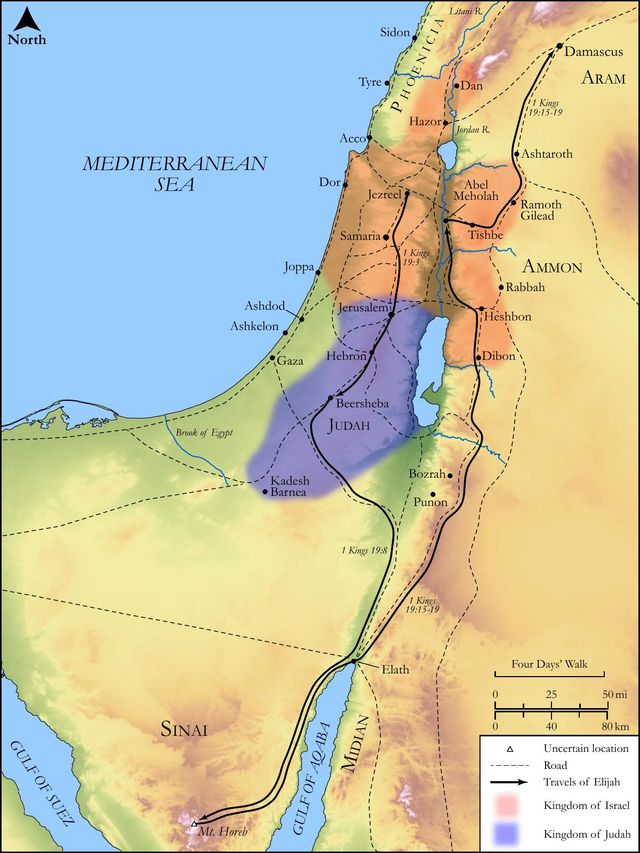
See on the biblical-era maps
Study this verse
Public-domain commentary
Matthew Henry
From his Commentary on the Whole Bible. Henry comments on passages, not single verses — this entry covers 1 Kings 19:9–18. His four-level outline is real structure in the source text, so it is rendered as structure.
Here is, I. Elijah housed in a cave at Mount Horeb, which is called the mount of God, because on it God had formerly manifested his glory. And perhaps this was the same cave, or cleft of a rock, in which Moses was hidden when the Lord passed by before him and proclaimed his name, Exo 33:22. What Elijah proposed to himself in coming to lodge here, I cannot conceive, unless it was to indulge his melancholy, or to satisfy his curiosity and assist his faith and devotion with the sight of that famous place where the law was given and where so many great things were done, and hoping to meet with God himself there, where Moses met with him, or in token of his abandoning his people Israel, who hated to be reformed (in the latter case, it agrees with Jeremiah's wish, Jer 9:2, O that I had in the wilderness a lodging place of wayfaring men, that I might leave my people, and go from them, for they are all adulterers) and so it was a bad omen of God's forsaking them; or it was because the thought he could not be safe any where else, and to this instance of the hardships this good man was reduced to the apostle refers, Heb 11:38. They wandered in deserts and in mountains, and in dens and caves of the earth.
II.The visit God paid to him there and the enquiry he made concerning him:
The word of the Lord came to him. We cannot go any where to be out of the reach of God's eye, his arm, and his word. Whither can I flee from thy Spirit? Psa 139:7, etc. God will take care of his out-casts; and those who, for his sake, are driven out from among men, he will find, and own, and gather with everlasting loving-kindnesses. John saw the visions of the Almighty when he was in banishment in the isle of Patmos, Rev 1:9. The question God puts to the prophet it, What doest thou here, Elijah? Kg1 19:9, and again Kg1 19:13. This is a reproof,
1.For his fleeing hither. "What brings thee so far from home? Dost thou flee from Jezebel? Couldst thou not depend upon almighty power for thy protection?" Lay the emphasis upon the pronoun thou. "What thou! So great a man, so great a prophet, so famed for resolution - dost thou flee thy country, forsake thy colours thus?" This cowardice would have been more excusable in another, and not so bad an example. Should such a man as I flee? Neh 6:11. Howl, fir-trees, if the cedars be thus shaken.
2.For his fixing here. "What doest thou here, in this cave? Is this a place for a prophet of the Lord to lodge in? Is this a time for such men to retreat, when the public has such need of them?" In the retirement to which God sent Elijah (ch. 17) he was a blessing to a poor widow at Sarepta, but here he had no opportunity of doing good. Note, It concerns us often to enquire whether we be in our place and in the way of our duty. "Am I where I should be, whither God calls me, where my business lies, and where I may be useful?"
III.The account he gives of himself, in answer to the question put to him (Kg1 19:10), and repeated, in answer to the same question, Kg1 19:14.
1.He excuses his retreat, and desires it may not be imputed to his want of zeal for reformation, but to his despair of success. For God knew, and his own conscience witnessed for him, that as long as there was any hope of doing good he had been very jealous for the Lord God of Hosts; but now that he had laboured in vain, and all his endeavours were to no purpose, he thought it was time to give up the cause, and mourn for what he could not mend. Abi in cellam, et dic, Miserere mei - "Away to thy cell, and cry, Have compassion on me."
2.He complains of the people, their obstinacy in sin, and the height of impiety to which they had arrived: "The children of Israel have forsaken thy covenant, and that is the reason I have forsaken them; who can stay among them, to see every thing that is sacred ruined and run down?" This the apostle calls his making intercession against Israel, Rom 11:2, Rom 11:3. He had often been, of choice, their advocate, but now he is necessitated to be their accuser, before God. Thus Joh 5:45, There is one that accuseth you, even Moses, whom you trust. Those are truly miserable that have the testimony and prayers of God's prophets against them.
(1.)He charges them with having forsaken God's covenant; though they retained circumcision, that sign and seal of it, yet they had quitted his worship and service, which was the intention of it. Those who neglect God's ordinances, and let fall their communion with him, do really forsake his covenant, and break their league with him.
(2.)With having thrown down his altars, not only deserted them and suffered them to go to decay, but, in their zeal for the worship of Baal, wilfully demolished them. This alludes to the private altars which the prophets of the Lord had, and which good people attended, who could not go up to Jerusalem and would not worship the calves nor Baal. These separate altars, though breaking in upon the unity of the church, yet, being erected and attended by those that sincerely aimed at the glory of God and served him faithfully, the seeming schism was excused. God owned them for his altars, as well as that at Jerusalem, and the putting of them down is charged upon Israel as a crying sin. But this was not all.
(3.)They have slain thy prophets with the sword, who, it is probable, ministered at those altars. Jezebel, a foreigner, slew them (Kg1 18:4), but the crime is charged upon the body of the people because the generality of them were consenting to their death, and pleased with it.
3.He gives the reasons why he retired into this desert and took up his residence in this cave.
(1.)It was because he could not appear to any purpose: "I only am left, and have none to second or support me in any good design. They all said, The Lord he is God, but none of them would stand by me nor offer to shelter me. That point then gained was presently lost again, and Jezebel can do more to debauch them than I can to reform them. What can one do against thousands?" Despair of success hinders many a good enterprise. No one is willing to venture alone, forgetting that those are not alone who have God with them.
(2.)It was because he could not appear with any safety: "They seek my life to take it away; and I had better spend my life in a useless solitude than lose my life in a fruitless endeavour to reform those that hate to be reformed."
IV.God's manifestation of himself to him.
Did he come hither to meet with God? He shall find that God will not fail to give him the meeting. Moses was put into the cave when God's glory passed before him; but Elijah was called out of it: Stand upon the mount before the Lord, Kg1 19:11. He saw no manner of similitude, any more than Israel did when God talked to them in Horeb. But,
1.He heard a strong wind, and saw the terrible effects of it, for it rent the mountains and tore the rocks. Thus was the trumpet sounded before the Judge of heaven and earth, by his angels, whom he makes spirits, or winds (Psa 104:4), sounded so loud that the earth not only rang, but rent again.
2.He felt the shock of an earthquake.
3.He saw an eruption of fire, Kg1 19:12. These were to usher in the designed manifestation of the divine glory, angels being employed in them, whom he maketh a flame of fire, and who, as his ministers, march before him, to prepare in this desert a highway for our God. But,
4.At last he perceived a still small voice, in which the Lord was, that is, by which he spoke to him, and not out of the wind, or the earthquake, or the fire. Those struck an awe upon him, awakened his attention, and inspired humility and reverence; but God chose to make known his mind to him in whispers soft, not in those dreadful sounds. When he perceived this,
(1.)He wrapped hi face in his mantle, as one afraid to look upon the glory of God, and apprehensive that it would dazzle his eyes and overcome him. The angels cover their faces before God in token of reverence, Isa 6:2. Elijah hid his face in token of shame for having been such a coward as to flee from his duty when he had such a God of power to stand by him in it. The wind, and earthquake, and fire, did not make him cover his face, but the still voice did. Gracious souls are more affected by the tender mercies of the Lord than by his terrors.
(2.)He stood at the entrance of the cave, ready to hear what God had to say to him. This method of God's manifesting himself here at Mount Horeb seems to refer to the discoveries God formerly made of himself at this place to Moses.
[1.]Then there was a tempest, an earthquake, and fire (Heb 12:18); but, when God would show Moses his glory, he proclaimed his goodness; and so here: He was, the Word was, in the still small voice.
[2.]Then the law was thus given to Israel, with the appearances of terror first and then with a voice of words; and Elijah being now called to revive that law, especially the first two commandments of it, is here taught how to manage it; he must not only awaken and terrify the people with amazing signs, like the earthquake and fire, but he must endeavour, with a still small voice, to convince and persuade them, and not forsake them when he should be addressing them. Faith comes by hearing the word of God; miracles do but make way for it.
[3.]Then God spoke to his people with terror; but in the gospel of Christ, which was to be introduced by the spirit and power of Elias, he would speak by a still small voice, the dread of which should not make us afraid; see Heb 12:18, etc.
V.The orders God gives him to execute.
He repeats the question he had put to him before, "What doest thou here? This is not a place for thee now." Elijah gives the same answer (Kg1 19:14), complaining of Israel's apostasy from God and the ruin of religion among them. To this God gives him a reply. When he wished he might die (Kg1 19:4) God answered him not according to his folly, but was so far from letting him die that he not only kept him alive then but provided that he should never die, but be translated. But when he complained of his discouragement (and whither should God's prophets go with their complaints of that kind but to their Master?) God gave him an answer. He sends him back with directions to appoint Hazael king of Syria (Kg1 19:15), Jehu king of Israel, and Elisha his successor in the eminency of the prophetical office (Kg1 19:16), which is intended as a prediction that by these God would chastise the degenerate Israelites, plead his own cause among them, and avenge the quarrel of his covenant, Kg1 19:17. Elijah complained that the wickedness of Israel was unpunished. The judgment of famine was too gentle, and had not reclaimed them; it was removed before they were reformed: "I have been jealous," says he, "for God's name, but he himself has not appeared jealous for it." "Well," says God, "be content; it is all in good time; judgments are prepared for those scorners, though they are not yet inflicted; the persons are pitched upon, and shall now be nominated, for they are now in being, who shall do the business." 1. "When Hazael comes to be king of Syria, he shall make bloody work among the people (Kg2 8:12) and so correct them for their idolatry." 2. "When Jehu comes to be king of Israel he shall make bloody work with the royal family, and shall utterly destroy the house of Ahab, that set up and maintained idolatry." 3. "Elisha, while thou art on earth, shall strengthen thy hands; and, when thou art gone, shall carry on thy work, and be a remaining witness against the apostasy of Israel, and even he shall slay the children of Bethel, that idolatrous city." Note, The wicked are reserved to judgment. Evil pursues sinners, and there is no escaping it; to attempt an escape is but to run from one sword's point upon another. See Jer 48:44, He that flees from the fear shall fall into the pit; and he that gets up out of the pit shall be taken in the snare. Elisha, with the sword of the Spirit, shall terrify and wound the consciences of those who escape Hazael's sword of war and Jehu's sword of justice. With the breath of his lips shall he slay the wicked, Isa 11:4; Th2 2:8; Hos 6:5. It is a great comfort to good men and good ministers to think that God will never want instruments to do his work in his time, but, when they are gone, others shall be raised up to carry it on.
VI.The comfortable information God gives him of the number of Israelites who retained their integrity, though he thought he was left alone (Kg1 19:18): I have left 7000 in Israel (besides Judea) who have not bowed the knee to Baal. Note,
1.In times of the greatest degeneracy and apostasy God has always had, and will have, a remnant faithful to him, some that keep their integrity and do not go down the stream. The apostle mentions this answer of God to Elijah (Rom 11:4) and applies it to his own day, when the Jews generally rejected the gospel. Yet, says he, at this time also there is a remnant, Kg1 19:5.
2.It is God's work to preserve that remnant, and distinguish them from the rest, for without his grace they could not have distinguished themselves: I have left me; it is therefore said to be a remnant according to the election of grace.
3.It is but a little remnant, in comparison with the degenerate race; what are 7000 to the thousands of Israel? Yet, when those of every age come together, they will be found many more, 12,000 sealed out of each tribe, Rev 7:4.
4.God's faithful ones are often his hidden ones (Psa 83:3), and the visible church is scarcely visible, the wheat lost in the chaff and the gold in the dross, till the sifting, refining, separating day comes.
5.The Lord knows those that are his, though we do not; he sees in secret.
6.There are more good people in the world than some wise and holy men think there are. Their jealousy of themselves, and for God, makes them think the corruption is universal; but God sees not as they do. When we come to heaven, as we shall miss a great many whom we thought to meet there, so we shall meet a great many whom we little thought to find there. God's love often proves larger than man's charity and more extensive.
Historical interpretation
Seventeen Centuries of Reception
3 surviving comments on this verse. Each one is dated, so this reads as a timeline rather than a list.
Select a marker to jump to its quote. Markers stagger vertically where authors wrote within a few decades of each other.
I say then, Hath God cast away his people? God forbid. For I also am an Israelite, of the seed of Abraham, of the tribe of Benjamin. God hath not cast away his people which he foreknew. Wot ye not what the scripture saith of Elias? how he maketh intercession to God against Israel, saying, Lord, they have killed thy prophets, and digged down thine altars; and I am left alone, and they seek my life. But what saith the answer of God unto him? I have reserved to myself seven thousand men, who have not bowed the knee to the image of Baal. [1 Kings 19:10-18] Even so then at this present time also there is a remnant according to the election of grace.
Then the word of the Lord came to him, saying, “What are you doing here, Elijah?” After reaching Horeb, the mountain of God, Elijah spent the night in a cave, and on the next day, when he heard the noise of God coming to him, he went out to the entrance of the cave where he heard him saying, “What are you doing?” And he answered, “I have been very zealous for the Lord, the God of hosts. That is why I have stopped the heavens, so that it might no longer rain on the sinners, or on the earth either so that it might not give them any food, even though this seems to be a mild punishment for those who deserve a harsh and cruel torture. Should I have been quiet and kept silent while I was seeing the apostasy of an impious people that despised your commandments, abandoned your covenant made on this mountain, and exchanged you for Baal, the idol of the Sidonians, and for the vain cults of the pagans? Or should I have endured the insanity of Jezebel, who persecuted and killed your prophets? But I stood, thanks to the abundance of your mercy, because your powerful hand protected me at the Wadi Cherith and in Zarephath of Sidon. And now you have led me to your sacred mountain, even though the mad queen does not cease from setting up ambushes to destroy my soul.”
I alone am left: Viz., of the prophets in the kingdom of Israel, or of the ten tribes; for in the kingdom of Juda religion was at that time in a very flourishing condition under the kings Asa and Josaphat. And even in Israel there remained several prophets, though not then known to Elias. See chap. 20. 13, 28, 35.
Continue studying 1 Kings 19:10 across the web’s major study libraries — every link below opens this exact verse, chapter, or book on the destination site.
Read & Compare
 BibleGatewayThis verse in more than 200 translations and 70 languages.
 Bible.comThe YouVersion reader — hundreds of translations, reading plans, and highlights.
 ESV.orgCrossway's official English Standard Version reader.
 NET BibleThe NET translation with 60,000+ translators' notes on every rendering decision.
 STEP BibleTyndale House's free study tool — original text, vocabulary, and scholarly resources.
 BibliaLogos Bible Software's free web reader.
 USCCBThe New American Bible (Revised Edition) with the U.S. bishops' study notes.
Commentaries
 BibleHub CommentariesDozens of classic commentaries on this verse, gathered on one page.
 StudyLightMore than 100 commentary sets — the largest collection on the web.
 BibleRefPlain-English commentary on what this verse means, verse by verse.
 Enduring WordDavid Guzik's free commentary on this chapter, widely used by Bible teachers.
 Bible Study ToolsVerse commentary alongside Greek and Hebrew study aids.
Original Language & Research
- BibleHub InterlinearThe verse word by word — original language, transliteration, and English.
- BibleHub LexiconEvery word's original-language definition and Strong's entry.
 Blue Letter BibleDeep-study tools — Strong's numbers, concordance, and word studies.
 SefariaThe Hebrew text with Rashi and centuries of Jewish commentary.
Sermons, Hymns & Audio


TrulyRandomVerse is not affiliated with these sites and doesn’t control their content. They’re linked because they’re genuinely useful.
Summary
1 Kings 19:10 captures the prophet Elijah's raw lament to God from Mount Horeb, a moment of profound despair and isolation following his dramatic victory over the prophets of Baal. He expresses his fervent zeal for the Lord, contrasting it sharply with Israel's widespread apostasy, characterized by covenant breaking, altar destruction, and the murder of God's prophets. His poignant cry, "I, even I only, am left," reveals his deep sense of loneliness and vulnerability, believing himself to be the last faithful servant facing imminent death at the hands of those who seek his life.
Context
ShowHideLiterary Context
This verse is a pivotal moment following the triumphant display of God's power on Mount Carmel, where Elijah single-handedly challenged and defeated the prophets of Baal. Immediately after this spiritual high, Elijah flees in fear from Queen Jezebel's death threat, as recounted in 1 Kings 19:1-3. His journey takes him to Mount Horeb, the very mountain where God had revealed Himself to Moses and given the Law. This complaint is Elijah's first direct response to God's question, "What doest thou here, Elijah?" (1 Kings 19:9), setting the stage for God's subsequent revelation in the "still small voice" and the commissioning of Elijah's successors in 1 Kings 19:11-18.
Historical & Cultural Context
Elijah's ministry occurred during the tumultuous reign of King Ahab and Queen Jezebel in the Northern Kingdom of Israel (mid-9th century BC). This period was marked by aggressive state-sponsored Baal worship, actively promoted by Jezebel, a Phoenician princess. This idolatry was a direct violation of the Mosaic Covenant, which commanded exclusive worship of Yahweh. The "altars" mentioned are those dedicated to Yahweh, which had been torn down, while the "prophets" refer to the true prophets of Yahweh who were being systematically persecuted and slain, as exemplified by Obadiah's efforts to hide a hundred prophets in caves (1 Kings 18:4). Elijah's flight to Mount Horeb (Sinai) is significant, as it represents a return to the foundational place of Israel's covenant with God, a symbolic seeking of divine intervention where the covenant was first established.
Key Themes
ShowHideThis verse powerfully encapsulates several key themes prevalent throughout the book of 1 Kings: Zeal for God's Honor is paramount, as Elijah's "very jealous" declaration highlights his passionate commitment to Yahweh's exclusive worship in the face of widespread apostasy. The theme of Israel's Covenant Disobedience and Apostasy is central, with specific charges of forsaking the covenant, destroying Yahweh's altars, and persecuting His prophets. This underscores the nation's spiritual rebellion against God's Law and His messengers. Furthermore, the verse introduces the theme of Prophetic Suffering and Isolation, as Elijah expresses his profound loneliness and vulnerability, believing he is the last faithful prophet left alive. This human frailty of a mighty prophet serves to highlight God's enduring faithfulness and the existence of a hidden remnant, a truth later revealed to Elijah in 1 Kings 19:18.
Exposition and Analysis
ShowHideKey Word Analysis
ShowHideThis word (H7065) signifies a fervent, passionate, and protective zeal, often with a sense of indignation or righteous anger against disloyalty. When applied to God, it describes His demand for exclusive devotion from His people, like a husband's jealousy for his wife's fidelity. Here, Elijah mirrors God's own righteous jealousy, indicating his deep identification with God's honor and his distress over Israel's spiritual adultery.
This term (H1285) refers to the solemn, binding agreement between God and Israel, initiated at Sinai, which established Israel as God's chosen people with specific obligations, primarily exclusive worship of Yahweh. Israel's "forsaking" of this covenant implies a fundamental breach of their relationship with God, a turning away from their foundational identity and commitment.
This word (H3498) means to remain or be left over, often implying a remnant. Elijah's use of it here expresses his profound sense of being the sole survivor of God's faithful prophets, highlighting his isolation and the perceived widespread destruction of true worship in Israel. It underscores his feeling of being the last vestige of true faith.
Verse Breakdown
ShowHide"And he said, I have been very jealous for the LORD God of hosts"
Elijah opens with a declaration of his unwavering and intense devotion to Yahweh, the supreme and powerful God. His "jealousy" is not a negative emotion but a righteous zeal for God's honor and the purity of His worship, which he perceives as being utterly defiled by the nation. This statement serves as a justification for his deep distress and complaint.
"for the children of Israel have forsaken thy covenant, thrown down thine altars, and slain thy prophets with the sword"
This clause provides the detailed indictment against Israel, explaining the basis of Elijah's zeal and despair. It outlines three specific, grave acts of apostasy: (1) forsaking God's covenant, indicating a complete abandonment of their foundational relationship and obligations to Yahweh; (2) throwing down God's altars, referring to the destruction of places where Yahweh was legitimately worshipped, replacing them with Baal altars; and (3) slaying God's prophets, highlighting the violent persecution and murder of those who faithfully proclaimed God's word, leaving Elijah feeling isolated and vulnerable.
"and I, [even] I only, am left; and they seek my life, to take it away"
This final clause expresses Elijah's profound sense of isolation and imminent danger. The emphatic "I, even I only" underscores his belief that he is the sole remaining faithful prophet of Yahweh in Israel. This sentiment, while emotionally understandable given the persecution, is a hyperbole born of his despair. He concludes by stating the immediate threat to his life, emphasizing his vulnerability and the relentless pursuit by those who oppose God.
Literary Devices
ShowHideThe verse employs several powerful Literary Devices to convey Elijah's emotional state and the dire spiritual condition of Israel. The most prominent is Lament, as Elijah pours out his complaint and sorrow to God, a common feature in prophetic and wisdom literature. His statement, "I, even I only, am left," is a clear example of Hyperbole, an exaggeration used for emotional emphasis, reflecting his deep despair and sense of isolation rather than objective reality. This hyperbole is later corrected by God, who reveals a remnant of 7,000. There is also a strong element of Contrast between Elijah's fervent zeal for Yahweh and Israel's comprehensive apostasy. The three charges against Israel—"forsaken thy covenant, thrown down thine altars, and slain thy prophets"—form a powerful Tricolon, a rhetorical device of three parallel clauses, which builds intensity and emphasizes the pervasive nature of Israel's rebellion.
Theological and Thematic Connections
ShowHideElijah's lament in 1 Kings 19:10 serves as a profound theological statement on the nature of divine faithfulness amidst human apostasy, the cost of prophetic ministry, and the reality of human frailty even in the mightiest of God's servants. It underscores God's demand for exclusive worship and the severe consequences of covenant breaking. The prophet's despair, though rooted in a misperception of his isolation, highlights the emotional toll of spiritual warfare and the need for divine comfort and perspective. Ultimately, this passage sets the stage for God's gentle revelation, demonstrating that His presence is not always in the dramatic but often in the quiet, and that He always preserves a faithful remnant, even when human eyes cannot perceive it.
Reflection and Application
ShowHideElijah's experience in 1 Kings 19:10 offers profound comfort and practical wisdom for believers navigating periods of spiritual discouragement, isolation, or burnout. It reminds us that even after significant spiritual victories, the human spirit can become profoundly exhausted and overwhelmed by fear or despair. Elijah's raw honesty in expressing his feelings to God provides a powerful model for our own prayer lives: we are invited to bring our unvarnished complaints, fears, and sense of loneliness before the Lord, trusting that He hears and cares. This passage encourages us to remember that our limited perspective often distorts reality; what appears to be utter isolation may, in God's broader plan, be part of a larger, unseen community of faith. God's response to Elijah ultimately teaches us that He provides comfort, sustenance, and renewed purpose, reminding us that even when we feel weakest, His strength is perfected in our weakness, and His work continues beyond our immediate sight.
Questions for Reflection
ShowHideFAQ
ShowHideWas Elijah truly the only prophet left who was faithful to God?
ShowHideNo, Elijah's statement "I, even I only, am left" was a reflection of his profound despair and limited human perspective, not an objective reality. While he felt utterly isolated, God later revealed to him that there were seven thousand in Israel who had not bowed the knee to Baal. Furthermore, earlier in the narrative, Obadiah, Ahab's palace administrator, had hidden one hundred prophets of the Lord in two caves, providing them with food and water. Elijah's lament, while deeply felt, highlights how easily even great men of faith can lose sight of God's hidden work and the existence of His faithful remnant amidst widespread apostasy.
Why did God allow Elijah to feel such despair after such a mighty victory on Mount Carmel?
ShowHideGod often allows His servants to experience the full range of human emotions, including fear, exhaustion, and despair, even after significant spiritual triumphs. This serves several purposes: it underscores the humanity of even the greatest prophets, preventing glorification of the individual over God; it teaches dependence on God's sustaining grace rather than human strength or past successes; and it allows for a deeper, more intimate encounter with God, as seen when God meets Elijah not in the dramatic wind, earthquake, or fire, but in a gentle whisper. This period of despair also prepares Elijah for a renewed mission and helps him to appreciate God's faithfulness in preserving a remnant, even when it is unseen.
Christ-Centered Fulfillment
ShowHideElijah's zealous complaint in 1 Kings 19:10, though born of despair, powerfully foreshadows the ultimate zeal and suffering of Jesus Christ. Elijah's declaration, "I have been very jealous for the LORD God of hosts," resonates with Christ's own consuming passion for God's honor, as seen when He cleansed the temple, declaring that zeal for God's house consumed Him. Just as Elijah lamented Israel's forsaking of the covenant, throwing down altars, and slaying prophets, Jesus too confronted a generation that had rejected God's truth and persecuted His messengers, ultimately leading to His own rejection and crucifixion, as prophesied in Isaiah 53:3. Elijah's poignant cry, "I, even I only, am left," while a hyperbole for him, finds its ultimate and agonizing fulfillment in Christ's complete isolation on the cross, where He cried out, "My God, my God, why have you forsaken me?". Yet, even in that moment, just as God was with Elijah, the Father was ultimately with Christ, for He always did what pleased the Father. Elijah, the faithful prophet, stands as a type of Christ, the ultimate Prophet and faithful witness, whose life and ministry, including His suffering and perceived isolation, perfectly fulfilled God's righteous demands and secured a true, eternal remnant by grace through His atoning sacrifice.