


1 Kings 19:4
Bible text: King James Version (1769 Blayney text) · Public domain
Bible text: King James Version with Strong's numbers · Public domain
Bible text: Berean Standard Bible · Public domain
Bible text: American Standard Version (1901) · Public domain
Bible text: World English Bible, Messianic edition · Public domain
Bible text: Geneva Bible (1599) · Public domain
Bible text: Young's Literal Translation · Public domain
- וְהוּאve·hu'and heH1931Conj-w ¦ Pro-3msPronoun Personal 3rd Singular Masculineוְandהוּאhe
- הָלַךְha·Lakhhe wentH1980V-Qal-Perf-3msVerb Qal Perfect 3rd Singular Masculine
- בַּמִּדְבָּרba·mid·Barin the wildernessH4057Prep-b ¦ N-msNoun Singular Masculine Absoluteבַּin theמִּדְבָּרwilderness
- דֶּרֶךְDe·rekha journey ofH1870N-cscNoun Singular common gender Construct
- יוֹםYoma dayH3117N-msNoun Singular Masculine Absolute
- וַיָּבֹאvai·ya·Vo'and he cameH935Conj-w ¦ V-Qal-ConsecImperf-3msVerb Qal Consecutive Imperfect 3rd Singular Masculineוַandיָּבֹאhe came
- וַיֵּשֶׁבvai·Ye·shevand he satH3427Conj-w ¦ V-Qal-ConsecImperf-3msVerb Qal Consecutive Imperfect 3rd Singular Masculineוַandיֵּשֶׁבhe sat
- תַּחַתTa·chatunderH8478N-mscNoun Singular Masculine Construct
- רֹתֶםRo·tema broom plantH7574N-msNoun Singular Masculine Absolute
- אֶחָד'e·chatoneH259N-fsNoun Singular Feminine Absolute
- וַיִּשְׁאַלvai·yish·'Aland he askedH7592Conj-w ¦ V-Qal-ConsecImperf-3msVerb Qal Consecutive Imperfect 3rd Singular Masculineוַandיִּשְׁאַלhe asked
- אֶת'et<obj.>H853DirObjMParticle Object Indicator
- נַפְשׁוֹnaf·Shohis selfH5315N-fsc ¦ 3msNoun Singular Feminine Constructנַפְשׁselfוֹhis
- לָמוּתla·Mutto dieH4191Prep-l ¦ V-Qal-InfVerb Qal Infinitive Constructלָtoמוּתdie
- וַיֹּאמֶרvai·Yo·merand he saidH559Conj-w ¦ V-Qal-ConsecImperf-3msVerb Qal Consecutive Imperfect 3rd Singular Masculineוַandיֹּאמֶרhe said
- רַבRavenoughH7227Adj-msAdjective Singular Masculine Absolute
- עַתָּה'a·TahnowH6258AdvAdverb
- יְהוָהYah·wehO YahwehH3068N-properNoun Proper Title
- קַחkachtakeH3947V-Qal-Imp-2msVerb Qal Imperative 2nd Singular Masculine
- נַפְשִׁיnaf·Shimy lifeH5315N-fsc ¦ 1csNoun Singular Feminine Constructנַפְשִׁlifeיmy
- כִּיkiforH3588PrtParticle Conditional
- לֹאlo'notH3808NegParticle Negative
- טוֹבTov[am] goodH2896Adj-msAdjective Singular Masculine Absolute
- אָנֹכִי'a·no·KhiIH595Pro-1csPronoun Personal 1st Singular common gender
- מֵאֲבֹתָיme·'a·vo·Taimore than my ancestorsH1Prep-m ¦ N-fpc ¦ 1csNoun Plural Feminine Constructמֵmore thanאֲבֹתָancestorsיmy
English is a literal word-by-word gloss of the Hebrew, not the KJV's wording. Why?
This is the original text the KJV's translators worked from — each Hebrew word with its own literal English meaning in this verse, prepared by scholars at Tyndale House, Cambridge. The KJV translates whole sentences, not word by word, so its wording differs: one Hebrew word can become several English words, and the KJV may choose “the LORD” where the gloss reads “Yahweh”. Both are faithful — they answer different questions. For the KJV's own rendering, switch to the KJV text.
Details
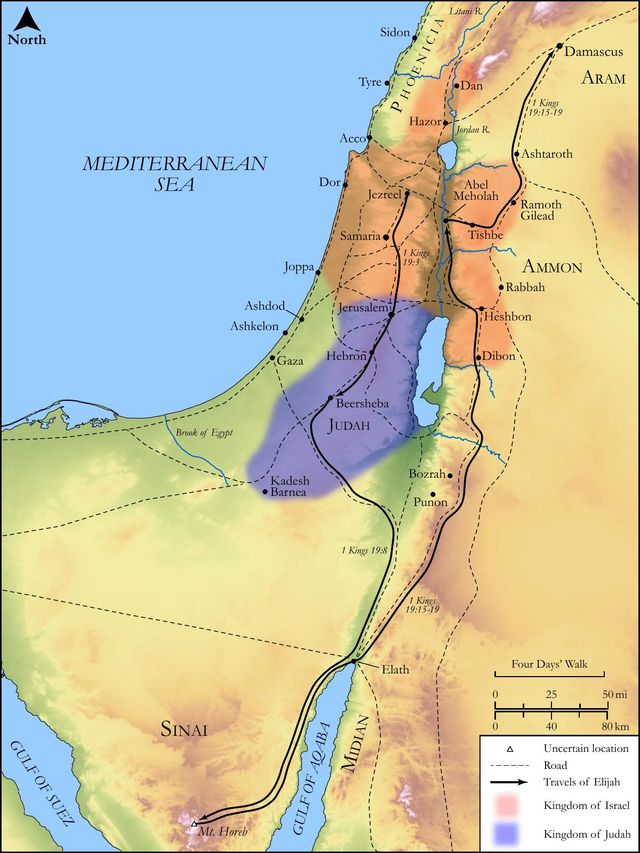
See on the biblical-era maps

Study this verse
Public-domain commentary
Matthew Henry
From his Commentary on the Whole Bible. Henry comments on passages, not single verses — this entry covers 1 Kings 19:1–8.
One would have expected, after such a public and sensible manifestation of the glory of God and such a clear decision of the controversy depending between him and Baal, to the honour of Elijah, the confusion of Baal's prophets, and the universal satisfaction of the people - after they had seen both fire and water come from heaven at the prayer of Elijah, and both in mercy to them, the one as it signified the acceptance of their offering, the other as it refreshed their inheritance, which was weary - that now they would all, as one man, return to the worship of the God of Israel and take Elijah for their guide and oracle, that he would thenceforward be prime-minister of state, and his directions would be as laws both to king and kingdom. But it is quite otherwise; he is neglected whom God honoured; no respect is paid to him, nor care taken of him, nor any use made of him, but, on the contrary, the land of Israel, to which he had been, and might have been, so great a blessing, is now made too hot for him. 1. Ahab incensed Jezebel against him. That queen-consort, it seems, was in effect queen-regent, as she was afterwards when she was queen-dowager, an imperious woman that managed king and kingdom and did what she would. Ahab's conscience would not let him persecute Elijah (some remains he had in him of the blood and spirit of an Israelite, which tied his hands), but he told Jezebel all that Elijah had done (Kg1 19:1), not ton convince, but to exasperate her. It is not said he told her what God had done, but what Elijah had done, as if he, by some spell or charm, had brought fire from heaven, and the hand of the Lord had not been in it. Especially he represented to her, as that which would make her outrageous against him, that he had slain the prophets; the prophets of Baal he calls the prophets, as if none but they were worthy of the name. His heart was set upon them, and he aggravated the slaying of them as Elijah's crime, without taking notice that it was a just reprisal upon Jezebel for killing God's prophets, Kg1 18:4. Those who, when they cannot for shame or fear do mischief themselves, yet stir up others to do it, will have it laid to their charge as if they had themselves done it. 2. Jezebel sent him a threatening message (Kg1 19:2), that she had vowed and sworn to be the death of him within twenty-four hours. Something prevents her from doing it just now, but she resolves it shall not be long undone. Note, Carnal hearts are hardened and enraged against God by that which should convince and conquer them and bring them into subjection to him. She swears by her gods, and, raging like one distracted, curseth herself if she slay not him, without any proviso of a divine permission. Cruelty and confidence often meet in persecutors. I will pursue, I will overtake, Exo 15:9. But how came she to send him word of her design, and so to give him an opportunity of making his escape? Did she think him so daring that he would not flee, or herself so formidable that she could prevent him? Or was there a special providence in it, that she should be thus infatuated by her own fury? I am apt to think that though she desired nothing more than his blood, yet, at this time, she durst not meddle with him for fear of the people, all counting him a prophet, a great prophet, and therefore sent this message to him merely to frighten him and get him out of the way. for the present, that he might not carry on what he had begun. The backing of her threats with an oath and imprecation does not at all prove that she really intended to slay him, but only that she intended to make him believe so. The gods she swore by could do her no harm. 3. Elijah, hereupon, in a great fright, fled for his life, it is likely by night, and came to Beer-sheba, Kg1 19:3. Shall we praise him for this? We praise him not. Where was the courage with which he had lately confronted Ahab and all the prophets of Baal? Nay, which kept him by his sacrifice when the fire of God fell upon it? He that stood undaunted in the midst of the terrors both of heaven and earth trembles at the impotent menaces of a proud passionate woman. Lord, what is man! Great faith is not always alike strong. He could not but know that he might be very serviceable to Israel at this juncture, and had all the reason in the world to depend upon God's protection while he was doing God's work; yet he fled. In his former danger God had bidden him hide himself (Kg1 17:3), therefore he supposed he might do so now. 4. From Beer-sheba he went forward into the wilderness, that vast howling wilderness in which the Israelites wandered. Beer-sheba was so far distant from Jezreel, and within the dominion of so good a king as Jehoshaphat, that he could not but be safe there; yet, as if his fears haunted him even when he was out of the reach of danger, he could not rest there, but went a day's journey into the desert. Yet perhaps he retired thither not so much for his safety as that he might be wholly retired from the world, in order to a more free and intimate communion with God. He left his servant at Beer-sheba that he might be private in the wilderness, as Abraham left his servants at the bottom of the hill when he went up into the mount to worship God, and as Christ in the garden was withdrawn from his disciples, or perhaps it was because he would not expose his servant, who was young and tender, to the hardships of the wilderness, which would have been putting new wine into old bottles. We ought thus to consider the frame of those who are under our charge, for God considers ours. 5. Being wearied with his journey, he grew cross (like children when they are sleepy) and wished he might die, Kg1 19:4. He requested for his life (so it is ion the margin), that he might die; for death is life to a good man; the death of the body is the life of the soul. Yet that was not the reason why he wished to die; it was not the deliberate desire of grace, as Paul's, to depart and be with Christ, but the passionate wish of his corruption, as Job's. Those that are, in this manner, forward to die are not in the fittest frame for dying. Jezebel has sworn his death, and therefore he, in a fret, prays for it, runs from death to death, yet with this difference, he wishes to die by the hand of the Lord, whose tender mercies are great, and not to fall into the hands of man, whose tender mercies are cruel. He would rather die in the wilderness than as Baal's prophet died, according to Jezebel's threatening (Kg1 19:2), lest the worshippers of Baal should triumph and blaspheme the God of Israel, whom they will think themselves too hard for, if they can run down his advocate. He pleads, "It is enough. I have done enough, and suffered enough. I am weary of living." Those that have secured a happiness in the other world will soon have enough of this world. He pleads, "I am not better than my fathers, not better able to bear those fatigues, and therefore why should I be longer burdened with them than they were?" But is this that my lord Elijah? Can that great and gallant spirit shrink thus? God thus left him to himself, to show that when he was bold and strong it was in the Lord and the power of his might, but of himself he was no better than his fathers or brethren. 6. God, by an angel, fed him in that wilderness, into the wants and perils of which he had wilfully thrown himself, and in which, if God had not graciously succoured him, he would have perished. How much better does God deal with his froward children than they deserve! Elijah, in a pet, wished to die; God needed him not, yet he designed further to employ and honour him, and therefore sent an angel to keep him alive. Our case would be bad sometimes if God should take us at our word and grant us our foolish passionate requests. Having prayed that he might die, he laid down and slept (Kg1 19:5), wishing it may be to die in his sleep, and not to awake again; but he is awakened out of his sleep, and finds himself not only well provided for with bread and water (Kg1 19:6), but, which was more, attended by an angel, who guarded him when he slept, and twice called him to his food when it was ready for him, Kg1 19:5, Kg1 19:7. He needed not to complain of the unkindness of men when it was thus made up by the ministration of angels. Thus provided for, he had reason to think he had fared better than the prophets of the groves, that did eat at Jezebel's table. Wherever God's children are, as they are still upon their Father's ground, so they are still under their Father's eye and care. They may lose themselves in a wilderness, but God has not lost them; there they may look at him that lives and sees them, as Hagar, Gen 16:13. 7. He was carried, in the strength of this meat, to Horeb, the mount of God, Kg1 19:8. Thither the Spirit of the Lord led him, probably beyond his own intention, that he might have communion with God in the same place where Moses had, the law that was given by Moses being revived by him. The angel bade him eat the second time, because of the greatness of the journey that was before him, Kg1 19:7. Note God knows what he designs us for, though we do not, what service, what trials, and will take care for us when we, for want of foresight, cannot for ourselves, that we be furnished for them with grace sufficient. He that appoints what the voyage shall be will victual the ship accordingly. See how many different ways God took to keep Elijah alive; he fed him by ravens, with multiplied meals - then by an angel - and now, to show that man lives not by bread alone, he kept him alive forty days without meat, not resting and sleeping, which might make him the less to crave sustenance, but continually traversing the mazes of the desert, a day for a year of Israel's wanderings; yet he neither needs food nor desires it. The place, no doubt, reminds him of the manna, and encourages him to hope that God will sustain him here, and in due time bring him hence, as he did Israel, though, like him, fretful and distrustful.
Historical interpretation
Fourteen Centuries of Reception
4 surviving comments on this verse. Each one is dated, so this reads as a timeline rather than a list.
Select a marker to jump to its quote. Markers stagger vertically where authors wrote within a few decades of each other.
“He came and sat down under a solitary broom tree. He asked that he might die.” He hopes for death, but not for the one with which Jezebel had threatened him, that is, the one that would have given the prophets of Baal the pretext to say that Baal had defeated the God of Israel, otherwise he would have never abandoned his servant in such a danger: therefore he had forsaken him by force.
To be sure, it was not a woman that such a great prophet was fleeing, but it was this world. And it was not death that he feared, for he offered himself to the one that searched for him and said to the Lord, “Take my soul.” He endured a weariness of this life, not a desire for it, but he was fleeing worldly enticement and the contagion of filthy conduct and the impious acts of an unholy and sinful generation.
Elijah, whom John the Baptist followed in spirit and virtue and who caused fire to fall from heaven and the waters of the Jordan to part by his prayers, was afraid of Jezebel and fled, and exhausted, he sat down in the wilderness under a tree, and, wearied from walking, he prayed for death, saying, “It is enough for me, Lord, take away my soul, for I am no better than my ancestors.” Who can deny that he was a just man? And yet fear, not to mention of a woman, but of a human being, proceeds from a disturbance of the soul, which cannot be faultless, as David says: “The Lord is my helper; I will not fear what people can do to me.”
That he might die: Elias requested to die, not out of impatience or pusillanimity, but out of zeal against sin; and that he might no longer be witness of the miseries of his people; and the war they were waging against God and his servants. See ver. 10.
Continue studying 1 Kings 19:4 across the web’s major study libraries — every link below opens this exact verse, chapter, or book on the destination site.
Read & Compare
 BibleGatewayThis verse in more than 200 translations and 70 languages.
 Bible.comThe YouVersion reader — hundreds of translations, reading plans, and highlights.
 ESV.orgCrossway's official English Standard Version reader.
 NET BibleThe NET translation with 60,000+ translators' notes on every rendering decision.
 STEP BibleTyndale House's free study tool — original text, vocabulary, and scholarly resources.
 BibliaLogos Bible Software's free web reader.
 USCCBThe New American Bible (Revised Edition) with the U.S. bishops' study notes.
Commentaries
 BibleHub CommentariesDozens of classic commentaries on this verse, gathered on one page.
 StudyLightMore than 100 commentary sets — the largest collection on the web.
 BibleRefPlain-English commentary on what this verse means, verse by verse.
 Enduring WordDavid Guzik's free commentary on this chapter, widely used by Bible teachers.
 Bible Study ToolsVerse commentary alongside Greek and Hebrew study aids.
Original Language & Research
- BibleHub InterlinearThe verse word by word — original language, transliteration, and English.
- BibleHub LexiconEvery word's original-language definition and Strong's entry.
 Blue Letter BibleDeep-study tools — Strong's numbers, concordance, and word studies.
 SefariaThe Hebrew text with Rashi and centuries of Jewish commentary.
Sermons, Hymns & Audio


TrulyRandomVerse is not affiliated with these sites and doesn’t control their content. They’re linked because they’re genuinely useful.
Summary
The prophet Elijah at a profound moment of human frailty and despair. Following his monumental victory over the prophets of Baal on Mount Carmel and facing the immediate, deadly threat from Queen Jezebel, Elijah flees into the desolate wilderness. There, under the meager shade of a broom tree, he is overcome by exhaustion and hopelessness, expressing a desperate plea for death and a deep sense of inadequacy, revealing the intense vulnerability inherent even in God's most powerful servants.
Context
ShowHideLiterary Context
This verse presents a dramatic and immediate contrast to the preceding narrative in 1 Kings 18. In that chapter, Elijah stands as a towering figure of faith, boldly challenging the prophets of Baal, witnessing divine fire consume his sacrifice, and orchestrating the end of a devastating drought. This display of God's overwhelming power should have solidified his confidence and the people's allegiance. However, the narrative pivots sharply in 1 Kings 19:1-3, where Queen Jezebel, enraged by the slaughter of her prophets, vows to take Elijah's life within twenty-four hours. Instead of confronting her with divine power, Elijah flees in terror, marking a sudden and poignant shift from prophetic triumph to personal collapse. His "day's journey into the wilderness" is more than a physical escape; it signifies a descent into spiritual and emotional desolation, setting the stage for God's tender, restorative intervention.
Historical & Cultural Context
Elijah's flight carries him from Jezreel, the royal city, southward through Judah into the wilderness, likely towards Beersheba and beyond, a region known for its arid, uninhabited expanses. This arduous journey would have been physically taxing and mentally isolating, intensifying his feelings of vulnerability and abandonment. The "juniper tree," more accurately identified as a broom tree (Retama raetam), was one of the few sources of shade in such a desolate environment, symbolizing a temporary, meager refuge in a place of utter exposure. Culturally, prophets in ancient Israel were regarded as direct emissaries of God, often bearing immense burdens and facing significant opposition from idolatrous rulers and a wayward populace. Elijah's despair, therefore, was not merely personal but also reflected the immense pressure of his prophetic calling in a nation deeply entrenched in Baal worship under the reign of King Ahab and Queen Jezebel. His lament, "not better than my fathers," speaks to a cultural expectation of prophetic succession and the desire to surpass or at least equal the spiritual achievements of past generations, a burden that now felt crushing.
Key Themes
ShowHide1 Kings 19:4 powerfully introduces and develops several critical themes. Firstly, it highlights Human Vulnerability and Burnout, demonstrating unequivocally that even the most spiritually powerful individuals are susceptible to fear, exhaustion, and profound emotional distress. Elijah's collapse after such intense spiritual warfare serves as a poignant reminder that ministry, even when divinely empowered and successful, exacts a significant toll. Secondly, the theme of Despair and the Desire for Death is starkly presented. Elijah's raw prayer, "It is enough; now, O LORD, take away my life," reveals a profound sense of hopelessness and a feeling of utter failure in his mission. He believes his efforts have been futile, and he has achieved no more than his predecessors, leading to a deep sense of inadequacy and disillusionment with the spiritual state of Israel. Lastly, the Wilderness as a Place of Isolation and Testing is a prominent motif. His journey "a day's journey into the wilderness" underscores his desire for solitude and escape. Biblically, the wilderness is often a setting for divine encounter, purification, and provision, but also one of profound loneliness and desolation, where one's faith is tested to its limits, as seen in the experiences of the Israelites in Exodus 16 and Jesus' temptation in Matthew 4:1-11.
Exposition and Analysis
ShowHideKey Word Analysis
ShowHideThis primitive root means "to walk" in a great variety of applications, both literally and figuratively. In this context, it describes Elijah's physical movement, emphasizing his deliberate act of going into the wilderness. It conveys the weariness of his journey and the intentionality of his retreat, highlighting that his flight was not a sudden, panicked sprint but a sustained, arduous movement away from the conflict.
This refers to the Spanish broom, a desert shrub known for its pole-like stems and sparse foliage. While it offers some shade, it is meager compared to larger trees. Its presence here is highly symbolic, representing a place of minimal comfort and temporary, inadequate refuge in a desolate landscape. It underscores Elijah's utter exhaustion and the harsh reality of his surroundings.
This word signifies abundance, sufficiency, or "much." In Elijah's desperate plea, "It is enough," it conveys a sense of finality, resignation, and utter weariness. It expresses his profound physical, emotional, and spiritual exhaustion, signaling a desire for cessation from his prophetic burdens and the relentless opposition he faced. It's a cry of complete depletion, indicating he can endure no more.
Verse Breakdown
ShowHide"But he himself went a day's journey into the wilderness"
This clause emphasizes Elijah's individual action and isolation. The "day's journey" signifies a considerable physical effort and distance, highlighting his desperate need to escape and the profound exhaustion that would accompany such a trek into the desolate, uncultivated regions. It marks his retreat from the world and entry into a place of solitude and testing.
"and came and sat down under a juniper tree"
This vividly portrays Elijah's physical collapse. His act of "sitting down" suggests utter weariness and the inability to continue. The "juniper tree" (broom tree), offering only sparse shade, underscores the desolation of his surroundings and the meager comfort available to him, painting a picture of a man utterly spent, seeking any available shelter from the elements and his internal turmoil.
"and he requested for himself that he might die; and said, It is enough; now, O LORD, take away my life"
This is the heart of Elijah's profound despair. His "request" is a direct, desperate prayer to God, revealing a complete loss of hope and a longing for an end to his suffering. The phrase "It is enough" (Hebrew rab) signifies his absolute resignation and weariness, believing his life's purpose is exhausted and he can endure no more. This is a raw, honest expression of suicidal ideation born from extreme emotional and spiritual distress.
"for I [am] not better than my fathers"
This final clause reveals the profound sense of failure and inadequacy underlying Elijah's death wish. He compares himself to the prophets and spiritual leaders who came before him, implying that despite his spectacular victory on Carmel, he has not succeeded in turning Israel back to God any more effectively than they did. This statement reflects a deep disillusionment with his prophetic mission and a feeling that his efforts have been futile, leading to a profound sense of personal and professional failure.
Literary Devices
ShowHideThe passage employs several potent literary devices to convey Elijah's profound state of despair. Symbolism is prominent: the "wilderness" symbolizes a place of isolation, testing, and spiritual stripping, while the "juniper tree" represents a meager, temporary refuge in a desolate environment, underscoring Elijah's utter exhaustion and the lack of substantial comfort. The narrative also uses Contrast to heighten the drama, juxtaposing Elijah's triumphant display of power on Mount Carmel with his subsequent flight and profound despair. This serves to emphasize the Irony of a prophet who called down fire from heaven now fleeing in terror from a single woman's threat. Elijah's prayer, "take away my life," is an example of Hyperbole born of extreme emotional distress, conveying the depth of his suffering and his desire for an end to his unbearable circumstances. The entire scene functions as a powerful Character Study, revealing the profound humanity and vulnerability of even the greatest of God's servants.
Theological and Thematic Connections
ShowHideElijah's experience in 1 Kings 19:4 offers profound theological insights into the nature of human weakness, God's compassionate response, and the often-unseen toll of spiritual warfare. It shatters any illusion of invincibility for God's servants, demonstrating that even those who walk most closely with the Almighty are susceptible to the deepest forms of despair, burnout, and fear. This vulnerability underscores the truth that our strength is not inherent but derived from God alone. Furthermore, it reveals God's tender and patient dealing with His weary servants, not with rebuke, but with provision, rest, and gentle redirection, highlighting His unwavering grace even in our moments of profound doubt and weakness. This divine compassion serves as a model for how God cares for His people when they are at their lowest ebb.
Reflection and Application
ShowHideElijah's raw vulnerability under the juniper tree provides immense comfort and validation for anyone experiencing profound despair, burnout, or a crushing sense of failure. It reminds us that spiritual strength does not equate to emotional invulnerability. Even the most zealous and successful servants of God can reach breaking points where they feel utterly spent and long for an end to their suffering. This passage invites us to embrace our humanity and acknowledge our limitations without shame. Critically, God did not rebuke Elijah for his despair but met him with tender care, providing rest, food, and a gentle presence. This serves as a powerful reminder that in our moments of deepest weakness, God's compassion is boundless. He understands our frailties and often provides for our physical and emotional needs before addressing our spiritual state or giving new directives. It encourages us to seek rest, acknowledge our limits, and trust in God's restorative grace when we are weary and heavy-laden, knowing that He is ever-present to minister to our brokenness and lead us back to wholeness.
Questions for Reflection
ShowHideFAQ
ShowHideWhy did Elijah, after such a great victory, fall into such despair?
ShowHideElijah's profound despair, immediately following his spectacular triumph on Mount Carmel, is a powerful illustration of the psychological and spiritual toll of intense ministry and spiritual warfare. Several factors contributed to his collapse:
His experience highlights that even the most spiritually gifted and divinely empowered individuals are still human, subject to the same pressures, fears, and vulnerabilities as anyone else.
What is the significance of the "juniper tree" in this passage?
ShowHideThe "juniper tree" (more accurately, a broom tree, Retama raetam) holds significant symbolic and practical meaning in this passage, serving as more than just a backdrop.
Christ-Centered Fulfillment
ShowHideElijah's profound despair under the juniper tree, and God's compassionate response, finds its ultimate fulfillment and deepest meaning in the person and work of Jesus Christ. While Elijah, a great prophet, succumbed to the crushing weight of his mission and the threat of death, Christ faced similar, even greater, human weakness and opposition without yielding to despair. In the Garden of Gethsemane, Jesus Himself experienced intense anguish, to the point of sweating blood, praying, "My Father, if it be possible, let this cup pass from me" (Matthew 26:39). Yet, unlike Elijah, He concluded with perfect submission, "nevertheless, not as I will, but as you will." Jesus fully understands our human frailty and the crushing weight of despair, for "we do not have a high priest who is unable to sympathize with our weaknesses" (Hebrews 4:15), having been tempted in every way, yet without sin. Where Elijah felt he was "not better than his fathers," Jesus, the true Son and perfect Prophet, perfectly fulfilled all righteousness and accomplished the ultimate work of salvation, surpassing all who came before Him. He is the one who invites all who are weary and heavy-laden to "come to me, and I will give you rest" (Matthew 11:28), offering a rest far more profound and lasting than the temporary respite under a juniper tree. Through His death and resurrection, Christ provides the ultimate victory over sin, death, and despair, enabling believers to find strength in their weakness, knowing that "my grace is sufficient for you, for my power is made perfect in weakness" (2 Corinthians 12:9), a promise that transforms even the deepest human despair into an opportunity for divine power to be revealed.