


Philippians 1:24
- τὸto<the>G3588T-NSNDefinite article Nominative Singular Neuter
- δὲdebutG1161CONJConjunction
- ἐπιμένεινepimeneinto remainG1961V-PANVerb Present Active Infinitive
- ἐνeninG1722PREPPreposition
- τῇtēatheG3588T-DSFDefinite article Dative Singular Feminine
- σαρκὶsarkifleshG4561N-DSFNoun Dative Singular Feminine
- ἀναγκαιότερονanagkaioteron[is] more necessaryG316A-NSN-CAdjective Nominative Singular Neuter Comparative
- δι᾽di᾽for the sake ofG1223PREPPreposition
- ὑμᾶςhumasyouG4771P-2APPersonal pronoun Accusative 2nd Plural
English is a literal word-by-word gloss of the Greek, not the KJV's wording. Why?
This is the original text the KJV's translators worked from — each Greek word with its own literal English meaning in this verse, prepared by scholars at Tyndale House, Cambridge. The KJV translates whole sentences, not word by word, so its wording differs: one Greek word can become several English words, and the KJV may choose “charity” where the gloss reads “love”. Both are faithful — they answer different questions. For the KJV's own rendering, switch to the KJV text.
Details
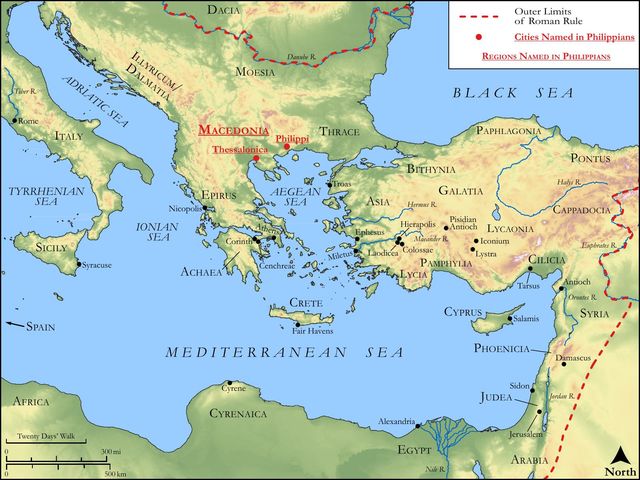
See on the biblical-era map

Study this verse
Public-domain commentary
Matthew Henry
From his Commentary on the Whole Bible. Henry comments on passages, not single verses — this entry covers Philippians 1:21–26. His three-level outline is real structure in the source text, so it is rendered as structure.
We have here an account of the life and death of blessed Paul: his life was Christ, and his death was gain. Observe, 1. It is the undoubted character of every good Christian that to him to live is Christ. The glory of Christ ought to be the end of our life, the grace of Christ the principle of our life, and the word of Christ the rule of it. The Christian life is derived from Christ, and directed to him. He is the principle, rule, and end of it. 2. All those to whom to live is Christ to them to die will be gain: it is great gain, a present gain, everlasting gain. Death is a great loss to a carnal worldly man; for he loses all his comforts and all his hopes: but to a good Christian it is gain, for it is the end of all his weakness and misery and the perfection of his comforts and accomplishment of his hopes; it delivers him from all the evils of life, and brings him to the possession of the chief good. Or, To me to die is gain; that is, "to the gospel as well as to myself, which will receive a further confirmation by the seal of my blood, as it had before by the labours of my life." So Christ would be magnified by his death, Phi 1:20. Some read the whole expression thus: To me, living and dying, Christ is gain; that is, "I desire no more, neither while I live nor when I die, but to win Christ and be found in him." It might be thought, if death were gain to him, he would be weary of life, and impatient for death. No, says he,
I.If I live in the flesh, this is the fruit of my labour (Phi 1:22), that is, Christ is.
He reckoned his labour well bestowed, if he could be instrumental to advance the honour and interest of the kingdom of Christ in the world. It is the fruit of my labour - karpos ergou - operae pretium. It is worth while for a good Christian and a good minister to live in the world as long as he can glorify God and do good to his church. Yet what I shall choose I wot not; for I am in a strait betwixt two. It was a blessed strait which Paul was in, not between two evil things, but between two good things. David was in a strait by three judgments - sword, famine, and pestilence: Paul was in a strait between two blessings - living to Christ, and being with him. Here we have him reasoning with himself upon the matter.
1.His inclination was for death. See the power of faith and of divine grace; it can reconcile the mind to death, and make us willing to die, though death is the destruction of our present nature and the greatest natural evil. We have naturally an aversion to death, but he had an inclination to it (Phi 1:23); Having a desire to depart, and to be with Christ, Observe,
(1.)It is being with Christ which makes a departure desirable to a good man. It is not simply dying, or putting off the body, it is not of itself and for its own sake a desirable thing; but it may be necessarily connected with something else which may make it truly so. If I cannot be with Christ without departing, I shall reckon it desirable on that account to depart.
(2.)As soon as ever the soul departs, it is immediately with Christ. This day shalt thou be with me in paradise, Luk 23:43. Absent from the body and present with the Lord (Co2 5:8), without any interval between. Which is far better, pollō gar mallon kreisson - very much exceeding, or vastly preferable. Those who know the value of Christ and heaven will readily acknowledge it far better to be in heaven than to be in this world, to be with Christ than to be with any creature; for in this world we are compassed about with sin, born to trouble, born again to it; but, if we come to be with Christ, farewell sin and temptation, farewell sorrow and death, for ever.
2.His judgment was rather to live awhile longer in this world, for the service of the church (Phi 1:24): Nevertheless to abide in the flesh is more needful for you. It is needful for the church to have ministers; and faithful ministers can ill be spared when the harvest is plenteous and the labourers are few. Observe, Those who have most reason to desire to depart should be willing to continue in the world as long as God has any work for them to do. Paul's strait was not between living in this world and living in heaven; between these two there is no comparison: but his strait was between serving Christ in this world and enjoying him in another. Still it was Christ that his heart was upon: though, to advance the interest of Christ and his church, he chose rather to tarry here, where he met with oppositions and difficulties, and to deny himself for awhile the satisfaction of his reward.
II.And, having this confidence, I know that I shall abide and continue with you all for your furtherance and joy of faith, Phi 1:25.
Observe here, 1. What a great confidence Paul had in the divine Providence, that it would order all for the best to him. "Having this confidence that it will be needful for you that I should abide in the flesh, I know that I shall abide." 2. Whatsoever is best for the church, we may be sure God will do. If we know what is needful for building up the body of Christ, we may certainly know what will be; for he will take care of its interests, and do what is best, all things considered, in every condition it is in. 3. Observe what ministers are continued for: For our furtherance and joy of faith, our further advancement in holiness and comfort. 4. What promotes our faith and joy of faith is very much for our furtherance in the way to heaven. The more faith the more joy, and the more faith and joy the more we are furthered in our Christian course. 5. There is need of a settled ministry, not only for the conviction and conversion of sinners, but for the edification of saints, and their furtherance in spiritual attainments.
III.That your rejoicing may be more abundant in Jesus Christ for me, by my coming to you again, Phi 1:26.
They rejoiced in the hope of seeing him, and enjoying his further labours among them. Observe,
1.The continuance of ministers with the church ought to be the rejoicing of all who wish well to the church, and to its interests.
2.All our joys should terminate in Christ. Our joy in good ministers should be our joy in Christ Jesus for them; for they are but the friends of the bridegroom, and are to be received in his name, and for his sake.
Historical interpretation
Historical reception
4 surviving comments on this verse. Each one is dated, so this reads as a timeline rather than a list.
Select a marker to jump to its quote. Markers stagger vertically where authors wrote within a few decades of each other.
Behold another joy of ours, that, in the duty of your episcopate, although in the meantime you have been, owing to the condition of the times, divided from your brethren, you have frequently confirmed the confessors by your letters; that you have ever afforded necessary supplies from your own just acquisitions; that in all things you have always shown yourself in some sense present; that in no part of your duty have you hung behind as a deserter. But what more strongly stimulated us to a greater joy we cannot be silent upon, but must describe with all the testimony of our voice. For we observe that you have both rebuked with fitting censure, and worthily, those who, unmindful of their sins, had, with hasty and eager desire, extorted peace from the presbyters in your absence, and those who, without respect for the Gospel, had with profane facility granted the holiness of the Lord unto dogs, and pearls to swine; although a great crime, and one which has extended with incredible destructiveness almost over the whole earth, ought only, as you yourself write, to be treated cautiously and with moderation, with the advice of all the bishops, presbyters, deacons, confessors, and even the laymen who abide fast, as in your letters you yourself also testify; so that, while wishing unseasonably to bring repairs to the ruins, we may not appear to be bringing about other and greater destruction, for where is the divine word left, if pardon be so easily granted to sinners? Certainly their spirits are to be cheered and to be nourished up to the season of their maturity, and they are to be instructed from the Holy Scriptures how great and surpassing a sin they have committed. Nor let them be animated by the fact that they are many, but rather let them be checked by the fact that they are not few. An unblushing number has never been accustomed to have weight in extenuation of a crime; but shame, modesty, patience, discipline, humility, and subjection, waiting for the judgment of others upon itself, and bearing the sentence of others upon its own judgment,-this it is which proves penitence; this it is which skins over a deep wound; this it is which raises up the ruins of the fallen spirit and restores them, which quells and restrains the burning vapour of their raging sins. For the physician will not give to the sick the food of healthy bodies, lest the unseasonable nourishment, instead of repressing, should stimulate the power of the raging disease,-that is to say, lest what might have been sooner diminished by abstinence, should, through impatience, be prolonged by growing indigestion.
He admits that it might be much easier to be dissolved and be with Christ. But nonetheless he knows that it is necessary for him to remain in the flesh for the benefit of the faithful, so that their glory may abound in the Lord and all may praise the Lord when they see him again. They will thereby increase their knowledge and become more deeply grounded in faith. How great was his affection for the believers that he does not choose what he says would be much better for himself. Rather he wants what is more profitable to many, in the assurance that what conduces to the benefit of many will also please the Lord.
"Yet to abide in the flesh is more needful for your sake."
These words were to prepare them for his death when it came, that they might bear it nobly: this was to teach true wisdom. "It is good for me to depart and be with Christ," for even death is a thing indifferent; since death itself is no ill, but to be punished after death is an ill. Nor is death a good, but it is good after our departure "to be with Christ." What follows death is either good or ill.
Let us then not simply grieve for the dead, nor joy for the living simply. But how? Let us grieve for sinners, not only when dying, but also while living. Let us joy for the just, not only while living, but also when dead. For those though living are dead, while these although dead, yet live: those even while here are to be pitied of all, because they are at enmity with God; the other even when they have departed Thither, are blessed, because they are gone to Christ. Sinners, wherever they are, are far from the King. Therefore they are subjects for tears; while the just, be they here, or be they there, are with the King; and there, in a higher and nearer degree, not through an entrance, or by faith, but "face to face." (1 Cor. xiii. 12.)
Let us then not make wailings for the dead simply, but for those who have died in sins. They deserve wailing; they deserve beating of the breast and tears. For tell me what hope is there, when our sins accompany us Thither, where there is no putting off sins? As long as they were here, perchance there was great expectation that they would change, that they would become better; but when they are gone to Hades, where nought can be gained from repentance (for it is written, "In Sheol who shall give thee thanks?") (Ps. vi. 5), are they not worthy of our lamentation? Let us wail for those who depart hence in such sort; let us wail, I hinder you not; yet in no unseemly way, not in tearing our hair, or baring our arms, or lacerating our face, or wearing black apparel, but only in soul, shedding in quiet the bitter tear. For we may weep bitterly without all that display. And not as in sport only. For the laments which many make differ not from sport. Those public mournings do not proceed from sympathy, but from display, from emulation and vainglory. Many women do this as of their craft. Weep bitterly; moan at home, when no one sees you; this is the part of true sympathy; by this you profit yourself too. For he who laments another in such sort, will be much the more earnest never to fall into the same sins. Sin henceforth will be an object of dread to thee. Weep for the unbelievers; weep for those who differ in nowise from them, those who depart hence without the illumination, without the seal! they indeed deserve our wailing, they deserve our groans; they are outside the Palace, with the culprits, with the condemned: for, "Verily I say unto you, Except a man be born of water and the Spirit, he shall not enter into the kingdom of Heaven." Mourn for those who have died in wealth, and did not from their wealth think of any solace for their soul, who had power to wash away their sins and would not. Let us all weep for these in private and in public, but with propriety, with gravity, not so as to make exhibitions of ourselves; let us weep for these, not one day, or two, but all our life. Such tears spring not from senseless passion, but from true affection. The other sort are of senseless passion. For this cause they are quickly quenched, whereas if they spring from the fear of God, they always abide with us. Let us weep for these; let us assist them according to our power; let us think of some assistance for them, small though it be, yet still let us assist them. How and in what way? By praying and entreating others to make prayers for them, by continually giving to the poor on their behalf. This deed hath some consolation; for hear the words of God Himself, when He says, "I will defend this city for Mine own sake, and for My servant David's sake." (2 Kings xx. 6.) If the remembrance only of a just man had so great power when deeds are done for one, how great power will it not have? Not in vain did the Apostles order that remembrance should be made of the dead in the dreadful Mysteries. They know that great gain resulteth to them, great benefit; for when the whole people stands with uplifted hands, a priestly assembly, and that awful Sacrifice lies displayed, how shall we not prevail with God by our entreaties for them? And this we do for those who have departed in faith, whilst the catechumens are not thought worthy even of this consolation, but are deprived of all means of help save one. And what is this? We may give to the poor on their behalf. This deed in a certain way refreshes them. For God wills that we should be mutually assisted; else why hath He ordered us to pray for peace and the good estate of the world? why on behalf of all men? since in this number are included robbers, violaters of tombs, thieves, men laden with untold crimes; and yet we pray on behalf of all; perchance they may turn. As then we pray for those living, who differ not from the dead, so too we may pray for them. Job offered sacrifice for his children, and freed them from their sins. "It may be," said he, "that they have renounced God in their hearts." (Job i. 5.) Thus does one provide for one's children! He said not, as many do nowadays, I will leave them property; he said not, I will procure them honor; he said not, I will purchase an office; he said not, I will buy them land; but, "it may be that they have renounced God in their hearts." For what profit is there in those things? None at all, in those that remain here. I will make the King of all things favorable to them, and then they will no more want any thing. "The Lord," saith one, "is my Shepherd, I shall not want." (Ps. xxiii. 4.) This is great wealth, this is treasure. If we have the fear of God, we want nothing; if we have not this, though we have royalty itself, we are the poorest of all men. Nothing is like the man that feareth the Lord. For "the fear of the Lord," it is said, "surpasseth all things." (Ecclus. xxv. 11.) This let us procure; let us do all things for its sake. If need be that we lay down our lives, if our body must be mangled, let us not spare them; let us do all, to obtain this fear. For thus shall we abound above all men; and shall obtain those good things to come in Christ Jesus our Lord.
For this cause "to abide in the flesh is more needful for your sake."
And what excuse is left to us? ofttimes it happens that a man who possesses a little and poor city, chooses not to depart to another place, preferring his own rest. Paul might depart to Christ, and would not, (Christ whom he so desired, as for his sake to choose even hell,) but still remained in the contest on behalf of man. What excuse shall we have? May we then even make mention of Paul? Look to his deeds. He showed that to depart was better, persuading himself not to grieve: he showed them, that if he remained, he remained for their sake, that it proceeded not from wickedness of those who plotted against him. He subjoined also the reason, that he might secure their belief. For if this is necessary, that is, I shall by all means remain, and I will not "remain" simply, but "will remain with you." For this is the meaning of the word, "and I shall abide with," i.e. I shall see you. For what cause? "For your progress and joy in the faith." Here too he rouses them, to take heed unto themselves. If, says he, for your sakes I abide, see that ye shame not my abiding. "For your progress," I have chosen to remain, when I was about to see Christ. I have chosen to remain, because my presence advances both your faith and your joy. What then? Did he remain for the sake of the Philippians only? He stayed not for their sake only; but this he says, that he may show regard to them. And how were they to "progress" in "the faith"? That you may be more strengthened, like young fowl, who need their mother until their feathers are set. This is a proof of his great love. In like sort, we also rouse some of you, when we say, for your sake have I remained, that I may make you good.
Continue studying Philippians 1:24 across the web’s major study libraries — every link below opens this exact verse, chapter, or book on the destination site.
Read & Compare
 BibleGatewayThis verse in more than 200 translations and 70 languages.
 Bible.comThe YouVersion reader — hundreds of translations, reading plans, and highlights.
 ESV.orgCrossway's official English Standard Version reader.
 NET BibleThe NET translation with 60,000+ translators' notes on every rendering decision.
 STEP BibleTyndale House's free study tool — original text, vocabulary, and scholarly resources.
 BibliaLogos Bible Software's free web reader.
 USCCBThe New American Bible (Revised Edition) with the U.S. bishops' study notes.
Commentaries
 BibleHub CommentariesDozens of classic commentaries on this verse, gathered on one page.
 StudyLightMore than 100 commentary sets — the largest collection on the web.
 BibleRefPlain-English commentary on what this verse means, verse by verse.
 Enduring WordDavid Guzik's free commentary on this chapter, widely used by Bible teachers.
 Bible Study ToolsVerse commentary alongside Greek and Hebrew study aids.
Original Language & Research
- BibleHub InterlinearThe verse word by word — original language, transliteration, and English.
- BibleHub LexiconEvery word's original-language definition and Strong's entry.
 Blue Letter BibleDeep-study tools — Strong's numbers, concordance, and word studies.
 CNTR CollationThe earliest Greek manuscripts of this verse, collated letter by letter.
Sermons, Hymns & Audio


TrulyRandomVerse is not affiliated with these sites and doesn’t control their content. They’re linked because they’re genuinely useful.
Summary
Philippians 1:24 encapsulates the Apostle Paul's profound pastoral heart and selfless commitment to the Philippian believers. Following his deeply personal reflection on the choice between immediate death to be with Christ and continued earthly life, Paul concludes that remaining in his physical body is not only beneficial but "more needful" for the spiritual welfare and progress of the church in Philippi, prioritizing their needs over his own ultimate comfort and heavenly reward.
Context
ShowHideLiterary Context
This verse stands as the resolution to a profound personal dilemma Paul articulates in the immediately preceding verses. In Philippians 1:21, he declares his life's purpose: "For to me to live is Christ, and to die is gain." He then elaborates on this tension in Philippians 1:22-23, expressing his personal desire to "depart and be with Christ, which is far better." However, in verse 24, he pivots, revealing that his continued earthly existence, despite his personal longing for glory, serves a higher purpose for the Philippians. This sets the stage for his expectation to remain with them for their "furtherance and joy of faith" as stated in Philippians 1:25-26. The entire passage highlights Paul's Christ-like self-sacrifice and his unwavering commitment to the spiritual growth of the churches he founded.
Historical & Cultural Context
Paul wrote the letter to the Philippians from prison, likely in Rome, around 60-62 AD. His imprisonment (referenced in Philippians 1:7) adds a layer of poignancy to his dilemma; death could have been a release from suffering. The Philippian church itself, founded during Paul's second missionary journey (Acts 16), was a beloved community known for its generosity and faithfulness, but also facing external persecution (Philippians 1:28-30) and potential internal disunity (Philippians 4:2-3). In the Greco-Roman world, the concept of a noble death was common, but Paul's perspective transcends this, viewing life and death through the lens of Christ's purpose and the needs of the church. His decision to remain "in the flesh" for the sake of others was a radical act of self-denial, contrasting with the prevailing emphasis on individual pursuit of glory or comfort.
Key Themes
ShowHidePhilippians 1:24 profoundly contributes to several key themes within the letter and Paul's broader theology. Firstly, it exemplifies Selfless Service and Sacrifice, echoing the ultimate example of Christ's humility and self-emptying. Paul willingly postpones his personal spiritual gain for the benefit of others, demonstrating that true Christian leadership is characterized by sacrificial love. Secondly, it underscores Paul's deep Pastoral Heart and Responsibility for the churches. His concern for the Philippians' "furtherance and joy of faith" (Philippians 1:25) outweighs his own longing for glory, revealing the profound bond between apostle and congregation. Lastly, the verse highlights the theme of Purpose in Life and Ministry. For Paul, life was not merely existence but an opportunity to advance the gospel and build up the body of Christ. His continued life served a divine calling, emphasizing that believers' remaining time on earth is for God's redemptive purposes, contributing to the spiritual maturity and joy of fellow believers.
Exposition and Analysis
ShowHideKey Word Analysis
ShowHideDerived from epí (upon, over) and ménō (to remain, stay), this verb signifies "to stay over" or "to remain." In this context, it refers to Paul's continued physical presence and existence on earth. It implies not just passive existence but an active perseverance in his earthly state, enduring the challenges of ministry and imprisonment for a specific purpose.
This term, while often referring to the physical body, carries broader theological implications in Paul's writings. Here, "in the flesh" (ἐν σαρκί) refers to his human, embodied existence on earth, with its inherent limitations, frailties, and mortality. It stands in contrast to his desired state of being "with Christ" (σὺν Χριστῷ), which implies a disembodied or glorified state beyond earthly limitations.
This word, in its comparative form anankaióteron (more needful/necessary), emphasizes a compelling obligation or urgent necessity. It is not merely "good" or "helpful" for the Philippians, but genuinely "more necessary" for their spiritual well-being and the advancement of the gospel. Paul perceives his continued life as a divine imperative, a greater necessity in God's economy for the Philippians' sake.
Verse Breakdown
ShowHide"Nevertheless"
This conjunction (G1161, dé) introduces a strong contrast or counterpoint to Paul's personal desire expressed in the preceding verses. It signals a shift from his individual longing for glory to a consideration of the greater good, indicating a deliberate and weighty decision.
"to abide in the flesh"
This phrase refers to Paul's continued physical existence and life on earth. It encompasses all the realities of his earthly ministry, including his imprisonment, suffering, and ongoing labor for the gospel.
"[is] more needful"
The comparative "more needful" (G316, anankaîos) is the crux of the verse. It asserts that Paul's continued earthly life is of greater necessity and importance than his personal desire to depart and be with Christ. This necessity is not for his own sake, but for the benefit of others.
"for you"
This direct address (G5209, hymâs) specifies the beneficiaries of Paul's decision: the Philippian believers. His continued life serves their spiritual growth, joy, and progress in the faith, underscoring his deep pastoral love and commitment to their welfare.
Literary Devices
ShowHidePhilippians 1:24 masterfully employs several literary devices. The most prominent is Antithesis, as Paul sets up a stark contrast between his personal longing for death and immediate union with Christ ("far better") and the pastoral necessity of remaining alive for the Philippians ("more needful for you"). This creates a powerful tension that highlights the depth of Paul's self-sacrifice. The verse also exhibits a profound Pastoral Tone, revealing Paul's deep affection, responsibility, and selfless concern for the spiritual maturity and joy of the Philippian church. His decision is not one of resignation but of deliberate, loving choice. Furthermore, the use of the comparative "more needful" functions as a form of Understatement or Litotes in relation to his personal desire; while being with Christ is "far better," Paul's continued earthly life is presented as an even greater, compelling necessity in the divine scheme for the sake of the church.
Theological and Thematic Connections
ShowHidePhilippians 1:24 offers profound theological insights into the nature of Christian existence, ministry, and self-sacrifice. It challenges a purely individualistic understanding of faith by demonstrating that personal spiritual fulfillment, no matter how desirable, can be willingly deferred for the corporate good of the body of Christ. Paul's decision underscores the divine value of earthly life when lived for God's purposes, particularly in advancing the gospel and building up believers. It reveals that God often sustains His servants not for their own comfort, but for the ongoing work of His kingdom through them. This passage affirms that our lives, while ultimately destined for glory with Christ, have significant purpose and impact in the "now," serving as instruments of God's grace and truth to those around us. It is a powerful testament to the priority of selfless love and the communal nature of the Christian faith.
Reflection and Application
ShowHidePhilippians 1:24 serves as a powerful call to examine our own priorities and purpose in life. While a natural and commendable desire for believers is to ultimately be with the Lord, Paul's example challenges us to consider why God might keep us here on earth. Our continued existence is not merely for personal comfort or achievement, but often for the benefit of others and the advancement of God's kingdom. This verse encourages a selfless, outward-focused perspective, prompting us to ask: "For whom, or for what purpose, is my life 'more needful'?" It reminds us that our gifts, time, and resources are intended to be poured out for the spiritual growth, encouragement, and evangelization of those around us. Living out this principle means actively seeking opportunities to serve, mentor, share the gospel, and build up the church, understanding that our remaining time is a precious opportunity for God's work through us, contributing to the "furtherance and joy of faith" in others.
Questions for Reflection
ShowHideFAQ
ShowHideWhy did Paul consider remaining in the flesh "more needful" for the Philippians, despite his desire to be with Christ?
ShowHidePaul's decision was rooted in his profound pastoral love and commitment to the spiritual well-being of the Philippian church. While his personal desire was to depart and be with Christ, which he considered "far better" (Philippians 1:23), he recognized a greater, more urgent necessity for the Philippians' sake. His continued life and ministry would contribute to their "furtherance and joy of faith" (Philippians 1:25), strengthen them against persecution, and help them navigate internal challenges. He understood that God had a specific purpose for his remaining on earth: to advance the gospel (Philippians 1:12) and build up the body of Christ. Thus, his choice was a selfless act of prioritizing the needs of the church over his own immediate heavenly reward.
Christ-Centered Fulfillment
ShowHidePhilippians 1:24, while a testament to Paul's sacrificial love, finds its ultimate and perfect fulfillment in the person and work of Jesus Christ. Paul's willingness to "abide in the flesh" for the sake of others directly mirrors Christ's own incarnation and earthly ministry. The Son of God, who existed in the form of God and did not consider equality with God something to be grasped (Philippians 2:6), willingly divested Himself of heavenly glory to "abide in the flesh" (John 1:14) for humanity's salvation. His entire earthly life, from His birth to His death, was "more needful" for us—to reveal the Father (John 14:9), to teach and heal (Luke 4:18-19), and ultimately to offer Himself as the perfect, atoning sacrifice for sin (Philippians 2:8). Without Christ's "abiding in the flesh" and His subsequent death and resurrection (Romans 4:25), there would be no salvation, no "gain" in death for believers, and no hope of being "with Christ." Paul's selflessness, therefore, is a Christ-like echo, a participation in the very pattern of the Savior who lived, died, and continues to intercede (Hebrews 7:25) for His people, demonstrating that true love always puts the needs of others first.