


Philippians 1:21
Bible text: King James Version (1769 Blayney text) · Public domain
Bible text: Berean Standard Bible · Public domain
Bible text: American Standard Version (1901) · Public domain
Bible text: World English Bible, Messianic edition · Public domain
Bible text: Geneva Bible (1599) · Public domain
Bible text: Young's Literal Translation · Public domain
- ἘμοὶEmoiTo me myselfG1473P-1DSPersonal pronoun Dative 1st Singular
- γὰρgarforG1063CONJConjunction
- τὸto<the>G3588T-NSNDefinite article Nominative Singular Neuter
- ζῆνzēnto liveG2198V-PANVerb Present Active Infinitive
- ΧριστὸςChristos[is] ChristG5547N-NSM-TNoun Nominative Singular Masculine Title
- καὶkaiandG2532CONJConjunction
- τὸto<the>G3588T-NSNDefinite article Nominative Singular Neuter
- ἀποθανεῖνapothaneinto dieG599V-2AANVerb 2nd Aorist Active Infinitive
- κέρδοςkerdos[is] gainG2771N-NSNNoun Nominative Singular Neuter
English is a literal word-by-word gloss of the Greek, not the KJV's wording. Why?
This is the original text the KJV's translators worked from — each Greek word with its own literal English meaning in this verse, prepared by scholars at Tyndale House, Cambridge. The KJV translates whole sentences, not word by word, so its wording differs: one Greek word can become several English words, and the KJV may choose “charity” where the gloss reads “love”. Both are faithful — they answer different questions. For the KJV's own rendering, switch to the KJV text.
Details
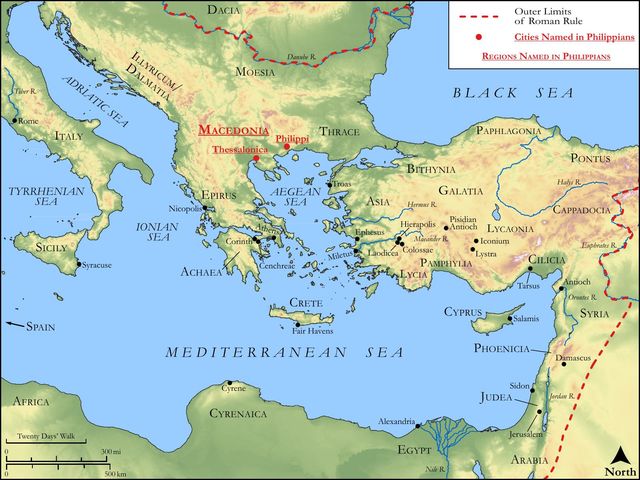
See on the biblical-era maps

Study this verse
Public-domain commentary
Matthew Henry
From his Commentary on the Whole Bible. Henry comments on passages, not single verses — this entry covers Philippians 1:21–26. His three-level outline is real structure in the source text, so it is rendered as structure.
We have here an account of the life and death of blessed Paul: his life was Christ, and his death was gain. Observe, 1. It is the undoubted character of every good Christian that to him to live is Christ. The glory of Christ ought to be the end of our life, the grace of Christ the principle of our life, and the word of Christ the rule of it. The Christian life is derived from Christ, and directed to him. He is the principle, rule, and end of it. 2. All those to whom to live is Christ to them to die will be gain: it is great gain, a present gain, everlasting gain. Death is a great loss to a carnal worldly man; for he loses all his comforts and all his hopes: but to a good Christian it is gain, for it is the end of all his weakness and misery and the perfection of his comforts and accomplishment of his hopes; it delivers him from all the evils of life, and brings him to the possession of the chief good. Or, To me to die is gain; that is, "to the gospel as well as to myself, which will receive a further confirmation by the seal of my blood, as it had before by the labours of my life." So Christ would be magnified by his death, Phi 1:20. Some read the whole expression thus: To me, living and dying, Christ is gain; that is, "I desire no more, neither while I live nor when I die, but to win Christ and be found in him." It might be thought, if death were gain to him, he would be weary of life, and impatient for death. No, says he,
I.If I live in the flesh, this is the fruit of my labour (Phi 1:22), that is, Christ is.
He reckoned his labour well bestowed, if he could be instrumental to advance the honour and interest of the kingdom of Christ in the world. It is the fruit of my labour - karpos ergou - operae pretium. It is worth while for a good Christian and a good minister to live in the world as long as he can glorify God and do good to his church. Yet what I shall choose I wot not; for I am in a strait betwixt two. It was a blessed strait which Paul was in, not between two evil things, but between two good things. David was in a strait by three judgments - sword, famine, and pestilence: Paul was in a strait between two blessings - living to Christ, and being with him. Here we have him reasoning with himself upon the matter.
1.His inclination was for death. See the power of faith and of divine grace; it can reconcile the mind to death, and make us willing to die, though death is the destruction of our present nature and the greatest natural evil. We have naturally an aversion to death, but he had an inclination to it (Phi 1:23); Having a desire to depart, and to be with Christ, Observe,
(1.)It is being with Christ which makes a departure desirable to a good man. It is not simply dying, or putting off the body, it is not of itself and for its own sake a desirable thing; but it may be necessarily connected with something else which may make it truly so. If I cannot be with Christ without departing, I shall reckon it desirable on that account to depart.
(2.)As soon as ever the soul departs, it is immediately with Christ. This day shalt thou be with me in paradise, Luk 23:43. Absent from the body and present with the Lord (Co2 5:8), without any interval between. Which is far better, pollō gar mallon kreisson - very much exceeding, or vastly preferable. Those who know the value of Christ and heaven will readily acknowledge it far better to be in heaven than to be in this world, to be with Christ than to be with any creature; for in this world we are compassed about with sin, born to trouble, born again to it; but, if we come to be with Christ, farewell sin and temptation, farewell sorrow and death, for ever.
2.His judgment was rather to live awhile longer in this world, for the service of the church (Phi 1:24): Nevertheless to abide in the flesh is more needful for you. It is needful for the church to have ministers; and faithful ministers can ill be spared when the harvest is plenteous and the labourers are few. Observe, Those who have most reason to desire to depart should be willing to continue in the world as long as God has any work for them to do. Paul's strait was not between living in this world and living in heaven; between these two there is no comparison: but his strait was between serving Christ in this world and enjoying him in another. Still it was Christ that his heart was upon: though, to advance the interest of Christ and his church, he chose rather to tarry here, where he met with oppositions and difficulties, and to deny himself for awhile the satisfaction of his reward.
II.And, having this confidence, I know that I shall abide and continue with you all for your furtherance and joy of faith, Phi 1:25.
Observe here, 1. What a great confidence Paul had in the divine Providence, that it would order all for the best to him. "Having this confidence that it will be needful for you that I should abide in the flesh, I know that I shall abide." 2. Whatsoever is best for the church, we may be sure God will do. If we know what is needful for building up the body of Christ, we may certainly know what will be; for he will take care of its interests, and do what is best, all things considered, in every condition it is in. 3. Observe what ministers are continued for: For our furtherance and joy of faith, our further advancement in holiness and comfort. 4. What promotes our faith and joy of faith is very much for our furtherance in the way to heaven. The more faith the more joy, and the more faith and joy the more we are furthered in our Christian course. 5. There is need of a settled ministry, not only for the conviction and conversion of sinners, but for the edification of saints, and their furtherance in spiritual attainments.
III.That your rejoicing may be more abundant in Jesus Christ for me, by my coming to you again, Phi 1:26.
They rejoiced in the hope of seeing him, and enjoying his further labours among them. Observe,
1.The continuance of ministers with the church ought to be the rejoicing of all who wish well to the church, and to its interests.
2.All our joys should terminate in Christ. Our joy in good ministers should be our joy in Christ Jesus for them; for they are but the friends of the bridegroom, and are to be received in his name, and for his sake.
Historical interpretation
Historical reception
7 surviving comments on this verse. Each one is dated, so this reads as a timeline rather than a list.
Select a marker to jump to its quote. Markers stagger vertically where authors wrote within a few decades of each other.
And because now your word is more effectual in prayers, and supplication is more quick to obtain what is sought for in afflictions, seek more eagerly, and ask that the divine condescension would consummate the confession of all of us; that from this darkness and these snares of the world God would set us also free with you, sound and glorious; that we who here are united in the bond of charity and peace, and have stood together against the wrongs of heretics and the oppressions of the heathens, may rejoice together in the heavenly kingdom. I bid you, most blessed and most beloved brethren, ever farewell in the Lord, and always and everywhere remember me.
How great is the advantage of going out of the world, Christ Himself, the Teacher of our salvation and of our good works, shows to us, who, when His disciples were saddened that He said that He was soon to depart, spoke to them, and said, "If ye loved me, ye would surely rejoice because I go to the Father; " teaching thereby, and manifesting that when the dear ones whom we love depart from the world, we should rather rejoice than grieve. Remembering which truth, the blessed Apostle Paul in his epistle lays it down, saying, "To me to live is Christ, and to die is gain; " counting it the greatest gain no longer to be held by the snares of this world, no longer to be liable to the sins and vices of the flesh, but taken away from smarting troubles, and freed from the envenomed fangs of the devil, to go at the call of Christ to the joy of eternal salvation.
And, to pass over everything else, we ought to remember what a glory it is to come immaculate to Christ-to be a sharer in His suffering, and to reign in a perpetual eternity with the Lord-to be free from the threatening destruction of the world, and not to be mixed up with the bloody carnage of wasting diseases in a common lot with others; and, not to speak of the crown itself, if, being situated in the midst of these critical evils of nature, you had the promise of an escape from this life, would you not rejoice with all your heart? If, I say, while tossing amid the tempests of this world, a near repose should invite you, would you not consider death in the light of a remedy? Thus, surrounded as you are with the knives of the executioners, and the instruments of testing tortures, stand sublime and strong, considering how great is the penalty of denying, in a time when you are unable to enjoy, the world for the sake of which you would deny, because indeed the Lord knew that cruel torments and mischievous acts of punishment would be armed against us for our destruction, in order that He might make us strong to endure the all. son, says He, "if thou come to serve God, stand fast in righteousness, and fear, and prepare thy soul for temptation." Moreover, also, the blessed Apostle Paul exclaimed, and said, "To me to live is Christ, and to die is gain."
It is not death itself that is gain, but to die in Christ. Life is Christ. The one who has hope in him is always alive, both now and forever.… Therefore they achieve nothing, whether they hand me over to death or to tortures in life. Neither alternative harms me. Life under torments is no punishment for me, since Christ is my life. And if they kill me, that too is no punishment for me, since Christ for me is life and to die is gain.
What others had contrived for his death proved to be life for him. This is life: if Christ is preached. He is fully prepared to meet death so that this can be accomplished. He knows that a great blessing will be given to him for his prayer and constancy. Clumsy malice will continue to work against him in ignorance. To trample down the malevolence of those who were laying snares against his life under a covering of deceit, he bears patient witness. He is fortified by the protection of God.
We see, then, that this death is a gain and life a penalty, so that Paul says: "To me to live is Christ and to die is gain." What is Christ but the death of the body, the breath of life? And so let us die with Him, that we may live with Him. Let there then be in us as it were a daily practice and inclination to dying, that by this separation from bodily desires, of which we have spoken, our soul may learn to withdraw itself, and, as it were placed on high, when earthly lusts cannot approach and attach it to themselves, may take upon herself the likeness of death, that she incur not the penalty of death.
"For to me," he says, "to live is Christ, and to die is gain."
For even in dying, he means, I shall not have died, for I have my life in myself: then would they truly have slain me, had they had power through this fear to cast faith out of my soul. But as long as Christ is with me, even though death overtake me, still I live, and in this present life, not this, but Christ is my life. Since, then, not even in the present life is it so, "but that life which I now live in the flesh I live in faith;" so I say in that state also, "I live, yet not I, but Christ liveth in me." (Gal. ii. 20.) Such ought a Christian to be! I live not, he says, the common life. How livest thou then, O blessed Paul? Dost thou not see the sun, dost thou not breathe the common air? art thou not nourished with the same food as others? dost thou not tread the earth as we? needest thou not sleep, nor clothing, nor shoes? what meanest thou by, "I live not"? how dost thou not live? Why boastest thou thyself? No boasting is here. For if indeed the fact did not witness to him, a man might with some show have called it boasting; but if facts do witness, how is boasting here? Let us then learn how he lives not, for he himself says in another place, "I have been crucified to the world, and the world to me." (Gal. vi. 14.) Hear then how he says, "I no longer live." And how he says, "to me to live is Christ." The word "life" is much significant, beloved, as also the word "death." There is this life of the body, there is the life of sin, as he himself elsewhere says, "But if we died to sin, how shall we any longer live therein?" (Rom. vi. 2.) It is then possible to live the life of sin. Attend diligently, I entreat you, lest my labor be vain. There is the life everlasting and immortal; with eternal life the heavenly; "for our citizenship" says he "is in heaven" (Phil. iii 20.) There is the life of the body whereof he speaks, "through him we live and move and have our being." (Acts xvii. 28.) He does not then deny that he lives the natural life, but that of sin, which all men live. He who desires not the present life, how does he live it? He who is hastening to another, how does he live this life? He who despiseth death, how does he live this life? He who desires nothing, how does he live it? For as one made of adamant, though he were struck a thousand blows, would never attend to it, no more would Paul. And "I live," says he, "but no longer I," that is, no longer the old man; as again elsewhere, "Wretched man that I am, who shall deliver me out of the body of this death!" (Rom. vii. 24.) How too does he live who does nought for the sake of food, nought for the sake of clothing, nought for any of these present things? Such an one does not even live the natural life: he who takes thought for none of the things which sustain life, lives not. We live this life, whose every action regards it. But he lived not; he busied himself about nought of the things here. How then lived he? Just as we are accustomed to say, in common matters, such an one is not with me, when he does nothing that pertains to me. Again, in like sort, such a man lives not for me. Elsewhere he shows that he rejects not the natural life: "The life which I now live in the flesh, I live in the faith of the Son of God, who loved me, and gave himself for me" (Gal. ii. 20); i.e. a certain new life I live, an altered one. And truly all these things he said to comfort the Philippians. Think not, says he, that I shall be deprived of this life, for neither whilst alive did I live this life, but that which Christ willed. For tell me? He who despises money, luxury, hunger, thirst, dangers, health, safety, does he live this life? He who has nothing here, and is ofttimes willing to cast life away, if need be, and clings not to it, does he live this life? By no means. This I must make dear to you by a kind of example. Let us imagine some one in great wealth, with many servants, and much gold, and who makes no use of all these things; is such an one rich for all his wealth? By no means. Let him see his children dissipating his property, strolling idly about; let him feel no concern for them; when beaten let him not even be pained; shall we call him a man of wealth? By no means; although his wealth is his own. "To me," he says, "to live is Christ;" if you will enquire of my life, it is He. "And to die is gain." Wherefore? Because I shall more clearly be present with Him; so that my death is rather a coming to life; they who kill me will work on me no dreadful thing, they will only send me onward to my proper life, and free me from that which is not mine. What then, while thou wert here, wert thou not Christ's? Yes, and in a high degree.
Continue studying Philippians 1:21 across the web’s major study libraries — every link below opens this exact verse, chapter, or book on the destination site.
Read & Compare
 BibleGatewayThis verse in more than 200 translations and 70 languages.
 Bible.comThe YouVersion reader — hundreds of translations, reading plans, and highlights.
 ESV.orgCrossway's official English Standard Version reader.
 NET BibleThe NET translation with 60,000+ translators' notes on every rendering decision.
 STEP BibleTyndale House's free study tool — original text, vocabulary, and scholarly resources.
 BibliaLogos Bible Software's free web reader.
 USCCBThe New American Bible (Revised Edition) with the U.S. bishops' study notes.
Commentaries
 BibleHub CommentariesDozens of classic commentaries on this verse, gathered on one page.
 StudyLightMore than 100 commentary sets — the largest collection on the web.
 BibleRefPlain-English commentary on what this verse means, verse by verse.
 Enduring WordDavid Guzik's free commentary on this chapter, widely used by Bible teachers.
 Bible Study ToolsVerse commentary alongside Greek and Hebrew study aids.
Original Language & Research
- BibleHub InterlinearThe verse word by word — original language, transliteration, and English.
- BibleHub LexiconEvery word's original-language definition and Strong's entry.
 Blue Letter BibleDeep-study tools — Strong's numbers, concordance, and word studies.
 CNTR CollationThe earliest Greek manuscripts of this verse, collated letter by letter.
Sermons, Hymns & Audio


TrulyRandomVerse is not affiliated with these sites and doesn’t control their content. They’re linked because they’re genuinely useful.
Summary
Philippians 1:21 stands as a quintessential declaration of the Apostle Paul's life philosophy and spiritual conviction, encapsulating the radical reorientation of purpose that occurs when one's existence is fully surrendered to Christ. This profound statement reveals that for Paul, every aspect of his being, his motivations, and his future—whether in life or in death—was entirely consumed by and directed toward Jesus Christ, transforming even the ultimate human fear into an anticipated spiritual advantage.
Context
ShowHideLiterary Context
Paul's declaration in Philippians 1:21 is the climax of a deeply personal reflection on his imprisonment and uncertain future. In the preceding verse, Philippians 1:20, he expresses his fervent expectation that Christ will be magnified in his body, whether through life or death, emphasizing his earnest desire for Christ's honor above his own safety or comfort. This sets the stage for the bold assertion that follows, articulating the foundational principle behind such an expectation: Christ is his life's sole purpose and death's ultimate gain. The verse serves as a powerful summary of Paul's unwavering commitment, providing a theological anchor for the exhortations and teachings that follow in the letter to his beloved Philippian church.
Historical & Cultural Context
Paul wrote the letter to the Philippians from prison, most likely in Rome, around A.D. 60-62. His imprisonment was not comfortable, and his fate, potentially martyrdom, was uncertain. Among the Greeks and Romans, the concept of "gain" (Greek: kerdos) was typically associated with material profit, social standing, or personal advantage. Death was generally feared as an end to all things, or at best, a shadowy existence in the underworld. Paul's statement radically subverts these common perceptions. His perspective is not one of Stoic indifference to suffering or death, but a vibrant, Christ-centered hope that transcends earthly circumstances and redefines what constitutes true "gain." This message would have been particularly impactful for the Philippian believers, who themselves faced persecution and societal pressure, offering them a counter-cultural framework for understanding their own lives and potential suffering.
Key Themes
ShowHidePhilippians 1:21 contributes significantly to several major themes within the book of Philippians and Paul's broader theology. Foremost is the theme of Christ as the Centrality of Life. For Paul, Christ is not merely a part of his life, but its very essence and purpose, echoing his earlier declaration in Galatians 2:20. This leads to the theme of Joy Amidst Suffering, as Paul consistently expresses joy despite his imprisonment, rooted in his unwavering focus on Christ (e.g., Philippians 4:4). Furthermore, the verse highlights the theme of Redefined Values, where earthly "loss" (like suffering or death) is transformed into spiritual "gain" when viewed through the lens of Christ, a concept powerfully articulated in Philippians 3:7-8.
Exposition and Analysis
ShowHideKey Word Analysis
ShowHideThis primary verb signifies to exist, to breathe, to be alive, but also carries the figurative sense of having a vibrant, active spiritual life. For Paul, this is not mere biological existence but a life animated and defined by Christ.
Derived from the verb "to anoint," this title signifies "the Anointed One" or "Messiah." Its use here emphasizes Jesus' identity as the promised deliverer and Lord, the one in whom all of Paul's hopes and purposes converge. Christ is not just an object of faith but the very subject and substance of Paul's life.
This noun denotes profit, advantage, or material gain. Paul employs this commercial term to underscore that death, far from being a loss or a feared end, is a supreme spiritual benefit for the believer, leading to an even deeper and more immediate communion with Christ.
Verse Breakdown
ShowHide"For to me to live is Christ"
This clause reveals Paul's ultimate purpose and identity. His life is not defined by his circumstances, his achievements, or his personal desires, but entirely by Christ. Christ is the source, the goal, and the very meaning of his existence. Every breath, every action, every thought is to be an expression of Christ's life within him.
"and to die is gain"
This clause presents a profound paradox. For Paul, death is not an end to be feared but a transition to a superior state. The "gain" is the immediate, unhindered presence with Christ, a state far more desirable than his earthly existence, even one spent in service to the Lord. Death, for the believer, is a spiritual profit, an advancement to ultimate communion.
Literary Devices
ShowHidePhilippians 1:21 is rich with literary artistry, primarily employing Antithesis and Paradox. The verse is structured around a clear Antithesis between "to live" and "to die," presenting two seemingly opposite states of being. However, Paul immediately resolves this opposition through a profound Paradox: while life is defined by Christ, death is presented as "gain." This challenges conventional human understanding, where death is typically viewed as loss. The statement also functions as a powerful Chiasmus (though not perfectly symmetrical in wording, the conceptual reversal is clear: A-B, B'-A' where A=live, B=Christ, B'=gain, A'=die, emphasizing the complete reversal of values). Furthermore, the phrase "to live is Christ" can be seen as a Metaphor, equating Paul's very existence with the person of Christ, indicating a complete identification and indwelling.
Theological and Thematic Connections
ShowHidePaul's declaration in Philippians 1:21 is a cornerstone of Christian theology regarding the believer's identity in Christ and the hope of eternity. It underscores the radical transformation of values that occurs when one truly embraces the Gospel, shifting from self-centered living to Christ-centered living, and from fearing death to embracing it as a pathway to ultimate communion. This verse beautifully articulates the Christian hope that transcends earthly suffering and even the finality of death, finding its ultimate meaning and reward in the person of Jesus Christ. It speaks to the comprehensive nature of salvation, impacting not only one's eternal destiny but also the very purpose and orientation of one's daily life.
Reflection and Application
ShowHidePhilippians 1:21 challenges believers to a profound re-evaluation of their priorities and purpose. It calls us to examine whether Christ truly is the center of our lives, not just an important part, but the very essence that defines our existence, our motivations, and our aspirations. Living "for Christ" means surrendering our ambitions, our comforts, and even our fears to His sovereign will, finding our deepest satisfaction and meaning in serving and glorifying Him. This verse also offers immense comfort and hope in the face of death, transforming it from a dreaded end into an anticipated reunion with our Savior. It reminds us that our true "gain" is not found in earthly possessions or fleeting successes, but in the eternal, unhindered presence of Christ. This perspective empowers us to live boldly, knowing that whether we live or die, we are eternally secure in Him, and every moment is an opportunity to magnify His name.
Questions for Reflection
ShowHideFAQ
ShowHideWhat does Paul mean by "to live is Christ"?
ShowHideWhen Paul says "to live is Christ," he means that his entire existence, his identity, purpose, and every motivation, is completely centered on Jesus Christ. Christ is not merely a part of his life; He is his life. This signifies a radical surrender where Paul's personal ambitions, desires, and even his very breath are dedicated to serving, knowing, and exalting Christ. It means that Christ is the source, the goal, and the sum total of his being, making his life a living embodiment of the Gospel message. This perspective is echoed in Galatians 2:20, where Paul states, "I live; yet not I, but Christ liveth in me."
How can death be "gain" for a believer?
ShowHideFor Paul, death is "gain" because it signifies an immediate and unhindered transition into the direct presence of Jesus Christ. While earthly life, even in service to Christ, involves suffering, separation, and imperfection, death for the believer means perfect communion with the Lord, free from sin, sorrow, and pain. It is a spiritual "profit" or "advantage" because it brings the believer into the ultimate fulfillment of their faith – being "present with the Lord," as described in 2 Corinthians 5:8. This perspective transforms death from a feared enemy into a welcomed gateway to eternal glory and intimacy with God.
Christ-Centered Fulfillment
ShowHidePhilippians 1:21 finds its ultimate Christ-centered fulfillment in the person and work of Jesus Himself. Christ is not merely the subject of Paul's devotion, but the very embodiment of the life and gain Paul describes. Jesus is the one who perfectly lived a life entirely "for God," demonstrating what it means for one's existence to be fully aligned with divine purpose (e.g., John 4:34). Furthermore, Jesus' death was the ultimate "gain" for humanity, as through His sacrifice on the cross, He conquered sin and death, securing eternal life for all who believe (e.g., Hebrews 2:14-15). His resurrection then confirmed this victory, demonstrating that death is not the end but a pathway to glorious new life. Thus, when Paul declares "to live is Christ, and to die is gain," he is not merely expressing a personal philosophy, but articulating a profound theological truth made possible and actualized by Christ's own perfect life, atoning death, and triumphant resurrection. Christ is both the pattern for such a life and the guarantor of such a gain, making Him the Alpha and Omega of the believer's existence and eternal hope (e.g., Revelation 1:8).