


Romans 15:13
Bible text: King James Version (1769 Blayney text) · Public domain
Bible text: King James Version with Strong's numbers · Public domain
Bible text: Berean Standard Bible · Public domain
Bible text: American Standard Version (1901) · Public domain
Bible text: World English Bible, Messianic edition · Public domain
Bible text: Geneva Bible (1599) · Public domain
Bible text: Young's Literal Translation · Public domain
- ὉHo<the>G3588T-NSMDefinite article Nominative Singular Masculine
- δὲdeAndG1161CONJConjunction
- θεὸςtheosthe GodG2316N-NSM-TNoun Nominative Singular Masculine Title
- τῆςtēs<the>G3588T-GSFDefinite article Genitive Singular Feminine
- ἐλπίδοςelpidosof hopeG1680N-GSFNoun Genitive Singular Feminine
- πληρώσαιplērōsaiwould fillG4137V-AAO-3SVerb Aorist Active Optative 3rd Singular
- ὑμᾶςhumasyouG4771P-2APPersonal pronoun Accusative 2nd Plural
- πάσηςpasēswith allG3956A-GSFAdjective Genitive Singular Feminine
- χαρᾶςcharasjoyG5479N-GSFNoun Genitive Singular Feminine
- καὶkaiandG2532CONJConjunction
- εἰρήνηςeirēnēspeaceG1515N-GSFNoun Genitive Singular Feminine
- ἐνeninG1722PREPPreposition
- τῷtō<the>G3588T-DSNDefinite article Dative Singular Neuter
- πιστεύεινpisteueinbelievingG4100V-PANVerb Present Active Infinitive
- εἰςeisforG1519PREPPreposition
- τὸto<the>G3588T-ASNDefinite article Accusative Singular Neuter
- περισσεύεινperisseueinto aboundG4052V-PANVerb Present Active Infinitive
- ὑμᾶςhumasyouG4771P-2APPersonal pronoun Accusative 2nd Plural
- ἐνeninG1722PREPPreposition
- τῇtēa<the>G3588T-DSFDefinite article Dative Singular Feminine
- ἐλπίδιelpidihopeG1680N-DSFNoun Dative Singular Feminine
- ἐνeninG1722PREPPreposition
- δυνάμειdunamei[the] powerG1411N-DSFNoun Dative Singular Feminine
- πνεύματοςpneumatos[of the] SpiritG4151N-GSNNoun Genitive Singular Neuter
- ἁγίουhagiouHolyG40A-GSNAdjective Genitive Singular Neuter
English is a literal word-by-word gloss of the Greek, not the KJV's wording. Why?
This is the original text the KJV's translators worked from — each Greek word with its own literal English meaning in this verse, prepared by scholars at Tyndale House, Cambridge. The KJV translates whole sentences, not word by word, so its wording differs: one Greek word can become several English words, and the KJV may choose “charity” where the gloss reads “love”. Both are faithful — they answer different questions. For the KJV's own rendering, switch to the KJV text.
Details
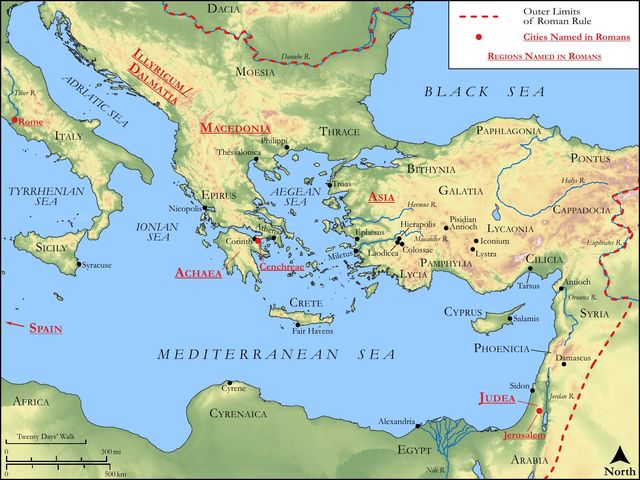
See on the biblical-era maps

Study this verse
Public-domain commentary
Matthew Henry
From his Commentary on the Whole Bible. Henry comments on passages, not single verses — this entry covers Romans 15:13. His four-level outline is real structure in the source text, so it is rendered as structure.
Here is another prayer directed to God, as the God of hope; and it is, as the former (Rom 15:5, Rom 15:6), for spiritual blessings: these are the blest blessings, and to be first and chiefly prayed for.
I.Observe how he addresses himself to God, as the God of hope.
It is good in prayer to fasten upon those names, titles, and attributes of God, which are most suitable to the errand we come upon, and will best serve to encourage our faith concerning it. Every word in the prayer should be a plea. Thus should the cause be skilfully ordered, and the mouth filled with arguments. God is the God of hope. He is the foundation on which our hope is built, and he is the builder that doth himself raise it: he is both the object of our hope, and the author of it. That hope is but fancy, and will deceive us, which is not fastened upon God (as the goodness hoped for, and the truth hoped in), and which is not of his working in us. We have both together, Psa 119:49. Thy word - there is God the object; on which thou hast caused me to hope - there is God the author of our hope, Pe1 1:3.
II.What he asks of God, not for himself, but for them.
1.That they might be filled with all joy and peace in believing. Joy and peace are two of those things in which the kingdom of God consists, Rom 14:17. Joy in God, peace of conscience, both arising from a sense of our justification; see Rom 5:1, Rom 5:2. Joy and peace in our own bosoms would promote a cheerful unity and unanimity with our brethren. Observe,
(1.)How desirable this joy and peace are: they are filling. Carnal joy puffs up the soul, but cannot fill it; therefore in laughter the heart is sad. True, heavenly, spiritual joy is filling to the soul; it has a satisfaction in it, answerable to the soul's vast and just desires. Thus does God satiate and replenish the weary soul. Nothing more than this joy, only more of it, even the perfection of it in glory, is the desire of the soul that hath it, Psa 4:6, Psa 4:7; Psa 36:8; Psa 63:5; Psa 65:4.
(2.)How it is attainable.
[1.]By prayer. We must go to God for it; he will for this be enquired of. Prayer fetches in spiritual joy and peace.
[2.]By believing; that is the means to be used. It is vain, and flashy, and transient joy, that is the product of fancy; true substantial joy is the fruit of faith. Believing, you rejoice with joy unspeakable, Pe1 1:8. It is owing to the weakness of our faith that we are so much wanting in joy and peace. Only believe; believe the goodness of Christ, the love of Christ, the promises of the covenant, and the joys and glories of heaven; let faith be the substance and evidence of these things, and the result must needs be joy and peace. Observe, It is all joy and peace - all sorts of true joy and peace. When we come to God by prayer we must enlarge our desires; we are not straitened in him, why should we be straitened in ourselves? Ask for all joy; open thy mouth wide, and he will fill it.
2.That they might abound in hope through the power of the Holy Ghost. The joy and peace of believers arise chiefly from their hopes. What is laid out upon them is but little, compared with what is laid up for them; therefore the more hope they have the more joy and peace they have. We do then abound in hope when we hope for great things from God, and are greatly established and confirmed in these hopes. Christians should desire and labour after an abundance of hope, such hope as will not make ashamed. This is through the power of the Holy Ghost. The same almighty power that works grace begets and strengthens this hope. Our own power will never reach it; and therefore where this hope is, and is abounding, the blessed Spirit must have all the glory.
Historical interpretation
Four Centuries of Reception
5 surviving comments on this verse. Each one is dated, so this reads as a timeline rather than a list.
Select a marker to jump to its quote. Markers stagger vertically where authors wrote within a few decades of each other.
Precisely how all this can be fulfilled so that they may be filled with all joy and peace is hard to say, especially since the apostle himself, when talking about the gifts of the Spirit, says that he knows in part and prophesies in part. But I think that believers can have the fullness of peace when they are reconciled to God the Father by faith.… For if someone who believes is armed with the power of the Holy Spirit, it is certain that he will always have the fullness of joy and peace.
"Now the God of hope fill you with all joy and peace in believing, that ye may abound in hope, through the power of the Holy Ghost."
That is, that ye may get clear of that heartlessness towards one another, and may never be cast down by temptations. And this will be by your abounding in hope. Now this is the cause of all good things, and it comes from the Holy Spirit. But it is not simply from the Spirit, but on condition of our contributing our part also. This is why he says, "in believing." For this is the way for you to be filled with joy, if ye believe, if ye hope. Yet he does not say if ye hope, but, "if ye abound in hope," so as not to find comfort in troubles only, but even to have joy through the abundance of faith and hope. And in this way, ye will also draw the Spirit to you. In this way, when He is come ye will continually keep to all good things. For just as food maintaineth our life, and by this ruleth the body, so if we have good works, we shall have the Spirit; and if we have the Spirit, we shall also have good works. As also, on the other hand, if we have no works, the Spirit flieth away. But if we be deserted by the Spirit, we shall also halt in our works. For when this hath gone, the unclean one cometh: this is plain from Saul. For what if he doth not choke us as he did him, still he strangles us in some other way by wicked works. We have need then of the harp of David, that we may charm our souls with the divine songs, both these, and those from good actions. Since if we do the one only, and while we listen to the charm, war with the charmer by our actions, as he did of old; the remedy will even turn to judgment to us, and the madness become the more furious. For before we heard, the wicked demon was afraid lest we should hear it and recover. But when after hearing it even, we continue the same as we were, this is the very thing to rid him of his fear. Let us sing then the Psalm of good deeds, that we may cast out the sin that is worse than the demon. For a demon certainly will not deprive us of heaven, but doth in some cases even work with the sober-minded. But sin will assuredly cast us out. For this is a demon we willingly receive, a self-chosen madness. Wherefore also it hath none to pity it or to pardon it. Let us then sing charms over a soul in this plight, as well from the other Scriptures, as also from the blessed David. And let the mouth sing, and the mind be instructed. Even this is no small thing. For if we once teach the tongue to sing, the soul will be ashamed to be devising the opposite of what this singeth. Nor is this the only good thing that we shall gain, for we shall also come to know many things which are our interest.
All the joy of believers should be in the hope to come. Where there is peace, all is joy. However, there is no joy in discord but only widespread sorrow.… Hope rests in the signs and wonders of the Holy Spirit.
By “the God of all hope” Paul means that God has blessed us with the hope of things to come.
And again: "Now the God of hope fill you with all joy and peace in believing, that ye may abound in hope, by the power of the Holy Spirit."
Continue studying Romans 15:13 across the web’s major study libraries — every link below opens this exact verse, chapter, or book on the destination site.
Read & Compare
 BibleGatewayThis verse in more than 200 translations and 70 languages.
 Bible.comThe YouVersion reader — hundreds of translations, reading plans, and highlights.
 ESV.orgCrossway's official English Standard Version reader.
 NET BibleThe NET translation with 60,000+ translators' notes on every rendering decision.
 STEP BibleTyndale House's free study tool — original text, vocabulary, and scholarly resources.
 BibliaLogos Bible Software's free web reader.
 USCCBThe New American Bible (Revised Edition) with the U.S. bishops' study notes.
Commentaries
 BibleHub CommentariesDozens of classic commentaries on this verse, gathered on one page.
 StudyLightMore than 100 commentary sets — the largest collection on the web.
 BibleRefPlain-English commentary on what this verse means, verse by verse.
 Enduring WordDavid Guzik's free commentary on this chapter, widely used by Bible teachers.
 Bible Study ToolsVerse commentary alongside Greek and Hebrew study aids.
Original Language & Research
- BibleHub InterlinearThe verse word by word — original language, transliteration, and English.
- BibleHub LexiconEvery word's original-language definition and Strong's entry.
 Blue Letter BibleDeep-study tools — Strong's numbers, concordance, and word studies.
 CNTR CollationThe earliest Greek manuscripts of this verse, collated letter by letter.
Sermons, Hymns & Audio


TrulyRandomVerse is not affiliated with these sites and doesn’t control their content. They’re linked because they’re genuinely useful.
Summary
Romans 15:13 stands as a profound benediction and prayer from the Apostle Paul, encapsulating the wellspring of Christian experience: the "God of hope." It invokes divine empowerment for believers to be thoroughly filled with joy and peace, not through external circumstances, but through the act of believing. This spiritual abundance is purposed to enable them to overflow in hope, a dynamic reality made possible and sustained by the indwelling and active power of the Holy Spirit.
Context
ShowHideLiterary Context
This verse serves as a climactic benediction following Paul's extensive exhortation in Romans 14 and the beginning of Romans 15 concerning unity and mutual acceptance within the diverse Roman church. Paul has just urged stronger believers to bear with the weaker, emphasizing Christ's example of not pleasing Himself but living for the glory of God and the benefit of others (Romans 15:1-3). The prayer for the "God of hope" to fill them with joy and peace in believing, leading to abounding hope through the Holy Spirit, is a natural culmination of his appeal for harmonious, faith-filled living, setting the stage for his subsequent discussion of his apostolic mission and plans to visit Rome. It underscores that the spiritual resources for such unity and perseverance come directly from God.
Historical & Cultural Context
The church in Rome was a complex tapestry of Jewish and Gentile believers, each bringing their own cultural norms, dietary laws, and theological perspectives. Tensions arose, particularly around issues of food sacrificed to idols, observance of special days, and general matters of conscience (as detailed in Romans 14). Paul's letter aimed to address these divisions, establish doctrinal foundations, and prepare the way for his visit and potential mission to Spain. In this context, a prayer for "joy and peace in believing" was not merely a spiritual platitude but a deep longing for the practical manifestation of unity and spiritual well-being amidst internal strife and external pressures from a pagan society. The "God of hope" would have been a comforting and empowering concept for a community navigating such challenges, reminding them of God's faithfulness despite their present difficulties.
Key Themes
ShowHideRomans 15:13 powerfully contributes to several overarching themes in the book of Romans. Firstly, it highlights God's character as the ultimate source of spiritual blessings, particularly hope, joy, and peace. This aligns with Paul's consistent emphasis on God's sovereignty and grace throughout the epistle. Secondly, it underscores the centrality of faith (believing) as the conduit through which these blessings are received, a foundational theme in Romans (Romans 1:17). Thirdly, the verse emphasizes the indispensable role of the Holy Spirit in empowering the Christian life, enabling believers to experience and abound in hope, echoing the Spirit's work described in Romans 8). Finally, it speaks to the dynamic nature of Christian hope, not as wishful thinking, but as a confident expectation that overflows, providing strength and perseverance for the journey of faith, a hope that does not disappoint (Romans 5:5).
Exposition and Analysis
ShowHideKey Word Analysis
ShowHideFrom a primary verb meaning "to anticipate, usually with pleasure," this term denotes expectation, whether abstractly or concretely, and confidence. In the New Testament, Christian hope is not a mere uncertain wish but a confident, certain expectation based on God's character and promises. It is a forward-looking assurance of future good, particularly the consummation of salvation and the return of Christ.
Meaning "to make replete," "to cram," "to level up," or "to furnish/imbue," this word suggests a complete, abundant filling, not just a partial measure. It implies that God's desire is for believers to be thoroughly saturated with joy and peace, to the point of overflowing.
Derived from a root meaning "to be able," this term refers to inherent force, ability, or strength. It often implies miraculous power, but more broadly, it signifies the divine energy and capacity of the Holy Spirit that enables believers to live the Christian life, to abound in hope, and to overcome spiritual challenges.
Verse Breakdown
ShowHide"Now the God of hope fill you with all joy and peace in believing"
Paul begins with a direct address to God, identifying Him as the ultimate "God of hope." This title emphasizes God's character as the source and sustainer of all true hope. The prayer is that this God would "fill" the Roman believers—and by extension, all believers—with "all joy and peace." The crucial qualifier "in believing" highlights that this profound spiritual filling is not automatic or circumstantial, but is directly contingent upon and experienced through active faith and trust in God. It implies that as believers exercise faith, they open themselves to receive and be saturated by these divine qualities.
"that ye may abound in hope, through the power of the Holy Ghost"
This clause reveals the purpose and the means of the preceding request. The "filling" with joy and peace in believing is so that believers may "abound" or overflow in hope. This signifies a dynamic, ever-increasing, and superabundant experience of hope, not merely a static possession. The agency through which this abounding hope becomes a reality is explicitly stated: "through the power of the Holy Ghost." The Holy Spirit is the divine enabler, the one who energizes, empowers, and sustains this overflowing hope within the believer, making it a vibrant and practical reality in their lives.
Literary Devices
ShowHideRomans 15:13 is a powerful example of a Benediction, a formal blessing or prayer for divine favor, characteristic of Paul's epistolary style. The verse employs Personification by referring to God as "the God of hope," attributing a quality (hope) to God as His very essence, implying He is not just a giver of hope but its ultimate source and embodiment. There is a clear Cause and Effect relationship: believing leads to being filled with joy and peace, which in turn leads to abounding hope, all empowered by the Holy Spirit. The repetition of "hope" ("God of hope" and "abound in hope") creates Emphasis on this central theme, highlighting its significance as both a divine attribute and a Christian experience. The structure also exhibits a form of Climax, moving from God's character, through the experience of joy and peace, to the ultimate overflowing of hope, all facilitated by the Spirit's power.
Theological and Thematic Connections
ShowHideThis profound benediction in Romans 15:13 beautifully synthesizes several core theological truths. It affirms God as the ultimate wellspring of all spiritual good, particularly the virtues of hope, joy, and peace. These are not humanly generated emotions but divine gifts, received through the active posture of faith. The verse also underscores the essential, active role of the Holy Spirit in the believer's life, not merely as a comforter but as the dynamic power that enables the Christian to experience and express these spiritual realities in abundance. This overflowing hope, rooted in God's character and empowered by the Spirit, is a vital component of Christian perseverance and witness, particularly in times of difficulty or division.
Reflection and Application
ShowHideRomans 15:13 offers a profound blueprint for the Christian life, revealing that true joy, lasting peace, and abounding hope are not found in perfect circumstances or human effort, but are divine endowments accessed through faith. It challenges believers to cultivate a deep, active trust in God, recognizing Him as the "God of hope" who desires to fill them completely. This filling is not a one-time event but an ongoing process, leading to an overflowing, dynamic hope that empowers us to face life's challenges, bear with others, and live in unity. To experience this fullness, we must consciously lean into our faith, allowing the Holy Spirit to work within us, transforming our inner landscape and enabling us to reflect God's character in a world desperate for genuine hope, joy, and peace. It serves as a powerful model for our own prayers, encouraging us to seek these spiritual realities from their divine source.
Questions for Reflection
ShowHideFAQ
ShowHideWhat does it mean for God to be "the God of hope"?
ShowHideTo call God "the God of hope" means that hope originates entirely from Him; He is its ultimate source, sustainer, and object. It's not merely that God gives hope, but that hope is an intrinsic part of His character and nature. Our hope is therefore not based on uncertain wishes or human optimism, but on the unchangeable character and faithful promises of a sovereign God. This divine attribute provides a firm foundation for believers to confidently anticipate future good, even in the midst of present difficulties, knowing that God is actively working all things for their good and His glory (Romans 8:28).
How are joy and peace connected to "believing" in this verse?
ShowHideThe phrase "in believing" is crucial, indicating that joy and peace are not external, circumstantial feelings, but internal realities that flow directly from an active, ongoing trust in God. It means that as we exercise faith—as we commit ourselves to God, His promises, and His truth—we open ourselves to receive and be filled with His joy and peace. This connection highlights that Christian joy and peace are spiritual fruits, cultivated through a relationship of faith with God, rather than being dependent on the absence of problems or the presence of favorable conditions (Philippians 4:6-7).
Christ-Centered Fulfillment
ShowHideRomans 15:13, though a prayer to the "God of hope," finds its ultimate fulfillment and deepest meaning in Jesus Christ. He is the embodiment of God's hope, the one through whom all of God's promises find their "Yes" and "Amen" (2 Corinthians 1:20). The joy and peace that believers receive "in believing" are fundamentally rooted in their faith in Christ's atoning work on the cross and His resurrection, which conquered sin and death, offering the ultimate basis for hope (1 Peter 1:3). It is through Christ that we have access by one Spirit to the Father (Ephesians 2:18). The "power of the Holy Ghost" that enables us to abound in hope is the very Spirit of Christ, poured out upon believers to empower them for life and witness, connecting them intimately to the resurrected Lord (Acts 1:8 and Romans 8:11). Thus, Christ is the object of our faith, the source of our joy and peace, and the means by which the Spirit empowers us to live a life overflowing with confident hope in God's redemptive plan.