


Philippians 1:23
- συνέχομαιsunechomaiI am pressedG4912V-PPI-1SVerb Present Passive Indicative 1st Singular
- δὲdenowG1161CONJConjunction
- ἐκekbetweenG1537PREPPreposition
- τῶνtōntheG3588T-GPNDefinite article Genitive Plural Neuter
- δύοduotwoG1417A-NUIAdjective
- τὴνtēntheG3588T-ASFDefinite article Accusative Singular Feminine
- ἐπιθυμίανepithumiandesireG1939N-ASFNoun Accusative Singular Feminine
- ἔχωνechōnhavingG2192V-PAP-NSMVerb Present Active Participle Nominative Singular Masculine
- εἰςeisfor [myself]G1519PREPPreposition
- τὸto<the>G3588T-ASNDefinite article Accusative Singular Neuter
- ἀναλῦσαιanalusaito departG360V-AANVerb Aorist Active Infinitive
- καὶkaiandG2532CONJConjunction
- σὺνsunwithG4862PREPPreposition
- ΧριστῷChristōChristG5547N-DSM-TNoun Dative Singular Masculine Title
- εἶναιeinaito beG1511V-PANVerb Present Active Infinitive
- πολλῷpollōvery muchG4183A-DSNAdjective Dative Singular Neuter
- μᾶλλονmallonmoreG3123ADVAdverb
- κρεῖσσον·kreissonbetterG2908A-NSN-CAdjective Nominative Singular Neuter Comparative
English is a literal word-by-word gloss of the Greek, not the KJV's wording. Why?
This is the original text the KJV's translators worked from — each Greek word with its own literal English meaning in this verse, prepared by scholars at Tyndale House, Cambridge. The KJV translates whole sentences, not word by word, so its wording differs: one Greek word can become several English words, and the KJV may choose “charity” where the gloss reads “love”. Both are faithful — they answer different questions. For the KJV's own rendering, switch to the KJV text.
Details
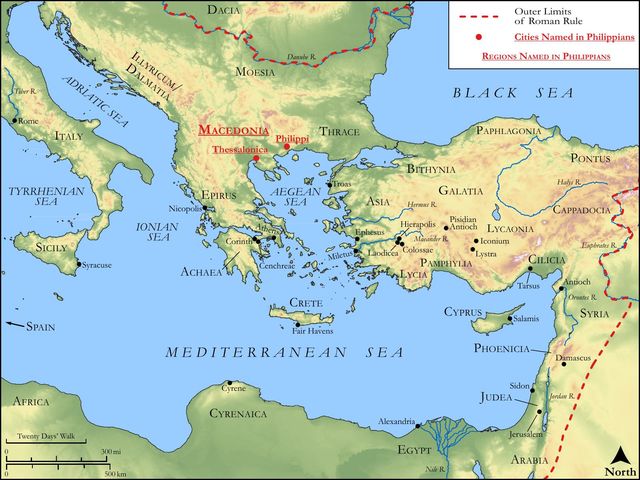
See on the biblical-era map

Study this verse
Public-domain commentary
Matthew Henry
From his Commentary on the Whole Bible. Henry comments on passages, not single verses — this entry covers Philippians 1:21–26. His three-level outline is real structure in the source text, so it is rendered as structure.
We have here an account of the life and death of blessed Paul: his life was Christ, and his death was gain. Observe, 1. It is the undoubted character of every good Christian that to him to live is Christ. The glory of Christ ought to be the end of our life, the grace of Christ the principle of our life, and the word of Christ the rule of it. The Christian life is derived from Christ, and directed to him. He is the principle, rule, and end of it. 2. All those to whom to live is Christ to them to die will be gain: it is great gain, a present gain, everlasting gain. Death is a great loss to a carnal worldly man; for he loses all his comforts and all his hopes: but to a good Christian it is gain, for it is the end of all his weakness and misery and the perfection of his comforts and accomplishment of his hopes; it delivers him from all the evils of life, and brings him to the possession of the chief good. Or, To me to die is gain; that is, "to the gospel as well as to myself, which will receive a further confirmation by the seal of my blood, as it had before by the labours of my life." So Christ would be magnified by his death, Phi 1:20. Some read the whole expression thus: To me, living and dying, Christ is gain; that is, "I desire no more, neither while I live nor when I die, but to win Christ and be found in him." It might be thought, if death were gain to him, he would be weary of life, and impatient for death. No, says he,
I.If I live in the flesh, this is the fruit of my labour (Phi 1:22), that is, Christ is.
He reckoned his labour well bestowed, if he could be instrumental to advance the honour and interest of the kingdom of Christ in the world. It is the fruit of my labour - karpos ergou - operae pretium. It is worth while for a good Christian and a good minister to live in the world as long as he can glorify God and do good to his church. Yet what I shall choose I wot not; for I am in a strait betwixt two. It was a blessed strait which Paul was in, not between two evil things, but between two good things. David was in a strait by three judgments - sword, famine, and pestilence: Paul was in a strait between two blessings - living to Christ, and being with him. Here we have him reasoning with himself upon the matter.
1.His inclination was for death. See the power of faith and of divine grace; it can reconcile the mind to death, and make us willing to die, though death is the destruction of our present nature and the greatest natural evil. We have naturally an aversion to death, but he had an inclination to it (Phi 1:23); Having a desire to depart, and to be with Christ, Observe,
(1.)It is being with Christ which makes a departure desirable to a good man. It is not simply dying, or putting off the body, it is not of itself and for its own sake a desirable thing; but it may be necessarily connected with something else which may make it truly so. If I cannot be with Christ without departing, I shall reckon it desirable on that account to depart.
(2.)As soon as ever the soul departs, it is immediately with Christ. This day shalt thou be with me in paradise, Luk 23:43. Absent from the body and present with the Lord (Co2 5:8), without any interval between. Which is far better, pollō gar mallon kreisson - very much exceeding, or vastly preferable. Those who know the value of Christ and heaven will readily acknowledge it far better to be in heaven than to be in this world, to be with Christ than to be with any creature; for in this world we are compassed about with sin, born to trouble, born again to it; but, if we come to be with Christ, farewell sin and temptation, farewell sorrow and death, for ever.
2.His judgment was rather to live awhile longer in this world, for the service of the church (Phi 1:24): Nevertheless to abide in the flesh is more needful for you. It is needful for the church to have ministers; and faithful ministers can ill be spared when the harvest is plenteous and the labourers are few. Observe, Those who have most reason to desire to depart should be willing to continue in the world as long as God has any work for them to do. Paul's strait was not between living in this world and living in heaven; between these two there is no comparison: but his strait was between serving Christ in this world and enjoying him in another. Still it was Christ that his heart was upon: though, to advance the interest of Christ and his church, he chose rather to tarry here, where he met with oppositions and difficulties, and to deny himself for awhile the satisfaction of his reward.
II.And, having this confidence, I know that I shall abide and continue with you all for your furtherance and joy of faith, Phi 1:25.
Observe here, 1. What a great confidence Paul had in the divine Providence, that it would order all for the best to him. "Having this confidence that it will be needful for you that I should abide in the flesh, I know that I shall abide." 2. Whatsoever is best for the church, we may be sure God will do. If we know what is needful for building up the body of Christ, we may certainly know what will be; for he will take care of its interests, and do what is best, all things considered, in every condition it is in. 3. Observe what ministers are continued for: For our furtherance and joy of faith, our further advancement in holiness and comfort. 4. What promotes our faith and joy of faith is very much for our furtherance in the way to heaven. The more faith the more joy, and the more faith and joy the more we are furthered in our Christian course. 5. There is need of a settled ministry, not only for the conviction and conversion of sinners, but for the edification of saints, and their furtherance in spiritual attainments.
III.That your rejoicing may be more abundant in Jesus Christ for me, by my coming to you again, Phi 1:26.
They rejoiced in the hope of seeing him, and enjoying his further labours among them. Observe,
1.The continuance of ministers with the church ought to be the rejoicing of all who wish well to the church, and to its interests.
2.All our joys should terminate in Christ. Our joy in good ministers should be our joy in Christ Jesus for them; for they are but the friends of the bridegroom, and are to be received in his name, and for his sake.
Historical interpretation
Two Centuries of Reception
9 surviving comments on this verse. Each one is dated, so this reads as a timeline rather than a list.
Select a marker to jump to its quote. Markers stagger vertically where authors wrote within a few decades of each other.
Impatience is a bad omen for our hope. It puts our faith in doubt. We wound Christ when we do not accept with equanimity his calling people away, treating them as though they were to be pitied. “I long,” says the apostle, “to be taken up and be with Christ.” How much better is the wish that he expresses!
"But Christians concern themselves about posterity"-to whom there is no to-morrow! Shall the servant of God yearn after heirs, who has disinherited himself from the world? And is it to be a reason for a man to repeat marriage, if from his first (marriage) he have no children? And shall he thus have, as the first benefit (resulting therefrom), this, that he should desire longer life, when the apostle himself is in haste to be "with the Lord? " Assuredly, most free will he be from encumbrance in persecutions, most constant in martyrdoms, most prompt in distributions of his goods, most temperate in acquisitions; lastly, undistracted by cares will he die, when he has left children behind him-perhaps to perform the last rites over his grave! Is it then, perchance, in forecast for the commonwealth that such (marriages)are contracted? for fear the States fail, if no rising generations be trained up? for fear the rights of law, for fear the branches of commerce, sink quite into decay? for fear the temples be quite forsaken? for fear there be none to raise the acclaim, "The lion for the Christians? "-for these are the acclaims which they desire to hear who go in quest of offspring! Let the well-known burdensomeness of children-especially in our case-suffice to counsel widowhood: (children) whom men are compelled by laws to undertake (the charge of); because no wise man would ever willingly have desired sons! What, then, will you do if you succeed in filling your new wife with your own conscientious scruples? Are you to dissolve the conception by aid of drags? I think to us it is no more lawful to hurt (a child) in process of birth, than one (already) horn.
You long for the goal, and the stage, and the dust, and the place of combat! I would have you answer me this question: Can we not live without pleasure, who cannot but with pleasure die? For what is our wish but the apostle's, to leave the world, and be taken up into the fellowship of our Lord? You have your joys where you have your longings.
For why should we be eager to bear children, whom, when we have them, we desire to send before us (to glory) (in respect, I mean, of the distresses that are now imminent); desirous as we are ourselves, too, to be taken out of this most wicked world, and received into the Lord's presence, which was the desire even of an apostle? To the servant of God, forsooth, offspring is necessary! For of our own salvation we are secure enough, so that we have leisure for children! Burdens must be sought by us for ourselves which are avoided even by the majority of the Gentiles, who are compelled by laws, who are decimated by abortions; burdens which, finally, are to us most of all unsuitable, as being perilous to faith! For why did the Lord foretell a "woe to them that are with child, and them that give suck," except because He testifies that in that day of disencumbrance the encumbrances of children will be an inconvenience? It is to marriage, of course, that those encumbrances appertain; but that ("woe") will not pertain to widows.
In expressing such a desire he knew that when he returns to Christ he will know more plainly the causes of all that is happening on earth. He will then know more of what constitutes his own humanity, his soul, his mind, his spirit. He will then know more of what the Spirit is enabling and what grace it is that is being given to those who are faithful in the Holy Spirit.
And so that you may know that it is good to agree the beginning and the end, Jesus Himself says: I am the Alpha and the Omega, the beginning and the end. Therefore, since our mind is always with him, let it never depart from his temple, from his word. Let it always be in the reading of the Scriptures, in meditations, in prayers, so that his word, who he is, may always work in us, and so that every day as we go to the Church, or as we engage in domestic prayers, we may begin with him and end in him. Therefore, may the whole day of our life and the course of the day take its beginning from him and end in him. For just as it is necessary to believe and be initiated to God from the beginning of life, so perseverance is necessary until the end. But no one is good, except God alone. From Him we proceed, created by Him: to Him we return, for to be with Christ is much better.
What does this departure mean but the dissolution and torpor of the body, while the soul for its part is turned toward its rest and made free, if it be faithful, “to be with Christ”?
Oh that spirit of Paul! nothing was ever like it, nor ever will be! Thou fearest the future, thou art compassed by innumerable dreadful things, and wilt thou not be with Christ? No, he answers, and this for Christ's sake, that I may render more loving unto Him those whom I have made his servants, that I may make the plot which I have planted bear much fruit. Didst thou not hear me, when I declared that I sought not "that which profited myself" but my neighbor? Heardest thou not these words, "I could wish that I myself were anathema from Christ", that many might come unto Him? I, who chose that part, shall I not much rather choose this, shall I not with pleasure harm myself by this delay and postponement, that they may be saved?
"Who shall utter Thy mighty acts, O Lord", because Thou sufferedst not Paul to be hidden, because Thou madest manifest to the world such a man? All the Angels of God praised Thee with one accord, when Thou madest the stars, and so too surely when Thou madest the sun, but not so much as when Thou didst manifest Paul to the whole world. By this, the earth was made more brilliant than the heaven, for he is brighter than the solar light, he hath shot forth more brilliant rays, he hath shed abroad more joyous beams. What fruit hath this man borne for us! not by making fat our corn, not by nurturing our pomegranates, but by producing and perfecting the fruit of holiness, and when falling to pieces, continually recovering them. For the sun itself can nothing profit fruits that are once decayed, but Paul has called out of their sins those who had manifold decays. And it gives place to the night, but he had mastery over the Devil. Nothing ever subdued him, nothing mastered him. The sun, when it mounts the heavens, darts down its rays, but he, as he rose from beneath, filled not the mid space of heaven and earth with light, but as soon as he opened his mouth, filled the Angels with exceeding joy. For if "there is joy in heaven over one sinner that repenteth", while he at his first address caught multitudes, does he not fill with joy the Powers above? What say I? It sufficeth that Paul should only be named, and the heavens leap for joy. For if when the Israelites "went forth out of Egypt, the mountains skipped like rams", how great, thinkest thou, was the joy, when men ascended from earth to heaven!
"I am in a strait betwixt the two, having the desire."
See the affection of this blessed one; in this way too he comforts them, when they see that he is master of his own choice, and that this is done not by man's sin, but by the dispensation of God. Why mourn ye, says he, at my death? It had been far better to have passed away long since. "For to depart," he says, "and to be with Christ, is very far better."
Continue studying Philippians 1:23 across the web’s major study libraries — every link below opens this exact verse, chapter, or book on the destination site.
Read & Compare
 BibleGatewayThis verse in more than 200 translations and 70 languages.
 Bible.comThe YouVersion reader — hundreds of translations, reading plans, and highlights.
 ESV.orgCrossway's official English Standard Version reader.
 NET BibleThe NET translation with 60,000+ translators' notes on every rendering decision.
 STEP BibleTyndale House's free study tool — original text, vocabulary, and scholarly resources.
 BibliaLogos Bible Software's free web reader.
 USCCBThe New American Bible (Revised Edition) with the U.S. bishops' study notes.
Commentaries
 BibleHub CommentariesDozens of classic commentaries on this verse, gathered on one page.
 StudyLightMore than 100 commentary sets — the largest collection on the web.
 BibleRefPlain-English commentary on what this verse means, verse by verse.
 Enduring WordDavid Guzik's free commentary on this chapter, widely used by Bible teachers.
 Bible Study ToolsVerse commentary alongside Greek and Hebrew study aids.
Original Language & Research
- BibleHub InterlinearThe verse word by word — original language, transliteration, and English.
- BibleHub LexiconEvery word's original-language definition and Strong's entry.
 Blue Letter BibleDeep-study tools — Strong's numbers, concordance, and word studies.
 CNTR CollationThe earliest Greek manuscripts of this verse, collated letter by letter.
Sermons, Hymns & Audio


TrulyRandomVerse is not affiliated with these sites and doesn’t control their content. They’re linked because they’re genuinely useful.
Summary
In Philippians 1:23, the Apostle Paul articulates a profound spiritual dilemma, revealing his innermost thoughts and desires during his imprisonment. This verse encapsulates the Christian hope regarding life, death, and eternity with Christ, offering immense comfort and insightful perspective into the believer's ultimate destiny and the surpassing superiority of eternal fellowship with the Savior.
Context
ShowHideLiterary Context
Philippians 1:23 stands as the culmination of Paul's deeply personal reflection on his imprisonment and the purpose of his life and death. It immediately follows his powerful declaration in Philippians 1:21: "For to me to live is Christ, and to die is gain." This verse then elaborates on why death is gain – it is the direct means to achieve immediate presence with Christ. The tension expressed here, between his personal longing for Christ and his commitment to the Philippian believers, is resolved in the subsequent verses (Philippians 1:24-26), where he ultimately decides that remaining alive for their spiritual advancement is more needful. Thus, this verse serves as a pivotal moment in his argument, highlighting the depth of his devotion to both Christ and the church.
Historical & Cultural Context
Paul is writing from prison, most likely in Rome, facing the very real possibility of execution. In the Roman world, death was often viewed with fear, as an inevitable end, or sometimes with Stoic indifference, but rarely with the profound hope expressed by Paul. The Philippian church, situated in a Roman colony, would be familiar with Roman legal proceedings and the concept of a prisoner's fate. Paul's language of "departing" (like a ship setting sail or a tent being struck) would resonate with common travel metaphors of the time. His dilemma transcends mere personal preference, reflecting a deep theological conviction about the nature of the afterlife, contrasting sharply with pagan or even some Jewish views that lacked the specific Christian assurance of immediate, conscious fellowship with the resurrected Christ.
Key Themes
ShowHideThis verse contributes significantly to several major themes within Philippians and Paul's broader theology. First, it powerfully articulates The Christian Hope Beyond Death, asserting that death for a believer is not an end but a glorious transition into the direct presence of Christ. Second, it underscores The Supremacy of Christ, declaring that being with Him is "far better" than any earthly experience, even a life dedicated to ministry. This highlights the unparalleled value and joy found in direct communion with the Savior. Third, it illuminates Selfless Service versus Personal Desire, showcasing Paul's profound internal struggle between his intense spiritual longing for heaven and his pastoral responsibility to continue ministering to the Philippians for their "progress and joy in the faith" (Philippians 1:25). This tension reveals the depth of his love and commitment to the church, even when it meant delaying his ultimate spiritual fulfillment.
Exposition and Analysis
ShowHideKey Word Analysis
ShowHideThis verb, translated as "in a strait," means "to hold together," "to compress," or "to be constrained." Figuratively, it conveys being perplexed, afflicted, or preoccupied by a strong internal pressure. Paul is not merely undecided; he is truly caught in a profound dilemma, intensely pressed by two compelling, yet opposing, forces.
This word literally means "to unloose," "to break up a camp," or "to set sail." It is a vivid and evocative metaphor for death, implying a release from earthly bonds and a journey to a new destination. It suggests not an annihilation, but a transition or a setting off for a better, predetermined place, much like a ship leaving harbor.
This adjective means "better" or "of greater advantage." In the KJV, the phrase "far better" intensifies this, reflecting the Greek construction pollō mâllon kreîsson (much rather better), emphasizing an immense, undeniable, and incomparable superiority. Paul's conviction is that being with Christ is not just a slight improvement, but an overwhelmingly superior state of existence.
Verse Breakdown
ShowHide"For I am in a strait betwixt two"
Paul expresses an intense internal conflict, a feeling of being pressed or constrained by two opposing, yet equally compelling, options. This is not mere indecision but a profound spiritual tension arising from his deep love for Christ and his pastoral heart for the Philippian believers.
"having a desire to depart, and to be with Christ;"
Paul reveals his personal, deep-seated longing for death, not as an escape from suffering, but as the direct means to achieve immediate, intimate, and unhindered fellowship with Christ. "Depart" is a euphemism for death, implying a journey or release into a more glorious reality.
"which is far better:"
This declares the absolute and incomparable superiority of being with Christ over any earthly existence, even a life dedicated to fruitful ministry. It is an emphatic statement of the ultimate gain found in Christ's presence, surpassing all other experiences, benefits, or desires.
Literary Devices
ShowHidePhilippians 1:23 effectively employs several literary devices to convey Paul's profound spiritual state. The primary device is Dilemma or Antithesis, as Paul presents himself as "in a strait betwixt two" compelling options: continuing life and ministry versus departing to be with Christ. This highlights the tension between his earthly calling and his heavenly longing. Paul also uses Euphemism when he speaks of "departing" for death, softening the harsh reality of mortality while simultaneously imbuing it with a sense of purposeful journey. The phrase "far better" functions as a form of Hyperbole or Intensification, utilizing a strong comparative in Greek (πολλῷ μᾶλλον κρεῖσσον) to emphasize the overwhelming and incomparable superiority of being with Christ. Finally, the verse is a powerful Personal Confession, offering a deeply intimate glimpse into Paul's innermost thoughts and desires, making his theological convictions relatable and impactful.
Theological and Thematic Connections
ShowHidePhilippians 1:23 stands as a cornerstone for understanding the Christian's hope beyond death, affirming the immediate and conscious presence of believers with Christ upon their physical demise. It underscores that for the follower of Jesus, death is not an end but a promotion, a transition from earthly pilgrimage to eternal, unhindered communion with the Savior. This perspective transforms death from a feared enemy into a gateway to ultimate fulfillment, redefining life's priorities and infusing believers with courage in the face of mortality. It highlights the profound truth that the greatest good is not found in earthly achievements or even in ministry itself, but in the person of Christ and unmediated fellowship with Him.
Reflection and Application
ShowHidePaul's profound dilemma in Philippians 1:23 offers immense comfort and a vital perspective for believers today, particularly regarding death and our ultimate hope. It assures us that for the Christian, death is not a terrifying void but a direct, immediate transition into the glorious presence of Christ, a reality that is "far better" than anything this life can offer. This truth can radically transform our fear of dying into a confident anticipation of eternal joy, providing deep solace in times of grief and loss for loved ones who have died in Christ. Furthermore, it challenges us to live with an eternal perspective, prioritizing what truly matters in light of our ultimate destination. While we long for that "far better" reality, Paul's example also reminds us of our present calling: to selflessly serve God and others, even when it means delaying our personal desires, for the advancement of the gospel and the spiritual growth of the church.
Questions for Reflection
ShowHideFAQ
ShowHideDoes this verse imply that Christians go directly to heaven upon death?
ShowHideYes, Philippians 1:23 strongly supports the concept of immediate, conscious presence with Christ upon death. Paul's desire to "depart, and to be with Christ" clearly indicates a direct transition, without any intervening period of unconsciousness or delay. This aligns with other New Testament passages that describe believers being "absent from the body, and present with the Lord" (2 Corinthians 5:8).
Was Paul wishing for death here?
ShowHidePaul was not expressing a suicidal wish or a desire to escape suffering. Rather, he was articulating a profound spiritual longing for the ultimate fulfillment of his faith, which he knew would come through death and immediate, unhindered fellowship with Christ. It was a desire rooted in deep love for Christ and a clear understanding of the glorious destiny awaiting believers.
How does Paul reconcile his desire to die with his commitment to ministry?
ShowHidePaul reconciles this intense personal longing with his ministerial commitment by prioritizing the spiritual welfare and advancement of the Philippian believers. While being with Christ was "far better" for him personally, he recognized that his continued presence and ministry were "more needful" for their "progress and joy in the faith" (Philippians 1:24-26). His decision demonstrates a profound act of selfless love and obedience to God's ongoing call on his life.
Christ-Centered Fulfillment
ShowHidePaul's profound desire to "depart, and to be with Christ" is not merely a personal wish but a powerful testament to the Christ-centered hope that defines the Christian faith. The "far better" reality is exclusively made possible by the person and work of Jesus Christ. It is Christ who conquered death and the grave through His resurrection, thereby disarming its power and transforming it from a dreaded end into a glorious gateway. He is the one who promised, "I go to prepare a place for you... that where I am, there ye may be also" (John 14:3). Paul's longing is for the ultimate consummation of his relationship with the Lamb of God, who sacrificed Himself to reconcile humanity to God. Our hope is not in a vague heaven, but in the living Christ, who is our life and our peace. Thus, Philippians 1:23 points us not simply to an afterlife, but to the eternal, unhindered, and perfect communion with our Risen Lord, the very essence of our salvation and ultimate joy.