


1 Kings 19:6
Bible text: King James Version (1769 Blayney text) · Public domain
Bible text: Berean Standard Bible · Public domain
Bible text: American Standard Version (1901) · Public domain
Bible text: World English Bible, Messianic edition · Public domain
Bible text: Geneva Bible (1599) · Public domain
Bible text: Young's Literal Translation · Public domain
- וַיַּבֵּטvai·ya·Betand he lookedH5027Conj-w ¦ V-Hiphil-ConsecImperf-3msVerb Hiphil Consecutive Imperfect 3rd Singular Masculineוַandיַּבֵּטhe looked
- וְהִנֵּהve·hi·Nehand there!H2009Conj-w ¦ PrtParticle Interjectionוְandהִנֵּהthere!
- מְרַאֲשֹׁתָיוme·ra·'a·sho·Tav[was] [the] his place of headH4763N-fpc ¦ 3msNoun Plural Feminine Constructמְרַאֲשֹׁתָי[was] [the] place of headוhis
- עֻגַת'u·Gata bread cake ofH5692N-fscNoun Singular Feminine Construct
- רְצָפִיםre·tza·Fimhot coalsH7529N-mpNoun Plural Masculine Absolute
- וְצַפַּחַתve·tza·Pa·chatand a jug ofH6835Conj-w ¦ N-fscNoun Singular Feminine Constructוְandצַפַּחַתa jug of
- מָיִםMa·yimwaterH4325N-mpNoun Plural Masculine Absolute
- וַיֹּאכַלvai·Yo·khaland he ateH398Conj-w ¦ V-Qal-ConsecImperf-3msVerb Qal Consecutive Imperfect 3rd Singular Masculineוַandיֹּאכַלhe ate
- וַיֵּשְׁתְּvai·Ye·shetand he drankH8354Conj-w ¦ V-Qal-ConsecImperf-3msVerb Qal Consecutive Imperfect 3rd Singular Masculineוַandיֵּשְׁתְּhe drank
- וַיָּשָׁבvai·Ya·shovand he returnedH7725Conj-w ¦ V-Qal-ConsecImperf-3msVerb Qal Consecutive Imperfect 3rd Singular Masculineוַandיָּשָׁבhe returned
- וַיִּשְׁכָּבvai·yish·Kavand he lay downH7901Conj-w ¦ V-Qal-ConsecImperf-3msVerb Qal Consecutive Imperfect 3rd Singular Masculineוַandיִּשְׁכָּבhe lay down
English is a literal word-by-word gloss of the Hebrew, not the KJV's wording. Why?
This is the original text the KJV's translators worked from — each Hebrew word with its own literal English meaning in this verse, prepared by scholars at Tyndale House, Cambridge. The KJV translates whole sentences, not word by word, so its wording differs: one Hebrew word can become several English words, and the KJV may choose “the LORD” where the gloss reads “Yahweh”. Both are faithful — they answer different questions. For the KJV's own rendering, switch to the KJV text.
Details
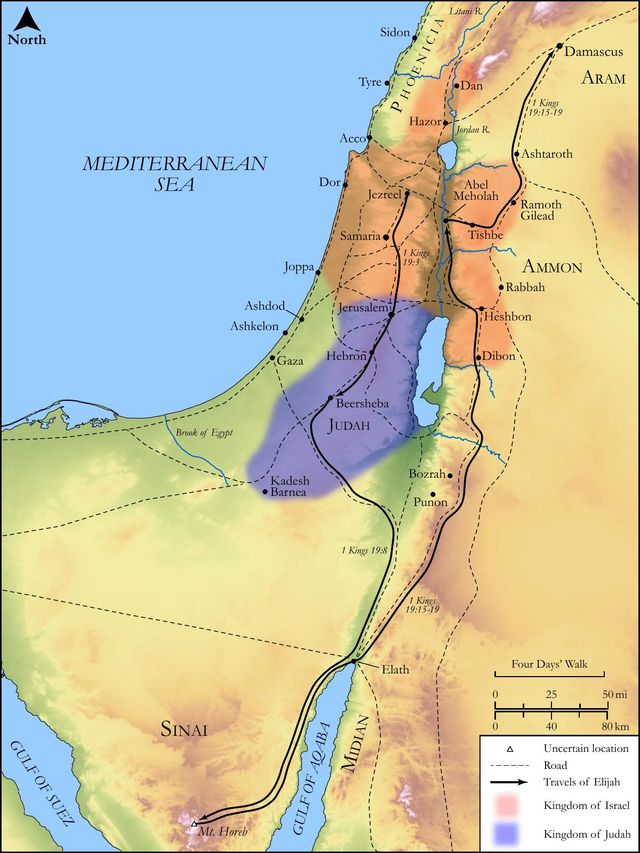
See on the biblical-era maps
Study this verse
Public-domain commentary
Matthew Henry
From his Commentary on the Whole Bible. Henry comments on passages, not single verses — this entry covers 1 Kings 19:1–8.
One would have expected, after such a public and sensible manifestation of the glory of God and such a clear decision of the controversy depending between him and Baal, to the honour of Elijah, the confusion of Baal's prophets, and the universal satisfaction of the people - after they had seen both fire and water come from heaven at the prayer of Elijah, and both in mercy to them, the one as it signified the acceptance of their offering, the other as it refreshed their inheritance, which was weary - that now they would all, as one man, return to the worship of the God of Israel and take Elijah for their guide and oracle, that he would thenceforward be prime-minister of state, and his directions would be as laws both to king and kingdom. But it is quite otherwise; he is neglected whom God honoured; no respect is paid to him, nor care taken of him, nor any use made of him, but, on the contrary, the land of Israel, to which he had been, and might have been, so great a blessing, is now made too hot for him. 1. Ahab incensed Jezebel against him. That queen-consort, it seems, was in effect queen-regent, as she was afterwards when she was queen-dowager, an imperious woman that managed king and kingdom and did what she would. Ahab's conscience would not let him persecute Elijah (some remains he had in him of the blood and spirit of an Israelite, which tied his hands), but he told Jezebel all that Elijah had done (Kg1 19:1), not ton convince, but to exasperate her. It is not said he told her what God had done, but what Elijah had done, as if he, by some spell or charm, had brought fire from heaven, and the hand of the Lord had not been in it. Especially he represented to her, as that which would make her outrageous against him, that he had slain the prophets; the prophets of Baal he calls the prophets, as if none but they were worthy of the name. His heart was set upon them, and he aggravated the slaying of them as Elijah's crime, without taking notice that it was a just reprisal upon Jezebel for killing God's prophets, Kg1 18:4. Those who, when they cannot for shame or fear do mischief themselves, yet stir up others to do it, will have it laid to their charge as if they had themselves done it. 2. Jezebel sent him a threatening message (Kg1 19:2), that she had vowed and sworn to be the death of him within twenty-four hours. Something prevents her from doing it just now, but she resolves it shall not be long undone. Note, Carnal hearts are hardened and enraged against God by that which should convince and conquer them and bring them into subjection to him. She swears by her gods, and, raging like one distracted, curseth herself if she slay not him, without any proviso of a divine permission. Cruelty and confidence often meet in persecutors. I will pursue, I will overtake, Exo 15:9. But how came she to send him word of her design, and so to give him an opportunity of making his escape? Did she think him so daring that he would not flee, or herself so formidable that she could prevent him? Or was there a special providence in it, that she should be thus infatuated by her own fury? I am apt to think that though she desired nothing more than his blood, yet, at this time, she durst not meddle with him for fear of the people, all counting him a prophet, a great prophet, and therefore sent this message to him merely to frighten him and get him out of the way. for the present, that he might not carry on what he had begun. The backing of her threats with an oath and imprecation does not at all prove that she really intended to slay him, but only that she intended to make him believe so. The gods she swore by could do her no harm. 3. Elijah, hereupon, in a great fright, fled for his life, it is likely by night, and came to Beer-sheba, Kg1 19:3. Shall we praise him for this? We praise him not. Where was the courage with which he had lately confronted Ahab and all the prophets of Baal? Nay, which kept him by his sacrifice when the fire of God fell upon it? He that stood undaunted in the midst of the terrors both of heaven and earth trembles at the impotent menaces of a proud passionate woman. Lord, what is man! Great faith is not always alike strong. He could not but know that he might be very serviceable to Israel at this juncture, and had all the reason in the world to depend upon God's protection while he was doing God's work; yet he fled. In his former danger God had bidden him hide himself (Kg1 17:3), therefore he supposed he might do so now. 4. From Beer-sheba he went forward into the wilderness, that vast howling wilderness in which the Israelites wandered. Beer-sheba was so far distant from Jezreel, and within the dominion of so good a king as Jehoshaphat, that he could not but be safe there; yet, as if his fears haunted him even when he was out of the reach of danger, he could not rest there, but went a day's journey into the desert. Yet perhaps he retired thither not so much for his safety as that he might be wholly retired from the world, in order to a more free and intimate communion with God. He left his servant at Beer-sheba that he might be private in the wilderness, as Abraham left his servants at the bottom of the hill when he went up into the mount to worship God, and as Christ in the garden was withdrawn from his disciples, or perhaps it was because he would not expose his servant, who was young and tender, to the hardships of the wilderness, which would have been putting new wine into old bottles. We ought thus to consider the frame of those who are under our charge, for God considers ours. 5. Being wearied with his journey, he grew cross (like children when they are sleepy) and wished he might die, Kg1 19:4. He requested for his life (so it is ion the margin), that he might die; for death is life to a good man; the death of the body is the life of the soul. Yet that was not the reason why he wished to die; it was not the deliberate desire of grace, as Paul's, to depart and be with Christ, but the passionate wish of his corruption, as Job's. Those that are, in this manner, forward to die are not in the fittest frame for dying. Jezebel has sworn his death, and therefore he, in a fret, prays for it, runs from death to death, yet with this difference, he wishes to die by the hand of the Lord, whose tender mercies are great, and not to fall into the hands of man, whose tender mercies are cruel. He would rather die in the wilderness than as Baal's prophet died, according to Jezebel's threatening (Kg1 19:2), lest the worshippers of Baal should triumph and blaspheme the God of Israel, whom they will think themselves too hard for, if they can run down his advocate. He pleads, "It is enough. I have done enough, and suffered enough. I am weary of living." Those that have secured a happiness in the other world will soon have enough of this world. He pleads, "I am not better than my fathers, not better able to bear those fatigues, and therefore why should I be longer burdened with them than they were?" But is this that my lord Elijah? Can that great and gallant spirit shrink thus? God thus left him to himself, to show that when he was bold and strong it was in the Lord and the power of his might, but of himself he was no better than his fathers or brethren. 6. God, by an angel, fed him in that wilderness, into the wants and perils of which he had wilfully thrown himself, and in which, if God had not graciously succoured him, he would have perished. How much better does God deal with his froward children than they deserve! Elijah, in a pet, wished to die; God needed him not, yet he designed further to employ and honour him, and therefore sent an angel to keep him alive. Our case would be bad sometimes if God should take us at our word and grant us our foolish passionate requests. Having prayed that he might die, he laid down and slept (Kg1 19:5), wishing it may be to die in his sleep, and not to awake again; but he is awakened out of his sleep, and finds himself not only well provided for with bread and water (Kg1 19:6), but, which was more, attended by an angel, who guarded him when he slept, and twice called him to his food when it was ready for him, Kg1 19:5, Kg1 19:7. He needed not to complain of the unkindness of men when it was thus made up by the ministration of angels. Thus provided for, he had reason to think he had fared better than the prophets of the groves, that did eat at Jezebel's table. Wherever God's children are, as they are still upon their Father's ground, so they are still under their Father's eye and care. They may lose themselves in a wilderness, but God has not lost them; there they may look at him that lives and sees them, as Hagar, Gen 16:13. 7. He was carried, in the strength of this meat, to Horeb, the mount of God, Kg1 19:8. Thither the Spirit of the Lord led him, probably beyond his own intention, that he might have communion with God in the same place where Moses had, the law that was given by Moses being revived by him. The angel bade him eat the second time, because of the greatness of the journey that was before him, Kg1 19:7. Note God knows what he designs us for, though we do not, what service, what trials, and will take care for us when we, for want of foresight, cannot for ourselves, that we be furnished for them with grace sufficient. He that appoints what the voyage shall be will victual the ship accordingly. See how many different ways God took to keep Elijah alive; he fed him by ravens, with multiplied meals - then by an angel - and now, to show that man lives not by bread alone, he kept him alive forty days without meat, not resting and sleeping, which might make him the less to crave sustenance, but continually traversing the mazes of the desert, a day for a year of Israel's wanderings; yet he neither needs food nor desires it. The place, no doubt, reminds him of the manna, and encourages him to hope that God will sustain him here, and in due time bring him hence, as he did Israel, though, like him, fretful and distrustful.
Historical interpretation
Historical reception
1 surviving comment on this verse from the historical church.
“The angel of the Lord came a second time, touched him and said, ‘Get up and eat, otherwise the journey will be too much for you.’ ” Elijah was sleeping under a tree. Now an angel came to him and woke him up (sleep was weighing him down because of his fatigue, affliction and discouragement) and provided him with strength and comfort through the meal that he prepared for him. The nourishment of the prophet consisted of bread baked in the ashes and his drink of water. “And he said, ‘The journey will be too much for you,’ ” that is, “you will not escape the affliction which you fear, through your death, as you believe, but through your flight. Therefore the journey is too long for you, and it is not like going to Cherith, a place close by. Rather, you are leaving for a distant location among foreign people where you will get peace and prosperity. That is why, until you are allowed to do so, you must eat and drink and prepare yourself to be strong enough for a long journey, because in a barren and desert land, you will not find any food.”Allegorically the bread baked in the ashes, which the vigilant [the angel] offers to Elijah, has two different meanings: on the one side, it immediately shows the toils of penitence which the ashes symbolize perfectly, since they are a figure of mourning and of a contrite heart; the unleavened bread soaked in ashes and the water are also the food of the poor and the miserable. But we can say, with greater accuracy, that they are figures of all the righteous, for whom the providence of the Creator has established a course of life in the paths of privation. Therefore he leads them through much suffering, privation of food and a severe fast in order to purify them completely from all the filth of earthly things. Then he guides them to the mountain, which is the perfection and the accomplishment of the saints.
Continue studying 1 Kings 19:6 across the web’s major study libraries — every link below opens this exact verse, chapter, or book on the destination site.
Read & Compare
 BibleGatewayThis verse in more than 200 translations and 70 languages.
 Bible.comThe YouVersion reader — hundreds of translations, reading plans, and highlights.
 ESV.orgCrossway's official English Standard Version reader.
 NET BibleThe NET translation with 60,000+ translators' notes on every rendering decision.
 STEP BibleTyndale House's free study tool — original text, vocabulary, and scholarly resources.
 BibliaLogos Bible Software's free web reader.
 USCCBThe New American Bible (Revised Edition) with the U.S. bishops' study notes.
Commentaries
 BibleHub CommentariesDozens of classic commentaries on this verse, gathered on one page.
 StudyLightMore than 100 commentary sets — the largest collection on the web.
 BibleRefPlain-English commentary on what this verse means, verse by verse.
 Enduring WordDavid Guzik's free commentary on this chapter, widely used by Bible teachers.
 Bible Study ToolsVerse commentary alongside Greek and Hebrew study aids.
Original Language & Research
- BibleHub InterlinearThe verse word by word — original language, transliteration, and English.
- BibleHub LexiconEvery word's original-language definition and Strong's entry.
 Blue Letter BibleDeep-study tools — Strong's numbers, concordance, and word studies.
 SefariaThe Hebrew text with Rashi and centuries of Jewish commentary.
Sermons, Hymns & Audio


TrulyRandomVerse is not affiliated with these sites and doesn’t control their content. They’re linked because they’re genuinely useful.
Summary
1 Kings 19:6 vividly portrays God's tender and immediate provision for the prophet Elijah, who, after a monumental spiritual triumph and subsequent flight from Queen Jezebel, had succumbed to profound despair and physical exhaustion. This verse details the miraculous appearance of a freshly baked cake and a cruse of water, provided by an angelic messenger. Elijah's act of eating, drinking, and then resuming his rest underscores the divine care that met his most basic physical and emotional needs, thereby restoring him and preparing him for the arduous journey and renewed divine encounter that lay ahead. It is a powerful illustration of God's compassionate attentiveness to His servants, even in their moments of deepest vulnerability.
Context
ShowHideLiterary Context
This verse is a pivotal moment in the narrative immediately following Elijah's dramatic victory over the prophets of Baal on Mount Carmel. Despite this profound display of divine power, Elijah surprisingly flees into the wilderness upon hearing Queen Jezebel's death threat (1 Kings 19:1-3). Overwhelmed by fear and exhaustion, he reaches a point of utter despondency under a broom tree, praying for death (1 Kings 19:4). While in this state of physical and emotional collapse, an angel of the Lord touches him, instructing him to eat, setting the stage for the specific provision detailed in 1 Kings 19:5. The act of eating, drinking, and resting in verse 6 is not merely a physical restoration but a crucial divine intervention, preparing Elijah for the demanding journey to Mount Horeb and his subsequent encounter with God.
Historical & Cultural Context
Elijah's flight leads him deep into the wilderness, likely south towards Beersheba and beyond, an exceptionally desolate and arid region where natural sustenance is extremely scarce. The provision of "a cake baken on the coals" and "a cruse of water" reflects the simple, essential diet of travelers in ancient Israel, particularly those traversing harsh, uninhabited landscapes. Bread and water were fundamental for survival in such conditions. The method of baking on coals (likely hot stones or embers) was a common, quick way to prepare unleavened bread in the field, emphasizing the immediate and practical nature of the provision. The "cruse" (Hebrew: tsappachath) was a small, narrow-necked jar, typically used for carrying precious liquids like water or oil. This context profoundly underscores the miraculous nature of the provision—not just what was provided, but where (a place of extreme isolation) and when (a moment of dire need), highlighting God's direct and supernatural intervention in a hostile environment.
Key Themes
ShowHideThis verse powerfully contributes to several overarching themes within 1 Kings and the broader biblical narrative. Firstly, it exemplifies Divine Provision, showcasing God's faithful and meticulous attentiveness to the physical and spiritual needs of His servants, even when they are at their weakest and most vulnerable. This is a recurring motif, echoing the manna in the wilderness (Exodus 16) and foreshadowing Jesus' feeding of the multitudes (Matthew 14:13-21). Secondly, it highlights God's Compassion in Despair. Rather than rebuking Elijah for his fear or despondency, God responds with tender, practical care, demonstrating that divine restoration often begins with meeting fundamental physical and emotional needs before spiritual instruction can be fully received. This anticipates the New Testament emphasis on God's grace and understanding for human weakness, as seen in Hebrews 4:15. Finally, the provision serves as Preparation for Future Service. The physical sustenance was not an end in itself but was crucial for Elijah's recovery and the arduous journey to Mount Horeb, where God would reveal Himself and recommission Elijah, underscoring that God equips His servants for the tasks He calls them to.
Exposition and Analysis
ShowHideKey Word Analysis
ShowHideThis primitive root signifies "to scan," or "look intently at." It implies a focused, intentional gaze, often with a sense of consideration or care. In Elijah's case, it suggests his awakening and the deliberate act of perceiving the miraculous provision before him, emphasizing the sudden and undeniable reality of God's intervention.
Derived from a root meaning "to encircle," this term refers specifically to an "ash-cake" or "cake upon the hearth." It describes a flat, round, unleavened bread, quickly baked directly on hot coals or stones. Its presence here signifies a simple, basic, and immediate form of sustenance, perfectly suited for the urgent need and desolate environment, highlighting the unadorned yet perfect nature of God's provision.
This primitive root means "to turn back," often implying repetition or resumption of an action. In this context, it emphasizes that Elijah, after eating and drinking, resumed his previous state of rest or sleep. This highlights the profound exhaustion he experienced and underscores the restorative power of the divine provision, indicating that the meal enabled him to return to a state of much-needed recuperation.
Verse Breakdown
ShowHide"And he looked, and, behold, [there was] a cake baken on the coals"
Roused from his sleep by the angel, Elijah opens his eyes to a truly astonishing sight. The interjection "behold" (Hebrew: hinneh) serves to draw attention to the sudden, surprising, and divinely orchestrated nature of the discovery. The "cake baken on the coals" signifies immediate, fresh, and simple sustenance, prepared through supernatural means, perfectly tailored to his urgent need in the desolate wilderness.
"and a cruse of water at his head"
The careful placement of the "cruse of water" conveniently "at his head" underscores the tender, personal, and meticulous nature of God's care. It was not merely provided but positioned within easy reach, anticipating Elijah's critical need for hydration alongside nourishment, especially vital in an arid land. This detail highlights the thoughtfulness and precision of the divine provision, demonstrating God's intimate knowledge of Elijah's needs.
"And he did eat and drink, and laid him down again"
This concluding clause describes Elijah's immediate and complete response to the divine gift. He consumes the food and water, indicating his profound hunger and thirst. The act of "laid him down again" confirms his extreme exhaustion and the profound restorative power of the meal. It shows that God's provision was not just for survival but for genuine rest and recuperation, essential for his physical and emotional recovery before facing future challenges.
Literary Devices
ShowHideThe passage employs several potent literary devices that deepen its meaning. Irony is strikingly present, as the mighty prophet who dramatically called down fire from heaven and executed Baal's prophets is now depicted as utterly helpless, dependent on an angel's humble provision of bread and water. This stark contrast powerfully highlights human weakness and vulnerability set against the backdrop of unwavering divine strength and compassion. Symbolism is also at play: the cake and water are not merely physical sustenance but profoundly symbolize God's life-giving presence, spiritual nourishment, and holistic restoration in moments of despair. They represent renewal, preparing Elijah not just physically but also spiritually for his subsequent encounter with God on Mount Horeb. The repetition of "eat and drink" (first in 1 Kings 19:5 and then implicitly here, followed by the angel's second instruction in 1 Kings 19:7) underscores the critical importance of this physical restoration for Elijah's arduous journey and the continuation of his prophetic ministry. The narrative also effectively uses pathos, evoking deep sympathy for Elijah's plight, which in turn makes God's tender and precise care all the more impactful and moving.
Theological and Thematic Connections
ShowHide1 Kings 19:6 stands as a profound testament to God's compassionate sovereignty, demonstrating that His care extends far beyond grand displays of power to encompass the most intimate and basic needs of His servants. It challenges the common misconception that spiritual strength precludes human weakness, revealing that even the most zealous and powerful prophets can experience profound despair, exhaustion, and burnout. God's response to Elijah's brokenness is not condemnation or rebuke, but rather a tender, practical provision, illustrating His unwavering commitment to restoring His people holistically—physically, emotionally, and spiritually. This divine attentiveness underscores the profound truth that God sustains us not only for our own well-being but also to enable us to continue in His service, preparing us for the next steps in our journey of faith and equipping us for the tasks He has set before us.
Reflection and Application
ShowHideThe poignant scene of Elijah under the broom tree, utterly defeated and wishing for death, serves as a powerful and relatable reminder that even the most devout and spiritually powerful individuals are not immune to profound despair, overwhelming exhaustion, and debilitating burnout. God's response in 1 Kings 19:6 is not a theological lecture or a spiritual rebuke, but a tangible, practical act of profound care: providing sustenance, hydration, and rest. This teaches us the vital spiritual discipline of attending to our physical and emotional well-being. Sometimes, when we are overwhelmed and depleted, the most "spiritual" thing we can do is to humbly acknowledge our limits, eat nourishing food, drink water, and allow ourselves to rest, trusting that God uses these basic provisions to restore our strength, clarity, and perspective. It encourages us to seek help when we are depleted, to acknowledge our human frailty, and to remember that God's grace meets us not just in our triumphs but, perhaps even more profoundly, in our moments of utter weakness and vulnerability. He provides not only for the long journey ahead but for the immediate, pressing need of our weary souls and bodies.
Questions for Reflection
ShowHideFAQ
ShowHideWhy did God provide physical sustenance instead of immediate spiritual revelation to Elijah?
ShowHideGod's profound wisdom often addresses our immediate, foundational needs before moving to deeper spiritual instruction. Elijah was physically and emotionally depleted after his intense confrontation with the prophets of Baal and his subsequent flight. His body and mind were at their breaking point, making him unable to fully receive or process profound spiritual revelation. By providing a simple meal and rest, God demonstrated His tender compassion and restored Elijah's capacity to hear and respond to Him. This highlights a crucial biblical principle: God cares for our holistic well-being, recognizing that our physical and emotional states profoundly impact our spiritual receptivity. It's a testament to God's practical love, meeting us precisely where we are before calling us to where He wants us to go, much like Jesus' own ministry of feeding the hungry before teaching them (Matthew 14:13-21).
Does this passage suggest that God will always provide food and water miraculously when we are in need?
ShowHideWhile God can and does intervene miraculously, as He did for Elijah, this passage primarily illustrates God's unwavering faithfulness to provide for His children's needs, often through ordinary means. The miracle here is not just the presence of the food, but its timely and specific provision in a desolate place by an angel. For us today, God's provision typically comes through natural means, such as the generosity of others, our own labor, the resources of creation, or the wisdom to seek help. The core message is God's unwavering commitment to sustain His people, whether through extraordinary intervention or through His providential care in everyday life. We are called to trust in His provision, knowing that He knows what we need before we even ask (Matthew 6:31-33).
Christ-Centered Fulfillment
ShowHide1 Kings 19:6, with its poignant depiction of divine provision for a weary and despairing prophet, finds its ultimate and most profound fulfillment in the person and redemptive work of Jesus Christ. Elijah's miraculous meal in the wilderness powerfully foreshadows Jesus, who is the true Bread of Life, offering eternal sustenance to all who are spiritually famished and thirsty. Just as the angel ministered to Elijah's physical needs, Jesus, our great High Priest, perfectly understands our weaknesses and provides for us in our moments of deepest despair, for He Himself was "tempted in every respect as we are, yet without sin" (Hebrews 4:15). He extends an invitation to all who are weary and burdened to come to Him for true rest (Matthew 11:28). The physical bread and water given to Elijah serve as powerful types pointing to the spiritual nourishment found in Christ's body and blood, offered as the ultimate sacrifice for our redemption and eternal life (John 6:53-58). Moreover, Elijah's restoration prepared him for further prophetic service; similarly, Christ not only sustains us but empowers us through His indwelling Holy Spirit for the work of the Kingdom, promising that His grace is always sufficient for us in our weakness (2 Corinthians 12:9). In Christ, we find not just temporary relief but eternal rest, an inexhaustible supply for every need, and the divine strength to persevere in faith even when our human strength utterly fails.