


Isaiah 33:16
Bible text: King James Version (1769 Blayney text) · Public domain
Bible text: Berean Standard Bible · Public domain
Bible text: American Standard Version (1901) · Public domain
Bible text: World English Bible, Messianic edition · Public domain
Bible text: Geneva Bible (1599) · Public domain
Bible text: Young's Literal Translation · Public domain
- הוּאhu'heH1931Pro-3msPronoun Personal 3rd Singular Masculine
- מְרוֹמִיםme·ro·Mimhigh placesH4791N-mpNoun Plural Masculine Absolute
- יִשְׁכֹּןyish·Konhe will dwellH7931V-Qal-Imperf-3msVerb Qal Imperfect 3rd Singular Masculine
- מְצָדוֹתme·tza·Dot[will be] strongholds ofH4679N-fpcNoun Plural Feminine Construct
- סְלָעִיםse·la·'ImcliffsH5553N-mpNoun Plural Masculine Absolute
- מִשְׂגַּבּוֹmis·ga·Bohis refugeH4869N-msc ¦ 3msNoun Singular Masculine Constructמִשְׂגַּבּrefugeוֹhis
- לַחְמוֹlach·Mohis foodH3899N-msc ¦ 3msNoun Singular Masculine Constructלַחְמfoodוֹhis
- נִתָּןni·Tan[will be] givenH5414V-Niphal-Prtcpl-msVerb Niphal Participle Singular Masculine Absolute
- מֵימָיוmei·Mavhis waterH4325N-mpc ¦ 3msNoun Plural Masculine Constructמֵימָיwaterוhis
- נֶאֱמָנִיםne·'e·ma·Nim[will be] reliableH539V-Niphal-Prtcpl-mpVerb Niphal Participle Plural Masculine Absolute
English is a literal word-by-word gloss of the Hebrew, not the KJV's wording. Why?
This is the original text the KJV's translators worked from — each Hebrew word with its own literal English meaning in this verse, prepared by scholars at Tyndale House, Cambridge. The KJV translates whole sentences, not word by word, so its wording differs: one Hebrew word can become several English words, and the KJV may choose “the LORD” where the gloss reads “Yahweh”. Both are faithful — they answer different questions. For the KJV's own rendering, switch to the KJV text.
Details
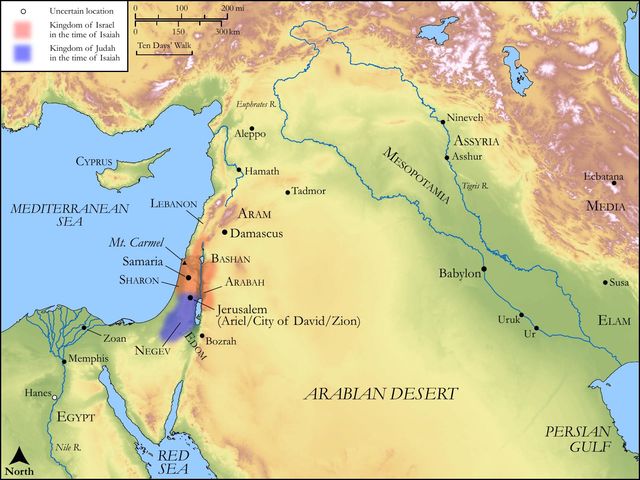
See on the biblical-era map
Study this verse
Public-domain commentary
Matthew Henry
From his Commentary on the Whole Bible. Henry comments on passages, not single verses — this entry covers Isaiah 33:13–24. His three-level outline is real structure in the source text, so it is rendered as structure.
Here is a preface that commands attention; and it is fit that all should attend, both near and afar off, to what God says and does (Isa 33:13): Hear, you that are afar off, whether in place or time. Let distant regions and future ages hear what God has done. They do so; they will do so from the scripture, with as much assurance as those that were near, the neighbouring nations and those that lived at that time. But whoever hears what God has done, whether near or afar off, let them acknowledge his might, that it is irresistible, and that he can do every thing. Those are very stupid who hear what God has done and yet will not acknowledge his might. Now what is it that God has done which we must take notice of, and in which we must acknowledge his might?
I.He has struck a terror upon the sinners in Zion (Isa 33:14):
Fearfulness has surprised the hypocrites. There are sinners in Zion, hypocrites, that enjoy Zion's privileges and concur in Zion's services, but their hearts are not right in the sight of God; they keep up secret haunts of sin under the cloak of a visible profession, which convicts them of hypocrisy. Sinners in Zion will have a great deal to answer for above other sinners; and their place in Zion will be so far from being their security that it will aggravate both their sin and their punishment. Now those sinners in Zion, though always subject to secret frights and terrors, were struck with a more than ordinary consternation from the convictions of their own consciences.
1.When they saw the Assyrian army besieging Jerusalem, and ready to set fire to it and lay it in ashes, and burn the wasps in the nest. Finding they could not make their escape to Egypt, as some had done, and distrusting the promises God had made by his prophets that he would deliver them, they were at their wits' end, and ran about like men distracted, crying, "Who among us shall dwell with devouring fire? Let us therefore abandon the city, and shift for ourselves elsewhere; one had as good live in everlasting burnings as live here." Who will stand up for us against this devouring fire? so some read it. See here how the sinners in Zion are affected when the judgments of God are abroad; while they were only threatened they slighted them and made nothing of them; but, when they come to be executed, they run into the other extreme, then they magnify them, and make the worst of them; they call them devouring fire and everlasting burnings, and despair of relief and succour. Those that rebel against the commands of the word cannot take the comforts of it in a time of need. Or, rather,
2.When they saw the Assyrian army destroyed; for the destruction of that is the fire spoken of immediately before, Isa 33:11, Isa 33:2. When the sinners in Zion saw what dreadful execution the wrath of God made they were in a great fright, being conscious to themselves that they had provoked this God by their secretly worshipping other gods; and therefore they cry out, Who among us shall dwell with this devouring fire, before which so vast an army is as thorns? Who among us shall dwell with these everlasting burnings, which have made the Assyrians as the burnings of lime? Isa 33:12. Thus they said, or should have said. Note, God's judgments upon the enemies of Zion should strike a terror upon the sinners in Zion, nay, David himself trembles at them, Psa 119:120. God himself is this devouring fire, Heb 12:29. Who is able to stand before him? Sa1 6:20. His wrath will burn those everlastingly that have made themselves fuel for it. It is a fire that shall never be quenched, nor will ever go out of itself; for it is the wrath of an everlasting God preying upon the conscience of an immortal soul. Nor can the most daring sinners bear up against it, so as to bear either the execution of it or the fearful expectation of it. Let this awaken us all to flee from the wrath to come, by fleeing to Christ as our refuge.
II.He has graciously provided for the security of his people that trust in him:
Hear this, and acknowledge his power in making those that walk righteously, and speak uprightly, to dwell on high, Isa 33:15, Isa 33:16. We have here,
1.The good man's character, which he preserves even in times of common iniquity, in divers instances.
(1.)He walks righteously. In the whole course of his conversation he acts by rules of equity, and makes conscience of rendering to all their due, to God his due, as well as to men theirs. His walk is righteousness itself; he would not for a world wilfully do an unjust thing.
(2.)He speaks uprightly, uprightnesses (so the word is); he speaks what is true and right, and with an honest intention. He cannot think one thing and speak another, nor look one way and row another. His word is to him as sacred as his oath, and is not yea and nay.
(3.)He is so far from coveting ill-gotten gain that he despises it. He thinks it a mean and sordid thing, and unbecoming a man of honour, to enrich himself by any hardship put upon his neighbour. He scorns to do a wrong thing, nay, to do a severe thing, though he might get by it. He does not over-value gain itself, and therefore easily abhors the gain that is not honestly come by.
(4.)If he have a bribe at any time thrust into his hand, to pervert justice, he shakes his hands from holding it, with the utmost detestation, taking it as an affront to have it offered him.
(5.)He stops his ears from hearing any thing that tends to cruelty or bloodshed, or any suggestions stirring him up to revenge, Job 31:31. He turns a deaf ear to those that delight in war and entice him to cast in his lot among them, Pro 1:14, Pro 1:16.
(6.)He shuts his eyes from seeing evil. He has such an abhorrence of sin that he cannot bear to see others commit it, and does himself watch against all the occasions of it. Those that would preserve the purity of their souls must keep a strict guard upon the senses of their bodies, must stop their ears to temptations, and turn away their eyes from beholding vanity.
2.The good man's comfort, which he may preserve even in times of common calamity, Isa 33:16.
(1.)He shall be safe; he shall escape the devouring fire and the everlasting burnings; he shall have access to, and communion with, that God who is a devouring fire, but shall be to him a rejoicing light. And, as to present troubles, he shall dwell on high, out of the reach of them, nay, out of the hearing of the noise of them; he shall not be really harmed by them, nay, he shall not be greatly frightened at them: The floods of great waters shall not come nigh him; or, if they should attack him, his place of defence shall be the munitions of rocks, strong and impregnable, fortified by nature as well as art. The divine power will keep him safe, and his faith in that power will keep him easy. God, the rock of ages, will be his high tower.
(2.)He shall be supplied; he shall want nothing that is necessary for him: Bread shall be given him, even when the siege is straitest and provisions are cut off; and his waters shall be sure, that is, he shall be sure of the continuance of them, so that he shall not drink his water by measure and with astonishment. Those that fear the Lord shall not want any thing that is good for them.
III.He will protect Jerusalem, and deliver it out of the hands of the invaders.
This storm that threatened them should blow over, and they should enjoy a prosperous state again. Many instances are here given of this prosperity.
1.Hezekiah shall put off his sackcloth and all the sadness of his countenance, and shall appear publicly in his beauty, in his royal robes and with a pleasing aspect (Isa 33:17), to the great joy of all his loving subjects. Those that walk uprightly shall not only have bread given them, and their water sure, but they shall with an eye of faith see the King of kings in his beauty, the beauty of holiness, and that beauty shall be upon them.
2.The siege being raised, by which they were kept close within the walls of Jerusalem, they shall now be at liberty to go abroad upon business or pleasure without danger of falling into the enemies' hand: They shall behold the land that is very far off; they shall visit the utmost corners of the nation, and take a prospect of the adjacent countries, which will be the more pleasant after so long a confinement. Thus believers behold the heavenly Canaan, that land that is very far off, and comfort themselves with the prospect of it in evil times.
3.The remembrance of the fright they were in shall add to the pleasure of their deliverance (Isa 33:18): Thy heart shall meditate terror, meditate it with pleasure when it is over. Thou shalt think thou still hearest the alarm in thy ears, when all the cry was, "Arm, arm, arm! every man to his post. Where is the scribe or secretary of war? Let him appear to draw up the muster-roll. Where is the receiver and pay-master of the army? Let him see what he had in bank, to defray the charge of a defence. Where is he that counted the towers? Let him bring in the account of them, that care may be taken to put a competent number of men in each." Or these words may be taken as Jerusalem's triumph over the vanquished army of the Assyrians, and the rather because the apostle alludes to them in his triumphs over the learning of this world, when it was baffled by the gospel of Christ, Co1 1:20. The virgin, the daughter of Zion, despises all their military preparations. Where is the scribe or muster-master of the Assyrian army? Where is their weigher (or treasurer), and where are their engineers that counted the towers? They are all either dead or fled. There is an end of them.
4.They shall no more be terrified with the sight of the Assyrians, who were a fierce people naturally, and were particularly fierce against the people of the Jews, and were of a strange language, that could understand neither their petitions nor their complaints, and therefore had a pretence for being deaf to them, nor could themselves be understood: "They are of a deeper speech than thou canst perceive, which will make them the more formidable, Isa 33:19. Thy eyes shall no more see them thus fierce, but their countenances changed when they shall all become dead corpses."
5.They shall no more be under apprehensions of the danger of Jerusalem-Zion, and the temple there (Isa 33:20): "Look upon Zion, the city of our solemnities, the city where our solemn sacred feasts are kept, where we used to meet to worship God in religious assemblies." The good people among them, in the time of their distress, were most in pain for Zion upon this account, that it was the city of their solemnities, that the conquerors would burn their temple and they should not have that to keep their solemn feasts in any more. In times of public danger our concern should be most about our religion, and the cities of our solemnities should be dearer to us than either our strong cities or our store-cities. It is with an eye to this that God will work deliverance for Jerusalem, because it is the city of religious solemnities: let those be conscientiously kept up, as the glory of a people, and we may depend upon God to create a defence upon that glory. Two things are here promised to Jerusalem: - (1.) A well-grounded security. It shall be a quiet habitation for the people of God; they shall not be molested and disturbed, as they have been, by the alarms of the sword either of war or persecution, Isa 29:20. It shall be a quiet habitation, as it is the city of our solemnities. It is desirable to be quiet in our own houses, but much more so to be quiet in God's house and have none to make us afraid there. Thus it shall be with Jerusalem; and the eyes shall see it, which will be a great satisfaction to a good man, Psa 128:5, Psa 128:6. "Thou shalt see the good of Jerusalem, and peace upon Israel; thou shalt live to see it and share in it." (2.) An unmoved stability. Jerusalem, the city of our solemnities, is indeed but a tabernacle, in comparison with the New Jerusalem. The present manifestations of the divine glory and grace are nothing in comparison with those that are reserved for the future state. But it is such a tabernacle as shall not be taken down. After this trouble is over Jerusalem shall long enjoy a confirmed peace; and her sacred privileges, which are the stakes and cords of her tabernacle, shall not be removed from her, nor any disturbance given to the course and circle of her religious services. God's church on earth is a tabernacle, which, though it may be shifted from one place to another, shall not be taken down while the world stands; for in every age Christ will have a seed to serve him. The promises of the covenant are its stakes, which shall never be removed, and the ordinances and institutions of the gospel are its cords, which shall never be broken. They are things which cannot be shaken, though heaven and earth be, but shall remain.
6.God himself will be their protector and Saviour, Isa 33:21, Isa 33:22. This the principal ground of their confidence: "He that is himself the glorious Lord will display his glory for us and be a glory to us, such as shall eclipse the rival-glory of the enemy." God, in being a gracious Lord, is a glorious Lord; for his goodness is his glory. God will be the Saviour of Jerusalem and her glorious Lord,
(1.)As a guard against their adversaries abroad. He will be a place of broad rivers and streams. Jerusalem had no considerable river running by it, as most great cities have, nothing but the brook Kidron, and so wanted one of the best natural fortifications, as well as one of the greatest advantages for trade and commerce, and upon this account their enemies despised them and doubted not but to make an easy prey of them; but the presence and power of God are sufficient at any time to make up to us the deficiencies of the creature and of its strength and beauty. We have all in God, all we need or can desire. Many external advantages Jerusalem has not which other places have, but in God there is more than an equivalent. But, if there be broad rivers and streams about Jerusalem, may not these yield an easy access to the fleet of an invader? No; these are rivers and streams in which shall go no galley with oars, no man of war or gallant ship. If God himself be the river, it must needs be inaccessible to the enemy; they can neither find nor force their way by it.
(2.)As a guide to their affairs at home: "For the Lord is our Judge, to whom we are accountable, to whose judgment we refer ourselves, by whose judgment we abide, and who therefore (we hope) will judge for us. He is our lawgiver; his word is a law to us, and to him every thought within us is brought into obedience. He is our King, to whom we pay homage and tribute, and an inviolable allegiance, and therefore he will save us." For, as protection draws allegiance, so allegiance may expect protection, and shall have it with God. By faith we take Christ for our prince and Saviour, and as such depend upon him and devote ourselves to him. Observe with what an air of triumph, and with what an emphasis laid upon the glorious name of God, they comfort themselves with this: Jehovah is our Judge, Jehovah is our Lawgiver, Jehovah is our King, who, being self-existent, is self-sufficient, and all-sufficient to us.
7.The enemies shall be quite infatuated, and all their powers and projects broken, like a ship at sea in stress of weather, that cannot ride out the storm, but having her tackle torn, her masts split, and nothing wherewith to repair them, is given up for a wreck, Isa 33:23. The tacklings of the Assyrian are loosed; they are like a ship whose tacklings are loose, or forsaken by the ship's crew, when they give it over for lost, finding that they cannot strengthen the mast, but it will come down. They thought themselves sure of Jerusalem; but when they were just entering the port as it were, and though all was their own, they were quite becalmed, and could not spread their sail, but lay wind-bound till God poured the fury of his wrath upon them. The enemies of God's church are often disarmed and unrigged when they think they have almost gained their point.
8.The wealth of their camp shall be a rich booty for the Jews: Then is the prey of a great spoil divided. When the greater part were slain the rest fled in confusion, and with such precipitation that (like the Syrians) they left their tents as they were, so that all the treasure in them fell into the hands of the besieged; and even the lame take the prey. Those that tarried at home did divide the spoil. It was so easy to come at that not only the strong man might make himself master of it, but even the lame man, whose hands were lame, that he could not fight, and his feet, that he could not pursue. As the victory shall cost them no peril, so the prey shall cost them no toil. And there was such abundance of it that when those who were forward, and came first, had carried off as much as they would, even the lame, who came late, found sufficient. Thus God brought good out of evil, and not only delivered Jerusalem, but enriched it, and abundantly recompensed the losses they had sustained. Thus comfortably and well do the frights and distresses of the people of God often end.
9.Both sickness and sin shall be taken away; and then sickness is taken away in mercy when this is all the fruit of it, and the recovery from it, even the taking away of sin.
(1.)The inhabitant shall not say, I am sick. As the lame shall take the prey, so shall the sick, notwithstanding their weakness, make a shift to get to the abandoned camp and seize something for themselves; or there shall be such a universal transport of joy upon this occasion that even the sick shall, for the present, forget their sickness and the sorrows of it, and join with the public in its rejoicings; the deliverance of their city shall be their cure. Or it intimates that, whereas infectious diseases are commonly the effect of long sieges, it shall not be so with Jerusalem, but the inhabitants of it with their victory and peace shall have health also, and there shall be no complaining upon the account of sickness within their gates. Or those that are sick shall bear their sickness without complaining as long as they see it goes well with Jerusalem. Our sense of private grievances should be drowned in our thanksgivings for public mercies.
(2.)The people that dwell therein shall be forgiven their iniquity, not only the body of the nation forgiven their national guilt in the removing of the national judgment, but particular persons, that dwell therein, shall repent, and reform, and have their sins pardoned. And this is promised as that which is at the bottom of all other favours; he will do so and so for them, for he will be merciful to their unrighteousness, Heb 8:12. Sin is the sickness of the soul. When God pardons the sin he heals the disease; and, when the diseases of sin are healed by pardoning mercy, the sting of bodily sickness is taken out and the cause of it removed; so that either the inhabitant shall not be sick or at least shall not say, I am sick. If iniquity be taken away, we have little reason to complain of outward affliction. Son, be of good cheer; thy sins are forgiven thee.
Historical interpretation
Two Centuries of Reception
2 surviving comments on this verse. Each one is dated, so this reads as a timeline rather than a list.
Select a marker to jump to its quote. Markers stagger vertically where authors wrote within a few decades of each other.
(Ver. 13 et seq.) Hear, you who are far away, what I have done, and know the strength of my neighbors. Sinners are terrified in Zion, hypocrites are trembling. Who among you can dwell with devouring fire? Who among you can endure everlasting burnings? The one who walks in righteousness and speaks truth, who rejects greed by slander, and keeps his hands away from every gift, who stops his ears from hearing of bloodshed, and shuts his eyes from seeing evil. He will dwell on high, the height of his fortress of rocks; bread is given to him, and his waters are faithful. His eyes will see the king in his beauty; they will behold the land from afar. Your heart will meditate on fear. Where is the scribe? Where are those who weigh the words of the law? Where is the teacher of the little ones? You will not see an ignorant people, a people of deep speech beyond your comprehension, in whom there is no wisdom. LXX: Let those who are far away hear what I have done; let those who are near acknowledge my power. The wicked in Zion are afraid; trembling grips the godless: 'Who can live with the consuming fire? Who can dwell with everlasting burning?' The one who walks in righteousness and speaks with integrity, who rejects gain from extortion and keeps his hand from accepting bribes, who stops his ears from listening to murderous plots and shuts his eyes against contemplating evil— this is the man who will dwell on the heights, whose refuge will be the mountain fortress. Bread will be given to him, and his water will be faithful: your eyes will see the king with glory, they will see the land from afar; your soul will meditate fear. Where are the grammarians? Where are the counselors? Where is he who counts those who nourish both the small and the large population? To whom he did not give counsel: nor did he know the deep voice of him, so that the despised people would not hear, and the one who is listening would not have understanding. For the paths are scattered, the one passing through the pathways has ceased, the covenant with the people of Judah has been voided, God has cast away their cities, he has not considered them among men; therefore, you who are far away, hear what I have done, and approach to recognize my strength. They were terrified, or those who were sinners or wicked withdrew from Zion, and trembling possessed the hypocrites, to whom the Lord spoke in the Gospel: Woe to you, Scribes and Pharisees, hypocrites (Matthew 23:14)! Who among you can dwell with the devouring fire? Who among you can dwell with everlasting burnings? Or according to the LXX: Who will declare to you that eternal fire burns, which God has prepared for the devil and his angels? So who then can dwell with God, or declare the coming punishments? Everyone who is of this kind, as the prophetic discourse describes, who walks in many justices, and not once, but always loves justices, and not just once, but constantly speaks the truth: who rejects greed, which is the mother of slander. For money is not heaped up for one's own gain at the expense and harm of another. And he withdraws his hands from every gift. Indeed, gifts blind the eyes, even of the wise. He who stops up his ears does not hear the judgment of blood. Every wickedness and oppression and injustice is a judgment of blood: and although it does not kill with a sword, it kills by will. And he closes his eyes so as not to see evil. Blessed is the conscience that does not hear, nor see evil. Therefore, whoever is such, he himself shall dwell in the highest, that is, in the kingdom of heaven, or in the lofty cave of the strongest rock, in Christ Jesus: which rock followed the people of Israel, so that they might drink of it and be protected by its strength. Bread will be given to him, and its waters are faithful: which the fables of the Gentiles understand as ambrosia and nectar. But we, the most faithful breads and waters, will interpret the law of God. Therefore, whoever is such, will see the king Christ in his glory, of whom it is said above (Ad cap. XXXII, 1): Behold, a just king will reign, and princes will preside in judgment. And his eyes will see the earth from afar, which they have desired for a long time, the land of the gentle and meek, of which it is written in the Gospel: Blessed are the meek, for they shall inherit the earth (Matth. V, 4): whether they are placed in heaven, they despise earthly things. Your heart will meditate on fear: so that when you have accomplished all things, you may say with the Apostle: I am not worthy to be called an Apostle, because I persecuted the Church of God (1 Corinthians 15:9). For the fear of the Lord is the beginning of wisdom. Where is the scribe? Where is he who weighs the words of the law? Where is the teacher of children? Where, it is said, are the scribes and Pharisees, who weighed the words of the Law, deceiving the unhappy people? whom Scripture now calls little children, little in understanding, little in intelligence. But when the eyes of the believer behold the king in his majesty, and his heart is filled with awe, then he will not see the foolish people, the people of the Jews, or the philosophers and orators of the world, who applaud themselves in secular knowledge and eloquence, about whom he now says: They are a people of high speech, so that you cannot understand the eloquence of their language; their allurement is in words, which have only the foliage and shadow of discourse, and do not possess the fruit of truth. Finally it follows: In this there is no wisdom, about which it is said in another place: I will destroy the wisdom of the wise, and the understanding of the prudent I will reject (1 Corinthians 1:19). Why? because God has made the wisdom of this world foolish.
“Bread” signifies perfection, as Paul attested while exhorting the weak to conversion: “I gave you milk to drink, not food, for you were then and still remain unable to eat.” If milk is for children, then bread is only for the perfect. Consequently, it was said about the strength of the perfect man: “He will live upon the heights, a fortress of rocks will be his dwelling, bread will be given to him.”
Continue studying Isaiah 33:16 across the web’s major study libraries — every link below opens this exact verse, chapter, or book on the destination site.
Read & Compare
 BibleGatewayThis verse in more than 200 translations and 70 languages.
 Bible.comThe YouVersion reader — hundreds of translations, reading plans, and highlights.
 ESV.orgCrossway's official English Standard Version reader.
 NET BibleThe NET translation with 60,000+ translators' notes on every rendering decision.
 STEP BibleTyndale House's free study tool — original text, vocabulary, and scholarly resources.
 BibliaLogos Bible Software's free web reader.
 USCCBThe New American Bible (Revised Edition) with the U.S. bishops' study notes.
Commentaries
 BibleHub CommentariesDozens of classic commentaries on this verse, gathered on one page.
 StudyLightMore than 100 commentary sets — the largest collection on the web.
 BibleRefPlain-English commentary on what this verse means, verse by verse.
 Enduring WordDavid Guzik's free commentary on this chapter, widely used by Bible teachers.
 Bible Study ToolsVerse commentary alongside Greek and Hebrew study aids.
Original Language & Research
- BibleHub InterlinearThe verse word by word — original language, transliteration, and English.
- BibleHub LexiconEvery word's original-language definition and Strong's entry.
 Blue Letter BibleDeep-study tools — Strong's numbers, concordance, and word studies.
 SefariaThe Hebrew text with Rashi and centuries of Jewish commentary.
Sermons, Hymns & Audio


TrulyRandomVerse is not affiliated with these sites and doesn’t control their content. They’re linked because they’re genuinely useful.
Summary
Isaiah 33:16 delivers a profound and comforting promise of divine security and unfailing provision for the righteous. It vividly portrays an individual dwelling in an elevated, impregnable fortress, receiving guaranteed sustenance. This imagery symbolizes God's steadfast care and unwavering faithfulness to those who walk in integrity amidst a world of turmoil and judgment, assuring believers that their ultimate safety and well-being are secured by God Himself.
Context
ShowHideLiterary Context
Isaiah 33 is strategically placed within a larger prophetic unit (chapters 28-35) that masterfully weaves together pronouncements of divine judgment against Israel's enemies and promises of glorious restoration for the faithful remnant. The chapter itself opens with a "Woe" oracle directed at an unnamed "destroyer" (likely a veiled reference to Assyria, a dominant and oppressive power during Isaiah's time), depicting the widespread devastation and terror that will engulf the land. However, a dramatic shift in tone occurs around Isaiah 33:10-13, where God declares His imminent and powerful intervention, proclaiming, "Now will I rise; now will I be exalted; now will I lift up myself." This divine uprising brings terrifying judgment upon the wicked, who are depicted in Isaiah 33:14 as unable to endure "the devouring fire" or "everlasting burnings." In stark contrast to the fate of the unrighteous, Isaiah 33:15 meticulously describes the character of the righteous person—one who "walketh righteously, and speaketh uprightly," rejecting oppression and bribery. Verse 16 directly follows this description, serving as the climactic assurance of the blessed outcome and secure dwelling for such an individual, thereby completing the powerful antithesis between the destiny of the wicked and the righteous.
Historical & Cultural Context
The prophecies of Isaiah, particularly those found in chapters 32-33, are deeply rooted in the historical reality of the late 8th century BCE, a period dominated by the formidable Assyrian Empire. During the reign of King Hezekiah of Judah, the nation faced immense political and military pressure, culminating in Sennacherib of Assyria's devastating invasion and siege of Jerusalem, vividly recounted in 2 Kings 18-19. In this era of profound geopolitical instability and existential threat, the concepts of fortified cities and natural strongholds were not abstract but vital for survival, making the imagery of "munitions of rocks" powerfully resonant with the audience's lived experience. Furthermore, the guaranteed provision of "bread" and "waters" spoke directly to the most fundamental human needs in a land prone to drought and siege warfare, where access to sustenance was a matter of life and death. Culturally, the understanding of divine protection and provision was intrinsically linked to the covenant relationship between God and Israel, where obedience to God's law was understood to correlate directly with divine blessing and security.
Key Themes
ShowHideIsaiah 33:16 profoundly articulates several overarching themes central to Isaiah's prophecy and the broader biblical narrative. Firstly, it underscores Divine Sovereignty and Judgment, portraying God as the ultimate arbiter who orchestrates both the terrifying judgment upon the wicked and the glorious salvation for the faithful. Secondly, it powerfully highlights the theme of Righteousness and Its Reward, emphasizing that a life characterized by integrity, justice, and moral uprightness is the indispensable prerequisite for experiencing divine favor and protection, standing in stark contrast to the dire fate of the unrighteous, as delineated in Isaiah 33:14-15. Thirdly, God's Unfailing Protection and Provision emerges as a central and comforting message, depicting Him as an impregnable fortress and an ever-present, inexhaustible source of sustenance. This theme resonates deeply with other biblical affirmations of God's care, such as those found in Psalm 46:1 and Psalm 23:1-2. Finally, the verse offers a powerful message of Hope and Assurance in times of profound distress, presenting a vision of peace, stability, and security that transcends immediate circumstances, firmly rooted in God's unchanging character and His immutable promises.
Exposition and Analysis
ShowHideKey Word Analysis
ShowHideMeaning "to reside or permanently stay (literally or figuratively); abide, continue, (cause to, make to) dwell(-er), have habitation, inhabit, lay, place, (cause to) remain, rest, set (up)." This word denotes more than a temporary lodging; it signifies a settled, established, and secure dwelling. In the context of divine protection, it implies a stable and enduring safety, a permanent habitation under God's watchful care, rather than a fleeting shelter.
Meaning "properly, a cliff (or other lofty or inaccessible place); abstractly, altitude; figuratively, a refuge; defence, high fort (tower), refuge, Misgab, a place in Moab; Misgab." This term vividly describes a natural, elevated stronghold—a place of ultimate security and inaccessibility to enemies. It serves as a powerful metaphor for God Himself as the ultimate defender, a refuge that is unassailable and provides absolute safety.
Meaning "to build up or support; to foster as a parent or nurse; figuratively to render (or be) firm or faithful, to trust or believe, to be permanent or quiet; morally to be true or certain; hence, assurance, believe, bring up, establish, [phrase] fail, be faithful (of long continuance, stedfast, sure, surely, trusty, verified), nurse, (-ing father), (put), trust, turn to the right." When applied to "waters," it signifies that the supply is utterly reliable, unfailing, and guaranteed. This word underscores God's trustworthiness and the absolute certainty of His promised provision, implying an enduring and dependable source.
Verse Breakdown
ShowHide"He shall dwell on high:"
This opening clause immediately establishes a position of exalted security and prominence. The phrase "on high" (mârôwm, H4791) suggests a place beyond the reach of earthly threats and turmoil, implying a divinely bestowed elevation and protection. It speaks to a spiritual and physical safety that is superior to any human defense, a realm of peace and stability.
"his place of defence [shall be] the munitions of rocks:"
This expands upon the nature of the secure dwelling. "Place of defence" (misgâb, H4869) refers to an inaccessible refuge, while "munitions" (mᵉtsad, H4679) and "rocks" (çelaʻ, H5553) collectively reinforce the imagery of an unassailable, natural fortress. This is not a man-made stronghold, which could be breached, but a divinely provided bulwark, symbolizing absolute, unshakeable security and protection from all adversaries.
"bread shall be given him;"
This clause transitions from security of dwelling to the assurance of sustenance. "Bread" (lechem, H3899) represents essential physical nourishment, the most basic and universal form of provision necessary for life. The passive voice "shall be given" (nâthan, H5414) powerfully emphasizes that this provision is a direct, gracious act of God, not something earned or acquired through human effort, highlighting God's active and benevolent role as the ultimate provider.
"his waters [shall be] sure."
Complementing the provision of bread, "waters" (mayim, H4325) signify another fundamental necessity for life, especially vital in the often-arid climate of Judah. The word "sure" (ʼâman, H539) guarantees the consistency, reliability, and unfailing nature of this supply. It means the waters will not fail or run dry, emphasizing the unwavering and dependable character of God's comprehensive care for His righteous ones.
Literary Devices
ShowHideIsaiah 33:16 is rich with literary devices that amplify its message of divine security and provision. Imagery is paramount, painting a vivid mental picture of an individual dwelling "on high" in "munitions of rocks," immediately evoking a sense of impregnable safety and transcendence above earthly dangers. This visual is deepened by Metaphor, where God Himself is implicitly presented as this unassailable fortress and the ultimate source of sustenance. The "munitions of rocks" function as a powerful Symbol of God's protective power and unwavering strength, while "bread" and "waters" symbolize comprehensive, unfailing provision for all of life's necessities, encompassing both physical and spiritual well-being. The structure of the verse also exhibits a form of Parallelism, contrasting the secure dwelling with the assured provision, thereby reinforcing the holistic and comprehensive nature of God's care. The certainty conveyed through the use of passive voice and future tense in phrases like "shall be given" and "shall be sure" contributes to a pervasive tone of Assurance, instilling profound confidence in the reader regarding God's faithfulness and reliability.
Theological and Thematic Connections
ShowHideIsaiah 33:16 stands as a profound theological declaration concerning God's character as both the ultimate Protector and the faithful Provider for those who align themselves with His righteousness. It powerfully articulates the biblical principle that genuine faith, tangibly demonstrated through a life of integrity, justice, and moral uprightness (as meticulously described in Isaiah 33:15), is the divinely ordained pathway to experiencing His profound favor and unwavering protection. This verse assures us that God's unwavering commitment to His faithful people extends to their most fundamental needs, encompassing both physical sustenance and existential security, offering an impregnable refuge in a tumultuous and often threatening world. The evocative imagery of an elevated fortress and unfailing sustenance speaks to a holistic security that far transcends human capabilities, rooted entirely in God's unchanging character and His immutable faithfulness.
Reflection and Application
ShowHideIn a contemporary world often characterized by profound uncertainty, economic instability, and myriad threats to personal and global peace and security, Isaiah 33:16 offers a steadfast anchor for the soul. It issues a compelling call for believers to reorient their focus, shifting from reliance on fallible human institutions, fluctuating economic systems, or even personal efforts, to the ultimate and unshakeable security found in God alone. Living a life of righteousness, as meticulously outlined in the preceding verse, is presented not merely as a moral imperative or a set of rules, but as the divinely appointed pathway to experiencing God's promised protection and abundant provision. This verse profoundly encourages us to cultivate unwavering integrity in our actions, words, and intentions, trusting implicitly that God Himself will be our impregnable fortress and our unfailing source of sustenance. It serves as a powerful reminder that true peace and profound security emanate from resting confidently in His sovereign and benevolent care, knowing with certainty that He is faithful to His promises, even when external circumstances appear dire or overwhelming. This divine assurance empowers us to live boldly, free from debilitating anxiety about our basic needs, and to courageously pursue justice, truth, and righteousness in every facet of our daily lives.
Questions for Reflection
ShowHideFAQ
ShowHideWho is the "He" in Isaiah 33:16, and what does it mean for them to "dwell on high"?
ShowHideThe "He" in Isaiah 33:16 refers to the righteous person, whose character is meticulously described in the preceding verse, Isaiah 33:15. This individual is one who "walketh righteously, and speaketh uprightly; he that despiseth the gain of oppressions, that shaketh his hands from holding of bribes, that stoppeth his ears from hearing of blood, and shutteth his eyes from seeing evil." To "dwell on high" signifies a position of divine favor, elevated security, and spiritual prominence. It implies a refuge and protection from God that transcends earthly dangers and the judgments that afflict the wicked, much like a fortress built on an inaccessible cliff. This is a state of profound spiritual and existential safety, a secure dwelling place beyond vulnerability.
Is the "bread" and "waters" mentioned in this verse only about physical sustenance?
ShowHideWhile "bread" and "waters" certainly refer to essential physical provisions necessary for survival, the biblical context often expands these terms to encompass comprehensive well-being and spiritual sustenance. In a broader, more profound sense, they symbolize God's complete and holistic provision for all of life's necessities—physical, emotional, and spiritual. Just as physical food and water sustain the body, God provides spiritual nourishment, such as His life-giving Word (as highlighted in Deuteronomy 8:3, where man does not live by bread alone), and the "living water" that Jesus offers (as promised in John 4:14). These spiritual provisions sustain the soul and spirit, ensuring a full, abundant, and eternally secure life under His faithful care.
Christ-Centered Fulfillment
ShowHideIsaiah 33:16 finds its ultimate and most profound fulfillment in the person and work of Jesus Christ. The righteous one, whose security and provision are divinely guaranteed, is perfectly embodied in Christ, who alone lived a life of absolute and unblemished righteousness, perfectly fulfilling the character described in Isaiah 33:15. He is our true "place of defence" and "munitions of rocks," the ultimate refuge and impregnable stronghold for all who place their faith in Him. Through His atoning sacrifice and victorious resurrection, Christ became our secure dwelling, elevating us to a position of spiritual safety and exalted status "on high" with Him, as we are seated with Him in the heavenly places (as seen in Ephesians 2:6). Moreover, Jesus unequivocally declared Himself to be the "bread of life" (John 6:35), offering eternal spiritual nourishment that truly satisfies, and the inexhaustible source of "living water" (John 7:37-38), providing unfailing spiritual sustenance that quenches all thirst for eternity. Thus, the promises of secure dwelling and unfailing provision in Isaiah 33:16 are not merely earthly blessings but find their eternal, complete, and glorious reality in Christ, who guarantees both spiritual and ultimate physical provision for His redeemed people (as promised in Philippians 4:19) and offers a secure, eternal dwelling in His very presence (John 14:2-3).