


Isaiah 32:18
Bible text: King James Version (1769 Blayney text) · Public domain
Bible text: Berean Standard Bible · Public domain
Bible text: American Standard Version (1901) · Public domain
Bible text: World English Bible, Messianic edition · Public domain
Bible text: Geneva Bible (1599) · Public domain
Bible text: Young's Literal Translation · Public domain
- וְיָשַׁבve·ya·Shavand it will dwellH3427Conj-w ¦ V-Qal-ConsecPerf-3msVerb Qal Consecutive Perfect 3rd Singular Masculineוְandיָשַׁבit will dwell
- עַמִּי'a·Mimy peopleH5971N-msc ¦ 1csNoun Singular Masculine Constructעַמִּpeopleיmy
- בִּנְוֵהbin·Vehin a habitation ofH5116Prep-b ¦ N-mscNoun Singular Masculine Constructבִּinנְוֵהa habitation of
- שָׁלוֹםsha·LompeaceH7965N-msNoun Singular Masculine Absolute
- וּבְמִשְׁכְּנוֹתu·ve·mish·ke·nOtand in dwelling places ofH4908Conj-w ¦ Prep-b ¦ N-fpcNoun Plural Feminine Constructוּandבְinמִשְׁכְּנוֹתdwelling places of
- מִבְטַחִיםmiv·ta·ChimsecurityH4009N-mpNoun Plural Masculine Absolute
- וּבִמְנוּחֹתu·vim·nu·Chotand in resting placesH4496Conj-w ¦ Prep-b ¦ N-fpcNoun Plural Feminine Constructוּandבִinמְנוּחֹתresting places
- שַׁאֲנַנּוֹתsha·'a·na·NotundisturbedH7600Adj-fpAdjective Plural Feminine Absolute
English is a literal word-by-word gloss of the Hebrew, not the KJV's wording. Why?
This is the original text the KJV's translators worked from — each Hebrew word with its own literal English meaning in this verse, prepared by scholars at Tyndale House, Cambridge. The KJV translates whole sentences, not word by word, so its wording differs: one Hebrew word can become several English words, and the KJV may choose “the LORD” where the gloss reads “Yahweh”. Both are faithful — they answer different questions. For the KJV's own rendering, switch to the KJV text.
Details
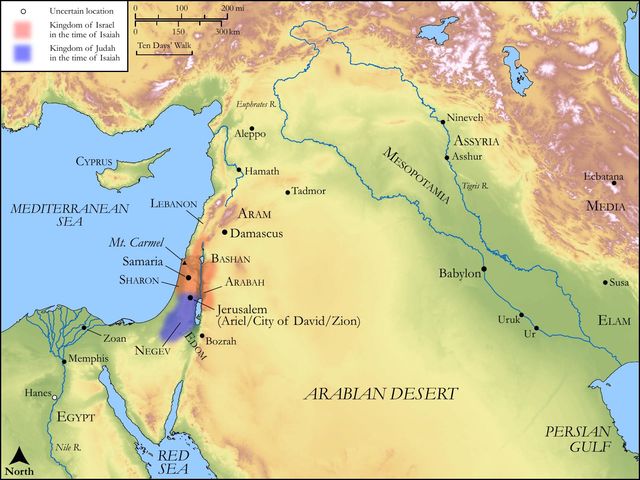
See on the biblical-era map
Study this verse
Public-domain commentary
Matthew Henry
From his Commentary on the Whole Bible. Henry comments on passages, not single verses — this entry covers Isaiah 32:9–20. His four-level outline is real structure in the source text, so it is rendered as structure.
In these verses we have God rising up to judgment against the vile persons, to punish them for their villainy; but at length returning in mercy to the liberal, to reward them for their liberality.
I.When there was so great a corruption of manners, and so much provocation given to the holy God, bad times might well be expected, and here is a warning given of such times coming. The alarm is sounded to the women that were at ease (Isa 32:9) and the careless daughters, to feed whose pride, vanity, and luxury, their husbands and fathers were tempted to starve the poor. Let them hear what the prophet has to say to them in God's name: "Rise up, and hear with reverence and attention."
1.Let them know that God was about to bring wasting desolating judgments upon the land in which they lived in pleasure and were wanton. This seems to refer primarily to the desolations made by Sennacherib's army when he seized all the fenced cities of Judah: but then those words, many days and years, must be rendered (as the margin reads them) days above a year, that is, something above a year shall this havock be in the making: so long it was from the first entrance of that army into the land of Judah to the overthrow of it. But it is applicable to the wretched disappointment which those will certainly meet with, first or last, that set their hearts upon the world and place their happiness in it: You shall be troubled, you careless women. It will not secure us from trouble to cast away care when we are at ease; nay, to those who affect to live carelessly even little troubles will be great vexations and press hard upon them. They were careless and at ease because they had money enough and mirth enough; but the prophet here tells them,
(1.)That the country whence they had their tents and dainties should shortly be laid waste: "The vintage shall fail; and then what will you do for wine to make merry with? The gathering of fruit shall not come, for there shall be none to be gathered, and you will find the want of them, Isa 32:10. You will want the teats, the good milk from the cows, the pleasant fields and their productions:" the useful fields that are serviceable to human life are the pleasant ones. "You will want the fruitful vine, and the grapes it used to yield you." The abuse of plenty is justly punished with scarcity; and those deserve to be deprived of the supports of life who make them the food and fuel of lust and prepare them for Baal.
(2.)That the cities too, the cities of Judah, where they lived at ease, spent their rents, and made themselves merry with their dainties, should be laid waste (Isa 32:13, Isa 32:14): Briers and thorns, the fruits of sin and the curse, shall come up, not only upon the land of my people, which shall lie uncultivated, but upon all the houses of joy - the play-houses, the gaming-houses, the taverns - in the joyous cities. When a foreign army was ravaging the country the houses of joy, no doubt, became houses of mourning; then the palaces, or noblemen's houses, were forsaken by their owners, who perhaps fled to Egypt for refuge; the multitude of the city were left by their leaders to shift for themselves. Then the stately houses shall be for dens for ever, which had been as forts and towers for strength and magnificence. They shall be abandoned; the owners shall never return to them; every body shall look upon them to be like Jericho, an anathema; so that, even when peace returns, they shall not be rebuilt, but shall be thrown to the waste: A joy of wild asses and a pasture of flocks. Thus is many a house brought to ruin by sin. Jam seges est ubi Troja fuit - Corn grows on the site of Troy.
2.In the foresight of this let them tremble and be troubled, strip themselves, and gird sackcloth upon their loins, Isa 32:11. This intimates not only that when the calamity comes they shall thus be made to tremble and be forced to strip themselves, that then God's judgments would strip them and make them bare, but,
(1.)That the best prevention of the trouble would be to repent and humble themselves for their sin, and lie in the dust before God in true remorse and godly sorrow, which would be the lengthening out of their tranquillity. This is meeting God in the way of his judgments, and saving a correction by correcting our own mistakes. Those only shall break that will not bend.
(2.)That the best preparation for the trouble would be to deny themselves and live a life of mortification, and to sit loose to all the delights of sense. Those that have already by a holy contempt of this world stripped themselves can easily bear to be stripped when trouble and death come.
II.While there was still a remnant that kept their integrity they had reason to hope for good times at length and such times the prophet here gives them a pleasant prospect of. Such times they saw in the latter end of the reign of Hezekiah; but the prophecy may well be supposed to look further, to the days of the Messiah, who is King of righteousness and King of peace, and to whom all the prophets bear witness. Now observe,
1.How those blessed times shall be introduced-by the pouring out of the Spirit from on high (Isa 32:15), which speaks not only of the good-will of God towards us, but the good work of God in us; for then, and not till then, there will be good times, when God by his grace gives men good hearts; and therefore God's giving his Holy Spirit to those that ask him is in effect his giving them all good things, as appears by comparing Luk 11:13 with Mat 7:11. This is the great thing that God's people comfort themselves with the hopes of, that the Spirit shall be poured out upon them, that there shall be a more plentiful effusion of the Spirit of grace than formerly, according as the necessity of the church, in its desolate estate, calls for. This comes from on high, and therefore they look up to their Father in heaven for it. When God designs favours for his church he pours out his Spirit, both to prepare his people to receive his favours and to qualify and give success to those whom he designs to employ as instruments of his favour; for their endeavours to repair the desolations of the church are all fruitless until the Spirit be poured out upon them and then the work is done suddenly. The kingdom of the Messiah was brought in, and set up, by the pouring out of the Spirit (Acts 2), and so it is still kept up, and will be to the end.
2.What a wonderfully happy change shall then be made. That which was a wilderness, dry and barren, shall become a fruitful field, and that which we now reckon a fruitful field, in comparison with what it shall be then, shall be counted for a forest. Then shall the earth yield her increase. It is promised that in the days of the Messiah the fruit of the earth shall shake like Lebanon, Psa 72:16. Some apply this to the admission of the Gentiles into the gospel church (which made the wilderness a fruitful field), and the rejection and exclusion of the Jews, which made that a forest which had been a fruitful field. On the Gentiles was poured out a spirit of life, but on the Jews a spirit of slumber. See what is the evidence and effect of the pouring out of the Spirit upon any soul; it is thereby made fruitful, and has its fruit unto holiness. Three things go to make these times happy: -
(1.)Judgment and righteousness, Isa 32:16. When the Spirit is poured out upon a land, then judgment shall dwell in the wilderness and turn it into a fruitful field, and righteousness shall remain in the fruitful field and make it yet more fruitful. Ministers shall expound the law and magistrates execute it, and both so judiciously and faithfully that by both the bad shall be made good and the good made better. Among all sorts of people, the poor and low and unlearned, that are neglected as the wilderness, and the rich and great and learned, that are valued as the fruitful field, there shall be right thoughts of things, good principles commanding, and conscience made of good and evil, sin and duty. Or in all parts of the land, both champaign and enclosed, country and city, the ruder parts and those that are more cultivated and refined, justice shall be duly administered. The law of Christ introduces a judgment or rule by which we must be governed, and the gospel of Christ a righteousness by which we must be saved; and, wherever the Spirit is poured out, both these dwell and remain as an everlasting righteousness.
(2.)Peace and quietness, Isa 32:17, Isa 32:18. The peace here promised is of two kinds: -
[1.]Inward peace, Isa 32:17. This follows upon the indwelling of righteousness, Isa 32:16. Those in whom that work is wrought shall experience this blessed product of it. It is itself peace, and the effect of it is quietness and assurance for ever, that is, a holy serenity and security of mind, by which the soul enjoys itself and enjoys its God, and it is not in the power of this world to disturb it in those enjoyments. Note, Peace, and quietness, and everlasting assurance may be expected, and shall be found, in the way and work of righteousness. True satisfaction is to be had only in true religion, and there it is to be had without fail. Those are the quiet and peaceable lives that are spent in all godliness and honesty, Ti1 2:2. First, Even the work of righteousness shall be peace. In the doing of our duty we shall find abundance of true pleasure, a present great reward of obedience in obedience. Though the work of righteousness may be toilsome and costly, and expose us to contempt, yet it is peace, such peace as is sufficient to bear our charges. Secondly, The effect of righteousness shall be quietness and assurance, not only to the end of time, of our time, and in the end, but to the endless ages of eternity. Real holiness is real happiness now and shall be perfect happiness, that is, perfect holiness, for ever.
[2.]Outward peace, Isa 32:18. It is a great mercy when those who by the grace of God have quiet and peaceable spirits are by the providence of God made to dwell in quiet and peaceable habitations, not disturbed in their houses or solemn assemblies. When the terror of Sennacherib's invasion was over, the people, no doubt, were more sensible than ever of the mercy of a quiet habitation, not disturbed with the alarms of war. Let every family study to keep itself quiet from strifes and jars within, not two against three and three against two in the house, and then put itself under God's protection to dwell safely, and to be quiet from the fear of evil without. Jerusalem shall be a peaceable habitation; compare Isa 33:20. Even when it shall hail, and there shall be a violent battering storm coming down on the forest that lies bleak, then shall Jerusalem be a quiet resting-place, for the city shall be low in a low place, under the wind, not exposed (as those cities are that stand high) to the fury of the storm, but sheltered by the mountains that are round about Jerusalem, Psa 125:2. The high forts and towers are brought down (Isa 32:14), but the city that lies low shall be a quiet resting-place. Those are most safe, and may dwell most at ease, that are humble, and are willing to dwell low, Isa 32:19. Those that would dwell in a peaceable habitation must be willing to dwell low, and in a low place. Some think here is an allusion to the preservation of the land of Goshen from the plague of hail, which made great destruction in the land of Egypt.
(3.)Plenty and abundance. There shall be such good crops gathered in every where, and every year, that the husbandmen shall be commended, and though happy, who sow beside all water (Isa 32:20), who sow all the grounds that are fit for seedness, who cast their bread, or bread-corn, upon the water, Ecc 11:1. God will give the increase, but then the husbandman must be industrious, and mind his business, and sow beside all waters; and, if he do this, the corn shall come up so thick and rank that he shall turn in his cattle, even the ox and the ass, to eat the tops of it and keep it under. This is applicable,
[1.]To the preaching of the word. Some think it points at the ministry of the apostles, who, as husbandmen, went forth to sow their seed (Mat 13:3); they sowed beside all waters; they preached the gospel wherever they came. Waters signify people, and they preached to multitudes. Wherever they found men's hearts softened, and moistened, and disposed to receive the word, they cast in the good seed. And whereas, by the law of Moses, the Jews were forbidden to plough with an ox and an ass together (Deu 22:10), which intimated that Jews and Gentiles should not intermix, now that distinction shall be taken away, and both the ox and the ass, both Jews and Gentiles, shall be employed in, and enjoy the benefit of, the gospel husbandry.
[2.]To works of charity. When God sends these happy times blessed are those that improve them in doing good with what they have, that sow beside all waters, that embrace all opportunities of relieving the necessitous; for in due season they shall reap.
Historical interpretation
Historical reception
1 surviving comment on this verse from the historical church.
(Verse 9 and following) Women of wealth, rise up and listen to my voice: confident daughters, hear my words. After days and years, you will be troubled, O confident ones: for the harvest is complete, and there will be no more gathering. O women of wealth, be astounded, be troubled: strip yourselves and be ashamed. As Symmachus interpreted, expose yourselves: it continues. Gird your loins, beat your breasts, over the desirable region, over the fertile vineyard: over the ground of my people, thorns and thistles will grow: how much more over all the houses of the joyful city? For the house was abandoned: the multitude of the city was left behind: darkness and groping became over caves forever: the joy of wild donkeys the pasture of flocks. Until the spirit is poured out upon us from on high: and the wilderness becomes a fruitful field, and the fruitful field is counted as a forest. Then justice will dwell in the wilderness, and righteousness will remain in the fruitful field. The work of righteousness will be peace, and the service of righteousness quietness and confidence forever. And my people shall dwell in the beauty of peace, and in tabernacles of trust, and in abundant rest. But there shall be hail in the descent of the forest, and with humility the city shall be humbled. Blessed are those who sow over all waters, sending forth the foot of the ox and the donkey. Seventy, for darkness and groping, which were made over the caves forever, they were transferred, and your cities shall be caves forever: which in Hebrew is called Ophel and Been, which the Hebrews think to be two towers in Jerusalem, lofty and very sturdy, which are called by these names. The first of these is interpreted as darkness or clouds, because it raised its head up to the clouds. The second is the proof and strength, or as Symmachus translates it, the inquiry: because the eyes were deceived in contemplating its summit. In the end, the chapters are interpreted as follows: Blessed are they who sow over all waters, where the ox and the donkey tread. After the calling of the Gentiles, when Christ the king shall rule with justice, and his princes, the apostles and apostolic men shall govern believers in judgment, the prophetic discourse will be directed to rich women, whom we should understand to be either the cities of Judea, or the synagogues of that time, or as most people think, the wealthy matrons of the former Jewish people, who are spoken of as if they were lying down after the ruin: Arise; and yet they are also called confident daughters, or hopeful: and it is commanded to them that they listen to the words of the Lord, and remember the days and years, about which we shall speak in what follows, the Savior himself saying: The spirit of the Lord is upon me, for which reason he has anointed me: he has sent me to bring good news to the poor, to proclaim release to captives, and recovery of sight to the blind: to call the year of the Lord acceptable (Luke IV, 18, 19), and let this remembrance be for them according to the Septuagint, in sorrow with hope, that they may lament that the Lord denied them, and have hope of salvation, if they repent. For he says that the vintage is finished, and after the final devastation, which happened under Vespasian and Titus and Hadrian, there will by no means be another captivity, nor will there remain grapes on the vines that need to be gathered afterward. Hence they are prompted to lamentation, and are commanded to bare their chests and gird their loins, because once a desirable region and a fruitful vineyard, of which it is written: I have planted you a fruitful vineyard, the whole of it true: how have you turned into the bitterness of a strange vine (Jer. II, 21)? Being destroyed, he said, the land of my people shall be overgrown with thorns and briars, or it shall be covered with hay. And the meaning is this: If the land of Judea, which is the promised land, is overgrown with thorns and briars, how much more so other cities that are filled with joy, and those that will achieve that evangelical promise; Woe to you who are rejoicing now, for you shall mourn (Luke 6:25)! For the Lord (or, the House) has been forsaken, as I said to the Apostles: Arise, let us go hence (John 14:31); and to the unbelievers: Your house shall be left desolate (Luke 13:35). The secret chambers of the Temple and the hidden mysteries have been taken over by palpable darkness, and the cellars of the Lord's vessels have become caves forever. For they had heard from the Lord and Savior (Matthew 21:13): My Father's house shall be called a house of prayer, but you have made it a den of thieves. He says: The joy of wild donkeys, the grazing grounds of the flocks. This can be understood either literally, because all things are deserted, or spiritually, because after Israel was driven out, wild men, lacking knowledge of God, inhabit Judea. And let this be done until the Spirit from on high is poured out upon us, whom the Savior, ascending to the Father, promised to believers, saying: Behold, I go, and I will send you the Advocate, the Spirit of truth (John 16). And again: Until you receive power from on high (Luke 24:49). And what he said above: Yet a little while, and Lebanon shall be turned into a fruitful field, and the fruitful field shall be esteemed as a forest. And in that day the deaf shall hear the words of the book, and out of darkness and obscurity the eyes of the blind shall see (Isaiah 29); he now repeats in other words the same thing, that the wilderness of the nations shall be turned into the riches of Israel, and Israel shall be esteemed as the nations. At that time the Lord and Savior, to whom the Father has given all judgment, will dwell in the desert. And justice will rest in Carmel, of which it was said above: And it will be in Carmel, a desert in which judgment and justice reside, and it will rest in Carmel, which was previously called a desert. The work of justice is also peace, which, according to the Apostle, surpasses all understanding (Philippians 4). And the worship of justice is silence, so that they may not worship the Lord with excessive words like the Jews, but with the brevity of faith; and may they rest in eternal peace, and may wealth be in their dwellings, about which the Apostle spoke (1 Corinthians 1:5): I give thanks to my God through Jesus Christ, because in everything you have been enriched in Him, in all speech and all knowledge. But when the Christian people have settled or dwelled in beauty, as the LXX translated, in the city of peace, undoubtedly in the Church; then hail and storm, and the anger of the Lord raging, will descend in a leap, of which it was said above: And Charmel will be considered a leap; and the city of Jerusalem will be humbled, and according to another Scripture, it will speak from the earth. When these things are so, and we have learned from the prophetic prophecy how much good the Church will possess, and how many evils Jerusalem will suffer: blessed are you, Apostles, and other Teachers, who sow above all waters of holy Scripture, in which the ox and the donkey tread. The world is a dirty place because of the choices of the fathers, the donkey is unclean because of the idolatry of the former pagans, so that both the Church of the Lord may be assembled concerning Circumcision and concerning the Uncircumcision. That which is said above, according to the Septuagint, is: On the earth of my people thorns and hay shall come up. It can be understood as referring both to heretics and to simple believers who do not understand Holy Scripture as it befits its majesty. Therefore, we have connected each thing to its corresponding thing, so that the land of the people of God may bring thorns to the heretics and hay to the ignorant ones.
Continue studying Isaiah 32:18 across the web’s major study libraries — every link below opens this exact verse, chapter, or book on the destination site.
Read & Compare
 BibleGatewayThis verse in more than 200 translations and 70 languages.
 Bible.comThe YouVersion reader — hundreds of translations, reading plans, and highlights.
 ESV.orgCrossway's official English Standard Version reader.
 NET BibleThe NET translation with 60,000+ translators' notes on every rendering decision.
 STEP BibleTyndale House's free study tool — original text, vocabulary, and scholarly resources.
 BibliaLogos Bible Software's free web reader.
 USCCBThe New American Bible (Revised Edition) with the U.S. bishops' study notes.
Commentaries
 BibleHub CommentariesDozens of classic commentaries on this verse, gathered on one page.
 StudyLightMore than 100 commentary sets — the largest collection on the web.
 BibleRefPlain-English commentary on what this verse means, verse by verse.
 Enduring WordDavid Guzik's free commentary on this chapter, widely used by Bible teachers.
 Bible Study ToolsVerse commentary alongside Greek and Hebrew study aids.
Original Language & Research
- BibleHub InterlinearThe verse word by word — original language, transliteration, and English.
- BibleHub LexiconEvery word's original-language definition and Strong's entry.
 Blue Letter BibleDeep-study tools — Strong's numbers, concordance, and word studies.
 SefariaThe Hebrew text with Rashi and centuries of Jewish commentary.
Sermons, Hymns & Audio


TrulyRandomVerse is not affiliated with these sites and doesn’t control their content. They’re linked because they’re genuinely useful.
Summary
Isaiah 32:18 presents a profound prophetic vision of the future state of God's people, depicting a time of unparalleled security, stability, and tranquility. This verse, nestled within a broader prophecy of a righteous king's reign and the outpouring of the Spirit, promises a divinely established environment where the redeemed will dwell in complete peace, free from fear and disturbance. It paints a picture of holistic well-being, where physical dwelling places and spiritual repose converge under God's sovereign care, signifying the blessed outcome of true righteousness.
Context
ShowHideLiterary Context
Isaiah 32:18 is situated within a significant prophetic section (Isaiah 32:1-20) that contrasts the present desolation and injustice with a glorious future under the reign of a righteous king. The preceding verses vividly describe the transformation that will occur: the king will reign in righteousness (Isaiah 32:1), acting as a refuge and shelter (Isaiah 32:2). The spiritual dullness of the people will be removed (Isaiah 32:3-4), and the character of society will be inverted, with the noble esteemed and the vile exposed (Isaiah 32:5-8). Following a lament over the complacency of the women of Jerusalem and the subsequent desolation (Isaiah 32:9-14), a pivotal shift occurs in Isaiah 32:15, which prophesies the outpouring of the Spirit from on high. This divine intervention transforms the wilderness into a fruitful field, leading directly to the establishment of righteousness (Isaiah 32:16). Isaiah 32:17 then explicitly states, "And the work of righteousness shall be peace; and the effect of righteousness quietness and assurance for ever." Verse 18, therefore, describes the tangible, blessed outcome of this Spirit-wrought righteousness: secure and peaceful habitation for God's people.
Historical & Cultural Context
The book of Isaiah addresses Judah during a period of significant political instability and spiritual decline, particularly in the 8th century BCE. The Assyrian Empire posed a constant threat, leading to alliances with foreign powers and a reliance on human strength rather than divine protection. Internally, there was widespread oppression, corruption, and a superficial religiosity that lacked true devotion to Yahweh. The cultural understanding of "peace" (shalom) in ancient Israel was far more comprehensive than merely the absence of war; it encompassed holistic well-being, prosperity, health, and harmony in all relationships—with God, with others, and with the land. Dwellings were often vulnerable to attack or natural disasters, making the promise of "sure dwellings" and "quiet resting places" particularly resonant in a society where security was often precarious. The vision in Isaiah 32:18 speaks to a longing for an ideal state of existence, a return to Edenic harmony, which was deeply embedded in the cultural memory and prophetic hope of Israel.
Key Themes
ShowHideThe verse contributes significantly to several major themes in Isaiah. Firstly, it underscores the theme of Divine Sovereignty and Restoration, emphasizing that God alone is the ultimate source of true peace and security, not human alliances or military might. The promise of a transformed land and people is a testament to His redemptive power. Secondly, it highlights the Centrality of Righteousness; the peace and security described are not arbitrary but are the direct fruit of righteousness, as explicitly stated in Isaiah 32:17. This reinforces the Old Testament principle that blessing follows obedience and a right relationship with God. Thirdly, the passage points to Messianic Hope, as the righteous king (Isaiah 32:1) who ushers in this era of peace is widely understood to be the Messiah, whose reign will establish an everlasting kingdom of justice and tranquility. Lastly, it develops the theme of God's Dwelling with His People, where the secure habitations foreshadow the ultimate dwelling of God with humanity in the new creation, as glimpsed in Revelation 21:3.
Exposition and Analysis
ShowHideKey Word Analysis
ShowHideFrom H5971, this term refers to "a people (as a congregated unit); specifically, a tribe (as those of Israel); hence (collectively) troops or attendants; figuratively, a flock." In this context, "my people" specifically denotes God's chosen people, Israel, but with a prophetic scope that extends to all who are truly His, living in covenant relationship with Him. It emphasizes a collective identity and destiny under divine care.
From H3427, a primitive root meaning "to sit down (specifically as judge, in ambush, in quiet); by implication, to dwell, to remain; causatively, to settle, to marry." Here, it conveys a sense of settled, permanent habitation, not a temporary encampment. It implies rest, stability, and an established presence, contrasting with the previous state of desolation and insecurity.
From H7965, from the root shâlam, meaning "safe, i.e. (figuratively) well, happy, friendly; also (abstractly) welfare, i.e. health, prosperity, peace." This is the rich Hebrew concept of shalom, encompassing wholeness, completeness, well-being, harmony, and prosperity in every dimension of life—spiritual, social, and physical. It is not merely the absence of conflict but a state of flourishing.
Verse Breakdown
ShowHide"And my people shall dwell"
This opening phrase immediately establishes the beneficiaries of the prophecy: "my people," indicating a covenant relationship with God. The verb "shall dwell" (yâshab) denotes a settled, permanent, and secure habitation, contrasting with the transient or threatened existence often experienced by Israel. It implies a state of rest and establishment.
"in a peaceable habitation"
This clause describes the quality of their dwelling. "Peaceable" (shalom) signifies not just the absence of conflict but a profound state of holistic well-being, harmony, and completeness. The "habitation" (nâveh) refers to a home, a settled abode, often associated with comfort and belonging. Together, it paints a picture of a dwelling infused with divine peace.
"and in sure dwellings"
This phrase reinforces the stability and reliability of their abodes. "Sure" (mibṭâch) conveys absolute security, confidence, and trust. The "dwellings" (mishkân) can refer to a residence or even the Tabernacle, suggesting a divinely sanctioned and protected space. This emphasizes that their security is not based on human strength but on God's unwavering faithfulness.
"and in quiet resting places;"
This final clause further elaborates on the tranquility and repose experienced. "Quiet" (shaʼănân) implies undisturbed ease, a state of being settled and at peace, free from agitation or threat. "Resting places" (mᵉnûwchâh) signifies repose, comfort, and a place of stillness. This speaks to an internal and external tranquility, a deep spiritual and physical rest that is the fruit of God's presence and provision.
Literary Devices
ShowHideIsaiah 32:18 employs several powerful literary devices to convey its message of profound peace and security. Parallelism is evident in the repetition of similar concepts across the three descriptive phrases: "peaceable habitation," "sure dwellings," and "quiet resting places." Each phrase reiterates and deepens the central idea of secure and tranquil abode, building a comprehensive picture of holistic well-being. The use of Imagery is central, conjuring vivid mental pictures of settled homes, peaceful environments, and undisturbed rest, which would have been deeply appealing to a people often experiencing instability and threat. The phrase "my people" also functions as a form of Possession, highlighting the intimate covenant relationship between God and those who will experience this blessing. Furthermore, the entire verse serves as a Prophecy, offering a future hope that transcends immediate circumstances, pointing towards a divinely orchestrated era of righteousness and peace.
Theological and Thematic Connections
ShowHideIsaiah 32:18 encapsulates a profound theological truth: true and lasting peace, security, and rest are ultimately gifts from God, flowing from His righteous reign and the work of His Spirit. This vision extends beyond mere physical safety to encompass a holistic state of shalom, where every aspect of life is in harmony and well-being. It underscores that this blessed state is not achieved through human effort or political maneuvering, but is the direct consequence of righteousness, which itself is a divine work (Isaiah 32:15-17). The promise of "sure dwellings" speaks to God's unwavering commitment to provide ultimate refuge for His people, a theme echoed throughout Scripture where God Himself is depicted as the ultimate dwelling place and stronghold. This eschatological hope serves as a powerful anchor for believers, reminding them of the ultimate destiny of God's kingdom.
Reflection and Application
ShowHideIsaiah 32:18 offers a profound source of hope and comfort for believers today. While its ultimate fulfillment awaits the full establishment of God's kingdom, its principles are profoundly applicable to our present lives. We live in a world marked by anxiety, instability, and constant change, where true peace often seems elusive. This verse reminds us that genuine security and tranquility are not found in material possessions, human achievements, or political systems, but in our relationship with God and His promised future. It calls us to cultivate a trust in God's sovereign provision, recognizing that He is our ultimate "sure dwelling" and "quiet resting place." Even amidst life's storms, the indwelling Spirit enables us to experience a foretaste of this prophetic peace, knowing that our ultimate home and rest are secure in Christ. It encourages us to live righteously, understanding that true peace is the fruit of a life aligned with God's will, and to eagerly anticipate the day when perfect peace will fully reign, transforming our anxieties into an unwavering confidence in God's faithfulness.
Questions for Reflection
ShowHideFAQ
ShowHideIs this prophecy exclusively for ancient Israel, or does it apply to believers today?
ShowHideWhile the prophecy in Isaiah was initially given to ancient Israel, its ultimate fulfillment extends beyond a single nation to encompass all of God's people, including New Testament believers. The "my people" in Isaiah 32:18 refers to those in covenant relationship with God, and through Christ, Gentiles are grafted into this covenant, becoming part of God's spiritual Israel (Romans 11:17-24). The themes of righteousness, peace, security, and the outpouring of the Spirit are universal and find their ultimate realization in the person and work of Jesus Christ and His church. Therefore, while its historical context is specific, its spiritual and eschatological implications apply to all who trust in God.
How does this verse relate to the concept of "rest" in the Bible?
ShowHideIsaiah 32:18's promise of "quiet resting places" is deeply connected to the biblical concept of rest. This rest is more than mere cessation from labor; it signifies a state of security, peace, and fulfillment in God. It echoes the Sabbath rest established at creation (Genesis 2:2-3), the rest promised to Israel in the Promised Land (Deuteronomy 12:10), and ultimately points to the spiritual rest found in Christ (Matthew 11:28-30). The "quiet resting places" in Isaiah 32:18 represent the ultimate, undisturbed peace that God provides for His people, a foretaste of the eternal rest awaiting believers in His presence (Hebrews 4:9-11).
What is the significance of the "outpouring of the Spirit" mentioned in the broader context of Isaiah 32?
ShowHideThe "outpouring of the Spirit from on high" in Isaiah 32:15 is crucial because it is presented as the divine catalyst for the transformation that leads to the peace and security described in Isaiah 32:18. It signifies a supernatural intervention that renews the land and, more importantly, the hearts of the people, enabling them to live righteously. This prophetic outpouring finds its ultimate fulfillment at Pentecost, where the Holy Spirit was poured out on believers (Acts 2:1-4), empowering them to live lives of righteousness and experience the peace of God. It highlights that spiritual transformation is a prerequisite for the promised external peace and security.
Christ-Centered Fulfillment
ShowHideIsaiah 32:18 finds its profound Christ-centered fulfillment in the person and work of Jesus, the promised righteous King. The "peaceable habitation" and "sure dwellings" are ultimately established by Christ, who is our true Prince of Peace. His reign, unlike any earthly kingdom, is one of perfect justice and everlasting peace, as prophesied in Isaiah 9:7. The Spirit, whose outpouring in Isaiah 32:15 is the catalyst for this peace, was fully present in Christ and subsequently poured out upon His church at Pentecost, enabling believers to experience a foretaste of this promised tranquility even now. Through Christ, we are given access to a peace that "transcends all understanding" (Philippians 4:7) and are brought into a secure dwelling with God, becoming part of His spiritual house built on the foundation of the apostles and prophets, with Christ Jesus Himself as the chief cornerstone (Ephesians 2:19-22). Ultimately, the vision of a people dwelling in perfect peace and security points to the new heavens and new earth, where Christ will reign eternally, and God will dwell among His people, wiping away every tear and establishing a dwelling of perfect rest and security for all eternity (Revelation 21:3-4).