


Matthew 4:11
Bible text: King James Version (1769 Blayney text) · Public domain
Bible text: Berean Standard Bible · Public domain
Bible text: American Standard Version (1901) · Public domain
Bible text: World English Bible, Messianic edition · Public domain
Bible text: Geneva Bible (1599) · Public domain
Bible text: Young's Literal Translation · Public domain
- τότεtoteThenG5119ADVAdverb
- ἀφίησινaphiēsinleavesG863V-PAI-3SVerb Present Active Indicative 3rd Singular
- αὐτὸνautonHimG846P-ASMPersonal pronoun Accusative Singular Masculine
- ὁhotheG3588T-NSMDefinite article Nominative Singular Masculine
- διάβολοςdiabolosdevilG1228A-NSMAdjective Nominative Singular Masculine
- καὶkaiandG2532CONJConjunction
- ἰδοὺidoubeholdG2400INJInterjection
- ἄγγελοιangeloiangelsG32N-NPMNoun Nominative Plural Masculine
- προσῆλθονprosēlthoncameG4334V-2AAI-3PVerb 2nd Aorist Active Indicative 3rd Plural
- καὶkaiandG2532CONJConjunction
- διηκόνουνdiēkonounthey were ministeringG1247V-IAI-3PVerb Imperfect Active Indicative 3rd Plural
- αὐτῷautōto HimG846P-DSMPersonal pronoun Dative Singular Masculine
English is a literal word-by-word gloss of the Greek, not the KJV's wording. Why?
This is the original text the KJV's translators worked from — each Greek word with its own literal English meaning in this verse, prepared by scholars at Tyndale House, Cambridge. The KJV translates whole sentences, not word by word, so its wording differs: one Greek word can become several English words, and the KJV may choose “charity” where the gloss reads “love”. Both are faithful — they answer different questions. For the KJV's own rendering, switch to the KJV text.
Details
See on the biblical-era maps
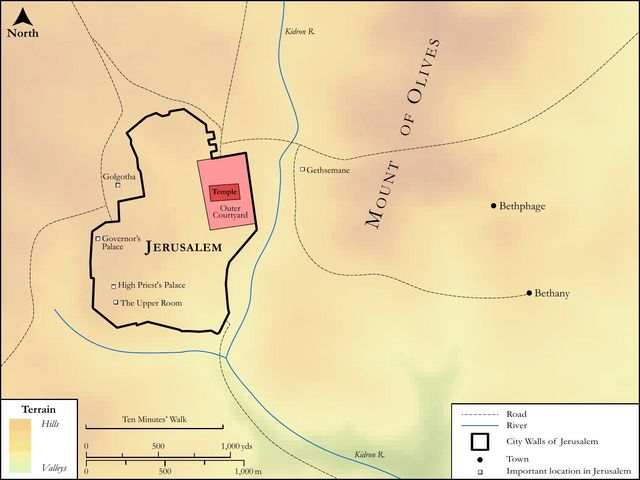
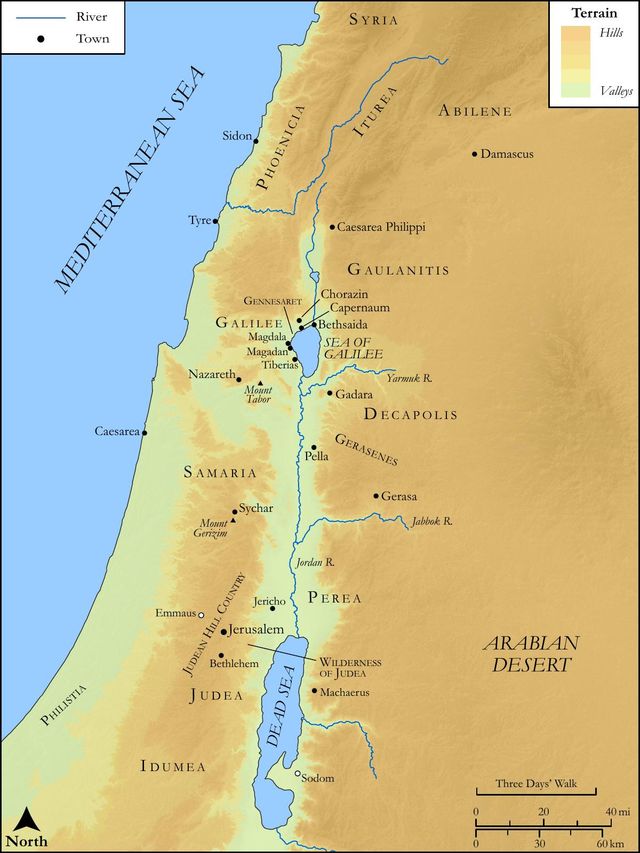
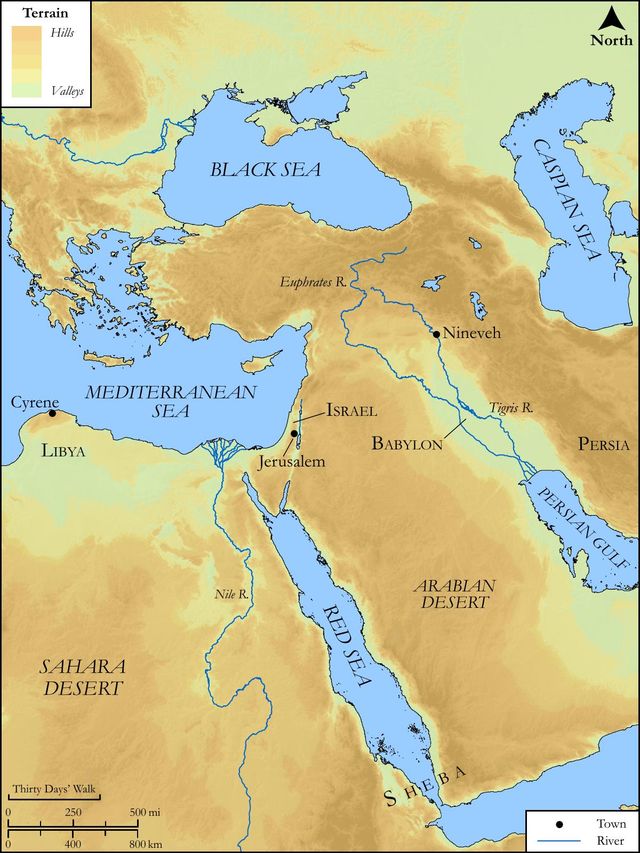
Study this verse
Public-domain commentary
Matthew Henry
From his Commentary on the Whole Bible. Henry comments on passages, not single verses — this entry covers Matthew 4:1–11. His four-level outline is real structure in the source text, so it is rendered as structure.
We have here the story of a famous duel, fought hand to hand, between Michael and the dragon, the Seed of the woman and the seed of the serpent, nay, the serpent himself; in which the seed of the woman suffers, being tempted, and so has his heel bruised; but the serpent is quite baffled in his temptations, and so has his head broken; and our Lord Jesus comes off a Conqueror, and so secures not only comfort, but conquest at last, to all his faithful followers. Concerning Christ's temptation, observe,
I.The time when it happened:
Then; there is an emphasis laid upon that. Immediately after the heavens were opened to him, and the Spirit descended on him, and he was declared to be the Son of God, and the Saviour of the world, the next news we hear of him is, he is tempted; for then he is best able to grapple with the temptation. Note,
1.Great privileges, and special tokens of divine favour, will not secure us from being tempted. Nay,
2.After great honours put upon us, we must expect something that is humbling; as Paul has a messenger of Satan sent to buffer him, after he had been in the third heavens.
3.God usually prepares his people for temptation before he calls them to it; he gives strength according to the day, and, before a sharp trial, gives more than ordinary comfort.
4.The assurance of our sonship is the best preparative for temptation. If the good Spirit witness to our adoption, that will furnish us with an answer to all the suggestions of the evil spirit, designed either to debauch or disquiet us.
Then, when he was newly come from a solemn ordinance, when he was baptized, then he was tempted. Note, After we have been admitted into the communion of God, we must expect to be set upon by Satan. The enriched soul must double its guard. When thou has eaten and art full, then beware. Then, when he began to show himself publicly to Israel, then he was tempted, so as he never had been while he lived in privacy. Note, The Devil has a particular spite at useful persons, who are not only good, but given to do good, especially at their first setting out. It is the advice of the Son of Sirach (Ecclesiasticus ii. 1), My son, if thou come to serve the Lord, prepare thyself for temptation. Let young ministers know what to expect, and arm accordingly.
II.The place where it was; in the wilderness; probably in the great wilderness of Sinai, where Moses and Elijah fasted forty days, for no part of the wilderness of Judea was so abandoned to wild beasts as this is said to have been, Mark i. 13. When Christ was baptized, he did not go to Jerusalem, there to publish the glories that had been put upon him, but retired into a wilderness. After communion with God, it is good to be private awhile, lest we lose what we have received, in the crowd and hurry of worldly business. Christ withdrew into the wilderness, 1. To gain advantage to himself. Retirement gives an opportunity for meditation an communion with God; even they who are called to the most active life must yet have their contemplative hours, and must first find time to be alone with God. Those are not fit to speak of the things of God in public to others, who have not first conversed with those things in secret by themselves. When Christ would appear as a Teacher come from God, it shall not be said of him, "He is newly come from travelling, he has been abroad, and has seen the world;" but, "He is newly come out of the desert, he has been alone conversing with God and his own heart." 2. To give advantage to the tempter, that he might have a readier access to him than he could have had in company. Note, Though solitude is a friend to a good heart, yet Satan knows how to improve it against us. Woe to him that is alone. Those who, under pretence of sanctity and devotion, retire into dens and deserts, find that they are not out of reach of their spiritual enemies, and that there they want the benefit of the communion with saints. Christ retired, (1.) To make his victory the more illustrious, he gave the enemy sun and wind on his side, and yet baffled him. He might give the Devil advantage, for the prince of this world had nothing in him; but he has in us, and therefore we must pray not to be led into temptation, and must keep out of harm's way. (2.) That he might have an opportunity to do his best himself, that he might be exalted in his own strength; for so it was written, I have trod the wine-press alone, and of the people there was none with me. Christ entered the lists without a second.
III.The preparatives for it, which were two.
1.He was directed to the combat; he did not wilfully thrust himself upon it, but he was led up of the Spirit to be tempted of the Devil. The Spirit that descended upon him like a dove made him meek, and yet made him bold. Note, Our care must be, not to enter into temptation; but if God, by his providence, order us into circumstances of temptation for our trial, we must not think it strange, but double our guard. Be strong in the Lord, resist stedfast in the faith, and all shall be well. If we presume upon our own strength, and tempt the devil to tempt us, we provoke God to leave us to ourselves; but, whithersoever God leads us, we may hope he will go along with us, and bring us off more than conquerors.
Christ was led to be tempted of the Devil, and of him only. Others are tempted, when they are drawn aside of their own lust and enticed (Jam. i. 14); the Devil takes hold of that handle, and ploughs with that heifer; but our Lord Jesus had no corrupt nature, and therefore he was led securely, without any fear or trembling, as a champion into the field, to be tempted purely by the Devil.
Now Christ's temptation is, (1.) An instance of his own condescension and humiliation. Temptations are fiery darts, thorns in the flesh, buffetings, siftings, wrestlings, combats, all which denote hardship and suffering; therefore Christ submitted to them, because he would humble himself, in all things to be made like unto his brethren; thus he gave his back to the smiters. (2.) An occasion of Satan's confusion. There is no conquest without a combat. Christ was tempted, that he might overcome the tempter. Satan tempted the first Adam, and triumphed over him; but he shall not always triumph, the second Adam shall overcome him and lead captivity captive. (3.) Matter of comfort to all the saints. In the temptation of Christ it appears, that our enemy is subtle, spiteful, and very daring in his temptations; but it appears withal, that he is not invincible. Though he is a strong man armed, yet the Captain of our salvation is stronger than he. It is some comfort to us to think that Christ suffered, being tempted; for thus it appears that temptations, if not yielded to, are not sins, they are afflictions only, and such as may be pleased. And we have a High Priest who knows, by experience, what it is to be tempted, and who therefore is the more tenderly touch with the feelings of our infirmities in an hour of temptation, Heb. ii. 18; iv. 15. But it is much more a comfort to think that Christ conquered, being tempted, and conquered for us; not only that the enemy we grapple with is a conquered, baffled, disarmed enemy, but that we are interested in Christ's victory over him, and through him are more than conquerors.
2.He was dieted for the combat, as wrestlers, who are temperate in all things (1 Cor. ix. 25); but Christ beyond any other, for he fasted forty days and forty nights, in compliance with the type and example of Moses the great lawgiver, and of Elias, the great reformer, of the Old Testament. John Baptist came as Elias, in those things that were moral, but not in such things as were miraculous (John x. 41); that honour was reserved for Christ. Christ needed not to fast for mortification (he had no corrupt desires to be subdued); yet he fasted,
(1.)That herein he might humble himself, and might seem as one abandoned, whom no man seeketh after.
(2.)That he might give Satan both occasion and advantage against him; and so make his victory over him the more illustrious.
(3.)That he might sanctify and recommend fasting to us, when God in his providence calls to it, or when we are reduced to straits, and are destitute of daily food, or when it is requisite for the keeping under of the body, or the quickening of prayer, those excellent preparatives for temptation. If good people are brought low, if they want friends and succours, this may comfort them, that their Master himself was in like manner exercised. A man may want bread, and yet be a favourite of heaven, and under the conduct of the Spirit. The reference which the Papists make of their lent-fast to this fasting of Christ forty days, is a piece of foppery and superstition which the law of our land witnesses against, Stat. 5 Eliz. chap. 5 sect. 39, 40. When he fasted forty days he was never hungry; converse with heaven was instead of meat and drink to him, but he was afterwards an hungred, to show that he was really and truly Man; and he took upon him our natural infirmities, that he might atone for us. Man fell by eating, and that way we often sin, and therefore Christ was an hungred.
IV.The temptations themselves.
That which Satan aimed at, in all his temptations, was, to bring him to sin against God, and so to render him for ever incapable of being a Sacrifice for the sins of others. Now, whatever the colours were, that which he aimed at was, to bring him,
1.To despair of his Father's goodness.
2.To presume upon his Father's power.
3.To alienate his Father's honour, by giving it to Satan. In the two former, that which he tempted him to, seemed innocent, and there in appeared the subtlety of the tempter; in the last, that which he tempted him with, seemed desirable. The two former are artful temptations, which there was need of great wisdom to discern; the last was a strong temptation, which there was need of great resolution to resist; yet he was baffled in them all.
1.He tempted him to despair of his Father's goodness, and to distrust his Father's care concerning him.
(1.)See how the temptation was managed (v. 3); The tempter came to him. Note, The Devil is the tempter, and therefore he is Satan—an adversary; for those are our worst enemies, that entice us to sin, and are Satan's agents, are doing his work, and carrying on his designs. He is called emphatically the tempter, because he was so to our first parents, and still is so, and all other tempters are set on work by him. The tempter came to Christ in a visible appearance, not terrible and affrighting, as afterward in his agony in the garden; no, if ever the Devil transformed himself into an angel of light, he did so now, and pretended to be a good genius, a guardian angel.
Observe the subtlety of the tempter, in joining this first temptation with what went before to make it the stronger. [1.] Christ began to be hungry, and therefore the motion seemed very proper, to turn stones into bread for his necessary support. Note, It is one of the wiles of Satan to take advantage of our outward condition, in that to plant the battery of his temptations. He is an adversary no less watchful than spiteful; and the more ingenious he is to take advantage against us, the more industrious we must be to give him none. When he began to be hungry, and that in a wilderness, where there was nothing to be had, then the Devil assaulted him. Note, Want and poverty are a great temptation to discontent and unbelief, and the use of unlawful means for our relief, under pretence that necessity has no law; and it is excused with this that hunger will break through stone walls, which yet is no excuse, for the law of God ought to be stronger to us than stone walls. Agur prays against poverty, not because it is an affliction and reproach, but because it is a temptation; lest I be poor, and steal. Those therefore who are reduced to straits, have need to double their guard; it is better to starve to death, than live and thrive by sin. [2.] Christ was lately declared to be the Son of God, and here the Devil tempts him to doubt of that; If thou be the Son of God. Had not the Devil known that the Son of God was to come into the world, he would not have said this; and had he not suspected that this was he, he would not have said it to him, nor durst he have said it if Christ had not now drawn a veil over his glory, and if the Devil had not now put on an impudent face.
First, "Thou has now an occasion to question whether thou be the Son of God or no; for can it be, that the Son of God, who is Heir of all things, should be reduced to such straits? If God were thy Father, he would not see thee starve, for all the beasts of the forest are his, Ps. l. 10, 12. It is true there was a voice from heaven, This is my beloved Son, but surely it was delusion, and thou was imposed upon by it; for either God is not thy Father, or he is a very unkind one." Note, 1. The great thing Satan aims at, in tempting good people, is to overthrow their relation to God as a Father, and so to cut off their dependence on him, their duty to him, and their communion with him. The good Spirit, as the Comforter of the brethren, witnesses that they are the children of God; the evil spirit, as the accuser of the brethren, does all he can to shake that testimony. 2. Outward afflictions, wants and burdens, are the great arguments Satan uses to make the people of God question their sonship; as if afflictions could not consist with, when really they proceed from, God's fatherly love. They know how to answer this temptation, who can say with holy Job, Though he slay me, though he starve me, yet I will trust in him, and love him as a Friend, even when he seems to come forth against me as an Enemy. 3. The Devil aims to shake our faith in the word of God, and bring us to question the truth of that. Thus he began with our first parents; Yea, has God said so and so? Surely he has not. So here, Has God said that thou art his beloved Son? Surely he did not say so; or if he did it is not true. We then give place to the Devil, when we question the truth of any word that God has spoken; for his business, as the father of lies, is to oppose the true sayings of God. 4. The Devil carries on his designs very much by possessing people with hard thoughts of God, as if he were unkind, or unfaithful, and had forsaken or forgotten those who had ventured their all with him. He endeavored to beget in our first parents a notion that God forbade them the tree of knowledge, because he grudged them the benefit of it; and so here he insinuates to our Saviour, that his Father had cast him off, and left him to shift for himself. But see how unreasonable this suggestion was, and how easily answered. If Christ seemed to be a mere Man now, because he was hungry, why was he not confessed to be more than a Man, even the Son of God, when for forty days he fasted, and was not hungry?
Secondly, "Thou hast now an opportunity to show that thou art the son of God. If thou art the Son of God, prove it by this, command these stones" (a heap of which, probably, lay now before him) "be made bread, v. 3. John Baptist said but the other day, that God can out of stone raise up children to Abraham, a divine power therefore can, no doubt, out of stones, make bread for those children; if there thou has that power, exert it now in a time of need for thyself." He does not say, Pray to thy Father that he would turn them into bread; but command it to be done; thy Father hath forsaken thee, set up for thyself, and be not beholden to him. The Devil is for nothing that is humbling, but ever thing that is assuming; and gains his point, if he can but bring men off from their dependence upon God, and possess them with an opinion of their self-sufficiency.
(2.)See how this temptation was resisted and overcome.
[1.]Christ refused to comply with it. He would not command these stones to be made bread; not because he could not; his power, which soon after this turned stones into bread; but he would not. And why would he not? At first view, the thing appears justifiable enough, and the truth is, the more plausible a temptation is, and the greater appearance there is of good in it, the more dangerous it is. This matter would bear a dispute, but Christ was soon aware of the snake in the grass, and would not do any thing, First, That looked like questioning the truth of the voice he heard from heaven, or putting that upon a new trial which was already settled. Secondly, That looked like distrusting his Father's care of him, or limiting him to one particular way of providing for him. Thirdly, That looked like setting up for himself, and being his own carver; or, Fourthly, That looked like gratifying Satan, by doing a thing at his motion. Some would have said, To give the Devil his due, this was good counsel; but for those who wait upon God, to consult him, is more than his due; it is like enquiring of the god Ekron, when there is a God in Israel.
[2.]He was ready to reply to it (v. 4); He answered and said, It is written. This is observable, that Christ answered and baffled all the temptations of Satan with, It is written. He is himself the eternal Word, and could have produced the mind of God without having recourse to the writings of Moses; but he put honour upon the scripture, and, to set us an example, he appealed to what was written in the law; and he says this to Satan, taking it for granted that he knew well enough what was written. It is possible that those who are the Devil's children may yet know very well what is written in God's book; The devils believe and tremble. This method we must take when at any time we are tempted to sin; resist and repel the temptation with, It is written. The Word of God is the sword of the Spirit, the only offensive weapon in all the Christian armoury (Eph. vi. 17); and we may say of it as David of Goliath's sword, None is like that in our spiritual conflicts.
This answer, as all the rest, is taken out of the book of Deuteronomy, which signifies the second law, and in which there is very little ceremonial; the Levitical sacrifices and purifications could not drive away Satan, though of divine institution, much less holy water and the sign of the cross, which are of human invention; but moral precepts and evangelical promises, mixed with faith, these are mighty, through God, for the vanquishing of Satan. This is here quoted from Deut. viii. 3, where the reason given why God fed the Israelites with manna is, because he would teach them that man shall not live by bread alone. This Christ applies to his own case. Israel was God's son, whom he called out of Egypt (Hos. xi. 1), so was Christ (ch. ii. 15); Israel was then in a wilderness, Christ was so now, perhaps the same wilderness. Now, First, The Devil would have him question his sonship, because he was in straits; no, says he, Israel was God's son, and a son he was very tender of and whose manners he bore (Acts xiii. 18); and yet he brought them into straits; and it follows there (Deut. viii. 5), As a man chasteneth his son, so the Lord thy God chasteneth thee. Christ, being a Son, thus learns obedience. Secondly, The Devil would have him distrust his Father's love and care. "No," says he, "that would be to do as Israel did, who, when they were in want, said, Is the Lord among us? and, Can he furnish a table in the wilderness? Can he give bread?" Thirdly, The Devil would have him, as soon as he began to be hungry, immediately looking out for supply; whereas God, for wise and holy ends, suffered Israel to hunger before he fed them; to humble them, and prove them. God will have his children, when they want, not only to wait on him, but to wait for him. Fourthly, The Devil would have him to supply himself with bread. "No," says Christ, "what need is there of that? It is a point long since settled, and incontestably proved, that man may live without bread, as Israel in the wilderness lived forty years upon manna." It is true, God in his providence ordinarily maintains men by bread out of the earth (Job xxviii. 5); but he can, if he please, make use of other means to keep men alive; any word proceeding out of the mouth of God, any thing that God shall order and appoint for that end, will be a good a livelihood for man as bread, and will maintain him as well. As we may have bread, and yet not be nourished, if God deny his blessing (Hag. i. 6, 9; Mic. vi. 14; for though bread is the staff of life, it is God's blessing that is the staff of bread), so we may want bread, and yet be nourished some other way. God sustains Moses and Elias without bread, and Christ himself just now for forty days; he sustained Israel with bread from heaven, angels' food; Elijah with bread sent miraculously by ravens, and another time with the widow's meal miraculously multiplied; therefore Christ need not turn stones into bread, but trust God to keep him alive some other way now that he is hungry, as he had done forty days before he hungred. Note, As in our great abundance we must not think to live without God, so in our greatest straits we must learn to live upon God; and when the fig-tree does not blossom, and the field yields no meat, when all ordinary means of succour and support are cut off, yet then we must rejoice in the Lord; then we must not think to command what we will, though contrary to his command, but must humbly pray for what he thinks fit to give us, and be thankful for the bread of our allowance, though it be a short allowance. Let us learn of Christ here to be at God's finding, rather than at our own; and not to take any irregular courses for our supply, when our wants are ever so pressing (Ps. xxxvii. 3). Jehovah-jireh; some way or other the Lord will provide. It is better to live poorly upon the fruits of God's goodness, than live plentifully upon the products of our own sin.
2.He tempted him to presume upon his Father's power and protection. See what a restless unwearied adversary the Devil is! If he fail in one assault, he tries another.
Now in this second attempt we may observe,
(1.)What the temptation was, and how it was managed. In general, finding Christ so confident of his Father's care of him, in point of nourishment, he endeavors to draw him to presume upon that care in point of safety. Note, We are in danger of missing our way, both on the right hand and on the left, and therefore must take heed, lest, when we avoid one extreme, we be brought by the artifices of Satan, to run into another; lest, by overcoming our prodigality, we fall into covetousness. Nor are any extremes more dangerous than those of despair and presumption, especially in the affairs of our souls. Some who have obtained a persuasion that Christ is able and willing to save them from their sins, are then tempted to presume that he will save them in their sins. Thus when people begin to be zealous in religion, Satan hurries them into bigotry and intemperate heats.
Now in this temptation we may observe,
[1.]How he made way for it. He took Christ, not by force against his will, but moved him to go, and went along with him, to Jerusalem. Whether Christ went upon the ground, and so went up the stairs to the top of the temple, or whether he went in the air, is uncertain; but so it was, that he was set upon a pinnacle, or spire; upon the fane (so some), upon the battlements (so others), upon the wing (so the word is), of the temple. Now observe, First, How submissive Christ was, in suffering himself to be hurried thus, that he might let Satan do his worst and yet conquer him. The patience of Christ here, as afterward in his sufferings and death, is more wonderful than the power of Satan or his instruments; for neither he nor they could have any power against Christ but what was given them from above. How comfortable is it, that Christ, who let loose this power of Satan against himself, does not in like manner let it loose against us, but restrains it, for he knows our frame! Secondly, How subtle the Devil was, in the choice of the place for his temptations. Intending to solicit Christ to an ostentation of his own power, and a vain-glorious presumption upon God's providence, he fixes him on a public place in Jerusalem, a populous city, and the joy of the whole earth; in the temple, one of the wonders of the world, continually gazed upon with admiration by some one or other. There he might make himself remarkable, and be taken notice of by everybody, and prove himself the Son of God; not, as he was urged in the former temptation, in the obscurities of a wilderness, but before multitudes, upon the most eminent stage of action.
Observe, 1. That Jerusalem is here called the holy city; for so it was in name and profession, and there was in it a holy seed, that was the substance thereof. Note, There is no city on earth so holy as to exempt and secure us from the Devil and his temptations. The first Adam was tempted in the holy garden, the second in the holy city. Let us not, therefore, in any place, be off our watch. Nay, the holy city is the place where he does, with great advantage and success, tempt men to pride and presumption; but, blessed be God, into the Jerusalem above, that holy city, no unclean thing shall enter; there we shall be for ever out of temptation. 2. That he set him upon a pinnacle of the temple, which (as Josephus describes it, Antiq. 15. 412) was so very high, that it would make a man's head giddy to look down to the bottom. Note, Pinnacles of the temple are places of temptation; I mean, (1.) High places are so; they are slippery places; advancement in the world makes a man a fair mark for Satan to shoot his fiery darts at. God casts down, that he may raise up; the Devil raises up, that he may cast down: therefore they who would take heed of falling, must take heed of climbing. (2.) High places in the church are, in a special manner, dangerous. They who excel in gifts, who are in eminent stations, and have gained great reputation, have need to keep humble; for Satan will be sure to aim at them, to puff them up with pride, that they may fall into the condemnation of the Devil. Those that stand high are concerned to stand fast.
[2.]How he moved it; "If thou be the Son of God, now show thyself to the world, and prove thyself to be so; cast thyself down, and then," First, "Thou wilt be admired, as under the special protection of heaven. When they see thee receive no hurt by a fall from such a precipice, they will say" (as the barbarous people did of Paul) "that thou art a God." Tradition says, that Simon Magnus by this very thing attempted to prove himself a god, but that his pretensions were disproved, for he fell down, and was miserably bruised. "Nay," Secondly, "Thou wilt be received, as coming with a special commission from heaven. All Jerusalem will see and acknowledge, not only that thou art more than a man, but that thou art that Messenger, that Angel of the covenant, that should suddenly come to the temple (Mal. iii. 1), and from thence descend into the streets of the holy city; and thus the work of convincing the Jews will be cut short, and soon done."
Observe, The Devil said, Cast thyself down. The Devil could not cast him down, though a little thing would have done it, from the top of a spire. Note, The power of Satan is a limited power; hitherto he shall come, and no further. Yet, if the Devil had cast him down, he had not gained his point; that had been his suffering only, not his sin. Note, Whatever real mischief is done us, it is of our own doing; the Devil can but persuade, he cannot compel; he can but say, Cast thyself down; he cannot cast us down. Every man is tempted, when he is drawn away of his own lust, and not forced, but enticed. Therefore let us not hurt ourselves, and then, blessed be God, no one else can hurt us, Prov. ix. 12.
[3.]How he backed this motion with a scripture; For it is written, He shall give his angels charge concerning thee. But is Saul also among the prophets? Is Satan so well versed in scripture, as to be able to quote it so readily? It seems, he is. Note, It is possible for a man to have his head full of scripture-notions, and his mouth full of scripture-expressions, while his heart is full of reigning enmity to God and all goodness. The knowledge which the devils have of the scripture, increases both their mischievousness and their torment. Never did the devil speak with more vexation to himself, than when he said to Christ, I know thee who thou art. The devil would persuade Christ to throw himself down, hoping that he would be his own murderer, and that there would be an end of him and his undertaking, which he looked upon with a jealous eye; to encourage him to do it, he tells them, that there was no danger, that the good angels would protect him, for so was the promise (Ps. xci. 11), He shall give his angels charge over thee. In this quotation,
First, There was something right. It is true, there is such a promise of the ministration of the angels, for the protection of the saints. The devil knows it by experience; for he finds his attempts against them fruitless, and he frets and rages at it, as he did at the hedge about Job, which he speaks of so sensibly, Job i. 10. He was also right in applying it to Christ, for to him all the promises of the protection of the saints primarily and eminently belong, and to them, in and through him. That promise, that not a bone of theirs shall be broken (Ps. xxxiv. 20), was fulfilled in Christ, John xix. 36. The angels guard the saints for Christ's sake, Rev. vii. 5, 11.
Secondly, There was a great deal wrong in it; and perhaps the devil had a particular spite against this promise, and perverted it, because it often stood in his way, and baffled his mischievous designs against the saints. See here, 1. How he misquoted it; and that was bad. The promise is, They shall keep thee; but how? In all thy ways; not otherwise; if we go out of our way, out of the way of our duty, we forfeit the promise, and put ourselves out of God's protection. Now this word made against the tempter, and therefore he industriously left it out. If Christ had cast himself down, he had been out of his way, for he had no call so to expose himself. It is good for us upon all occasions to consult the scriptures themselves, and not to take things upon trust, that we may not be imposed upon by those that maim and mangle the word of God; we must do as the noble Bereans, who searched the scriptures daily. 2. How he misapplied it; and that was worse. Scripture is abused when it is pressed to patronize sin; and when men thus wrest it to their own temptation, they do it to their own destruction 2 Pet. iii. 16. This promise is firm, and stands good; but the devil made an ill use of it, when he used it as an encouragement to presume upon the divine care. Note, It is no new thing for the grace of God to be turned into wantonness; and for men to take encouragement in sin from the discoveries of God's good will to sinners. But shall we continue in sin, that grace may abound? throw ourselves down, that the angels may bear us up? God forbid.
(2.)How Christ overcame this temptation; he resisted and overcame it, as he did the former, with, It is written. The devil's abusing of scripture did not prevent Christ from using it, but he presently urges, Deut. vi. 16, Thou shalt not tempt the Lord thy God. The meaning of this is not, Therefore thou must not tempt me; but, Therefore I must not tempt my Father. In the place whence it is quoted, it is in the plural number, You shall not tempt; here it is singular, Thou shalt not. Note, We are then likely to get good by the word of God, when we hear and receive general promises as speaking to us in particular. Satan said, It is written; Christ says, It is written; not that one scripture contradicts another. God is one, and his word one, and he is one mind, but that is a promise, this is a precept, and therefore that is to be explained and applied by this; for scripture is the best interpreter of scripture; and they who prophesy, who expound scripture, must do it according to the proportion of faith (Rom. xii. 6), consistently with practical godliness.
If Christ should cast himself down, it would be the tempting of God, [1.] As it would be requiring a further confirmation of that which was so well confirmed. Christ was abundantly satisfied that God was already his Father, and took care of him, and gave his angels a charge concerning him; and therefore to put it upon a new experiment, would be to tempt him, as the Pharisees tempted Christ; when they had so many signs on earth, they demanded a sign from heaven. This is limiting the Holy One of Israel. [2.] As it would be requiring a special preservation of him, in doing that which he had no call to. If we expect that because God has promised not to forsake us, therefore he should follow us out of the way of our duty; that because he has promised to supply our wants, therefore he should humour us, and please our fancies; that because he has promised to keep us, we may wilfully thrust ourselves into danger, and may expect the desired end, without using the appointed means; this is presumption, this is tempting God. And it is an aggravation of the sin, that he is the Lord our God; it is an abuse of the privilege we enjoy, in having him for our God; he has thereby encouraged us to trust him, but we are very ungrateful, if therefore we tempt him; it is contrary to our duty to him as our God. This is to affront him whom we ought to honour. Note, We must never promise ourselves any more than God has promised us.
3.He tempted him to the most black and horrid idolatry, with the proffer of the kingdoms of the world, and the glory of them. And here we may observe,
(1.)How the devil made this push at our Saviour, v. 8, 9. The worst temptation was reserved for the last. Note, Sometimes the saint's last encounter is with the sons of Anak, and the parting blow is the sorest; therefore, whatever temptation we have been assaulted by, still we must prepare for worse; must be armed for all attacks, with the armour of righteousness on the right hand and on the left.
In this temptation, we may observe,
[1.]What he showed him—all the kingdoms of the world. In order to do this, he took him to an exceeding high mountain; in hopes of prevailing, as Balak with Balaam, he changed his ground. The pinnacle of the temple is not high enough; the prince of the power of the air must have him further up into his territories. Some think this high mountain was on the other side of Jordan, because there we find Christ next after the temptation, John i. 28, 29. Perhaps it was mount Pisgah, whence Moses, in communion with God, had all the kingdoms of Canaan shown him. Hither the blessed Jesus was carried for the advantage of a prospect; as if the devil could show him more of the world than he knew already, who made and governed it. Thence he might discover some of the kingdoms situate about Judea, though not the glory of them; but there was doubtless a juggle and a delusion of Satan's in it; it is probable that that which he showed him, was but a landscape, an airy representation in a cloud, such as that great deceiver could easily frame and put together; setting forth, in proper and lively colours, the glories and the splendid appearances of princes; their robes and crowns, their retinue, equipage, and lifeguards; the pomp of thrones, and courts, and stately palaces, the sumptuous buildings in cities, the gardens and fields about the country-seats, with the various instances of their wealth, pleasure, and gaiety; so as might be most likely to strike the fancy, and excite the admiration and affection. Such was this show, and his taking him up into a high mountain, was but to humour the thing, and to colour the delusion; in which yet the blessed Jesus did not suffer himself to be imposed upon, but saw through the cheat, only he permitted Satan to take his own way, that his victory over him might be the more illustrious. Hence observe, concerning Satan's temptations, that, First, They often come in at the eye, which is blinded to the things it should see, and dazzled with the vanities it should be turned from. The first sin began in the eye, Gen. iii. 6. We have therefore need to make a covenant with our eyes, and to pray that God would turn them away from beholding vanity. Secondly, That temptations commonly take rise from the world, and the things in it. The lust of the flesh, and of the eye, with the pride of life, are the topics from which the devil fetches most of his arguments. Thirdly, That it is a great cheat which the devil puts upon poor souls, in his temptations. He deceives, and so destroys; he imposes upon men with shadows and fast colours; shows the world and the glory of it, and hides from men's eyes the sin and sorrow and death which stain the pride of all this glory, the cares and calamities which attend great possessions, and the thorns which crowns themselves are lined with. Fourthly, That the glory of the world is the most charming temptation to the unthinking and unwary, and that by which men are most imposed upon. Laban's sons grudge Jacob all this glory; the pride of life is the most dangerous snare.
(2.)What he said to him (v. 9); All these things I will give thee, if thou wilt fall down and worship me. See,
First, How vain the promise was. All these things I will give thee. He seems to take it for granted, that in the former temptations he had in part gained his point, and proved that Christ was not the Son of God, because he had not given him those evidences of it which he demanded; so that here he looks upon him as a mere man. "Come," says he, "it seems that God whose Son thou thinkest thyself to be deserts thee, and starves thee—a sign that he is not thy Father; but if thou wilt be ruled by me, I will provide better for thee than so; own me for thy father, and ask my blessing, and all this will I give thee." Note, Satan makes an easy prey of men, when he can persuade them to think themselves abandoned of God. The fallacy of this promise lies in that, All this will I give thee. And what was all that? It was but a map, a picture, a mere phantasm, that had nothing in it real or solid, and this he would give him; a goodly prize! Yet such are Satan's proffers. Note, Multitudes lose the sight of that which is, by setting their eyes on that which is not. The devil's baits are all a sham; they are shows and shadows with which he deceives them, or rather they deceive themselves. The nations of the earth had been, long before, promised to the Messiah; if he be the Son of God, they belong to him; Satan pretends now to be a good angel, probably one of those that were set over kingdoms, and to have received a commission to deliver possession to him according to promise. Note, We must take heed of receiving even that which God hath promised, out of the devil's hand; we do so when we precipitate the performance, by catching at it in a sinful way.
Secondly, How vile the condition was; If thou will fall down, and worship me. All the worship which the heathen performed to their gods, was directed to the devil (Deut. xxxii. 17), who is therefore called the god of this world, 2 Cor. iv. 4; 1 Cor. x. 20. And fain would he draw Christ into his interests, and persuade him, now that he set up for a Teacher, to preach up the Gentile idolatry, and to introduce it again among the Jews, and then the nations of the earth would soon flock in to him. What temptation could be more hideous, more black? Note, The best of saints may be tempted to the worst of sins, especially when they are under the power of melancholy; as, for instance, to atheism, blasphemy, murder, self-murder, and what not. This is their affliction, but while there is no consent to it, nor approbation of it, it is not their sin; Christ was tempted to worship Satan.
(2.)See how Christ warded off the thrust, baffled the assault, and came off a conqueror. He rejected the proposal,
[1.]With abhorrence and detestation; Get thee hence, Satan. The two former temptations had something of colour, which would admit a consideration, but this was so gross as not to bear a parley; it appears abominable at the first sight, and therefore is immediately rejected. If the best friend we have in the world suggests such a thing as this to us, Go, serve other gods, he must not be heard with patience, Deut. xiii. 6, 8. Some temptations have their wickedness written in their forehead, they are open before-hand; they are not to be disputed with, but rejected; "Get thee hence, Satan. Away with it, I cannot bear the thought of it!" While Satan tempted Christ to do himself a mischief, by casting himself down, though he yielded not, yet he heard it; but now that the temptation flies in the face of God, he cannot bear it; Get thee hence, Satan. Note, It is a just indignation, which rises at the proposal of any thing that reflects on the honour of God, and strikes at his crown. Nay, whatever is an abominable thing, which we are sure the Lord hates, we must thus abominate it; far be it from us that we should have any thing to do with it. Note, It is good to be peremptory in resisting temptation, and to stop our ears to Satan's charms.
[2.]With an argument fetched from scripture. Note, In order to the strengthening of our resolutions against sin, it is good to see what a great deal of reason there is for those resolutions. The argument is very suitable, and exactly to the purpose, taken from Deut. vi. 13, and x. 20. Thou shalt worship the Lord thy God, and him only shalt thou serve. Christ does not dispute whether he were an angel of light, as he pretended, or not; but though he were, yet he must not be worshipped, because that is an honour due to God only. Note, It is good to make our answers to temptation as full and as brief as may be, so as not to leave room for objections. Our Saviour has recourse to the fundamental law in this case, which is indispensable, and universally obligatory. Note, Religious worship is due to God only, and must not be given to any creature; it is a flower of the crown which cannot be alienated, a branch of God's glory which he will not give to another, and which he would not give to his own Son, by obliging all men to honour the Son, even as they honour the Father, if he had not been God, equal to him, and one with him. Christ quotes this law concerning religious worship, and quotes it with application to himself; First, To show that in his estate of humiliation he was himself made under this law: though, as God, he was worshipped, yet, as Man, he did worship God, both publicly and privately. He obliges us to no more than what he was first pleased to oblige himself to. Thus it became him to fulfil all righteousness. Secondly, To show that the law of religious worship is of eternal obligation: though he abrogated and altered many institutions of worship, yet this fundamental law of nature—That God only is to be worshipped, he came to ratify, and confirm, and enforce upon us.
V.We have here the end and issue of this combat, v.
11. Though the children of God may be exercised with many and great temptations, yet God will not suffer them to be tempted above the strength which either they have, or he will put into them, 1 Cor. x. 13. It is but for a season that they are in heaviness, through manifold temptations.
Now the issue was glorious, and much to Christ's honour: for,
1.The devil was baffled, and quitted the field; Then the devil leaveth him, forced to do so by the power that went along with that word of command, Get thee hence, Satan. He made a shameful and inglorious retreat, and came off with disgrace; and the more daring his attempts had been, the more mortifying was the foil that was given him. Magnis tamen excidit ausis—The attempt, however, in which he failed, was daring. Then, when he had done his worst, had tempted him with all the kingdoms of the world, and the glory of them, and found that he was not influenced by that bait, that he could not prevail with that temptation with which he had overthrown so many thousands of the children of men, then he leaves him; then he gives him over as more than a man. Since this did not move him, he despairs of moving him, and begins to conclude, that he is the Son of God, and that it is in vain to tempt him any further. Note, If we resist the devil, he will flee from us; he will yield, if we keep our ground; as when Naomi saw that Ruth was steadfastly resolved, she left off speaking to her. When the devil left our Saviour, he owned himself fairly beaten; his head was broken by the attempt he made to bruise Christ's heel. He left him because he had nothing in him, nothing to take hold of; he saw it was to no purpose, and so gave over. Note, The devil, though he is an enemy to all saints, is a conquered enemy. The Captain of our salvation has defeated and disarmed him; we have nothing to do but to pursue the victory.
2.The holy angels came and attended upon our victorious Redeemer; Behold, angels came and ministered unto him. They came in a visible appearance, as the devil had done in the temptation. While the devil was making his assaults upon our Saviour, the angels stood at a distance, and their immediate attendance and administration were suspended, that it might appear that he vanquished Satan in his own strength, and that his victory might be the more illustrious; and that afterward, when Michael makes use of his angels in fighting with the dragon and his angels, it might appear, that it is not because he needs them, or could not do his work without them, but because he is pleased to honour them so far as to employ them. One angel might have served to bring him food, but here are many attending him, to testify their respect to him, and their readiness to receive his commands. Behold this! It is worth taking notice of;
(1.)That as there is a world of wicked, malicious spirits that fight against Christ and his church, and all particular believers, so there is a world of holy, blessed spirits engaged and employed for them. In reference to our war with devils, we may take abundance of comfort from our communion with angels.
(2.)That Christ's victories are the angels' triumphs. The angels came to congratulate Christ on his success, to rejoice with him, and to give him the glory due to his name; for that was sung with a loud voice in heaven, when the great dragon was cast out (Rev. xii. 9, 10), Now is come salvation and strength.
(3.)That the angels ministered to the Lord Jesus, not only food, but whatever else he wanted after this great fatigue. See how the instances of Christ's condescension and humiliation were balanced with tokens of his glory. As when he was crucified in weakness, yet he lived by the power of God; so when in weakness he was tempted, was hungry and weary, yet by his divine power he commanded the ministration of angels. Thus the Son of man did eat angels' food, and, like Elias, is fed by an angel in the wilderness, 1 Kings xix. 4, 7. Note, Though God may suffer his people to be brought into wants and straits, yet he will take effectual care for their supply, and will rather send angels to feed them, than see them perish. Trust in the Lord, and verily thou shalt be fed, Ps. xxxvii. 3.
Christ was thus succoured after the temptation, [1.] For his encouragement to go on in his undertaking, that he might see the powers of heaven siding with him, when he saw the powers of hell set against him. [2.] For our encouragement to trust in him; for as he knew, by experience, what it was to suffer, being tempted, and how hard that was, so he knew what it was to be succoured, being tempted, and how comfortable that was; and therefore we may expect, not only that he will sympathize with his tempted people, but that he will come in with seasonable relief to them; as our great Melchizedec, who met Abraham when he returned from the battle, and as the angels here ministered to him.
Historical interpretation
Nine Centuries of Reception
12 surviving comments on this verse. Each one is dated, so this reads as a timeline rather than a list.
Select a marker to jump to its quote. Markers stagger vertically where authors wrote within a few decades of each other.
When we have overcome the Devil and bruised his head, we see that Angels' ministry and the offices of heavenly virtues will not be wanting to us.
(in Luc. c. iv. 11.) Ambition has its dangers at home; that it may govern, it is first others' slave; it bows in flattery that it may rule in honour; and while it would be exalted, it is made to stoop.
"And, behold, angels came and ministered unto Him." For when the assault was going on, He suffered them not to appear, that He might not thereby drive away the prey; but after He had convicted him in all points, and caused him to take to flight, then they appear: that thou also mayest learn, that after thy victories which are copied from His, angels will receive thee also applauding thee, and waiting as guards on thee in all things. Thus, for example, angels take Lazarus away with them, after the furnace of poverty and of famine and of all distress. For as I have already said, Christ on this occasion exhibits many things, which we ourselves are to enjoy.
Forasmuch then as all these things have been done for thee, do thou emulate and imitate His victory. And should any one approach thee of those who are that evil spirit's servants, and savor the things that be of him, upbraiding thee and saying, "If thou art marvellous and great, remove the mountain;" be not troubled, nor confounded, but answer with meekness, and say some such thing as thou hast heard thy Lord say: "Thou shalt not tempt the Lord thy God."
Or should he, offering glory and dominion, and an endless amount of wealth, enjoin thee to worship him, do thou stand again manfully. For neither did the devil deal so with the common Lord of us all only, but every day also he brings these his machinations to bear on each of His servants, not in mountains only and in wildernesses, nor by himself: but in cities likewise, in market-places, and in courts of justice, and by means of our own kindred, even men. What then must we do? Disbelieve him altogether, and stop our ears against him, and hate him when he flatters, and when he proffers more, then so much the more shun him. Because in Eve's case also, when he was most lifting her up with hopes, then he cast her down, and did her the greatest evils. Yea, for he is an implacable enemy, and hath taken up against us such war as excludes all treaty. And we are not so earnest for our own salvation, as he is for our ruin. Let us then shun him, not with words only, but also with works; not in mind only, but also in deed; and let us do none of the things which he approves, for so shall we do all those which God approves.
It should be noted, that the required texts are taken from the book of Deuteronomy only, that He might show the sacraments of the second Law.
An arrogant and vain vaunt; for he hath not the power to bestow all kingdoms, since many of the saints have, we know, been made kings by God.
The Devil and Peter are not, as many suppose, condemned to the same sentence. To Peter it is said, Get thee behind me, Satan; i. e. follow thou behind Me who art contrary to My will. But here it is, Go, Satan, and is not added 'behind Me,' that we may understand into the fire prepared for thee and thy angels.
When the Devil says to the Saviour, If thou wilt fall down and worship me, he is answered by the contrary declaration, that it more becomes him to worship Jesus as his Lord and God.
(Verse 11.) Then the devil left him: and behold, angels came and ministered to him. Temptation precedes victory. Angels minister, to demonstrate the dignity of the victor.
(De Civ. Dei, ix. 21.) After the temptation the Holy Angels, to be dreaded of all unclean spirits, ministered to the Lord, by which it was made yet more manifest to the daemons how great was His power.
The Devil, left in uncertainty by this second reply, passes to a third temptation. Christ had broken the nets of appetite, had passed over those of ambition, he now spreads for Him those of covetousness; He taketh him up into a very high mountain, such as in going round about the earth he had noticed rising above the rest. The higher the mountain, the wider the view from it. He shows Him not so as that they truly saw the very kingdoms, cities, nations, their silver and their gold; but the quarters of the earth where each kingdom and city lay. As suppose from some high ground I were to point out to you, see there lies Rome, there Alexandria; you are not supposed to see the towns themselves, but the quarter in which they lie. Thus the Devil might point out the several quarters with his finger, and recount in words the greatness of each kingdom and its condition; for that is said to be shown whch is in any way presented to the understanding.
But such things as are gotten by iniquity in this world, as riches, for instance, gained by fraud or perjury, these the Devil bestows. The Devil therefore cannot give riches to whom he will, but to those only who are willing to receive them of him.
With these words He puts an end to the temptations of the Devil, that they should proceed no further.
Observe how Christ when Himself suffered wrong at the hands of the Devil, being tempted of him, saying, If thou be the Son of God, cast thyself down, yet was not moved to chide the Devil. But now when the Devil usurps the honour of God, he is wroth, and drives him away, saying, Go thy way, Satan; that we may learn by His example to bear injuries to ourselves with magnanimity, but wrongs to God, to endure not so much as to hear; for to be patient under our own wrongs is praiseworthy, to dissemble when God is wronged is impiety.
The Devil, we may fairly suppose, did not depart in obedience to the command, but the Divine nature of Christ, and the Holy Spirit which was in Him drove him thence, and then the Devil left him. Which also serves for our consolation, to see that the Devil does not tempt the men of God so long as he wills, but so long as Christ suffers. And though He may suffer him to tempt for a short time, yet in the end He drives him away because of the weakness of our nature.
He says not 'Angels descended from heaven,' that it may be known that they were ever on the earth to minister to Him, but had now by the Lord's command departed from Him, to give opportunity for the Devil to approach, who perhaps when he saw Him surrounded by Angels would not have come near Him. But in what matters they ministered to Him, we cannot know, whether in the healing diseases, or purifying souls, or casting out dæmons; for all these things He does by the ministration of Angels, so that what they do, Himself appears to do. However it is manifest, that they did not now minister to Him because His weakness needed it, but for the honour of His power; for it is not said that they 'succoured Him,' but that they ministered to Him.
Now let us shortly review what is signified by Christ's temptations. The fasting is abstinence from things evil, hunger is the desire of evil, bread is the gratification of the desire. He who indulges himself in any evil thing, turns stones into bread. Let him answer to the Devil's persuasions that man does not live by the indulgence of desire alone, but by keeping the commands of God. When any is puffed up as though he were holy he is led to the temple, and when he esteems himself to have reached the summit of holiness he is set on a pinnacle of the temple. And this temptation follows the first, because victory over temptation begets conceit. But observe that Christ had voluntarily undertaken the fasting; but was led to the temple by the Devil; therefore do you voluntarily use praiseworthy abstinence, but suffer yourself not to be exalted to the summit of sanctity; fly high-mindedness, and you will not suffer a fall. The ascent of the mountain is the going forward to great riches, and the glory of this world which springs from pride of heart. When you desire to become rich, that is, to ascend the mountain, you begin to think of the ways of gaining wealth and honours, then the prince of this world is showing you the glory of his kingdom. In the third place He provides you reasons, that if you seek to obtain all these things, you should serve him, and neglect the righteousness of God.
By their glory, is meant, their gold and silver, precious stones and temporal goods.
Wonderful infatuation in the Devil! To promise earthly kingdoms to Him who gives heavenly kingdoms to His faithful people, and the glory of earth to Him who is Lord of the glory of heaven!
Other copies read, Get thee behind me; i. e. remember thee in what glory thou wast created, and into what misery thou hast fallen.
(non occ. vid. in Ezek. 1:8. n. 24. in 1 Reg. 1:1. n. 1. 2.) In these things is shown the twofold nature in one person; it is the man whom the Devil tempts; the same is God to whom Angels minister.
The Devil shows all this to the Lord, not as though he had power to extend his vision or show Him any thing unknown. But setting forth in speech as excellent and pleasant, that vain worldly pomp wherein himself delighted, he thought by suggestion of it, to create in Christ a love of it.
The Lord conquered the three temptations of gluttony, vainglory, and avarice. These are the chief passions, and by conquering them, how much more so does He conquer the others. Wherefore Luke says that the devil "ended every temptation" (Lk. 4:13), having ended these chief temptations. Whereupon angels serve Him to show that the angels will serve us as well after our victory over temptation. For everything that Christ did and revealed was for our sake, since the angels are always serving Him as God.
(ord.) He saw not, as we see, with the eye of lust, but as a physician looks on disease without receiving any hurt.
(non occ.) See the Devil's pride as of old. In the beginning he sought to make himself equal with God, now he seeks to usurp the honours due to God, saying, If thou wilt fall down and worship me. Who then worships the Devil must first fall down.
(ap. Anselm.) Though Luke's order seems the more historical; Matthew relates the temptations as they were done to Adam.
Continue studying Matthew 4:11 across the web’s major study libraries — every link below opens this exact verse, chapter, or book on the destination site.
Read & Compare
 BibleGatewayThis verse in more than 200 translations and 70 languages.
 Bible.comThe YouVersion reader — hundreds of translations, reading plans, and highlights.
 ESV.orgCrossway's official English Standard Version reader.
 NET BibleThe NET translation with 60,000+ translators' notes on every rendering decision.
 STEP BibleTyndale House's free study tool — original text, vocabulary, and scholarly resources.
 BibliaLogos Bible Software's free web reader.
 USCCBThe New American Bible (Revised Edition) with the U.S. bishops' study notes.
Commentaries
 BibleHub CommentariesDozens of classic commentaries on this verse, gathered on one page.
 StudyLightMore than 100 commentary sets — the largest collection on the web.
 BibleRefPlain-English commentary on what this verse means, verse by verse.
 Enduring WordDavid Guzik's free commentary on this chapter, widely used by Bible teachers.
 Bible Study ToolsVerse commentary alongside Greek and Hebrew study aids.
Original Language & Research
- BibleHub InterlinearThe verse word by word — original language, transliteration, and English.
- BibleHub LexiconEvery word's original-language definition and Strong's entry.
 Blue Letter BibleDeep-study tools — Strong's numbers, concordance, and word studies.
 CNTR CollationThe earliest Greek manuscripts of this verse, collated letter by letter.
Sermons, Hymns & Audio


TrulyRandomVerse is not affiliated with these sites and doesn’t control their content. They’re linked because they’re genuinely useful.
Summary
Matthew 4:11 marks the triumphant conclusion of Jesus' temptation in the wilderness, where, having successfully resisted the devil's every assault with the Word of God, the adversary departs. Immediately following this spiritual victory, angels are dispatched by God to minister to Jesus, signifying divine approval, provision, and restoration after His arduous ordeal, thus preparing Him for the commencement of His public ministry.
Context
ShowHideLiterary Context
This verse serves as the climactic resolution to the temptation narrative found in Matthew 4:1-10. Preceding this, Jesus' baptism by John the Baptist in Matthew 3 affirmed His divine Sonship and anointing by the Holy Spirit, setting the stage for His confrontation with Satan. The temptation itself highlights Jesus' perfect obedience and reliance on Scripture, contrasting sharply with Israel's failures in the wilderness. Matthew 4:11 acts as a transition point, immediately preceding Jesus' return to Galilee and the commencement of His public ministry, including His call of the first disciples and the beginning of His teaching and healing ministry as detailed in Matthew 4:12-25.
Historical & Cultural Context
The wilderness setting for Jesus' temptation carries significant historical and theological weight, echoing Israel's forty years of testing in the desert after their exodus from Egypt, as recounted in Numbers 14:33. Unlike Israel, who frequently grumbled and disobeyed, Jesus, the true Israel, perfectly obeyed God. Fasting for forty days was a period of intense spiritual discipline and preparation, reminiscent of Moses' time on Mount Sinai (Exodus 34:28) and Elijah's journey to Horeb (1 Kings 19:8). The belief in angels as divine messengers and servants was deeply ingrained in Jewish thought, frequently appearing in the Old Testament to deliver messages, protect, or provide sustenance, as seen with Elijah in 1 Kings 19:5-7.
Key Themes
ShowHideMatthew 4:11 powerfully underscores several crucial themes. Firstly, it exemplifies Victory Over Temptation, demonstrating Jesus' complete and unwavering triumph over the devil's most cunning and direct assaults. His reliance on the authoritative Word of God, as repeatedly quoted in Matthew 4:4, Matthew 4:7, and Matthew 4:10, proves to be the decisive weapon. Secondly, the immediate arrival of angels highlights Divine Vindication and Provision. God's swift intervention and care for His obedient Son serve as a powerful testament to His faithfulness in providing for those who endure trials and stand firm in faith. Lastly, the verse showcases the Ministry of Angels, affirming their role as God's servants and messengers who provide comfort, strength, and practical assistance to God's people in times of need, reinforcing the biblical truth that angels are "ministering spirits sent forth to minister for them who shall be heirs of salvation" (Hebrews 1:14).
Exposition and Analysis
ShowHideKey Word Analysis
ShowHideFrom the verb meaning "to throw across," "to slander," or "to accuse." This term denotes a "traducer," a "false accuser," or a "slanderer." It is specifically used here to refer to Satan, the chief adversary of God and humanity. His departure signifies the immediate cessation of his direct, intense assault on Jesus.
This is an interjection used to draw attention to something sudden, striking, or significant. It functions as an imperative, meaning "look!" or "see!" Its inclusion emphasizes the immediate, dramatic, and divinely orchestrated nature of the angels' appearance, highlighting the wonder and importance of the event.
Derived from the noun diákonos (deacon), this verb signifies active, practical service, often involving attending to needs such as food, drink, or comfort. It implies a humble, diligent, and often personal service. In this context, it suggests the angels provided restorative care to Jesus after His physically and spiritually exhausting ordeal, likely bringing sustenance and offering comfort and strength.
Verse Breakdown
ShowHide"Then the devil leaveth him"
This clause marks the decisive end of the direct confrontation. The adverb "Then" (G5119 tóte) indicates an immediate consequence of Jesus' final command in Matthew 4:10. The devil, identified as diábolos, the "slanderer" or "accuser," is forced to depart, signifying Jesus' complete victory over his temptations. This departure, however, is temporary, as noted in the parallel account in Luke 4:13, which states he departed "for a season."
"and, behold, angels came"
Immediately following the devil's retreat, there is a dramatic and divinely orchestrated intervention. The interjection "behold" (G2400 idoú) draws the reader's attention to the sudden and significant appearance of "angels" (G32 ángelos), God's messengers. Their arrival underscores God's immediate recognition and affirmation of Jesus' perfect obedience and victory. The verb "came" (G4334 prosérchomai) implies an approach, drawing near to Jesus.
"and ministered unto him"
This final phrase describes the purpose of the angels' arrival. The term "ministered" (G1247 diakonéō) denotes active, practical service, likely involving providing physical sustenance (such as food and water after Jesus' forty-day fast) and spiritual comfort or strength. This divine provision serves as a profound act of restoration and encouragement for Jesus, preparing Him for the monumental task of His public ministry that lay ahead.
Literary Devices
ShowHideMatthew 4:11 employs several powerful literary devices. A stark Contrast is evident between the departure of the malevolent devil and the arrival of benevolent angels, highlighting the immediate shift from spiritual warfare to divine peace and provision. The use of "behold" acts as a Dramatic Shift or an interjection, drawing the reader's attention to the sudden and significant nature of the angels' appearance, emphasizing divine intervention. The entire scene functions as Symbolism, where the wilderness represents a place of testing and spiritual battle, and the angels symbolize God's direct care, vindication, and empowerment of His Son. This immediate divine response underscores the theological truth of God's faithfulness to those who endure temptation.
Theological and Thematic Connections
ShowHideMatthew 4:11 profoundly illustrates the immediate and tangible nature of God's care for His Son, and by extension, for all who faithfully endure spiritual trials. Jesus' victory over temptation is not merely a personal triumph but a foundational act that secures His authority and demonstrates His perfect obedience as the Son of God. The divine response, manifested through angelic ministry, affirms God's pleasure in Jesus' faithfulness and provides the necessary strength for the next phase of His mission. This passage assures believers that divine provision and comfort often follow periods of intense spiritual warfare and unwavering obedience.
Reflection and Application
ShowHideThis pivotal moment in Jesus' life offers profound encouragement and practical guidance for believers navigating their own spiritual battles. Just as Jesus, in His human weakness, was sustained by the Word of God and then divinely ministered to, so too can we expect God's presence and provision after enduring seasons of intense temptation or hardship. The passage reminds us that our primary weapon against the adversary is the unwavering truth of Scripture, faithfully applied. When we stand firm, resisting the devil through submission to God, we can trust that God will not abandon us but will dispatch His resources—whether through direct spiritual comfort, the encouragement of fellow believers, or tangible provision—to restore and strengthen us. Our faithfulness in the crucible of temptation precedes and often invites a fresh outpouring of divine grace and empowerment, preparing us for the next phase of our journey with Christ.
Questions for Reflection
ShowHideFAQ
ShowHideWhat does "ministered unto him" specifically imply regarding the angels' actions?
ShowHideThe Greek word diakonéō (G1247) implies active, practical service, often involving attending to physical needs. While the text doesn't specify, it is widely understood that the angels likely brought Jesus food and water after His forty-day fast, which would have left Him physically exhausted and hungry. Beyond physical sustenance, their presence would have provided immense spiritual comfort, encouragement, and strength, affirming God's approval and love for His Son after such a grueling ordeal. This act of ministry prepared Jesus for the demanding public ministry that was about to begin.
Was this the last time Jesus was tempted by the devil?
ShowHideNo, this was not the devil's final attempt to tempt Jesus. While the devil "leaveth him" in Matthew 4:11, the parallel account in Luke 4:13 states that the devil "departed from him for a season." This implies that the devil would return at opportune times, seeking to tempt or hinder Jesus again. We see evidence of this throughout Jesus' ministry, particularly in the Garden of Gethsemane (Luke 22:39-46), where an angel again appeared to strengthen Him, and ultimately on the cross, where Satan's final attempts to thwart God's plan were decisively defeated.
Christ-Centered Fulfillment
ShowHideMatthew 4:11 is a profound Christ-centered moment, showcasing Jesus as the perfectly obedient Son who triumphs where the first Adam and even Israel failed. His victory over the devil in the wilderness is not merely a personal achievement but a foundational act that secures redemption for humanity. By perfectly resisting temptation, Jesus qualifies Himself as the spotless Lamb of God, the sinless High Priest who can truly sympathize with our weaknesses, having been tempted in every way, yet without sin (Hebrews 4:15). The subsequent angelic ministry foreshadows the divine provision and comfort available to all who are "in Christ." Because Jesus endured and conquered, believers are now empowered to "resist the devil" (James 4:7) and stand firm in faith, knowing that the One who triumphed over all the powers of darkness (Colossians 2:15) is their advocate and strength. His victory ensures that though we face trials, we are never left without divine aid, for He Himself, "having suffered when tempted, is able to help those who are being tempted" (Hebrews 2:18).