


1 Kings 18:4
Bible text: King James Version (1769 Blayney text) · Public domain
Bible text: King James Version with Strong's numbers · Public domain
Bible text: Berean Standard Bible · Public domain
Bible text: American Standard Version (1901) · Public domain
Bible text: World English Bible, Messianic edition · Public domain
Bible text: Geneva Bible (1599) · Public domain
Bible text: Young's Literal Translation · Public domain
- וַיְהִיvay·Hiand it wasH1961Conj-w ¦ V-Qal-ConsecImperf-3msVerb Qal Consecutive Imperfect 3rd Singular Masculineוַandיְהִיit was
- בְּהַכְרִיתbe·hakh·Ritwhen cut offH3772Prep-b ¦ V-Hiphil-InfVerb Hiphil Infinitive Constructבְּwhenהַכְרִיתcut off
- אִיזֶבֶל'i·Ze·velJezebelH348N-proper-fNoun Proper Feminine
- אֵת'et<obj.>H853DirObjMParticle Object Indicator
- נְבִיאֵיne·vi·'Ei[the] prophets ofH5030N-mpcNoun Plural Masculine Construct
- יְהוָהYah·wehYahwehH3068N-properNoun Proper Title
- וַיִּקַּחvai·yi·Kachand he tookH3947Conj-w ¦ V-Qal-ConsecImperf-3msVerb Qal Consecutive Imperfect 3rd Singular Masculineוַandיִּקַּחhe took
- עֹבַדְיָהוּ'oad·Ya·huObadiahH5662N-proper-mNoun Proper Masculine
- מֵאָהme·'Ahone hundredH3967N-fsNoun Singular Feminine Absolute
- נְבִאִיםne·vi·'ImprophetsH5030N-mpNoun Plural Masculine Absolute
- וַיַּחְבִּיאֵםvai·yach·bi·'Emand he hid themH2244Conj-w ¦ V-Hiphil-ConsecImperf-3ms ¦ 3mpVerb Hiphil Consecutive Imperfect 3rd Singular Masculineוַandיַּחְבִּיאֵhe hidםthem
- חֲמִשִּׁיםcha·mi·ShimfiftyH2572N-mpNoun Plural Masculine Absolute
- אִישׁ'ishmanH376N-msNoun Singular Masculine Absolute
- בַּמְּעָרָהba·me·'a·Rahin the caveH4631Prep-b ¦ N-fsNoun Singular Feminine Absoluteבַּin theמְּעָרָהcave
- וְכִלְכְּלָםve·khil·ke·Lamand he supplied themH3557Conj-w ¦ V-Piel-ConsecPerf-3ms ¦ 3mpVerb Piel Consecutive Perfect 3rd Singular Masculineוְandכִלְכְּלָhe suppliedםthem
- לֶחֶםLe·chemfoodH3899N-msNoun Singular Masculine Absolute
- וָמָיִםva·Ma·yimand waterH4325Conj-w ¦ N-mpNoun Plural Masculine Absoluteוָandמָיִםwater
English is a literal word-by-word gloss of the Hebrew, not the KJV's wording. Why?
This is the original text the KJV's translators worked from — each Hebrew word with its own literal English meaning in this verse, prepared by scholars at Tyndale House, Cambridge. The KJV translates whole sentences, not word by word, so its wording differs: one Hebrew word can become several English words, and the KJV may choose “the LORD” where the gloss reads “Yahweh”. Both are faithful — they answer different questions. For the KJV's own rendering, switch to the KJV text.
Details
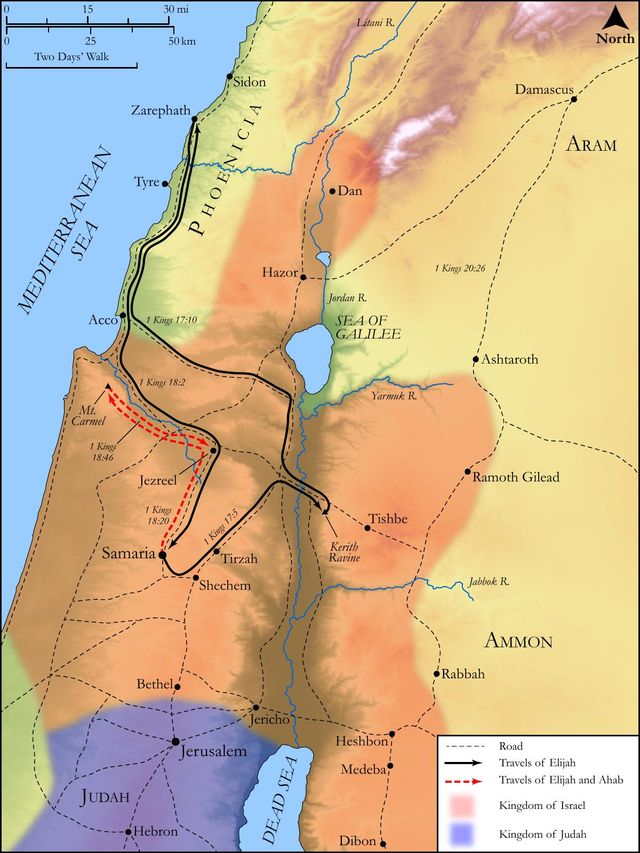
See on the biblical-era maps

Study this verse
Public-domain commentary
Matthew Henry
From his Commentary on the Whole Bible. Henry comments on passages, not single verses — this entry covers 1 Kings 18:1–16. His four-level outline is real structure in the source text, so it is rendered as structure.
In these verses we find,
I.The sad state of Israel at this time, upon two accounts: -
1.Jezebel cut off the prophets of the Lord (Kg1 18:4), slew them, Kg1 18:13. Being an idolater, she was a persecutor, and made Ahab one. Even in those bad times, when the calves were worshipped and the temple at Jerusalem deserted, yet there were some good people that feared God and served him, and some good prophets that instructed them in the knowledge of him and assisted them in their devotions. The priests and the Levites had all gone to Judah and Jerusalem (Ch2 11:13, Ch2 11:14), but, instead of them, God raised up these prophets, who read and expounded the law in private meetings, or in the families that retained their integrity, for we read not of any synagogues at this time; they had not the spirit of prophecy as Elijah, nor did they offer sacrifice, or burn incense, but taught people to live well, and keep close to the God of Israel. These Jezebel aimed to extirpate, and put many of them to death, which was as much a public calamity as a public iniquity, and threatened the utter ruin of religion's poor remains in Israel. Those few that escaped the sword were forced to abscond, and hide themselves in caves, where they were buried alive and cut off, though not from life, yet from usefulness, which is the end and comfort of life; and, when the prophets were persecuted and driven into corners, no doubt their friends, those few good people that were in the land, were treated in like manner. Yet, bad as things were,
(1.)There was one very good man, who was a great man at court, Obadiah, who answered his name - a servant of the Lord, one who feared God and was faithful to him, and yet was steward of the household to Ahab. Observe his character: He feared the Lord greatly (Kg1 18:3), was not only a good man, but zealously and eminently good; his great place put a lustre upon his goodness, and gave him great opportunities of doing good; and he feared the Lord from his youth (Kg1 18:12), he began betimes to be religious and had continued long. Note, Early piety, it is to be hoped, will be eminent piety; those that are good betimes are likely to be very good; he that feared God from his youth came to fear him greatly. He that will thrive must rise betimes. But it is strange to find such an eminently good man governor of Ahab's house, an office of great honour, power, and trust.
[1.]It was strange that so wicked a man as Ahab would prefer him to it and continue him in it; certainly it was because he was a man of celebrated honesty, industry, and ingenuity, and one in whom he could repose a confidence, whose eyes he could trust as much as his own, as appears here, Kg1 18:5. Joseph and Daniel were preferred because there were none so fit as they for the places they were preferred to. Note, Those who profess religion should study to recommend themselves to the esteem even of those that are without by their integrity, fidelity, and application to business.
[2.]It was strange that so good a man as Obadiah would accept of preferment in a court so addicted to idolatry and all manner of wickedness. We may be sure it was not made necessary to qualify him for preferment that he should be of the king's religion, that he should conform to the statues of Omri, or the law of the house of Ahab. Obadiah would not have accepted the place if he could not have had it without bowing the knee to Baal, nor was Ahab so impolitic as to exclude those from offices that were fit to serve him, merely because they would not join with him in his devotions. That man that is true to his God will be faithful to his prince. Obadiah therefore could with a good conscience enjoy the place, and therefore would not decline it, nor give it up, though he foresaw he could not do the good he desired to do in it. Those that fear God need not go out of the world, bad as it is.
[3.]It was strange that either he did not reform Ahab or Ahab corrupt him; but it seems they were both fixed; he that was filthy would be filthy still, and he that was holy would be holy still. Those fear God greatly that keep up the fear of him in bad times and places; thus Obadiah did. God has his remnant among all sorts, high and low; there were saints in Nero's household, and in Ahab's.
(2.)This great good man used his power for the protection of God's prophets. He hid 100 of them in two caves, when the persecution was hot, and fed them with bread and water, Kg1 18:4. He did not think it enough to fear God himself, but, having wealth and power wherewith to do it, he thought himself obliged to assist and countenance others that feared God; nor did he think his being kind to them would excuse him from being good himself, but he did both, he both feared God greatly himself and patronised those that feared him likewise. See how wonderfully God raises up friends for his ministers and people, for their shelter in difficult times, even where one would least expect them. Bread and water were now scarce commodities, yet Obadiah will find a competence of both for God's prophets, to keep them alive for service hereafter, though now they were laid aside.
2.When Jezebel cut off God's prophets God cut off the necessary provisions by the extremity of the drought. Perhaps Jezebel persecuted God's prophets under pretence that they were the cause of the judgment, because Elijah had foretold it. Christianos ad leones - Away with Christians to the lions. But God made them know the contrary, for the famine continued till Baal's prophets were sacrificed, and so great a scarcity of water there was that the king himself and Obadiah went in person throughout the land to seek for grass for the cattle, Kg1 18:5, Kg1 18:6. Providence ordered it so, that Ahab might, with his own eyes, see how bad the consequences of this judgment were, that so he might be the better inclined to hearken to Elijah, who would direct him into the only way to put an end to it. Ahab's care was not to lose all the beasts, many being already lost; but he took no care about his soul, not to lose that; he took a deal of pains to seek grass, but none to seek the favour of God, fencing against the effect, but not enquiring how to remove the cause. The land of Judah lay close to the land of Israel, yet we find no complaint there of the want of rain; for Judah yet ruled with God, and was faithful with the saints and prophets (Hos 11:12), by which distinction Israel might plainly have seen the ground of God's controversy, when God caused it to rain upon one city and not upon another (Amo 4:7, Amo 4:8); but they blinded their eyes, and hardened their hearts, and would not see.
II.The steps taken towards redressing the grievance, by Elijah's appearing again upon the stage, to act as a Tishbite, a converter or reformer of Israel, for so (some think) that title of his signifies. Turn them again to the Lord God of hosts, from whom they have revolted, and all will be well quickly; this must be Elijah's doing. See Luk 1:16, Luk 1:17.
1.Ahab had made diligent search for him (Kg1 18:10), had offered rewards to any one that would discover him, sent spies into every tribe and lordship of his own dominions, as some understand it, or, as others, into all the neighbouring nations and kingdoms that were in alliance with him; and, when they denied that they knew any thing of him, he would not believe them unless they swore it, and, as should seem, promised likewise upon oath that, if ever they found him among them, they would discover him and deliver him up. It should seem, he made this diligent search for him, not so much that he might punish him for what he had done in denouncing the judgment as that he might oblige him to undo it again, by recalling the sentence, because he had said it should be according to his word, having such an opinion of him as men foolishly conceive of witches (that, if they can but compel them to bless that which they have bewitched, it will be well again), or such as the king of Moab had of Balaam. I incline to this because we find, when they came together, Elijah, knowing what Ahab wanted him for, appointed him to meet him on Mount Carmel, and Ahab complied with the appointment, though Elijah took such a way to revoke the sentence and bless the land as perhaps he little thought of.
2.God, at length, ordered Elijah to present himself to Ahab, because the time had now come when he would send rain upon the earth (Kg1 18:1), or rather upon the land. Above two years he had lain hid with the widow at Zarephath, after he had been concealed one year by the brook Cherith; so that the third year of his sojourning there, here spoken of (Kg1 18:1), was the fourth of the famine, which lasted in all three years and six months, as we find, Luk 4:25; Jam 5:17. Such was Elijah's zeal, no doubt, against the idolatry of Baal, and such his compassion to his people, that he thought it long to be thus confined to a corner; yet he appeared not till God bade him: "Go and show thyself to Ahab, for now thy hour has come, even the time to favour Israel." Note, It bodes well to any people when God calls his ministers out of their corners, and bids them show themselves - a sign that he will give rain on the earth; at least we may the better be content with the bread of affliction while our eyes see our teachers, Isa 30:20, Isa 30:21.
3.Elijah first surrendered, or rather discovered, himself to Obadiah. He knew, by the Spirit, where to meet him, and we are here told what passed between them.
(1.)Obadiah saluted him with great respect, fell on his face, and humbly asked, Art thou that my lord Elijah? Kg1 18:7. As he had shown the tenderness of a father to the sons of the prophets, so he showed the reverence of a son to this father of the prophets; and by this made it appear that he did indeed fear God greatly, that he did honour to one that was his extraordinary ambassador and had a great interest in heaven.
(2.)Elijah, in answer to him,
[1.]Transfers the title of honour he gave him to Ahab: "Call him thy lord, not me;" that is a fitter title for a prince than for a prophet, who seeks not honour from men. Prophets should be called seers, and shepherds, and watchmen, and ministers, rather than lords, as those that mind duty more than dominion.
[2.]He bids Obadiah go and tell the king that he is there to speak with him: Tell thy lord, Behold, Elijah is forth-coming, Kg1 18:8. He would have the king know before, that it might not be a surprise to him and that he might be sure it was the prophet's own act to present himself to him.
(3.)Obadiah begs to be excused from carrying this message to Ahab, for it might prove as much as his life was worth.
[1.]He tells Elijah what great search Ahab had made for him and how much his heart was upon it to find him out, Oba 1:10.
[2.]He takes it for granted that Elijah would again withdraw (Oba 1:12): The Spirit of the Lord shall carry thee (as it is likely he had done sometimes, when Ahab thought he had been sure of him) whither I know not. See Kg2 2:16. He thought Elijah was not in good earnest when he bade him tell Ahab where he was, but intended only to expose the impotency of his malice; for he knew Ahab was not worthy to receive any kindness from the prophet and it was not fit that the prophet should receive any mischief from him.
[3.]He is sure Ahab would be so enraged at the disappointment that he would put him to death for making a fool of him, or for not laying hands on Elijah himself, when he had him in his reach, Kg1 18:12. Tyrants and persecutors, in their passion, are often unreasonably outrageous, even towards their friends and confidants.
[4.]He pleads that he did not deserve to be thus exposed, and put in peril of his life: What have I said amiss? Kg1 18:9. Nay (Kg1 18:13), Was it not told my lord how I hid the prophets? He mentions this, not in pride or ostentation, but to convince Elijah that though he was Ahab's servant he was not in his interest, and therefore deserved not to be bantered as one of the tools of his persecution. He that had protected so many prophets, he hoped, should not have his own life hazarded by so great a prophet.
(4.)Elijah satisfied him that he might with safety deliver this message to Ahab, by assuring him, with an oath, that he would, this very day, present himself to Ahab, Kg1 18:15. Let but Obadiah know that he spoke seriously and really intended it, and he will make no scruple to carry the message to Ahab. Elijah swears by the Lord of hosts, who has all power in his hands, and is therefore able to protect his servants against all the powers of hell and earth.
(5.)Notice is hereby soon brought to Ahab that Elijah had sent him a challenge to meet him immediately at such a place, and Ahab accepts the challenge: He went to meet Elijah, Kg1 18:16. We may suppose it was a great surprise to Ahab to hear that Elijah, whom he had so long sought and not found, was now found without seeking. He went in quest of grass, and found him from whose word, at God's mouth, he must expect rain. Yet his guilty conscience gave him little reason to hope for it, but, rather, to fear some other more dreadful judgment. Had he, by his spies, surprised Elijah, he would have triumphed over him; but, now that he was thus surprised by him, we may suppose he even trembled to look him in the face, hated him, and yet feared him, as Herod did John.
Continue studying 1 Kings 18:4 across the web’s major study libraries — every link below opens this exact verse, chapter, or book on the destination site.
Read & Compare
 BibleGatewayThis verse in more than 200 translations and 70 languages.
 Bible.comThe YouVersion reader — hundreds of translations, reading plans, and highlights.
 ESV.orgCrossway's official English Standard Version reader.
 NET BibleThe NET translation with 60,000+ translators' notes on every rendering decision.
 STEP BibleTyndale House's free study tool — original text, vocabulary, and scholarly resources.
 BibliaLogos Bible Software's free web reader.
 USCCBThe New American Bible (Revised Edition) with the U.S. bishops' study notes.
Commentaries
 BibleHub CommentariesDozens of classic commentaries on this verse, gathered on one page.
 StudyLightMore than 100 commentary sets — the largest collection on the web.
 BibleRefPlain-English commentary on what this verse means, verse by verse.
 Enduring WordDavid Guzik's free commentary on this chapter, widely used by Bible teachers.
 Bible Study ToolsVerse commentary alongside Greek and Hebrew study aids.
Original Language & Research
- BibleHub InterlinearThe verse word by word — original language, transliteration, and English.
- BibleHub LexiconEvery word's original-language definition and Strong's entry.
 Blue Letter BibleDeep-study tools — Strong's numbers, concordance, and word studies.
 SefariaThe Hebrew text with Rashi and centuries of Jewish commentary.
Sermons, Hymns & Audio


TrulyRandomVerse is not affiliated with these sites and doesn’t control their content. They’re linked because they’re genuinely useful.
Summary
First Kings 18:4 provides a vivid snapshot of the intense spiritual conflict in ancient Israel, depicting Queen Jezebel's ruthless campaign to eradicate the prophets of the LORD and the remarkably courageous, clandestine efforts of Obadiah, King Ahab's palace administrator, to preserve a remnant of these faithful servants by hiding and sustaining one hundred of them in caves during a severe famine. This verse not only underscores the pervasive apostasy and persecution of the era but also highlights the quiet, unwavering faithfulness of an individual who risked everything to protect God's messengers and ensure the continuation of the prophetic voice in a land steeped in idolatry.
Context
ShowHideLiterary Context
This pivotal verse is strategically positioned within the broader narrative of Elijah's ministry, serving as a crucial prelude to the dramatic confrontation on Mount Carmel detailed in 1 Kings 18. The preceding chapter, 1 Kings 17, establishes the severe three-and-a-half-year drought as a divine judgment upon Israel's rampant idolatry, initiated by Elijah's bold prophecy in 1 Kings 17:1. Chapter 18 opens with God instructing Elijah to reappear before Ahab, promising the imminent return of rain. However, before this climactic encounter, the text deliberately pauses to reveal the dire state of affairs for Yahweh's prophets and to introduce Obadiah, a surprising figure of profound faithfulness operating within Ahab's deeply corrupt court. This revelation of Jezebel's systematic persecution and Obadiah's counter-actions sets a grim but hopeful stage for the intense spiritual battle, demonstrating the depth of the apostasy and the desperate need for divine intervention, while simultaneously showcasing God's hidden means of preservation.
Historical & Cultural Context
The period described in 1 Kings is characterized by profound spiritual and moral decline in the Northern Kingdom of Israel. King Ahab's strategic political marriage to Jezebel, a zealous Phoenician princess and worshipper of Baal and Asherah, introduced destructive religious syncretism and outright idolatry into the very heart of Israelite society. Jezebel actively promoted her native deities, establishing temples and maintaining hundreds of Baal and Asherah prophets at the royal table, effectively creating a state-sponsored pagan religion. Her campaign to "cut off" the prophets of the LORD was a systematic, violent, and murderous purge, a state-sanctioned effort to eliminate any opposition to her religious agenda and consolidate Baal worship as the dominant religion. This persecution was not merely social ostracization but a brutal extermination, making Obadiah's actions incredibly dangerous and culturally counter-normative for a high-ranking official. The severe drought would have exacerbated the challenge of providing for 100 people, highlighting the immense risk and sacrifice involved in his sustained act of defiance and compassion.
Key Themes
ShowHide1 Kings 18:4 powerfully illustrates several crucial themes. Firstly, it highlights the persecution of the righteous, demonstrating the extreme lengths to which those hostile to God will go to suppress His truth and silence His messengers, as vividly seen in Jezebel's brutal extermination campaign. Secondly, it showcases courageous faithfulness amidst widespread apostasy and danger; Obadiah's actions, risking his life and prestigious position, stand as a testament to unwavering commitment to God, even when surrounded by profound wickedness. Thirdly, the verse underscores the divine preservation of a remnant. Even when it seemed the true worship of the LORD was being utterly wiped out, God always preserved a faithful few, often through unexpected means or individuals like Obadiah. This echoes the broader biblical theme of God's enduring covenant with His people, even in their unfaithfulness, as later seen in God's revelation to Elijah about the 7,000 who had not bowed to Baal. Finally, it exemplifies hidden service and provision, revealing how God can use covert, yet profoundly impactful, actions to sustain His servants in desperate circumstances, often through channels that appear unlikely and at great personal cost.
Exposition and Analysis
ShowHideKey Word Analysis
ShowHideThis name, belonging to the Phoenician princess and wife of King Ahab, signifies "Where is the Prince?" or "Baal Exalts." Her very identity is intertwined with the promotion of Baal worship and the persecution of Yahweh's prophets. Her actions in this verse epitomize the spiritual opposition faced by God's people in Israel, portraying her as a formidable and ruthless antagonist to the covenant God.
This primitive root means "to cut (off, down or asunder)." In this context, it carries the strong implication of "to destroy," "to exterminate," or "to annihilate." It denotes a decisive and violent act aimed at complete elimination. Jezebel's intent was not merely to dismiss or silence the prophets but to utterly remove their presence and influence from the land, a systematic purge designed to leave no trace of Yahweh's prophetic voice.
Meaning "servant of Jah" or "worshipper of Yahweh." This name is profoundly significant and ironic given his position as the chief administrator in the household of Ahab, the most idolatrous king of Israel. His name highlights his personal devotion to the LORD despite his proximity to profound wickedness, setting him apart as a remarkable example of faithfulness and courage in a deeply corrupt environment.
A primitive root meaning "to secrete" or "to hide (self)." This word emphasizes the clandestine and dangerous nature of Obadiah's actions. He did not merely shelter the prophets but actively concealed them, implying a deliberate effort to keep their existence and his actions secret from Jezebel's murderous campaign. This act of hiding was essential for their survival and underscores the immense risk involved.
Verse Breakdown
ShowHide"For it was [so], when Jezebel cut off the prophets of the LORD"
This opening clause establishes the grim and dangerous context, highlighting the severe, state-sponsored persecution initiated by Queen Jezebel. Her actions were a deliberate, systematic campaign to eradicate the legitimate prophetic voice of Yahweh from Israel, aiming to solidify the supremacy of Baal worship. The phrase "cut off" (Hebrew kârath) implies a decisive and violent extermination, underscoring the existential threat faced by God's servants.
"that Obadiah took an hundred prophets"
This introduces the counter-narrative of courageous and compassionate intervention. Obadiah, despite his high-ranking and politically sensitive position as King Ahab's palace administrator (as mentioned in 1 Kings 18:3), actively sought out and gathered a significant number of the persecuted prophets. This act was incredibly risky, as discovery would have meant certain death for him and the prophets, demonstrating profound personal faith and moral courage.
"and hid them by fifty in a cave"
This detail reveals the practical, dangerous, and covert nature of Obadiah's rescue mission. Hiding them in caves provided natural, secluded shelters, but also presented immense logistical challenges for sustenance and secrecy. Dividing them into two groups of fifty might have been a strategy for managing resources, reducing the risk of discovery for all, or simply utilizing available space. This act underscores the desperate circumstances and Obadiah's meticulous planning to ensure their safety.
"and fed them with bread and water"
This final clause highlights Obadiah's sustained provision for the hidden prophets, which was particularly challenging during the severe famine afflicting the land. Bread and water, though basic, were essential for survival and represented a remarkable act of sustained charity and risk. This provision not only met their physical needs but also symbolized the preservation of their lives and, by extension, the prophetic ministry in Israel during a period of intense spiritual darkness.
Literary Devices
ShowHideThe verse is rich with literary devices that amplify its profound message. Irony is strikingly prominent, most notably in Obadiah's name, which means "servant of Yahweh," contrasting sharply with his service in the household of the idolatrous King Ahab. This highlights his hidden, yet profound, faithfulness in a corrupt system. There is also a powerful Contrast between the zealous, murderous actions of Jezebel, who seeks to destroy God's prophets, and the quiet, life-preserving actions of Obadiah. This juxtaposition underscores the spiritual battle for Israel's soul and the stark difference between those who oppose God and those who serve Him. Furthermore, the act of "feeding them with bread and water" during a severe drought functions as Symbolism for divine provision and sustenance, mirroring God's own miraculous care for Elijah and the widow of Zarephath in the preceding chapter. Obadiah becomes an instrument of God's preserving grace, ensuring the continuation of the prophetic voice even when it seems utterly suppressed. The Foreshadowing of God's faithfulness to preserve a remnant, even in the darkest times, is also evident, setting the stage for Elijah's later discovery of the 7,000 who had not bowed to Baal.
Theological and Thematic Connections
ShowHideThis verse profoundly illustrates God's unwavering commitment to preserve a faithful remnant, even in times of widespread apostasy and intense persecution. It reveals that God's purposes are not thwarted by human wickedness; rather, He raises up unexpected individuals like Obadiah to be instruments of His preserving grace. The theological implication is that true faith can exist and thrive even in the most hostile environments, often expressed through hidden acts of courage and sacrificial service. Obadiah's actions serve as a powerful testament to the principle that God always maintains a witness for Himself, ensuring that His truth is not utterly extinguished. This narrative encourages believers to trust in God's sovereign hand, even when the forces against faith seem overwhelming, and to recognize the vital role of quiet, faithful service in the broader scope of God's redemptive plan. It underscores that God's kingdom often advances not through overt displays of power, but through the steadfast, often unseen, obedience of His people.
Reflection and Application
ShowHideThe story of Obadiah in 1 Kings 18:4 offers profound and enduring lessons for contemporary believers. In a world that often seems increasingly hostile to biblical truth and Christian values, Obadiah's quiet courage challenges us to examine the depth of our own convictions and the extent of our faithfulness. He did not engage in public confrontation or dramatic displays of power, yet his behind-the-scenes faithfulness was absolutely critical for the survival of God's prophetic voice in Israel. This reminds us that not all impactful ministry is visible, celebrated, or even recognized by others; often, the most vital and strategic work is done in obscurity, at great personal risk, driven by a deep love for God and His people. We are called to cultivate a faith that is resilient in adversity, willing to take risks for the sake of truth, and compassionate in its care for others, especially those who are persecuted or vulnerable for their faith. Furthermore, Obadiah's example encourages us to look for and support the "Obadiahs" in our own contexts—those who faithfully serve God in hidden ways, often bearing significant burdens to sustain ministry, protect the vulnerable, or uphold truth in challenging environments. His story is a powerful reminder that God always has a remnant, and He sovereignly uses ordinary people in extraordinary ways to preserve His truth and His people, even when the spiritual landscape appears bleak and hope seems scarce.
Questions for Reflection
ShowHideFAQ
ShowHideWho was Obadiah, and what was his significance in the story of Elijah?
ShowHideObadiah was a high-ranking official, specifically the "governor of Ahab's house" or chief administrator, as stated in 1 Kings 18:3. His name, meaning "servant of Yahweh," stands in stark contrast to his position in the court of the most idolatrous king of Israel, Ahab. His significance lies in his unwavering devotion to the LORD despite being surrounded by profound wickedness and persecution. He secretly hid and sustained one hundred prophets of the LORD whom Queen Jezebel was attempting to eradicate. This act of courageous, clandestine faithfulness was crucial for preserving the prophetic voice in Israel during a period when it was under existential threat, making him a vital instrument in God's plan to maintain a faithful remnant and prepare the way for Elijah's public ministry.
Why did Jezebel want to "cut off" the prophets of the LORD?
ShowHideQueen Jezebel, a Phoenician princess and a zealous worshipper of Baal and Asherah, was determined to establish her native deities as the dominant gods in Israel. Her marriage to King Ahab, detailed in 1 Kings 16:31-33, brought widespread idolatry and moral corruption into the Northern Kingdom. The prophets of the LORD were the primary voice of Yahweh, directly challenging the idolatry, injustice, and spiritual apostasy of the kingdom. They represented a direct threat to Jezebel's religious agenda and her efforts to consolidate the worship of Baal. Therefore, her campaign to "cut off" or exterminate them was a systematic, state-sponsored purge aimed at eliminating any opposition and ensuring the complete supremacy of her pagan religion.
Christ-Centered Fulfillment
ShowHideThe quiet, courageous faithfulness of Obadiah, who risked his life to preserve the prophets of the LORD by providing them with bread and water, powerfully foreshadows the ultimate divine preservation and sustenance found in Jesus Christ. Just as Obadiah ensured the physical sustenance of the prophets during a severe famine, Jesus declares Himself to be the Bread of Life, offering eternal spiritual sustenance and life to all who believe, ensuring that no one who comes to Him will ever hunger or thirst spiritually. The intense persecution faced by the prophets under Jezebel's hand anticipates the profound hostility and suffering that Christ Himself would endure, as well as the persecution that His followers would continue to face throughout history, as Jesus warned that if they persecuted Him, they would also persecute His disciples. Moreover, Obadiah's act of preserving a remnant points to Christ's ultimate work in building and preserving His Church. Despite all the forces of evil, persecution, and spiritual darkness, Jesus assures us that the gates of hell shall not prevail against His Church. Obadiah's hidden service, born of deep loyalty to Yahweh, finds its ultimate fulfillment in Christ, who, through His sacrificial death and glorious resurrection, secured the spiritual life and eternal preservation of all who are His, establishing a new covenant and an indestructible spiritual remnant that will endure forever, sustained by His very presence and power.