


Isaiah 30:20
Bible text: King James Version (1769 Blayney text) · Public domain
Bible text: King James Version with Strong's numbers · Public domain
Bible text: Berean Standard Bible · Public domain
Bible text: American Standard Version (1901) · Public domain
Bible text: World English Bible, Messianic edition · Public domain
Bible text: Geneva Bible (1599) · Public domain
Bible text: Young's Literal Translation · Public domain
- וְנָתַןve·na·Tanand he will giveH5414Conj-w ¦ V-Qal-ConsecPerf-3msVerb Qal Consecutive Perfect 3rd Singular Masculineוְandנָתַןhe will give
- לָכֶםla·Khemto youPrep-l ¦ 2mpSuffix Personal 2nd Plural Masculineלָtoכֶםyou
- אֲדֹנָי'a·do·Nai[the] LordH136N-properNoun Proper Title
- לֶחֶםLe·chembreadH3899N-msNoun Singular Masculine Absolute
- צָרtzardistressH6862Adj-msAdjective Singular Masculine Absolute
- וּמַיִםu·Ma·yimand waterH4325Conj-w ¦ N-mpNoun Plural Masculine Absoluteוּandמַיִםwater
- לָחַץLa·chatzoppressionH3906N-msNoun Singular Masculine Absolute
- וְלֹאve·lo'and notH3808Conj-w ¦ NegParticle Negativeוְandלֹאnot
- יִכָּנֵףyi·ka·Nefhe will hide himselfH3670V-Niphal-Imperf-3msVerb Niphal Imperfect 3rd Singular Masculine
- עוֹד'OdagainH5750Adj-msAdjective Numerical Singular Masculine Absolute
- מוֹרֶיךָmo·Rei·khayour teachersH4175N-mpc ¦ 2msNoun Plural Masculine Constructמוֹרֶיteachersךָyour
- וְהָיוּve·ha·Yuand they will beH1961Conj-w ¦ V-Qal-ConsecPerf-3cpVerb Qal Consecutive Perfect 3rd Plural common genderוְandהָיוּthey will be
- עֵינֶיךָ'ei·Nei·khayour eyesH5869N-fdc ¦ 2msNoun Dual Feminine Constructעֵינֶיeyesךָyour
- רֹאוֹתro·'otseeingH7200V-Qal-Prtcpl-fpVerb Qal Participle Plural Feminine Absolute
- אֶת'et<obj.>H853DirObjMParticle Object Indicator
- מוֹרֶיךָmo·Rei·khayour teachersH4175N-mpc ¦ 2msNoun Plural Masculine Constructמוֹרֶיteachersךָyour
English is a literal word-by-word gloss of the Hebrew, not the KJV's wording. Why?
This is the original text the KJV's translators worked from — each Hebrew word with its own literal English meaning in this verse, prepared by scholars at Tyndale House, Cambridge. The KJV translates whole sentences, not word by word, so its wording differs: one Hebrew word can become several English words, and the KJV may choose “the LORD” where the gloss reads “Yahweh”. Both are faithful — they answer different questions. For the KJV's own rendering, switch to the KJV text.
Details
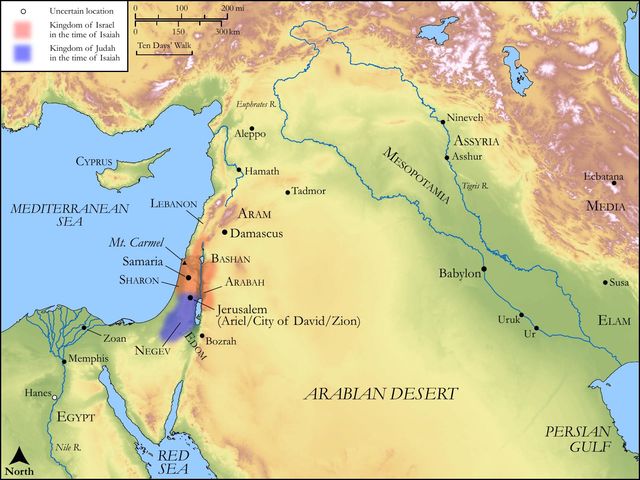
See on the biblical-era map
Study this verse
Public-domain commentary
Matthew Henry
From his Commentary on the Whole Bible. Henry comments on passages, not single verses — this entry covers Isaiah 30:18–26. His three-level outline is real structure in the source text, so it is rendered as structure.
The closing words of the foregoing paragraph (You shall be left as a beacon upon a mountain) some understand as a promise that a remnant of them should be reserved as monuments of mercy; and here the prophet tells them what good times should succeed these calamities. Or the first words in this paragraph may be read by way of antithesis, Notwithstanding this, yet will the Lord wait that he may be gracious. The prophet, having shown that those who made Egypt their confidence would be ashamed of it, here shows that those who sat still and made God alone their confidence would have the comfort of it. It is matter of comfort to the people of God, when the times are very bad, that all will be well yet, well with those that fear God, when we say to the wicked, It shall be ill with you.
I.God will be gracious to them and will have mercy on them.
This is the foundation of all good. If we find favour with God, and he have mercy upon us, we shall have comfort according to the time that we have been afflicted.
1.The mercy in store for them is very affectingly expressed. (1.) "He will wait to be gracious (Isa 30:18); he will wait till you return to him and seek his face, and then he will be ready to meet you with mercy. He will wait, that he may do it in the best and fittest time, when it will be most for his glory, when it will come to you with the most pleasing surprise. He will continually follow you with his favours, and not let slip any opportunity of being gracious to you." (2.) "He will stir up himself to deliver you, will be exalted, will be raised up out of his holy habitation (Zac 2:13), that he may appear for you in more than ordinary instances of power and goodness; and thus he will be exalted, that is, he will glorify his own name. This is what he aims at in having mercy on his people." (3.) He will be very gracious (Isa 30:19), and this in answer to prayer, which makes his kindness doubly kind: "He will be gracious to thee, at the voice of thy cry, the cry of thy necessity, when that is most urgent - the cry of thy prayer, when that is most fervent. When he shall hear it, there needs no more; at the first word he will answer thee, and say, Here I am." Herein he is very gracious indeed. In particular, [1.] Those who were disturbed in the possession of their estates shall again enjoy them quietly. When the danger is over the people shall dwell in Zion, at Jerusalem, as they used to do; they shall dwell safely, free from the fear of evil. [2.] Those who were all in tears shall have cause to rejoice, and shall weep no more; and those who dwell in Zion, the holy city, will find enough there to wipe away tears from their eyes.
2.This is grounded upon two great truths:
(1.)That the Lord is a God of judgment; he is both wise and just in all the disposals of his providence, true to his word and tender of his people. If he correct his children, it is with judgment (Jer 10:24), with moderation and discretion, considering their frame. We think we may safely refer ourselves to a man of judgment; and shall we not commit our way to a God of judgment?
(2.)That therefore all those are blessed who wait for him, who not only wait on him with their prayers, but wait for him with their hopes, who will not take any indirect course to extricate themselves out of their straits, or anticipate their deliverance, but patiently expect God's appearances for them in his own way and time. Because God is infinitely wise, those are truly happy who refer their cause to him.
II.They shall not again know the want of the means of grace, Isa 30:20, Isa 30:21. Here,
1.It is supposed that they might be brought into straits and troubles after this deliverance was wrought for them. It was promised (Isa 30:19), that they should weep no more and that God would be gracious to them; and yet here it is taken for granted that God may give them the bread of adversity and the water of affliction, prisoners' fare (Kg1 22:27), coarse and sorry food, such as the poor use. When one trouble is over we know not how soon another may succeed; and we may have an interest in the favour of God, and such consolations as are sufficient to prohibit weeping, and yet may have bread of adversity given us to eat and water of affliction to drink. Let us therefore not judge of love or hatred by what is before us.
2.It is promised that their eyes should see their teachers, that is, that they should have faithful teachers among them, and should have hearts to regard them and not slight them as they had done; and then they might the better be reconciled to the bread of adversity and the water of affliction. It was a common saying among the old Puritans, Brown bread and the gospel are good fare. A famine of bread is not so great a judgment as a famine of the word of God, Amo 8:11, Amo 8:12. It seems that their teachers had been removed into corners (probably being forced to shift for their safety in the reign of Ahaz), but it shall be so no more. Veritas non quaerit angulos - Truth seeks no corners for concealment. But the teachers of truth may sometimes be driven into corners for shelter; and it goes ill with the church when it is so, when the woman with her crown of twelve stars is forced to flee into the wilderness (Rev 12:6), when the prophets are hidden by fifty in a cave, Kg1 18:4. But God will find a time to call the teachers out of their corners again, and to replace them in their solemn assemblies, which shall see their own teachers, the eyes of all the synagogue being fastened on them, Luk 4:20. And it will be the more pleasing because of the restraint they have been for some time under, as light out of darkness, as life from the dead. To all that love God and their own souls this return of faithful teachers out of their corners, especially with a promise that they shall not be removed into corners any more, is the most acceptable part of any deliverance, and has comfort enough in it to sweeten even the bread of adversity and the water of affliction. But this is not all:
3.It is promised that they shall have the benefit, not only of the public ministry, but of private and particular admonition and advice (Isa 30:21): "Thy ears shall hear a word behind thee, calling after thee as a man calls after a traveller that he sees going out of his road." Observe, (1.) Whence this word shall come - from behind thee, from some one whom thou dost not see, but who sees thee. "Thy eyes see thy teachers; but this is a teacher out of sight, it is thy own conscience, which shall now by the grace of God be awakened to do its office." (2.) What the word shall be: "This is the way, walk you in it. When thou art doubting, conscience shall direct thee to the way of duty; when thou art dull and trifling, conscience shall quicken thee in that way." As God has not left himself without witness, so he has not left us without guides to show us our way. (3.) The seasonableness of this word: It shall come when you turn to the right hand or to the left. We are very apt to miss our way; there are turnings on both hands, and those so tracked and seemingly straight that they may easily be mistaken for the right way. There are right-hand and left-hand errors, extremes on each side virtue; the tempter is busy courting us into the by-paths. It is happy then if by the particular counsels of a faithful minister or friend, or the checks of conscience and the strivings of God's Spirit, we be set right and prevented from going wrong. (4.) The success of this word: "It shall not only be spoken, but thy ears shall hear it; whereas God has formerly spoken once, yea, twice, and thou hast not perceived it (Job 33:14), now thou shalt listen attentively to these secret whispers, and hear them with an obedient ear." If God gives us not only the word, but the hearing ear, not only the means of grace, but a heart to make a good use of those means, we have reason to say, He is very gracious to us, and reason to hope he has yet further mercy in store for us.
III.They shall be cured of their idolatry, shall fall out with their idols, and never be reconciled to them again, Isa 30:22.
The deliverance God shall work for them shall convince them that it is their interest, as well as duty, to serve him only; and they shall own that, as their trouble was brought upon them for their idolatries, so it was removed upon condition that they should not return to them. This is also the good effect of their seeing their teachers and hearing the word behind them; by this it shall appear that they are the better for the means of grace they enjoy - they shall break off from their best-beloved sin. Observe,
1.How foolishly mad they had formerly been upon their idols, in the day of their apostasy. Idolaters are said to be mad upon their idols (Jer 50:38), doatingly fond of them. They had graven images of silver, and molten images of gold, and, though gold needs no painting, they had coverings and ornaments on these; they spared no cost in doing honour to their idols.
2.How wisely mad (if I may so speak) they now were at their idols, what a holy indignation they conceived against them in the day of their repentance. They not only degraded their images, but defaced them, not only defaced them, but defiled them; they not only spoiled the shape of them, but in a pious fury threw away the gold and silver they were made of, though otherwise valuable and convertible to a good use. They could not find in their hearts to make any vessel of honour of them. The rich clothes wherewith their images were dressed up they cast away as a filthy cloth which rendered those that touched it unclean until the evening, Lev 15:23. Note, To all true penitents sin has become very odious; they loathe it, and loathe themselves because of it; they cast it away to the dunghill, the fittest place for it, nay, to the cross, for they crucify the flesh; their cry against it is, Crucify it, crucify it. They say unto it, Abi hinc in malam rem - Get thee hence. They are resolved never to harbour it any more. They put as far from as they can all the occasions of sin and temptations to it, though they are as a right eye or a right hand, and protest against it as Ephraim did (Hos 14:8), What have I to do any more with idols? Probably this was fulfilled in many particular persons, who, by the deliverance of Jerusalem from Sennacherib's army, were convinced of the folly of their idolatry and forsook it. It was fulfilled in the body of the Jewish nation at their return from their captivity in Babylon, for they abhorred idols ever after; and it is accomplished daily in the conversion of souls, by the power of divine grace, from spiritual idolatry to the fear and love of God. Those that join themselves to the Lord must abandon every sin, and say unto it, Get thee hence.
IV.God will then give them plenty of all good things.
When he gives them their teachers, and they give him their hearts, so that they begin to seek the kingdom of God and the righteousness thereof, then all other things shall be added to them Mat 6:33. And when the people are brought to praise God then shall the earth yield her increase, and with it God, even our own God, shall bless us, Psa 67:5, Psa 67:6. So it follows here: "When you shall have abandoned your idols, then shall God give the rain of your seed," Isa 30:23. When we return to God in a way of duty he will meet us with his favours.
1.God will give you rain of your seed, rain to water the seed you sow, just at the time that it calls for it, as much as it needs and no more. Observe, How man's industry and God's blessing concur to the good things we enjoy relating to the life that now is: Thou shalt sow the ground, that is thy part, and then God will give the rain of thy seed, that is his part. It is so in spiritual fruit; we must take pains with our hearts and then wait on God for his grace.
2.The increase of the earth shall be rich and good, and every thing the best of the kind; it shall be fat and fat, very fat and very good, fat and plenteous (so we read it), good and enough of it. Your land shall be Canaan indeed; it was remarkably so after the defeat of Sennacherib, by the special blessing of God, Isa 37:30. God would thus repair the losses they sustained by that devastation.
3.Not only the tillage, but the pasture-ground should be remarkably fruitful: The cattle shall feed in large pastures; those that are at grass shall have room enough, and the oxen and asses that are kept up for use, to ear the ground, which must be the better fed for their being worked, shall eat clean provender. The corn shall not be given them in the chaff as usual, to make it go the further, but they shall have good clean corn fit for man's use, being winnowed with the fan. The brute-creatures shall share in the abundance; it is fit they should, for they groan under the burden of the curse which man's sin has brought upon the earth.
4.Even the tops of the mountains, that used to be barren, shall be so well watered with the rain of heaven that there shall be rivers and streams there, and running down thence to the valleys (Isa 30:25), and this in the day of the great slaughter that should be made by the angel in the camp of the Assyrians, when the towers and batteries they had erected for the carrying on of the siege of Jerusalem, the army being slain, should fall of course. It is probable that this was fulfilled in the letter of it, and that about the same time that that army was cut off there were extraordinary rains in mercy to the land.
V.The effect of all this should be extraordinary comfort and joy to the people of God, Isa 30:26.
Light shall increase; that is, knowledge shall increase (when the prophecies are accomplished they shall be fully understood) or rather triumph shall: the light of the joy that is sown for the righteous shall now come up with a great increase. The light of the moon shall become as bright and as strong as that of the sun, and that of the sun shall increase proportionably and be as the light of seven days; every one shall be much more cheerful and appear much more pleasant than usual. There shall be a high spring-tide of joy in Judah and Jerusalem, upon occasion of the ruin of the Assyrian army, when the Lord binds up the breach of his people, not only saves them from being further wounded, but heals the wounds that have been given them by this invasion and makes up all their losses. The great distress they were reduced to, their despair of relief, and the suddenness of their deliverance, would much augment their joy. This is not unfitly applied by many to the light which the gospel brought into the world to those that sat in darkness, which has far exceeded the Old Testament light as that of the sun does that of the moon, and which proclaims healing to the broken-hearted, and the binding up of their wounds.
Historical interpretation
Two Centuries of Reception
3 surviving comments on this verse. Each one is dated, so this reads as a timeline rather than a list.
Select a marker to jump to its quote. Markers stagger vertically where authors wrote within a few decades of each other.
(Verse 20.) Crying, you will not weep in vain, showing compassion, he will have compassion on you: at the sound of your cry, as soon as he hears, he will answer you. When you return to Zion and dwell in Jerusalem, you will not weep as you wept before, but your mourning will turn into joy: For blessed are those who weep, for they themselves will laugh (Luke VI, 21). And after you have called out and said to the Lord. I cried out with all my heart, hear me, O Lord (Psalm CXVIII, 145). And again: I cried out, have mercy on me, and I will keep your commandments (Psalm 85). And elsewhere: I waited for the morning and cried out (Psalm 118, 147), and your voice was so clear that it penetrated the heavens: immediately the Lord will answer you, and you will be like Moses, of whom it is written: Moses spoke, and the Lord answered him (Exodus 19, 20).
“Let waters from your own fountain flow in abundance for you, but let your waters pass through into your streets.” And according to the prophet Isaiah, “You shall be like a watered garden and like a fountain of water whose waters shall not fail. And the places that have been desolate for ages shall be built in you; you shall raise up the foundations of generation and generation; and you shall be called the repairer of the fences, turning the paths into rest.” And that blessedness shall come upon you which the same prophet promises: “And the Lord will not cause your teacher to flee away from you any more, and your eyes shall see your teacher. And your ears shall hear the word of one admonishing you behind your back. This is the way, walk in it, and go not aside either to the right hand or to the left.” And so it will come to pass that not only every purpose and thought of our heart but also all the wanderings and rovings of your imagination will become to you a holy and unceasing pondering of the divine law.
He has seen us sinning and has borne with it. He who forbade us to sin before we did it does not stop waiting to pardon us even after we have sinned. The one we have rejected is calling us. We have turned away from him, but he has not turned away. Hence Isaiah said, “Your eyes shall see your teacher, and your ears shall hear the voice of a counselor behind you.” A person is counseled to his face, so to speak, when he is created for righteousness and receives the precepts of rectitude. When he despises these precepts, it is as if he is turning his back to his Creator’s face. But he still follows behind us and counsels us that we have despised him, but he still does not cease to call us. We turn our backs on his face, so to speak, when we reject his words, when we trample his commandments under foot; but he who sees that we reject him still calls out to us by his commandments and waits for us by his patience, stands behind us, and calls us back when we have turned away.
Continue studying Isaiah 30:20 across the web’s major study libraries — every link below opens this exact verse, chapter, or book on the destination site.
Read & Compare
 BibleGatewayThis verse in more than 200 translations and 70 languages.
 Bible.comThe YouVersion reader — hundreds of translations, reading plans, and highlights.
 ESV.orgCrossway's official English Standard Version reader.
 NET BibleThe NET translation with 60,000+ translators' notes on every rendering decision.
 STEP BibleTyndale House's free study tool — original text, vocabulary, and scholarly resources.
 BibliaLogos Bible Software's free web reader.
 USCCBThe New American Bible (Revised Edition) with the U.S. bishops' study notes.
Commentaries
 BibleHub CommentariesDozens of classic commentaries on this verse, gathered on one page.
 StudyLightMore than 100 commentary sets — the largest collection on the web.
 BibleRefPlain-English commentary on what this verse means, verse by verse.
 Enduring WordDavid Guzik's free commentary on this chapter, widely used by Bible teachers.
 Bible Study ToolsVerse commentary alongside Greek and Hebrew study aids.
Original Language & Research
- BibleHub InterlinearThe verse word by word — original language, transliteration, and English.
- BibleHub LexiconEvery word's original-language definition and Strong's entry.
 Blue Letter BibleDeep-study tools — Strong's numbers, concordance, and word studies.
 SefariaThe Hebrew text with Rashi and centuries of Jewish commentary.
Sermons, Hymns & Audio


TrulyRandomVerse is not affiliated with these sites and doesn’t control their content. They’re linked because they’re genuinely useful.
Summary
Isaiah 30:20 delivers a profound promise of divine clarity and unwavering spiritual guidance, even amidst periods of severe hardship and God's disciplinary actions. While the people of Judah would indeed experience intense trials, metaphorically depicted as "the bread of adversity and the water of affliction," the Lord assures them that their true spiritual instructors would no longer be hidden or silenced. Instead, their eyes would clearly perceive their teachers, signifying a restoration of direct, unobstructed access to God's truth and prophetic instruction, enabling them to navigate the consequences of their disobedience with renewed spiritual discernment and hope.
Context
ShowHideLiterary Context
Isaiah 30 is situated within a significant section of the book (chapters 28-33) often referred to as the "Woes against Judah." This segment primarily addresses Judah's spiritual rebellion and their misguided reliance on foreign alliances, particularly with Egypt, rather than placing their trust solely in Yahweh for deliverance from the looming Assyrian threat. The preceding verses in chapter 30 detail God's pronouncements of judgment against Judah for their obstinacy and refusal to listen to His prophets. However, these judgments are not God's final word; they are immediately followed by expressions of God's patient desire to show mercy and His ultimate plan for restoration. Verse 20, therefore, serves as a pivotal turning point, transitioning from the announcement of deserved suffering to a glorious promise of renewed spiritual insight and divine presence. It anticipates a future where God's people, having been disciplined, will walk in obedience and enjoy His clear guidance, a theme further elaborated in Isaiah 30:21.
Historical & Cultural Context
The historical backdrop for Isaiah 30:20 is the tumultuous late 8th century BCE. The northern kingdom of Israel had already fallen to the Assyrian Empire in 722 BCE, and the southern kingdom of Judah faced the imminent and formidable threat of Assyrian invasion. In a desperate attempt to secure their safety, King Hezekiah and the leaders of Judah sought a military alliance with Egypt, a powerful but often unreliable regional force. This act of seeking human strength and political maneuvering over divine trust was a direct violation of God's covenant with His people and a profound affront to His sovereignty. In this period, prophets like Isaiah served as God's primary means of communication, delivering divine instruction, warnings, and promises. However, their messages were frequently rejected, ignored, or even suppressed by those in power, leading to a spiritual "famine" of the word of God. The promise in Isaiah 30:20 directly addresses this spiritual drought, offering a future where God's voice would be clearly heard again.
Key Themes
ShowHideThis verse powerfully encapsulates several major themes prevalent throughout Isaiah and the broader prophetic literature. Firstly, it highlights Divine Discipline and Restoration, demonstrating that God's allowance of "adversity" and "affliction" is not punitive abandonment but a purposeful means of refinement, correction, and a pathway to repentance. This discipline ultimately leads to a restored relationship and clear spiritual understanding, echoing the principle that the Lord disciplines those He loves, as seen in Proverbs 3:11-12. Secondly, it emphasizes Unveiled Spiritual Guidance, promising an end to periods where prophetic voices were scarce, silenced, or hidden. This ensures direct and unobstructed access to divine truth and instruction, pointing to a future era of abundant revelation, a stark contrast to the spiritual blindness and deafness often lamented in passages like Isaiah 6:9-10. Finally, it underscores Hope Amidst Hardship, assuring believers that even in the deepest trials, God will not abandon them to confusion but will make His will and way clear, providing a beacon of light and direction in times of darkness and uncertainty.
Exposition and Analysis
ShowHideKey Word Analysis
ShowHideThis term (H136) is an emphatic form of the Hebrew word for "lord" or "master," used here as a proper name of God. Its use emphasizes God's supreme authority, sovereignty, and ownership over His people. It underscores that it is the sovereign God Himself who orchestrates both the "bread of adversity" and the subsequent restoration of clear teaching, highlighting His ultimate control and benevolent purposes even in discipline.
The Hebrew word (H3384) comes from a primitive root meaning "to flow as water," "to lay or throw" (like an arrow), or figuratively, "to point out," "to teach." This root beautifully connects the idea of instruction to the natural flow of water, suggesting a life-giving, natural, and abundant impartation of truth. In this context, "teachers" refers to those who impart divine instruction—prophets, priests, and wise individuals who faithfully communicate God's word and will to His people.
The verb "removed" (H3670) is derived from a root meaning "to project laterally" or "to withdraw." The phrase "into a corner" (related to "wing" or "extremity") suggests being hidden, concealed, or made inaccessible. This imagery conveys a period of spiritual famine or suppression where true prophetic voices were scarce, silenced, or pushed aside, making it difficult for the people to receive clear divine guidance. The promise is that this period of obscurity will end.
Verse Breakdown
ShowHide"And [though] the Lord give you the bread of adversity, and the water of affliction,"
This initial clause acknowledges that God, in His sovereign wisdom and disciplinary love, will allow or bring about severe hardship for His people. "Bread of adversity" (H3899, H6862) and "water of affliction" (H4325, H3906) are potent metaphors for a sustained period of intense suffering, distress, and oppression. This is not arbitrary punishment but a refining process, a consequence of their disobedience and reliance on human strength, intended to draw the people back to Him in repentance and renewed trust.
"yet shall not thy teachers be removed into a corner any more,"
Despite the impending hardship and the experience of divine discipline, God promises a definitive end to the spiritual famine. The "teachers" (H3384), those appointed by God to impart divine instruction and guidance, will no longer be hidden, silenced, overlooked, or made inaccessible. This signifies a restoration of clear, accessible, and abundant divine revelation and guidance through faithful prophets and spiritual leaders, a stark and hopeful contrast to times when God's voice seemed distant or absent.
"but thine eyes shall see thy teachers:"
This final clause powerfully reinforces the promise of clarity and accessibility of divine instruction. The people will not merely have teachers present, but their "eyes" (H5869) will "see" (H7200) them. This implies a direct, undeniable, and experiential recognition of God's messengers and their message. It suggests a renewed spiritual perception and receptivity on the part of the people, enabling them to discern, understand, and embrace the truth that God provides, ensuring they are not left to wander in confusion.
Literary Devices
ShowHideIsaiah 30:20 employs several potent literary devices to convey its message with vividness and impact. The most prominent is Metaphor, seen powerfully in "the bread of adversity, and the water of affliction." These phrases are not literal food and drink but serve as profound symbolic representations of severe, prolonged hardship and divine discipline, making the abstract concept of suffering tangible and relatable to the daily experience of the people. The verse also utilizes striking Contrast, setting the initial state of hidden, obscured, or "removed into a corner" teachers against the future promise that "thine eyes shall see thy teachers." This stark opposition highlights the dramatic and hopeful shift from spiritual obscurity and confusion to clear revelation and undeniable guidance. Furthermore, there is a subtle yet effective form of Parallelism in the two clauses concerning the teachers, where the negative statement ("yet shall not thy teachers be removed into a corner any more") is immediately followed by its positive affirmation ("but thine eyes shall see thy teachers"). This rhetorical structure reinforces the certainty and completeness of the promised spiritual clarity and the restoration of divine instruction.
Theological and Thematic Connections
ShowHideIsaiah 30:20 is a profound testament to God's unwavering commitment to His people, even in their rebellion and the subsequent experience of His discipline. It reveals that divine discipline, though painful and difficult, is ultimately redemptive and purposive. God allows hardship not to destroy, but to refine, correct, and reorient His people towards Himself, fostering a deeper reliance and trust. Crucially, this verse underscores God's deep desire for His people to be guided by truth and to walk in clarity. The promise of visible and accessible teachers signifies the restoration of clear, accessible divine revelation, ensuring that His people will not wander in spiritual darkness. This speaks to the enduring importance of God's Word and those whom He raises up to faithfully proclaim it, serving as spiritual guides and instructors. It points to a future where God's presence and instruction are undeniable, fostering a deeper, more intimate knowledge of Him that transcends periods of perceived abandonment or confusion.
Reflection and Application
ShowHideIsaiah 30:20 offers a powerful message of enduring hope and profound assurance for believers navigating difficult seasons in their lives. It reminds us that periods of "adversity" and "affliction" are often not arbitrary suffering, but rather integral parts of God's loving, refining plan, meticulously designed to draw us closer to Him, deepen our faith, and cultivate a more profound reliance on His divine wisdom. In such trying times, it is natural to feel lost, abandoned, or as if God's voice has been "removed into a corner," becoming distant or indiscernible. However, this verse provides a comforting assurance that even in our darkest moments, God remains faithful and desires to provide the necessary spiritual guidance. It calls us to actively seek out and listen to the "teachers" He provides—whether through the clear and unchanging instruction of His written Word, the illuminating and convicting work of the Holy Spirit within us, or the wise counsel and faithful teaching of godly mentors and spiritual leaders within the community of faith. We are encouraged to cultivate a posture of humility and receptivity, trusting implicitly that God will make His path clear, preventing us from being lost in spiritual confusion and enabling us to discern His will with renewed clarity and confidence, even amidst life's most challenging circumstances.
Questions for Reflection
ShowHideFAQ
ShowHideWhat does "the bread of adversity, and the water of affliction" mean?
ShowHideThis is a powerful metaphorical expression for severe, prolonged hardship, distress, and divine discipline. It signifies a period of intense suffering that God, in His sovereign wisdom, allows or brings upon His people, often as a consequence of their disobedience, but ultimately for their refinement and restoration. It represents a sustained experience of difficulty that permeates daily life, much like bread and water are daily necessities, indicating that the affliction is a constant, unavoidable reality.
Who are the "teachers" referred to in this verse?
ShowHideThe "teachers" (Hebrew: yârâh) primarily refer to God's prophets, priests, and spiritual leaders who faithfully communicated His word and will to the people of Israel. These were individuals divinely appointed to instruct, warn, and guide the nation according to God's covenant. In a broader sense, it encompasses any means by which God imparts divine instruction and guidance, including the Law (Torah) and ultimately, His own direct revelation. The promise is that these sources of divine truth, which may have been scarce or suppressed due to the people's rebellion, would become clearly visible and accessible again.
What does it mean for teachers to be "removed into a corner"?
ShowHideThis phrase implies that the true sources of divine instruction and prophetic guidance would be hidden, silenced, overlooked, or made inaccessible to the people. It speaks to a period of spiritual famine or obscurity where the people struggled to hear God's clear voice or find faithful leaders who would accurately convey His truth, perhaps because the people themselves had rejected them or because God had withdrawn His prophetic voice as a form of judgment. The promise in Isaiah 30:20 is a reversal of this state, where God's guidance would be undeniable and readily available.
Christ-Centered Fulfillment
ShowHideIsaiah 30:20 finds its ultimate and most profound fulfillment in the person and work of Jesus Christ, who is the Living Word and the supreme Teacher. While the Old Testament teachers, prophets, and the Law pointed to God's truth, they were but shadows and partial revelations, anticipating the one who is the Truth incarnate. Jesus Himself experienced the "bread of adversity and the water of affliction" in its fullest, most redemptive sense, enduring profound suffering, rejection, and ultimately death on the cross (Isaiah 53:3-5). Yet, through His suffering, He became the perfect Teacher and Savior, bringing salvation and revealing God's character fully (Hebrews 5:8-9). In Christ, the period of spiritual obscurity and hidden teachers comes to a definitive and glorious end. He is the one through whom God has spoken most fully and clearly, the final and complete revelation of God to humanity (Hebrews 1:1-2). No longer are God's teachers "removed into a corner," for Jesus, the light of the world, has come to make God known and to illuminate the path to life (John 1:14 and John 8:12). Furthermore, through the Holy Spirit, whom Christ sent after His ascension, believers are now taught directly by God, receiving divine instruction and discernment (John 14:26 and 1 John 2:27). Christ also continues to provide teachers and spiritual guides within His Church to equip the saints for ministry and build up the body of Christ (Ephesians 4:11-13). Thus, our "eyes" truly "see" our Teacher in Christ, who ensures His truth is perpetually accessible, transforming, and guiding His people.