


Isaiah 30:19
Bible text: King James Version (1769 Blayney text) · Public domain
Bible text: King James Version with Strong's numbers · Public domain
Bible text: Berean Standard Bible · Public domain
Bible text: American Standard Version (1901) · Public domain
Bible text: World English Bible, Messianic edition · Public domain
Bible text: Geneva Bible (1599) · Public domain
Bible text: Young's Literal Translation · Public domain
- כִּיkiforH3588PrtParticle Conditional
- עַם'ama peopleH5971N-msNoun Singular Masculine Absolute
- בְּצִיּוֹןbe·tzi·Yonin ZionH6726Prep-b ¦ N-properNoun Proper LocationבְּinצִיּוֹןZion
- יֵשֵׁבye·Shevit will dwellH3427V-Qal-Imperf-3msVerb Qal Imperfect 3rd Singular Masculine
- בִּירוּשָׁלִָםbi·ru·sha·Limin JerusalemH3389Prep-b ¦ N-properNoun Proper LocationבִּinירוּשָׁלִָםJerusalem
- בָּכוֹba·Khocertainly <weep>H1058V-Qal-InfAbsVerb Qal Infinitive Absolute
- לֹאlo'notH3808NegParticle Negative
- תִבְכֶּהtiv·Kehyou will weepH1058V-Qal-Imperf-2msVerb Qal Imperfect 2nd Singular Masculine
- חָנוֹןcha·Noncertainly <to show favor>H2603V-Qal-InfAbsVerb Qal Infinitive Absolute
- יָחְנְךָya·che·ne·Khahe will show favor to youH2603V-Qal-Imperf-3ms ¦ 2msVerb Qal Imperfect 3rd Singular Masculineיָחְנְhe will show favor toךָyou
- לְקוֹלle·Kolto [the] sound ofH6963Prep-l ¦ N-mscNoun Singular Masculine Constructלְtoקוֹל[the] sound of
- זַעֲקֶךָza·'a·Ke·chacrying out youH2199V-Qal-Inf ¦ 2msVerb Qal Infinitive Constructזַעֲקֶcrying outךָyou
- כְּשָׁמְעָתוֹke·sha·me·'a·Towhen he hearsH8085Prep-k ¦ V-Qal-Inf ¦ 3msVerb Qal Infinitive Constructכְּwhenשָׁמְעָתhearsוֹhe
- עָנָךְ'a·Nakhhe will answer youH6030V-Qal-Perf-3ms ¦ 2msVerb Qal Perfect 3rd Singular Masculineעָנָhe will answerךְyou
English is a literal word-by-word gloss of the Hebrew, not the KJV's wording. Why?
This is the original text the KJV's translators worked from — each Hebrew word with its own literal English meaning in this verse, prepared by scholars at Tyndale House, Cambridge. The KJV translates whole sentences, not word by word, so its wording differs: one Hebrew word can become several English words, and the KJV may choose “the LORD” where the gloss reads “Yahweh”. Both are faithful — they answer different questions. For the KJV's own rendering, switch to the KJV text.
Details
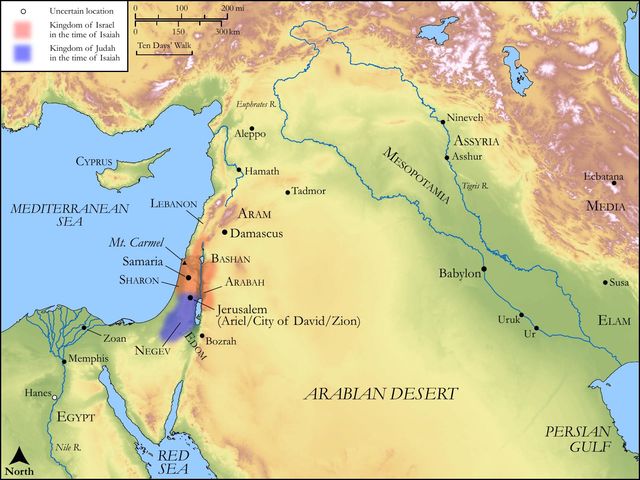
See on the biblical-era map
Study this verse
Public-domain commentary
Matthew Henry
From his Commentary on the Whole Bible. Henry comments on passages, not single verses — this entry covers Isaiah 30:18–26. His three-level outline is real structure in the source text, so it is rendered as structure.
The closing words of the foregoing paragraph (You shall be left as a beacon upon a mountain) some understand as a promise that a remnant of them should be reserved as monuments of mercy; and here the prophet tells them what good times should succeed these calamities. Or the first words in this paragraph may be read by way of antithesis, Notwithstanding this, yet will the Lord wait that he may be gracious. The prophet, having shown that those who made Egypt their confidence would be ashamed of it, here shows that those who sat still and made God alone their confidence would have the comfort of it. It is matter of comfort to the people of God, when the times are very bad, that all will be well yet, well with those that fear God, when we say to the wicked, It shall be ill with you.
I.God will be gracious to them and will have mercy on them.
This is the foundation of all good. If we find favour with God, and he have mercy upon us, we shall have comfort according to the time that we have been afflicted.
1.The mercy in store for them is very affectingly expressed. (1.) "He will wait to be gracious (Isa 30:18); he will wait till you return to him and seek his face, and then he will be ready to meet you with mercy. He will wait, that he may do it in the best and fittest time, when it will be most for his glory, when it will come to you with the most pleasing surprise. He will continually follow you with his favours, and not let slip any opportunity of being gracious to you." (2.) "He will stir up himself to deliver you, will be exalted, will be raised up out of his holy habitation (Zac 2:13), that he may appear for you in more than ordinary instances of power and goodness; and thus he will be exalted, that is, he will glorify his own name. This is what he aims at in having mercy on his people." (3.) He will be very gracious (Isa 30:19), and this in answer to prayer, which makes his kindness doubly kind: "He will be gracious to thee, at the voice of thy cry, the cry of thy necessity, when that is most urgent - the cry of thy prayer, when that is most fervent. When he shall hear it, there needs no more; at the first word he will answer thee, and say, Here I am." Herein he is very gracious indeed. In particular, [1.] Those who were disturbed in the possession of their estates shall again enjoy them quietly. When the danger is over the people shall dwell in Zion, at Jerusalem, as they used to do; they shall dwell safely, free from the fear of evil. [2.] Those who were all in tears shall have cause to rejoice, and shall weep no more; and those who dwell in Zion, the holy city, will find enough there to wipe away tears from their eyes.
2.This is grounded upon two great truths:
(1.)That the Lord is a God of judgment; he is both wise and just in all the disposals of his providence, true to his word and tender of his people. If he correct his children, it is with judgment (Jer 10:24), with moderation and discretion, considering their frame. We think we may safely refer ourselves to a man of judgment; and shall we not commit our way to a God of judgment?
(2.)That therefore all those are blessed who wait for him, who not only wait on him with their prayers, but wait for him with their hopes, who will not take any indirect course to extricate themselves out of their straits, or anticipate their deliverance, but patiently expect God's appearances for them in his own way and time. Because God is infinitely wise, those are truly happy who refer their cause to him.
II.They shall not again know the want of the means of grace, Isa 30:20, Isa 30:21. Here,
1.It is supposed that they might be brought into straits and troubles after this deliverance was wrought for them. It was promised (Isa 30:19), that they should weep no more and that God would be gracious to them; and yet here it is taken for granted that God may give them the bread of adversity and the water of affliction, prisoners' fare (Kg1 22:27), coarse and sorry food, such as the poor use. When one trouble is over we know not how soon another may succeed; and we may have an interest in the favour of God, and such consolations as are sufficient to prohibit weeping, and yet may have bread of adversity given us to eat and water of affliction to drink. Let us therefore not judge of love or hatred by what is before us.
2.It is promised that their eyes should see their teachers, that is, that they should have faithful teachers among them, and should have hearts to regard them and not slight them as they had done; and then they might the better be reconciled to the bread of adversity and the water of affliction. It was a common saying among the old Puritans, Brown bread and the gospel are good fare. A famine of bread is not so great a judgment as a famine of the word of God, Amo 8:11, Amo 8:12. It seems that their teachers had been removed into corners (probably being forced to shift for their safety in the reign of Ahaz), but it shall be so no more. Veritas non quaerit angulos - Truth seeks no corners for concealment. But the teachers of truth may sometimes be driven into corners for shelter; and it goes ill with the church when it is so, when the woman with her crown of twelve stars is forced to flee into the wilderness (Rev 12:6), when the prophets are hidden by fifty in a cave, Kg1 18:4. But God will find a time to call the teachers out of their corners again, and to replace them in their solemn assemblies, which shall see their own teachers, the eyes of all the synagogue being fastened on them, Luk 4:20. And it will be the more pleasing because of the restraint they have been for some time under, as light out of darkness, as life from the dead. To all that love God and their own souls this return of faithful teachers out of their corners, especially with a promise that they shall not be removed into corners any more, is the most acceptable part of any deliverance, and has comfort enough in it to sweeten even the bread of adversity and the water of affliction. But this is not all:
3.It is promised that they shall have the benefit, not only of the public ministry, but of private and particular admonition and advice (Isa 30:21): "Thy ears shall hear a word behind thee, calling after thee as a man calls after a traveller that he sees going out of his road." Observe, (1.) Whence this word shall come - from behind thee, from some one whom thou dost not see, but who sees thee. "Thy eyes see thy teachers; but this is a teacher out of sight, it is thy own conscience, which shall now by the grace of God be awakened to do its office." (2.) What the word shall be: "This is the way, walk you in it. When thou art doubting, conscience shall direct thee to the way of duty; when thou art dull and trifling, conscience shall quicken thee in that way." As God has not left himself without witness, so he has not left us without guides to show us our way. (3.) The seasonableness of this word: It shall come when you turn to the right hand or to the left. We are very apt to miss our way; there are turnings on both hands, and those so tracked and seemingly straight that they may easily be mistaken for the right way. There are right-hand and left-hand errors, extremes on each side virtue; the tempter is busy courting us into the by-paths. It is happy then if by the particular counsels of a faithful minister or friend, or the checks of conscience and the strivings of God's Spirit, we be set right and prevented from going wrong. (4.) The success of this word: "It shall not only be spoken, but thy ears shall hear it; whereas God has formerly spoken once, yea, twice, and thou hast not perceived it (Job 33:14), now thou shalt listen attentively to these secret whispers, and hear them with an obedient ear." If God gives us not only the word, but the hearing ear, not only the means of grace, but a heart to make a good use of those means, we have reason to say, He is very gracious to us, and reason to hope he has yet further mercy in store for us.
III.They shall be cured of their idolatry, shall fall out with their idols, and never be reconciled to them again, Isa 30:22.
The deliverance God shall work for them shall convince them that it is their interest, as well as duty, to serve him only; and they shall own that, as their trouble was brought upon them for their idolatries, so it was removed upon condition that they should not return to them. This is also the good effect of their seeing their teachers and hearing the word behind them; by this it shall appear that they are the better for the means of grace they enjoy - they shall break off from their best-beloved sin. Observe,
1.How foolishly mad they had formerly been upon their idols, in the day of their apostasy. Idolaters are said to be mad upon their idols (Jer 50:38), doatingly fond of them. They had graven images of silver, and molten images of gold, and, though gold needs no painting, they had coverings and ornaments on these; they spared no cost in doing honour to their idols.
2.How wisely mad (if I may so speak) they now were at their idols, what a holy indignation they conceived against them in the day of their repentance. They not only degraded their images, but defaced them, not only defaced them, but defiled them; they not only spoiled the shape of them, but in a pious fury threw away the gold and silver they were made of, though otherwise valuable and convertible to a good use. They could not find in their hearts to make any vessel of honour of them. The rich clothes wherewith their images were dressed up they cast away as a filthy cloth which rendered those that touched it unclean until the evening, Lev 15:23. Note, To all true penitents sin has become very odious; they loathe it, and loathe themselves because of it; they cast it away to the dunghill, the fittest place for it, nay, to the cross, for they crucify the flesh; their cry against it is, Crucify it, crucify it. They say unto it, Abi hinc in malam rem - Get thee hence. They are resolved never to harbour it any more. They put as far from as they can all the occasions of sin and temptations to it, though they are as a right eye or a right hand, and protest against it as Ephraim did (Hos 14:8), What have I to do any more with idols? Probably this was fulfilled in many particular persons, who, by the deliverance of Jerusalem from Sennacherib's army, were convinced of the folly of their idolatry and forsook it. It was fulfilled in the body of the Jewish nation at their return from their captivity in Babylon, for they abhorred idols ever after; and it is accomplished daily in the conversion of souls, by the power of divine grace, from spiritual idolatry to the fear and love of God. Those that join themselves to the Lord must abandon every sin, and say unto it, Get thee hence.
IV.God will then give them plenty of all good things.
When he gives them their teachers, and they give him their hearts, so that they begin to seek the kingdom of God and the righteousness thereof, then all other things shall be added to them Mat 6:33. And when the people are brought to praise God then shall the earth yield her increase, and with it God, even our own God, shall bless us, Psa 67:5, Psa 67:6. So it follows here: "When you shall have abandoned your idols, then shall God give the rain of your seed," Isa 30:23. When we return to God in a way of duty he will meet us with his favours.
1.God will give you rain of your seed, rain to water the seed you sow, just at the time that it calls for it, as much as it needs and no more. Observe, How man's industry and God's blessing concur to the good things we enjoy relating to the life that now is: Thou shalt sow the ground, that is thy part, and then God will give the rain of thy seed, that is his part. It is so in spiritual fruit; we must take pains with our hearts and then wait on God for his grace.
2.The increase of the earth shall be rich and good, and every thing the best of the kind; it shall be fat and fat, very fat and very good, fat and plenteous (so we read it), good and enough of it. Your land shall be Canaan indeed; it was remarkably so after the defeat of Sennacherib, by the special blessing of God, Isa 37:30. God would thus repair the losses they sustained by that devastation.
3.Not only the tillage, but the pasture-ground should be remarkably fruitful: The cattle shall feed in large pastures; those that are at grass shall have room enough, and the oxen and asses that are kept up for use, to ear the ground, which must be the better fed for their being worked, shall eat clean provender. The corn shall not be given them in the chaff as usual, to make it go the further, but they shall have good clean corn fit for man's use, being winnowed with the fan. The brute-creatures shall share in the abundance; it is fit they should, for they groan under the burden of the curse which man's sin has brought upon the earth.
4.Even the tops of the mountains, that used to be barren, shall be so well watered with the rain of heaven that there shall be rivers and streams there, and running down thence to the valleys (Isa 30:25), and this in the day of the great slaughter that should be made by the angel in the camp of the Assyrians, when the towers and batteries they had erected for the carrying on of the siege of Jerusalem, the army being slain, should fall of course. It is probable that this was fulfilled in the letter of it, and that about the same time that that army was cut off there were extraordinary rains in mercy to the land.
V.The effect of all this should be extraordinary comfort and joy to the people of God, Isa 30:26.
Light shall increase; that is, knowledge shall increase (when the prophecies are accomplished they shall be fully understood) or rather triumph shall: the light of the joy that is sown for the righteous shall now come up with a great increase. The light of the moon shall become as bright and as strong as that of the sun, and that of the sun shall increase proportionably and be as the light of seven days; every one shall be much more cheerful and appear much more pleasant than usual. There shall be a high spring-tide of joy in Judah and Jerusalem, upon occasion of the ruin of the Assyrian army, when the Lord binds up the breach of his people, not only saves them from being further wounded, but heals the wounds that have been given them by this invasion and makes up all their losses. The great distress they were reduced to, their despair of relief, and the suddenness of their deliverance, would much augment their joy. This is not unfitly applied by many to the light which the gospel brought into the world to those that sat in darkness, which has far exceeded the Old Testament light as that of the sun does that of the moon, and which proclaims healing to the broken-hearted, and the binding up of their wounds.
Historical interpretation
Historical reception
3 surviving comments on this verse. Each one is dated, so this reads as a timeline rather than a list.
Select a marker to jump to its quote. Markers stagger vertically where authors wrote within a few decades of each other.
(Verse 19) For the people of Zion will dwell in Jerusalem. The Jews refer these things to the time of Cyrus, when the people returned from Babylon to Judaea under Zerubbabel and the high priest Joshua. But we, as we have often said already, refer all the promises that surpass the mediocrity of that time to the coming of Christ, in which the once captive people, freed by the passion of the Lord, dwelled in Zion and Jerusalem, namely, in the watchtower and vision of peace, that is, in the Church. Furthermore, that which is added in the Septuagint as a word of sanctity, they said: 'For a holy people dwells in Zion' (alternative: will dwell), we can interpret it to mean that no one dwells in Zion unless they are holy and hear the Lord saying, 'Be holy, for I am holy' (Leviticus 11:44).
These two then, namely, the grace of God and free will, seem opposed to each other but really are in harmony. And we gather from the system of goodness that we ought to have both alike, lest if we withdraw one of them from man, we may seem to have broken the rule of the church’s faith. For when God sees us inclined to will what is good, he meets, guides and strengthens us. For “at the voice of your cry, as soon as he shall hear, he will answer you”; and “Call upon me,” he said, “in the day of tribulation, and I will deliver you, and you shall glorify me.” And again, if he finds that we are unwilling or have grown cold, he stirs our hearts with salutary exhortations, by which a good will is either renewed or formed in us.
The divine protection, then, is always inseparably present to us, and so great is the love of the Creator for his creature that his providence not only stands by it but even goes constantly before it. The prophet, who has experienced this, confesses it very clearly when he says, “My God will go before me with his mercy.” When he notices good will making an appearance in us, at once he enlightens and encourages it and spurs it on to salvation, giving increase to what he himself planted and saw arise from our own efforts. For, he says, “before they cry, I will hear them. I will hear them when they are still speaking.” And again: “As soon as he hears the voice of your cry, he will respond to you.” Not only does he graciously inspire holy desires, but also he arranges favorable moments in one’s life and the possibility of good results, and he shows the way of salvation to those who are straying.
Continue studying Isaiah 30:19 across the web’s major study libraries — every link below opens this exact verse, chapter, or book on the destination site.
Read & Compare
 BibleGatewayThis verse in more than 200 translations and 70 languages.
 Bible.comThe YouVersion reader — hundreds of translations, reading plans, and highlights.
 ESV.orgCrossway's official English Standard Version reader.
 NET BibleThe NET translation with 60,000+ translators' notes on every rendering decision.
 STEP BibleTyndale House's free study tool — original text, vocabulary, and scholarly resources.
 BibliaLogos Bible Software's free web reader.
 USCCBThe New American Bible (Revised Edition) with the U.S. bishops' study notes.
Commentaries
 BibleHub CommentariesDozens of classic commentaries on this verse, gathered on one page.
 StudyLightMore than 100 commentary sets — the largest collection on the web.
 BibleRefPlain-English commentary on what this verse means, verse by verse.
 Enduring WordDavid Guzik's free commentary on this chapter, widely used by Bible teachers.
 Bible Study ToolsVerse commentary alongside Greek and Hebrew study aids.
Original Language & Research
- BibleHub InterlinearThe verse word by word — original language, transliteration, and English.
- BibleHub LexiconEvery word's original-language definition and Strong's entry.
 Blue Letter BibleDeep-study tools — Strong's numbers, concordance, and word studies.
 SefariaThe Hebrew text with Rashi and centuries of Jewish commentary.
Sermons, Hymns & Audio


TrulyRandomVerse is not affiliated with these sites and doesn’t control their content. They’re linked because they’re genuinely useful.
Summary
Isaiah 30:19 delivers a profound prophetic promise of divine restoration and abundant comfort to the people of Judah, marking a pivotal shift from a period of judgment to one of grace. It assures them of a secure dwelling in Zion, an end to their weeping and suffering, and God's compassionate and immediate responsiveness to their cries, thereby underscoring His unwavering faithfulness, profound patience, and overflowing graciousness towards His repentant people.
Context
ShowHideLiterary Context
Isaiah 30 is situated within a larger prophetic section (chapters 28-33) where the prophet Isaiah vehemently condemns Judah's misguided foreign policy, specifically their reliance on an alliance with Egypt rather than trusting in Yahweh for protection against the formidable Assyrian threat. The preceding verses (Isaiah 30:1-17) are characterized by severe warnings, rebukes for their rebellion, and pronouncements of judgment for their refusal to heed divine instruction and their foolish trust in human strength. This creates a stark backdrop of impending doom and the consequences of disobedience. However, a dramatic and beautiful pivot occurs in Isaiah 30:18, which reveals God's deep, patient longing to show mercy and be gracious despite their unfaithfulness. Verse 19 then immediately follows as the concrete manifestation of this promised grace, detailing the blessings of restoration, secure dwelling, and divine responsiveness that await a repentant people.
Historical & Cultural Context
The historical setting for Isaiah 30 is the tumultuous late 8th century BCE, a period dominated by the expansionist Neo-Assyrian Empire. Judah, a small kingdom, found itself caught between the Assyrian juggernaut and the ancient power of Egypt. Against Isaiah's consistent prophetic warnings, King Hezekiah and Judah's leaders sought a military alliance with Egypt, a move that symbolized a profound lack of faith in Yahweh, their covenant God. Jerusalem, often referred to as Zion, was not merely a geographical location but the spiritual and political heart of Judah, the city where God had chosen to place His name and where His Temple stood. The concept of dwelling securely in Zion was therefore synonymous with divine presence, protection, and national well-being, standing in stark contrast to the pervasive fear and instability brought about by the Assyrian threat and the specter of exile.
Key Themes
ShowHideThis verse powerfully contributes to several overarching themes within the book of Isaiah and the broader prophetic tradition. Firstly, it highlights the theme of Divine Sovereignty and Faithfulness, demonstrating that despite human rebellion and failure, God remains true to His covenant promises of ultimate restoration for His people. Secondly, the promise of dwelling securely in Zion underscores God's Presence and Secure Dwelling, emphasizing that true security, peace, and flourishing are found only in His chosen city, under His protection, contrasting sharply with the false security offered by foreign alliances, as seen in Isaiah 31:1-3. Thirdly, the declaration "thou shalt weep no more" introduces the profound theme of Cessation of Suffering and Divine Comfort, pointing to a future where God Himself will wipe away the tears of His people, a motif that finds its ultimate eschatological fulfillment in the New Creation (Revelation 21:4). Finally, the assurance that God will hear and answer their cry powerfully emphasizes the theme of Divine Responsiveness and Grace, showcasing God's compassionate nature and His willingness to extend abundant favor to those who humble themselves and turn to Him in earnest prayer, a truth echoed throughout the Psalms, as in Psalm 145:18-19.
Exposition and Analysis
ShowHideKey Word Analysis
ShowHideThis primitive root (H1058) signifies a deep emotional response encompassing profound sorrow, distress, and lamentation. It denotes not merely the shedding of tears but also the act of bemoaning, complaining, and mourning. The prophetic declaration "thou shalt weep no more" thus promises a complete and permanent cessation of the conditions that cause such intense grief, implying a radical transformation from a state of anguish to one of joy, peace, and divine comfort.
This root word (H2603) conveys the idea of bending or stooping in kindness to an inferior, to show favor, or to bestow compassion. It describes an active, benevolent demonstration of mercy, often in response to a petition or plea. In this context, it highlights God's inherent goodness, His compassionate disposition, and His willingness to act favorably towards His people, not based on their merit, but solely out of His abundant and inherent goodness and covenant love. The double emphasis in the Hebrew ("very gracious") underscores the overflowing nature of this divine favor.
This term (H2199) refers to a fervent shriek or outcry, typically stemming from anguish, danger, or deep distress. It implies an urgent, often desperate, call for help, a passionate plea for intervention. The use of this word emphasizes the intensity of the people's suffering and their earnest, heartfelt appeal to God, underscoring the depth of their need and the immediacy and compassion of God's promised response.
Verse Breakdown
ShowHide"For the people shall dwell in Zion at Jerusalem"
This opening clause initiates the promise of restoration, declaring a secure, permanent, and peaceful habitation for God's people. "Zion" and "Jerusalem" are used synonymously, representing the holy city, the chosen place of God's presence. After periods of threat, instability, and potential displacement, this promises a future of stability, peace, and divine protection within their sacred homeland, signifying a return to covenant blessing and a renewed relationship with God as their ultimate protector and provider.
"thou shalt weep no more"
This powerful and tender declaration signifies a complete and lasting cessation of sorrow, grief, and the conditions that cause tears. It speaks to an end of oppression, hardship, the consequences of sin, and the pain of judgment, promising a future characterized by comfort, joy, and profound divine solace. It is a deeply personal assurance that God Himself will intervene to alleviate their suffering and wipe away every tear.
"he will be very gracious unto thee at the voice of thy cry"
This phrase emphasizes God's compassionate, benevolent, and highly responsive nature. The Hebrew construction for "very gracious" (chânon yichaneka) conveys an intensified sense of abundant and overflowing favor that God will extend. This overflowing grace is directly linked to "the voice of thy cry," indicating that God's favor is activated and poured out in response to the earnest, distressed prayers and heartfelt pleas of His people. It underscores His attentiveness and willingness to respond to their genuine need, not out of obligation but out of His character.
"when he shall hear it, he will answer thee"
This final clause confirms the certainty, efficacy, and immediacy of God's divine response. It moves from the act of hearing their desperate plea to the active, effective, and transformative "answer." This is not merely an acknowledgment of their suffering but a divine intervention that brings about the desired relief, deliverance, and restoration. It solidifies the promise of God's active involvement in the lives of His people, assuring them that their petitions will not go unheard or unanswered, but will be met with His powerful and gracious action.
Literary Devices
ShowHideIsaiah 30:19 employs several potent literary devices to convey its message of hope and restoration with profound impact. Prophecy is the overarching device, as Isaiah foretells a future state of blessing and divine favor for Judah, contrasting sharply with their present state of judgment and impending distress. The verse utilizes Personification when directly addressing Jerusalem ("thou shalt weep no more"), imbuing the city with human emotion and experience. This makes the promise of comfort more intimate and relatable, as if God is speaking directly to a grieving individual. There is a strong element of Contrast evident between the preceding warnings of judgment and the sudden, gracious turn to promises of peace, joy, and divine responsiveness. The phrase "very gracious" employs a form of Intensification or Emphasis (a Hebrew infinitive absolute construction), highlighting the abundant, overflowing, and certain nature of God's favor. Finally, the structure of the latter part of the verse, "when he shall hear it, he will answer thee," demonstrates a clear Parallelism, linking God's attentiveness to His effective action, thereby reinforcing the certainty and reliability of His divine intervention and the efficacy of prayer.
Theological and Thematic Connections
ShowHideIsaiah 30:19 stands as a profound testament to God's enduring covenant faithfulness and His compassionate character, even in the face of His people's rebellion and unfaithfulness. It reveals that while God is just in judgment and must address sin, His ultimate disposition towards His repentant people is one of profound grace, mercy, and restoration. The promise of dwelling securely in Zion signifies not merely physical restoration to the land but a renewed spiritual intimacy, where God's presence brings true peace, security, and an end to sorrow. This verse underscores the foundational theological truth that God is neither distant nor indifferent to the cries of His people; rather, He actively listens, deeply cares, and graciously responds, demonstrating His unwavering commitment to their well-being and His sovereign power to transform their circumstances from despair to delight. It is a powerful reminder that God's grace triumphs over judgment when His people humble themselves and turn to Him in genuine repentance and earnest prayer.
Reflection and Application
ShowHideIsaiah 30:19 serves as an enduring beacon of hope and a profound source of comfort for believers navigating life's inevitable challenges and periods of distress. It powerfully reminds us that even when we face the consequences of our own poor choices, experience the pain of a fallen world, or endure seasons of intense suffering, God's ultimate disposition towards His repentant and humble people is one of profound grace and restorative love. This verse encourages us to cultivate a posture of humble dependence on God, turning to Him with our deepest cries, our most urgent needs, and our most profound sorrows, rather than seeking solace or solutions in fleeting human endeavors or unreliable worldly alliances. The promise that we "shall weep no more" offers immense comfort, assuring us that our present sorrows are not our final destination; God Himself promises to bring a definitive end to our grief and usher in a season of peace, joy, and divine solace. It calls us to trust implicitly in His active involvement in our lives, knowing with certainty that He hears our prayers and will answer in His perfect timing and according to His perfect will, transforming our distress into divine deliverance and our tears into testimonies of His faithfulness.
Questions for Reflection
ShowHideFAQ
ShowHideWhat is the significance of "Zion at Jerusalem" in this verse?
ShowHide"Zion" and "Jerusalem" are often used interchangeably in biblical prophecy, representing the chosen city of God, the spiritual and political capital of Israel, and the sacred place where God's presence (the Temple) resided. Its significance in Isaiah 30:19 is multifaceted: it symbolizes security, divine protection, and the restoration of God's people to their rightful inheritance and covenant blessings. After periods of judgment, threat, or exile, the promise to "dwell in Zion at Jerusalem" signifies a return to peace, stability, and a renewed, intimate covenant relationship with God in His holy city, a place of ultimate blessing and divine favor. It stands in stark contrast to the instability and displacement that Judah faced due to their unfaithfulness and the existential threats from surrounding empires.
Why does God promise such grace and comfort immediately after condemning Judah's actions in the earlier part of Isaiah 30?
ShowHideThe juxtaposition of stern judgment and overflowing grace in Isaiah 30 highlights a profound and consistent aspect of God's character: His justice is always intertwined with His boundless mercy and infinite patience. While God, in His righteousness, must address sin and disobedience, His ultimate desire is for His people's repentance, restoration, and flourishing. Isaiah 30:18 explicitly states, "Therefore the LORD waits to be gracious to you; therefore he exalts himself to show mercy to you." This demonstrates that God's promises of comfort and restoration in verse 19 are not a contradiction of His earlier warnings but an overflow of His enduring covenant love and a testament to His willingness to forgive, heal, and restore those who turn back to Him in humility and faith. It underscores the theme of divine patience and the hope of redemption that is always available, even in the midst of deserved consequences.
Christ-Centered Fulfillment
ShowHideIsaiah 30:19, with its rich promises of secure dwelling, cessation of weeping, abundant grace, and divine responsiveness, finds its ultimate and most profound fulfillment in the person and redemptive work of Jesus Christ. The promise that "the people shall dwell in Zion at Jerusalem" is spiritually realized in Christ, who is the true Temple (John 2:19-21) and the very foundation of the New Jerusalem. Through His atoning work on the cross, believers are brought into a secure and eternal dwelling with God, becoming part of the spiritual Zion, the church, which is the body of Christ and the dwelling place of God's Spirit (Ephesians 2:19-22). The declaration "thou shalt weep no more" is powerfully fulfilled in Christ's victory over sin, death, and all the sources of human sorrow. While we still experience tears and suffering in this present age, Christ's resurrection assures us of a glorious future where God Himself will definitively wipe away every tear in the New Heavens and New Earth (Revelation 21:4). Furthermore, the promise that God "will be very gracious unto thee at the voice of thy cry; when he shall hear it, he will answer thee" is perfectly embodied in Jesus Christ. He is the ultimate High Priest who intercedes for us, through whom we can "draw near with confidence to the throne of grace, that we may receive mercy and find grace to help in time of need" (Hebrews 4:16). Jesus Himself is the embodiment of God's grace (John 1:14) and the compassionate Savior who hears and answers the cries of His people, offering rest to the weary and heavy-laden (Matthew 11:28). Thus, the ancient prophecy of Isaiah points directly to the saving work, compassionate heart, and ultimate fulfillment found in our Lord Jesus Christ, through whom all these divine promises are made "Yes" and "Amen" for those who believe (2 Corinthians 1:20).