


Isaiah 30:21
Bible text: King James Version (1769 Blayney text) · Public domain
Bible text: Berean Standard Bible · Public domain
Bible text: American Standard Version (1901) · Public domain
Bible text: World English Bible, Messianic edition · Public domain
Bible text: Geneva Bible (1599) · Public domain
Bible text: Young's Literal Translation · Public domain
- וְאָזְנֶיךָve·'a·ze·Nei·khaand your earsH241Conj-w ¦ N-fdc ¦ 2msNoun Dual Feminine Constructוְandאָזְנֶיearsךָyour
- תִּשְׁמַעְנָהtish·Ma'·nahthey will hearH8085V-Qal-Imperf-3fpVerb Qal Imperfect 3rd Plural Feminine
- דָבָרda·Vara wordH1697N-msNoun Singular Masculine Absolute
- מֵאַחֲרֶיךָme·'a·cha·Rei·khafrom behind youH310Prep-m ¦ Adj-mpc ¦ 2msAdjective Numerical Plural Masculine Constructמֵfromאַחֲרֶיbehindךָyou
- לֵאמֹרle·Mor<to> sayingH559Prep-l ¦ V-Qal-InfVerb Qal Infinitive Constructלֵ<to>אמֹרsaying
- זֶהzehthisH2088PrtParticle Demonstrative
- הַדֶּרֶךְha·De·rekh[is] the wayH1870Art ¦ N-csNoun Singular common gender Absoluteהַ[is] theדֶּרֶךְway
- לְכוּle·KhuwalkH1980V-Qal-Imp-2mpVerb Qal Imperative 2nd Plural Masculine
- בוֹvoin <the> itPrep-b ¦ 3msSuffix Personal 3rd Singular Masculineבin <the>וֹit
- כִּיkithatH3588PrtParticle Conditional
- תַאֲמִינוּta·'a·Mi·nuyou will go to [the] rightH541V-Hiphil-Imperf-2mpVerb Hiphil Imperfect 2nd Plural Masculine
- וְכִיve·Khiand thatH3588Conj-w ¦ PrtParticle Conditionalוְandכִיthat
- תַשְׂמְאִילוּtas·me·'I·luyou will go to [the] leftH8041V-Hiphil-Imperf-2mpVerb Hiphil Imperfect 2nd Plural Masculine
English is a literal word-by-word gloss of the Hebrew, not the KJV's wording. Why?
This is the original text the KJV's translators worked from — each Hebrew word with its own literal English meaning in this verse, prepared by scholars at Tyndale House, Cambridge. The KJV translates whole sentences, not word by word, so its wording differs: one Hebrew word can become several English words, and the KJV may choose “the LORD” where the gloss reads “Yahweh”. Both are faithful — they answer different questions. For the KJV's own rendering, switch to the KJV text.
Details
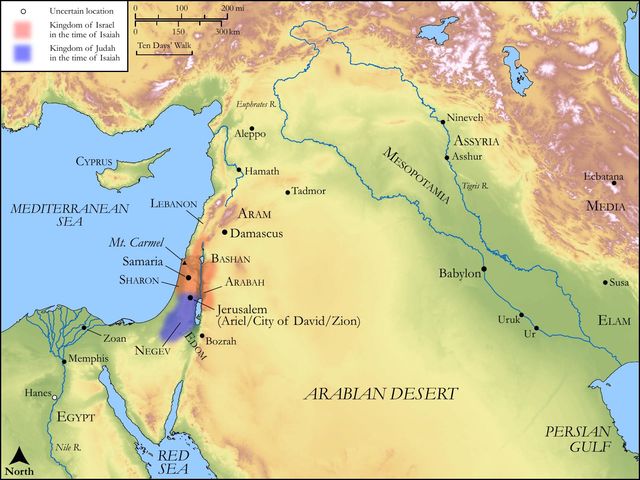
See on the biblical-era map
Study this verse
Public-domain commentary
Matthew Henry
From his Commentary on the Whole Bible. Henry comments on passages, not single verses — this entry covers Isaiah 30:18–26. His three-level outline is real structure in the source text, so it is rendered as structure.
The closing words of the foregoing paragraph (You shall be left as a beacon upon a mountain) some understand as a promise that a remnant of them should be reserved as monuments of mercy; and here the prophet tells them what good times should succeed these calamities. Or the first words in this paragraph may be read by way of antithesis, Notwithstanding this, yet will the Lord wait that he may be gracious. The prophet, having shown that those who made Egypt their confidence would be ashamed of it, here shows that those who sat still and made God alone their confidence would have the comfort of it. It is matter of comfort to the people of God, when the times are very bad, that all will be well yet, well with those that fear God, when we say to the wicked, It shall be ill with you.
I.God will be gracious to them and will have mercy on them.
This is the foundation of all good. If we find favour with God, and he have mercy upon us, we shall have comfort according to the time that we have been afflicted.
1.The mercy in store for them is very affectingly expressed. (1.) "He will wait to be gracious (Isa 30:18); he will wait till you return to him and seek his face, and then he will be ready to meet you with mercy. He will wait, that he may do it in the best and fittest time, when it will be most for his glory, when it will come to you with the most pleasing surprise. He will continually follow you with his favours, and not let slip any opportunity of being gracious to you." (2.) "He will stir up himself to deliver you, will be exalted, will be raised up out of his holy habitation (Zac 2:13), that he may appear for you in more than ordinary instances of power and goodness; and thus he will be exalted, that is, he will glorify his own name. This is what he aims at in having mercy on his people." (3.) He will be very gracious (Isa 30:19), and this in answer to prayer, which makes his kindness doubly kind: "He will be gracious to thee, at the voice of thy cry, the cry of thy necessity, when that is most urgent - the cry of thy prayer, when that is most fervent. When he shall hear it, there needs no more; at the first word he will answer thee, and say, Here I am." Herein he is very gracious indeed. In particular, [1.] Those who were disturbed in the possession of their estates shall again enjoy them quietly. When the danger is over the people shall dwell in Zion, at Jerusalem, as they used to do; they shall dwell safely, free from the fear of evil. [2.] Those who were all in tears shall have cause to rejoice, and shall weep no more; and those who dwell in Zion, the holy city, will find enough there to wipe away tears from their eyes.
2.This is grounded upon two great truths:
(1.)That the Lord is a God of judgment; he is both wise and just in all the disposals of his providence, true to his word and tender of his people. If he correct his children, it is with judgment (Jer 10:24), with moderation and discretion, considering their frame. We think we may safely refer ourselves to a man of judgment; and shall we not commit our way to a God of judgment?
(2.)That therefore all those are blessed who wait for him, who not only wait on him with their prayers, but wait for him with their hopes, who will not take any indirect course to extricate themselves out of their straits, or anticipate their deliverance, but patiently expect God's appearances for them in his own way and time. Because God is infinitely wise, those are truly happy who refer their cause to him.
II.They shall not again know the want of the means of grace, Isa 30:20, Isa 30:21. Here,
1.It is supposed that they might be brought into straits and troubles after this deliverance was wrought for them. It was promised (Isa 30:19), that they should weep no more and that God would be gracious to them; and yet here it is taken for granted that God may give them the bread of adversity and the water of affliction, prisoners' fare (Kg1 22:27), coarse and sorry food, such as the poor use. When one trouble is over we know not how soon another may succeed; and we may have an interest in the favour of God, and such consolations as are sufficient to prohibit weeping, and yet may have bread of adversity given us to eat and water of affliction to drink. Let us therefore not judge of love or hatred by what is before us.
2.It is promised that their eyes should see their teachers, that is, that they should have faithful teachers among them, and should have hearts to regard them and not slight them as they had done; and then they might the better be reconciled to the bread of adversity and the water of affliction. It was a common saying among the old Puritans, Brown bread and the gospel are good fare. A famine of bread is not so great a judgment as a famine of the word of God, Amo 8:11, Amo 8:12. It seems that their teachers had been removed into corners (probably being forced to shift for their safety in the reign of Ahaz), but it shall be so no more. Veritas non quaerit angulos - Truth seeks no corners for concealment. But the teachers of truth may sometimes be driven into corners for shelter; and it goes ill with the church when it is so, when the woman with her crown of twelve stars is forced to flee into the wilderness (Rev 12:6), when the prophets are hidden by fifty in a cave, Kg1 18:4. But God will find a time to call the teachers out of their corners again, and to replace them in their solemn assemblies, which shall see their own teachers, the eyes of all the synagogue being fastened on them, Luk 4:20. And it will be the more pleasing because of the restraint they have been for some time under, as light out of darkness, as life from the dead. To all that love God and their own souls this return of faithful teachers out of their corners, especially with a promise that they shall not be removed into corners any more, is the most acceptable part of any deliverance, and has comfort enough in it to sweeten even the bread of adversity and the water of affliction. But this is not all:
3.It is promised that they shall have the benefit, not only of the public ministry, but of private and particular admonition and advice (Isa 30:21): "Thy ears shall hear a word behind thee, calling after thee as a man calls after a traveller that he sees going out of his road." Observe, (1.) Whence this word shall come - from behind thee, from some one whom thou dost not see, but who sees thee. "Thy eyes see thy teachers; but this is a teacher out of sight, it is thy own conscience, which shall now by the grace of God be awakened to do its office." (2.) What the word shall be: "This is the way, walk you in it. When thou art doubting, conscience shall direct thee to the way of duty; when thou art dull and trifling, conscience shall quicken thee in that way." As God has not left himself without witness, so he has not left us without guides to show us our way. (3.) The seasonableness of this word: It shall come when you turn to the right hand or to the left. We are very apt to miss our way; there are turnings on both hands, and those so tracked and seemingly straight that they may easily be mistaken for the right way. There are right-hand and left-hand errors, extremes on each side virtue; the tempter is busy courting us into the by-paths. It is happy then if by the particular counsels of a faithful minister or friend, or the checks of conscience and the strivings of God's Spirit, we be set right and prevented from going wrong. (4.) The success of this word: "It shall not only be spoken, but thy ears shall hear it; whereas God has formerly spoken once, yea, twice, and thou hast not perceived it (Job 33:14), now thou shalt listen attentively to these secret whispers, and hear them with an obedient ear." If God gives us not only the word, but the hearing ear, not only the means of grace, but a heart to make a good use of those means, we have reason to say, He is very gracious to us, and reason to hope he has yet further mercy in store for us.
III.They shall be cured of their idolatry, shall fall out with their idols, and never be reconciled to them again, Isa 30:22.
The deliverance God shall work for them shall convince them that it is their interest, as well as duty, to serve him only; and they shall own that, as their trouble was brought upon them for their idolatries, so it was removed upon condition that they should not return to them. This is also the good effect of their seeing their teachers and hearing the word behind them; by this it shall appear that they are the better for the means of grace they enjoy - they shall break off from their best-beloved sin. Observe,
1.How foolishly mad they had formerly been upon their idols, in the day of their apostasy. Idolaters are said to be mad upon their idols (Jer 50:38), doatingly fond of them. They had graven images of silver, and molten images of gold, and, though gold needs no painting, they had coverings and ornaments on these; they spared no cost in doing honour to their idols.
2.How wisely mad (if I may so speak) they now were at their idols, what a holy indignation they conceived against them in the day of their repentance. They not only degraded their images, but defaced them, not only defaced them, but defiled them; they not only spoiled the shape of them, but in a pious fury threw away the gold and silver they were made of, though otherwise valuable and convertible to a good use. They could not find in their hearts to make any vessel of honour of them. The rich clothes wherewith their images were dressed up they cast away as a filthy cloth which rendered those that touched it unclean until the evening, Lev 15:23. Note, To all true penitents sin has become very odious; they loathe it, and loathe themselves because of it; they cast it away to the dunghill, the fittest place for it, nay, to the cross, for they crucify the flesh; their cry against it is, Crucify it, crucify it. They say unto it, Abi hinc in malam rem - Get thee hence. They are resolved never to harbour it any more. They put as far from as they can all the occasions of sin and temptations to it, though they are as a right eye or a right hand, and protest against it as Ephraim did (Hos 14:8), What have I to do any more with idols? Probably this was fulfilled in many particular persons, who, by the deliverance of Jerusalem from Sennacherib's army, were convinced of the folly of their idolatry and forsook it. It was fulfilled in the body of the Jewish nation at their return from their captivity in Babylon, for they abhorred idols ever after; and it is accomplished daily in the conversion of souls, by the power of divine grace, from spiritual idolatry to the fear and love of God. Those that join themselves to the Lord must abandon every sin, and say unto it, Get thee hence.
IV.God will then give them plenty of all good things.
When he gives them their teachers, and they give him their hearts, so that they begin to seek the kingdom of God and the righteousness thereof, then all other things shall be added to them Mat 6:33. And when the people are brought to praise God then shall the earth yield her increase, and with it God, even our own God, shall bless us, Psa 67:5, Psa 67:6. So it follows here: "When you shall have abandoned your idols, then shall God give the rain of your seed," Isa 30:23. When we return to God in a way of duty he will meet us with his favours.
1.God will give you rain of your seed, rain to water the seed you sow, just at the time that it calls for it, as much as it needs and no more. Observe, How man's industry and God's blessing concur to the good things we enjoy relating to the life that now is: Thou shalt sow the ground, that is thy part, and then God will give the rain of thy seed, that is his part. It is so in spiritual fruit; we must take pains with our hearts and then wait on God for his grace.
2.The increase of the earth shall be rich and good, and every thing the best of the kind; it shall be fat and fat, very fat and very good, fat and plenteous (so we read it), good and enough of it. Your land shall be Canaan indeed; it was remarkably so after the defeat of Sennacherib, by the special blessing of God, Isa 37:30. God would thus repair the losses they sustained by that devastation.
3.Not only the tillage, but the pasture-ground should be remarkably fruitful: The cattle shall feed in large pastures; those that are at grass shall have room enough, and the oxen and asses that are kept up for use, to ear the ground, which must be the better fed for their being worked, shall eat clean provender. The corn shall not be given them in the chaff as usual, to make it go the further, but they shall have good clean corn fit for man's use, being winnowed with the fan. The brute-creatures shall share in the abundance; it is fit they should, for they groan under the burden of the curse which man's sin has brought upon the earth.
4.Even the tops of the mountains, that used to be barren, shall be so well watered with the rain of heaven that there shall be rivers and streams there, and running down thence to the valleys (Isa 30:25), and this in the day of the great slaughter that should be made by the angel in the camp of the Assyrians, when the towers and batteries they had erected for the carrying on of the siege of Jerusalem, the army being slain, should fall of course. It is probable that this was fulfilled in the letter of it, and that about the same time that that army was cut off there were extraordinary rains in mercy to the land.
V.The effect of all this should be extraordinary comfort and joy to the people of God, Isa 30:26.
Light shall increase; that is, knowledge shall increase (when the prophecies are accomplished they shall be fully understood) or rather triumph shall: the light of the joy that is sown for the righteous shall now come up with a great increase. The light of the moon shall become as bright and as strong as that of the sun, and that of the sun shall increase proportionably and be as the light of seven days; every one shall be much more cheerful and appear much more pleasant than usual. There shall be a high spring-tide of joy in Judah and Jerusalem, upon occasion of the ruin of the Assyrian army, when the Lord binds up the breach of his people, not only saves them from being further wounded, but heals the wounds that have been given them by this invasion and makes up all their losses. The great distress they were reduced to, their despair of relief, and the suddenness of their deliverance, would much augment their joy. This is not unfitly applied by many to the light which the gospel brought into the world to those that sat in darkness, which has far exceeded the Old Testament light as that of the sun does that of the moon, and which proclaims healing to the broken-hearted, and the binding up of their wounds.
Historical interpretation
Two Centuries of Reception
4 surviving comments on this verse. Each one is dated, so this reads as a timeline rather than a list.
Select a marker to jump to its quote. Markers stagger vertically where authors wrote within a few decades of each other.
(Verse 21.) And the Lord will give you tight bread and brief water. If we refer these times to Zerubbabel, the interpretation is easy; that under him there was not perfect joy, as David says: When the Lord turned the captivity of Zion, we were made like those who are comforted: so that they would receive not full and perfect consolation, but a likeness of consolation. But if we refer it to the coming of the Savior, tight bread and brief water, according to the Apostle Paul and the same prophet Isaiah, are predicted in the Gospel message, which, summarizing in one word all the tattered observances and commandments of the Law, is this: You shall love your neighbor as yourself. For the Lord has made his word complete and concise upon the earth (Galatians 5).
If, then, such matters are carefully received, if they are hidden and consigned within the quiet places of the mind, if they are marked in silence, they will later be like a wine of sweet aroma bringing gladness to the human heart. Matured by long reflection and by patience, they will be poured out as a great fragrance from the vessel of your heart. Like some everlasting spring they will flow out from the channels of experience and from the flowing waters of virtue. They will come bounding forth, running, unceasing, from, as it were, the abyss of your heart.… And, as the prophet Isaiah declares, “You will be like a well-watered garden, like a flowing spring whose waters will never fail. And places emptied for ages will be built up in you. You will lift up the foundations laid by generation after generation. You will be called the builder of fences, the one who turns the pathways toward peace.” That blessing promised by the prophet will come to you: “And the Lord will not cause your teacher to fly far away from you, and your eyes will look upon your guide. And your ears shall hear the word of warning from behind, ‘This is the path. Walk along it and turn neither to the right nor to the left.’ ”
We are truly repentant if we weep bitterly over the actions we have committed. Let us consider the riches of our Creator’s attitude toward us. He has seen us sinning, and has borne with it. He who forbade us to sin before we did it, does not stop waiting to pardon us even after we have sinned. The one we have rejected is calling us. We have turned away from him, but he has not turned away. Hence Isaiah said, “Your eyes shall see your Teacher, and your ears shall hear the voice of a Counselor behind you.” A person is counseled to his face, so to speak, when he is created for righteousness and receives the precepts of rectitude. When he despises these precepts, it is as if he is turning his back to his Creator’s face. But he still follows behind us, and counsels us that we have despised him but that he still does not cease to call us. We turn our backs on his face, so to speak, when we reject his words, when we trample his commandments under foot; but he who sees that we reject him, and still calls out to us by his commandments, and waits for us by his patience, stands behind us, and calls us back when we have turned away.
God opens the bosom of his loving kindness to us if we return to him after sinning, for he says by the prophet, “If a man puts away his wife, and she goes from him and marries another man, shall he return to her any more? Shall not that woman be polluted and defiled? But you have prostituted yourself to many lovers; nevertheless return to me, says the Lord.” Note how the plea of justice is proposed in regard to the wife who commits fornication and is deserted, and yet, for us who return after our fall, it is not justice but loving kindness that is shown. The inference is obvious, namely, that if our sins are spared with such great love, how great would be our wickedness if we sinned but failed to return after our sin, and what pardon can the wicked expect from him who does not cease to call them after they have sinned! This mercy of God in calling us after our sin is well expressed by the prophet, when it is said to him who turns away from him: “And your eyes shall see your teacher, and you ears shall hear the word of one admonishing you behind your back.”
Continue studying Isaiah 30:21 across the web’s major study libraries — every link below opens this exact verse, chapter, or book on the destination site.
Read & Compare
 BibleGatewayThis verse in more than 200 translations and 70 languages.
 Bible.comThe YouVersion reader — hundreds of translations, reading plans, and highlights.
 ESV.orgCrossway's official English Standard Version reader.
 NET BibleThe NET translation with 60,000+ translators' notes on every rendering decision.
 STEP BibleTyndale House's free study tool — original text, vocabulary, and scholarly resources.
 BibliaLogos Bible Software's free web reader.
 USCCBThe New American Bible (Revised Edition) with the U.S. bishops' study notes.
Commentaries
 BibleHub CommentariesDozens of classic commentaries on this verse, gathered on one page.
 StudyLightMore than 100 commentary sets — the largest collection on the web.
 BibleRefPlain-English commentary on what this verse means, verse by verse.
 Enduring WordDavid Guzik's free commentary on this chapter, widely used by Bible teachers.
 Bible Study ToolsVerse commentary alongside Greek and Hebrew study aids.
Original Language & Research
- BibleHub InterlinearThe verse word by word — original language, transliteration, and English.
- BibleHub LexiconEvery word's original-language definition and Strong's entry.
 Blue Letter BibleDeep-study tools — Strong's numbers, concordance, and word studies.
 SefariaThe Hebrew text with Rashi and centuries of Jewish commentary.
Sermons, Hymns & Audio


TrulyRandomVerse is not affiliated with these sites and doesn’t control their content. They’re linked because they’re genuinely useful.
Summary
Isaiah 30:21 delivers a profound and comforting promise of unwavering divine guidance, asserting that even when God's people waver or contemplate diverging from His path, His clear, authoritative voice will provide precise direction. This verse paints a vivid portrait of a faithful and intimately involved God who proactively intervenes, speaking directly to the hearts and minds of His beloved, ensuring they remain on the way of righteousness, provided they cultivate a listening ear and a responsive heart. It encapsulates the Lord's commitment to shepherd His flock through life's complexities, offering timely and unmistakable instruction.
Context
ShowHideLiterary Context
Isaiah 30 is situated within a larger prophetic section (chapters 28-33) where Isaiah vehemently condemns Judah's persistent rebellion and their misplaced trust in human alliances rather than in the Lord. Specifically, the chapter opens with a "woe" against those who "go down to Egypt for help" (Isaiah 30:1-7), highlighting Judah's foolish decision to seek military support from Egypt against the formidable Assyrian threat. Despite God's explicit warnings and their stubborn refusal to heed prophetic counsel (Isaiah 30:9-11), the chapter pivots to a remarkable display of God's enduring patience and desire to extend mercy and grace (Isaiah 30:18). The verses immediately preceding Isaiah 30:21 describe a glorious future era of restoration and abundant blessing for Judah, where God will provide physical sustenance (rain, fertile land) and spiritual healing. This culminates in a promise of direct, personal instruction from God, signifying a renewed and intimate covenant relationship where His people will be taught by Him. The guidance promised in Isaiah 30:21 is thus a key component of this promised restoration and intimate fellowship, emphasizing a future where God's presence is tangibly felt as a guiding force.
Historical & Cultural Context
The historical backdrop for Isaiah's prophecy is the tumultuous latter half of the 8th century BCE. The Neo-Assyrian Empire, under powerful kings like Tiglath-Pileser III, Shalmaneser V, and Sennacherib, was at the height of its power, systematically expanding its dominion and posing an existential threat to the smaller nations of the Levant, including the Kingdom of Judah. King Hezekiah of Judah, like his predecessors, faced immense political and military pressure to secure his nation's survival. In this climate, forming alliances with other regional powers, such as Egypt, a traditional rival to Mesopotamia, seemed a pragmatic and logical course of action for earthly security. However, Isaiah, speaking for Yahweh, consistently and forcefully warned against such alliances, stressing that Judah's true and only security lay in absolute trust and dependence on God alone (Isaiah 31:1-3). Culturally, the concept of a "way" or "path" (Hebrew: derek) was profoundly significant, extending beyond a mere physical route to encompass one's moral conduct, spiritual journey, and overall course of life. This imagery resonated deeply in an agrarian society where shepherds guided their flocks along specific paths, and parents diligently instructed their children on the "way" they should live. Thus, the promise of divine guidance in Isaiah 30:21 would have been understood as a deeply personal and practical assurance of God's active involvement in every aspect of their existence, directing them away from perilous detours.
Key Themes
ShowHideIsaiah 30:21 powerfully contributes to several overarching themes prevalent throughout Isaiah's prophecy and the broader biblical narrative. It emphatically underscores God's Sovereignty and Faithfulness, demonstrating His active and benevolent involvement in the lives of His people, and His unwavering commitment to their well-being, even in the face of their stubborn rebellion. The theme of Divine Guidance is central, highlighting that God does not abandon His people to wander aimlessly but provides clear, authoritative, and timely direction. This promise stands in stark contrast to Judah's self-reliance and misplaced trust in human strategies and foreign powers, thereby emphasizing the critical importance of Trust and Obedience to God's voice above all else. Furthermore, this verse looks forward to the eschatological promise of Covenant Renewal and Restoration that God envisions for His repentant people. It anticipates a future era where His presence and teaching will be intimately experienced, leading them to walk in righteousness and experience abundant blessings, a vision beautifully articulated in the broader context of Isaiah 30. The verse also speaks to the theme of Divine Pedagogy, where God Himself becomes the ultimate teacher of His people.
Exposition and Analysis
ShowHideKey Word Analysis
ShowHideThis term (H1697) is exceptionally rich and multifaceted, signifying far more than a simple spoken sound. It encompasses a "matter," "thing," "affair," "decree," "message," or "speech." In this context, it denotes a substantial, authoritative communication from God—not a mere suggestion or a vague prompting, but a definitive declaration concerning the path. It implies a divine utterance that carries inherent weight, consequence, and a shaping power, providing clear and binding instruction for life.
The Hebrew word (H1870) literally translates to a "road" or "path" (specifically, one that is trodden). Figuratively, and more profoundly in this spiritual context, it refers to a "course of life" or a "mode of action." It represents the moral, spiritual, and existential direction one takes. The divine instruction is not abstract but points to a concrete, discernible path that leads to life, righteousness, and flourishing, standing in stark contrast to the misguided paths of self-reliance, sin, or worldly alliances.
This verb (H8085) means "to hear intelligently," often carrying the crucial implication of not just auditory perception but also "attention," "understanding," and, most importantly, "obedience." When the ears "hear" God's word in this sense, it is an active, responsive hearing that leads directly to compliance and action. It suggests a readiness and willingness on the part of the listener to receive, internalize, and act upon the divine instruction, distinguishing it from mere passive listening.
Verse Breakdown
ShowHide"And thine ears shall hear a word behind thee,"
This evocative phrase paints a vivid picture of a constant, watchful, and intimately present divine guide. The "word behind thee" suggests a presence that is always accompanying, perhaps subtly redirecting from the rear, much like a shepherd guiding his flock or a parent walking behind a child. It implies a gentle yet firm redirection, not a distant, thunderous pronouncement, but an intimate, personal communication that is perpetually available and attuned to the listener's movements.
"saying, This [is] the way, walk ye in it,"
This constitutes the core of the divine instruction: a clear, unambiguous, and authoritative command. God does not offer multiple options or obscure hints; He states definitively, "This is the way." The imperative "walk ye in it" demands active, decisive obedience and a committed adherence to the revealed path. It underscores that divine guidance is not merely for intellectual assent or theoretical understanding but for practical living and decisive action in every aspect of life.
"when ye turn to the right hand, and when ye turn to the left."
This crucial clause specifies the precise moments when this guidance will be most evident and necessary. It refers to times of deviation, uncertainty, temptation, or potential error—when one is on the verge of straying from the straight path of righteousness. It powerfully highlights God's proactive, timely, and precise intervention, ensuring that even when His people are on the cusp of error or confusion, His clear voice will be there to call them back to the correct course, preventing them from going too far astray.
Literary Devices
ShowHideIsaiah 30:21 is rich with several potent literary devices that amplify its message of divine guidance. Personification is strikingly evident in the phrase "thine ears shall hear a word behind thee, saying," which attributes the human act of speaking to an abstract "word" or, by extension, to the divine presence it represents. This makes the guidance feel immediate, personal, and conversational. The central concept of "the way" functions as a powerful Metaphor, representing not merely a physical road but the moral, spiritual, and existential course of life that God intends for His people. This metaphor emphasizes the journey aspect of faith and the need for continuous direction. The phrase "when ye turn to the right hand, and when ye turn to the left" employs both Antithesis and Merism. It uses opposing directions (right and left) to encompass all possible deviations or errors from the straight path, implying that whether one errs in one direction or another, God's guidance will be present to correct and redirect. Finally, the entire verse is rich in Imagery, painting a vivid and sensory picture of a guiding voice, a clear path, and the act of turning, making the abstract concept of divine direction tangible, relatable, and deeply comforting.
Theological and Thematic Connections
ShowHideThis verse beautifully encapsulates God's character as a faithful, ever-present, and intimately involved guide who delights in leading His people. It speaks profoundly to the nature of divine revelation, which is not only authoritative and infallible but also deeply personal and remarkably timely. The guidance promised here is not a one-time event or a distant decree but a continuous, dynamic, and intimate relationship where God actively participates in the daily walk of His followers. It underscores the foundational biblical truth that God desires His people to walk in righteousness and provides the necessary means to do so, even when they are prone to wander or become disoriented. This divine direction is a profound manifestation of His covenant love, His unwavering faithfulness, and a testament to His redemptive plan, ensuring that His people can fulfill their purpose by staying aligned with His perfect will. It reassures believers that they are never truly alone or without direction.
Reflection and Application
ShowHideIsaiah 30:21 offers profound comfort and intensely practical instruction for believers navigating the myriad complexities and uncertainties of life. It assures us that we are never left to our own limited devices to discern the right path, but rather, God is actively and intimately engaged in every step of our journey, ever-ready to provide clear and unmistakable direction. This divine guidance is not exclusively limited to grand, life-altering decisions but extends profoundly to the subtle, everyday choices where we might inadvertently "turn to the right hand, or to the left." Our primary responsibility, then, is to cultivate a deeply listening heart, to be acutely attentive to the "word behind us," which often manifests through the consistent and prayerful study of God's written Word, the quiet and persistent promptings of the Holy Spirit within us, the wise and discerning counsel of godly community, and even through the providential circumstances God orchestrates in our lives. This verse powerfully encourages us to relinquish our often-stubborn self-reliance and embrace a posture of humble, dependent trust, confidently believing that God's way is always the best way, even when it diverges sharply from our own inclinations, desires, or perceived wisdom.
Questions for Reflection
ShowHideFAQ
ShowHideHow does God speak "behind" us, as described in this verse?
ShowHideThe imagery of a "word behind thee" suggests a subtle, constant, and proactive form of divine guidance, akin to a shepherd gently nudging his flock from the rear. It's not necessarily a loud, dramatic, or external voice, but rather a consistent, intimate presence that gently redirects or confirms. This can manifest through the Holy Spirit bringing specific Scripture passages to mind, a deep sense of peace or unease, the wise counsel of trusted spiritual mentors, or even through providential circumstances and open or closed doors. It implies that God is always watching over His children, ready to guide them back to the intended path even before they fully realize they are straying. It's a deeply personal and ever-present form of guidance, ensuring His children remain on the path of righteousness.
What does "turning to the right hand, and when ye turn to the left" signify in this context?
ShowHideThis phrase is a common biblical expression, a merism, indicating any deviation, however slight, from the straight, prescribed path of God's will. It represents moments of uncertainty, temptation, distraction, or when one is about to make a choice that is not aligned with God's perfect plan. It can refer to moral deviations (straying into sin or unrighteousness), practical decisions (choosing a course of action not ordained by God), or simply moments of confusion where the correct course of action is unclear. The profound promise of the verse is that precisely at these critical junctures, God's clear, authoritative voice will be heard, offering the necessary redirection and clarity. This concept of not turning aside is echoed in Deuteronomy 5:32 and Joshua 1:7.
Is this divine guidance only for major life decisions, or does it apply to everyday choices?
ShowHideWhile God certainly provides profound guidance for major life decisions (such as career paths, marriage, or significant ministry endeavors), the context of Isaiah 30:21 strongly suggests a continuous, moment-by-moment relationship with God. The phrase "when ye turn to the right hand, and when ye turn to the left" implies that God's guidance is available for the subtle, daily deviations and choices that, if left uncorrected, can gradually lead one far astray. It speaks to a life lived in constant, humble communion with God, where His voice is a consistent, accessible presence, helping us navigate both the grand, pivotal moments and the mundane, seemingly insignificant aspects of our daily journey. The Holy Spirit's role, as promised by Jesus, is to guide us into "all truth" (John 16:13), implying comprehensive and pervasive guidance for every facet of life.
Christ-Centered Fulfillment
ShowHideIsaiah 30:21 finds its ultimate and most profound fulfillment in the person and work of Jesus Christ. While the Old Testament promise spoke of a prophetic voice guiding Israel back to the path, Jesus declares Himself to be the very embodiment of "the way." In His foundational statement in John 14:6, He proclaims, "I am the way, the truth, and the life: no man cometh unto the Father, but by me." He is not merely a guide to the way; He is the way itself, the living path to God. The "word behind thee" becomes manifest in the living Word, Jesus, who perfectly reveals the Father's will, perfectly embodies righteousness, and provides the perfect example of walking in complete obedience. Furthermore, after His atoning sacrifice and glorious ascension, Jesus sent the Holy Spirit, the "Spirit of truth," who continues this intimate guidance, dwelling within believers, leading them into all truth, and reminding them of Christ's teachings (John 16:13). Just as a good shepherd knows his sheep by name and leads them out, going before them (John 10:3-4), so Christ, through His indwelling Spirit, provides the continuous, personal redirection needed when we are prone to stray "to the right hand, or to the left." He is the ultimate, divine Shepherd, ensuring His flock remains on the path of righteousness that leads to eternal life and communion with the Father.