


2 Kings 2:16
Bible text: King James Version (1769 Blayney text) · Public domain
Bible text: King James Version with Strong's numbers · Public domain
Bible text: Berean Standard Bible · Public domain
Bible text: American Standard Version (1901) · Public domain
Bible text: World English Bible, Messianic edition · Public domain
Bible text: Geneva Bible (1599) · Public domain
Bible text: Young's Literal Translation · Public domain
- וַיֹּאמְרוּvai·yo·me·Ruand they saidH559Conj-w ¦ V-Qal-ConsecImperf-3mpVerb Qal Consecutive Imperfect 3rd Plural Masculineוַandיֹּאמְרוּthey said
- אֵלָיו'e·Lavto himH413Prep ¦ 3msPrepositionאֵלָיtoוhim
- הִנֵּהhi·nehhere!H2009PrtParticle Interjection
- נָאna'pleaseH4994PrtParticle Interjection
- יֵשׁyeshthereH3426Adj-csAdjective Numerical Singular common gender Absolute
- אֶת'etwithH854PrepPreposition
- עֲבָדֶיךָ'a·va·dei·Khayour servantsH5650N-mpc ¦ 2msNoun Plural Masculine Constructעֲבָדֶיservantsךָyour
- חֲמִשִּׁיםcha·mi·Shim[are] fiftyH2572N-mpNoun Plural Masculine Absolute
- אֲנָשִׁים'a·na·ShimmenH582N-mpNoun Plural Masculine Absolute
- בְּנֵיbe·neisons ofH1121N-mpcNoun Plural Masculine Construct
- חַיִלCha·yilabilityH2428N-msNoun Singular Masculine Absolute
- יֵלְכוּYe·le·khulet them goH1980V-Qal-Imperf-3mpVerb Qal Imperfect 3rd Plural Masculine
- נָאna'pleaseH4994PrtParticle Interjection
- וִיבַקְשׁוּvi·vak·Shuso they may search forH1245Conj-w ¦ V-Piel-ConjImperf-3mpVerb Piel Conjunction+Imperfect 3rd Plural Masculineוִsoיבַקְשׁוּthey may search for
- אֶת'et<obj.>H853DirObjMParticle Object Indicator
- אֲדֹנֶיךָ'a·do·nei·Khayour master<s>H113N-mpc ¦ 2msNoun Plural Masculine Constructאֲדֹנֶיmaster<s>ךָyour
- פֶּןpenlestH6435PrtParticle Conditional
- נְשָׂאוֹne·sa·'Oit has carried off himH5375V-Qal-Perf-3ms ¦ 3msVerb Qal Perfect 3rd Singular Masculineנְשָׂאit has carried offוֹhim
- רוּחַRu·ach[the] spirit ofH7307N-fscNoun Singular Feminine Construct
- יְהוָהYah·wehYahwehH3068N-properNoun Proper Title
- וַיַּשְׁלִכֵהוּvai·yash·li·Khe·huand it has cast himH7993Conj-w ¦ V-Hiphil-ConsecImperf-3ms ¦ 3msVerb Hiphil Consecutive Imperfect 3rd Singular Masculineוַandיַּשְׁלִכֵit has castהוּhim
- בְּאַחַדbe·'a·Chadon one ofH259Prep-b ¦ N-fscNoun Singular Feminine Constructבְּonאַחַדone of
- הֶהָרִיםhe·ha·Rimthe mountainsH2022Art ¦ N-mpNoun Plural Masculine Absoluteהֶtheהָרִיםmountains
- אוֹ'oorH176ConjConjunction
- בְּאַחַתbe·'a·Chatin one ofH259Prep-b ¦ N-fscNoun Singular Feminine Constructבְּinאַחַתone of
- הַגֵּאָיוֹתha·ge·ya·'otthe valleysH1516Art ¦ N-cpNoun Plural common gender Absoluteהַtheגֵּאָיוֹתvalleys
- וַיֹּאמֶרvai·Yo·merand he saidH559Conj-w ¦ V-Qal-ConsecImperf-3msVerb Qal Consecutive Imperfect 3rd Singular Masculineוַandיֹּאמֶרhe said
- לֹאlo'notH3808NegParticle Negative
- תִשְׁלָחוּtish·La·chuyou must sendH7971V-Qal-Imperf-2mpVerb Qal Imperfect 2nd Plural Masculine
English is a literal word-by-word gloss of the Hebrew, not the KJV's wording. Why?
This is the original text the KJV's translators worked from — each Hebrew word with its own literal English meaning in this verse, prepared by scholars at Tyndale House, Cambridge. The KJV translates whole sentences, not word by word, so its wording differs: one Hebrew word can become several English words, and the KJV may choose “the LORD” where the gloss reads “Yahweh”. Both are faithful — they answer different questions. For the KJV's own rendering, switch to the KJV text.
Details
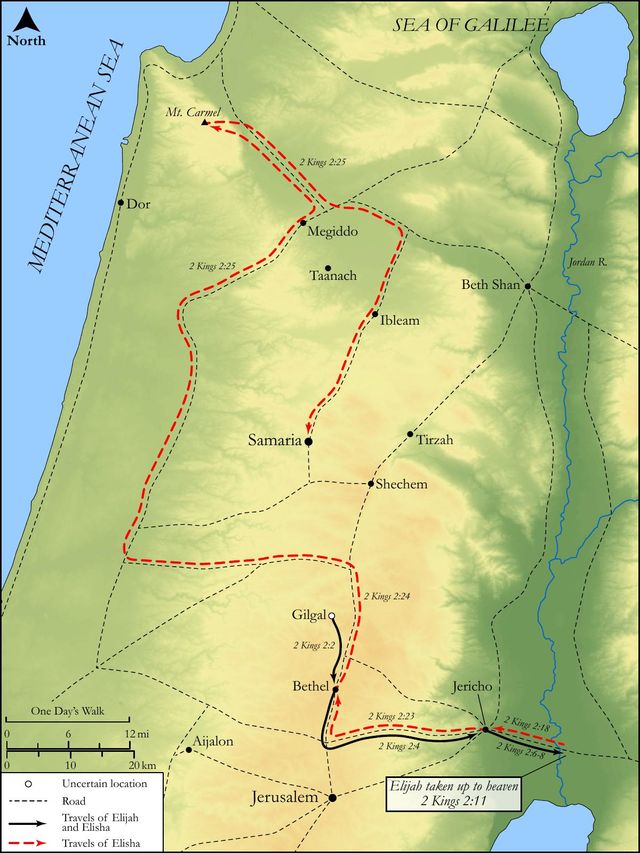
See on the biblical-era map
Study this verse
Public-domain commentary
Matthew Henry
From his Commentary on the Whole Bible. Henry comments on passages, not single verses — this entry covers 2 Kings 2:13–18. His four-level outline is real structure in the source text, so it is rendered as structure.
We have here an account of what followed immediately after the translation of Elijah.
I.The tokens of God's presence with Elisha, and the marks of his elevation into Elijah's room, to be, as he had been, a father to the sons of the prophets, and the chariots and horsemen of Israel.
1.He was possessed of Elijah's mantle, the badge of his office, which, we may suppose, he put on and wore for his master's sake, Kg2 2:13. When Elijah went to heaven, though he did not let fall his body as others do, he let fall his mantle instead of it; for he was unclothed, that he might be clothed upon with immortality: he was going to a world where he needed not the mantle to adorn him, nor to shelter him from the weather, nor to wrap his face in, as Kg1 19:13. He left his mantle as a legacy to Elisha, and, though in itself it was of small value, yet as it was a token of the descent of the Spirit upon him, it was more than if he had bequeathed to him thousands of gold and silver. Elisha took it up, not as a sacred relic to be worshipped, but as a significant garment to be worn, and a recompence to him for his own garments which he had rent. he loved this cloak ever since it was first cast over him, Kg1 19:19. He that then so cheerfully obeyed the summons of it, and became Elihah's servant, is now dignified with it, and becomes his successor. There are remains of great and good men, which, like this mantle, ought to be gathered up and preserved by the survivors, their sayings, their writings, their examples, that, as their works follow them in the reward of them, they may stay behind in the benefit of them.
2.He was possessed of Elijah's power to divide Jordan, Kg2 2:14. Having parted with his father, he returns to his sons in the schools of the prophets. Jordan was between him and them; it had been divided to make way for Elijah to his glory; he will try whether it will divide to make way for him to his business, and by that he will know that God is with him, and that he has the double portion of Elijah's spirit. Elijah's last miracle shall be Elisha's first; thus he begins where Elijah left off and there is no vacancy. In dividing the waters,
(1.)He made use of Elijah's mantle, as Elijah himself had done (Kg2 2:8), to signify that he designed to keep to his master's methods and would not introduce any thing new, as those affect to do that think themselves wiser than their predecessors.
(2.)He applied to Elijah's God: Where is the Lord God of Elijah? He does not ask, "Where is Elijah?" as poring upon the loss of him, as if he could not be easy now that he was gone, - or as doubting of his happy state, as if, like the sons of the prophets here, he knew not what had become of him, - or as curiously enquiring concerning him, and the particular of that state he was removed to (no, that is a hidden life, it does not yet appear what we shall be), - nor as expecting help from him; no, Elijah is happy, but is neither omniscient nor omnipotent; but he asks, Where is the Lord God of Elijah? Now that Elijah was taken to heaven God had abundantly proved himself the God of Elijah; if he had not prepared for him that city, and done better for him there than ever he did for him in this world, he would have been ashamed to be called his God, Heb 11:16; Mat 27:31, Mat 27:32. Now that Elijah was taken to heaven Elisha enquired,
[1.]After God. When our creature-comforts are removed, we have a God to go to, that lives for ever.
[2.]After The God of Elijah, the God that Elijah served, and honoured, and pleaded for, and adhered to when all Israel had deserted him. This honour is done to those who cleave to God in times of general apostasy, that God will be, in a peculiar manner, their God. "The God that owned, and protected, and provided for Elijah, and many ways honoured him, especially now at last, where is he? Lord, am not I promised Elijah's spirit? Make good that promise." The words which next follow in the original, Aph-his - even he, which we join to the following clause, when he also had smitten the waters, some make an answer to this question, Where is Elijah's God? Etiam ille adhuc superest - "He is in being still, and nigh at hand. We have lost Elijah, but we have not lost Elijah's God. He has not forsaken the earth; it is even he that is still with me." Note, First, It is the duty and interest of the saints on earth to enquire after God, and apply to him as the Lord God of the saints that have gone before to heaven, the God of our fathers. Secondly, It is very comfortable to those who enquire of him; it is even he that is in his holy temple (Psa 11:4) and nigh to all who call upon him, Psa 145:18. Thirdly, Those that walk in the spirit and steps of their godly faithful predecessors shall certainly experience the same grace that they experienced; Elijah's God will be Elisha's too. The Lord God of the holy prophets is the same yesterday, today, and for ever; and what will it avail us to have the mantles of those that are gone, their places, their books, if we have not their spirit, their God?
3.He was possessed of Elijah's interest in the sons of the prophets, Kg2 2:15. Some of the fellows of the college at Jericho, who had placed themselves conveniently near Jordan, to see what passed, were surprised to see Jordan divided before Elisha in his return, and took that as a convincing evidence that the spirit of Elijah did rest upon him, and that therefore they ought to pay the same respect and deference to him that they had paid to Elijah. Accordingly they went to meet him, to congratulate him on his safe passage through fire and water, and the honour God had put upon him; and they bowed themselves to the ground before him. They were trained up in the schools; Elisha was taken from the plough; yet when they perceived that God was with him, and that this was the man whom he delighted to honour, they readily submitted to him as their head and father, as the people to Joshua when Moses was dead, Jos 1:17. Those that appear to have God's Spirit and presence with them ought to have our esteem and best affections, notwithstanding the meanness of their extraction and education. This ready submission of the sons of the prophets, no doubt, was a great encouragement to Elisha, and helped to clear his call.
II.The needless search which the sons of the prophets made for Elijah.
1. They suggested that possibly he was dropped, either alive or dead, upon some mountain, or in some valley; and it would be a satisfaction to them if they sent some strong men, whom they had at command, in quest of him, Kg2 2:16. Some of them perhaps started this as a demurrer to the choice of Elisha: "Let us first be sure that Elijah has quite gone. Can we think Elijah thus neglected by heaven, that chosen vessel thus cast away as a vessel in which was no pleasure?" 2. Elisha consented not to their motion till they overcame him with importunity, Kg2 2:17. They urged him till he was ashamed to oppose it any further lest he should be thought wanting in his respect to his old master or loth to resign the mantle again. Wise men may yield to that, for the sake of peace and the good opinion of others, which yet their judgment is against as needless and fruitless. 3. The issue made them as much ashamed of their proposal as they, by their importunity, had made Elisha ashamed of his opposing it. Their messengers, after they had tired themselves with fruitless search, returned with a non est inventus - he is not to be found, and gave Elisha an opportunity of upbraiding his friends with their folly: Did I not say unto you, Go not? Kg2 2:18. This would make them the more willing to acquiesce in his judgment another time. Traversing hills and valleys will never bring us to Elijah, but the imitation of his holy faith and zeal will, in due time.
Continue studying 2 Kings 2:16 across the web’s major study libraries — every link below opens this exact verse, chapter, or book on the destination site.
Read & Compare
 BibleGatewayThis verse in more than 200 translations and 70 languages.
 Bible.comThe YouVersion reader — hundreds of translations, reading plans, and highlights.
 ESV.orgCrossway's official English Standard Version reader.
 NET BibleThe NET translation with 60,000+ translators' notes on every rendering decision.
 STEP BibleTyndale House's free study tool — original text, vocabulary, and scholarly resources.
 BibliaLogos Bible Software's free web reader.
 USCCBThe New American Bible (Revised Edition) with the U.S. bishops' study notes.
Commentaries
 BibleHub CommentariesDozens of classic commentaries on this verse, gathered on one page.
 StudyLightMore than 100 commentary sets — the largest collection on the web.
 BibleRefPlain-English commentary on what this verse means, verse by verse.
 Enduring WordDavid Guzik's free commentary on this chapter, widely used by Bible teachers.
 Bible Study ToolsVerse commentary alongside Greek and Hebrew study aids.
Original Language & Research
- BibleHub InterlinearThe verse word by word — original language, transliteration, and English.
- BibleHub LexiconEvery word's original-language definition and Strong's entry.
 Blue Letter BibleDeep-study tools — Strong's numbers, concordance, and word studies.
 SefariaThe Hebrew text with Rashi and centuries of Jewish commentary.
Sermons, Hymns & Audio


TrulyRandomVerse is not affiliated with these sites and doesn’t control their content. They’re linked because they’re genuinely useful.
Summary
Following the dramatic, supernatural ascension of Elijah, the prophet, into heaven, 2 Kings 2:16 captures the understandable human struggle of the "sons of the prophets" to fully grasp such a miraculous event. Despite having witnessed Elisha's immediate display of prophetic power, they propose a search party for Elijah, revealing a blend of genuine concern, lingering skepticism, and a limited earthly understanding of the Spirit's boundless power, to which Elisha responds with a firm refusal.
Context
ShowHideLiterary Context
This verse immediately follows the climactic and unprecedented departure of Elijah, who was taken into heaven by a whirlwind and chariots of fire 2 Kings 2:11. Elisha, having witnessed this glorious event and received Elijah's mantle, has just demonstrated his new prophetic authority by miraculously parting the Jordan River, echoing Elijah's own feat 2 Kings 2:14. The "sons of the prophets" from Jericho, who had observed these events from a distance, have now come to meet Elisha, acknowledging that "the spirit of Elijah rests on Elisha" 2 Kings 2:15. It is in this context of awe-inspiring divine action and the transfer of prophetic leadership that they approach Elisha with their proposal, struggling to reconcile the supernatural with their earthly expectations.
Historical & Cultural Context
The "sons of the prophets" were not literal offspring but members of prophetic guilds or communities, likely students or disciples who lived together under the guidance of a senior prophet. These groups were known from the time of Samuel 1 Samuel 10:5 and continued through Elijah and Elisha's ministries. Their existence points to an organized prophetic movement in Israel, serving as centers for spiritual training and the preservation of prophetic tradition. While they acknowledged the power of the "Spirit of the LORD" to move individuals, their suggestion of a search party reflects a common human tendency to rationalize or limit divine actions to what is physically comprehensible. They likely conceived of the Spirit's power in terms of forceful, yet still earthly, relocation, rather than a full heavenly translation, revealing a tension between their theological understanding of God's power and their practical, human-centered worldview.
Key Themes
ShowHideThe verse powerfully highlights several key themes. Firstly, it underscores the tension between human understanding and divine revelation. Even those deeply involved in spiritual matters can struggle to fully grasp or accept truly miraculous, unprecedented divine interventions. Their proposal to search for Elijah reveals a rationalistic inclination, assuming the Spirit merely relocated him within the earthly realm, rather than taking him to heaven. Secondly, it emphasizes the acknowledged power and agency of the Spirit of the LORD. Despite their skepticism about Elijah's ultimate destination, the prophets clearly attribute the event to the "Spirit of the LORD," demonstrating a fundamental belief in God's extraordinary power to move and act, even if the precise nature of that action is misunderstood. This resonates with other biblical accounts where the Spirit supernaturally moves individuals, such as Ezekiel being lifted by the Spirit or Philip being caught away by the Spirit. Lastly, the verse subtly introduces Elisha's emerging authority and discernment. Having personally witnessed Elijah's ascent, Elisha knows their search would be futile. His initial refusal, "Ye shall not send," demonstrates his clear understanding of the divine event and his growing confidence as the new prophetic leader, even as he later yields to their persistence in the subsequent verse 2 Kings 2:17.
Exposition and Analysis
ShowHideKey Word Analysis
ShowHideThe Hebrew term רוּחַ יְהֹוָה (rûwach Yᵉhôvâh) combines rûwach (wind, breath, spirit) and Yᵉhôvâh (the self-Existent or Eternal, God's personal name). This phrase denotes the powerful, active, and personal presence of God. The sons of the prophets correctly attribute Elijah's disappearance to this divine Spirit, acknowledging its supernatural agency. However, their subsequent speculation about Elijah being "cast upon some mountain, or into some valley" reveals a limited understanding of the Spirit's full capabilities, confining its action to an earthly, albeit forceful, relocation rather than a heavenly translation.
The verb נָשָׂא (nâsâʼ) means "to lift, bear, carry, take away." While it can describe a physical elevation, as in "raise (up)" or "lift (self) up," in the context of Elijah's departure, the prophets' usage implies a less dignified, more accidental or forceful movement rather than a purposeful, divine translation. Their choice falls short of capturing the full, glorious, and unique nature of his ascension into heaven.
The verb שָׁלַךְ (shâlak) means "to throw out, down or away." The prophets' use of this verb, alongside "taken him up," implies a somewhat violent or haphazard relocation by the Spirit. This choice of words underscores their earthly, limited perception of the Spirit's power, imagining a scenario where Elijah might have been dropped or flung onto an earthly location, rather than gloriously and permanently translated into God's presence.
Verse Breakdown
ShowHide"And they said unto him, Behold now, there be with thy servants fifty strong men; let them go, we pray thee, and seek thy master:"
This clause reveals the practical, yet ultimately misguided, proposal of the "sons of the prophets." Their initiative, born from a desire to confirm Elijah's fate and perhaps out of genuine concern for his well-being, highlights their human inclination to solve spiritual mysteries through physical means. The mention of "fifty strong men" emphasizes the considerable physical effort they are willing to expend, contrasting sharply with the supernatural nature of Elijah's departure and the limitless power of God.
"lest peradventure the Spirit of the LORD hath taken him up, and cast him upon some mountain, or into some valley."
This is the core of their misunderstanding. While correctly attributing Elijah's disappearance to the "Spirit of the LORD," they imagine the Spirit's action as a forceful, yet still earthly, relocation. They cannot conceive of a full ascension into heaven, instead picturing Elijah being deposited somewhere on earth, perhaps disoriented or injured. This reflects a common human tendency to project our limited understanding onto divine omnipotence, attempting to rationalize an unprecedented miracle within familiar physical parameters.
"And he said, Ye shall not send."
Elisha's terse and authoritative response is born from direct knowledge and spiritual discernment. He was the sole human witness to Elijah's glorious ascension into heaven. His immediate, unequivocal refusal demonstrates his clear understanding of the divine event and his emerging authority as the new prophetic leader. He knows a search would be utterly futile, a waste of resources, and would implicitly undermine the miraculous, heavenly nature of Elijah's departure.
Literary Devices
ShowHideThe passage employs several potent literary devices. There is clear Irony in the situation: the sons of the prophets, having just acknowledged Elisha's anointing and the "spirit of Elijah" resting upon him, still struggle to accept the full reality of Elijah's supernatural departure, proposing an earthly search for a man who is in heaven. This creates a stark Contrast between human skepticism and divine power, between earthly reasoning and heavenly reality. The "fifty strong men" represent futile human effort contrasted with the boundless, effortless power of the Spirit. Furthermore, Elisha's firm, concise refusal, "Ye shall not send," immediately establishes his Authority as the new prophetic leader, demonstrating his discernment and direct knowledge of God's ways, which sets him apart from the limited understanding of the prophetic guild. The very suggestion of "some mountain, or into some valley" also serves as Foreshadowing of their eventual futile search in 2 Kings 2:17, confirming Elisha's initial wisdom.
Theological and Thematic Connections
ShowHideThis verse serves as a powerful reminder of the chasm that can exist between human perception and divine reality. Even those dedicated to God's service can struggle to fully comprehend or accept the truly miraculous, preferring to fit God's actions into understandable, earthly frameworks. It underscores the profound truth that God's ways are often far beyond human comprehension or expectation, challenging us to embrace faith over sight. The sons of the prophets, while acknowledging the Spirit's power, limited its scope to what they could conceive. This highlights the ongoing need for believers to expand their understanding of God's limitless power and to trust in His extraordinary methods, even when they defy conventional logic and human experience.
Reflection and Application
ShowHideThe scene in 2 Kings 2:16 offers profound insights for contemporary believers. We, too, are often prone to explain away the miraculous or to fit God's actions into our limited human understanding. This passage challenges us to cultivate a posture of humility and wonder, trusting God's word and His supernatural power even when it defies our logic or expectations. It reminds us that God's methods are not bound by our capabilities or our rationalizations. Furthermore, Elisha's initial firm refusal, followed by his eventual yielding (as seen in the next verse), offers a lesson in patience and discernment. Sometimes, people need to exhaust their own limited efforts or experience the futility of their doubts before they can fully embrace a divine truth. We are called to stand firm in what we know of God's truth, but also to exercise grace and patience with those who are still struggling to believe or comprehend, allowing them space to encounter truth for themselves, even if it means a temporary detour into their own misguided efforts.
Questions for Reflection
ShowHideFAQ
ShowHideWho were the "sons of the prophets"?
ShowHideThe "sons of the prophets" were not literal offspring of individual prophets but rather members of prophetic guilds or communities. These were groups of disciples or students who gathered around a leading prophet, like Elijah or Elisha, to learn, train, and live in community. They were often involved in prophetic ministry, though perhaps not always in the same authoritative capacity as the leading prophet. They represent an organized aspect of the prophetic movement in ancient Israel, dedicated to the study of God's word and the practice of prophecy, as seen in passages like 1 Samuel 10:5 and 2 Kings 4:38.
Why did Elisha initially refuse their request to send a search party?
ShowHideElisha initially refused their request because he had personally witnessed Elijah's glorious ascension into heaven 2 Kings 2:11. He knew with certainty that Elijah had not merely been relocated to an earthly mountain or valley, but had been taken by God to a realm beyond human reach. Sending a search party would have been a futile exercise, a waste of effort, and would have implicitly denied the miraculous nature of Elijah's departure. Elisha's refusal demonstrated his clear understanding of the divine event and his emerging authority as the new prophetic leader.
Does this passage suggest the Spirit sometimes moves people physically?
ShowHideWhile the "sons of the prophets" mistakenly believed the Spirit might have "cast" Elijah onto an earthly location, the Bible does record instances where the Spirit of the Lord supernaturally transported individuals. For example, Ezekiel was lifted by the Spirit and transported to different locations in visions. Similarly, after baptizing the Ethiopian eunuch, Philip was caught away by the Spirit of the Lord and found himself in Azotus. However, Elijah's ascension was unique; it was a permanent translation into heaven, not a temporary relocation on earth. The sons of the prophets' error lay in misinterpreting the nature of the Spirit's action in Elijah's case, limiting it to an earthly phenomenon rather than recognizing its heavenly destination.
Christ-Centered Fulfillment
ShowHideThe dramatic ascension of Elijah, while unique in the Old Testament, serves as a powerful foreshadowing of the ultimate and infinitely more significant ascension of Jesus Christ. Just as the "Spirit of the LORD" took Elijah up, so too did Christ, after His resurrection and forty days of teaching, ascend into heaven, demonstrating His triumph over death and His return to the Father's right hand Acts 1:9-11. The sons of the prophets' limited understanding of Elijah's departure mirrors humanity's struggle to grasp the full implications of Christ's heavenly reign and His ongoing work. Unlike Elijah, who was taken up by chariots of fire, Christ ascended by His own divine power, leading captivity captive and bestowing gifts on men Ephesians 4:8-10. Elijah's departure left a mantle for Elisha, signifying a transfer of prophetic authority; Christ's ascension, however, inaugurated the pouring out of the Holy Spirit on all believers, empowering them for ministry and establishing a new covenant of direct access to God Acts 2:33. Ultimately, Elijah's ascension points to the hope of a future translation for believers at Christ's return 1 Thessalonians 4:17, but it finds its complete fulfillment and theological significance in the glorious, authoritative, and redemptive ascension of the Lamb of God, who prepares a place for us in His Father's house John 14:1-3.