


2 Kings 2:11
- וַיְהִיvay·Hiand it wasH1961Conj-w ¦ V-Qal-ConsecImperf-3msVerb Qal Consecutive Imperfect 3rd Singular Masculineוַandיְהִיit was
- הֵמָּהHe·mahtheyH1992Pro-3mpPronoun Personal 3rd Plural Masculine
- הֹלְכִיםho·le·Khim[were] walkingH1980V-Qal-Prtcpl-mpVerb Qal Participle Plural Masculine Absolute
- הָלוֹךְha·loKhcontinuously <to walk>H1980V-Qal-InfAbsVerb Qal Infinitive Absolute
- וְדַבֵּרve·da·Berand speakingH1696Conj-w ¦ V-Piel-InfVerb Piel Infinitive Constructוְandדַבֵּרspeaking
- וְהִנֵּהve·hi·Nehand there!H2009Conj-w ¦ PrtParticle Interjectionוְandהִנֵּהthere!
- רֶכֶבre·kheva chariot ofH7393N-mscNoun Singular Masculine Construct
- אֵשׁ'eshfireH784N-csNoun Singular common gender Absolute
- וְסוּסֵיve·Su·seiand horses ofH5483Conj-w ¦ N-mpcNoun Plural Masculine Constructוְandסוּסֵיhorses of
- אֵשׁ'EshfireH784N-csNoun Singular common gender Absolute
- וַיַּפְרִדוּvai·yaf·Ri·duand they separatedH6504Conj-w ¦ V-Hiphil-ConsecImperf-3mpVerb Hiphil Consecutive Imperfect 3rd Plural Masculineוַandיַּפְרִדוּthey separated
- בֵּיןbeinbetweenH996Adj-mscAdjective Numerical Singular Masculine Construct
- שְׁנֵיהֶםshe·nei·Hem[the] two of themH8147N-cdc ¦ 3mpNoun Dual common gender Constructשְׁנֵי[the] two ofהֶםthem
- וַיַּעַלvai·Ya·'aland he went upH5927Conj-w ¦ V-Qal-ConsecImperf-3msVerb Qal Consecutive Imperfect 3rd Singular Masculineוַandיַּעַלhe went up
- אֵלִיָּהוּ'e·li·Ya·huElijahH452N-proper-mNoun Proper Masculine
- בַּסְעָרָהba·se·'a·Rahin the whirlwindH5591Prep-b ¦ N-fsNoun Singular Feminine Absoluteבַּin theסְעָרָהwhirlwind
- הַשָּׁמָיִםha·sha·Ma·yimthe heavensH8064Art ¦ N-mpNoun Plural Masculine Absoluteהַtheשָּׁמָיִםheavens
English is a literal word-by-word gloss of the Hebrew, not the KJV's wording. Why?
This is the original text the KJV's translators worked from — each Hebrew word with its own literal English meaning in this verse, prepared by scholars at Tyndale House, Cambridge. The KJV translates whole sentences, not word by word, so its wording differs: one Hebrew word can become several English words, and the KJV may choose “the LORD” where the gloss reads “Yahweh”. Both are faithful — they answer different questions. For the KJV's own rendering, switch to the KJV text.
Details
See on the biblical-era map
Study this verse
Public-domain commentary
Matthew Henry
From his Commentary on the Whole Bible. Henry comments on passages, not single verses — this entry covers 2 Kings 2:9–12. His three-level outline is real structure in the source text, so it is rendered as structure.
Here, I. Elijah makes his will, and leaves Elisha his heir, now anointing him to be prophet in his room, more than when he cast his mantle upon him, Kg1 19:19.
1.Elijah, being greatly pleased with the constancy of Elisha's affection and attendance, bade him ask what he should do for him, what blessing he should leave him at parting; he does not say (as bishop Hall observes), "Ask of me when I am gone, in heaven I shall be better able to befriend thee," but, "Ask before I go." Our friends on earth may be spoken to, and can give us an answer, but we know not that we can have access to any friend in heaven but Christ, and God in him. Abraham is ignorant of us.
2.Elisha, having this fair opportunity to enrich himself with the best riches, prays for a double portion of his spirit. He asks not for wealth, nor honour, nor exemption from trouble, but to be qualified for the service of God and his generation, he asks,
(1.)For the Spirit, not that the gifts and graces of the Spirit were in Elijah's power to give, therefore he says not, "Give me the Spirit" (he knew very well it was God's gift), but "Let it be upon me, intercede with God for this for me." Christ bade his disciples ask what they would, not one, but all, and promised to send the Spirit, with much more authority and assurance than Elijah could.
(2.)For his spirit, because he was to be a prophet in his room, to carry on his work, to father the sons of the prophets and face their enemies, because he had the same perverse generation to deal with that he had, so that, if he have not his spirit, he has not strength according to the day.
(3.)For a double portion of his spirit; he does not mean double to what Elijah had, but double to what the rest of the prophets had, from whom so much would not be expected as from Elisha, who had been brought up under Elijah. It is a holy ambition to covet earnestly the best gifts, and those which will render us most serviceable to God and our brethren. Note, We all ought, both ministers and people, to set before us the example of our predecessors, to labour after their spirit, and to be earnest with God for that grace which carried them through their work and enabled them to finish well.
3.Elijah promised him that which he asked, but under two provisos, Kg2 2:10.
(1.)Provided he put a due value upon it and esteem it highly: this he teaches him to do by calling it a hard thing, not too hard for God to do, but too great for him to expect. Those are best prepared for spiritual blessings that are most sensible of their worth and their own unworthiness to receive them.
(2.)Provided he kept close to his master, even to the last, and was observant of him: If thou see me when I am taken from thee, it shall be so, otherwise not. A diligent attendance upon his master's instructions, and a careful observance of his example, particularly now in his last scene, were the condition and would be a proper means of obtaining much of his spirit. Taking strict notice of the manner of his ascension would likewise be of great use to him. The comforts of departing saints, and their experiences, will mightily help both to gild our comforts and to steel our resolutions. Or, perhaps, this was intended only as a sign: "If God favour thee so far as to give thee a sight of me when I ascend, take that for a token that he will do this for thee, and depend upon it." Christ's disciples saw him ascend, and were thereupon assured that they should, in a little time, be filled with his Spirit, Act 1:8. Elisha, we may suppose, hereupon prayed earnestly, Lord, show me this token for good.
II.Elijah is carried up to heaven in a fiery chariot, Kg2 2:11.
Like Enoch, he was translated, that he should not see death; and was (as Mr. Cowley expresses it) the second man that leaped the ditch where all the rest of mankind fell, and went not downward to the sky. Many curious questions might be asked about this matter, which could not be answered. Let it suffice that we are here told,
1.What his Lord, when he came, found him doing. He was talking with Elisha, instructing and encouraging him, directing him in his work, and quickening him to it, for the good of those whom he left behind. He was not meditating nor praying, as one wholly taken up with the world he was going to, but engaged in edifying discourse, as one concerned about the kingdom of God among men. We mistake if we think our preparation for heaven is carried on only by contemplation and the acts of devotion. Usefulness to others will pass as well in our account as any thing. Thinking of divine things is good, but talking of them (if it come from the heart) is better, because for edification, Co1 14:4. Christ ascended as he was blessing his disciples.
2.What convoy his Lord sent for him - a chariot of fire and horses of fire, which appeared either descending upon them from the clouds or (as bishop Patrick thinks) running towards them upon the ground: in this form the angels appeared. The souls of all the faithful are carried by an invisible guard of angels into the bosom of Abraham; but, Elijah being to carry his body with him, this heavenly guard was visible, not in a human shape, as usual, though they might so have borne him up in their arms, or carried him as on eagles' wings, but that would have been to carry him like a child, like a lamp (Isa 40:11, Isa 40:31); they appear in the form of a chariot and horses, that he may ride in state, may ride in triumph, like a prince, like a conqueror, yea, more than a conqueror. The angels are called in scripture cherubim and seraphim, and their appearance here, though it may seem below their dignity, answers to both those names; for (1.) Seraphim signifies fiery, and God is said to make them a flame of fire, Psa 104:4. (2.) Cherubim (as many think) signifies chariots, and they are called the chariots of God (Psa 68:17), and he is said to ride upon a cherub (Psa 18:10), to which perhaps there is an allusion in Ezekiel's vision of four living creatures, and wheels, like horses and chariots; in Zechariah's vision, they are so represented, Zac 1:8; Zac 6:1. Compare Rev 6:2, etc. See the readiness of the angels to do the will go God, even in the meanest services, for the good of those that shall be heirs of salvation. Elijah must remove to the world of angels, and therefore, to show how desirous they were of his company, some of them would come to fetch him. The chariot and horses appeared like fire, not for burning, but brightness, not to torture or consume him, but to render his ascension conspicuous and illustrious in the eyes of those that stood afar off to view it. Elijah had burned with holy zeal for God and his honour, and now with a heavenly fire he was refined and translated.
3.How he was separated from Elisha. This chariot parted them both asunder. Note, The dearest friends must part. Elisha had protested he would not leave him, yet now is left behind by him.
4.Whither he was carried. He went up by a whirlwind into heaven. The fire tends upward; the whirlwind helped to carry him through the atmosphere, out of the reach of the magnetic virtue of this earth, and then how swiftly he ascended through the pure ether to the world of holy and blessed spirits we cannot conceive.
"But where he stopped will ne'er be known,
'Till Phenix-nature, aged grown,
To a better being shall aspire,
Mounting herself, like him, to eternity in fire."
- Cowley
Elijah had once, in a passion, wished he might die; yet God was so gracious to him as not only not to take him at his word then, but to honour him with this singular privilege, that he should never see death; and by this instance, and that of Enoch, (1.) God showed how men should have left the world if they had not sinned, not by death, but by a translation. (2.) He gave a glimpse of that life and immortality which are brought to light by the gospel, of the glory reserved for the bodies of the saints, and the opening of the kingdom of heaven to all believers, as then to Elijah. It was also a figure of Christ's ascension.
III.Elisha pathetically laments the loss of that great prophet, but attends him with an ecomium, Kg2 2:12.
1.He saw it; thus he received the sign by which he was assured of the grant of his request for a double portion of Elijah's spirit. He looked stedfastly towards heaven, whence he was to expect that gift, as the disciples did, Act 1:10. he saw it awhile, but the vision was presently out of his sight; and he saw him no more.
2.He rent his own clothes, in token of the sense he had of his own and the public loss. Though Elijah had gone triumphantly to heaven, yet this world could ill spare him, and therefore his removal ought to be much regretted by the survivors. Surely their hearts are hard whose eyes are dry when God, by taking away faithful useful men, calls for weeping and mourning. Though Elijah's departure made way for Elisha's eminency, especially since he was now sure of a double portion of his spirit, yet he lamented the loss of him, for he loved him, and could have served him for ever.
3.He gave him a very honourable character, as the reason why he thus lamented the loss of him.
(1.)He himself had lost the guide of his youth: My father, my father. He saw his own condition like that of a fatherless child thrown upon the world, and lamented it accordingly. Christ, when he left his disciples, did not leave them orphans (Joh 14:15), but Elijah must.
(2.)The public had lost its best guard; he was the chariot of Israel, and the horsemen thereof. He would have brought them all to heaven, as in this chariot, if it had not been their own fault; they used not chariots and horses in their wars, but Elijah was to them, by his counsels, reproofs, and prayers, better than the strongest force of chariot and horse, and kept off the judgments of God. His departure was like the routing of an army, an irreparable loss. "Better have lost all our men of war than this man of God."
Historical interpretation
Five Centuries of Reception
3 surviving comments on this verse. Each one is dated, so this reads as a timeline rather than a list.
Select a marker to jump to its quote. Markers stagger vertically where authors wrote within a few decades of each other.
But do not marvel in regard to what is said about Elijah, if, just as something strange happened to him different from all the saints who are recorded, in respect of his having been caught up by a whirlwind into heaven, so his spirit had something of choice excellence, so that not only did it rest on Elisha but also descended along with John at his birth; and that John, separately, "was filled with the Holy Spirit even from his mother's womb," and separately "came before Christ in the spirit and power of Elijah." For it is possible for several spirits not only worse, but also better, to be in the same person. David accordingly asks to be established by a free spirit and that a right spirit be renewed in his inward parts. But if, in order that the Savior may impart to us of the "spirit of wisdom and understanding, the spirit of counsel and might, the spirit of knowledge and reverence," he was filled also with the spirit of the fear of the Lord; it is possible also that these several good spirits may be conceived as being in the person. And this also we have brought forward, because of John having come before Christ "in the spirit and power of Elijah," in order that the saying "Elijah has already come" may be referred to the spirit of Elijah that was in John; as also the three disciples who had gone up with him understood that he spoke to them about John the Baptist. On Elisha, then, only the spirit of Elijah rested, but John came before, not only in the spirit but also in the power of Elijah. Wherefore, also, Elisha could not have been called Elijah, but John was Elijah himself. But if it is necessary to adduce the Scripture from which the scribes said that Elijah must first come, listen to Malachi, who says, "And behold, I will send to you Elijah the Tishbite," down to the words "Lest I come and strike the earth utterly." And it seems to be indicated by these words that Elijah was to prepare for the glorious coming of Christ by certain holy words and dispositions in their souls, those who had been made fittest for this, which those on earth could not have endured, because of the excellence of the glory, unless they had been prepared beforehand by Elijah. And likewise, by Elijah, in this place, I do not understand the soul of that prophet but his spirit and his power; for these it is by which all things shall be restored, so that when they have been restored, and, as a result of that restoration, become capable of receiving the glory of Christ, the Son of God who shall appear in glory may sojourn with them. But if also Elijah is in some sort a word inferior to "the word who was in the beginning with God, God the Word," this word also might come as a preparatory discipline to the people prepared by it, that they might be trained for the reception of the perfect Word.
A burdened stomach drags down the heart toward vices and depresses the mind to keep it unable to experience heavenly piety. Scripture tells us, “The corruptible body is a load on the soul, and the earthly habitation presses down the mind that muses on many things.” Hence, the Lord said, too, “Take heed lest your hearts be overburdened with self-indulgence and drunkenness.” Therefore, the stomach should be relieved by the tempering influence of a fast, so that the mind can be unburdened and attend to higher things, rise to virtues and like a winged bird fly in its entirety to the very Author of piety. The case of Elijah proves this. Relieved of bodily weight by continuing that fast that the Lord arranged, he flew to heaven as victor over death.
The prophets proclaimed the mystery of the Lord’s ascension not only by their words but also by their actions. Both Enoch, the seventh [in the line of descent] from Adam, who was transported from the world, and Elijah, who was taken up into heaven, gave evidence that the Lord would ascend above all the heavens.…Elijah presented an image of this festivity of the Lord by a miracle with richer significance. When the time in which he was to be taken away from the world was near, he came to the river Jordan with his disciple Elisha. With his rolled-up cloak he struck the waters, they were divided, and both of them crossed over on dry land. And he said to Elisha, “Ask what you want me to do before I am taken away from you,” and Elisha said, “I entreat you that your spirit may become double in me.” As they went on conversing together, behold, Elijah was suddenly snatched away, and, as the Scripture says, “He ascended as if into heaven.” By this action of his soaring aloft it is meant that [Elijah] was not taken up into heaven itself, as was our Lord, but into the height of the air [above the earth], from where he was borne invisibly to the joys of paradise. Elisha took up the cloak of Elijah that had fallen from him; and, coming to the river Jordan, he struck the water with it, and after calling on God, he divided the water and crossed over.
Let your love take note, my brothers, how the symbolic event agrees point by point with its fulfillment. Elijah came to the river Jordan, and having laid aside his cloak, he struck the waters and divided them. The Lord came to the stream of death, in which the human race ordinarily was immersed, and laying aside from himself for a time the clothing of flesh that he had assumed, struck down death by dying and opened up for us the way to life by rising. The change and decline of our mortal life is properly represented by the river Jordan, since the meaning of Jordan in Latin is “their descent,” and since as the river flows into the Dead Sea, it loses its praiseworthy waters. After [the water of the river] Jordan was divided, Elijah and Elisha crossed over on dry land; by his rising from the dead the Savior bestowed on his faithful ones the hope of rising too. After they had crossed over the river Jordan, Elijah gave Elisha the option of asking for what he wanted. The Lord too, after the glory of his resurrection had been fulfilled, implanted in his disciples a fuller comprehension of what he had promised previously, that “whatever you ask in my name, I will do [for you].” Elisha asked that the spirit of Elijah might become double in him. The disciples, thoroughly instructed by the Lord, desired to receive the promised gift of the Spirit, which would make them capable of preaching not only to the single nation of Judah, which he himself taught when he was present in the flesh, but to all countries throughout the globe as well. Did he not pledge the double grace of his Spirit when he said, “A person who believes in me will himself also do the works that I do, and he will do even greater ones than these”? As Elijah and Elisha were conversing together, a chariot with fiery horses suddenly snatched Elijah as if into heaven. By the chariot and fiery horses we are to understand the angelic powers, of whom it is written, “He makes the angels his spirits and his ministers a burning fire” (Elijah, being an ordinary human being, had need of them to be raised up from the earth). The Lord too was suddenly taken up as he was speaking with his apostles and as they were looking on; although he was not assisted by the help of angels, he was served by an angelic band of companions. He was truly assumed into heaven with the angels also bearing witness to it, for they said [to the apostles], “This Jesus who has been taken up from you into heaven.” When Elijah was raised up to the heavens, he let the cloak with which he had been clothed fall to Elisha. When our Lord ascended into heaven, he left the mysteries of the humanity he had assumed to his disciples, to the entire church in fact, so that it could be sanctified by them and warmed by the power of his love. Elisha took up Elijah’s cloak and struck the waters of the river Jordan with it; and when he called on the God of Elijah, [the waters] were divided, and he crossed over. The apostles and the entire church took up the sacraments of their Redeemer that had been instituted through the apostles, so that, spiritually guided by them and cleansed and consecrated by them, they too learned to overcome death’s assaults by calling on the name of God the Father and to cross over to undying life, spurning the obstacles of death.
Continue studying 2 Kings 2:11 across the web’s major study libraries — every link below opens this exact verse, chapter, or book on the destination site.
Read & Compare
 BibleGatewayThis verse in more than 200 translations and 70 languages.
 Bible.comThe YouVersion reader — hundreds of translations, reading plans, and highlights.
 ESV.orgCrossway's official English Standard Version reader.
 NET BibleThe NET translation with 60,000+ translators' notes on every rendering decision.
 STEP BibleTyndale House's free study tool — original text, vocabulary, and scholarly resources.
 BibliaLogos Bible Software's free web reader.
 USCCBThe New American Bible (Revised Edition) with the U.S. bishops' study notes.
Commentaries
 BibleHub CommentariesDozens of classic commentaries on this verse, gathered on one page.
 StudyLightMore than 100 commentary sets — the largest collection on the web.
 BibleRefPlain-English commentary on what this verse means, verse by verse.
 Enduring WordDavid Guzik's free commentary on this chapter, widely used by Bible teachers.
 Bible Study ToolsVerse commentary alongside Greek and Hebrew study aids.
Original Language & Research
- BibleHub InterlinearThe verse word by word — original language, transliteration, and English.
- BibleHub LexiconEvery word's original-language definition and Strong's entry.
 Blue Letter BibleDeep-study tools — Strong's numbers, concordance, and word studies.
 SefariaThe Hebrew text with Rashi and centuries of Jewish commentary.
Sermons, Hymns & Audio


TrulyRandomVerse is not affiliated with these sites and doesn’t control their content. They’re linked because they’re genuinely useful.
Summary
Second Kings 2:11 chronicles one of the most extraordinary and unique events in biblical history: the supernatural departure of the prophet Elijah from earth. As Elijah and his devoted successor Elisha walked and conversed, a spectacular manifestation of divine power—a chariot of fire and horses of fire—suddenly appeared, decisively separating the two men. Immediately thereafter, Elijah was taken up by a whirlwind into heaven, bypassing physical death and marking the climactic conclusion of his powerful prophetic ministry and the dramatic, divinely orchestrated transition of prophetic authority to Elisha.
Context
ShowHideLiterary Context
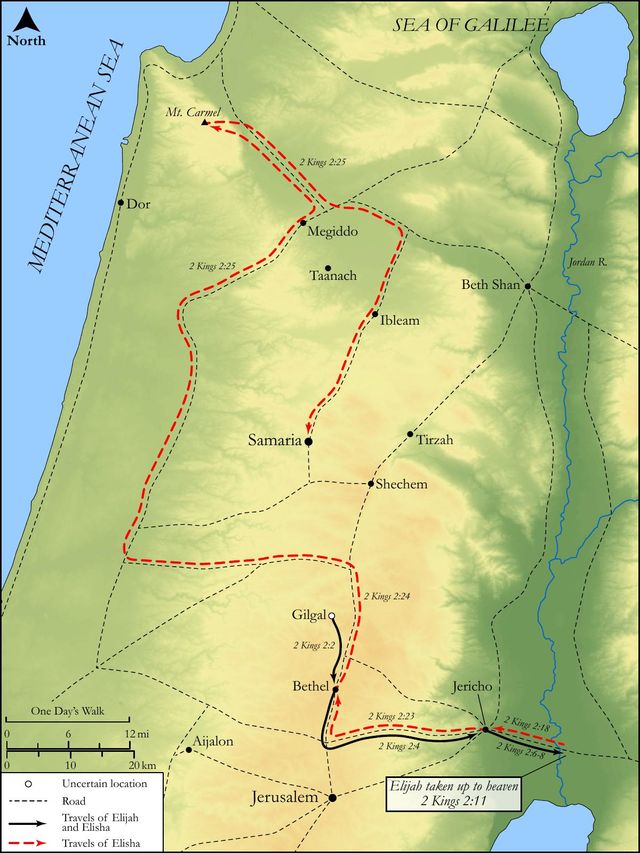
This verse serves as the dramatic and divinely orchestrated climax to the narrative of Elijah's prophetic ministry, which began with his sudden appearance in 1 Kings 17. The preceding verses in 2 Kings 2 meticulously build anticipation for this moment. Elijah, keenly aware of his impending departure, repeatedly attempts to dissuade Elisha from following him, urging him to stay behind at Gilgal, Bethel, and Jericho. However, Elisha's steadfast loyalty is evident in his repeated vow, "As the LORD lives and as you yourself live, I will not leave you" (2 Kings 2:2). Their journey culminates at the Jordan River, where Elijah, reminiscent of Moses and Joshua, miraculously parts the waters with his mantle (2 Kings 2:8). Elisha's audacious request for a "double portion" of Elijah's spirit (2 Kings 2:9) sets the precise condition for receiving this anointing: witnessing Elijah's departure. Thus, the event in verse 11 is not merely a spectacle but the definitive sign of God's approval of Elisha's succession and the transfer of prophetic power.
Historical & Cultural Context
The period of Elijah and Elisha's ministry (9th century BCE) was a tumultuous era in the Northern Kingdom of Israel, characterized by widespread apostasy and the pervasive worship of Baal, aggressively promoted by King Ahab and Queen Jezebel. Elijah had been God's primary instrument in confronting this idolatry, famously demonstrating the LORD's absolute supremacy over Baal through the dramatic contest on Mount Carmel (1 Kings 18). While the concept of a prophet's departure or even a divine "taking" was not entirely alien in ancient Near Eastern thought, Elijah's direct, fiery ascension to heaven without experiencing death was unprecedented in its spectacle and divine intervention. This extraordinary event underscored God's unique honor for Elijah, His direct involvement in the prophetic succession, and served to unequivocally legitimize Elisha's future ministry in a culture that highly valued overt divine signs and wonders as proof of authority. It also provided a powerful counter-narrative to the false gods of the surrounding nations, showcasing the living God's unparalleled power.
Key Themes
ShowHideThis pivotal verse encapsulates several profound theological and narrative themes. Firstly, it powerfully demonstrates Divine Sovereignty and Supernatural Intervention, revealing God's absolute control over creation and His ability to transcend natural laws to accomplish His purposes. The fiery spectacle underscores His omnipotence and immediate presence. Secondly, it highlights the Transition of Prophetic Authority, serving as the undeniable divine sign that God was transferring Elijah's anointing and prophetic mantle to Elisha. Elisha's witnessing of the ascension fulfilled the condition for receiving the "double portion" of spirit, unequivocally marking him as Elijah's legitimate successor and setting the stage for his own prolific ministry, which would indeed feature even more miracles than Elijah's. Thirdly, it speaks profoundly to God's Honor for His Faithful Servants, as Elijah, a prophet who faithfully served God through immense challenges, isolation, and persecution, is uniquely honored with a direct translation to heaven, bypassing death. This echoes the earlier account of Enoch's walk with God in Genesis 5:24, presenting Elijah as one of only two individuals in the Old Testament recorded as being taken directly into God's presence without experiencing physical death.
Exposition and Analysis
ShowHideKey Word Analysis
ShowHideFrom רָכַב (rakab), meaning "to ride." This term refers to a vehicle, often associated with military power, swiftness, and transportation. In this context, combined with "fire," it signifies a supernatural, divine conveyance, not an earthly one. It points to a heavenly host or a direct manifestation of God's presence, indicating divine power and movement beyond human capabilities.
From an unused root meaning "to skip (properly, for joy)." This word denotes a horse, often associated with strength, speed, and military might. Paired with "fire," these are not literal earthly animals but part of the celestial entourage, emphasizing the overwhelming power and majesty of the divine forces at work in Elijah's translation.
From סָעַר (sa'ar), meaning "to storm." This term describes a hurricane or tempest, a powerful, often destructive, natural phenomenon. In biblical literature, the whirlwind is frequently associated with the manifestation of God's presence, power, and judgment (e.g., God speaking to Job "out of the whirlwind" in Job 38:1). Here, it serves as the divine means of transport, emphasizing the overwhelming, irresistible force by which Elijah was taken up, underscoring that his ascension was a direct, powerful act of God.
Verse Breakdown
ShowHide"And it came to pass, as they still went on, and talked"
This opening clause sets a scene of mundane, ordinary activity—Elijah and Elisha simply walking and conversing. This normalcy serves to heighten the dramatic impact of the sudden, extraordinary divine intervention that immediately follows, emphasizing that God's powerful acts can break into human experience at any moment, often without prior warning.
"that, behold, [there appeared] a chariot of fire, and horses of fire"
The interjection "behold" (הִנֵּה, hinneh) signals an astonishing, sudden, and divinely orchestrated appearance. The "chariot of fire, and horses of fire" is a spectacular, visible manifestation of God's glory, power, and angelic hosts. This fiery imagery powerfully communicates the supernatural, divine origin of the event, signifying God's direct and overwhelming involvement in Elijah's departure.
"and parted them both asunder"
This phrase describes the immediate, physical consequence of the divine manifestation. The fiery chariot and horses acted as a barrier, decisively separating Elijah from Elisha. This physical separation was crucial, as it ensured Elisha had an unobstructed, clear view of Elijah's ascension, thereby fulfilling the condition for receiving the "double portion" of Elijah's spirit and confirming his prophetic succession. It highlights the divine intentionality and precision of the event.
"and Elijah went up by a whirlwind into heaven"
This climactic clause describes Elijah's actual ascension. The "whirlwind" serves as the divine vehicle, signifying the immense, irresistible power of God that lifted Elijah. The destination, "into heaven," indicates a direct translation into God's presence, bypassing physical death. This unique event highlights God's extraordinary favor upon Elijah and sets him apart as one of only two individuals in the Old Testament recorded as being taken directly to God without dying.
Literary Devices
ShowHideThe narrative of Elijah's ascension is profoundly rich with Symbolism. The "chariot of fire and horses of fire" are not literal earthly vehicles but powerful symbols of divine presence, power, and angelic hosts, reminiscent of the fiery manifestations of God's glory seen elsewhere in scripture. "Fire" itself symbolizes God's holiness, purifying power, and consuming presence, often indicating a theophanic appearance. The "whirlwind" is also a potent symbol of God's overwhelming power and often signifies His direct intervention or revelation, demonstrating His mastery over creation. The entire scene functions as a Theophany or Angelophany, a visible manifestation of God's glory or His angelic agents, breaking into the earthly realm to accomplish a divine purpose. The Dramatic Irony is subtle but present: Elijah's repeated attempts to make Elisha stay behind are ultimately foiled by Elisha's unwavering faithfulness, which leads him to witness the very event that confirms his anointing. The narrative also employs Foreshadowing, as Elijah's unique ascension prefigures Christ's ascension and the future "rapture" of believers.
Theological and Thematic Connections
ShowHideThe ascension of Elijah is a profound theological statement about God's sovereign power, His intimate involvement in the lives of His faithful servants, and the reality of a spiritual realm that transcends the physical. It demonstrates that God can choose to bypass the natural order of death for those He uniquely honors, as He did with Enoch. This event serves as an undeniable divine endorsement of Elijah's ministry and, crucially, of Elisha's succession, ensuring the continuity of prophetic authority in Israel. It also offers a powerful glimpse into the unseen spiritual forces at God's command, reminding us that there is more to reality than what is physically perceived. The fiery chariots and whirlwind underscore the majesty and might of the Almighty, who orchestrates all things according to His perfect will, confirming His covenant faithfulness to His people through His chosen instruments.
Reflection and Application
ShowHideElijah's ascension offers profound lessons for believers today. Firstly, it powerfully affirms God's sovereignty and His ability to act beyond human comprehension. We are called to trust in a God who is not limited by our understanding or by natural laws, a God whose power is boundless and whose ways are higher than our ways. Secondly, it highlights the immense value God places on faithfulness. Elijah's unwavering devotion, even in the face of immense challenges, persecution, and isolation, was honored in an extraordinary way, reminding us that our faithfulness, though it may not result in a fiery chariot, is seen, deeply valued, and ultimately rewarded by God. It encourages us to persevere in our walk, knowing that our ultimate reward is with Him. Thirdly, the seamless transition of the prophetic mantle from Elijah to Elisha underscores the importance of spiritual mentorship, discipleship, and the intentional passing on of spiritual legacy. We are called to invest in the next generation of believers, equipping them to carry on God's work, ensuring the continuation of His kingdom's mission even after we are gone. This event, while unique in its manifestation, instills hope in the reality of life beyond death and the promise of God's ultimate triumph over mortality.
Questions for Reflection
ShowHideFAQ
ShowHideWas Elijah the only person to be taken to heaven without dying?
ShowHideNo, the Bible records one other individual who was taken directly to heaven without experiencing physical death: Enoch. Genesis 5:24 states that "Enoch walked with God; and he was not, for God took him." While both Enoch and Elijah were translated, Elijah's departure is described with far more dramatic and visible details, involving fiery chariots and a whirlwind, witnessed by Elisha. This makes Elijah's ascension particularly unique in its spectacle and the clear transfer of authority it signified.
What is the significance of the "chariot of fire and horses of fire"?
ShowHideThe "chariot of fire and horses of fire" is a symbolic manifestation of divine power, glory, and angelic presence. In biblical contexts, "fire" often represents God's holiness, purity, and consuming power (e.g., the burning bush in Exodus 3:2, the pillar of fire by night in Exodus 13:21). "Chariots and horses" symbolize military might, swiftness, and divine transportation. Together, they depict a powerful, supernatural vehicle, likely an angelic host, sent by God to transport Elijah. This imagery underscores the supernatural nature of the event and the overwhelming power at God's command, as later seen when Elisha's servant's eyes are opened to see the mountain full of "horses and chariots of fire" around Elisha in 2 Kings 6:17, revealing the unseen spiritual army protecting God's prophet.
Christ-Centered Fulfillment
ShowHideWhile Elijah's ascension is a singular and spectacular event, it finds its ultimate and supreme fulfillment in the person and work of Jesus Christ. Elijah was taken up by divine power, signifying God's unique favor and the transfer of an earthly prophetic mantle. However, Jesus Christ, after completing His redemptive work on the cross and His glorious resurrection, ascended to heaven by His own inherent divine power, not merely as a prophet, but as the resurrected Lord and King, taking His rightful place at the right hand of the Father (Acts 1:9-11, Ephesians 1:20-21). Elijah's departure marked the end of his earthly ministry and the beginning of Elisha's; Christ's ascension marked the inauguration of His heavenly high priestly ministry (Hebrews 4:14-16) and the sending of the Holy Spirit to empower His church for global mission (Acts 2:33). Furthermore, Elijah's unique translation without death powerfully foreshadows the blessed hope of believers who will be "caught up... to meet the Lord in the air" at Christ's second coming (1 Thessalonians 4:17), a promise made possible by Christ's decisive victory over death and His glorious ascension. Thus, Elijah's fiery departure points to the far greater glory, redemptive significance, and universal impact of Christ's own triumphant return to the Father and His promise of eternal life for all who believe.