


2 Kings 6:17
Bible text: King James Version (1769 Blayney text) · Public domain
Bible text: King James Version with Strong's numbers · Public domain
Bible text: Berean Standard Bible · Public domain
Bible text: American Standard Version (1901) · Public domain
Bible text: World English Bible, Messianic edition · Public domain
Bible text: Geneva Bible (1599) · Public domain
Bible text: Young's Literal Translation · Public domain
- וַיִּתְפַּלֵּלvai·yit·pa·Leland he prayedH6419Conj-w ¦ V-Hithpael-ConsecImperf-3msVerb Hithpael Consecutive Imperfect 3rd Singular Masculineוַandיִּתְפַּלֵּלhe prayed
- אֱלִישָׁע'e·li·Sha'ElishaH477N-proper-mNoun Proper Masculine
- וַיֹּאמַרvai·yo·Marand he saidH559Conj-w ¦ V-Qal-ConsecImperf-3msVerb Qal Consecutive Imperfect 3rd Singular Masculineוַandיֹּאמַרhe said
- יְהוָהYah·wehO YahwehH3068N-properNoun Proper Title
- פְּקַחpe·kachopenH6491V-Qal-Imp-2msVerb Qal Imperative 2nd Singular Masculine
- נָאna'pleaseH4994PrtParticle Interjection
- אֶת'et<obj.>H853DirObjMParticle Object Indicator
- עֵינָיו'ei·Navhis eyesH5869N-fdc ¦ 3msNoun Dual Feminine Constructעֵינָיeyesוhis
- וְיִרְאֶהve·yir·'Ehso he may seeH7200Conj-w ¦ V-Qal-ConjImperf-3msVerb Qal Conjunction+Imperfect 3rd Singular Masculineוְsoיִרְאֶהhe may see
- וַיִּפְקַחvai·yif·Kachand he openedH6491Conj-w ¦ V-Qal-ConsecImperf-3msVerb Qal Consecutive Imperfect 3rd Singular Masculineוַandיִּפְקַחhe opened
- יְהוָהYah·wehYahwehH3068N-properNoun Proper Title
- אֶת'et<obj.>H853DirObjMParticle Object Indicator
- עֵינֵי'ei·Nei[the] eyes ofH5869N-fdcNoun Dual Feminine Construct
- הַנַּעַרha·Na·'arthe servantH5288Art ¦ N-msNoun Singular Masculine Absoluteהַtheנַּעַרservant
- וַיַּרְאvai·Yar'and he sawH7200Conj-w ¦ V-Qal-ConsecImperf-3msVerb Qal Consecutive Imperfect 3rd Singular Masculineוַandיַּרְאhe saw
- וְהִנֵּהve·hi·Nehand there!H2009Conj-w ¦ PrtParticle Interjectionוְandהִנֵּהthere!
- הָהָרha·Harthe hillH2022Art ¦ N-msNoun Singular Masculine Absoluteהָtheהָרhill
- מָלֵאma·Le'it was fullH4390V-Qal-Prtcpl-msVerb Qal Participle Singular Masculine Absolute
- סוּסִיםsu·SimhorsesH5483N-mpNoun Plural Masculine Absolute
- וְרֶכֶבve·Re·khevand chariotry ofH7393Conj-w ¦ N-mscNoun Singular Masculine Constructוְandרֶכֶבchariotry of
- אֵשׁ'eshfireH784N-csNoun Singular common gender Absolute
- סְבִיבֹתse·vi·VotaroundH5439N-cpcNoun Plural common gender Construct
- אֱלִישָׁע'e·li·Sha'ElishaH477N-proper-mNoun Proper Masculine
English is a literal word-by-word gloss of the Hebrew, not the KJV's wording. Why?
This is the original text the KJV's translators worked from — each Hebrew word with its own literal English meaning in this verse, prepared by scholars at Tyndale House, Cambridge. The KJV translates whole sentences, not word by word, so its wording differs: one Hebrew word can become several English words, and the KJV may choose “the LORD” where the gloss reads “Yahweh”. Both are faithful — they answer different questions. For the KJV's own rendering, switch to the KJV text.
Details
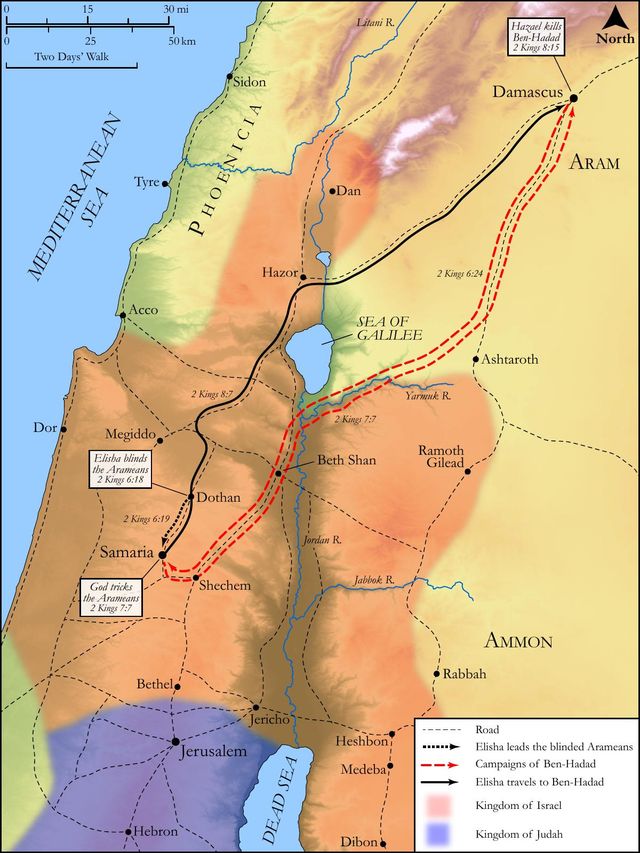
See on the biblical-era map
Study this verse
Public-domain commentary
Matthew Henry
From his Commentary on the Whole Bible. Henry comments on passages, not single verses — this entry covers 2 Kings 6:13–23. His four-level outline is real structure in the source text, so it is rendered as structure.
Here is, 1. The great force which the king of Syria sent to seize Elisha. He found out where he was, at Dothan (Kg2 6:13), which was not far from Samaria; thither he sent a great host, who were to come upon him by night, and to bring him dead or alive, Kg2 6:14. Perhaps he had heard that when only one captain and his fifty men were sent to take Elijah they were baffled in the attempt, and therefore he sent an army against Elisha, as if the fire from heaven that consumed fifty men could not as easily consume 50,000. Naaman could tell him that Elisha dwelt not in any strong-hold, nor was attended with any guards, nor had any such great interest in the people that he needed to fear a tumult among them; what occasion then was there for this great force? But thus he hoped to make sure of him, especially coming upon him by surprise. Foolish man! Did he believe that Elisha had informed the king of Israel of his secret counsels or not? If not, what quarrel had he with him? If he did, could he be so weak as to imagine that Elisha would not discover the designs laid against himself, and that, having interest enough in heaven to discover them, he would not have interest enough to defeat them? Those that fight against God, his people, and prophet, know not what they do.
II.The grievous fright which the prophet's servant was in, when he perceived the city surrounded by the Syrians, and the effectual course which the prophet took to pacify him and free him from his fears. It seems, Elisha accustomed his servant to rise early, that is the way to bring something to pass, and to do the work of a day in its day. Being up, we may suppose he heard the noise of soldiers, and thereupon looked out, and was aware of an army compassing the city (Kg2 6:15), with great assurance no doubt of success, and that they should have this troublesome prophet in their hands presently. Now observe,
1.What a consternation he was in. He ran straight to Elisha, to bring him an account of it: "Alas, master!" (said he) "what shall we do? We are undone, it is to no purpose to think either of fighting or flying, but we must unavoidably fall into their hands." Had he but studied David's Psalms, which were then extant, he might have learnt not to be afraid of 10,000 of people (Psa 3:6), no, not of a host encamped against him, Psa 27:3. Had he considered that he was embarked with his master, by whom God had done great things, and whom he would not now leave to fall into the hands of the uncircumcised, and who, having saved others, would no doubt save himself, he would not have been thus at a loss. If he had only said, What shall I do? it would have been like that of the disciples: Lord, save us, we perish; but he needed not to include his master as being in distress, nor to say, What shall we do?
2.How his master quieted him,
(1.)By word. What he said to him (Kg2 6:16) is spoken to all the faithful servants of God, when without are fightings and within are fears: "Fear not with that fear which has torment and amazement, for those that are with us, to protect us, are more than those that are against us, to destroy us - angels unspeakably more numerous - God infinitely more powerful." When we are magnifying the causes of our fear we ought to possess ourselves with clear, and great, and high thoughts of God and the invisible world. If God be for us, we know what follows, Rom 8:31.
(2.)By vision, Kg2 6:17.
[1.]It seems Elisha was much concerned for the satisfaction of his servant. Good men desire, not only to be easy themselves, but to have those about them easy. Elisha had lately parted with his old man, and this, having newly come into his service, had not the advantage of experience; his master was therefore desirous to give him other convincing evidence of that omnipotence which employed him and was therefore employed for him. Note, Those whose faith is strong ought tenderly to consider and compassionate those who are weak and of a timorous spirit, and to do what they can to strengthen their hands.
[2.]He saw himself safe, and wished no more than that his servant might see what he saw, a guard of angels round about him; such as were his master's convoy to the gates of heaven were his protectors against the gates of hell - chariots of fire, and horses of fire. Fire is both dreadful and devouring; that power which was engaged for Elisha's protection could both terrify and consume the assailants. As angels are God's messengers, so they are his soldiers, his hosts (Gen 32:2), his legions, or regiments, (Mat 26:53), for the good of his people.
[3.]For the satisfaction of his servant there needed no more than the opening of his eyes; that therefore he prayed for, and obtained for him: Lord, open his eyes that he may see. The eyes of his body were open, and with them he saw the danger. "Lord, open the eyes of his faith, that with them he may see the protection we are under." Note, First, The greatest kindness we can do for those that are fearful and faint-hearted is to pray for them, and so to recommend them to the mighty grace of God. Secondly, The opening of our eyes will be the silencing of our fears. In the dark we are most apt to be frightened. The clearer sight we have of the sovereignty and power of heaven the less we shall fear the calamities of this earth.
III.The shameful defeat which Elisha gave to the host of Syrians who came to seize him.
They thought to make a prey of him, but he made fools of them, perfectly played with them, so far was he from fearing them or any damage by them. 1. He prayed to God to smite them with blindness, and they were all struck blind immediately, not stone-blind, nor so as to be themselves aware that they were blind, for they could see the light, but their sight was so altered that they could not know the persons and places they were before acquainted with, Kg2 6:18. They were so confounded that those among them whom they depended upon for information did not know this place to be Dothan nor this person to be Elisha, but groped at noon day as in the night (Isa 59:10; Job 12:24, Job 12:25); their memory failed them, and their distinguishing faculty. See the power of God over the minds and understanding of men, both ways; he enlightened the eyes of Elisha's friend, and darkened the eyes of his foes, that they might see indeed, but not perceive, Isa 6:9 For this twofold judgment Christ came into this world, that those who see not might see, and that those who see might be made blind (Joh 9:39), a savour of life to some, of death to others.
2.When they were thus bewildered and confounded he led them to Samaria (Kg2 6:19), promising that he would show them the man whom they sought, and he did so. He did not lie to them when he told them, This is not the way, nor is this the city where Elisha is; for he had now come out of the city; and if they would see him, they must go to another city to which he would direct them. Those that fight against God and his prophets deceive themselves, and are justly given up to delusions.
3.When he had brought them to Samaria he prayed to God so to open their eyes and restore them their memories that they might see where they were (Kg2 6:20), and behold, to their great terror, they were in the midst of Samaria, where, it is probable, there was a standing force sufficient to cut them all off, or make them prisoners of war. Satan, the god of this world, blinds men's eyes, and so deludes them into their own ruin; but, when God enlightens their eyes, they then see themselves in the midst of their enemies, captives to Satan and in danger of hell, though before they thought their condition good. The enemies of God and his church, when they fancy themselves ready to triumph, will find themselves conquered and triumphed over.
4.When he had them at his mercy he made it appear that he was influenced by a divine goodness as well as a divine power.
(1.)He took care to protect them from the danger into which he had brought them, and was content to show them what he could have done; he needed not the sword of an angel to avenge his cause, the sword of the king of Israel is at his service if he please (Kg2 6:21): My father (so, respectfully does the king now speak to him, though, soon after, he swore his death), shall I smite them? And, again, as if he longed for the assault, Shall I smite them? Perhaps, he remembered how God was displeased at his father for letting go out of his hands those whom he had put it in his power to destroy, and he would not offend in like manner; yet such a reverence has he for the prophet that he will not strike a stroke without his commission. But the prophet would by no means suffer him to meddle with them; they were brought hither to be convinced and shamed, not to be killed, Kg2 6:22. Had they been his prisoners, taken captive by his sword and bow, when they asked quarter it would have been barbarous to deny, and, when he had given it to them, it would have been perfidious to do them any hurt, and against the laws of arms to kill men in cool blood. But they were not his prisoners; they were God's prisoners and the prophet's, and therefore he must do them no harm. Those that humble themselves under God's hand take the best course to secure themselves.
(2.)He took care to provide for them; he ordered the king to treat them handsomely and then dismiss them fairly, which he did, Kg2 6:23.
[1.]It was the king's praise that he was so obsequious to the prophet, contrary to his inclination, and, as it seemed, to his interest, Sa1 24:19. Nay, so willing was he to oblige Elisha that, whereas he was ordered openly to set bread and water before them (which are good fare for captives), he prepared great provision for them, for the credit of his court and country and of Elisha.
[2.]It was the prophet's praise that he was so generous to his enemies, who, though they came to take him, could not but go away admiring him, as both the mightiest and kindest man they ever met with. The great duty of loving enemies, and doing good to those that hate us, was both commanded in the Old Testament (Pro 25:21, Pro 25:22, If thy enemy hunger, feed him, Exo 23:4, Exo 23:5) and practised, as here by Elisha. His predecessor had given a specimen of divine justice when he called for flames of fire on the heads of his persecutors to consume them, but he have a specimen of divine mercy in heaping coals of fire on the heads of his persecutors to melt them. Let not us then be overcome of evil, but overcome evil with good.
IV.The good effect this had, for the present, upon the Syrians.
They came no more into the land of Israel (Kg2 6:23), namely, upon this errand, to take Elisha; they saw it was to no purpose to attempt that, nor would any of their bands be persuaded to make an assault on so great and good a man. The most glorious victory over an enemy is to turn him into a friend.
Historical interpretation
Historical reception
5 surviving comments on this verse. Each one is dated, so this reads as a timeline rather than a list.
Select a marker to jump to its quote. Markers stagger vertically where authors wrote within a few decades of each other.
Elisha prayed before the Lord and said, “strike this people with blindness.” And he struck them with blindness according to the words of Elisha. Ben-hadad, king of the Arameans, sent a large army to surround the city of Dothan and ordered them to arrest Elisha, who lived there at that time. Now his servant saw the army of the Arameans and was horrified. But Elisha opened the eyes of the young man and showed him the ranks of fire that the Lord had erected around him against the Arameans, and his fear disappeared. At the same time [the enemies] were struck in their eyes and did not know the route of their march. They asked Elisha to be their guide; he led them to Samaria, and they were imprisoned inside walls. Then their eyes opened and they realized the danger into which they had voluntarily thrown themselves. But Elisha ordered that nobody should hurt them, and by his command, king Jehoram warmly received them. After offering them a banquet, he sent them back to their land in peace.This is the symbolic meaning [of this passage]: God had predicted through the prophet Isaiah, “The heart of these people was hardened; they have stopped their ears and have shut their eyes, so that they cannot see with their eyes.” The people of Abraham had been blinded by a just sentence of God, because of their perverse will. They asked that the Savior of the world be killed and tried to delete any memory of him completely, but Christ has converted them from their perversity to good behavior. He has delivered his persecutors from their blindness and has given them the bread of heaven. Then he has scattered them through the earth to announce his wonders. Such were those who came back from the mount of Golgotha, beating their own chest. They said to Simon and the other apostles with contrite hearts, “Brothers, what should we do?” And such was Saul, the persecutor of the church whose eyes were open without seeing and whose eyes God wondrously closed but opened again very soon, and to whom he ordered to bring his name before the nations, the kings and the children of Israel.
But, as many delight in warfare, which is the most glorious, to bring a battle to an end by the strength of a great army or by merits before God alone? Elisha rested in one place while the king of Syria waged a great war against the people of our ancestors, and was adding to its terrors by various treacherous plans and was endeavoring to catch them in an ambush. But the prophet found out all their preparations, and being by the grace of God present everywhere in mental vigor, he told the thoughts of their enemies to his countrymen and warned them of what places to beware. And when this was known to the king of Syria, he sent an army and shut in the prophet. Elisha prayed and caused all of them to be struck with blindness and made those who had come to besiege him enter Samaria as captives.
Elsewhere, also, that is, in the books of Kings we read that Elisha was in Samaria, and suddenly an army of Syrians surrounded and set on him. Gehazi saw them and said to his master, “O master, what shall we do?” And Elisha the prophet said, “Do not fear, for there are more with us than with them.” And he prayed that the Lord would open the eyes of Gehazi. And his eyes were opened, and he saw the mountain full of horses and chariots around Elisha. And Elisha prayed that God would strike them with blindness. And they were struck, and they entered into the city whither they were going, seeing not at all. Surely, you soldiers who have been surrounded have heard that where there is perfidy, there is blindness. Rightly, therefore, was the army of the unbeliever blind. But where there is faith, there is an army of angels. Good, then, is faith, which often exercises its power among the dead. Hence our adversary [the devil] and his legions are daily hurled back by the virtue of the martyrs.
If, then, justice is binding, even in war, how much more ought we to observe it in time of peace. Such favor the prophet showed to those who came to seize him. We read that the king of Syria had sent his army to lie in wait for him, for he had learned that it was Elisha who had made known to all his plans and consultations. And Gehazi, the prophet’s servant, seeing the army, began to fear that his life was in danger. But the prophet said to him, “Do not fear, for they who are with us are more than they who are with them.” And when the prophet asked that the eyes of his servant might be opened, they were opened. Then Gehazi saw the whole mountain full of horse and chariots round about Elisha. As they came down to him the prophet says, “Strike, O God, the army of Syria with blindness.” And this prayer being granted, he says to the Syrians, “Follow me, and I will bring you to the man whom you seek.” Then they saw Elisha, whom they were endeavoring to lay hold of, and seeing him they could not hold him fast. It is clear from this that faith and justice should be observed even in war; and that it could not but be a disgraceful thing if faith were violated.
When the king of Syria wanted to capture the holy prophet Elisha and make him subject to his own authority and surrounded him with many divisions of armed men, Elisha was not terrified or distraught, but said to the servant who served as messenger: “Do not be afraid for there are more with us than there are with them.” O the faith of the holy prophet! He does not fear the enemies whom he sees, since he knows that there are angels with him whom he trusts. He does not dread earthly ambushes, because he knows that heavenly auxiliary troops are there for him. “There are more with us,” he says, “than there are with them.” This is an amazing thing. Holiness merits more defenders from heaven than the foes that immorality leads onto the field. “There are more with us than there are with them.” Behold the merit of blessedness! The prophet makes his announcement about the multitude while the servant is still uncertain of his own salvation. How much more do spiritual eyes perceive than those of the flesh! One sees the number of the armed men, while the other perceives the sign of their protection. How great is the divine mercy! A blessing is delivered to people, but it is not seen. They receive help while they are in danger, but they do not know it. For this is the mercy of the Savior, that he intervenes for salvation and in doing so he does not allow himself to be seen. He is sensed by the benefits that he bestows, but not with the eyes.So they are in error who think that when a battle is waged successfully, they have overcome through their own strength. For they should know that adversaries are conquered by merits rather than by strength, and they are overcome not so much by power as by holiness, as holy Elisha was overcoming his enemies by prayer and not by arms. For when he was telling his servant to banish his fear, that those defending them were more than those opposing them, not even then was the servant’s fear able to be dispelled. Then Elisha prayed to the Lord, saying: “Lord, open his eyes so that he can see!” And his eyes were opened and he saw, and there was a whole mountain filled with horsemen.” So the prophet’s prayer opened the servant’s eyes. It is no surprise that a prayer opened his eyes to see an army, since prayer opened heaven so that an army came. It is no surprise, I say, if the God who was promising new auxiliaries implanted new eyes. Or why could he not bring forth an army of seers who furnished an army of angels for battle? Why, I say, could not he, who through his merits penetrated the darkness of the clouds, have wiped away the dullness from the servant’s eyes? Certainly then holy Elisha granted safety by this act to the fearful servant to whom he had restored the brightness of sight.
Continue studying 2 Kings 6:17 across the web’s major study libraries — every link below opens this exact verse, chapter, or book on the destination site.
Read & Compare
 BibleGatewayThis verse in more than 200 translations and 70 languages.
 Bible.comThe YouVersion reader — hundreds of translations, reading plans, and highlights.
 ESV.orgCrossway's official English Standard Version reader.
 NET BibleThe NET translation with 60,000+ translators' notes on every rendering decision.
 STEP BibleTyndale House's free study tool — original text, vocabulary, and scholarly resources.
 BibliaLogos Bible Software's free web reader.
 USCCBThe New American Bible (Revised Edition) with the U.S. bishops' study notes.
Commentaries
 BibleHub CommentariesDozens of classic commentaries on this verse, gathered on one page.
 StudyLightMore than 100 commentary sets — the largest collection on the web.
 BibleRefPlain-English commentary on what this verse means, verse by verse.
 Enduring WordDavid Guzik's free commentary on this chapter, widely used by Bible teachers.
 Bible Study ToolsVerse commentary alongside Greek and Hebrew study aids.
Original Language & Research
- BibleHub InterlinearThe verse word by word — original language, transliteration, and English.
- BibleHub LexiconEvery word's original-language definition and Strong's entry.
 Blue Letter BibleDeep-study tools — Strong's numbers, concordance, and word studies.
 SefariaThe Hebrew text with Rashi and centuries of Jewish commentary.
Sermons, Hymns & Audio


TrulyRandomVerse is not affiliated with these sites and doesn’t control their content. They’re linked because they’re genuinely useful.
Summary
Second Kings 6:17 presents a profound moment of divine revelation where the prophet Elisha, confronted by his terrified servant who is overwhelmed by the surrounding Syrian army, intercedes for the young man's spiritual perception. In immediate response, the LORD supernaturally grants the servant the ability to see beyond the physical realm, revealing a breathtaking sight: the mountain around Elisha was not just encircled by enemy forces, but was also filled with an invisible, heavenly army of horses and chariots of fire, far outnumbering the visible threat and powerfully demonstrating God's sovereign, unseen, and overwhelming protection over His faithful.
Context
ShowHideLiterary Context
This verse serves as the dramatic climax of a narrative in 2 Kings 6 that profoundly illustrates God's protective hand over His prophet and His people. The preceding verses (6:8-14) establish the escalating conflict: the King of Aram repeatedly attempts to ambush Israel, but his plans are consistently foiled by Elisha, who supernaturally discerns and reveals them to the King of Israel. Frustrated and convinced that Elisha is the source of his strategic failures, the Aramean king dispatches a formidable military force, complete with horses and chariots, to Dothan, where Elisha is residing, with the explicit intent to capture him. Upon waking to find the city besieged, Elisha's young servant is overcome with terror, crying out in despair, "Alas, my master! how shall we do?" Elisha's calm and faith-filled assurance in 2 Kings 6:16, "Fear not: for they that be with us are more than they that be with them," directly precedes and sets the stage for the miraculous divine revelation in verse 17, which visually validates Elisha's words and transforms the servant's perspective.
Historical & Cultural Context
The era of Elisha's prophetic ministry was characterized by persistent military and political tensions between the Northern Kingdom of Israel and the powerful Aramean (Syrian) kingdom. Raids, ambushes, and sieges were common occurrences, making the sudden appearance of a large Aramean army a genuinely terrifying and existential threat for any Israelite city. Among the kings of that day, chariots and horses represented the pinnacle of military might, symbolizing speed, power, and overwhelming force. Thus, the encirclement of Dothan by such an army would have appeared insurmountable to the natural eye. Prophets like Elisha were not merely spiritual guides; they often played pivotal roles in national affairs, advising kings and influencing military outcomes, sometimes through extraordinary supernatural interventions. The cultural understanding of divine intervention included a belief in heavenly hosts and angelic armies, though their direct manifestation was rare and universally regarded with awe and reverence, underscoring the extraordinary nature of the event in 2 Kings 6:17.
Key Themes
ShowHide2 Kings 6:17 powerfully encapsulates several enduring themes prevalent throughout the book of 2 Kings and the broader biblical narrative.
Divine Protection and Sovereignty
At its core, the passage asserts God's absolute sovereignty over all earthly powers and His unwavering commitment to protect His faithful servants. Even when human perception is limited to an overwhelming physical threat, God's unseen forces are infinitely greater and actively engaged. This echoes the profound truth found in Psalm 34:7, "The angel of the LORD encampeth round about them that fear him, and delivereth them," illustrating that God's defense is both comprehensive and irresistible.
Spiritual Discernment vs. Physical Sight
The narrative starkly contrasts the servant's limited physical perception, which leads to fear, with Elisha's profound spiritual insight, which produces peace. The servant's terror is born of what he can see with his natural eyes, while Elisha's calm assurance stems from his awareness of a greater, invisible reality. The opening of the servant's eyes is not merely physical but a spiritual awakening, emphasizing the critical importance of faith as the "evidence of things not seen" (Hebrews 11:1) and the need to perceive beyond immediate circumstances.
The Power of Prayer
Elisha's simple, direct, and faith-filled prayer for his servant's eyes to be opened is met with an immediate and dramatic divine response. This highlights God's attentiveness and responsiveness to the prayers of His faithful, demonstrating that prayer is a potent means by which believers can access divine power, receive spiritual revelation, and witness supernatural intervention. It underscores that true security is found not in military might, but in reliance upon God through prayer.
God's Unseen Army and Spiritual Warfare
The vivid imagery of "horses and chariots of fire" serves as a powerful symbol of God's heavenly hosts and His irresistible power in spiritual warfare. This imagery connects to other instances of divine manifestation and power, such as the fiery chariots that took Elijah to heaven and the angelic armies mentioned elsewhere in Scripture. It underscores the profound reality of a spiritual realm where God's forces are actively engaged on behalf of His people, providing a tangible illustration of the unseen battles fought and won by divine power.
Exposition and Analysis
ShowHideKey Word Analysis
ShowHideThe verb פָּקַח (paqaḥ) means "to open," specifically in the context of opening eyes, often implying a transition from a state of blindness or ignorance to one of sight or understanding. In 2 Kings 6:17, Elisha's prayer for the servant's eyes to be "opened" signifies more than mere physical sight; it refers to a spiritual awakening or enlightenment. It is a request for divine intervention to uncloud the servant's spiritual perception, enabling him to perceive a reality that was previously hidden from his natural senses. This emphasizes the granting of spiritual discernment to see the unseen forces at work.
The verb רָאָה (râʼâh) means "to see," "to perceive," or "to understand." Following the divine act of opening his eyes, the servant "saw," indicating a complete and immediate fulfillment of Elisha's prayer. This "seeing" is not merely visual; it encompasses a profound recognition, comprehension, and experiential encounter with the divine presence and power. The stark contrast between his initial limited, fear-inducing sight and his subsequent spiritual vision is central to the verse's powerful impact, highlighting the transformative nature of divine revelation.
The verb מָלֵא (mâlêʼ) means "to fill" or "to be full of," conveying a sense of completeness, abundance, or overwhelming presence. In this verse, the mountain being "full of horses and chariots of fire" emphasizes the sheer, overwhelming number and density of God's heavenly army. It suggests that the divine forces were not merely present, but completely saturated the surrounding landscape, leaving no room for doubt about their supremacy and the comprehensive nature of God's protection. This fullness contrasts sharply with the servant's initial perception of being surrounded only by the enemy.
Verse Breakdown
ShowHide"And Elisha prayed, and said, LORD, I pray thee, open his eyes, that he may see."
This opening clause immediately establishes Elisha's calm and unwavering faith in the face of overwhelming odds. His immediate recourse to prayer underscores his reliance on God, not on human strength or strategy. The prayer itself is specific, compassionate, and deeply insightful, addressing the servant's fear not by removing the physical threat, but by seeking a spiritual remedy: a change in perception. The repetition of the desire for the servant to "see" highlights the critical need for spiritual vision to overcome fear and despair.
"And the LORD opened the eyes of the young man; and he saw:"
This clause powerfully demonstrates God's immediate, direct, and sovereign response to Elisha's prayer. The swiftness of the divine action emphasizes God's attentiveness and omnipotence. The phrase "opened the eyes of the young man" confirms that this was a supernatural act, granting him the ability to perceive a reality previously imperceptible to his natural senses. The simple, declarative "and he saw" signifies the instantaneous and complete fulfillment of the prayer, transforming the servant's fearful outlook into one of awe and understanding.
"and, behold, the mountain [was] full of horses and chariots of fire round about Elisha."
This climactic revelation is the visual, awe-inspiring manifestation of God's protective presence. The mountain, which moments before seemed to hold only the visible enemy, is now revealed to be teeming with an invisible, celestial army. The "horses and chariots of fire" are potent symbols of God's overwhelming power and the countless heavenly hosts at His command, recalling the divine power seen in Elijah's ascension. The phrase "round about Elisha" emphasizes the comprehensive, personal, and complete encirclement of divine protection, far exceeding the visible threat and unequivocally confirming Elisha's earlier assurance in 2 Kings 6:16 that "they that be with us are more than they that be with them."
Literary Devices
ShowHideThe narrative in 2 Kings 6:17 masterfully employs several literary devices to convey its profound theological and spiritual message. Contrast is central to the passage, starkly juxtaposing the servant's initial fear, which stems from his limited perception of visible threats, with Elisha's serene faith, rooted in his awareness of an unseen, greater reality. This highlights the fundamental difference between human, natural perception and a divinely granted, spiritual perspective. Symbolism is profoundly utilized with the "horses and chariots of fire," which are not merely literal military vehicles but powerful representations of God's heavenly hosts, His irresistible power, and His fiery, active presence. This imagery also creates a compelling Allusion to Elijah's dramatic ascension in 2 Kings 2:11, thereby linking Elisha's ministry to that of his predecessor and reinforcing the continuity of divine power and miraculous intervention. The sudden, unexpected revelation of the unseen army generates a moment of powerful Dramatic Irony, as the Syrian army, confident in their visible numerical superiority, is unknowingly surrounded by an infinitely more powerful, invisible force. Finally, the narrative hinges on direct Divine Intervention as the immediate and dramatic answer to Elisha's prayer, underscoring God's active involvement in human affairs and His immediate responsiveness to the faithful cries of His servants.
Theological and Thematic Connections
ShowHideThe profound truth unveiled in 2 Kings 6:17 is that God's reality transcends human perception, and His protective presence often operates in ways unseen by the natural eye. This passage serves as a powerful reminder that the spiritual realm is not only real but often more impactful and decisive than the physical, and that God's resources and power far exceed any earthly threat or challenge. It underscores the concepts of divine omnipresence and omnipotence, assuring believers that they are never truly alone or defenseless when aligned with God's will. The story invites us to cultivate a spiritual vision that looks beyond immediate, visible circumstances to discern God's active hand, even when it is hidden from plain sight. It affirms that God's commitment to His people is absolute, and His heavenly armies are always at the ready, providing a powerful foundation for faith in the face of adversity.
Reflection and Application
ShowHideThe account of Elisha and his servant in 2 Kings 6:17 offers profound encouragement and practical guidance for believers navigating the complexities and challenges of modern life. When we are faced with overwhelming circumstances—be it financial distress, relational conflict, health crises, professional pressures, or spiritual attacks—it is natural to feel fear and despair, much like Elisha's servant. Our natural sight often magnifies the problem, making it seem insurmountable and consuming our perspective. This passage calls us to remember that our human perception is inherently limited, and there is a greater, unseen reality at work, governed by a sovereign God. It challenges us to actively cultivate a spiritual vision, to pray earnestly for our eyes to be opened to God's active presence, His protective power, and His heavenly resources that are always at our disposal. Just as Elisha's servant moved from paralyzing terror to profound awe, we too can find peace, courage, and unwavering hope by trusting in God's unseen hand and His unfailing faithfulness, knowing that "they that be with us are more than they that be with them" (2 Kings 6:16). This spiritual perspective transforms our fear into faith, our despair into hope, and our anxiety into peace, reminding us that God is always at work, often in ways we cannot perceive with our natural senses, orchestrating His perfect plan for our protection and ultimate good.
Questions for Reflection
ShowHideFAQ
ShowHideWhat do the "horses and chariots of fire" represent in this passage?
ShowHideThe "horses and chariots of fire" in 2 Kings 6:17 represent God's heavenly hosts, His angelic armies, and His overwhelming, irresistible power. This imagery is highly symbolic, indicating divine presence and active intervention. It powerfully recalls the fiery chariots that took Elijah to heaven in 2 Kings 2:11, emphasizing that these are not ordinary military units but supernatural forces at God's command. They signify that God's protection is not passive but an active, dynamic, and invincible force, far superior to any earthly army or threat.
Why did Elisha's servant not see the heavenly army initially, and why did Elisha pray for his eyes to be opened?
ShowHideElisha's servant, like all humans, was limited to perceiving the physical realm with his natural eyes. The heavenly army existed within the spiritual realm, which is typically invisible to human sight. Elisha prayed for the servant's eyes to be "opened" because this was not a prayer for physical healing or improved natural vision, but for spiritual discernment—for the servant to be supernaturally granted the ability to perceive the spiritual reality that was already present but hidden. This highlights the crucial distinction between natural sight and supernatural, faith-enabled vision, demonstrating that God can supernaturally reveal unseen truths to His people, transforming their perspective from fear to faith.
How does this story apply to spiritual warfare today?
ShowHideThis story provides a powerful analogy for spiritual warfare in the lives of believers today. Just as Elisha and his servant faced a visible earthly enemy that seemed overwhelming, Christians face unseen spiritual adversaries and forces of darkness (Ephesians 6:12). 2 Kings 6:17 reminds us that while the enemy's forces may seem formidable or overwhelming, God's spiritual army and His protective power are infinitely greater. It encourages us to pray for spiritual discernment to recognize the true nature of our struggles and to see God's active presence and power at work on our behalf, even when it is not immediately apparent. It reinforces the profound truth that "if God be for us, who can be against us?" (Romans 8:31), and that our ultimate victory is secured in Christ, who has already triumphed over all principalities and powers.
Christ-Centered Fulfillment
ShowHideThe dramatic revelation in 2 Kings 6:17 finds its ultimate fulfillment and deepest meaning in the person and work of Jesus Christ. While Elisha's servant needed his eyes supernaturally opened to see God's protective army, Christ Himself is the visible manifestation of God's invisible presence and power, the very "image of the invisible God" (Colossians 1:15). In Jesus, the symbolic "chariots of fire" are no longer merely a distant, unseen army, but the very embodiment of God's triumph over all spiritual forces of darkness. His life, sacrificial death, and glorious resurrection definitively demonstrate God's ultimate victory over sin, death, and the devil, disarming principalities and powers and making a public spectacle of them (Colossians 2:15). Through Christ, believers are not just passively protected by an unseen army; they are actively united with the Victor, sharing in His triumph. He is the one who truly "opens the eyes" of the blind, not just to physical sight, but to spiritual truth, the glory of God, and the reality of His kingdom (John 9:39). The Holy Spirit, sent by Christ, continues this work, guiding believers into all truth and enabling them to discern spiritual realities (John 16:13). Thus, in Christ, the promise of divine protection is perfectly realized, and the call to spiritual vision is fulfilled, as we are empowered to walk by faith, not by sight, knowing that "He who is in you is greater than he who is in the world" (1 John 4:4).