


2 Kings 6:15
Bible text: King James Version (1769 Blayney text) · Public domain
Bible text: King James Version with Strong's numbers · Public domain
Bible text: Berean Standard Bible · Public domain
Bible text: American Standard Version (1901) · Public domain
Bible text: World English Bible, Messianic edition · Public domain
Bible text: Geneva Bible (1599) · Public domain
Bible text: Young's Literal Translation · Public domain
- וַיַּשְׁכֵּםVai·yash·kemand he rose earlyH7925Conj-w ¦ V-Hiphil-ConsecImperf-3msVerb Hiphil Consecutive Imperfect 3rd Singular Masculineוַandיַּשְׁכֵּםhe rose early
- מְשָׁרֵתme·sha·Ret[the] servant ofH8334V-Piel-Prtcpl-msVerb Piel Participle Singular Masculine Construct
- אִישׁ'ish[the] man ofH376N-mscNoun Singular Masculine Construct
- הָאֱלֹהִיםha·'E·lo·Him<the> GodH430Art ¦ N-mpNoun Plural Masculine Absoluteהָ<the>אֱלֹהִיםGod
- לָקוּםla·Kumto ariseH6965Prep-l ¦ V-Qal-InfVerb Qal Infinitive Constructלָtoקוּםarise
- וַיֵּצֵאvai·ye·Tze'and he went outH3318Conj-w ¦ V-Qal-ConsecImperf-3msVerb Qal Consecutive Imperfect 3rd Singular Masculineוַandיֵּצֵאhe went out
- וְהִנֵּהve·hi·nehand there!H2009Conj-w ¦ PrtParticle Interjectionוְandהִנֵּהthere!
- חַיִלCha·yilan armyH2428N-msNoun Singular Masculine Absolute
- סוֹבֵבso·Vev[was] surroundingH5437V-Qal-Prtcpl-msVerb Qal Participle Singular Masculine Absolute
- אֶת'et<obj.>H853DirObjMParticle Object Indicator
- הָעִירha·'Irthe cityH5892Art ¦ N-fsNoun Singular Feminine Absoluteהָtheעִירcity
- וְסוּסve·Susand horse[s]H5483Conj-w ¦ N-msNoun Singular Masculine Absoluteוְandסוּסhorse[s]
- וָרָכֶבva·Ra·khevand chariotryH7393Conj-w ¦ N-msNoun Singular Masculine Absoluteוָandרָכֶבchariotry
- וַיֹּאמֶרvai·Yo·merand he saidH559Conj-w ¦ V-Qal-ConsecImperf-3msVerb Qal Consecutive Imperfect 3rd Singular Masculineוַandיֹּאמֶרhe said
- נַעֲרוֹna·'a·Rohis servantH5288N-msc ¦ 3msNoun Singular Masculine Constructנַעֲרservantוֹhis
- אֵלָיו'e·Lavto himH413Prep ¦ 3msPrepositionאֵלָיtoוhim
- אֲהָהּ'a·Hahalas!H162PrtParticle Interjection
- אֲדֹנִי'a·do·Nimy O lordH113N-msc ¦ 1csNoun Singular Masculine ConstructאֲדֹנִO lordיmy
- אֵיכָה'ei·Khahhow?H349InterrogParticle Interrogative
- נַעֲשֶׂהNa·'a·Sehwill we doH6213V-Qal-Imperf-1cpVerb Qal Imperfect 1st Plural common gender
English is a literal word-by-word gloss of the Hebrew, not the KJV's wording. Why?
This is the original text the KJV's translators worked from — each Hebrew word with its own literal English meaning in this verse, prepared by scholars at Tyndale House, Cambridge. The KJV translates whole sentences, not word by word, so its wording differs: one Hebrew word can become several English words, and the KJV may choose “the LORD” where the gloss reads “Yahweh”. Both are faithful — they answer different questions. For the KJV's own rendering, switch to the KJV text.
Details
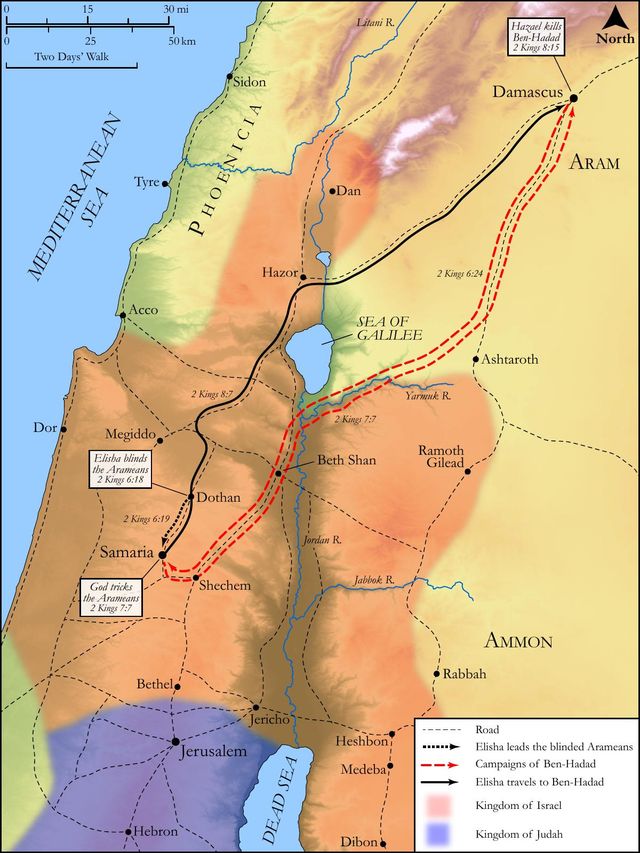
See on the biblical-era map
Study this verse
Public-domain commentary
Matthew Henry
From his Commentary on the Whole Bible. Henry comments on passages, not single verses — this entry covers 2 Kings 6:13–23. His four-level outline is real structure in the source text, so it is rendered as structure.
Here is, 1. The great force which the king of Syria sent to seize Elisha. He found out where he was, at Dothan (Kg2 6:13), which was not far from Samaria; thither he sent a great host, who were to come upon him by night, and to bring him dead or alive, Kg2 6:14. Perhaps he had heard that when only one captain and his fifty men were sent to take Elijah they were baffled in the attempt, and therefore he sent an army against Elisha, as if the fire from heaven that consumed fifty men could not as easily consume 50,000. Naaman could tell him that Elisha dwelt not in any strong-hold, nor was attended with any guards, nor had any such great interest in the people that he needed to fear a tumult among them; what occasion then was there for this great force? But thus he hoped to make sure of him, especially coming upon him by surprise. Foolish man! Did he believe that Elisha had informed the king of Israel of his secret counsels or not? If not, what quarrel had he with him? If he did, could he be so weak as to imagine that Elisha would not discover the designs laid against himself, and that, having interest enough in heaven to discover them, he would not have interest enough to defeat them? Those that fight against God, his people, and prophet, know not what they do.
II.The grievous fright which the prophet's servant was in, when he perceived the city surrounded by the Syrians, and the effectual course which the prophet took to pacify him and free him from his fears. It seems, Elisha accustomed his servant to rise early, that is the way to bring something to pass, and to do the work of a day in its day. Being up, we may suppose he heard the noise of soldiers, and thereupon looked out, and was aware of an army compassing the city (Kg2 6:15), with great assurance no doubt of success, and that they should have this troublesome prophet in their hands presently. Now observe,
1.What a consternation he was in. He ran straight to Elisha, to bring him an account of it: "Alas, master!" (said he) "what shall we do? We are undone, it is to no purpose to think either of fighting or flying, but we must unavoidably fall into their hands." Had he but studied David's Psalms, which were then extant, he might have learnt not to be afraid of 10,000 of people (Psa 3:6), no, not of a host encamped against him, Psa 27:3. Had he considered that he was embarked with his master, by whom God had done great things, and whom he would not now leave to fall into the hands of the uncircumcised, and who, having saved others, would no doubt save himself, he would not have been thus at a loss. If he had only said, What shall I do? it would have been like that of the disciples: Lord, save us, we perish; but he needed not to include his master as being in distress, nor to say, What shall we do?
2.How his master quieted him,
(1.)By word. What he said to him (Kg2 6:16) is spoken to all the faithful servants of God, when without are fightings and within are fears: "Fear not with that fear which has torment and amazement, for those that are with us, to protect us, are more than those that are against us, to destroy us - angels unspeakably more numerous - God infinitely more powerful." When we are magnifying the causes of our fear we ought to possess ourselves with clear, and great, and high thoughts of God and the invisible world. If God be for us, we know what follows, Rom 8:31.
(2.)By vision, Kg2 6:17.
[1.]It seems Elisha was much concerned for the satisfaction of his servant. Good men desire, not only to be easy themselves, but to have those about them easy. Elisha had lately parted with his old man, and this, having newly come into his service, had not the advantage of experience; his master was therefore desirous to give him other convincing evidence of that omnipotence which employed him and was therefore employed for him. Note, Those whose faith is strong ought tenderly to consider and compassionate those who are weak and of a timorous spirit, and to do what they can to strengthen their hands.
[2.]He saw himself safe, and wished no more than that his servant might see what he saw, a guard of angels round about him; such as were his master's convoy to the gates of heaven were his protectors against the gates of hell - chariots of fire, and horses of fire. Fire is both dreadful and devouring; that power which was engaged for Elisha's protection could both terrify and consume the assailants. As angels are God's messengers, so they are his soldiers, his hosts (Gen 32:2), his legions, or regiments, (Mat 26:53), for the good of his people.
[3.]For the satisfaction of his servant there needed no more than the opening of his eyes; that therefore he prayed for, and obtained for him: Lord, open his eyes that he may see. The eyes of his body were open, and with them he saw the danger. "Lord, open the eyes of his faith, that with them he may see the protection we are under." Note, First, The greatest kindness we can do for those that are fearful and faint-hearted is to pray for them, and so to recommend them to the mighty grace of God. Secondly, The opening of our eyes will be the silencing of our fears. In the dark we are most apt to be frightened. The clearer sight we have of the sovereignty and power of heaven the less we shall fear the calamities of this earth.
III.The shameful defeat which Elisha gave to the host of Syrians who came to seize him.
They thought to make a prey of him, but he made fools of them, perfectly played with them, so far was he from fearing them or any damage by them. 1. He prayed to God to smite them with blindness, and they were all struck blind immediately, not stone-blind, nor so as to be themselves aware that they were blind, for they could see the light, but their sight was so altered that they could not know the persons and places they were before acquainted with, Kg2 6:18. They were so confounded that those among them whom they depended upon for information did not know this place to be Dothan nor this person to be Elisha, but groped at noon day as in the night (Isa 59:10; Job 12:24, Job 12:25); their memory failed them, and their distinguishing faculty. See the power of God over the minds and understanding of men, both ways; he enlightened the eyes of Elisha's friend, and darkened the eyes of his foes, that they might see indeed, but not perceive, Isa 6:9 For this twofold judgment Christ came into this world, that those who see not might see, and that those who see might be made blind (Joh 9:39), a savour of life to some, of death to others.
2.When they were thus bewildered and confounded he led them to Samaria (Kg2 6:19), promising that he would show them the man whom they sought, and he did so. He did not lie to them when he told them, This is not the way, nor is this the city where Elisha is; for he had now come out of the city; and if they would see him, they must go to another city to which he would direct them. Those that fight against God and his prophets deceive themselves, and are justly given up to delusions.
3.When he had brought them to Samaria he prayed to God so to open their eyes and restore them their memories that they might see where they were (Kg2 6:20), and behold, to their great terror, they were in the midst of Samaria, where, it is probable, there was a standing force sufficient to cut them all off, or make them prisoners of war. Satan, the god of this world, blinds men's eyes, and so deludes them into their own ruin; but, when God enlightens their eyes, they then see themselves in the midst of their enemies, captives to Satan and in danger of hell, though before they thought their condition good. The enemies of God and his church, when they fancy themselves ready to triumph, will find themselves conquered and triumphed over.
4.When he had them at his mercy he made it appear that he was influenced by a divine goodness as well as a divine power.
(1.)He took care to protect them from the danger into which he had brought them, and was content to show them what he could have done; he needed not the sword of an angel to avenge his cause, the sword of the king of Israel is at his service if he please (Kg2 6:21): My father (so, respectfully does the king now speak to him, though, soon after, he swore his death), shall I smite them? And, again, as if he longed for the assault, Shall I smite them? Perhaps, he remembered how God was displeased at his father for letting go out of his hands those whom he had put it in his power to destroy, and he would not offend in like manner; yet such a reverence has he for the prophet that he will not strike a stroke without his commission. But the prophet would by no means suffer him to meddle with them; they were brought hither to be convinced and shamed, not to be killed, Kg2 6:22. Had they been his prisoners, taken captive by his sword and bow, when they asked quarter it would have been barbarous to deny, and, when he had given it to them, it would have been perfidious to do them any hurt, and against the laws of arms to kill men in cool blood. But they were not his prisoners; they were God's prisoners and the prophet's, and therefore he must do them no harm. Those that humble themselves under God's hand take the best course to secure themselves.
(2.)He took care to provide for them; he ordered the king to treat them handsomely and then dismiss them fairly, which he did, Kg2 6:23.
[1.]It was the king's praise that he was so obsequious to the prophet, contrary to his inclination, and, as it seemed, to his interest, Sa1 24:19. Nay, so willing was he to oblige Elisha that, whereas he was ordered openly to set bread and water before them (which are good fare for captives), he prepared great provision for them, for the credit of his court and country and of Elisha.
[2.]It was the prophet's praise that he was so generous to his enemies, who, though they came to take him, could not but go away admiring him, as both the mightiest and kindest man they ever met with. The great duty of loving enemies, and doing good to those that hate us, was both commanded in the Old Testament (Pro 25:21, Pro 25:22, If thy enemy hunger, feed him, Exo 23:4, Exo 23:5) and practised, as here by Elisha. His predecessor had given a specimen of divine justice when he called for flames of fire on the heads of his persecutors to consume them, but he have a specimen of divine mercy in heaping coals of fire on the heads of his persecutors to melt them. Let not us then be overcome of evil, but overcome evil with good.
IV.The good effect this had, for the present, upon the Syrians.
They came no more into the land of Israel (Kg2 6:23), namely, upon this errand, to take Elisha; they saw it was to no purpose to attempt that, nor would any of their bands be persuaded to make an assault on so great and good a man. The most glorious victory over an enemy is to turn him into a friend.
Continue studying 2 Kings 6:15 across the web’s major study libraries — every link below opens this exact verse, chapter, or book on the destination site.
Read & Compare
 BibleGatewayThis verse in more than 200 translations and 70 languages.
 Bible.comThe YouVersion reader — hundreds of translations, reading plans, and highlights.
 ESV.orgCrossway's official English Standard Version reader.
 NET BibleThe NET translation with 60,000+ translators' notes on every rendering decision.
 STEP BibleTyndale House's free study tool — original text, vocabulary, and scholarly resources.
 BibliaLogos Bible Software's free web reader.
 USCCBThe New American Bible (Revised Edition) with the U.S. bishops' study notes.
Commentaries
 BibleHub CommentariesDozens of classic commentaries on this verse, gathered on one page.
 StudyLightMore than 100 commentary sets — the largest collection on the web.
 BibleRefPlain-English commentary on what this verse means, verse by verse.
 Enduring WordDavid Guzik's free commentary on this chapter, widely used by Bible teachers.
 Bible Study ToolsVerse commentary alongside Greek and Hebrew study aids.
Original Language & Research
- BibleHub InterlinearThe verse word by word — original language, transliteration, and English.
- BibleHub LexiconEvery word's original-language definition and Strong's entry.
 Blue Letter BibleDeep-study tools — Strong's numbers, concordance, and word studies.
 SefariaThe Hebrew text with Rashi and centuries of Jewish commentary.
Sermons, Hymns & Audio


TrulyRandomVerse is not affiliated with these sites and doesn’t control their content. They’re linked because they’re genuinely useful.
Summary
2 Kings 6:15 vividly captures a moment of profound human fear and limited perception in the face of overwhelming physical threat. The scene unfolds early in the morning as Elisha's servant steps outside to discover their city, Dothan, completely encircled by a formidable Syrian army, equipped with a vast array of horses and chariots. This sight immediately plunges the servant into despair, prompting his desperate cry, "Alas, my master! how shall we do?" This exclamation sets the stage for a powerful divine intervention that will reveal a greater, unseen reality at work.
Context
ShowHideLiterary Context
This verse is a pivotal moment within a larger narrative in 2 Kings 6, which highlights Elisha's prophetic ministry and God's miraculous protection of Israel. Prior to this, Elisha has repeatedly thwarted the King of Syria's ambush attempts against Israel by supernaturally revealing the Syrian army's movements to the King of Israel, as detailed in 2 Kings 6:8-12. Frustrated by these repeated failures, the Syrian king learns that Elisha is the source of this intelligence and dispatches a large, elite military force specifically to capture the prophet in Dothan, as recorded in 2 Kings 6:13-14. The servant's fearful reaction in verse 15 serves as a dramatic setup for Elisha's profound demonstration of faith and God's unseen, protective power, which is revealed immediately in the verses that follow, culminating in the miraculous blinding and leading away of the Syrian army in 2 Kings 6:18-20.
Historical & Cultural Context
The period of Elisha's ministry (9th century BCE) was characterized by frequent conflicts between the Northern Kingdom of Israel and its powerful northern neighbor, Aram (Syria). These were often border skirmishes or attempts by Aram to assert dominance. Horses and chariots represented the most advanced and formidable military technology of the armies of that day, symbolizing overwhelming power and speed in warfare. A city being "compassed" or surrounded by such a force implied a siege, a common military tactic designed to cut off supplies and force surrender, often leading to dire consequences for the inhabitants. Dothan itself was a strategically located city, situated on a trade route in the northern part of Israel, making it a logical target for military operations. The servant's reaction is typical of someone facing a seemingly insurmountable military threat in a world where such encounters often meant destruction or enslavement.
Key Themes
ShowHideThe immediate context of 2 Kings 6:15 contributes significantly to several overarching themes within the book of 2 Kings and the broader prophetic narrative. The most prominent theme is the sovereignty and protective power of Yahweh over His people and His prophets, even in the face of superior earthly forces. This verse starkly contrasts human fear and limited perception with divine insight and unlimited power. The servant represents the natural human tendency to react with despair when faced with visible, overwhelming odds, while Elisha, in the subsequent verses, embodies unwavering faith in an unseen spiritual reality. This narrative also underscores the theme of spiritual warfare, where the true battle is often unseen, and God's heavenly hosts are far more numerous and powerful than any earthly army, echoing similar themes found in passages like Psalm 34:7 and Psalm 91:11.
Exposition and Analysis
ShowHideKey Word Analysis
ShowHideThis term, derived from a root meaning "to revolve" or "to be strong," refers to a force, whether of men, means, or other resources, often denoting an army, strength, or might. In this context, it emphasizes the sheer scale, organized nature, and military might of the Syrian forces. It is not merely a few soldiers but a vast, intimidating military presence that has completely surrounded the city, signifying an overwhelming and inescapable threat.
This is a primitive word expressing pain exclamatorily, conveying an utterance of "Oh!" or "Ah!" It is an exclamation of distress, lament, or despair. The servant's cry of "Alas!" conveys a deep sense of hopelessness and utter helplessness. He is not merely surprised; he is profoundly overwhelmed and believes their situation is beyond remedy, expressing a raw, visceral fear.
This primitive root means "to do or make" in the broadest sense and widest application. In the servant's desperate question, "how shall we do?", it signifies his inability to conceive of any action or solution. It is a cry of utter desperation, indicating a complete lack of perceived options or hope in the face of the formidable enemy.
Verse Breakdown
ShowHide"And when the servant of the man of God was risen early, and gone forth"
This clause establishes the setting – early morning – and the initial action of the servant. His "going forth" implies a routine or innocent act, making the discovery that follows all the more shocking and sudden. The title "servant of the man of God" emphasizes his proximity to Elisha and, by extension, to divine power, yet his immediate reaction is purely human.
"behold, an host compassed the city both with horses and chariots"
This is the dramatic revelation. The word "behold" (Hebrew, hinneh) draws immediate attention to the shocking sight. The "host" (army) is described with specific military components – "horses and chariots" – which were the elite, most powerful elements of ancient armies. The phrase "compassed the city" vividly portrays the complete encirclement, signifying that Dothan and its inhabitants, including Elisha and his servant, are trapped and utterly at the mercy of this overwhelming force.
"And his servant said unto him, Alas, my master! how shall we do?"
This final clause captures the servant's immediate, visceral, and human response to the terrifying sight. His address, "my master," signifies his dependence on Elisha, but his subsequent "Alas!" and "how shall we do?" reveal his complete despair and inability to conceive of any solution. He sees only the physical threat and perceives no way out, highlighting the stark contrast with Elisha's spiritual vision.
Literary Devices
ShowHideThe verse employs several potent literary devices to heighten its dramatic impact and convey its theological message. Contrast is immediately evident between the servant's limited, fear-driven perception and Elisha's later, divinely enlightened perspective. The overwhelming physical reality of the Syrian army stands in stark opposition to the unseen spiritual reality that Elisha will soon reveal. Foreshadowing is also present, as the servant's desperate cry sets the stage for Elisha's miraculous intervention, hinting that a solution beyond human capability is imminent. The description of the "host" with "horses and chariots" uses vivid imagery to evoke a sense of overwhelming power and inescapable threat, painting a clear picture of the servant's despair. The servant's rhetorical question, "how shall we do?", functions as a form of lament and hyperbole, emphasizing the perceived impossibility of their situation and underscoring the depth of his fear.
Theological and Thematic Connections
ShowHide2 Kings 6:15 serves as a powerful theological statement about the nature of spiritual reality versus physical appearances. It underscores the truth that God's people often face challenges that seem insurmountable from a purely human perspective, yet there is an unseen, spiritual realm where God's power and protection are actively at work. The servant's fear highlights the human tendency to rely solely on what is visible, leading to despair. However, the narrative implicitly teaches that true security and hope are found not in the absence of danger, but in the presence of God's unseen army, which is far greater than any earthly foe. This passage encourages believers to cultivate spiritual sight, trusting that God's resources and protective hand are always at play, even when circumstances appear dire.
Reflection and Application
ShowHideThe servant's immediate and overwhelming fear in 2 Kings 6:15 resonates deeply with the human experience. We, too, often find ourselves confronted by "hosts" that seem to "compass" our lives – whether they are financial crises, health challenges, relational breakdowns, or societal pressures. Our natural inclination is to panic, to exclaim, "Alas! How shall we do?" This verse serves as a profound mirror, inviting us to examine where our gaze is fixed in moments of crisis. Are we, like the servant, fixated solely on the visible, formidable obstacles, or are we seeking the spiritual perspective that Elisha embodies? The narrative reminds us that our perception of reality is often limited by our physical sight, and true hope and peace are found when we learn to look beyond the immediate circumstances to the unseen, all-powerful hand of God. It challenges us to cultivate a faith that trusts in God's unseen protection and provision, even when all visible evidence suggests otherwise.
Questions for Reflection
ShowHideFAQ
ShowHideWhy was the servant so afraid, given that he was with a powerful prophet like Elisha?
ShowHideThe servant's fear was a natural human reaction to an overwhelming physical threat. Despite being in the presence of Elisha, a man through whom God had performed many miracles, the servant's immediate perception was limited to what his eyes could see: a vast, well-equipped Syrian army completely surrounding their city. This sight alone was enough to induce panic and a sense of hopelessness, as it implied certain capture or death. His fear highlights the contrast between natural human sight and the spiritual insight that Elisha possessed and would soon demonstrate, reminding us that even those close to spiritual leaders can struggle with a limited perspective and need their spiritual eyes opened, as Elisha prayed for his servant in 2 Kings 6:17.
Christ-Centered Fulfillment
ShowHide2 Kings 6:15, with its stark contrast between visible threat and unseen divine protection, finds profound Christ-centered fulfillment. The servant's cry, "Alas, my master! how shall we do?" echoes humanity's desperate plea in the face of overwhelming spiritual foes – sin, death, and the powers of darkness – which are far more formidable than any earthly army. Just as Elisha opened his servant's eyes to see the "horses and chariots of fire" in 2 Kings 6:17, so too does Christ open the eyes of our understanding to perceive the spiritual realities of God's kingdom. He is the ultimate "man of God" who, through His life, death, and resurrection, has decisively defeated the unseen "host" that held humanity captive, triumphing over them by the cross, as declared in Colossians 2:15. In Christ, believers are not left to despair, for "greater is he that is in you, than he that is in the world," a truth proclaimed in 1 John 4:4. He is our ever-present protector, and through faith in Him, we are assured that no weapon formed against us shall prosper, as promised in Isaiah 54:17, for He has overcome the world, as He Himself stated in John 16:33. The spiritual vision granted by Christ reveals that we are surrounded not by defeat, but by the victorious presence of the Lamb of God and His heavenly host.