


2 Chronicles 20:12
Bible text: King James Version (1769 Blayney text) · Public domain
Bible text: King James Version with Strong's numbers · Public domain
Bible text: Berean Standard Bible · Public domain
Bible text: American Standard Version (1901) · Public domain
Bible text: World English Bible, Messianic edition · Public domain
Bible text: Geneva Bible (1599) · Public domain
Bible text: Young's Literal Translation · Public domain
- אֱלֹהֵינוּ'e·lo·Hei·nuour O GodH430N-mpc ¦ 1cpNoun Plural Masculine ConstructאֱלֹהֵיO Godנוּour
- הֲלֹאha·Lo'¿ notH3808Interrog ¦ NegParticle Negativeהֲ¿לֹאnot
- תִשְׁפָּטtish·potwill you enter into judgmentH8199V-Qal-Imperf-2msVerb Qal Imperfect 2nd Singular Masculine
- בָּםBamon themPrep-b ¦ 3mpSuffix Personal 3rd Plural Masculineבָּonםthem
- כִּיkiforH3588PrtParticle Conditional
- אֵין'einthere notH369N-mscNoun Singular Masculine Construct
- בָּנוּba·nuin usPrep-b ¦ 1cpSuffix Personal 1st Plural common genderבָּinנוּus
- כֹּחַKo·ach[is] strengthH3581N-msNoun Singular Masculine Absolute
- לִפְנֵיLif·nei<to> beforeH6440Prep-l ¦ N-mpcNoun Plural Masculine Constructלִ<to>פְנֵיbefore
- הֶהָמוֹןhe·ha·Monthe multitudeH1995Art ¦ N-msNoun Singular Masculine Absoluteהֶtheהָמוֹןmultitude
- הָרָבha·Rav<the> greatH7227Art ¦ Adj-msAdjective Singular Masculine Absoluteהָ<the>רָבgreat
- הַזֶּהha·Zeh<the> thisH2088Art ¦ PrtParticle Demonstrativeהַ<the>זֶּהthis
- הַבָּאha·Ba'which is comingH935Art ¦ V-Qal-Prtcpl-msVerb Qal Participle Singular Masculine Absoluteהַwhichבָּאis coming
- עָלֵינוּ'a·Lei·nuon usH5921Prep ¦ 1cpPrepositionעָלֵיonנוּus
- וַאֲנַחְנוּva·'a·Nach·nuand weH587Conj-w ¦ Pro-1cpPronoun Personal 1st Plural common genderוַandאֲנַחְנוּwe
- לֹאlo'notH3808NegParticle Negative
- נֵדַעne·Da'we knowH3045V-Qal-Imperf-1cpVerb Qal Imperfect 1st Plural common gender
- מַהmahwhat?H4100InterrogPronoun Interrogative
- נַּעֲשֶׂהna·'a·Sehwill we doH6213V-Qal-Imperf-1cpVerb Qal Imperfect 1st Plural common gender
- כִּיkiforH3588PrtParticle Conditional
- עָלֶיךָ'a·Lei·kha[are] on youH5921Prep ¦ 2msPrepositionעָלֶי[are] onךָyou
- עֵינֵינוּ'ei·Nei·nuour eyesH5869N-fdc ¦ 1cpNoun Dual Feminine Constructעֵינֵיeyesנוּour
English is a literal word-by-word gloss of the Hebrew, not the KJV's wording. Why?
This is the original text the KJV's translators worked from — each Hebrew word with its own literal English meaning in this verse, prepared by scholars at Tyndale House, Cambridge. The KJV translates whole sentences, not word by word, so its wording differs: one Hebrew word can become several English words, and the KJV may choose “the LORD” where the gloss reads “Yahweh”. Both are faithful — they answer different questions. For the KJV's own rendering, switch to the KJV text.
Details
See on the biblical-era map
Study this verse
Public-domain commentary
Matthew Henry
From his Commentary on the Whole Bible. Henry comments on passages, not single verses — this entry covers 2 Chronicles 20:1–13. His two-level outline is real structure in the source text, so it is rendered as structure.
We left Jehoshaphat, in the foregoing chapter, well employed in reforming his kingdom and providing for the due administration of justice and support of religion in it, and expected nothing but to hear of the peace and prosperity of his reign; but here we have him in distress, which distress, however, was followed by such a glorious deliverance as was an abundant recompence for his piety. If we meet with trouble in the way of duty, we may believe it is that God may have an opportunity of showing us so much the more of his marvellous loving-kindness. We have here,
I.A formidable invasion of Jehoshaphat's kingdom by the Moabites, and Ammonites, and their auxiliaries, Ch2 20:1.
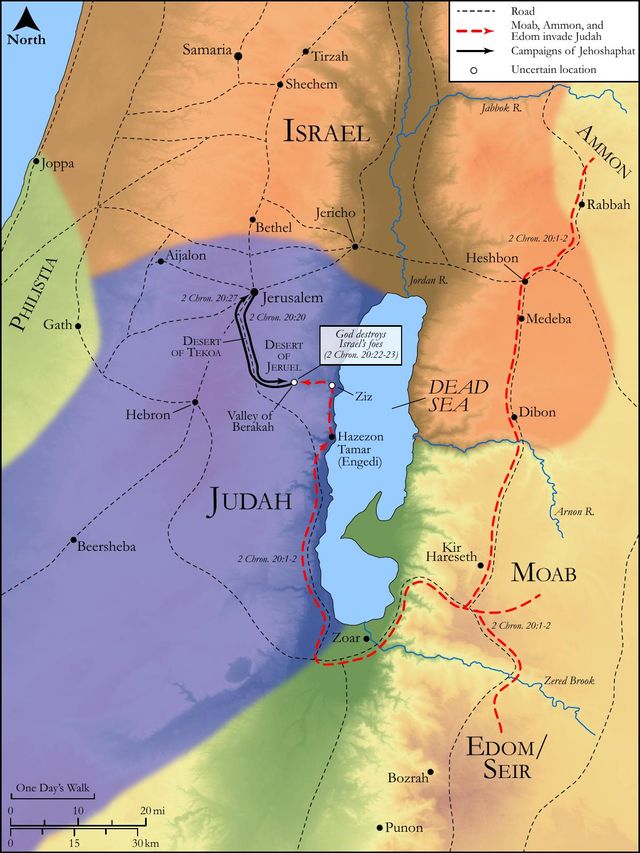
Jehoshaphat was surprised with the intelligence of it when the enemy had already entered his country, Ch2 20:2. What pretence they had to quarrel with Jehoshaphat does not appear; they are said to come from beyond the sea, meaning the Dead Sea, where Sodom had stood. It should seem, they marched through those of the ten tribes that lay beyond Jordan, and they gave them passage through their borders; so ungrateful were they to Jehoshaphat, who had lately put his hand to help them in recovering Ramoth-Gilead. Several nations joined in this confederacy, but especially the children of Lot, whom the rest helped, Psa 83:6-8. The neighbouring nations had feared Jehoshaphat (Ch2 17:10), but perhaps his affinity with Ahab had lessened him in their esteem, and they had some intimation that his God was displeased with him for it, which they fancied would give them an opportunity to make a prey of his kingdom.
II.The preparation Jehoshaphat made against the invaders.
No mention is made of his mustering his forces, which yet it is most probable he did, for God must be trusted in the use of means. But his great care was to obtain the favour of God, and secure him on his side, which perhaps he was the more solicitous about because he had been lately told that there was wrath upon him from before the Lord, Ch2 19:2. But he is of the mind of his father David. If we must be corrected, yet let us not fall into the hands of man.
1.He feared. Consciousness of guilt made him fear. Those that have least sin are the most sensible of it. The surprise added to the fright. Holy fear is a spur to prayer and preparation, Heb 11:7.
2.He set himself to seek the Lord, and, in the first place, to make him his friend. Those that would seek the Lord so as to find him, and to find favour with him, must set themselves to seek him, must do it with fixedness of thought, with sincerity of intention, and with the utmost vigour and resolution to continue seeking him.
3.He proclaimed a fast throughout all Judah, appointed a day of humiliation and prayer, that they might join together in confessing their sins and asking help of the Lord. Fasting from bodily refreshments, upon such extraordinary occasions, is a token of self-judging for the sins we have committed (we own ourselves unworthy of the bread we eat, and that God might justly withhold it from us), and of self-denial for the future; fasting for sin implies a resolution to fast from it, though it has been to us as a sweet morsel. Magistrates are to call their people to the duty of fasting and prayer upon such occasions, that it may be a national act, and so may obtain national mercies.
4.The people readily assembled out of all the cities of Judah in the court of the temple to join in prayer (Ch2 20:4), and they stood before the Lord, as beggars at his door, with their wives and children; they and their families were in danger, and therefore they bring their families with them to seek the Lord. "Lord, we are indeed a provoking people, that deserve to be abandoned to ruin; but here are little ones that are innocent, let not them perish in the storm." Nineveh was spared for the sake of the little ones, Jon 4:11. The place they met in was the house of the Lord, before the new court, which was perhaps lately added to the former courts (that, as some think, which was called the court of the women); thus they came within reach of that gracious promise which God had made, in answer to Solomon's prayer, Ch2 7:15. My ears shall be attentive to the prayer that is made in this place.
5.Jehoshaphat himself was the mouth of the congregation to God, and did not devolve the work upon his chaplains. Though the kings were forbidden to burn incense, they were allowed to pray and preach; as Solomon and Jehoshaphat here. The prayer Jehoshaphat prayed, upon this occasion, is here recorded, or part of it; and an excellent prayer it is. (1.) He acknowledges the sovereign dominion of the divine Providence, gives to God the glory of it and takes to himself the comfort of it (Ch2 20:6): "Art not thou God in heaven? No doubt thou art, which none of the gods of the heathen are; make it to appear then. Is not thy dominion, supreme over kingdoms themselves, and universal, over all kingdoms, even those of the heathen that know thee not? Control these heathen then; set bounds to their daring threatening insults. Is there not in thy hand the power and might which none is able to withstand? Lord, exert it on our behalf. Glorify thy own omnipotence." (2.) He lays hold on their covenant-relation to God and interest in him. "Thou that art God in heaven art the God of our fathers (Ch2 20:6) and our God, Ch2 20:7. Whom should we seek to, whom should we trust to, for relief, but to the God we have chosen and served?" (3.) He shows the title they had to this good land they were now in possession of; an indisputable title it was: "Thou gavest it to the seed of Abraham thy friend. He was thy friend (this is referred to, Jam 2:23, to show the honour of Abraham, that he was called the friend of God); we are his seed, and hope to be beloved for the father's sake," Rom 11:28; Deu 7:8, Deu 7:9. "We hold this land by grant from thee. Lord, maintain thy own grant, and warrant it against all unjust claims. Suffer us not to be cast out of they possession. We are tenants; thou art our landlord; wilt thou not hold thy own?" Ch2 20:11. Those that use what they have for God may comfortably hope that he will secure it to them. (4.) He makes mention of the sanctuary, the temple they had built for God's name (Ch2 20:8), not as if that merited any thing at God's hand, for of his own they gave him, but it was such a token of God's favourable presence with them that they had promised themselves he would hear and help them when, in their distress, they cried to him before that house, Ch2 20:8, Ch2 20:9. "Lord, when it was built it was intended for the encouragement of our faith at such a time as this. Here thy name is; here we are. Lord, help us, for the glory of thy name." (5.) He pleads the ingratitude and injustice of his enemies: "We are such as it will be thy glory to appear for; they are such as it will be thy glory to appear against; for, [1.] They ill requite our ancient kindnesses. Thou wouldst not let Israel invade them, nor give them any disturbance." Deu 2:5, Deu 2:9, Deu 2:19, Meddle not with the Edomites, distress not the Moabites, come not nigh the children of Ammon, no not though they provoke you. "Yet now see how they invade us." We may comfortably appear to God against those that render us evil for good. [2.] "They break in upon our ancient rights. They come to cast us out of our possessions, and seize our land for themselves. O! our God, wilt thou not judge them? Ch2 20:12. Wilt thou not give sentence against them, and execute it upon them?" The justice of God is the refuge of those that are wronged. (6.) He professes his entire dependence upon God for deliverance. Though he had a great army on foot, and well disciplined; yet he said, "We have no might against this great company, none without thee, none that we can expect any thing from without thy special presence and blessing, none to boast of, none to trust to; but our eyes are upon thee. We rely upon thee, and from thee is all our expectation. The disease seems desperate: we know not what to do, are quite at a loss, in a great strait. But this is a sovereign remedy, our eyes are upon thee, an eye of acknowledgment and humble submission, an eye of faith and entire dependence, an eye of desire and hearty prayer, an eye of hope and patient expectation. In thee, O God! do we put our trust; our souls wait on thee."
Continue studying 2 Chronicles 20:12 across the web’s major study libraries — every link below opens this exact verse, chapter, or book on the destination site.
Read & Compare
 BibleGatewayThis verse in more than 200 translations and 70 languages.
 Bible.comThe YouVersion reader — hundreds of translations, reading plans, and highlights.
 ESV.orgCrossway's official English Standard Version reader.
 NET BibleThe NET translation with 60,000+ translators' notes on every rendering decision.
 STEP BibleTyndale House's free study tool — original text, vocabulary, and scholarly resources.
 BibliaLogos Bible Software's free web reader.
 USCCBThe New American Bible (Revised Edition) with the U.S. bishops' study notes.
Commentaries
 BibleHub CommentariesDozens of classic commentaries on this verse, gathered on one page.
 StudyLightMore than 100 commentary sets — the largest collection on the web.
 BibleRefPlain-English commentary on what this verse means, verse by verse.
 Enduring WordDavid Guzik's free commentary on this chapter, widely used by Bible teachers.
 Bible Study ToolsVerse commentary alongside Greek and Hebrew study aids.
Original Language & Research
- BibleHub InterlinearThe verse word by word — original language, transliteration, and English.
- BibleHub LexiconEvery word's original-language definition and Strong's entry.
 Blue Letter BibleDeep-study tools — Strong's numbers, concordance, and word studies.
 SefariaThe Hebrew text with Rashi and centuries of Jewish commentary.
Sermons, Hymns & Audio


TrulyRandomVerse is not affiliated with these sites and doesn’t control their content. They’re linked because they’re genuinely useful.
Summary
2 Chronicles 20:12 captures King Jehoshaphat's profound prayer of utter desperation and absolute dependence during a national crisis. Faced with an overwhelmingly superior invading force, the king humbly confesses Judah's complete lack of human strength, strategy, and solutions. This culminates in a powerful declaration of unwavering trust and expectant focus on God as their sole source of deliverance and wisdom, establishing a timeless paradigm for seeking divine intervention when human resources are exhausted.
Context
ShowHideLiterary Context
This potent verse serves as the climactic confession within King Jehoshaphat's comprehensive prayer, recorded in 2 Chronicles 20:5-12. The prayer itself is Jehoshaphat's immediate and Spirit-led response to the alarming news of a vast coalition of Moabites, Ammonites, and Meunites (from Mount Seir) marching against Judah, as detailed in 2 Chronicles 20:1-2. Instead of resorting to conventional military mobilization or political maneuvering, Jehoshaphat immediately proclaimed a national fast, gathering the people from all the cities of Judah in the new court of the temple in Jerusalem (2 Chronicles 20:3-4). His prayer begins with a robust affirmation of God's sovereignty, historical faithfulness, and covenant promises to Abraham and Solomon concerning the temple as a designated place of prayer in times of distress (2 Chronicles 20:6-9). The prayer then transitions from theological grounding to a stark, honest confession of Judah's dire, humanly impossible situation, culminating in the complete surrender and trust expressed in this pivotal verse. This profound act of faith sets the stage for God's miraculous intervention and the subsequent, bloodless victory described in 2 Chronicles 20:14-30.
Historical & Cultural Context
The events of 2 Chronicles 20 transpire during the reign of Jehoshaphat (c. 870-848 BC), a generally righteous king of Judah who, despite some missteps (like his alliance with Ahab), largely walked in the ways of his father David. The invasion by the Moabites, Ammonites, and Meunites represented a significant existential threat to the kingdom of Judah. These nations, primarily from the Transjordan region, were traditional adversaries, and their combined forces would have vastly outnumbered Judah's military, promising a swift and brutal conquest by the standards of the warfare of that day. The cultural and religious response of proclaiming a national fast and gathering at the temple was deeply ingrained in Israelite tradition, reflecting a communal act of repentance, humility, and desperate appeal to Yahweh, the covenant God of Israel, in times of national calamity. This practice underscored the profound belief that divine intervention was the ultimate and often only recourse when human strength, strategy, and resources proved utterly insufficient. It was a demonstration of national humility before God.
Key Themes
ShowHideThis verse profoundly contributes to several overarching themes within 2 Chronicles and the broader biblical narrative. Firstly, it highlights the theme of confession of human helplessness, demonstrating that true, radical dependence on God begins with a humble, unvarnished acknowledgment of one's own limitations and inadequacy in the face of overwhelming odds. Jehoshaphat's candid admission, "we have no might against this great company that cometh against us; neither know we what to do," is presented as a necessary prerequisite for experiencing divine power. Secondly, it powerfully illustrates the theme of absolute dependence and unwavering trust in God. The pivotal phrase, "but our eyes [are] upon thee," signifies a complete turning from human solutions to divine intervention, embodying a posture of expectant faith that God alone can provide the necessary guidance and deliverance. This trust is not passive resignation but an active, hopeful looking to God. Thirdly, the entire narrative underscores the primacy of prayer as the first and ultimate resort in times of overwhelming crisis, particularly corporate prayer. Jehoshaphat's example encourages believers to make God their immediate and ultimate source of help, rather than a last resort, demonstrating that God often waits for His people to acknowledge their need before He acts. Finally, the opening plea, "O our God, wilt thou not judge them?", reflects an appeal to divine justice and God's covenant faithfulness, reminding God of His righteous character and His commitment to His people against unjust aggressors, a theme prevalent throughout the Psalms (e.g., Psalm 7:8) and prophetic literature.
Exposition and Analysis
ShowHideKey Word Analysis
ShowHideMeaning "vigor, force, capacity, means, produce; ability, power, strength, substance, wealth." In this context, "no might" (literally, "there is no strength in us") conveys an absolute and total lack of physical, military, or strategic power. It is not merely a statement of weakness but of utter incapacity to confront the enemy. This confession of complete human impotence is crucial, as it creates the vacuum into which God's omnipotence can flow, signifying the end of self-reliance and the beginning of true dependence.
Meaning "a noise, tumult, crowd; abundance, many, multitude, multiply, noise, riches, rumbling, sounding, store, tumult." The term "great company" emphasizes the overwhelming numerical superiority and the sheer, chaotic force of the invading coalition. It highlights the vastness of the threat, underscoring the human impossibility of the situation and amplifying the need for a supernatural intervention.
Meaning "an eye (literally or figuratively); by analogy, a fountain; affliction, outward appearance, countenance, sight." The idiomatic expression "our eyes [are] upon thee" is far more profound than a simple physical gaze. It denotes an intense, hopeful, and expectant focus, a complete reliance, and a looking to God as the sole source of help, wisdom, and deliverance. It implies an attitude of humble submission, confident anticipation, and unwavering trust that God will act. It is a declaration of faith that, despite the overwhelming circumstances, the only viable solution lies with the Almighty.
Verse Breakdown
ShowHide"O our God, wilt thou not judge them?"
This opening clause is a direct, impassioned appeal to God's character as a righteous and just judge. It functions as a rhetorical question, expressing both a fervent plea for divine intervention and an implicit affirmation of God's justice and His covenant commitment to defend His people against unprovoked aggression. It sets the tone for a prayer rooted in a deep theological understanding of God's nature.
"for we have no might against this great company that cometh against us;"
This is the first part of Judah's confession of utter helplessness. It's a stark, realistic, and unvarnished assessment of their military inferiority. The description of the enemy as a "great company" emphasizes the overwhelming numerical and strategic disadvantage, highlighting the human impossibility of the situation. This admission of complete inadequacy is vital for acknowledging God as the only possible solution.
"neither know we what to do:"
This second part of the confession extends the helplessness from physical might to intellectual and strategic wisdom. It's an admission of complete bewilderment, lack of direction, and absence of any viable human plan or strategy to resolve the crisis. This deepens the sense of utter dependence, as it indicates a void in both strength and wisdom, leaving no room for self-reliance.
"but our eyes [are] upon thee."
This is the climactic declaration of the verse and the entire prayer. The conjunction "but" creates a powerful contrast, pivoting abruptly from utter despair and human incapacity to absolute hope and divine focus. Despite all their weakness, ignorance, and fear, their gaze, their hope, their trust, and their entire being are fixed on God alone. It is a statement of defiant faith in the face of impossible odds, a posture of expectant waiting for divine intervention, and a profound act of spiritual surrender.
Literary Devices
ShowHide2 Chronicles 20:12 is rich in literary devices that amplify its theological message and emotional impact. The opening, "Rhetorical Question" ("O our God, wilt thou not judge them?"), serves to emphasize God's just character and implicitly remind Him of His covenant obligations, while simultaneously expressing a fervent plea for intervention. There is a strong use of "Confession" and "Lament," as Jehoshaphat articulates Judah's dire situation and their complete lack of resources, expressing genuine distress and vulnerability. The verse employs powerful "Contrast" between human weakness and divine omnipotence: "we have no might... neither know we what to do: but our eyes [are] upon thee." This sharp juxtaposition highlights the absolute chasm between human capability and God's boundless power, making God's subsequent intervention all the more miraculous. The phrase "our eyes [are] upon thee" functions as a potent "Metaphor" or "Idiom," representing not just physical sight but profound spiritual focus, trust, and expectant reliance. It is a concise yet powerful image of complete surrender and hopeful anticipation. Finally, the description of the enemy as "this great company" could be seen as a form of "Hyperbole," underscoring the overwhelming nature of the threat and further emphasizing the human impossibility of the situation, thereby magnifying the need for divine intervention.
Theological and Thematic Connections
ShowHide2 Chronicles 20:12 stands as a profound testament to the biblical principle that human weakness is the fertile ground for divine strength. It encapsulates the essence of true faith, which is not self-reliance but radical God-reliance. This verse teaches that acknowledging our limitations and turning our gaze fully to God is the pathway to experiencing His miraculous power and wisdom. It underscores God's sovereignty over all nations and His unwavering faithfulness to His covenant people, even when they face seemingly insurmountable odds. The narrative following this prayer vividly demonstrates that God honors such faith, providing deliverance not through human might or strategic brilliance, but through His own supernatural intervention, reinforcing the timeless truth that the battle belongs to the Lord.
Reflection and Application
ShowHideFor believers today, 2 Chronicles 20:12 offers an enduring blueprint for navigating personal, communal, and even global crises. When we encounter circumstances where our strength, intellect, or resources are utterly insufficient – be it a financial collapse, a health crisis, a relational breakdown, a spiritual battle, or a societal upheaval – this verse calls us to a posture of humble admission and absolute dependence. It challenges us to resist the urge to panic, resort to self-sufficiency, or seek human solutions as a first resort. Instead, like Jehoshaphat, we are invited to confess our helplessness honestly, to prioritize fervent prayer, and, most importantly, to fix our gaze expectantly upon God. This means cultivating a heart of unwavering trust, believing that God is able to provide wisdom, strength, and deliverance far beyond our comprehension or natural ability. It is in this place of acknowledged weakness and focused faith that God's power is most perfectly displayed, transforming impossible situations into profound testimonies of His faithfulness and sovereignty.
Questions for Reflection
ShowHideFAQ
ShowHideWhy did Jehoshaphat pray this way instead of mobilizing his army or seeking alliances?
ShowHideJehoshaphat's prayer in 2 Chronicles 20:12 demonstrates a profound theological understanding and spiritual maturity. While he did possess a formidable army (as seen in 2 Chronicles 17:12-19), he recognized that the sheer scale of the invading forces made a conventional military response futile. His immediate proclamation of a national fast and gathering at the temple (as described in 2 Chronicles 20:3-4) was a deliberate act of faith, acknowledging God's sovereignty and seeking His intervention as the ultimate solution. This approach was deeply rooted in Israel's covenant relationship with God, where in times of national crisis, the people were to turn to Yahweh for deliverance, rather than relying on human strength or foreign alliances. Jehoshaphat's actions exemplify the principle that when human resources are exhausted, divine power is the only hope, and it is accessed through humble, desperate prayer.
What does "our eyes are upon thee" truly mean for us today?
ShowHideThe phrase "our eyes are upon thee" (from 2 Chronicles 20:12) is a powerful declaration of absolute dependence and expectant trust in God. For us today, it means consciously shifting our focus from our problems, our limitations, or potential human solutions, and fixing it entirely on God. It implies:
Christ-Centered Fulfillment
ShowHide2 Chronicles 20:12, with its raw confession of human helplessness and its unwavering gaze upon God for deliverance, finds its ultimate and most profound fulfillment in the person and work of Jesus Christ. Jehoshaphat's "eyes upon thee" perfectly foreshadows the believer's complete reliance on Christ as the sole source of salvation, wisdom, and strength. In our greatest "company" of enemies—sin, death, and the power of darkness—humanity truly has "no might" and "knows not what to do." It is precisely in this state of utter spiritual destitution that the Lamb of God steps in, becoming our judge and our deliverer, taking upon Himself the just judgment we deserve. Jesus, who is God incarnate, is the one upon whom we fix our eyes, not merely for physical deliverance from earthly foes, but for eternal salvation and spiritual victory over all the powers of evil. As Hebrews 12:2 exhorts us to "look unto Jesus, the author and finisher of our faith," He is the ultimate answer to our helplessness, the divine wisdom when we "know not what to do," and the perfect fulfillment of Jehoshaphat's desperate, faithful cry. Through His crucifixion and glorious resurrection, Christ has decisively conquered the "great company" of our spiritual adversaries, ensuring that in Him, the battle is truly the Lord's, and our victory is secured by His finished work (Colossians 2:15). He is our mighty God, our wise counselor, and the one upon whom our eternal gaze is fixed.