


2 Chronicles 20:6
Bible text: King James Version (1769 Blayney text) · Public domain
Bible text: King James Version with Strong's numbers · Public domain
Bible text: Berean Standard Bible · Public domain
Bible text: American Standard Version (1901) · Public domain
Bible text: World English Bible, Messianic edition · Public domain
Bible text: Geneva Bible (1599) · Public domain
Bible text: Young's Literal Translation · Public domain
- וַיֹּאמַרvai·yo·Marand he saidH559Conj-w ¦ V-Qal-ConsecImperf-3msVerb Qal Consecutive Imperfect 3rd Singular Masculineוַandיֹּאמַרhe said
- יְהוָהYah·wehO YahwehH3068N-properNoun Proper Title
- אֱלֹהֵי'e·lo·Hei[the] God ofH430N-mpcNoun Plural Masculine Construct
- אֲבֹתֵינוּ'a·vo·Tei·nuour ancestorsH1N-fpc ¦ 1cpNoun Plural Feminine Constructאֲבֹתֵיancestorsנוּour
- הֲלֹאha·Lo'¿ notH3808Interrog ¦ NegParticle Negativeהֲ¿לֹאnot
- אַתָּה'a·tah[are] youH859Pro-2msPronoun Personal 2nd Singular Masculine
- הוּאhu'heH1931Pro-3msPronoun Personal 3rd Singular Masculine
- אֱלֹהִים'E·lo·HimGodH430N-mpNoun Plural Masculine Absolute
- בַּשָּׁמַיִםba·sha·Ma·yimin the heavensH8064Prep-b ¦ N-mpNoun Plural Masculine Absoluteבַּin theשָּׁמַיִםheavens
- וְאַתָּהve·'a·Tahand youH859Conj-w ¦ Pro-2msPronoun Personal 2nd Singular Masculineוְandאַתָּהyou
- מוֹשֵׁלmo·Shel[are] rulerH4910V-Qal-Prtcpl-msVerb Qal Participle Singular Masculine Absolute
- בְּכֹלbe·Kholover allH3605Prep-b ¦ N-mscNoun Singular Masculine Constructבְּoverכֹלall
- מַמְלְכוֹתmam·le·Khot[the] kingdoms ofH4467N-fpcNoun Plural Feminine Construct
- הַגּוֹיִםha·go·Yimthe nationsH1471Art ¦ N-mpNoun Plural Masculine Absoluteהַtheגּוֹיִםnations
- וּבְיָדְךָu·ve·ya·de·Khaand [are] in your handH3027Conj-w ¦ Prep-b ¦ N-csc ¦ 2msNoun Singular common gender Constructוּandבְ[are] inיָדְhandךָyour
- כֹּחַKo·achpowerH3581N-msNoun Singular Masculine Absolute
- וּגְבוּרָהu·ge·vu·Rahand strengthH1369Conj-w ¦ N-fsNoun Singular Feminine Absoluteוּandגְבוּרָהstrength
- וְאֵיןve·'Einand there notH369Conj-w ¦ N-mscNoun Singular Masculine Constructוְandאֵיןthere not
- עִמְּךָ'i·me·Kha[is] with youH5973Prep ¦ 2msPrepositionעִמְּ[is] withךָyou
- לְהִתְיַצֵּבle·hit·ya·Tzevto hold groundH3320Prep-l ¦ V-Hithpael-InfVerb Hithpael Infinitive Constructלְtoהִתְיַצֵּבhold ground
English is a literal word-by-word gloss of the Hebrew, not the KJV's wording. Why?
This is the original text the KJV's translators worked from — each Hebrew word with its own literal English meaning in this verse, prepared by scholars at Tyndale House, Cambridge. The KJV translates whole sentences, not word by word, so its wording differs: one Hebrew word can become several English words, and the KJV may choose “the LORD” where the gloss reads “Yahweh”. Both are faithful — they answer different questions. For the KJV's own rendering, switch to the KJV text.
Details
See on the biblical-era map
Study this verse
Public-domain commentary
Matthew Henry
From his Commentary on the Whole Bible. Henry comments on passages, not single verses — this entry covers 2 Chronicles 20:1–13. His two-level outline is real structure in the source text, so it is rendered as structure.
We left Jehoshaphat, in the foregoing chapter, well employed in reforming his kingdom and providing for the due administration of justice and support of religion in it, and expected nothing but to hear of the peace and prosperity of his reign; but here we have him in distress, which distress, however, was followed by such a glorious deliverance as was an abundant recompence for his piety. If we meet with trouble in the way of duty, we may believe it is that God may have an opportunity of showing us so much the more of his marvellous loving-kindness. We have here,
I.A formidable invasion of Jehoshaphat's kingdom by the Moabites, and Ammonites, and their auxiliaries, Ch2 20:1.
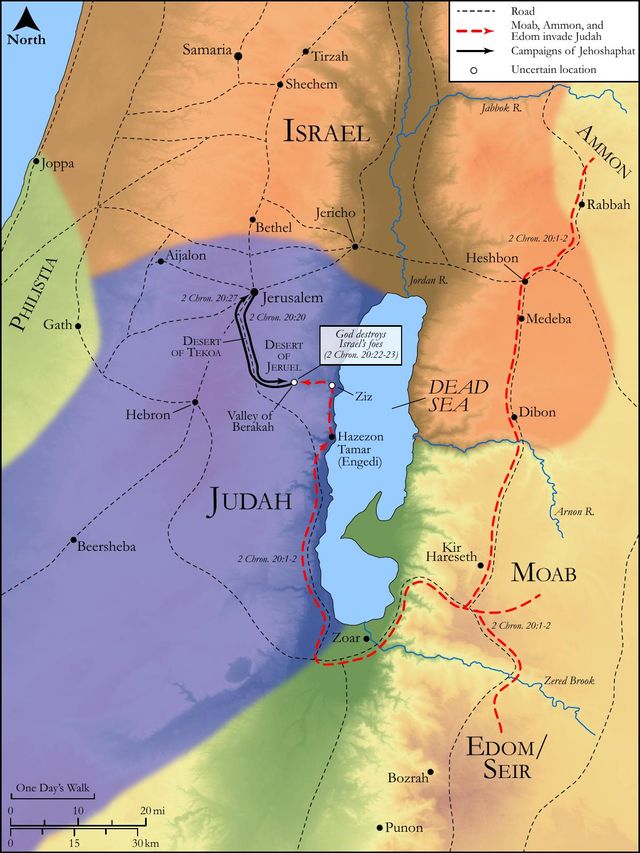
Jehoshaphat was surprised with the intelligence of it when the enemy had already entered his country, Ch2 20:2. What pretence they had to quarrel with Jehoshaphat does not appear; they are said to come from beyond the sea, meaning the Dead Sea, where Sodom had stood. It should seem, they marched through those of the ten tribes that lay beyond Jordan, and they gave them passage through their borders; so ungrateful were they to Jehoshaphat, who had lately put his hand to help them in recovering Ramoth-Gilead. Several nations joined in this confederacy, but especially the children of Lot, whom the rest helped, Psa 83:6-8. The neighbouring nations had feared Jehoshaphat (Ch2 17:10), but perhaps his affinity with Ahab had lessened him in their esteem, and they had some intimation that his God was displeased with him for it, which they fancied would give them an opportunity to make a prey of his kingdom.
II.The preparation Jehoshaphat made against the invaders.
No mention is made of his mustering his forces, which yet it is most probable he did, for God must be trusted in the use of means. But his great care was to obtain the favour of God, and secure him on his side, which perhaps he was the more solicitous about because he had been lately told that there was wrath upon him from before the Lord, Ch2 19:2. But he is of the mind of his father David. If we must be corrected, yet let us not fall into the hands of man.
1.He feared. Consciousness of guilt made him fear. Those that have least sin are the most sensible of it. The surprise added to the fright. Holy fear is a spur to prayer and preparation, Heb 11:7.
2.He set himself to seek the Lord, and, in the first place, to make him his friend. Those that would seek the Lord so as to find him, and to find favour with him, must set themselves to seek him, must do it with fixedness of thought, with sincerity of intention, and with the utmost vigour and resolution to continue seeking him.
3.He proclaimed a fast throughout all Judah, appointed a day of humiliation and prayer, that they might join together in confessing their sins and asking help of the Lord. Fasting from bodily refreshments, upon such extraordinary occasions, is a token of self-judging for the sins we have committed (we own ourselves unworthy of the bread we eat, and that God might justly withhold it from us), and of self-denial for the future; fasting for sin implies a resolution to fast from it, though it has been to us as a sweet morsel. Magistrates are to call their people to the duty of fasting and prayer upon such occasions, that it may be a national act, and so may obtain national mercies.
4.The people readily assembled out of all the cities of Judah in the court of the temple to join in prayer (Ch2 20:4), and they stood before the Lord, as beggars at his door, with their wives and children; they and their families were in danger, and therefore they bring their families with them to seek the Lord. "Lord, we are indeed a provoking people, that deserve to be abandoned to ruin; but here are little ones that are innocent, let not them perish in the storm." Nineveh was spared for the sake of the little ones, Jon 4:11. The place they met in was the house of the Lord, before the new court, which was perhaps lately added to the former courts (that, as some think, which was called the court of the women); thus they came within reach of that gracious promise which God had made, in answer to Solomon's prayer, Ch2 7:15. My ears shall be attentive to the prayer that is made in this place.
5.Jehoshaphat himself was the mouth of the congregation to God, and did not devolve the work upon his chaplains. Though the kings were forbidden to burn incense, they were allowed to pray and preach; as Solomon and Jehoshaphat here. The prayer Jehoshaphat prayed, upon this occasion, is here recorded, or part of it; and an excellent prayer it is. (1.) He acknowledges the sovereign dominion of the divine Providence, gives to God the glory of it and takes to himself the comfort of it (Ch2 20:6): "Art not thou God in heaven? No doubt thou art, which none of the gods of the heathen are; make it to appear then. Is not thy dominion, supreme over kingdoms themselves, and universal, over all kingdoms, even those of the heathen that know thee not? Control these heathen then; set bounds to their daring threatening insults. Is there not in thy hand the power and might which none is able to withstand? Lord, exert it on our behalf. Glorify thy own omnipotence." (2.) He lays hold on their covenant-relation to God and interest in him. "Thou that art God in heaven art the God of our fathers (Ch2 20:6) and our God, Ch2 20:7. Whom should we seek to, whom should we trust to, for relief, but to the God we have chosen and served?" (3.) He shows the title they had to this good land they were now in possession of; an indisputable title it was: "Thou gavest it to the seed of Abraham thy friend. He was thy friend (this is referred to, Jam 2:23, to show the honour of Abraham, that he was called the friend of God); we are his seed, and hope to be beloved for the father's sake," Rom 11:28; Deu 7:8, Deu 7:9. "We hold this land by grant from thee. Lord, maintain thy own grant, and warrant it against all unjust claims. Suffer us not to be cast out of they possession. We are tenants; thou art our landlord; wilt thou not hold thy own?" Ch2 20:11. Those that use what they have for God may comfortably hope that he will secure it to them. (4.) He makes mention of the sanctuary, the temple they had built for God's name (Ch2 20:8), not as if that merited any thing at God's hand, for of his own they gave him, but it was such a token of God's favourable presence with them that they had promised themselves he would hear and help them when, in their distress, they cried to him before that house, Ch2 20:8, Ch2 20:9. "Lord, when it was built it was intended for the encouragement of our faith at such a time as this. Here thy name is; here we are. Lord, help us, for the glory of thy name." (5.) He pleads the ingratitude and injustice of his enemies: "We are such as it will be thy glory to appear for; they are such as it will be thy glory to appear against; for, [1.] They ill requite our ancient kindnesses. Thou wouldst not let Israel invade them, nor give them any disturbance." Deu 2:5, Deu 2:9, Deu 2:19, Meddle not with the Edomites, distress not the Moabites, come not nigh the children of Ammon, no not though they provoke you. "Yet now see how they invade us." We may comfortably appear to God against those that render us evil for good. [2.] "They break in upon our ancient rights. They come to cast us out of our possessions, and seize our land for themselves. O! our God, wilt thou not judge them? Ch2 20:12. Wilt thou not give sentence against them, and execute it upon them?" The justice of God is the refuge of those that are wronged. (6.) He professes his entire dependence upon God for deliverance. Though he had a great army on foot, and well disciplined; yet he said, "We have no might against this great company, none without thee, none that we can expect any thing from without thy special presence and blessing, none to boast of, none to trust to; but our eyes are upon thee. We rely upon thee, and from thee is all our expectation. The disease seems desperate: we know not what to do, are quite at a loss, in a great strait. But this is a sovereign remedy, our eyes are upon thee, an eye of acknowledgment and humble submission, an eye of faith and entire dependence, an eye of desire and hearty prayer, an eye of hope and patient expectation. In thee, O God! do we put our trust; our souls wait on thee."
Continue studying 2 Chronicles 20:6 across the web’s major study libraries — every link below opens this exact verse, chapter, or book on the destination site.
Read & Compare
 BibleGatewayThis verse in more than 200 translations and 70 languages.
 Bible.comThe YouVersion reader — hundreds of translations, reading plans, and highlights.
 ESV.orgCrossway's official English Standard Version reader.
 NET BibleThe NET translation with 60,000+ translators' notes on every rendering decision.
 STEP BibleTyndale House's free study tool — original text, vocabulary, and scholarly resources.
 BibliaLogos Bible Software's free web reader.
 USCCBThe New American Bible (Revised Edition) with the U.S. bishops' study notes.
Commentaries
 BibleHub CommentariesDozens of classic commentaries on this verse, gathered on one page.
 StudyLightMore than 100 commentary sets — the largest collection on the web.
 BibleRefPlain-English commentary on what this verse means, verse by verse.
 Enduring WordDavid Guzik's free commentary on this chapter, widely used by Bible teachers.
 Bible Study ToolsVerse commentary alongside Greek and Hebrew study aids.
Original Language & Research
- BibleHub InterlinearThe verse word by word — original language, transliteration, and English.
- BibleHub LexiconEvery word's original-language definition and Strong's entry.
 Blue Letter BibleDeep-study tools — Strong's numbers, concordance, and word studies.
 SefariaThe Hebrew text with Rashi and centuries of Jewish commentary.
Sermons, Hymns & Audio


TrulyRandomVerse is not affiliated with these sites and doesn’t control their content. They’re linked because they’re genuinely useful.
Summary
2 Chronicles 20:6 encapsulates the profound theological bedrock of King Jehoshaphat's desperate yet confident prayer, serving as a foundational declaration of God's absolute sovereignty and irresistible power. Faced with an overwhelming military coalition, Jehoshaphat appeals to the Lord by affirming His unique status as the transcendent God who rules from heaven, His universal dominion over all earthly kingdoms, and His inherent might that no force, human or spiritual, is able to withstand. This verse functions as a potent theological anchor, grounding human crisis in divine omnipotence and transcendent authority, setting the stage for a miraculous intervention.
Context
ShowHideLiterary Context
This powerful declaration forms the opening address of King Jehoshaphat's public prayer, delivered before a gathered assembly in the Temple courts. The preceding verses (2 Chronicles 20:1-5) detail the dire national crisis: Judah is threatened by a vast and formidable coalition of Moabites, Ammonites, and Meunim. Jehoshaphat's initial reaction is fear, but he swiftly turns to the Lord, proclaiming a national fast and gathering the people to seek divine help. Verse 6 establishes the theological foundation for the subsequent pleas, reminding God (and the people) of His unchanging character and past faithfulness before recounting His covenant promises and the nation's utter helplessness (2 Chronicles 20:7-12). The prayer culminates in a plea for divine intervention, which God answers through the prophet Jahaziel (2 Chronicles 20:14-17), leading to Judah's miraculous and bloodless victory.
Historical & Cultural Context
The events described in 2 Chronicles 20 unfold during the reign of King Jehoshaphat (c. 870-848 BC), a period generally characterized by religious reforms and a focus on covenant faithfulness, though not without significant external threats. The invading coalition of Moabites, Ammonites, and Meunim represented an existential threat to Judah; these nations were traditional adversaries, and their combined forces were formidable. In the warfare of that day, a smaller nation like Judah facing such a large invading army would typically rely on military alliances, strategic fortifications, or a desperate last stand. However, Jehoshaphat, known for his piety and consistent reliance on the Lord, chose a distinct path: national repentance, communal prayer, and seeking divine intervention. The proclamation of a fast and the public assembly in the Temple were established cultural and religious practices for seeking God's favor and guidance in times of national distress, emphasizing communal humility and profound dependence on the divine.
Key Themes
ShowHide2 Chronicles 20:6 profoundly contributes to several overarching themes within the book of Chronicles and the broader biblical narrative. Firstly, it powerfully underscores the Sovereignty of God, affirming His absolute rule not only over Israel but over "all the kingdoms of the heathen," highlighting His universal dominion. This resonates deeply with the Chronicler's emphasis on God's active involvement in human history and His ultimate control over nations, as seen in passages like Daniel 4:17. Secondly, the verse declares God's Omnipotence, asserting that "none is able to withstand" Him, a truth that provides immense comfort and assurance in the face of human weakness and overwhelming odds. This theme is central to the Chronicler's portrayal of God as the ultimate deliverer, powerfully demonstrated by the miraculous victory that immediately follows (2 Chronicles 20:22-24). Finally, Jehoshaphat's prayer exemplifies the theme of Dependence on God in Crisis, demonstrating that true wisdom and strength lie not in human might or strategic planning, but in humble reliance on the Lord's character and power, a principle echoed throughout the wisdom literature (e.g., Proverbs 3:5-6).
Exposition and Analysis
ShowHideKey Word Analysis
ShowHideThis term, a plural form often used with a singular meaning, refers to the supreme God of Israel, emphasizing His majesty, power, and divine nature. In this context, it highlights God's unique and incomparable status as the one true God, distinct from and superior to any pagan deity or earthly power. When linked with "heaven," it underscores His transcendent authority.
Referring to the sky or heavens, this word signifies God's exalted dwelling place, His transcendence, and His universal oversight. To be "God in heaven" implies a position of ultimate authority, from which God surveys and directs all earthly affairs, demonstrating His ability to intervene decisively in human history from a position of unchallengeable control.
This term, often translated as "nations" or "Gentiles," refers to foreign peoples who do not worship the God of Israel. In the context of 2 Chronicles 20:6, it specifically denotes the invading armies (Moabites, Ammonites, Meunim). Jehoshaphat's rhetorical question affirms that God's sovereignty is not confined to Israel but extends over all nations, even those hostile to His people, highlighting His universal dominion and His ability to orchestrate events among all peoples according to His divine will.
This word denotes inherent strength, vigor, or ability. It speaks to God's intrinsic capacity and might.
This term signifies active demonstration of strength, valor, or power. When paired with kôach, it emphasizes the comprehensive and irresistible nature of God's strength, indicating both His potential and His active exercise of overwhelming force. The phrase "power and might" together convey the absolute, unchallengeable, and effective nature of God's strength, ensuring that His purposes cannot be thwarted.
Verse Breakdown
ShowHide"And said, O LORD God of our fathers, [art] not thou God in heaven?"
Jehoshaphat initiates his prayer by addressing God as "LORD God of our fathers," invoking the covenant relationship established with Abraham, Isaac, and Jacob. This appeal to God's historical faithfulness reminds Him of His past promises and interventions on behalf of His people. The rhetorical question, "art not thou God in heaven?", is not a query but a profound affirmation of God's supreme, transcendent authority. It acknowledges His unique position as the sovereign ruler who dwells above all earthly powers, from whom all authority derives, setting the stage for the subsequent declarations of His dominion.
"and rulest [not] thou over all the kingdoms of the heathen?"
Building upon the previous affirmation of God's heavenly transcendence, this rhetorical question extends God's sovereignty beyond Israel to encompass "all the kingdoms of the heathen"—the Gentile nations, including the very armies threatening Judah. It emphasizes God's universal dominion, asserting that His rule is not confined to a specific people or territory but extends over all earthly powers, even those who do not acknowledge Him. This declaration provides immense comfort, reminding Judah that even their formidable enemies are ultimately under the Lord's control and subject to His divine purposes.
"and in thine hand [is there not] power and might, so that none is able to withstand thee?"
This final rhetorical question culminates in a powerful declaration of God's omnipotence and irresistible force. The phrase "in thine hand" signifies absolute possession, control, and inherent capability, asserting that all "power and might" reside exclusively with God. The concluding clause, "so that none is able to withstand thee," underscores the absolute and unchallengeable nature of His strength. It means that no human army, no natural force, and no spiritual entity can successfully oppose God's will, thwart His purposes, or stand against His might. This truth forms the bedrock of Jehoshaphat's faith and the ultimate basis for his expectation of divine deliverance.
Literary Devices
ShowHideThe primary literary device employed in 2 Chronicles 20:6 is the Rhetorical Question. Jehoshaphat poses three successive questions ("art not thou God in heaven?", "rulest not thou over all the kingdoms of the heathen?", "in thine hand is there not power and might, so that none is able to withstand thee?"). These are not genuine inquiries seeking information but emphatic Affirmations designed to underscore undeniable truths about God's character and attributes. By framing them as questions, Jehoshaphat powerfully engages the assembled people (and implicitly, God Himself) in a shared acknowledgment of divine sovereignty and omnipotence, reinforcing faith and building a compelling case for divine intervention. The questions also demonstrate a clear form of Parallelism, where each clause builds upon the previous one, progressively expanding the scope of God's dominion from His heavenly dwelling to His rule over all nations and finally to His absolute, irresistible power. This cumulative effect creates a powerful and persuasive declaration of faith, transforming fear into confident appeal and laying a firm theological foundation for the miraculous events that follow.
Theological and Thematic Connections
ShowHide2 Chronicles 20:6 serves as a profound theological statement, anchoring the believer's hope in God's unassailable character. It asserts that God's sovereignty is not merely theoretical but actively exercised over all creation, including the most formidable human powers and hostile nations. This declaration of divine omnipotence and universal rule provides the ultimate ground for trust and fervent prayer in times of crisis, reminding us that no situation is beyond God's control or ability to intervene. It challenges any humanistic reliance on self-strength, strategic alliances, or worldly solutions, redirecting focus to the one true source of power and deliverance. The verse encapsulates the biblical truth that God is utterly unique, incomparable, and supreme, and His purposes cannot be frustrated by any opposition, offering profound comfort and a call to humble dependence.
Reflection and Application
ShowHide2 Chronicles 20:6 offers a timeless blueprint for how believers should respond when faced with overwhelming challenges, whether personal, national, or global. In moments of despair, uncertainty, or seemingly insurmountable obstacles, this verse calls us to look beyond the immediate circumstances and fix our gaze upon the immutable character of God. It encourages us to articulate our faith in His supreme authority and irresistible power, not as a naive wish, but as a confident declaration rooted in biblical truth. Just as Jehoshaphat acknowledged Judah's helplessness before affirming God's omnipotence, we are invited to bring our weaknesses, fears, and impossible situations to the Lord, trusting that His hand holds all power and might, and that no foe or problem is too great for Him to overcome. This perspective transforms anxiety into worship, fear into faith, and despair into hope, empowering us to stand firm knowing that our God rules from heaven, orchestrating all things for His glory and our ultimate good.
Questions for Reflection
ShowHideFAQ
ShowHideWhat is the significance of Jehoshaphat's use of rhetorical questions in this prayer?
ShowHideJehoshaphat's use of rhetorical questions in 2 Chronicles 20:6 is a highly significant literary and theological device. These are not genuine questions seeking information, but rather emphatic affirmations designed to underscore undeniable truths about God's character and attributes. By asking "art not thou God in heaven?" or "rulest not thou over all the kingdoms of the heathen?", Jehoshaphat is not expressing doubt, but rather proclaiming with utmost certainty that God is indeed the supreme, transcendent, and universal ruler. This serves several crucial purposes: it reinforces his own faith and the faith of the assembled people, reminding them of God's omnipotence and sovereignty; it builds a powerful and persuasive argument for divine intervention, appealing to God's very nature; and it contrasts God's absolute power with Judah's utter helplessness, setting the stage for a miraculous deliverance that will glorify God alone. It is a declaration of unwavering faith disguised as a question, powerfully asserting God's unparalleled authority and capability.
Christ-Centered Fulfillment
ShowHideWhile 2 Chronicles 20:6 speaks of God's universal sovereignty and irresistible power, its ultimate fulfillment and most profound expression are found in the person and work of Jesus Christ. The "God in heaven" who rules over "all the kingdoms of the heathen" is perfectly revealed in Jesus, who is the image of the invisible God, the very embodiment of divine authority. All power and authority in heaven and on earth have been given to Him by the Father (see Matthew 28:18). Just as Jehoshaphat declared that "none is able to withstand" God, so too no earthly or spiritual power could ultimately withstand Christ's mission to redeem humanity. His victory over sin and death on the cross (as foreshadowed by God's deliverance of Judah) demonstrates His ultimate "power and might," disarming and triumphing over principalities and powers (see Colossians 2:15). Furthermore, Christ's ongoing reign at the right hand of the Father signifies that He truly "rules over all the kingdoms," not just of the heathen, but of all creation, actively bringing all things under His feet (see Ephesians 1:20-22). Thus, Jehoshaphat's confident declaration of God's unassailable power finds its glorious and complete realization in the Lord Jesus Christ, our sovereign King and victorious Deliverer, in whom all authority and might reside for the salvation and governance of His people and the world.