


Deuteronomy 2:5
Bible text: King James Version (1769 Blayney text) · Public domain
Bible text: King James Version with Strong's numbers · Public domain
Bible text: Berean Standard Bible · Public domain
Bible text: American Standard Version (1901) · Public domain
Bible text: World English Bible, Messianic edition · Public domain
Bible text: Geneva Bible (1599) · Public domain
Bible text: Young's Literal Translation · Public domain
- אַל'almay notH408NegParticle Negative
- תִּתְגָּרוּtit·ga·Ruyou engage in strifeH1624V-Hithpael-Imperf-2mpVerb Hithpael Imperfect 2nd Plural Masculine
- בָםVamwith themPrep-b ¦ 3mpSuffix Personal 3rd Plural Masculineבָwithםthem
- כִּיkiforH3588PrtParticle Conditional
- לֹאlo'notH3808NegParticle Negative
- אֶתֵּן'e·TenI will giveH5414V-Qal-Imperf-1csVerb Qal Imperfect 1st Singular common gender
- לָכֶםla·Khemto youPrep-l ¦ 2mpSuffix Personal 2nd Plural Masculineלָtoכֶםyou
- מֵאַרְצָםme·'ar·Tzamany of their landH776Prep-m ¦ N-fsc ¦ 3mpNoun Singular Feminine Constructמֵany ofאַרְצָlandםtheir
- עַד'adup toH5704PrepPreposition
- מִדְרַךְmid·Rakha treading place ofH4096N-mscNoun Singular Masculine Construct
- כַּףkaf[the] sole ofH3709N-fscNoun Singular Feminine Construct
- רָגֶלRa·gela footH7272N-fsNoun Singular Feminine Absolute
- כִּיkiforH3588PrtParticle Conditional
- יְרֻשָּׁהye·ru·Shaha possessionH3425N-fsNoun Singular Feminine Absolute
- לְעֵשָׂוle·'e·Savto EsauH6215Prep-l ¦ N-properNoun Proper LocationלְtoעֵשָׂוEsau
- נָתַתִּיna·Ta·tiI have givenH5414V-Qal-Perf-1csVerb Qal Perfect 1st Singular common gender
- אֶת'et<obj.>H853DirObjMParticle Object Indicator
- הַרhar[the] hill country ofH2022N-mscNoun Singular Masculine Construct
- שֵׂעִירse·'IrSeirH8165N-properNoun Proper Location
English is a literal word-by-word gloss of the Hebrew, not the KJV's wording. Why?
This is the original text the KJV's translators worked from — each Hebrew word with its own literal English meaning in this verse, prepared by scholars at Tyndale House, Cambridge. The KJV translates whole sentences, not word by word, so its wording differs: one Hebrew word can become several English words, and the KJV may choose “the LORD” where the gloss reads “Yahweh”. Both are faithful — they answer different questions. For the KJV's own rendering, switch to the KJV text.
Details
See on the biblical-era maps
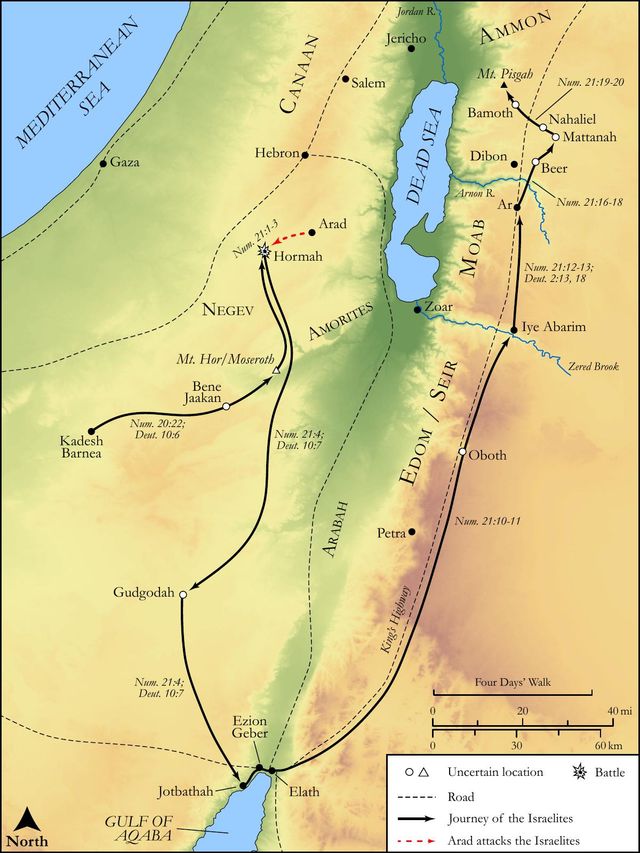
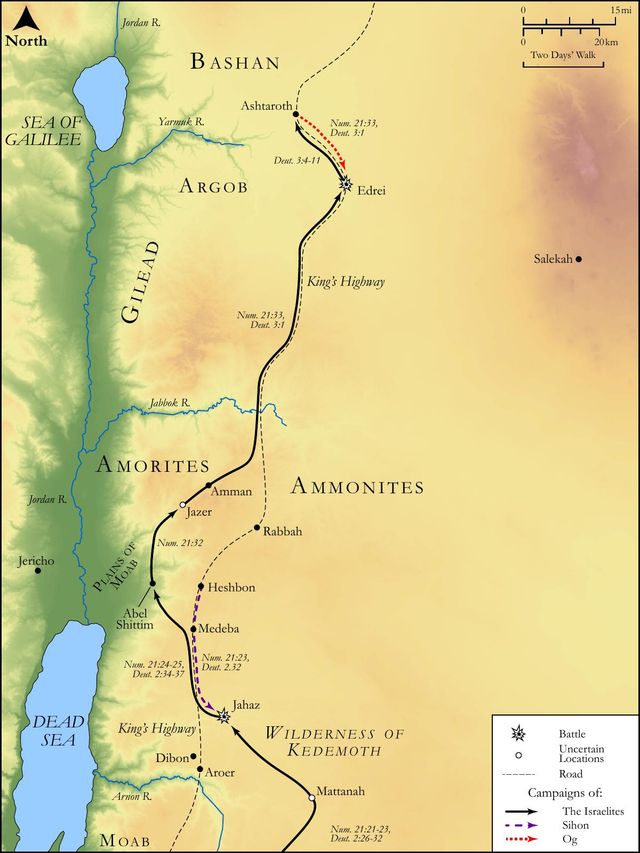
Study this verse
Public-domain commentary
Matthew Henry
From his Commentary on the Whole Bible. Henry comments on passages, not single verses — this entry covers Deuteronomy 2:1–7. His three-level outline is real structure in the source text, so it is rendered as structure.
Here is, I. A short account of the long stay of Israel in the wilderness: We compassed Mount Seir many days, Deu 2:1. Nearly thirty-eight years they wandered in the deserts of Seir; probably in some of their rests they staid several years, and never stirred; God by this not only chastised them for their murmuring and unbelief, but, 1. Prepared them for Canaan, by humbling them for sin, teaching them to mortify their lusts, to follow God, and to comfort themselves in him. It is a work of time to make souls meet for heaven, and it must be done by a long train of exercises. 2. He prepared the Canaanites for destruction. All this time the measure of their iniquity was filling up; and, though it might have been improved by them as a space to repent in, it was abused by them to the hardening of their hearts. Now that the host of Israel was once repulsed, and after that was so long entangled and seemingly lost in the wilderness, they were secure, and thought the danger was over from that quarter, which would make the next attempt of Israel upon them the more dreadful.
II.Orders given them to turn towards Canaan.
Though God contend long, he will not contend for ever. Though Israel may be long kept waiting for deliverance or enlargement, it will come at last: The vision is for an appointed time, and at the end it shall speak, and not lie.
III.A charge given them not to annoy the Edomites.
1.They must not offer any hostility to them as enemies: Meddle not with them, Deu 2:4, Deu 2:5.
(1.)They must not improve the advantage they had against them, by the fright they would be put into upon Israel's approach: "They shall be afraid of you, knowing your strength and numbers, and the power of God engaged for you; but think not that, because their fears make them an easy prey, you may therefore prey upon them; no, take heed to yourselves." There is need of great caution and a strict government of our own spirits, to keep ourselves from injuring those against whom we have an advantage. Or this caution is given to the princes; they must not only not meddle with the Edomites themselves, but not permit any of the soldiers to meddle with them.
(2.)They must not avenge upon the Edomites the affront they gave them in refusing them passage through their country, Num 20:21. Thus, before God brought Israel to destroy their enemies in Canaan, he taught them to forgive their enemies in Edom.
(3.)They must not expect to have any part of their land given them for a possession: Mount Seir was already settled upon the Edomites, and they must not, under pretence of God's covenant and conduct, think to seize for themselves all they could lay hands on. Dominion is not founded in grace. God's Israel shall be well placed, but must not expect to be placed alone in the midst of the earth, Isa 5:8.
2.They must trade with them as neighbours, buy meat and water of them, and pay for what they bought, Deu 2:6. Religion must never be made a cloak for injustice. The reason given (Deu 2:7), is, "God hath blessed thee, and hitherto thou hast lacked nothing; and therefore," (1.) "Thou needest not beg; scorn to be beholden to Edomites, when thou hast a God all-sufficient to depend upon. Thou hast wherewithal to pay for what thou callest for (thanks to the divine blessing!); use therefore what thou hast, use it cheerfully, and do not sponge upon the Edomites." (2.) "Therefore thou must not steal. Thou hast experienced the care of the divine providence concerning thee, in confidence of which for the future, and in a firm belief of its sufficiency, never use any indirect methods for thy supply. Live by the faith and not by thy sword."
Continue studying Deuteronomy 2:5 across the web’s major study libraries — every link below opens this exact verse, chapter, or book on the destination site.
Read & Compare
 BibleGatewayThis verse in more than 200 translations and 70 languages.
 Bible.comThe YouVersion reader — hundreds of translations, reading plans, and highlights.
 ESV.orgCrossway's official English Standard Version reader.
 NET BibleThe NET translation with 60,000+ translators' notes on every rendering decision.
 STEP BibleTyndale House's free study tool — original text, vocabulary, and scholarly resources.
 BibliaLogos Bible Software's free web reader.
 USCCBThe New American Bible (Revised Edition) with the U.S. bishops' study notes.
Commentaries
 BibleHub CommentariesDozens of classic commentaries on this verse, gathered on one page.
 StudyLightMore than 100 commentary sets — the largest collection on the web.
 BibleRefPlain-English commentary on what this verse means, verse by verse.
 Enduring WordDavid Guzik's free commentary on this chapter, widely used by Bible teachers.
 Bible Study ToolsVerse commentary alongside Greek and Hebrew study aids.
Original Language & Research
- BibleHub InterlinearThe verse word by word — original language, transliteration, and English.
- BibleHub LexiconEvery word's original-language definition and Strong's entry.
 Blue Letter BibleDeep-study tools — Strong's numbers, concordance, and word studies.
 SefariaThe Hebrew text with Rashi and centuries of Jewish commentary.
Sermons, Hymns & Audio


TrulyRandomVerse is not affiliated with these sites and doesn’t control their content. They’re linked because they’re genuinely useful.
Summary
Deuteronomy 2:5 encapsulates a pivotal divine directive to the Israelites during their wilderness wanderings, prohibiting any hostile engagement or territorial encroachment upon the Edomites. This command reveals God's absolute sovereignty in the allocation of land and the establishment of national boundaries, emphasizing His meticulous justice and foresight in having already granted Mount Seir as a perpetual possession to Esau's descendants. The verse serves as a profound lesson in respecting divinely ordained limits, avoiding unnecessary conflict, and trusting in God's perfect provision and timing for His people.
Context
ShowHideLiterary Context
Deuteronomy 2:5 is embedded within Moses' comprehensive historical review, delivered to the new generation of Israelites on the cusp of entering the Promised Land. Chapters 1-3 serve as a powerful retrospective, recounting God's unwavering faithfulness throughout their forty-year wilderness journey, highlighting past instances of obedience and disobedience, and detailing specific divine instructions for their interactions with surrounding nations. Immediately preceding this verse, Moses recounts the Lord's command to turn northward from the Red Sea and pass through the territory of their kinsmen, the Edomites. The preceding verses (Deuteronomy 2:1-4) describe the extended journey around Mount Seir and the explicit instruction from the Lord to avoid provoking the Edomites. This sets the stage for the specific prohibition in verse 5 against taking any of their land, underscoring the principle that Israel's conquest was divinely directed and limited, not a license for indiscriminate aggression.
Historical & Cultural Context
The Edomites were the descendants of Esau, Jacob's twin brother, establishing a complex relationship with Israel rooted in shared ancestry yet often marked by tension. Their homeland, Mount Seir, was a rugged, strategically important mountainous region located southeast of the Dead Sea, controlling vital trade routes. In Israel, land was not merely property but was deeply intertwined with national identity, economic sustenance, and divine blessing. Expansion through conquest was a common practice among empires and kingdoms. However, Deuteronomy 2:5 presents a counter-cultural divine mandate: God, as the ultimate sovereign of all creation, had already apportioned territories to various peoples, including the Edomites. This command for Israel to respect Edomite sovereignty demonstrated God's universal justice and order, extending His providential care beyond His chosen people to all humanity. It also strategically prevented Israel from engaging in conflicts that would divert their resources and focus from their primary, divinely appointed mission of conquering Canaan.
Key Themes
ShowHideDeuteronomy 2:5 significantly contributes to several overarching theological and narrative themes found throughout Deuteronomy and the Pentateuch. Firstly, it powerfully underscores Divine Sovereignty over Land Allocation, asserting God's ultimate authority over all creation and His precise distribution of territories to nations. Just as God had promised Canaan to Israel, He had previously given Mount Seir to Esau's descendants as an enduring inheritance, a fact reiterated in Genesis 36:8. Secondly, the verse highlights the theme of Respect for Boundaries and Property Rights. Despite being God's chosen people with a divine mandate to inherit the Promised Land, Israel was explicitly forbidden from seizing land indiscriminately. This teaches a profound lesson about justice, restraint, and the limits of even divinely sanctioned power, emphasizing that God's favor does not negate His universal moral law. Thirdly, it exemplifies the principle of Avoiding Unnecessary Conflict. God's clear delineation of off-limits territories guided Israel to conserve their strength and focus their efforts on the divinely appointed conquest of Canaan, preventing costly and uncommanded skirmishes. This principle resonates with the broader biblical emphasis on seeking peace and discerning when to engage in battle, as seen in Proverbs 20:3.
Exposition and Analysis
ShowHideKey Word Analysis
ShowHideThis verb (H1624) is a primitive root meaning "to grate," which figuratively extends to "to anger," "contend," "stir up," or "strive." In this context, it is a strong prohibition against initiating hostilities, provoking conflict, or engaging in any action that would incite a dispute with the Edomites. The command goes beyond merely avoiding physical combat; it demands a proactive abstinence from any form of contention or challenge to their established possession.
This term (H4096) is derived from a root meaning "to tread" and signifies "a treading, i.e., a place for stepping on; (foot-) breadth." When combined with "kaph regel" (H3709, H7272), it forms a vivid idiom meaning "the treading of the sole of the foot." It functions as a hyperbole, emphasizing the absolute and total prohibition against taking any land from the Edomites, no matter how minute. Not even enough ground to place one's foot upon was to be claimed, underscoring the strictness and comprehensiveness of God's command regarding their territory.
This noun (H3425) signifies "something occupied; a conquest; also a patrimony; heritage, inheritance, possession." Its usage here emphasizes that Mount Seir was not merely a temporary dwelling for Esau but a divinely appointed, enduring inheritance for his descendants. This term highlights the theological basis for the command: God's prior and permanent allocation of this land to Esau's lineage, establishing a divine right that Israel was bound to respect.
Verse Breakdown
ShowHide"Meddle not with them;"
This opening clause is a direct, imperative command from God, conveyed through Moses, to the Israelite nation. It serves as an unequivocal prohibition against any form of hostile engagement, provocation, or encroachment upon the Edomites. This sets the immediate tone for Israel's conduct towards a nation with whom they shared kinship but were explicitly forbidden from conquering, establishing a principle of non-aggression.
"for I will not give you of their land, no, not so much as a foot breadth;"
This clause provides the divine rationale and underscores the absolute nature of the prohibition. God explicitly declares that He will not grant Israel any portion of Edomite territory. The powerful hyperbole "no, not so much as a foot breadth" vividly conveys the totality of this restriction, leaving no room for misinterpretation or minor transgressions. It signifies that this land is entirely off-limits, emphasizing the divine boundary.
"because I have given mount Seir unto Esau [for] a possession."
This final clause offers the theological and historical justification for God's command. The fundamental reason Israel is not to take Edomite land is because God Himself, in His sovereign wisdom and justice, had already designated Mount Seir as a permanent inheritance ("possession") for Esau and his descendants. This demonstrates God's universal governance, His faithfulness to His word, and His equitable distribution of territories among all peoples, even those outside the immediate covenant line of Abraham.
Literary Devices
ShowHideDeuteronomy 2:5 is rich with literary devices that amplify its message. The predominant device is Divine Command, delivered directly from God to Moses and subsequently to the Israelites, which underscores the absolute authority and non-negotiable nature of the instruction. The phrase "no, not so much as a foot breadth" functions as Hyperbole, an intentional exaggeration used for emphatic effect. It vividly conveys the utter totality of the prohibition, ensuring that Israel fully grasps the strictness of God's boundary. Furthermore, the verse employs Covenant Language through the term "possession" (yᵉrushshâh), which frequently describes Israel's inheritance of Canaan. By applying this same term to Esau's claim over Mount Seir, the text subtly highlights God's universal covenantal dealings and His providential care, extending His land allocation beyond just Israel. The passage also contains an element of Narrative Foreshadowing, as this initial command to avoid conflict with Edom sets the stage for the often strained and complex relationship between the two nations throughout Israel's later history, where deviations from this foundational instruction sometimes led to significant strife.
Theological and Thematic Connections
ShowHideDeuteronomy 2:5 profoundly articulates God's universal sovereignty, reminding Israel—and by extension, all believers—that He is not merely the God of Israel, but the God of all nations, who orchestrates their existence, establishes their boundaries, and determines their destinies. His allocation of Mount Seir to Esau demonstrates His justice and providential care for all humanity, even those outside the direct line of the Abrahamic covenant. This verse challenges any notion of an exclusive divine favor that would permit Israel to disregard the rights or possessions of others. Instead, it teaches that God's moral law, including principles of justice, respect for property, and avoidance of unnecessary strife, applies universally. It underscores that true blessing and success come from faithful obedience to God's specific commands, not from grasping what He has not given or from pursuing self-serving expansion.
Reflection and Application
ShowHideDeuteronomy 2:5 offers timeless wisdom for believers today, calling us to cultivate a deep and unwavering trust in God's sovereign provision and perfect timing. It challenges us to resist the temptation to strive for what is not rightfully ours or what He has not explicitly given, whether in material possessions, relational dynamics, or professional aspirations. Just as God meticulously provided for Israel's needs and designated their inheritance, He promises to supply all our needs according to His glorious riches in Christ Jesus, as beautifully articulated in Philippians 4:19. This verse also compels us to respect the boundaries and possessions of others, whether they be physical property, personal space, emotional well-being, or professional roles. It promotes a spirit of contentment, justice, and peace, encouraging us to live peaceably with all people, discerning wisely when to engage in conflict and when to refrain. It serves as a powerful reminder that not every battle is ours to fight, and sometimes, the most faithful and wise path is to walk around what God has clearly marked as belonging to another. Our primary focus should remain on pursuing God's specific call for our lives, trusting that He will provide all that is necessary for our journey and fulfill His promises in His perfect way.
Questions for Reflection
ShowHideFAQ
ShowHideWhy did God command Israel not to take land from the Edomites, especially since they were entering the Promised Land through conquest?
ShowHideGod's command in Deuteronomy 2:5 highlights His universal sovereignty and profound justice, which extends far beyond His specific covenant relationship with Israel. While God had indeed promised the land of Canaan to Abraham's descendants as their inheritance, He had also, in His divine wisdom and foreknowledge, allocated other territories to different nations. Mount Seir was specifically given to Esau's descendants (the Edomites) as a permanent "possession" long before Israel's entry into Canaan. This demonstrates that God is the ultimate owner and dispenser of all land (Psalm 24:1) and that His plans for Israel did not involve indiscriminate conquest of all surrounding peoples. The command served multiple purposes: it prevented unnecessary conflict with a kindred nation, taught Israel about respecting divinely ordained boundaries even for those outside their direct covenant line, and underscored that Israel's right to the land of Canaan was based on God's unique and specific promise to them, not a general license for territorial expansion or a disregard for the rights of other nations.
Christ-Centered Fulfillment
ShowHideDeuteronomy 2:5, with its emphasis on God's sovereign allocation of land and the respect for divinely established boundaries, finds profound and expansive fulfillment in Christ. While the Old Testament narrative focuses on physical land and earthly inheritance, the New Testament reveals a spiritual inheritance and a kingdom that transcends geographical borders. Christ is the ultimate heir of all things, the one to whom God has given "a possession" far greater than Mount Seir or even Canaan itself. As the Lamb of God who takes away the sin of the world, He inherits not through earthly conquest but through His sacrificial death and glorious resurrection, thereby establishing a spiritual kingdom that is "not of this world" (John 18:36). Believers, united with Christ, receive an "inheritance that is imperishable, undefiled, and unfading, kept in heaven for you" (1 Peter 1:4). The Old Testament concept of "meddling not" and respecting boundaries transforms into the New Testament call for peace, reconciliation, and discerning spiritual battles over earthly ones, recognizing that "we wrestle not against flesh and blood, but against principalities, against powers, against the rulers of the darkness of this world, against spiritual wickedness in high places" (Ephesians 6:12). In Christ, our true "possession" is not a parcel of land, but the indwelling Holy Spirit, who is "the guarantee of our inheritance until we acquire possession of it" (Ephesians 1:14). Thus, the earthly command to respect boundaries points to the ultimate reality that our true citizenship and eternal inheritance are in heaven, secured by Christ's finished work, freeing us from the need to grasp for earthly possessions and enabling us to live as faithful stewards of God's universal kingdom.