


Deuteronomy 2:6
Bible text: King James Version (1769 Blayney text) · Public domain
Bible text: Berean Standard Bible · Public domain
Bible text: American Standard Version (1901) · Public domain
Bible text: World English Bible, Messianic edition · Public domain
Bible text: Geneva Bible (1599) · Public domain
Bible text: Young's Literal Translation · Public domain
- אֹכֶל'O·khelfoodH400N-msNoun Singular Masculine Absolute
- תִּשְׁבְּרוּtish·be·Ruyou will buyH7666V-Qal-Imperf-2mpVerb Qal Imperfect 2nd Plural Masculine
- מֵאִתָּםme·'i·Tamfrom with themH854Prep-m ¦ DirObjM ¦ 3mpParticle Object Indicatorמֵfromאִתָּwithםthem
- בַּכֶּסֶףba·Ke·seffor <the> silverH3701Prep-b ¦ N-msNoun Singular Masculine Absoluteבַּfor <the>כֶּסֶףsilver
- וַאֲכַלְתֶּםva·'a·khal·Temand you will eatH398Conj-w ¦ V-Qal-ConsecPerf-2mpVerb Qal Consecutive Perfect 2nd Plural Masculineוַandאֲכַלְתֶּםyou will eat
- וְגַםve·gamand alsoH1571Conj-w ¦ AdvAdverbוְandגַםalso
- מַיִםMa·yimwaterH4325N-mpNoun Plural Masculine Absolute
- תִּכְרוּtikh·Ruyou will buyH3739V-Qal-Imperf-2mpVerb Qal Imperfect 2nd Plural Masculine
- מֵאִתָּםme·'i·Tamfrom with themH854Prep-m ¦ DirObjM ¦ 3mpParticle Object Indicatorמֵfromאִתָּwithםthem
- בַּכֶּסֶףba·Ke·seffor <the> silverH3701Prep-b ¦ N-msNoun Singular Masculine Absoluteבַּfor <the>כֶּסֶףsilver
- וּשְׁתִיתֶםu·she·ti·Temand you will drinkH8354Conj-w ¦ V-Qal-ConsecPerf-2mpVerb Qal Consecutive Perfect 2nd Plural Masculineוּandשְׁתִיתֶםyou will drink
English is a literal word-by-word gloss of the Hebrew, not the KJV's wording. Why?
This is the original text the KJV's translators worked from — each Hebrew word with its own literal English meaning in this verse, prepared by scholars at Tyndale House, Cambridge. The KJV translates whole sentences, not word by word, so its wording differs: one Hebrew word can become several English words, and the KJV may choose “the LORD” where the gloss reads “Yahweh”. Both are faithful — they answer different questions. For the KJV's own rendering, switch to the KJV text.
Details
See on the biblical-era maps
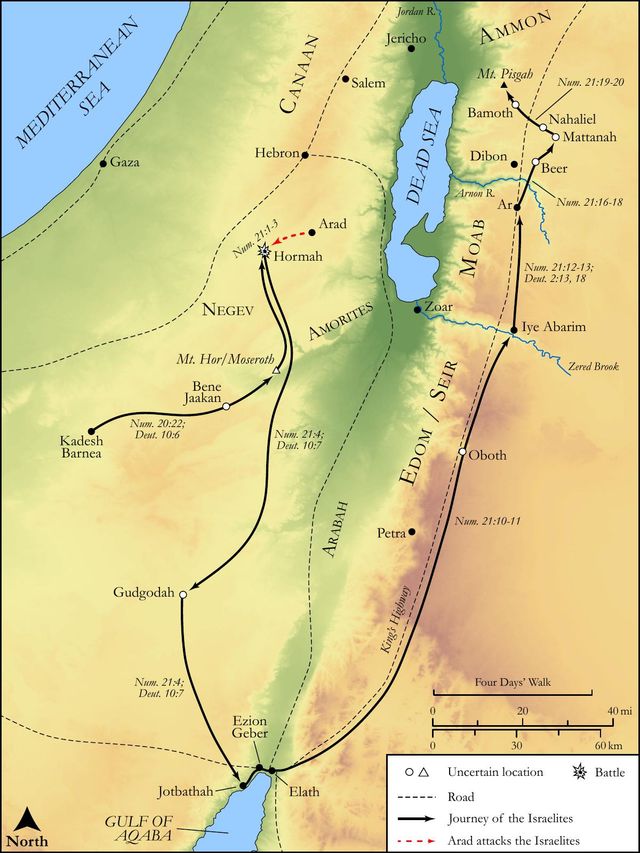
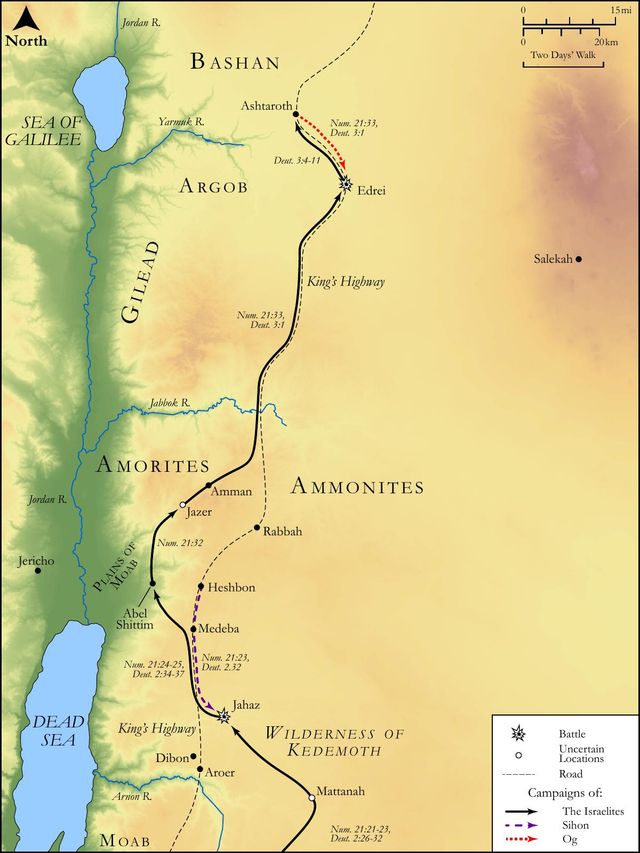
Study this verse
Public-domain commentary
Matthew Henry
From his Commentary on the Whole Bible. Henry comments on passages, not single verses — this entry covers Deuteronomy 2:1–7. His three-level outline is real structure in the source text, so it is rendered as structure.
Here is, I. A short account of the long stay of Israel in the wilderness: We compassed Mount Seir many days, Deu 2:1. Nearly thirty-eight years they wandered in the deserts of Seir; probably in some of their rests they staid several years, and never stirred; God by this not only chastised them for their murmuring and unbelief, but, 1. Prepared them for Canaan, by humbling them for sin, teaching them to mortify their lusts, to follow God, and to comfort themselves in him. It is a work of time to make souls meet for heaven, and it must be done by a long train of exercises. 2. He prepared the Canaanites for destruction. All this time the measure of their iniquity was filling up; and, though it might have been improved by them as a space to repent in, it was abused by them to the hardening of their hearts. Now that the host of Israel was once repulsed, and after that was so long entangled and seemingly lost in the wilderness, they were secure, and thought the danger was over from that quarter, which would make the next attempt of Israel upon them the more dreadful.
II.Orders given them to turn towards Canaan.
Though God contend long, he will not contend for ever. Though Israel may be long kept waiting for deliverance or enlargement, it will come at last: The vision is for an appointed time, and at the end it shall speak, and not lie.
III.A charge given them not to annoy the Edomites.
1.They must not offer any hostility to them as enemies: Meddle not with them, Deu 2:4, Deu 2:5.
(1.)They must not improve the advantage they had against them, by the fright they would be put into upon Israel's approach: "They shall be afraid of you, knowing your strength and numbers, and the power of God engaged for you; but think not that, because their fears make them an easy prey, you may therefore prey upon them; no, take heed to yourselves." There is need of great caution and a strict government of our own spirits, to keep ourselves from injuring those against whom we have an advantage. Or this caution is given to the princes; they must not only not meddle with the Edomites themselves, but not permit any of the soldiers to meddle with them.
(2.)They must not avenge upon the Edomites the affront they gave them in refusing them passage through their country, Num 20:21. Thus, before God brought Israel to destroy their enemies in Canaan, he taught them to forgive their enemies in Edom.
(3.)They must not expect to have any part of their land given them for a possession: Mount Seir was already settled upon the Edomites, and they must not, under pretence of God's covenant and conduct, think to seize for themselves all they could lay hands on. Dominion is not founded in grace. God's Israel shall be well placed, but must not expect to be placed alone in the midst of the earth, Isa 5:8.
2.They must trade with them as neighbours, buy meat and water of them, and pay for what they bought, Deu 2:6. Religion must never be made a cloak for injustice. The reason given (Deu 2:7), is, "God hath blessed thee, and hitherto thou hast lacked nothing; and therefore," (1.) "Thou needest not beg; scorn to be beholden to Edomites, when thou hast a God all-sufficient to depend upon. Thou hast wherewithal to pay for what thou callest for (thanks to the divine blessing!); use therefore what thou hast, use it cheerfully, and do not sponge upon the Edomites." (2.) "Therefore thou must not steal. Thou hast experienced the care of the divine providence concerning thee, in confidence of which for the future, and in a firm belief of its sufficiency, never use any indirect methods for thy supply. Live by the faith and not by thy sword."
Continue studying Deuteronomy 2:6 across the web’s major study libraries — every link below opens this exact verse, chapter, or book on the destination site.
Read & Compare
 BibleGatewayThis verse in more than 200 translations and 70 languages.
 Bible.comThe YouVersion reader — hundreds of translations, reading plans, and highlights.
 ESV.orgCrossway's official English Standard Version reader.
 NET BibleThe NET translation with 60,000+ translators' notes on every rendering decision.
 STEP BibleTyndale House's free study tool — original text, vocabulary, and scholarly resources.
 BibliaLogos Bible Software's free web reader.
 USCCBThe New American Bible (Revised Edition) with the U.S. bishops' study notes.
Commentaries
 BibleHub CommentariesDozens of classic commentaries on this verse, gathered on one page.
 StudyLightMore than 100 commentary sets — the largest collection on the web.
 BibleRefPlain-English commentary on what this verse means, verse by verse.
 Enduring WordDavid Guzik's free commentary on this chapter, widely used by Bible teachers.
 Bible Study ToolsVerse commentary alongside Greek and Hebrew study aids.
Original Language & Research
- BibleHub InterlinearThe verse word by word — original language, transliteration, and English.
- BibleHub LexiconEvery word's original-language definition and Strong's entry.
 Blue Letter BibleDeep-study tools — Strong's numbers, concordance, and word studies.
 SefariaThe Hebrew text with Rashi and centuries of Jewish commentary.
Sermons, Hymns & Audio


TrulyRandomVerse is not affiliated with these sites and doesn’t control their content. They’re linked because they’re genuinely useful.
Summary
Deuteronomy 2:6 delivers a precise divine directive to the Israelites during their wilderness journey, instructing them to engage in legitimate commerce with the Edomites for essential provisions like food and water, rather than resorting to seizure or force. This command, seemingly simple, profoundly underscores God's meticulous guidance and provision for His people, His unwavering respect for the sovereignty and property rights of other nations, and His expectation that Israel would conduct themselves with integrity and pursue peaceful coexistence, even amidst their challenging pilgrimage. The verse highlights a divinely ordained model of ethical interaction between peoples, demonstrating that even in times of great need, God's people are called to uphold justice and fairness.
Context
ShowHideLiterary Context
This verse is strategically placed within Moses' second major discourse in Deuteronomy, a historical recapitulation of Israel's forty-year wilderness wanderings, specifically detailing their approach to the land of Edom. Moses is preparing the new generation for entry into the Promised Land by reminding them of God's faithfulness and their past obedience (or disobedience). The preceding verses Deuteronomy 2:1-5 establish a crucial divine prohibition: Israel was not to provoke the Edomites, who were descendants of Esau and thus kinsmen. God had explicitly declared that He would not give Israel any of Edom's land, as it had been given to Esau as a perpetual possession. Deuteronomy 2:6 then provides the practical outworking of this command, detailing the specific, ethical manner in which Israel was to sustain itself while passing through Edomite territory, emphasizing commercial exchange over military appropriation. This instruction sets a significant precedent for Israel's interactions with other nations, particularly those with whom they shared a familial or historical connection, before they encountered more hostile nations later in their journey.
Historical & Cultural Context
The Edomites, a settled people residing in the mountainous region of Mount Seir (modern-day southern Jordan), possessed established trade routes and resources, a stark contrast to the nomadic Israelites. Among the nations of that day, it was a common and often accepted practice for armies traversing foreign territories to seize provisions from the local populace, either through plunder or forced requisition. However, God's command to Israel in Deuteronomy 2:6 directly counters this prevailing norm, reflecting a unique divine standard of conduct. The explicit mention of "money" (silver) indicates a functioning economy and the existence of a recognized medium of exchange, highlighting that Israel, despite their wilderness journey and miraculous provision, was equipped by God to participate in such legitimate transactions. This period also marks a subtle but significant transition for Israel from direct miraculous provision (like manna and water from the rock, as seen in Exodus 16 and Exodus 17) to more conventional means of sustenance, even as God continued to orchestrate their circumstances. The cultural expectation of respecting tribal boundaries, especially among kinsmen, is powerfully reinforced by this directive, even if the relationship between Israel and Edom was often fraught with tension.
Key Themes
ShowHideDeuteronomy 2:6 contributes significantly to several overarching themes woven throughout Deuteronomy and the Pentateuch. Firstly, it underscores Divine Provision and Guidance. While God had miraculously sustained Israel with manna and water in the past (e.g., as recounted in Deuteronomy 8:3), here He orchestrates their provision through legitimate commerce, demonstrating the adaptable and comprehensive nature of His care. Secondly, the verse highlights Respect for Sovereignty and Property Rights. The explicit instruction to "buy meat of them for money" and "buy water of them for money" is a powerful lesson in honoring the established boundaries and ownership of other nations and individuals. This principle is foundational to the Mosaic Law's emphasis on justice and fair dealings, even extending to non-Israelites (e.g., Leviticus 19:33-34). Lastly, the command promotes Peaceful Coexistence. By mandating legitimate trade, God facilitated a peaceful passage through Edomite territory, avoiding unnecessary conflict and demonstrating a model of responsible and ethical interaction between nations, a stark contrast to the typical imperialistic practices of the time. This aligns with the broader Deuteronomic call for Israel to be a distinct people, reflecting God's character in all their ways.
Exposition and Analysis
ShowHideKey Word Analysis
ShowHideWhile other Hebrew words for "buy" exist, this specific term (שָׁבַר, shâbar) denotes "to deal in grain" or "to buy/sell" provisions, particularly food. Its usage here emphasizes that the transaction was to be a commercial one, involving the exchange of goods for payment, rather than a mere acquisition. This highlights the practical, market-based nature of the divine command, indicating that Israel was to engage in normal economic activity with the Edomites for their sustenance.
The Hebrew term אֹכֶל (ʼôkel) is much broader than the modern English "meat," encompassing "food," "sustenance," or "provisions" in general. It refers to anything edible. This is crucial for understanding the scope of the command: Israel was to purchase any necessary foodstuffs from the Edomites, not exclusively animal flesh. This broad meaning underscores the comprehensive nature of their need and the Edomites' capacity to supply various provisions, from grains to other staples.
The Hebrew word כֶּסֶף (keçeph), meaning "silver" or "money," emphasizes that the transaction was to be a fair, paid exchange, not a coerced acquisition, a demand, or a charitable handout. The repetition of "for money" (בַּכֶּסֶף, bakesef) underscores the transactional nature and the principle of integrity. It signifies that Israel, despite being God's chosen people on a divine mission, was not exempt from the norms of fair trade and respecting others' economic systems. God had ensured they possessed the means to pay, further demonstrating His complete provision.
Verse Breakdown
ShowHide"Ye shall buy meat of them for money, that ye may eat;"
This initial clause directly commands the Israelites to acquire their food supplies from the Edomites through a monetary transaction. The phrase "of them" (מֵאִתָּם, me'ittam) clearly indicates the source of the provisions – the Edomites. The purpose clause, "that ye may eat," highlights the practical necessity behind the command: it was for their sustenance. This part of the verse establishes the principle of legitimate commerce for basic provisions, setting a precedent for respectful interaction even when in dire need. The emphasis is on ethical acquisition rather than forceful taking.
"and ye shall also buy water of them for money, that ye may drink."
This second clause parallels the first, extending the command to include water, another essential for survival in the arid wilderness. The repetition of "buy...for money" reinforces the non-negotiable nature of the transactional method, applying the same ethical standard to both fundamental necessities. The phrase "that ye may drink" again clarifies the life-sustaining purpose. The inclusion of water is particularly significant, as water sources in arid regions were often fiercely guarded and a common point of conflict, making the command to purchase it, rather than seize it, a powerful testament to God's insistence on respecting property rights and avoiding unnecessary hostilities.
Literary Devices
ShowHideDeuteronomy 2:6 employs several literary devices to convey its message with clarity and emphatic instruction. The most prominent is Repetition, specifically the phrase "for money" (בַּכֶּסֶף, bakesef), which appears twice within the single verse. This repetition serves to underscore the absolute necessity and non-negotiability of conducting the transaction through legitimate payment, reinforcing the core theme of integrity and fair dealing. There is also clear Parallelism in the verse's structure: "Ye shall buy meat of them for money, that ye may eat" is perfectly mirrored by "and ye shall also buy water of them for money, that ye may drink." This parallel construction highlights the two fundamental necessities (food and water) and applies the identical ethical standard of acquisition to both, emphasizing the comprehensive nature of the command. Furthermore, the verse functions as a direct Didactic Instruction, a characteristic pervasive throughout Deuteronomy. Moses, as God's authoritative mouthpiece, issues a clear, imperative command ("Ye shall buy..."), which serves to teach Israel fundamental principles of conduct, not just for this specific encounter but for their future interactions as a nation dwelling in the Promised Land.
Theological and Thematic Connections
ShowHideDeuteronomy 2:6 is a rich theological statement about God's character and His expectations for His people. It reveals a God who is not only sovereign over all nations and their territories but also one who upholds justice, integrity, and peace in international relations. Even when Israel was on a divinely ordained mission, God commanded them to respect the property rights and sovereignty of others, demonstrating that His purposes do not justify unethical means. This principle of fair dealing and peaceful coexistence, even with those who might later become adversaries, reflects God's universal moral law and His desire for His people to be a light to the nations, embodying righteousness in all their interactions. It teaches that true divine provision often comes through legitimate human endeavor and ethical commerce, not solely through miraculous intervention, and that God equips His people with the means to act righteously, fostering a mature reliance on Him that integrates both extraordinary and ordinary means of sustenance.
Reflection and Application
ShowHideDeuteronomy 2:6 offers timeless principles for believers navigating a complex and often morally ambiguous world. It challenges us to critically examine how we conduct ourselves in all our dealings, whether personal, professional, or communal. The divine command to "buy for money" reminds us that integrity, fairness, and respect for others' property are not optional virtues but are fundamental expressions of our faith and devotion to a just God. In a world frequently characterized by exploitation, greed, and the pursuit of gain at any cost, this verse calls us to be agents of righteousness, upholding justice and honoring the labor, property, and inherent dignity of others. It encourages a deep and abiding trust in God's multifaceted provision, recognizing that He can supply our needs through legitimate means and human enterprise, not always solely through extraordinary miracles. Furthermore, it fosters a profound commitment to peaceful coexistence, urging us to resolve conflicts through respectful negotiation and fair exchange rather than coercion, aggression, or opportunistic advantage. Our interactions with others, even those outside our immediate community of faith, should consistently reflect the character of God – just, compassionate, honorable, and peace-loving.
Questions for Reflection
ShowHideFAQ
ShowHideWhy did God command them to buy food and water when He had supernaturally provided for them for so long?
ShowHideGod's command to buy food and water from the Edomites in Deuteronomy 2:6 marks a significant and intentional shift in the mode of divine provision, not an end to it. For forty years, God had miraculously sustained Israel with manna and water from the rock, demonstrating His absolute power and their utter dependence. As they approached settled lands and encountered other nations, God transitioned them to more conventional means of sustenance. This demonstrated that God's provision is adaptable and comprehensive; He can provide miraculously, but also through human industry, commerce, and the resources of others. It also served as a crucial lesson in ethical interaction, teaching Israel to respect the property rights of other nations and engage in fair trade, preparing them for life in the Promised Land where they would be expected to live by such principles. This transition underscored their growing maturity as a nation, moving from complete dependence on direct miracles to responsible engagement with the world around them, all under God's continued guidance and sovereign orchestration.
What does this verse teach about international relations or interactions with those outside the faith community?
ShowHideDeuteronomy 2:6 offers profound and enduring lessons for international relations and interactions with those outside one's own community or faith. Firstly, it teaches respect for sovereignty and property rights. Despite being God's chosen people with a divine mission, Israel was explicitly commanded to honor Edom's ownership of their land and resources. They were not to take by force but to purchase, even in a time of great need. Secondly, it promotes peaceful coexistence and ethical commerce. God mandated legitimate trade, thereby avoiding conflict with a kinsman nation, even though historical and familial tensions existed. This demonstrates that even in challenging circumstances, peaceful and just interactions are God's ideal for His people. It serves as a powerful model for how God's people should conduct themselves in the broader world: with integrity, fairness, and a commitment to peace, reflecting God's righteous character to all.
Christ-Centered Fulfillment
ShowHideDeuteronomy 2:6, with its emphasis on divine provision through legitimate means, respect for others' property, and peaceful coexistence, finds its ultimate fulfillment and deeper spiritual meaning in Christ. While Israel was commanded to buy physical food and water for their journey, Jesus declares Himself the true and ultimate provision: the Bread of Life who satisfies eternal hunger, and the Living Water who quenches spiritual thirst. He freely offers spiritual sustenance that truly satisfies, not through monetary exchange or human effort, but through faith in His finished work. Furthermore, Jesus perfectly embodied the principles of integrity and respect for earthly authority and property, even while challenging spiritual corruption. He taught His disciples to render to Caesar what is Caesar's, demonstrating a proper respect for established systems and property rights. His entire ministry was one of peaceful engagement, seeking reconciliation and offering terms of peace, even to His enemies, rather than seizing power or resources by force (e.g., Matthew 5:9). The integrity and fairness commanded for Israel's physical journey in Deuteronomy 2:6 are transformed and elevated in the New Covenant, where believers are called to live out the righteousness of Christ, loving their neighbors as themselves (Matthew 22:39), and actively seeking peace with all people (Hebrews 12:14). Thus, the ethical conduct mandated for Israel foreshadows the spiritual integrity and peaceful nature of the Kingdom of God, fully realized in Christ's person and work.