


John 4:10
Bible text: King James Version (1769 Blayney text) · Public domain
Bible text: King James Version with Strong's numbers · Public domain
Bible text: Berean Standard Bible · Public domain
Bible text: American Standard Version (1901) · Public domain
Bible text: World English Bible, Messianic edition · Public domain
Bible text: Geneva Bible (1599) · Public domain
Bible text: Young's Literal Translation · Public domain
- ἈπεκρίθηApekrithēAnsweredG611V-ADI-3SVerb Aorist Middle Deponent Indicative 3rd Singular
- ἸησοῦςIēsousJesusG2424N-NSM-PNoun Nominative Singular Masculine Individual
- καὶkaiandG2532CONJConjunction
- εἶπενeipensaidG2036V-2AAI-3SVerb 2nd Aorist Active Indicative 3rd Singular
- αὐτῇ·autēato herG846P-DSFPersonal pronoun Dative Singular Feminine
- εἰeiIfG1487CONDConjunction
- ᾔδειςēdeisyou had knownG1492V-2LAI-2SVerb Pluperfect Active Indicative 2nd Singular
- τὴνtēntheG3588T-ASFDefinite article Accusative Singular Feminine
- δωρεὰνdōreangiftG1431N-ASFNoun Accusative Singular Feminine
- τοῦtou<the>G3588T-GSMDefinite article Genitive Singular Masculine
- θεοῦtheouof GodG2316N-GSM-TNoun Genitive Singular Masculine Title
- καὶkaiandG2532CONJConjunction
- τίςtiswhoG5101I-NSMInterrogative pronoun Nominative Singular Masculine
- ἐστινestinit isG1510V-PAI-3SVerb Present Active Indicative 3rd Singular
- ὁhowhoG3588T-NSMDefinite article Nominative Singular Masculine
- λέγωνlegōnis sayingG3004V-PAP-NSMVerb Present Active Participle Nominative Singular Masculine
- σοι·soito youG4771P-2DSPersonal pronoun Dative 2nd Singular
- δόςdosdo giveG1325V-2AAM-2SVerb 2nd Aorist Active Imperative 2nd Singular
- μοιmoiMeG3165P-1DSPersonal pronoun Dative 1st Singular
- πεῖνpeinto drinkG4095V-2AANVerb 2nd Aorist Active Infinitive
- σὺsuyou yourselfG4771P-2NSPersonal pronoun Nominative 2nd Singular
- ἂνanthen wouldG302PRTParticle or Disjunctive
- ᾔτησαςētēsasyou have askedG154V-AAI-2SVerb Aorist Active Indicative 2nd Singular
- αὐτὸνautonHimG846P-ASMPersonal pronoun Accusative Singular Masculine
- καὶkaiandG2532CONJConjunction
- ἔδωκενedōkenHe gaveG1325V-AAI-3SVerb Aorist Active Indicative 3rd Singular
- ἄνanmaybeG302PRTParticle or Disjunctive
- σοιsoito youG4771P-2DSPersonal pronoun Dative 2nd Singular
- ὕδωρhudōrwaterG5204N-ASNNoun Accusative Singular Neuter
- ζῶνzōnlivingG2198V-PAP-ASNVerb Present Active Participle Accusative Singular Neuter
English is a literal word-by-word gloss of the Greek, not the KJV's wording. Why?
This is the original text the KJV's translators worked from — each Greek word with its own literal English meaning in this verse, prepared by scholars at Tyndale House, Cambridge. The KJV translates whole sentences, not word by word, so its wording differs: one Greek word can become several English words, and the KJV may choose “charity” where the gloss reads “love”. Both are faithful — they answer different questions. For the KJV's own rendering, switch to the KJV text.
Details
See on the biblical-era maps
Study this verse
Public-domain commentary
Matthew Henry
From his Commentary on the Whole Bible. Henry comments on passages, not single verses — this entry covers John 4:4–26. His four-level outline is real structure in the source text, so it is rendered as structure.
We have here an account of the good Christ did in Samaria, when he passed through that country in his way to Galilee. The Samaritans, both in blood and religion, were mongrel Jews, the posterity of those colonies which the king of Assyria planted there after the captivity of the ten tribes, with whom the poor of the land that were left behind, and many other Jews afterwards, incorporated themselves. They worshipped the God of Israel only, to whom they erected a temple on mount Gerizim, in competition with that at Jerusalem. There was great enmity between them and the Jews; the Samaritans would not admit Christ, when they saw he was going to Jerusalem (Luke ix. 53); the Jews thought they could not give him a worse name than to say, He is a Samaritan. When the Jews were in prosperity, the Samaritans claimed kindred to them (Ezra iv. 2), but, when the Jews were in distress, they were Medes and Persians; see Joseph. Antiq. 11. 340-341; 12. 257. Now observe,
I.Christ's coming into Samaria.
He charged his disciples not to enter into any city of the Samaritans (Matt. x. 5), that is, not to preach the gospel, or work miracles; nor did he here preach publicly, or work any miracle, his eye being to the lost sheep of the house of Israel. What kindness he here did them was accidental; it was only a crumb of the children's bread that casually fell from the master's table.
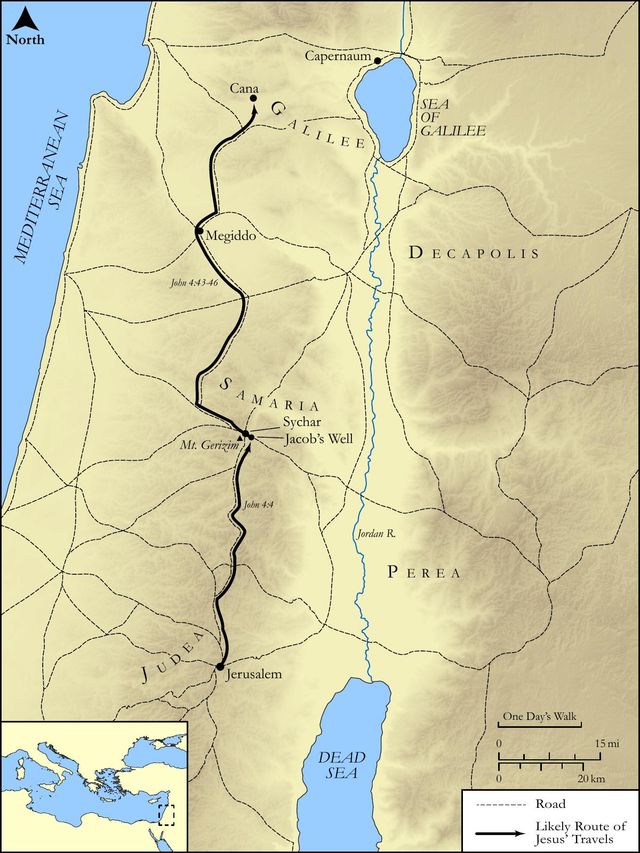
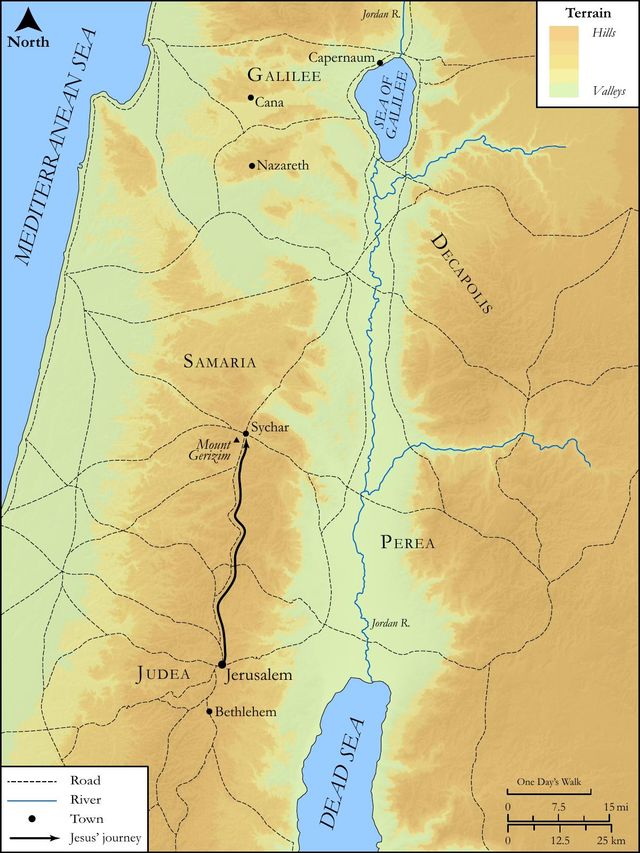
1.His road from Judea to Galilee lay through the country of Samaria (v. 4): He must needs go through Samaria. There was no other way, unless he would have fetched a compass on the other side Jordan, a great way about. The wicked and profane are at present so intermixed with God's Israel that, unless we will go out of the world, we cannot avoid going through the company of such, 1 Cor. v. 10. We have therefore need of the armour or righteousness on the right hand and on the left, that we may neither give provocation to them nor contract pollution by them. We should not go into places of temptation but when we needs must; and then we should not reside in them, but hasten through them. Some think that Christ must needs go through Samaria because of the good work he had to do there; a poor woman to be converted, a lost sheep to be sought and saved. This was work his heart was upon, the therefore he must needs go this way. It was happy for Samaria that it lay in Christ's way, which gave him an opportunity of calling on them. When I passed by thee, I said unto thee, Live, Ezek. xvi. 6.
2.His baiting place happened to be at a city of Samaria. Now observe,
(1.)The place described. It was called Sychar; probably the same with Sichem, or Shechem, a place which we read much of in the Old Testament. Thus are the names of places commonly corrupted by tract of time. Shechem yielded the first proselyte that ever came into the church of Israel (Gen. xxxiv. 24), and now it is the first place where the gospel is preached out of the commonwealth of Israel; so Dr. Lightfoot observes; as also that the valley of Achor, which was given for a door of hope, hope to the poor Gentiles, ran along by this city, Hos. ii. 15. Abimelech was made king here; it was Jeroboam's royal seat; but the evangelist, when he would give us the antiquities of the place, takes notice of Jacob's interest there, which was more its honour than its crowned heads.
[1.]Here lay Jacob's ground, the parcel of ground which Jacob gave to his son Joseph, whose bones were buried in it, Gen. xlviii. 22; Josh. xxiv. 32. Probably this is mentioned to intimate that Christ, when he reposed himself hard by here, took occasion from the ground which Jacob gave Joseph to meditate on the good report which the elders by faith obtained. Jerome chose to live in the land of Canaan, that the sight of the places might affect him the more with scripture stories.
[2.]Here was Jacob's well which he digged, or at least used, for himself and his family. We find no mention of this well in the Old Testament; but the tradition was that it was Jacob's well.
(2.)The posture of our Lord Jesus at this place: Being wearied with his journey, he sat thus on the well. We have here our Lord Jesus,
[1.]Labouring under the common fatigue of travellers. He was wearied with his journey. Though it was yet but the sixth hour, and he had performed but half his day's journey, yet he was weary; or, because it was the sixth hour, the time of the heat of the day, therefore he was weary. Here we see, First, That he was a true man, and subject to the common infirmities of the human nature. Toil came in with sin (Gen. iii. 19), and therefore Christ, having made himself a curse for us, submitted to it. Secondly, That he was a poor man, else he might have travelled on horseback or in a chariot. To this instance of meanness and mortification he humbled himself for us, that he went all his journeys on foot. When servants were on horses, princes walked as servants on the earth, Eccl. x. 7. When we are carried easily, let us think on the weariness of our Master. Thirdly, It should seem that he was but a tender man, and not of a robust constitution; it should seem, his disciples were not tired, for they went into the town without any difficulty, when their Master sat down, and could not go a step further. Bodies of the finest mould are most sensible of fatigue, and can worst bear it.
[2.]We have him here betaking himself to the common relief of travellers; Being wearied, he sat thus on the well. First, He sat on the well, an uneasy place, cold and hard; he had no couch, no easy chair to repose himself in, but took to that which was next hand, to teach us not to be nice and curious in the conveniences of this life, but content with mean things. Secondly, He sat thus, in an uneasy posture; sat carelessly—incuriose et neglectim; or he sat so as people that are wearied with travelling are accustomed to sit.
II.His discourse with a Samaritan woman, which is here recorded at large, while Christ's dispute with the doctors, and his discourse with Moses and Elias on the mount, are buried in silence. This discourse is reducible to four heads:—
1.They discourse concerning the water, v. 7-15.
(1.)Notice is taken of the circumstances that gave occasion to this discourse.
[1.]There comes a woman of Samaria to draw water. This intimates her poverty, she had no servant to be a drawer of water; and her industry, she would do it herself. See here, First, How God owns and approves of honest humble diligence in our places. Christ was made known to the shepherds when they were keeping their flock. Secondly, How the divine Providence brings about glorious purposes by events which seem to us fortuitous and accidental. This woman's meeting with Christ at the well may remind us of the stories of Rebekah, Rachel, and Jethro's daughter, who all met with husbands, good husbands, no worse than Isaac, Jacob, and Moses, when they came to the wells for water. Thirdly, How the preventing grace of God sometimes brings people unexpectedly under the means of conversion and salvation. He is found of them that sought him not.
[2.]His disciples were gone away into the city to buy meat. Hence learn a lesson, First, Of justice and honesty. The meat Christ ate, he bought and paid for, as Paul, 2 Thess. iii. 8. Secondly, Of daily dependence upon Providence: Take no thought for the morrow. Christ did not go into the city to eat, but sent his disciples to fetch his meat thither; not because he scrupled eating in a Samaritan city, but, 1. Because he had a good work to do at that well, which might be done while they were catering. It is wisdom to fill up our vacant minutes with that which is good, that the fragments of time may not be lost. Peter, while his dinner was getting ready, fell into a trance, Acts x. 10. 2. Because it was more private and retired, more cheap and homely, to have his dinner brought him hither, than to go into the town for it. Perhaps his purse was low, and he would teach us good husbandry, to spend according to what we have and not go beyond it. At least, he would teach us not to affect great things. Christ could eat his dinner as well upon a draw well as in the best inn in the town. Let us comport with our circumstances. Now this gave Christ an opportunity of discoursing with this woman about spiritual concerns, and he improved it; he often preached to multitudes that crowded after him for instruction, yet here he condescends to teach a single person, a woman, a poor woman, a stranger, a Samaritan, to teach his ministers to do likewise, as those that know what a glorious achievement it is to help to save, though but one soul, from death.
(2.)Let us observe the particulars of this discourse.
[1.]Jesus begins with a modest request for a draught of water: Give me to drink. He that for our sakes became poor here becomes a beggar, that those who are in want, and cannot dig, may not be ashamed to beg. Christ asked for it, not only because he needed it, and needed her help to come at it, but because he would draw on further discourse with her, and teach us to be willing to be beholden to the meanest when there is occasion. Christ is still begging in his poor members, and a cup of cold water, like this here, given to them in his name, shall not lose its reward.
[2.]The woman, though she does not deny his request, yet quarrels with him because he did not carry on the humour of his own nation (v. 9): How is it? Observe, First, What a mortal feud there was between the Jews and the Samaritans: The Jews have no dealings with the Samaritans. The Samaritans were the adversaries of Judah (Ezra iv. 1), were upon all occasions mischievous to them. The Jews were extremely malicious against the Samaritans, "looked upon them as having no part in the resurrection, excommunicated and cursed them by the sacred name of God, by the glorious writing of the tables, and by the curse of the upper and lower house of judgment, with this law, That no Israelite eat of any thing that is a Samaritan's, for it is as if he should eat swine's flesh." So Dr. Lightfoot, out of Rabbi Tanchum. Note, Quarrels about religion are usually the most implacable of all quarrels. Men were made to have dealing one with another; but if men, because one worships at one temple and another at another, will deny the offices of humanity, and charity, and common civility, will be morose and unnatural, scornful and censorious, and this under colour of zeal for religion, they plainly show that however their religion may be true they are not truly religious; but, pretending to stickle for religion, subvert the design of it. Secondly, How ready the woman was to upbraid Christ with the haughtiness and ill nature of the Jewish nation: How is it that thou, being a Jew, askest drink of me? By his dress or dialect, or both, she knew him to be a Jew, and thinks it strange that he runs not to the same excess of riot against the Samaritans with other Jews. Note, Moderate men of all sides are, like Joshua and his fellows (Zech. iii. 8), men wondered at. Two things this woman wonders at, 1. That he should ask this kindness; for it was the pride of the Jews that they would endure any hardship rather than be beholden to a Samaritan. It was part of Christ's humiliation that he was born of the Jewish nation, which was now not only in an ill state, subject to the Romans, but in an ill name among the nations. With what disdain did Pilate ask, Am I a Jew? Thus he made himself not only of no reputation, but of ill reputation; but herein he has set us an example of swimming against the stream of common corruptions. We must, like our master, put on goodness and kindness, though it should be ever so much the genius of our country, or the humour of our party, to be morose and ill-natured. This woman expected that Christ should be as other Jews were; but it is unjust to charge upon every individual person even the common faults of the community: no rule but has some exceptions. 2. She wonders that he should expect to receive this kindness from her that was a Samaritan: "You Jews could deny it to one of our nation, and why should we grant it to one of yours?" Thus quarrels are propagated endlessly by revenge and retaliation.
[3.]Christ takes this occasion to instruct her in divine things: If thou knewest the gift of God, thou wouldst have asked, v. 10. Observe,
First, He waives her objection of the feud between the Jews and Samaritans, and takes no notice of it. Some differences are best healed by being slighted, and by avoiding all occasions of entering into dispute about them. Christ will convert this woman, not by showing her that the Samaritan worship was schismatical (though really it was so), but by showing her her own ignorance and immoralities, and her need of a Saviour.
Secondly, He fills her with an apprehension that she had now an opportunity (a fairer opportunity than she was aware of) of gaining that which would be of unspeakable advantage to her. She had not the helps that the Jews had to discern the signs of the times, and therefore Christ tells her expressly that she had now a season of grace; this was the day of her visitation.
a.He hints to her what she should know, but was ignorant of: If thou knewest the gift of God, that is, as the next words explain it, who it is that saith, Give me to drink. If thou knewest who I am. She saw him to be a Jew, a poor weary traveller; but he would have her know something more concerning him that did yet appear. Note, (a.) Jesus Christ is the gift of God, the richest token of God's love to us, and the richest treasure of all good for us; a gift, not a debt which we could demand from God; not a loan, which he will demand from us again, but a gift, a free gift, ch. iii. 16. (b.) It is an unspeakable privilege to have this gift of God proposed and offered to us; to have an opportunity of embracing it: "He who is the gift of God is now set before thee, and addresses himself to thee; it is he that saith, Give me to drink; this gift comes a begging to thee." (c.) Though Christ is set before us, and sues to us in and by his gospel, yet there are multitudes that know him not. They know not who it is that speaks to them in the gospel, that saith, Give me to drink; they perceive not that it is the Lord that calls them.
b.He hopes concerning her, what she would have done if she had known him; to be sure she would not have given him such a rude and uncivil answer; nay, she would have been so far from affronting him that she would have made her addresses to him: Thou wouldest have asked. Note, (a.) Those that would have any benefit by Christ must ask for it, must be earnest in prayer to God for it. (b.) Those that have a right knowledge of Christ will seek to him, and if we do not seek unto him it is a sign that we do not know him, Ps. ix. 10. (c.) Christ knows what they that want the means of knowledge would have done if they had had them, Matt. xi. 21.
c.He assures her what he would have done for her if she had applied to him: "He would have given thee (and not have upbraided thee as thou doest me) living water." By this living water is meant the Spirit, who is not like the water in the bottom of the well, for some of which he asked, but like living or running water, which was much more valuable. Note, (a.) The Spirit of grace is as living water; see ch. vii. 38. Under this similitude the blessings of the Messiah had been promised in the Old Testament, Isa. xii. 3; xxxv. 7; xliv. 3; lv. 1; Zech. xiv. 8. The graces of the Spirit, and his comforts, satisfy the thirsting soul, that knows its own nature and necessity. (b.) Jesus Christ can and will give the Holy Spirit to them that ask him; for he received that he might give.
[4.]The woman objects against and cavils at the gracious intimation which Christ gave her (v. 11, 12): Thou hast nothing to draw with; and besides, Art thou greater than our father Jacob? What he spoke figuratively, she took literally; Nicodemus did so too. See what confused notions they have of spiritual things who are wholly taken up with the things that are sensible. Some respect she pays to this person, in calling him Sir, or Lord; but little respect to what he said, which she does but banter.
First, She does not think him capable of furnishing her with any water, no, not this in the well that is just at hand: Thou has nothing to draw with, and the well is deep. This she said, not knowing the power of Christ, for he who causeth the vapours to ascend from the ends of the earth needs nothing to draw. But there are those who will trust Christ no further than they can see him, and will not believe his promise, unless the means of the performance of it be visible; as if he were tied to our methods, and could not draw water without our buckets. She asks scornfully, "Whence hast thou this living water? I see not whence thou canst have it." Note, The springs of that living water which Christ has for those that come to him are secret and undiscovered. The fountain of life is hid with Christ. Christ has enough for us, though we see not whence he has it.
Secondly, She does not think it possible that he should furnish her with any better water than this which she could come at, but he could not: Art thou greater than our father Jacob, who gave us the well?
a.We will suppose the tradition true, that Jacob himself, and his children, and cattle, did drink of this well. And we may observe from it, (a.) The power and providence of God, in the continuance of the fountains of water from generation to generation, by the constant circulation of the rivers, like the blood in the body (Eccl. i. 7), to which circulation perhaps the flux and reflux of the sea, like the pulses of the heart, contribute. (b.) The plainness of the patriarch Jacob; his drink was water, and he and his children drank of the same well with his cattle.
b.Yet, allowing that to be true, she was out in several things; as, (a.) In calling Jacob father. What authority had the Samaritans to reckon themselves of the seed of Jacob? They were descended from that mixed multitude which the king of Assyria had placed in the cities of Samaria; what have they to do then with Jacob? Because they were the invaders of Israel's rights, and the unjust possessors of Israel's lands, were they therefore the inheritors of Israel's blood and honour? How absurd were those pretensions! (b.) She is out in claiming this well as Jacob's gift, whereas he did no more give it than Moses gave the manna, ch. vi. 32. But thus we are apt to call the messengers of God's gifts the donors of them, and to look so much at the hands they pass through as to forget the hand they come from. Jacob gave it to his sons, not to them. Yet thus the church's enemies not only usurp, but monopolize, the church's privileges. (c.) She was out in speaking of Christ as not worthy to be compared with our father Jacob. An over-fond veneration for antiquity makes God's graces, in the good people of our own day, to be slighted.
[5.]Christ answers this cavil, and makes it out that the living water he had to give was far better than that of Jacob's well, v. 13, 14. Though she spoke perversely, Christ did not cast her off, but instructed and encouraged her. He shows her,
First, That the water of Jacob's well yielded but a transient satisfaction and supply: "Whoso drinketh of this water shall thirst again. It is no better than other water; it will quench the present thirst, but the thirst will return, and in a few hours a man will have as much need, and as much desire, of water as ever he had." This intimates, 1. The infirmities of our bodies in this present state; they are still necessitous, and ever craving. Life is a fire, a lamp, which will soon go out, without continual supplies of fuel and oil. The natural heat preys upon itself. 2. The imperfections of all our comforts in this world; they are not lasting, nor our satisfaction in them remaining. Whatever waters of comfort we drink of, we shall thirst again. Yesterday's meat and drink will not do to-day's work.
Secondly, That the living waters he would give should yield a lasting satisfaction and bliss, v. 14. Christ's gifts appear most valuable when they come to be compared with the things of this world; for there will appear no comparison between them. Whoever partakes of the Spirit of grace, and the comforts of the everlasting gospel,
a.He shall never thirst, he shall never want that which will abundantly satisfy his soul's desires; they are longing, but not languishing. A desiring thirst he has, nothing more than God, still more and more of God; but not a despairing thirst.
b.Therefore he shall never thirst, because this water that Christ gives shall be in him a well of water. He can never be reduced to extremity that has in himself a fountain of supply and satisfaction. (a.) Ever ready, for it shall be in him. The principle of grace planted in him is the spring of his comfort; see ch. vii. 38. A good man is satisfied from himself, for Christ dwells in his heart. The anointing abides in him; he needs not sneak to the world for comfort; the work and the witness of the Spirit in the heart furnish him with a firm foundation of hope and an overflowing fountain of joy. (b.) Never failing, for it shall be in him a well of water. He that has at hand only a bucket of water needs not thirst as long as this lasts, but it will soon be exhausted; but believers have in them a well of water, overflowing, ever flowing. The principles and affections which Christ's holy religion forms in the souls of those that are brought under the power of it are this well of water. [a.] It is springing up, ever in motion, which bespeaks the actings of grace strong and vigorous. If good truths stagnate in our souls, like standing water, they do not answer the end of our receiving them. If there be a good treasure in the heart, we must thence bring forth good things. [b.] It is springing up unto everlasting life; which intimates, First, The aims of gracious actings. A sanctified soul has its eye upon heaven, means this, designs this, does all for this, will take up with nothing short of this. Spiritual life springs up towards its own perfection in eternal life. Secondly, The constancy of those actings; it will continue springing up till it come to perfection. Thirdly, The crown of them, eternal life at last. The living water rises from heaven, and therefore rises towards heaven; see Eccl. i. 7. And now is not this water better than that of Jacob's well?
[6.]The woman (whether in jest or earnest is hard to say) begs of him to give her some of this water (v. 15): Give me this water, that I thirst not. First, Some think that she speaks tauntingly, and ridicules what Christ had said as mere stuff; and, in derision of it, not desires, but challenges him to give her some of this water: "A rare invention; it will save me a great deal of pains if I never come hither to draw." But, Secondly, Others think that it was a well-meant but weak and ignorant desire. She apprehended that he meant something very good and useful, and therefore saith Amen, at a venture. Whatever it be, let me have it; who will show me any good? Ease, or saving of labour, is a valuable good to poor labouring people. Note, 1. Even those that are weak and ignorant may yet have some faint and fluctuating desires towards Christ and his gifts, and some good wishes of grace and glory. 2. Carnal hearts, in their best wishes, look no higher than carnal ends. "Give it to me," saith she, "not that I may have everlasting life" (which Christ proposed), "but that I come not hither to draw."
2.The next subject of discourse with this woman in concerning her husband, v. 16-18. It was not to let fall the discourse of the water of life that Christ started this, as many who will bring in any impertinence in conversation that they may drop a serious subject; but it was with a gracious design that Christ mentioned it. What he had said concerning his grace and eternal life he found had made little impression upon her, because she had not been convinced of sin: therefore, waiving the discourse about the living water, he sets himself to awaken her conscience, to open the wound of guilt, and then she would more easily apprehend the remedy by grace. And this is the method of dealing with souls; they must first be made weary and heavy-laden under the burden of sin, and then brought to Christ for rest; first pricked to the heart, and then healed. This is the course of spiritual physic; and if we proceed not in this order we begin at the wrong end.
Observe, (1.) How discreetly and decently Christ introduces this discourse (v. 16): Go, call thy husband, and come hither. Now, [1.] The order Christ gave her had a very good colour: "Call thy husband, that he may teach thee, and help thee to understand these things, which thou art so ignorant of" The wives that will learn must ask their husbands (1 Cor. xiv. 35), who must dwell with them as men of knowledge, 1 Pet. iii. 7. "Call thy husband, that he may learn with thee; that then you may be heirs together of the grace of life. Call thy husband, that he may be witness to what passes between us." Christ would thus teach us to provide things honest in the sight of all men, and to study that which is of good report. [2.] As it had a good colour, so it had a good design; for hence he would take occasion to call her sin to remembrance. There is need of art and prudence in giving reproofs; to fetch a compass, as the woman of Tekoa, 2 Sam. xiv. 20.
(2.)How industriously the woman seeks to evade the conviction, and yet insensibly convicts herself, and, ere she is aware, owns her fault; she said, I have no husband. Her saying this intimated no more than that she did not care to have her husband spoken of, nor that matter mentioned any more. She would not have her husband come thither, lest, in further discourse, the truth of the matter should come out, to her shame; and therefore, "Pray go on to talk of something else, I have no husband;" she would be thought a maid or a widow, whereas, though she had no husband, she was neither. The carnal mind is very ingenious to shift off convictions, and to keep them from fastening, careful to cover the sin.
(3.)How closely our Lord Jesus brings home the conviction to her conscience. It is probable that he said more than is here recorded, for she thought that he told her all that ever she did (v. 29), but that which is here recorded is concerning her husbands. Here is,
[1.]A surprising narrative of her past conversation: Thou has had five husbands. Doubtless, it was not her affliction (the burying of so many husbands), but her sin, that Christ intended to upbraid her with; either she had eloped (as the law speaks), had run away from her husbands, and married others, or by her undutiful, unclean, disloyal conduct, had provoked them to divorce her, or by indirect means had, contrary to law, divorced them. Those who make light of such scandalous practices as these, as no more than nine days' wonder, and as if the guilt were over as soon as the talk is over, should remember that Christ keeps account of all.
[2.]A severe reproof of her present state of life: He whom thou now hast is not thy husband. Either she was never married to him at all, or he had some other wife, or, which is most probable, her former husband or husbands were living: so that, in short, she lived in adultery. Yet observe how mildly Christ tells her of it; he doth not call her strumpet, but tells her, He with whom thou livest is not thy husband: and then leaves it to her own conscience to say the rest. Note, Reproofs are ordinarily most profitable when they are least provoking.
[3.]Yet in this he puts a better construction than it would well bear upon what she said by way of shuffle and evasion: Thou has well said I have no husband; and again, In that saidst thou truly. What she intended as a denial of the fact (that she had none with whom she lived as a husband) he favourably interpreted, or at least turned upon her, as a confession of the fault. Note, Those who would win souls should make the best of them, whereby they may hope to work upon their good-nature; for, if they make the worst of them, they certainly exasperate their ill-nature.
3.The next subject of discourse with this woman is concerning the place of worship, v. 19-24. Observe,
(1.)A case of conscience proposed to Christ by the woman, concerning the place of worship, v. 19, 20.
[1.]The inducement she had to put this case: Sir, I perceive that thou art a prophet. She does not deny the truth of what he had charged her with, but by her silence owns the justice of the reproof; nor is she put into a passion by it, as many are when they are touched in a sore place, does not impute his censure to the general disgust the Jews had to the Samaritans, but (which is a rare thing) can bear to be told of a fault. But this is not all; she goes further: First, She speaks respectfully to him, calls him Sir. Thus should we honour those that deal faithfully with us. This was the effect of Christ's meekness in reproving her; he gave her no ill language, and then she gave him none. Secondly, She acknowledges him to be a prophet, one that had a correspondence with Heaven. Note, The power of the word of Christ in searching the heart, and convincing the conscience of secret sins, is a great proof of its divine authority, 1 Cor. xiv. 24, 25. Thirdly, She desires some further instruction from him. Many that are not angry at their reprovers, nor fly in their faces, yet are afraid of them and keep out of their way; but this woman was willing to have some more discourse with him that told her of her faults.
[2.]The case itself that she propounded concerning the place of religious worship in public. Some think that she started this to shift off further discourse concerning her sin. Controversies in religion often prove great prejudices to serious godliness; but, it should seem, she proposed it with a good design; she knew she must worship God, and desired to do it aright; and therefore, meeting with a prophet, begs his direction. Note, It is our wisdom to improve all opportunities of getting knowledge in the things of God. When we are in company with those that are fit to teach, let us be forward to learn, and have a good question ready to put to those who are able to give a good answer. It was agreed between the Jews and the Samaritans that God is to be worshipped (even those who were such fools as to worship false gods were not such brutes as to worship none), and that religious worship is an affair of great importance: men would not contend about it if they were not concerned about it. But the matter in variance was where they should worship God. Observe how she states the case:—
First, As for the Samaritans: Our fathers worshipped in this mountain, near to this city and this well; there the Samaritan temple was built by Sanballat, in favour of which she insinuates, 1. That whatever the temple was the place was holy; it was mount Gerizim, the mount in which the blessings were pronounced; and some think the same on which Abraham built his altar (Gen. xii. 6, 7), and Jacob his, Gen. xxxiii. 18-20. 2. That it might plead prescription: Our fathers worshipped here. She thinks they have antiquity, tradition, and succession, on their side. A vain conversation often supports itself with this, that it was received by tradition from our fathers. But she had little reason to boast of their fathers; for, when Antiochus persecuted the Jews, the Samaritans, for fear of sharing with them in their sufferings, not only renounced all relation to the Jews, but surrendered their temple to Antiochus, with a request that it might be dedicated to Jupiter Olympius, and called by his name. Joseph. Antiq. 12. 257-264.
Secondly, As to the Jews: You say that in Jerusalem is the place where men ought to worship. The Samaritans governed themselves by the five books of Moses, and (some think) received only them as canonical. Now, though they found frequent mention there of the place God would choose, yet they did not find it named there; and they saw the temple at Jerusalem stripped of many of its ancient glories, and therefore thought themselves at liberty to set up another place, altar against altar.
(2.)Christ's answer to this case of conscience, v. 21, &c. Those that apply themselves to Christ for instruction shall find him meek, to teach the meek his way. Now here,
[1.]He puts a slight upon the question, as she had proposed it, concerning the place of worship (v. 21): "Woman, believe me as a prophet, and mark what I say. Thou art expecting the hour to come when either by some divine revelation, or some signal providence, this matter shall be decided in favour either of Jerusalem or of Mount Gerizim; but I tell thee the hour is at hand when it shall be no more a question; that which thou has been taught to lay so much weight on shall be set aside as a thing indifferent." Note, It should cool us in our contests to think that those things which now fill us, and which we make such a noise about, shall shortly vanish, and be no more: the very things we are striving about are passing away: The hour comes when you shall neither in this mountain nor yet at Jerusalem worship the Father. First, The object of worship is supposed to continue still the same—God, as a Father; under this notion the very heathen worshipped God, the Jews did so, and probably the Samaritans. Secondly, But a period shall be put to all niceness and all differences about the place of worship. The approaching dissolution of the Jewish economy, and the erecting of the evangelical state, shall set this matter at large, and lay all in common, so that it shall be a thing perfectly indifferent whether in either of these places or any other men worship God, for they shall not be tied to any place; neither here nor there, but both, and any where, and every where. Note, The worship of God is not now, under the gospel, appropriated to any place, as it was under the law, but it is God's will that men pray every where. 1 Tim. ii. 8; Mal. i. 11. Our reason teaches us to consult decency and convenience in the places of our worship: but our religion gives no preference to one place above another, in respect to holiness and acceptableness to God. Those who prefer any worship merely for the sake of the house or building in which it is performed (though it were as magnificent and as solemnly consecrated as ever Solomon's temple was) forget that the hour is come when there shall be no difference put in God's account: no, not between Jerusalem, which had been so famous for sanctity, and the mountain of Samaria, which had been so infamous for impiety.
[2.]He lays a stress upon other things, in the matter of religious worship. When he made so light of the place of worship he did not intend to lessen our concern about the thing itself, of which therefore he takes occasion to discourse more fully.
First, As to the present state of the controversy, he determines against the Samaritan worship, and in favour of the Jews, v. 22. He tells here, 1. That the Samaritans were certainly in the wrong; not merely because they worshipped in this mountain, though, while Jerusalem's choice was in force, that was sinful, but because they were out in the object of their worship. If the worship itself had been as it should have been, its separation from Jerusalem might have been connived at, as the high places were in the best reigns: But you worship you know not what, or that which you do not know. They worshipped the God of Israel, the true God (Ezra iv. 2; 2 Kings xvii. 32); but they were sunk into gross ignorance; they worshipped him as the God of that land (2 Kings xvii. 27, 33), as a local deity, like the gods of the nations, whereas God must be served as God, as the universal cause and Lord. Note, Ignorance is so far from being the mother of devotion that it is the murderer of it. Those that worship God ignorantly offer the blind for sacrifice, and it is the sacrifice of fools. 2. That the Jews were certainly in the right. For, (1.) "We know what we worship. We go upon sure grounds in our worship, for our people are catechised and trained up in the knowledge of God, as he has revealed himself in the scripture." Note, Those who by the scriptures have obtained some knowledge of God (a certain though not a perfect knowledge) may worship him comfortably to themselves, and acceptably to him, for they know what they worship. Christ elsewhere condemns the corruptions of the Jews' worship (Matt. xv. 9), and yet here defends the worship itself; the worship may be true where yet it is not pure and entire. Observe, Our Lord Jesus was pleased to reckon himself among the worshippers of God: We worship. Though he was a Son (and then are the children free), yet learned he this obedience, in the days of his humiliation. Let not the greatest of men think the worship of God below them, when the Son of God himself did not. (2.) Salvation is of the Jews; and therefore they know what they worship, and what grounds they go upon in their worship. Not that all the Jews were saved, nor that it was not possible but that many of the Gentiles and Samaritans might be saved, for in every nation he that fears God and works righteousness is accepted of him; but, [1.] The author of eternal salvation comes of the Jews, appears among them (Rom. ix. 5), and is sent first to bless them. [2.] The means of eternal salvation are afforded to them. The word of salvation (Acts xiii. 26) was of the Jews. It was delivered to them, and other nations derived it through them. This was a sure guide to them in their devotions, and they followed it, and therefore knew what they worshipped. To them were committed the oracles of God (Rom. iii. 2), and the service of God, (Rom. ix. 4). The Jews therefore being thus privileged and advanced, it was presumption for the Samaritans to vie with them.
Secondly, He describes the evangelical worship which alone God would accept and be well pleased with. Having shown that the place is indifferent, he comes to show what is necessary and essential—that we worship God in spirit and in truth, v. 23, 24. The stress is not to be laid upon the place where we worship God, but upon the state of mind in which we worship him. Note, The most effectual way to take up differences in the minor matters of religion is to be more zealous in the greater. Those who daily make it the matter of their care to worship in the spirit, one would think, should not make it the matter of their strife whether he should be worshipped here or there. Christ had justly preferred the Jewish worship before the Samaritan, yet here he intimates the imperfection of that. The worship was ceremonial, Heb. ix. 1, 10. The worshippers were generally carnal, and strangers to the inward part of divine worship. Note, It is possible that we may be better than our neighbours, and yet not so good as we should be. It concerns us to be right, not only in the object of our worship, but in the manner of it; and it is this which Christ here instructs us in. Observe,
a.The great and glorious revolution which should introduce this change: The hour cometh, and now is—the fixed stated time, concerning which it was of old determined when it should come, and how long it should last. The time of its appearance if fixed to an hour, so punctual and exact are the divine counsels; the time of its continuance is limited to an hour, so close and pressing is the opportunity of divine grace, 2 Cor. vi. 2. This hour cometh, it is coming in its full strength, lustre, and perfection, it now is in the embryo and infancy. The perfect day is coming, and now it dawns.
b.The blessed change itself. In gospel times the true worshippers shall worship the Father in spirit and in truth. As creatures, we worship the Father of all: as Christians, we worship the Father of our Lord Jesus. Now the change shall be, (a.) In the nature of the worship. Christians shall worship God, not in the ceremonial observances of the Mosaic institution, but in spiritual ordinances, consisting less in bodily exercise, and animated and invigorated more with divine power and energy. The way of worship which Christ has instituted is rational and intellectual, and refined from those external rites and ceremonies with which the Old-Testament worship was both clouded and clogged. This is called true worship, in opposition to that which was typical. The legal services were figures of the true, Heb. ix. 3, 24. Those that revolted from Christianity to Judaism are said to begin in the spirit, and end in the flesh, Gal. iii. 3. Such was the difference between Old-Testament and New-Testament institutions. (b.) In the temper and disposition of the worshippers; and so the true worshippers are good Christians, distinguished from hypocrites; all should, and they will, worship God in spirit and in truth. It is spoken of (v. 23) as their character, and (v. 24) as their duty. Note, It is required of all that worship God that they worship him in spirit and in truth. We must worship God, [a.] In spirit, Phil. iii. 3. We must depend upon God's Spirit for strength and assistance, laying our souls under his influences and operations; we must devote our own spirits to, and employ them in, the service of God (Rom. i. 9), must worship him with fixedness of thought and a flame of affection, with all that is within us. Spirit is sometimes put for the new nature, in opposition to the flesh, which is the corrupt nature; and so to worship God with our spirits is to worship him with our graces, Heb. xii. 28. [b.] In truth, that is, in sincerity. God requires not only the inward part in our worship, but truth in the inward part, Ps. li. 6. We must mind the power more than the form, must aim at God's glory, and not to be seen of men; draw near with a true heart, Heb. x. 22.
Thirdly, He intimates the reasons why God must be thus worshipped.
a.Because in gospel times they, and they only, are accounted the true worshippers. The gospel erects a spiritual way of worship, so that the professors of the gospel are not true in their profession, do not live up to gospel light and laws, if they do not worship God in spirit and in truth.
b.Because the Father seeketh such worshippers of him. This intimates, (a.) That such worshippers are very rare, and seldom met with, Jer. xxx. 21. The gate of spiritual worshipping is strait. (b.) That such worship is necessary, and what the God of heaven insists upon. When God comes to enquire for worshippers, the question will not be, "Who worshipped at Jerusalem?" but, "Who worshipped in spirit?" That will be the touchstone. (c.) That God is greatly well pleased with and graciously accepts such worship and such worshippers. I have desired it, Ps. cxxxii. 13, 14; Cant. ii. 14. (d.) That there has been, and will be to the end, a remnant of such worshippers; his seeking such worshippers implies his making them such. God is in all ages gathering in to himself a generation of spiritual worshippers.
c.Because God is a spirit. Christ came to declare God to us (ch. i. 18), and this he has declared concerning him; he declared it to this poor Samaritan woman, for the meanest are concerned to know God; and with this design, to rectify her mistakes concerning religious worship, to which nothing would contribute more than the right knowledge of God. Note, (a.) God is a spirit, for he is an infinite and eternal mind, an intelligent being, incorporeal, immaterial, invisible, and incorruptible. It is easier to say what God is not than what he is; a spirit has not flesh and bones, but who knows the way of a spirit? If God were not a spirit, he could not be perfect, nor infinite, nor eternal, nor independent, nor the Father of spirits. (b.) The spirituality of the divine nature is a very good reason for the spirituality of divine worship. If we do not worship God, who is a spirit, in the spirit, we neither give him the glory due to his name, and so do not perform the act of worship, nor can we hope to obtain his favour and acceptance, and so we miss of the end of worship, Matt. xv. 8, 9.
4.The last subject of discourse with this woman is concerning the Messiah, v. 25, 26. Observe here,
(1.)The faith of the woman, by which she expected the Messiah: I know that Messias cometh—and he will tell us all things. She had nothing to object against what Christ had said; his discourse was, for aught she knew, what might become the Messiah then expected; but from him she would receive it, and in the mean time she thinks it best to suspend her belief. Thus many have no heart to the price in their hand (Prov. xvii. 16), because they think they have a better in their eye, and deceive themselves with a promise that they will learn that hereafter which they neglect now. Observe here,
[1.]Whom she expects: I know that Messias cometh. The Jews and Samaritans, though so much at variance, agreed in the expectation of the messiah and his kingdom. The Samaritans received the writings of Moses, and were no strangers to the prophets, nor to the hopes of the Jewish nation; those who knew least knew this, that Messias was to come; so general and uncontested was the expectation of him, and at this time more raised than ever (for the sceptre was departed from Judah, Daniel's weeks were near expiring), so that she concludes not only, He will come, but erchetai—"He comes, he is just at hand:" Messias, who is called Christ. The evangelist, though he retains the Hebrew word Messias (which the woman used) in honour to the holy language, and to the Jewish church, that used it familiarly, yet, writing for the use of the Gentiles, he takes care to render it by a Greek word of the same signification, who is called Christ-Anointed, giving an example to the apostle's rule, that whatever is spoken in an unknown or less vulgar tongue should be interpreted, 1 Cor. xiv. 27, 28.
[2.]What she expects from him: "He will tell us all things relating to the service of God which it is needful for us to know, will tell us that which will supply our defects, rectify our mistakes, and put an end to all our disputes. He will tell us the mind of God fully and clearly, and keep back nothing." Now this implies an acknowledgement, First, Of the deficiency and imperfection of the discovery they now had of the divine will, and the rule they had of the divine worship; it could not make the comers thereunto perfect, and therefore they expected some great advance and improvement in matters of religion, a time of reformation. Secondly, Of the sufficiency of the Messiah to make this change: "He will tell us all things which we want to know, and about which we wrangle in the dark. He will introduce peace, by leading us into all truth, and dispelling the mists of error." It seems, this was the comfort of good people in those dark times that light would arise; if they found themselves at a loss, and run aground, it was a satisfaction to them to say, When Messias comes, he will tell us all things; as it may be to us now with reference to his second coming: now we see through a glass, but then face to face.
Historical interpretation
Nine Centuries of Reception
16 surviving comments on this verse. Each one is dated, so this reads as a timeline rather than a list.
Select a marker to jump to its quote. Markers stagger vertically where authors wrote within a few decades of each other.
[Heracleon] is not wrong when he says that “the water that the Savior gives is of his spirit and power.” And he has explained the statement “But he shall not thirst forever” as follows with these very words: “For the life he gives is eternal and never perishes, as, indeed, does the first life that comes from the well; the life he gives remains. For the grace and the gift of our Savior is not to be taken away, nor is it consumed, nor does it perish, when one partakes of it.” … Now [Heracleon’s] interpretation of the “leaping water” is not unconvincing. He takes it to refer “to those who partake of that which is richly supplied to them from above and who themselves cause what is supplied to them to gush out for the eternal life of others.” But he also praises the Samaritan woman “because she demonstrated a faith that was unhesitating and appropriate to her nature, when she had no doubt about what he said to her.”
They assert, however, that Edem is the brain, as it were, bound and tightly fastened in encircling robes, as if (in) heaven. But they suppose that man, as far as the head only, is Paradise, therefore that "this river, which proceeds out of Edem," that is, from the brain, "is divided into four heads, and that the name of the first river is called Phison; this is that which encompasseth all the land of Havilath: there is gold, and the gold of that land is excellent, and there is bdellium and the onyx stone." This, he says, is the eye, which, by its honour (among the rest of the bodily organs), and its colours, furnishes testimony to what is spoken. "But the name of the second river is Gihon: this is that which compasseth the land of Ethiopia." This, he says, is hearing, since Gihon is (a tortuous stream), resembling a sort of labyrinth. "And the name of the third is Tigris. This is that which floweth over against (the country of) the Assyrians." This, he says, is smelling, employing the exceedingly rapid current of the stream (as an analogy of this sense). But it flows over against (the country of) the Assyrians, because in every act of respiration following upon expiration, the breath drawn in from the external atmosphere enters with swifter motion and greater force. For this, he says, is the nature of respiration. "But the fourth river is Euphrates." This, they assert, is the mouth, through which are the passage outwards of prayer, and the passage inwards of nourishment. (The mouth) makes glad, and nurtures and fashions the Spiritual Perfect Man. This, he says, is "the water that is above the firmament," concerning which, he says, the Saviour has declared, "If thou knewest who it is that asks, thou wouldst have asked from Him, and He would have given you to drink living, bubbling water." Into this water, he says, every nature enters, choosing its own substances; and its peculiar quality comes to each nature from this water, he says, more than iron does to the magnet, and the gold to the backbone of the sea falcon, and the chaff to the amber.
And in them too the rest of the prophecy was fulfilled, when on the day of our Savior’s coming living water came forth from Jerusalem. The fruitful living word of Jerusalem, yes, from Jerusalem itself, and was spread over all the earth, even to the utmost bounds of the world. The Lord and Savior himself speaks of this water to the Samaritan woman.… And he goes on to teach what advantage would accrue to everyone who tastes of the living spiritual spring. Those that drink of it, denying the many evil demons who ruled them of old, will confess their one Lord and King, and that the Lord, who once was known only to the Hebrews, will become King of all nations that believe in him from all the earth, and that his name will be one, encircling all the earth and the wilderness. And who is not struck at seeing this fulfilled? For the Christian name, derived from the name of Christ (and Christ was indeed the Lord) has encircled every place and city and land and the very nations that dwell in the wilderness and at the ends of the earth, as the prophecy foretold.
And in that day it says, “Living water shall come forth out of Jerusalem.” This is that spiritual, sweet, life-giving and saving drink of the teaching of Christ. He speaks of it in the Gospel according to John, when instructing the Samaritan woman.… What was this drink, then, that came forth from Jerusalem? For it was there that its gospel went forth and its heralds filled the world. This is what is meant by the words “The living water shall go forth to the first sea and the last sea,” by which is meant the bounds of the whole world. That which is toward the eastern ocean is called “the first sea,” that toward the west is meant by “the last sea,” which, indeed, the living water of the saving gospel teaching has filled. He also taught about this when he said, “Whosoever shall drink of the water, which I shall give him, shall never thirst.”
And therefore He answered the woman, and said, "If thou knewest the gift of God and who it is that saith to thee, Give Me to drink, thou wouldest have asked of Him, and He would have given thee living water."
First, He showeth that she is worthy to hear and not to be overlooked, and then He revealeth Himself. For she, as soon as she had learnt who He was, would straightway hearken and attend to Him; which none can say of the Jews, for they, when they had learned, asked nothing of Him, nor did they desire to be informed on any profitable matter, but insulted and drove Him away. But when the woman had heard these words, observe how gently she answers: "Sir, thou hast nothing to draw with, and the well is deep; from whence then hast thou that living water?"
Already He hath raised her from her low opinion of Him, and from deeming that He is a common man. For not without a reason doth she here call Him, "Lord"; but assigning to Him high honor. That she spake these words to honor Him, is plain from what is said afterwards, since she did not laugh nor mock, but doubted for a while.
For at first she saith, "How is it that thou, being a Jew, askest drink of me?" she saith not, as though speaking to an alien and an enemy, "Far be it from me to give to thee, who art a foe and a stranger to our nation." And afterwards again, when she heard Him utter great words, a thing at which enemies are most annoyed, she did not mock nor deride; but what saith she? "Art thou greater than our father Jacob, which gave us the well, and drank thereof himself, and his children, and his cattle?"
And marvel not if she did not at once perceive all, for neither did Nicodemus. What saith he? "How can these things be?" and again, "How can a man be born when he is old?" and again, "Can he enter the second time into his mother's womb, and be born?" But this woman more reverently: "Sir, thou hast nothing to draw with, and the well is deep; from whence then hast thou that living water?" Christ said one thing, and she imagined another, hearing nothing beyond the words, and as yet unable to form any lofty thought. Yet, had she spoken hastily, she might have said, "If thou hadst had that living water, thou wouldest not have asked of me, but wouldest rather have provided for thyself. Thou art but a boaster." But she said nothing like this; she answers with much gentleness, both at first and afterwards.
(Hom. xxxii) In Scripture the grace of the Holy Spirit is sometimes called fire, sometimes water, which shows that these words are expressive not of its substance, but of its action. The metaphor of fire conveys the lively and sin-consuming property of grace; that of water the cleansing of the Spirit, and the refreshing of the souls who receive Him.
(Hom. xxxi. 4) These words raised the woman's notions of our Lord, and make her think Him no common person. She addresses Him reverentially by the title of Lord; The woman saith unto Him, Lord, Thou hast nothing to draw with, and the well is deep: from whence then hast Thou that living water?
At length, hear who it is that asketh drink: "Jesus answered and said unto her, If thou knewest the gift of God, and who it is that saith to thee, Give me to drink, thou wouldest, it may be, have asked of Him, and He would have given thee living water." He asks to drink, and promises to give drink. He longs as one about to receive; He abounds as one about to satisfy. "If thou knewest," saith He, "the gift of God." The gift of God is the Holy Spirit. But as yet He speaks to the woman guardedly, and enters into her heart by degrees. It may be He is now teaching her. For what can be sweeter and kinder than that exhortation? "If thou knewest the gift of God," etc.: thus far He keeps her in suspense. That is commonly called living water which issues from a spring: that which is collected from rain in pools and cisterns is not called living water. And it may have flowed from a spring; yet if it should stand collected in some place, not admitting to it that from which it flowed, but, with the course interrupted, separated, as it were, from the channel of the fountain, it is not called "living water:" but that is called living water which is taken as it flows. Such water there was in that fountain. Why, then, did He promise to give that which He was asking?
(Tract. xv) He who asked to drink, however, out of the woman's vessel, thirsted for the woman's faith: Jesus answered and said unto her, If thou knewest the gift of God, or Who it is that saith to thee, Give Me to drink, thou wouldest have asked of Him, and He would have given thee living water.
(1. lxxxiii. Quaest. qu. 64) He lets her know that it was not the water, which she meant, that Ho asked for; but that knowing her faith, He wished to satisfy her thirst, by giving her the Holy Spirit. For so must we interpret the living water, which is the gift of God; as He saith, If thou knewest the gift of God.
(Tr. xv) Living water is that which comes out of a spring, in distinction to what is collected in ponds and cisterns from the rain. If spring water too becomes stagnant, i. e. collects into some spot, where it is quite separated from its fountain head, it ceases to be living water.
Is it shown in the sacred books that the Holy Spirit is called the “gift of God”? If people look for this too, we have in the Gospel according to John the words of our Lord Jesus Christ, who says, “If anyone thirst, let him come to me and drink: he that believes on me, as the Scripture says, out of his belly shall flow rivers of living water.” And the Evangelist has gone on further to add, “And this he spoke of the Spirit, which they should receive who believe in him.” And hence Paul the apostle also says, “And we have all been made to drink into one Spirit.” The question then is whether that water is called the gift of God, which is the Holy Spirit. But as we find here that this water is the Holy Spirit, so we find elsewhere in the Gospel itself that this water is called the gift of God. For when the same Lord was talking with the woman of Samaria at the well, to whom he had said, “Give me to drink,” and she had answered that the Jews “have no dealings” with the Samaritans, Jesus answered and said to her, “If you had known the gift of God and who it is that says to you, ‘Give me to drink,’ you would have asked of him, and he would have given you living water.” … Because this living water, then, as the Evangelist has explained to us, is the Holy Spirit, without doubt the Spirit is the gift of God, of which the Lord says here, “If you had known the gift of God, and who it is that says to you, ‘Give me to drink,’ you would have asked of him, and he would have given you living water.” For that which is in the one passage, “Out of his belly shall flow rivers of living water,” is in the other, “shall be in him a fountain of water springing up to eternal life.”
The woman, however, being in suspense, saith to Him, "Lord, thou hast nothing to draw with, and the well is deep." See how she understood the living water, simply the water which was in that fountain. "Thou wouldst give me living water, and I carry that with which to draw, and thou dost not. The living water is here; how art thou to give it me?" Understanding another thing, and taking it carnally, she does in a manner knock, that the Master may open up that which is closed. She was knocking in ignorance, not with earnest purpose; she is still an object of pity, not yet of instruction.
Enquiry is the beginning of learning, and to those who are ignorant upon any subject, doubt concerning it is the root of understanding. This commencement the discourse aims at: wherefore the Saviour wisely hints, that He accounts of no value the customs of the Jews.
If thou knewest the gift of God, and Who It is That saith to thee, Give Me to drink; thou wouldest have asked of Him, and He would have given thee living water. The woman saith unto Him,
Not knowing the Essence of the Only Begotten, surpassing earth and heaven, yea rather being wholly ignorant of the Incarnate Word, the woman was calling Him a Jew. And profitably is He silent to this, that the foundation of His discourse with her may be kept. Yet does He uplift her to a higher conception of Himself, saying that she knows not Who It is Who asked drink, or how great grace Divine gifts have, insomuch that if she had had knowledge of it, she would not have endured to be behindhand, for she would have prevented the Lord in asking. He rouses her then by these things to a very earnest wish to learn. Observe how now too fashioning His discourse skillfully and free from boast, He says that He is God, even though the woman be slow to understand. For inducing her to marvel at the gift of God, He introduces Himself as the Giver of it. For if (says He,) thou knewest the gift of God and Who It is That saith to thee, thou wouldest have asked of Him. But whom would it befit to give the things of God? would it not Him Who is by Nature God?
But He calls the quickening gift of the Spirit living water, whereby alone human nature, albeit well nigh parched to its very roots, rendered now dry and barren of all virtue by the villainies of the devil, runneth back to its pristine beauty of nature, and drinking in the life-giving grace, is adorned with varied forms of good things, and shooting forth into a virtuous habit puts forth most thriving shoots of love towards God. Some such thing as this God says to us by the Prophet Isaiah also, The beast of the field shall honour Me, the dragons and the owls, because I give waters in the wilderness, and rivers in the desert, to give drink to My people, My chosen, whom I have formed for Myself to declare Mine excellencies. And another of the Saints says that the soul of the righteous shall be as a fruitful tree, and shall spring up as grass among the waters, and shall appear as the willow by running water.
We might heap up, besides those already quoted, many other testimonies also from the Divine Scripture, whence it would be very easy to show, that under the name of water, the Divine Spirit is often named. But it is no time to linger here. Wherefore we will swim to other places, pressing on upon the great and wide sea of Divine meditations.
Not everyone knows the gift of God, because not all desire the living water, for if they did desire it they would never postpone the sacrament of baptism.… Do not delay the remedies of your salvation because you do not know when your soul may be demanded of you.
The grace of the Holy Spirit then He calls living water; i. e. lifegiving, refreshing, stirring. For the grace of the Holy Spirit is ever stirring him who does good works, directing the risings of his heart.
Continue studying John 4:10 across the web’s major study libraries — every link below opens this exact verse, chapter, or book on the destination site.
Read & Compare
 BibleGatewayThis verse in more than 200 translations and 70 languages.
 Bible.comThe YouVersion reader — hundreds of translations, reading plans, and highlights.
 ESV.orgCrossway's official English Standard Version reader.
 NET BibleThe NET translation with 60,000+ translators' notes on every rendering decision.
 STEP BibleTyndale House's free study tool — original text, vocabulary, and scholarly resources.
 BibliaLogos Bible Software's free web reader.
 USCCBThe New American Bible (Revised Edition) with the U.S. bishops' study notes.
Commentaries
 BibleHub CommentariesDozens of classic commentaries on this verse, gathered on one page.
 StudyLightMore than 100 commentary sets — the largest collection on the web.
 BibleRefPlain-English commentary on what this verse means, verse by verse.
 Enduring WordDavid Guzik's free commentary on this chapter, widely used by Bible teachers.
 Bible Study ToolsVerse commentary alongside Greek and Hebrew study aids.
Original Language & Research
- BibleHub InterlinearThe verse word by word — original language, transliteration, and English.
- BibleHub LexiconEvery word's original-language definition and Strong's entry.
 Blue Letter BibleDeep-study tools — Strong's numbers, concordance, and word studies.
 CNTR CollationThe earliest Greek manuscripts of this verse, collated letter by letter.
Sermons, Hymns & Audio


TrulyRandomVerse is not affiliated with these sites and doesn’t control their content. They’re linked because they’re genuinely useful.
Summary
In John 4:10, Jesus engages the Samaritan woman at Jacob's well, shifting the conversation from a request for physical water to a profound revelation of spiritual truth. He introduces the concepts of "the gift of God" and "living water," implying His divine identity as the sole provider of true spiritual satisfaction and eternal life, thereby inviting the woman to recognize her deeper spiritual thirst and to ask Him for the sustenance only He can provide.
Context
ShowHideLiterary Context
This verse is a pivotal moment in Jesus' encounter with the Samaritan woman, following His unexpected request for a drink in John 4:7. The woman's surprise in John 4:9 at a Jew speaking to a Samaritan, especially a woman, sets the stage for Jesus' profound theological redirection. He moves from the mundane need for physical water to the spiritual reality of a divine "gift" and "living water," establishing Himself as the giver of something far superior to the well water. This statement initiates a dialogue that progressively reveals Jesus' identity and the nature of true worship, culminating in the woman's evangelistic testimony to her village.
Historical & Cultural Context
The interaction at Jacob's well in Sychar was highly unusual given the deep-seated animosity and religious schism between Jews and Samaritans, stemming from centuries of political and religious differences (e.g., dispute over the proper place of worship, John 4:20). Jewish custom also discouraged a rabbi from speaking to a woman in public, especially one of questionable reputation like the Samaritan woman. The term "living water" (Greek: hudōr zōon) in this context would have been understood literally as fresh, flowing spring water, highly prized over stagnant cistern water. Jesus leverages this common understanding to introduce a spiritual reality, challenging the woman's conventional worldview and the societal barriers of the time.
Key Themes
ShowHideJohn 4:10 introduces several central themes developed throughout the Gospel of John and the broader biblical narrative. It highlights the theme of Divine Revelation, as Jesus subtly begins to reveal His true identity as the Messiah and the source of eternal life. The verse also establishes a stark Contrast Between the Physical and Spiritual, moving beyond literal thirst and water to humanity's deeper spiritual needs and God's provision. It underscores the theme of Salvation for All, as Jesus intentionally engages a Samaritan woman, breaking down ethnic and social barriers to extend the offer of salvation. Furthermore, the "living water" metaphor points to the Gift of the Holy Spirit and Eternal Life, which are central to the new covenant established through Christ, as further elaborated in passages like John 7:37-39.
Exposition and Analysis
ShowHideKey Word Analysis
ShowHideThis verb, often translated as "to see," carries the implication in its perfect tense of "to know" or "to understand" in a deep, experiential sense, not merely intellectual acquaintance. Jesus suggests that if the woman possessed true insight into God's nature and His own identity, her response would be fundamentally different. Her current ignorance prevents her from perceiving the profound spiritual reality before her.
Derived from dōron (a gift), dōreá specifically denotes a gratuity, something freely bestowed without expectation of return or merit. This emphasizes the gracious, unearned nature of what God offers. In this context, "the gift of God" is multifaceted, referring ultimately to Jesus Himself as the embodiment of God's grace, and the spiritual life and Holy Spirit He provides.
This word means "to live" or "life-giving." When applied to water (hýdōr), it describes water that is fresh, flowing, and actively life-sustaining, as from a spring or river, in contrast to stagnant water. Spiritually, it signifies water that imparts life, specifically eternal life and spiritual vitality, contrasting with the temporary satisfaction of physical water.
Verse Breakdown
ShowHide"Jesus answered and said unto her,"
This phrase highlights Jesus' initiative in the conversation. He doesn't just respond to her surprise but strategically shifts the dialogue, demonstrating His divine purpose and control over the interaction.
"If thou knewest the gift of God,"
Jesus introduces a hypothetical condition, pointing to the woman's fundamental ignorance. "The gift of God" is a profound theological concept, encompassing God's gracious provision for humanity's deepest needs, ultimately personified in Jesus Christ Himself.
"and who it is that saith to thee, Give me to drink;"
This clause subtly reveals Jesus' veiled identity. He is not merely a thirsty Jewish traveler but the one who possesses the ultimate gift. He contrasts His humble request for physical water with His true nature as the source of spiritual life, setting up the revelation that He is the one who can give.
"thou wouldest have asked of him,"
This indicates the necessary human response to divine revelation: recognition, desire, and active petition. The woman's lack of knowledge prevents her from asking for what she truly needs, implying that spiritual seeking stems from spiritual understanding.
"and he would have given thee living water."
This is the climactic promise. The "living water" is the spiritual sustenance that Jesus offers, symbolizing eternal life, the Holy Spirit, and the complete satisfaction of the soul. It is a gift freely given to those who recognize and ask the true Giver.
Literary Devices
ShowHideJohn 4:10 is rich in Metaphor, with "living water" serving as the central extended metaphor for spiritual life, the Holy Spirit, and eternal salvation. This contrasts sharply with the literal "water" from the well, creating a powerful Juxtaposition between physical and spiritual realities. The verse also employs Irony, as Jesus, the ultimate source of spiritual life, begins by asking for a drink of physical water from a woman who is spiritually impoverished. Furthermore, the structure "If thou knewest... thou wouldest have asked... and he would have given" functions as a Conditional Statement, highlighting the cause-and-effect relationship between spiritual understanding, asking, and receiving. This rhetorical approach serves to challenge the woman's perception and draw her into a deeper spiritual inquiry.
Theological and Thematic Connections
ShowHideJohn 4:10 is a foundational statement about God's initiative in offering salvation and the unique role of Jesus Christ as the source of eternal life. The "gift of God" speaks to God's sovereign grace, freely bestowing what humanity desperately needs but cannot earn. This gift is intrinsically linked to Jesus Himself, who embodies God's redemptive purpose. The "living water" metaphor connects to the broader biblical theme of spiritual thirst and divine provision, signifying the Holy Spirit and the eternal life that permanently satisfies the soul's deepest longings, unlike any worldly substitute. It highlights that true fulfillment comes only through a relationship with Christ, who offers an unending supply of spiritual refreshment.
Reflection and Application
ShowHideJohn 4:10 serves as a profound invitation to introspection, urging us to consider the true nature of our deepest desires and where we seek satisfaction. Just as the Samaritan woman was focused on physical water, we often pursue worldly achievements, material possessions, or fleeting pleasures, believing they will quench our inner thirst. Yet, Jesus reveals that only He can provide the "living water" that truly satisfies, offering eternal life and spiritual refreshment that never runs dry. This verse challenges us to acknowledge our inherent spiritual need, to recognize Jesus as the divine source of life, and to actively "ask" Him for the spiritual sustenance only He can provide. It's a call to shift our focus from temporary fixes to the eternal wellspring of God's grace, leading to a life of true fulfillment and purpose.
Questions for Reflection
ShowHideFAQ
ShowHideWhat is "the gift of God" in John 4:10?
ShowHideIn John 4:10, "the gift of God" (Greek: dōreá) refers primarily to Jesus Christ Himself, who is God's ultimate and freely given provision for humanity's salvation. Secondarily, it encompasses the spiritual blessings that flow from Him, most notably the "living water" of eternal life and the Holy Spirit. This concept underscores God's gracious initiative in offering salvation and spiritual satisfaction to a world that is spiritually thirsty. It highlights that this divine offering is not earned but is a gratuity, freely bestowed by God.
What does "living water" symbolize in this verse?
ShowHide"Living water" (Greek: hudōr zōon) is a rich metaphor with multiple layers of meaning. Literally, it refers to fresh, flowing spring water, which was highly valued for its purity and life-sustaining properties, in contrast to stagnant water from a cistern. Spiritually, Jesus uses it to symbolize the eternal life and the Holy Spirit that He alone can provide. This "water" permanently quenches spiritual thirst, offering continuous refreshment, spiritual vitality, and a deep, abiding satisfaction that worldly pursuits cannot provide. The connection to the Holy Spirit is explicitly made later in John 7:37-39, where Jesus declares that those who believe in Him will have rivers of living water flowing from within them, referring to the Spirit.
Christ-Centered Fulfillment
ShowHideJohn 4:10 powerfully unveils Jesus as the unique and ultimate source of spiritual life, fulfilling the deep longings of the human heart that no earthly provision can satisfy. He is implicitly "the gift of God" (John 3:16), the embodiment of divine grace freely given to a lost world. The "living water" He offers is not merely a metaphor for abstract spiritual concepts but points directly to the indwelling presence of the Holy Spirit, poured out upon believers after His glorification (John 7:37-39; Acts 2:33). Jesus, by engaging the Samaritan woman—a social and religious outcast—demonstrates His mission to extend salvation beyond the confines of Jewish tradition, prefiguring the universal scope of the Gospel (Isaiah 49:6). His offer of life-giving water fulfills ancient prophetic promises of spiritual refreshment for the thirsty (Isaiah 44:3), revealing Him as the true Messiah who brings everlasting satisfaction to all who come to Him (John 6:35).