


Isaiah 44:3
Bible text: King James Version (1769 Blayney text) · Public domain
Bible text: King James Version with Strong's numbers · Public domain
Bible text: Berean Standard Bible · Public domain
Bible text: American Standard Version (1901) · Public domain
Bible text: World English Bible, Messianic edition · Public domain
Bible text: Geneva Bible (1599) · Public domain
Bible text: Young's Literal Translation · Public domain
- כִּיkiforH3588PrtParticle Conditional
- אֶצָּק'e·tzokI will pour outH3332V-Qal-Imperf-1csVerb Qal Imperfect 1st Singular common gender
- מַיִםma·yimwaterH4325N-mpNoun Plural Masculine Absolute
- עַל'alonH5921PrepPreposition
- צָמֵאtza·Me'thirsty [ground]H6771Adj-msAdjective Singular Masculine Absolute
- וְנֹזְלִיםve·no·ze·Limand streamsH5140Conj-w ¦ V-Qal-Prtcpl-mpVerb Qal Participle Plural Masculine Absoluteוְandנֹזְלִיםstreams
- עַל'alonH5921PrepPreposition
- יַבָּשָׁהya·ba·Shahdry groundH3004N-fsNoun Singular Feminine Absolute
- אֶצֹּק'e·TzokI will pour outH3332V-Qal-Imperf-1csVerb Qal Imperfect 1st Singular common gender
- רוּחִיru·Chimy spiritH7307N-csc ¦ 1fsNoun Singular common gender Constructרוּחִspiritיmy
- עַל'alonH5921PrepPreposition
- זַרְעֶךָzar·'E·khayour offspringH2233N-msc ¦ 2msNoun Singular Masculine Constructזַרְעֶoffspringךָyour
- וּבִרְכָתִיu·vir·kha·Tiand my blessingH1293Conj-w ¦ N-fsc ¦ 1csNoun Singular Feminine Constructוּandבִרְכָתִblessingיmy
- עַל'alonH5921PrepPreposition
- צֶאֱצָאֶיךָtze·'e·tza·'Ei·khayour descendantsH6631N-mpc ¦ 2msNoun Plural Masculine Constructצֶאֱצָאֶיdescendantsךָyour
English is a literal word-by-word gloss of the Hebrew, not the KJV's wording. Why?
This is the original text the KJV's translators worked from — each Hebrew word with its own literal English meaning in this verse, prepared by scholars at Tyndale House, Cambridge. The KJV translates whole sentences, not word by word, so its wording differs: one Hebrew word can become several English words, and the KJV may choose “the LORD” where the gloss reads “Yahweh”. Both are faithful — they answer different questions. For the KJV's own rendering, switch to the KJV text.
Details
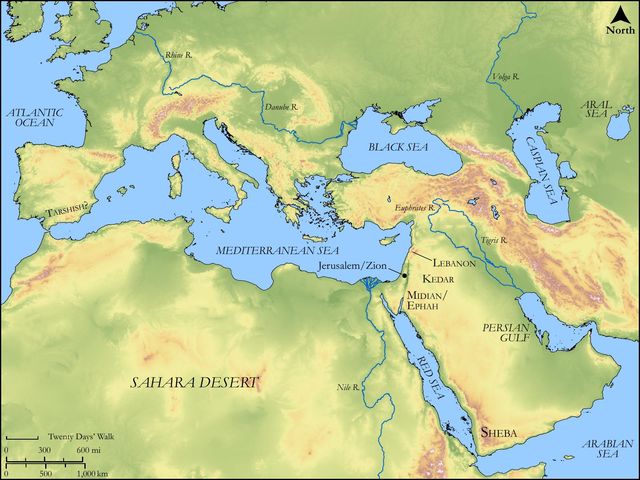
See on the biblical-era map
Study this verse
Public-domain commentary
Matthew Henry
From his Commentary on the Whole Bible. Henry comments on passages, not single verses — this entry covers Isaiah 44:1–8. His three-level outline is real structure in the source text, so it is rendered as structure.
Two great truths are abundantly made out in these verses: -
I.That the people of God are a happy people, especially upon account of the covenant that is between them and God.
The people of Israel were so as a figure of the gospel Israel. Three things complete their happiness: -
1.The covenant-relations wherein they stand to God, Isa 44:1, Isa 44:2. Israel is here called Jeshurun - the upright one; for those only, like Nathanael, are Israelites indeed, in whom is no guile, and those only shall have the everlasting benefit of these promises. Jacob and Israel had been represented, in the close of the foregoing chapter, as very provoking and obnoxious to God's wrath, and already given to the curse and to reproaches; but, as if God's bowels yearned towards him and his repentings were kindled together, mercy steps in with a non-obstante - notwithstanding, to all these quarrels: "Yet now, hear, O Jacob my servant! thou and I will be friends again for all this." God had said (Isa 43:25), I am he that blotteth out thy transgression, which is the only thing that creates this distance; and when that is taken away the streams of mercy run again in their former channel. The pardon of sin is the inlet of all the other blessings of the covenant. So and so I will do for them, says God (Heb 8:12), for I will be merciful to their unrighteousness. Therefore hear, O Jacob! hear these comfortable words; therefore fear not, O Jacob! fear not thy troubles, for by the pardon of sin the property of them too is altered. Now the relations wherein they stand to him are very encouraging.
(1.)They are his servants; and those that serve him he will own and stand by and see that they be not wronged.
(2.)They are his chosen, and he will abide by his choice; he knows those that are his, and those whom he has chosen he takes under special protection.
(3.)They are his creatures. He made them, and brought them into being; he formed them, and cast them into shape; he began betimes with them, for he formed them from the womb; and therefore he will help them over their difficulties and help them in their services.
2.The covenant-blessings which he has secured to them and theirs, Isa 44:3, Isa 44:4.
(1.)Those that are sensible of their spiritual wants, and the insufficiency of the creature to supply them, shall have abundant satisfaction in God: I will pour water upon him that is thirsty, that thirsts after righteousness; he shall be filled. Water shall be poured out to those who truly desire spiritual blessings above all the delights of sense.
(2.)Those that are barren as the dry ground shall be watered with the grace of God, with floods of that grace, and God will himself give the increase. If the ground be ever so dry, God has floods of grace to water it with.
(3.)The water God will pour out is his Spirit (Joh 7:39), which God will pour out without measure upon the seed, that is, Christ (Gal 3:16), and by measure upon all the seed of the faithful, upon all the praying wrestling seed of Jacob, Luk 11:13. This is the great New Testament promise, that God, having sent his servant Christ, and upheld him, will send his Spirit to uphold us.
(4.)This gift of the Holy Ghost is the great blessing God had reserved the plentiful effusion of for the latter days: I will pour my Spirit, that is, my blessing; for where God gives his Spirit he will give all other blessings.
(5.)This is reserved for the seed and offspring of the church; for so the covenant of grace runs: I will be a God to thee and to thy seed. To all who are thus made to partake of the privileges of adoption God will give the spirit of adoption.
(6.)Hereby there shall be a great increase of the church. Thus it shall be spread to distant places. Thus it shall be propagated and perpetuated to after-times: They shall spring up and grow as fast as willows by the watercourses, and in every thing that is virtuous and praiseworthy shall be eminent and excel all about them, as the willows overtop the grass among which they grow, Isa 44:4. Note, It is a great happiness to the church, and a great pleasure to good men, to see the rising generation hopeful and promising. And it will be so if God pour his Spirit upon them, that blessing, that blessing of blessings.
3.The consent they cheerfully give to their part of the covenant, Isa 44:5. When the Jews returned out of captivity they renewed their covenant with God (Jer 50:5), particularly that they would have no more to do with idols, Hos 14:2, Hos 14:3, Hos 14:8. Backsliders must thus repent and do their first works. Many of those that were without did at that time join themselves to them, invited by that glorious appearance of God for them, Zac 8:23; Est 8:17. And they say, We are the Lord's and call themselves by the name of Jacob; for there was one law, one covenant, for the stranger and for those that were born in the land. And doubtless it looks further yet, to the conversion of the Gentiles, and the multitudes of them who, upon the effusion of the Spirit, after Christ's ascension, should be joined to the Lord and added to the church. These converts are one and another, very many, of different ranks and nations, and all welcome to God, Col 3:11. When one does it another shall by his example be invited to do it, and then another; thus the zeal of one may provoke many. (1.) They shall resign themselves to God: not one in the name of the rest, but every one for himself shall say, "I am the Lord's; he has an incontestable right to rule me, and I submit to him, to all his commands, to all his disposal. I am, and will be, his only, his wholly, his for ever, will be for his interests, will be for his praise; living and dying I will be his." (2.) They shall incorporate themselves with the people of God, call themselves by the name of Jacob, forgetting their own people and their fathers' house, and desirous to wear the character and livery of God's family. They shall love all God's people, shall associate with them, give them the right hand of fellowship, espouse their cause, seek the good of the church in general and of all the particular members of it, and be willing to take their lot with them in all conditions. (3.) They shall do this very solemnly. Some of them shall subscribe with their hand unto the Lord, as, for the confirming of a bargain, a man sets his hand to it, and delivers it as his act and deed. The more express we are in our covenanting with God the better, Exo 24:7; Jos 24:26, Jos 24:27; Neh 9:38. Fast bind, fast find.
II.That, as the Israel of God are a happy people, so the God of Israel is a great God, and he is God alone.
This also, as the former, speaks abundant satisfaction to all that trust in him, Isa 44:6-8. Observe here, to God's glory and our comfort,
1.That the God we trust in is a God of incontestable sovereignty and irresistible power. He is the Lord, Jehovah, self-existent and self-sufficient; and he is the Lord of hosts, of all the hosts of heaven and earth, of angels and men.
2.That he stands in relation to, and has a particular concern for, his church. He is the King of Israel and his Redeemer; therefore his Redeemer because his King; and those that take God for their King shall have him for their Redeemer. When God would assert himself God alone he proclaims himself Israel's God, that his people may be encouraged both to adhere to him and to triumph in him.
3.That he is eternal - the first and the last. He is God from everlasting, before the worlds were, and will be so to everlasting, when the world shall be no more. If there were not a God to create, nothing would ever have been; and, if there were not a God to uphold, all would soon come to nothing again. He is all in all, is the first cause, from whom are all things, and the last end, to and for whom are all things (Rom 11:36), the Alpha and the Omega, Rev 1:11.
4.That he is God alone (Isa 44:6): Besides me there is no God. Is there a God besides me? Isa 44:8. We will appeal to the greatest scholars. Did they ever in all their reading meet with any other? To those that have had the largest acquaintance with the world. Did they ever meet with any other? There are gods many (Co1 8:5, Co1 8:6), called gods, and counterfeit gods: but is there any besides our God that is infinite and eternal, any besides him that is the creator of the world and the protector and benefactor of the whole creation, any besides him that can do that for their worshippers which he can and will do for his? "You are my witnesses. I have been a nonsuch to you. You have tried other gods; have you found any of them all-sufficient to you, or any of them like me? Yea, there is no god," no rock (so the word is), none besides Jehovah that can be a rock for a foundation to build on, a rock for shelter to flee to. God is the rock, and their rock is not as ours, Deu 32:4, Deu 32:31. I know not any; as if he had said, "I never met with any that offered to stand in competition with me, or that durst bring their pretensions to a fair trial; if I did know of any that could befriend you better than I can, I would recommend you to them; but I know not any." There is no God besides Jehovah. He is infinite, and therefore there can be no other; he is all-sufficient, and therefore there needs no other. This is designed for the confirming of the hopes of God's people in the promise of their deliverance out of Babylon, and, in order to that, for the curing of them of their idolatry; when the affliction had done its work it should be removed. They are reminded of the first and great article of their creed, that the Lord their God is one Lord, Deu 6:4. And therefore,
(1.)They needed not to hope in any other god. Those on whom the sun shines need neither moon nor stars, nor the light of their own fire.
(2.)They needed not to fear any other god. Their own God was more able to do them good than all the false and counterfeit gods of their enemies were to do them hurt.
5.That none besides could foretel these things to come, which God now by his prophet gave notice of to the world, above 200 years before they came to pass (Isa 44:7): "Who, as I, shall call, shall call Cyrus to Babylon? Is there any but God that can call effectually, and has every creature, every heart, at his beck? Who shall declare it, how it shall be, and by whom, as I do?" Nay, God goes further; he not only sees it in order, as having the foreknowledge of it, but sets it in order, as having the sole management and direction of it. Can any other pretend to this? He has always set things in order according to the counsel of his own will, ever since he appointed the ancient people, the people of Israel, who could give a truer and fuller account of the antiquities of their own nation than any other kingdom in the world could give of theirs. Ever since he appointed that people to be his peculiar people his providence was particularly conversant about them, and he told them beforehand the events that should occur respecting them - their bondage in Egypt, their deliverance from it, and their settlement in Canaan. All was set in order in the divine predictions as well as in the divine purposes. Could any other have done so? Would any other have been so far concerned for them? He challenges the pretenders to show the things that shall come hereafter: "Let them, if they can, tell us the name of the man that shall destroy Babylon ad deliver Israel? Nay, if they cannot pretend to tell us the things that shall come hereafter, let them tell us the things that are coming, that are nigh at hand and at the door. Let them tell us what shall come to pass tomorrow; but they cannot do that; fear them not therefore, nor be afraid of them. What harm can they do you? What hindrance can they give to your deliverance, when I have told thee it shall be accomplished in its season, and I have solemnly declared it?" Note, Those who have the word of God's promise to depend upon need not be afraid of any adverse powers or policies whatsoever.
Historical interpretation
Historical reception
3 surviving comments on this verse. Each one is dated, so this reads as a timeline rather than a list.
Select a marker to jump to its quote. Markers stagger vertically where authors wrote within a few decades of each other.
God himself testifies that the Holy Spirit presides over his blessings, saying, “I will put my Spirit on your seed and my blessings on your children.” For no blessing can be full except through the inspiration of the Holy Spirit.
(Chapter 44, verse 1 and following) Now listen, my servant Jacob, and Israel, whom I have chosen. Thus says the Lord, your maker and shaper from the womb, your helper. Do not fear, my servant Jacob, and you, whom I have chosen. For I will pour water on the thirsty land and streams on the dry ground; I will pour out my spirit on your offspring, and my blessing on your descendants. They will sprout among the grass, like willows by flowing streams. He will say, 'I am the Lord's,' and another will name himself by the name of Jacob, and another will write on his hand, 'The Lord's,' and adopt the name of Israel. LXX: But now hear, Jacob my servant, and Israel whom I have chosen. I am the Lord your God, who created you and formed you from the womb; you will still have my help. Do not fear, my servant Jacob, and beloved Israel whom I have chosen. I will pour water on the thirsty land and streams on the dry ground; I will pour out my Spirit on your offspring, and my blessings on your descendants.' And they shall spring up as among the grass, and as willows by the water courses. One shall say, I am the Lord's: and another shall call himself by the name of Jacob: and another shall subscribe with his hand unto the Lord, and surname himself by the name of Israel. When the people of Judah are accused of unbelief and blasphemy, they are called by simple names without any dignity: You have not called upon me, O Jacob, neither have you labored about me, O Israel; and again: I have given Jacob to utter destruction, and Israel to reproaches. But when he speaks to the choir of the Apostles, who are from the Jews, the privileges of their names are also joined. Listen, Jacob my servant, and Israel whom I have chosen: that servitude be first, election second. Thus says the Lord, your maker and your creator, who aided you in the womb (Gen. XXV): that even in the womb of your mother you would grasp the heel of your brother. Or who, at the beginning of the nascent Church, preserved you from persecutors. Do not fear their cruelty, my servant Jacob, whom I have chosen. He is also called Israel; Isurun in Hebrew, and the others, the most upright or the straightest. Only the LXX called him the most beloved, combining it with their own, Israel. Specifically, according to the Hebrews and the faith of the scriptures, Israel is called the upright one of God. But a man who sees God is not in the elements, but in the sound of his voice. And the book of Genesis is called εὐθεῖς, that is, the book of the righteous: Abraham, Isaac, and Israel. Therefore, do not be afraid, Jacob and Israel, for I will pour out water on the thirsty and the dry land, of which it has often been said: 'I will pour out, or I will put my spirit upon your offspring, and my blessing upon your descendants, who will be born again in water and the Holy Spirit in baptism. This promise was also made by the Savior in the Gospel, when he said: 'Let anyone who is thirsty come to me and drink.' And immediately he brings in: Now he said this about the Holy Spirit, whom those who believed in him were to receive (John 7). He also compares those who are reborn in baptism to evergreen herbs and willows that grow by flowing waters, and he brings forth fruits against nature, which was previously barren, or whose seed, when consumed as food, renders them barren. This is indeed read in the first psalm: And he shall be like a tree planted beside the running waters, which shall yield its fruit in due season, and its leaf shall not fall. Others among the herbs and the growing willows understand a twofold calling: that the people of the nations be in the herbs; in the willows, those who believed from Israel. And at the same time it describes the variety of believers: One will say, 'I am of the Lord', who trusts in the works of righteousness within himself; another will call, it is understood, 'sinners to repentance in the name of Jacob', so that they themselves may uproot vices and sins. Another will write with his own hand, 'I belong to God'. Or as they translated it in the Septuagint, he will write in his hand: I am of God, so that he may boast in the new apprenticeship of the service of Christ. And he will be assimilated in the name of Israel. For not all from Israel, but a great part from the multitude of the Gentiles, will be assimilated in the name of Israel, so that he may receive the Law and the Prophets, and all the graces of the Holy Spirit that were promised to the Israelite people.
He does not cease to make mention of the creation and of his kindness after the creation.… You will not be alone in enjoying my benefits, he says, for the thirsty nations will also drink from the streams of salvation, thanks to your descendants.… He is addressing those who are in Babylon, yet it is not to them but to their descendants that he promises to give the grace of the Spirit.… Here the prophetic text, having promised to give water to those traveling through a dry land, has shown through whom he will give it. “I will set my Spirit on your seed and my blessing on your children.”
Continue studying Isaiah 44:3 across the web’s major study libraries — every link below opens this exact verse, chapter, or book on the destination site.
Read & Compare
 BibleGatewayThis verse in more than 200 translations and 70 languages.
 Bible.comThe YouVersion reader — hundreds of translations, reading plans, and highlights.
 ESV.orgCrossway's official English Standard Version reader.
 NET BibleThe NET translation with 60,000+ translators' notes on every rendering decision.
 STEP BibleTyndale House's free study tool — original text, vocabulary, and scholarly resources.
 BibliaLogos Bible Software's free web reader.
 USCCBThe New American Bible (Revised Edition) with the U.S. bishops' study notes.
Commentaries
 BibleHub CommentariesDozens of classic commentaries on this verse, gathered on one page.
 StudyLightMore than 100 commentary sets — the largest collection on the web.
 BibleRefPlain-English commentary on what this verse means, verse by verse.
 Enduring WordDavid Guzik's free commentary on this chapter, widely used by Bible teachers.
 Bible Study ToolsVerse commentary alongside Greek and Hebrew study aids.
Original Language & Research
- BibleHub InterlinearThe verse word by word — original language, transliteration, and English.
- BibleHub LexiconEvery word's original-language definition and Strong's entry.
 Blue Letter BibleDeep-study tools — Strong's numbers, concordance, and word studies.
 SefariaThe Hebrew text with Rashi and centuries of Jewish commentary.
Sermons, Hymns & Audio


TrulyRandomVerse is not affiliated with these sites and doesn’t control their content. They’re linked because they’re genuinely useful.
Summary
Isaiah 44:3 presents a profound divine promise of abundant provision and spiritual revitalization, assuring a desolate and spiritually parched Israel that God will not only meet their physical needs with life-sustaining water but, more significantly, will lavishly pour out His life-giving Spirit upon their descendants. This declaration serves as a powerful antidote to the despair of exile and the barrenness of idolatry, guaranteeing a future of spiritual vitality, generational blessing, and renewed covenant relationship rooted in God's unwavering faithfulness and transformative power.
Context
ShowHideLiterary Context
Isaiah 44:3 is strategically placed within the "Book of Comfort" (Isaiah 40-55), a section predominantly addressed to the exiled Israelites, offering profound hope and assurance of their eventual return and restoration. The immediate literary context of Isaiah 44 begins with God's direct address to Jacob and Israel, reaffirming His unique election and enduring covenant relationship with them (e.g., Isaiah 44:1-2). This promise of water and Spirit is presented as a stark and life-affirming contrast to the utter futility and lifelessness of idols, which are meticulously exposed and ridiculed in the subsequent verses (Isaiah 44:9-20). The imagery of pouring water and Spirit directly counters the spiritual drought and barrenness that idolatry inevitably brings, emphatically asserting that God alone is the true source of life, blessing, and spiritual vitality.
Historical & Cultural Context
The prophecy of Isaiah was delivered during a tumultuous period for Israel, ultimately culminating in the devastating Babylonian exile. The nation had experienced severe spiritual and physical desolation due to their persistent unfaithfulness to God's covenant. Metaphorically, their land was "dry ground" and the people were "thirsty" for hope, restoration, and a renewed relationship with their God. In the arid climate of the land of Israel, water was not merely a commodity but an indispensable symbol of life, prosperity, and divine favor. The promise of "floods" and "water" would have resonated deeply with a people whose very survival and agricultural productivity depended on rainfall and fertile land. Furthermore, the cultural landscape was rife with pervasive idol worship, a constant and powerful temptation for Israel. God's promise to pour out His Spirit directly challenges the impotent and lifeless nature of the pagan deities, asserting His active, dynamic, and life-giving presence as the sole true source of sustenance and spiritual vitality.
Key Themes
ShowHideThis verse contributes significantly to several major themes woven throughout Isaiah and the broader biblical narrative. Firstly, it powerfully highlights Divine Provision and Sustenance, portraying God as the benevolent and abundant provider who meets both physical and spiritual needs, transforming desolation into overflowing abundance, as vividly depicted in the imagery of water on dry ground. Secondly, the promise of pouring out "my spirit" underscores the profound theme of Spiritual Outpouring and Renewal, foreshadowing a transformative work of God that transcends mere physical blessings to infuse divine life and empowering presence into His people. This theme is foundational to understanding the New Covenant and the work of the Holy Spirit. Thirdly, the extension of the promise to "thy seed" and "thine offspring" emphasizes Generational Blessing and Covenant Faithfulness, assuring Israel that God's promises are enduring and will continue through their descendants, ensuring a legacy of faith and divine favor, echoing earlier foundational promises made to Abraham in Genesis 12:2-3. Finally, the verse stands as a radiant beacon of Hope and Restoration, promising a future where spiritual barrenness is replaced by abundant life, demonstrating God's sovereign power to restore and renew even the most desolate situations, a prevalent and comforting theme throughout the "Book of Comfort" as seen in passages like Isaiah 40:1-2.
Exposition and Analysis
ShowHideKey Word Analysis
ShowHideFrom a primitive root, this verb (H3332) signifies a deliberate and abundant outpouring, whether literally of liquids or metaphorically of divine presence and blessing. It implies a complete and generous release, not a mere trickle or limited supply. In this context, it emphasizes the lavishness and totality of God's provision of both water and Spirit, ensuring a comprehensive and overflowing supply to meet the deep and extensive needs of His people.
This rich and multifaceted term (H7307) encompasses wind, breath, and, most significantly here, the divine Spirit. It refers to the very essence of God's life-giving, empowering, and animating presence. Its pouring out signifies a profound spiritual infusion, bringing vitality, revelation, divine guidance, and the active, transforming presence of God into the lives of individuals and the community, thereby transforming barrenness into spiritual fruitfulness and renewed life.
This word (H2233) literally means "seed" but figuratively refers to fruit, plant, and, most importantly in this prophetic context, posterity or offspring. Its inclusion highlights the generational aspect of God's promise. The blessings of water and Spirit are not confined to the immediate generation but are explicitly intended to extend to future descendants, ensuring the continuity of God's covenant people and the perpetuation of His divine favor and spiritual vitality through the lineage of Israel.
Verse Breakdown
ShowHide"For I will pour water upon him that is thirsty,"
This initial clause establishes God as the active, sovereign, and benevolent provider. The imagery of "water" immediately evokes physical sustenance and refreshing relief, particularly vital in an arid land. "Him that is thirsty" refers to those in desperate need, whether physically parched or, more profoundly, spiritually longing for divine intervention, hope, and renewal. It signifies God's direct and compassionate response to a state of profound need and yearning.
"and floods upon the dry ground:"
This phrase expands upon the previous image, intensifying the promise of provision from sufficiency to overwhelming abundance. "Floods" (Hebrew nâzal, H5140, implying flowing streams or gushing water) suggests an overwhelming, superabundant supply, far beyond mere adequacy. "Dry ground" (Hebrew yabbâshâh, H3004) vividly portrays a desolate, barren, and unproductive state, representing not only the physical land of Israel but also the spiritual condition of the people. God promises to transform this barrenness into lush fruitfulness and vibrancy.
"I will pour my spirit upon thy seed,"
This is the pivotal spiritual promise, elevating the divine provision beyond physical sustenance to profound spiritual empowerment. The repetition of "I will pour" emphasizes the certainty, intentionality, and generosity of God's action. "My spirit" refers to the Holy Spirit (Hebrew rûwach, H7307), the very presence, power, and animating force of God. This outpouring is explicitly directed "upon thy seed" (Hebrew zeraʻ, H2233), extending the spiritual blessing to future generations, ensuring a continuity of divine presence and spiritual vitality within the covenant community.
"and my blessing upon thine offspring:"
This final clause reinforces, summarizes, and expands upon the comprehensive nature of God's promise. "My blessing" (Hebrew bᵉrâkâh, H1293) encompasses prosperity, favor, well-being, and divine empowerment in its fullest sense. "Thine offspring" (Hebrew tseʼĕtsâʼ, H6631) is synonymous with "thy seed," reiterating and emphasizing the generational scope of God's covenant faithfulness. The Spirit's outpouring is inextricably linked to God's blessing, indicating that true prosperity and flourishing come from His life-giving presence and favor, extending through the generations.
Literary Devices
ShowHideIsaiah 44:3 is richly imbued with powerful Imagery and profound Symbolism, particularly through the vivid juxtaposition of "water" and "floods" with "thirsty" individuals and "dry ground." Water universally symbolizes life, purification, refreshment, and divine favor, while thirst and dry ground represent spiritual and physical desolation, desperate need, and barrenness. The act of "pouring" suggests an abundant, unhindered, and generous divine supply. The verse also employs a clear instance of Parallelism, specifically Synonymous Parallelism, where the second half of each line reiterates or intensifies the meaning of the first: "water upon him that is thirsty" is paralleled by "floods upon the dry ground," and "my spirit upon thy seed" by "my blessing upon thine offspring." This poetic structure emphasizes the certainty and dual nature (physical and spiritual) of God's comprehensive promise. Furthermore, the entire verse functions as a profound Metaphor, where the physical act of watering parched land serves as a vivid analogy for the spiritual renewal and life that God's Spirit brings to a spiritually dry and longing people.
Theological and Thematic Connections
ShowHideIsaiah 44:3 stands as a cornerstone prophecy, deeply rooted in the Old Testament's understanding of God's covenant faithfulness and pointing forward with remarkable clarity to the New Testament's revelation of the Holy Spirit. It underscores the foundational biblical truth that true life, flourishing, and spiritual vitality come not from human effort, self-reliance, or the worship of lifeless idols, but solely from the sovereign, life-giving presence of God. The promise of the Spirit's outpouring is a profound testament to God's desire for an intimate, transformative, and empowering relationship with His people, ensuring their spiritual vitality and the continuation of His redemptive plan through successive generations. This verse beautifully bridges the gap between the physical blessings often emphasized in the Old Covenant and the spiritual realities of the New, highlighting God's consistent character as a benevolent provider who always exceeds expectations and delights in bringing life out of desolation.
Reflection and Application
ShowHideIsaiah 44:3 offers profound and enduring encouragement for believers today, serving as a powerful reminder that God is perpetually eager to meet our deepest needs, both seen and unseen. When we experience spiritual dryness, a lack of passion, feel overwhelmed by the barrenness of our circumstances, or sense a spiritual drought in the world around us, this verse calls us to remember God's unchanging character as the ultimate source of refreshment, renewal, and life. It invites us to come to Him with our thirst, trusting that He will not merely trickle but "pour" out His Spirit upon us, bringing life, divine guidance, empowering presence, and spiritual fruitfulness. This promise also extends powerfully to our "seed" and "offspring"—our children, grandchildren, and future generations—underscoring our profound responsibility to pray fervently for their spiritual inheritance and to live in a way that models a deep thirst for God, thereby ensuring a legacy of faith and divine blessing. It compels us to live in expectant faith, knowing that the same God who promised to transform dry ground into floods of blessing is actively at work and willing to do so in our lives and in the lives of those who come after us, bringing forth spiritual abundance from spiritual desolation.
Questions for Reflection
ShowHideFAQ
ShowHideIs this promise of water and Spirit only for the nation of Israel?
ShowHideWhile Isaiah 44:3 was initially given within the specific historical context of the exiled nation of Israel, its profound theological implications extend far beyond a single ethnic group. The vivid imagery of water for the thirsty and Spirit for the seed is universally applicable to the human condition of spiritual need and God's boundless divine provision. The New Testament reveals that the widespread outpouring of the Holy Spirit, prophesied here and in passages like Joel 2:28-29, is for "all flesh" (Acts 2:17), encompassing believers from every nation who are now considered spiritual offspring of Abraham through faith in Christ (Galatians 3:7-9). Therefore, while deeply rooted in Israel's history and covenant, the spiritual promise finds its ultimate, broader, and inclusive fulfillment in the church, the global body of Christ.
How does God "pour" out His Spirit today?
ShowHideToday, God pours out His Spirit primarily through the indwelling presence of the Holy Spirit in every believer at the moment of salvation (Ephesians 1:13-14). Beyond this initial, foundational indwelling, the Spirit is continually "poured out" in various dynamic ways: through spiritual refreshment and renewal in times of prayer and worship (Acts 4:31), through empowerment for effective service and bold witness (Acts 1:8), through the impartation of diverse spiritual gifts for the building up of the church (1 Corinthians 12:4-11), and through the ongoing sanctifying work that produces Christ-like character and spiritual fruit (Galatians 5:22-23). This signifies a continuous, abundant, and transformative supply of God's active presence and power for all who thirst for Him.
Christ-Centered Fulfillment
ShowHideIsaiah 44:3, with its vivid imagery of life-giving water and the abundant outpouring of the Spirit, finds its climactic and ultimate fulfillment in the person and redemptive work of Jesus Christ. He is the ultimate source of the "living water" that eternally quenches spiritual thirst, as He profoundly declared in John 7:37-38, promising that those who believe in Him will have "rivers of living water flow from within them," which the Apostle John explicitly identifies as the Spirit. Jesus' sacrificial death on the cross, His victorious resurrection, and His subsequent ascension to the Father's right hand paved the way for the Spirit's promised outpouring. On the Day of Pentecost, as dramatically recorded in Acts 2, the prophecy of Joel (and by extension, the spirit of Isaiah's promise) was gloriously fulfilled as the Holy Spirit was poured out upon the disciples, powerfully empowering them and transforming them from a "dry ground" of fear and uncertainty into a vibrant, fruitful, and courageous community. Thus, Christ is the divine conduit through whom God's Spirit is poured out upon His "seed"—not merely physical Israel, but all who are united to Him by faith, becoming spiritual offspring of Abraham and heirs according to the promise (Galatians 3:29). Through Jesus, the comprehensive blessing of God's Spirit is extended to all who believe, bringing spiritual life, profound renewal, and empowering presence, thereby fulfilling the ancient promise in a glorious, global, and eternally significant way.