


Revelation 22:17
Bible text: King James Version (1769 Blayney text) · Public domain
Bible text: King James Version with Strong's numbers · Public domain
Bible text: Berean Standard Bible · Public domain
Bible text: American Standard Version (1901) · Public domain
Bible text: World English Bible, Messianic edition · Public domain
Bible text: Geneva Bible (1599) · Public domain
Bible text: Young's Literal Translation · Public domain
- καὶkaiAndG2532CONJConjunction
- τὸtotheG3588T-NSNDefinite article Nominative Singular Neuter
- πνεῦμαpneumaSpiritG4151N-NSNNoun Nominative Singular Neuter
- καὶkaiandG2532CONJConjunction
- ἡhētheG3588T-NSFDefinite article Nominative Singular Feminine
- νύμφηnumphēbrideG3565N-NSFNoun Nominative Singular Feminine
- λέγουσιν·legousinsayG3004V-PAI-3PVerb Present Active Indicative 3rd Plural
- ἔρχουerchouCome!G2064V-PNM-2SVerb Present Middle Or Passive Deponent Imperative 2nd Singular
- καὶkaiAndG2532CONJConjunction
- ὁhothe [one]G3588T-NSMDefinite article Nominative Singular Masculine
- ἀκούωνakouōnhearingG191V-PAP-NSMVerb Present Active Participle Nominative Singular Masculine
- εἰπάτω·eipatōhe should sayG2036V-2AAM-3SVerb 2nd Aorist Active Imperative 3rd Singular
- ἔρχουerchouCome!G2064V-PNM-2SVerb Present Middle Or Passive Deponent Imperative 2nd Singular
- καὶkaiAndG2532CONJConjunction
- ὁhothe [one]G3588T-NSMDefinite article Nominative Singular Masculine
- διψῶνdipsōnthirstingG1372V-PAP-NSMVerb Present Active Participle Nominative Singular Masculine
- ἐρχέσθωerchesthōhe should comeG2064V-PNM-3SVerb Present Middle Or Passive Deponent Imperative 3rd Singular
- καὶkaiandG2532CONJConjunction
- ὁhothe [one]G3588T-NSMDefinite article Nominative Singular Masculine
- θέλωνthelōndesiringG2309V-PAP-NSMVerb Present Active Participle Nominative Singular Masculine
- λαβέτωlabetōhe should takeG2983V-2AAM-3SVerb 2nd Aorist Active Imperative 3rd Singular
- τὸtotheG3588T-ASNDefinite article Accusative Singular Neuter
- ὕδωρhudōrwaterG5204N-ASNNoun Accusative Singular Neuter
- ζωῆςzōēsof lifeG2222N-GSFNoun Genitive Singular Feminine
- δωρεάνdōreanfreelyG1432ADVAdverb
English is a literal word-by-word gloss of the Greek, not the KJV's wording. Why?
This is the original text the KJV's translators worked from — each Greek word with its own literal English meaning in this verse, prepared by scholars at Tyndale House, Cambridge. The KJV translates whole sentences, not word by word, so its wording differs: one Greek word can become several English words, and the KJV may choose “charity” where the gloss reads “love”. Both are faithful — they answer different questions. For the KJV's own rendering, switch to the KJV text.
Details
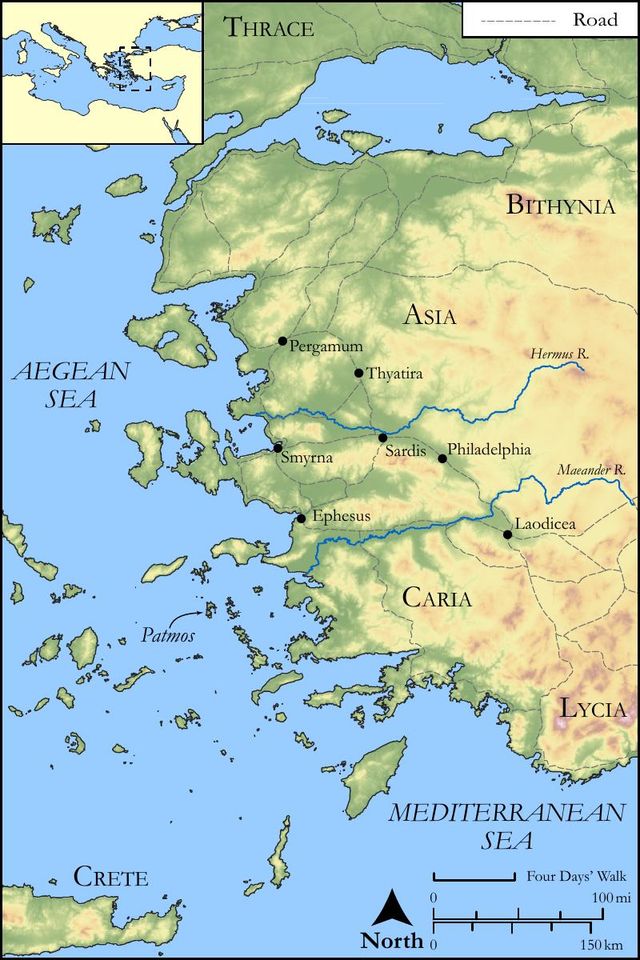
See on the biblical-era maps

Study this verse
Public-domain commentary
Matthew Henry
From his Commentary on the Whole Bible. Henry comments on passages, not single verses — this entry covers Revelation 22:6–19.
We have here a solemn ratification of the contents of this book, and particularly of this last vision (though some think it may not only refer to the whole book, but to the whole New Testament, yea, to the whole Bible, completing and confirming the canon of scripture); and here, 1. This is confirmed by the name and nature of that God who gave out these discoveries: he is the Lord God, faithful and true, and so are all his sayings. 2. By the messengers he chose, to reveal these things to the world; the holy angels showed them to holy men of God; and God would not employ his saints and angels in deceiving the world. 3. They will soon be confirmed by their accomplishment: they are things that must shortly be done; Christ will make haste, he will come quickly, and put all things out of doubt; and then those will prove the wise and happy men who have believed and kept his words. 4. By the integrity of that angel who had been the apostle's guide and interpreter in these visions; this integrity was such that he not only refused to accept religious adoration from John, but once and again reproved him for it. He who was so tender of the honour of God, and so displeased with what was a wrong to God, would never come in his name to lead the people of God into mere dreams and delusions; and it is a still further confirmation of the sincerity of this apostle that he confesses his own sin and folly, into which he had now again relapsed, and he leaves this his failing on perpetual record: this shows he was a faithful and an impartial writer. 5. By the order given to leave the book of the prophecy open, to be perused by all, that they might labour to understand it, that they might make their objections against it, and compare the prophecy with the events. God here deals freely and openly with all; he does not speak in secret, but calls every one to witness to the declarations here made, Rev 22:10. 6. By the effect this book, thus kept open, will have upon men; those that are filthy and unjust will take occasion thence to be more so, but it will confirm, strengthen, and further sanctify those that are upright with God; it will be a savour of life to some and of death to others, and so will appear to be from God, Rev 22:12. 7. It will be Christ's rule of judgment at the great day; he will dispense rewards and punishments to men according as their works agree or disagree with the word of God; and therefore that word itself must needs be faithful and true. 8. It is the word of him who is the author, finisher, and rewarder of the faith and holiness of his people, Rev 22:13, Rev 22:14. He is the first and the last, and the same from first to last, and so is his word too; and he will by this word give to his people, who conform themselves to it, a right to the tree of life, and an entrance into heaven; and this will be a full confirmation of the truth and authority of his word, since it contains the title and evidence of that confirmed state of holiness and happiness that remains for his people in heaven. 9. It is a book that condemns and excludes from heaven all wicked, unrighteous persons, and particularly those that love and make lies (Rev 22:15), and therefore can never be itself a lie. 10. It is confirmed by the testimony of Jesus, which is the Spirit of prophecy. And this Jesus, as God, is the root of David, though, as man, his offspring - a person in whom all uncreated and created excellencies meet, too great and too good to deceive his churches and the world. He is the fountain of all light, the bright and the morning star, and as such has given to his churches this morning light of prophecy, to assure them of the light of that perfect day which is approaching. 11. It is confirmed by an open and general invitation to all to come and partake of the promises and privileges of the gospel, those streams of the water of life; these are tendered to all who feel in their souls a thirst which nothing in this world can quench. 12. It is confirmed by the joint testimony of the Spirit of God, and that gracious Spirit that is in all the true members of the church of God; the Spirit and the bride join in testifying the truth and excellency of the gospel. 13. It is confirmed by a most solemn sanction, condemning and cursing all who should dare to corrupt or change the word of God, either by adding to it or taking from it, Rev 22:18, Rev 22:19. He that adds to the word of God draws down upon himself all the plagues written in this book; and he who takes any thing away from it cuts himself off from all the promises and privileges of it. This sanction is like a flaming sword, to guard the canon of the scripture from profane hands. Such a fence as this God set about the law (Deu 4:2), and the whole Old Testament (Mal 4:4), and now in the most solemn manner about the whole Bible, assuring us that it is a book of the most sacred nature, divine authority, and of the last importance, and therefore the peculiar care of the great God.
Historical interpretation
Eight Centuries of Reception
9 surviving comments on this verse. Each one is dated, so this reads as a timeline rather than a list.
Select a marker to jump to its quote. Markers stagger vertically where authors wrote within a few decades of each other.
Since therefore we have such proofs, it is not necessary to seek the truth among others which it is easy to obtain from the Church; since the apostles, like a rich man
How is it that he who wishes may take [of the tree of life] when he had said, “No one can come to me unless the Father who sent me draws him,” unless because we know that one who was previously unwilling becomes willing through divine inspiration? So also here free will is fittingly included when he says, “Let him who desires take,” since immediately grace is proclaimed when he says, “the water of life without price.” To be sure, [this means] let him take the water of life without price, even though no good [works] have gone before. As the apostle says, “What have you that you did not receive?” Therefore, we receive by grace from God even the will to come, and to this we have brought nothing beforehand so that we might be [willing]. How much more, therefore, [do we bring nothing] so that from being sinners we might be made righteous.
Salvation is given without any price and without any barter. Rather, he who desires to be saved, he will enter and will either receive free of charge the regeneration of baptism, or he will receive the remedy of repentance without cost or charge. The prophet spoke in a similar manner: “All who thirst, come to the waters; and you who have no money, hasten, come, buy and eat.”
The Holy Spirit and the church call all to come to salvation.… And whoever keeps the words of this prophecy and hears him whom the Lord himself has commanded [to speak], he is worthy to be taught.
The church and the Spirit in her crying out in our hearts “Abba, Father” call for the coming of the only begotten Son of God. Indeed, every faithful person who hears prays to God the Father as he has been taught, “Your kingdom come!”
Let him who thirsts come. Whoever desires, let him take the water of life freely. Thus free will is addressed by saying, "Whoever desires, let him take," so that grace is immediately proclaimed in what follows: "the water of life freely." Certainly without any preceding merits. For even the desire itself is a gift of God.
And let him who hears say, "Come." Whoever has received the inner light of faith or charity in his mind, let him call others to the same.
And the Spirit and the bride say, "Come." The head and the body of the Church, each individual member, exhort to faith.
And he says the Spirit, that is, the prophetic spirit, and the bride, the universal and the church everywhere, say Come. For we have been commanded to seek the second coming of the Lord, but also to place it in prayer; for he who says, "Your kingdom come," (Matt. 6:10) asks of God the kingdom of Christ, which is the kingdom of the Father and of the Spirit.
And let the one who hears say, Come. And everyone, he says, hearing the words present, and you, John, make prayer for the coming of the kingdom of Christ. He says this, urging all to works and practices of righteousness; for no one, not having righteousness firmly established in himself, would make prayer for the coming of Christ, in which he will be demanded an account of the words in which he lived.
And he who thirsts, he says, let him come; let him who wills take the free gift of the water of life; and in how long the time will come of my presence, says the Lord, to the fountain of life, to the practice of virtue affix your mouth. "And all of you who have no money, come, buy, and drink without money and without price." (Isa. 55:1) Isaiah admonishes us, prophesying the same things beforehand to the Lord.
And it has also been said in the passages that one receives the gift of virtue's reward after enduring sweats and toils, since "the sufferings of the present time are not worthy to be compared with the glory to be revealed to us, (Rom. 8:18) according to the words of Paul the most wise.
Continue studying Revelation 22:17 across the web’s major study libraries — every link below opens this exact verse, chapter, or book on the destination site.
Read & Compare
 BibleGatewayThis verse in more than 200 translations and 70 languages.
 Bible.comThe YouVersion reader — hundreds of translations, reading plans, and highlights.
 ESV.orgCrossway's official English Standard Version reader.
 NET BibleThe NET translation with 60,000+ translators' notes on every rendering decision.
 STEP BibleTyndale House's free study tool — original text, vocabulary, and scholarly resources.
 BibliaLogos Bible Software's free web reader.
 USCCBThe New American Bible (Revised Edition) with the U.S. bishops' study notes.
Commentaries
 BibleHub CommentariesDozens of classic commentaries on this verse, gathered on one page.
 StudyLightMore than 100 commentary sets — the largest collection on the web.
 BibleRefPlain-English commentary on what this verse means, verse by verse.
 Enduring WordDavid Guzik's free commentary on this chapter, widely used by Bible teachers.
 Bible Study ToolsVerse commentary alongside Greek and Hebrew study aids.
Original Language & Research
- BibleHub InterlinearThe verse word by word — original language, transliteration, and English.
- BibleHub LexiconEvery word's original-language definition and Strong's entry.
 Blue Letter BibleDeep-study tools — Strong's numbers, concordance, and word studies.
 CNTR CollationThe earliest Greek manuscripts of this verse, collated letter by letter.
Sermons, Hymns & Audio


TrulyRandomVerse is not affiliated with these sites and doesn’t control their content. They’re linked because they’re genuinely useful.
Summary
Revelation 22:17 delivers a profound and climactic invitation at the close of Scripture, echoing the Spirit's and the Church's fervent longing for Christ's return and for all humanity to embrace the free gift of eternal life. This verse extends a universal call to anyone who is spiritually thirsty and willing, urging them to partake of the life-giving water offered without cost, thereby encapsulating the Gospel's inclusive grace and the ultimate hope of salvation.
Context
ShowHideLiterary Context
Revelation 22:17 is strategically placed as one of the Bible's final appeals, immediately following a glorious description of the New Jerusalem, the river of the water of life, and the tree of life (Revelation 22:1-5). It precedes the final warnings and blessings of the book, including Jesus' own declaration of His imminent return (Revelation 22:7, Revelation 22:12, Revelation 22:20). This positioning amplifies its urgency and significance, acting as a final, open-ended invitation before the book's concluding benediction, drawing the reader into the narrative's ultimate purpose: salvation and eternal communion with God.
Historical & Cultural Context
The Book of Revelation was written by John during a period of intense persecution for early Christians under the Roman Empire, likely during the reign of Emperor Domitian. The audience, facing immense pressure to conform to imperial cult worship, would have found profound encouragement and hope in the visions of God's ultimate triumph and the promise of a new heaven and new earth. The imagery of "water of life" would resonate deeply with a people living in a largely arid region, where water symbolized sustenance, purity, and life itself. The concept of a "bride" for the Lamb (Christ) was a familiar Old Testament metaphor for Israel and later for the Church, signifying a covenantal relationship of intimacy and faithfulness, particularly relevant in a world where fidelity to Christ was often met with severe consequences.
Key Themes
ShowHideThis verse powerfully encapsulates several overarching themes of Revelation and the entire biblical narrative. It highlights the sovereignty of God in offering salvation, the active role of the Holy Spirit in extending the invitation, and the identity and mission of the Church as the "bride" longing for her Groom and inviting others to join. The theme of spiritual thirst is central, portraying humanity's innate longing for meaning and fulfillment, which can only be satisfied by God's provision. Most significantly, it underscores the free gift of grace, emphasizing that salvation is not earned but freely received, echoing the core Gospel message found throughout Scripture, from the initial promise of redemption in Genesis 3:15 to the climactic fulfillment in Christ's atoning work (Romans 6:23). The repeated call to "Come" also reinforces the imminent return of Christ and the urgency of responding to the divine invitation before the consummation of all things.
Exposition and Analysis
ShowHideKey Word Analysis
ShowHideThis primary verb signifies "to come or go" in a variety of applications, both literal and figurative. In Revelation 22:17, its repeated use functions as an urgent, open invitation, not merely a physical movement but a spiritual turning and embracing. It reflects the deep longing of the Spirit and the bride for the Lord's return, and simultaneously, their passionate desire for individuals to draw near to God and receive salvation. It is an active call for participation in the divine offer.
Derived from G1372, this word means "to thirst for," literally or figuratively. It vividly portrays the human condition of spiritual longing, a deep-seated need for satisfaction that worldly pursuits cannot fulfill. This thirst is not merely a physical craving but a profound spiritual emptiness, an innate yearning for God, truth, and eternal life. The invitation is specifically extended to those who recognize and feel this spiritual need.
This adverb means "gratuitously," "without a cause," or "for naught." Its inclusion here is paramount, emphasizing the unmerited nature of the "water of life." It underscores that salvation and eternal life are not earned through human effort, merit, or payment, but are a pure gift of God's boundless grace. This word highlights the radical generosity of God's offer, making it accessible to all who are willing to receive it.
Verse Breakdown
ShowHide"And the Spirit and the bride say, Come."
This opening clause presents a unified, divine-human invitation. The "Spirit" refers to the Holy Spirit, who convicts, regenerates, and empowers (John 16:8). The "bride" is the Church, Christ's redeemed people, eagerly awaiting His return (Revelation 21:2). Their joint cry of "Come" is both an earnest plea for Christ's return (Maranatha!) and a fervent evangelistic appeal to the world to accept salvation.
"And let him that heareth say, Come."
This clause extends the invitation's reach, making it a participatory call. Those who have heard the Gospel and embraced it are now commissioned to echo the invitation. It emphasizes the Church's responsibility to bear witness and share the good news, acting as God's messengers in the world, propagating the call to salvation.
"And let him that is athirst come."
This segment targets the recipient of the invitation, specifically those who recognize their spiritual need. "Athirst" speaks to humanity's inherent spiritual emptiness and longing for something more than what the world offers. It is an invitation to those who feel a deep spiritual void, promising ultimate satisfaction in God.
"And whosoever will, let him take the water of life freely."
This final clause broadens the invitation to universal reach and clarifies the nature of the gift. "Whosoever will" highlights the element of human volition and choice in responding to God's grace. The "water of life" is a profound metaphor for eternal life, spiritual refreshment, and the Holy Spirit Himself, all offered "freely" (without cost or merit) by God. It signifies that the greatest gift, salvation, is available to anyone who simply chooses to receive it.
Literary Devices
ShowHideRevelation 22:17 employs several potent literary devices to convey its urgent and gracious message. Personification is evident in "the Spirit and the bride say, Come," attributing speech to both the Holy Spirit and the Church, emphasizing their active and unified role in extending the divine invitation. The pervasive use of Repetition of the word "Come" (Greek: érchomai) creates a powerful, rhythmic, and insistent appeal, underscoring the urgency and sincerity of the invitation. This repetition also serves to reinforce the accessibility and universality of the call. Furthermore, the phrase "water of life" is a rich Metaphor, symbolizing eternal life, spiritual sustenance, and the Holy Spirit. This imagery draws on ancient Near Eastern understanding of water as essential for survival, making the spiritual truth profoundly tangible. The phrase "whosoever will" functions as a statement of Universal Reach, highlighting the boundless and unconditional nature of God's grace, open to all who choose to respond.
Theological and Thematic Connections
ShowHideRevelation 22:17 stands as a capstone to the biblical narrative, synthesizing the themes of divine grace, human responsibility, and the ultimate hope of salvation. It beautifully illustrates the Trinitarian nature of salvation: the Spirit's active work in drawing people, the Church's (the bride) participation in extending the invitation, and the Father's provision of the "water of life" through Christ. This final appeal underscores God's persistent desire for humanity's redemption, even at the very threshold of eternity. It is a testament to the enduring love and mercy of God, who continues to call all people to Himself, offering the most precious gift—eternal life—without any prerequisites other than a willing heart and spiritual thirst. This verse serves as a powerful reminder that the door to salvation remains open until the very end.
Reflection and Application
ShowHideRevelation 22:17 is not merely a historical record but a living invitation that resonates with profound relevance for believers today. It calls us to a dual posture: one of eager anticipation for Christ's return, and another of urgent evangelistic zeal. As the "bride," the Church is empowered by the Spirit to echo the "Come" to a world that is deeply thirsty, often unknowingly, for the living water that only Christ can provide. This verse compels us to examine our own spiritual thirst—are we truly hungering and thirsting for righteousness and for God's presence, or are we seeking fleeting satisfaction in the broken cisterns of the world? It also serves as a powerful assurance for those who respond, reminding us that salvation is a gratuitous gift, freely given, requiring only a willing heart to receive. Our mission, therefore, is to be faithful conduits of this divine invitation, extending grace and hope to all "whosoever will," knowing that the ultimate satisfaction for every human soul is found in the "water of life" that flows from God Himself.
Questions for Reflection
ShowHideFAQ
ShowHideWhat is the "water of life" mentioned in Revelation 22:17?
ShowHideThe "water of life" is a profound biblical metaphor that primarily signifies eternal life, spiritual sustenance, and the Holy Spirit Himself, freely offered by God. This imagery draws on the life-giving properties of water, especially in arid regions, to represent the spiritual vitality and unending satisfaction that comes from a relationship with God through Christ. It is a recurring theme in Scripture, notably seen in Jesus' conversation with the Samaritan woman where He speaks of "living water" that quenches spiritual thirst, and in Revelation 21:6, where God declares, "I will give unto him that is athirst of the fountain of the water of life freely."
Who are "the Spirit and the bride" that say, "Come"?
ShowHide"The Spirit" refers to the Holy Spirit, the third person of the Trinity, who works to convict the world of sin, righteousness, and judgment, and draws individuals to Christ (John 16:8). "The bride" refers to the Church, the collective body of believers who are united with Christ, their "Bridegroom" (Ephesians 5:25-27). Their joint cry of "Come" is twofold: it is both an earnest prayer for Christ's swift return ("Maranatha," meaning "Our Lord, come!") and a fervent evangelistic invitation to all humanity to come to Christ for salvation. This highlights the Spirit's empowering presence within the Church, enabling it to fulfill its mission of witness and invitation.
Christ-Centered Fulfillment
ShowHideRevelation 22:17 serves as a climactic Christ-centered invitation, drawing together the entire biblical narrative into a singular, urgent appeal. The "water of life" is ultimately found in Christ Himself, who declared, "If any man thirst, let him come unto me, and drink" and "I am the bread of life: he that cometh to me shall never hunger; and he that believeth on me shall never thirst". He is the source of eternal life, the one who satisfies the deepest longings of the human soul. The invitation to "come" is an invitation to come to Him, the Lamb of God who was slain to take away the sin of the world (John 1:29). His atoning sacrifice on the cross made it possible for humanity to receive this "water of life freely," as salvation is a gift of God's grace, not earned by works (Ephesians 2:8-9). Thus, this final biblical invitation is a direct summons to embrace the person and work of Jesus Christ, the Alpha and the Omega, the beginning and the end, who alone offers true and eternal satisfaction (Revelation 22:13).