


Isaiah 12:3
Bible text: King James Version (1769 Blayney text) · Public domain
Bible text: Berean Standard Bible · Public domain
Bible text: American Standard Version (1901) · Public domain
Bible text: World English Bible, Messianic edition · Public domain
Bible text: Geneva Bible (1599) · Public domain
Bible text: Young's Literal Translation · Public domain
- וּשְׁאַבְתֶּםu·she·'av·temand you will drawH7579Conj-w ¦ V-Qal-ConsecPerf-2mpVerb Qal Consecutive Perfect 2nd Plural Masculineוּandשְׁאַבְתֶּםyou will draw
- מַיִםMa·yimwaterH4325N-mpNoun Plural Masculine Absolute
- בְּשָׂשׂוֹןbe·sa·Sonwith joyH8342Prep-b ¦ N-msNoun Singular Masculine Absoluteבְּwithשָׂשׂוֹןjoy
- מִמַּעַיְנֵיmi·ma·'ay·Neifrom [the] springs ofH4599Prep-m ¦ N-mpcNoun Plural Masculine Constructמִfromמַּעַיְנֵי[the] springs of
- הַיְשׁוּעָהhay·shu·'Ah<the> salvationH3444Art ¦ N-fsNoun Singular Feminine Absoluteהַ<the>יְשׁוּעָהsalvation
English is a literal word-by-word gloss of the Hebrew, not the KJV's wording. Why?
This is the original text the KJV's translators worked from — each Hebrew word with its own literal English meaning in this verse, prepared by scholars at Tyndale House, Cambridge. The KJV translates whole sentences, not word by word, so its wording differs: one Hebrew word can become several English words, and the KJV may choose “the LORD” where the gloss reads “Yahweh”. Both are faithful — they answer different questions. For the KJV's own rendering, switch to the KJV text.
Details
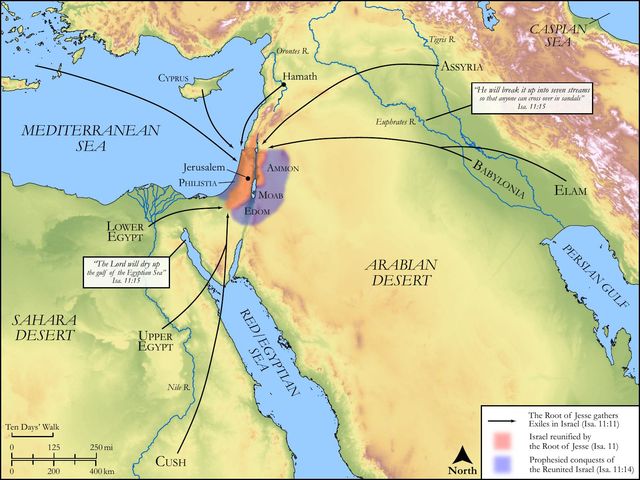
See on the biblical-era map
Study this verse
Public-domain commentary
Matthew Henry
From his Commentary on the Whole Bible. Henry comments on passages, not single verses — this entry covers Isaiah 12:1–3. His three-level outline is real structure in the source text, so it is rendered as structure.
This is the former part of the hymn of praise which is prepared for the use of the church, of the Jewish church when God would work great deliverances for them, and of the Christian church when the kingdom of the Messiah should be set up in the world in despite of the opposition of the powers of darkness: In that day thou shalt say, O Lord! I will praise thee. The scattered church, being united into one body, shall, as one man, with one mind and one mouth, thus praise God, who is one and his name one. In that day, when the Lord shall do these great things for thee, thou shalt say, O Lord! I will praise thee. That is,
I."Thou shalt have cause to say so." The promise is sure, and the blessings contained in it are very rich, and, when they are bestowed, will furnish the church with abundant matter for rejoicing and therefore with abundant matter for thanksgiving. The Old Testament prophecies of gospel times are often expressed by the joy and praise that shall then be excited; for the inestimable benefits we enjoy by Jesus Christ require the most elevated and enlarged thanksgivings.
II."Thou shalt have a heart to say so." All God's other gifts to his people shall be crowned with this.
He will give them grace to ascribe all the glory of them to him, and to speak of them upon all occasions with thankfulness to his praise. Thou shalt say, that is, thou oughtest to say so. In that day, when many are brought home to Jesus Christ and flock to him as doves to their windows, instead of envying the kind reception they find with Christ, as the Jews grudged the favour shown to the Gentiles, thou shalt say, O Lord! I will praise thee. Note, we ought to rejoice in, and give thanks for, the grace of God to others as well as to ourselves.
1.Believers are here taught to give thanks to God for the turning away of his displeasure from them and the return of his favour to them (Isa 12:1): O Lord! I will praise thee, though thou wast angry with me. Note, Even God's frowns must not put us out of tune for praising him; though he be angry with us, though he slay us, yet we must put our trust in him and give him thanks. God has often just cause to be angry with us, but we have never any reason to be angry with him, nor to speak otherwise than well of him; even when he blames us we must praise him. Thou was angry with us, but thy anger is turned away. Note,
(1.)God is sometimes angry with his own people and the fruits of his anger do appear, and they ought to take notice of this, that they may humble themselves under his mighty hand.
(2.)Though God may for a time be angry with his people, yet his anger shall at length be turned away; it endures but for a moment, nor will he contend for ever. By Jesus Christ, the root of Jesse, God's anger against mankind was turned away; for he is our peace.
(3.)Those whom God is reconciled to he comforts; even the turning away of his anger is a comfort to them; yet that is not all: those that are at peace with God may rejoice in hope of the glory of God, Rom 5:1, Rom 5:2. Nay, God sometimes brings his people into a wilderness that there he may speak comfortably to them, Hos 2:14.
(4.)The turning away of God's anger, and the return of his comforts to us, ought to be the matter of our joyful thankful praises.
2.They are taught to triumph in God and their interest in him (Isa 12:2): "Behold, and wonder; God is my salvation; not only my Saviour, by whom I am saved, but my salvation, in whom I am safe. I depend upon him as my salvation, for I have found him to be so. He shall have the glory of all the salvations that have been wrought for me, and from him only will I expect the salvations I further need, and not from hills and mountains: and if God be my salvation, if he undertake my eternal salvation, I will trust in him to prepare me for it and preserve me to it. I will trust him with all my temporal concerns, not doubting but he will make all to work for my good. I will be confident, that is, I will be always easy in my own mind." Note, Those that have God for their salvation may enjoy themselves with a holy security and serenity of mind. Let faith in God as our salvation be effectual,
(1.)To silence our fears. We must trust, and not be afraid, not be afraid that the God we trust in will fail us; no, there is no danger of that; not be afraid of any creature, though ever so formidable and threatening. Note, Faith in God is a sovereign remedy against disquieting tormenting fears.
(2.)To support our hopes. Is the Lord Jehovah our salvation? Then he will be our strength and song. We have work to do and temptations to resist, and we may depend upon him to enable us for both, to strengthen us with all might by his Spirit in the inner man, for he is our strength; his grace is so, and that grace shall be sufficient for us. We have many troubles to undergo, and must expect griefs in a vale of tears; and we may depend upon him to comfort us in all our tribulations, for he is our song; he giveth songs in the night. If we make God our strength, and put our confidence in him, he will be our strength; if we make him our song, and place our comfort in him, he will be our song. Many good Christians have God for their strength who have him not for their song; they walk in darkness: but light is sown for them. And those that have God for their strength ought to make him their song, that is, to give him the glory of it (see Psa 68:35) and to take to themselves the comfort of it, for he will become their salvation. Observe the title here given to God: Jah, Jehovah. Jah is the contraction of Jehovah, and both signify his eternity and unchangeableness, which are a great comfort to those that depend upon him as their strength and their song. Some make Jah to signify the Son of God made man; he is Jehovah, and in him we may glory as our strength, and song, and salvation.
3.They are aught to derive comfort to themselves from the love of God and all the tokens of that love (Isa 12:3): "Therefore, because the Lord Jehovah is your strength and song and will be your salvation, you shall draw water with joy." Note, The assurances God has given us of his love, and the experiences we have had of the benefit and comfort of his grace, should greatly encourage our faith in him and our expectations from him: "Out of the wells of salvation in God, who is the fountain of all good to his people, you shall draw water with joy. God's favour shall flow forth to you, and you shall have the comfort of it and make use of the blessed fruits of it." Note,
(1.)God's promises revealed, ratified, and given out to us, in his ordinances, are wells of salvation; wells of the Saviour (so some read it), for in them the Saviour and salvation are made known to us and made over to us.
(2.)It is our duty by faith to draw water out of these wells, to take to ourselves the benefit and comfort that are treasured up for us in them, as those that acknowledge all our fresh springs to be there and all our fresh streams to be thence, Psa 87:7.
(3.)Water is to be drawn out of the wells of salvation with a great deal of pleasure and satisfaction. It is the will of God that we should rejoice before him and rejoice in him (Deu 26:11), be joyful in his house of prayer (Isa 56:7), and keep his feasts with gladness, Act 2:46.
Historical interpretation
Two Centuries of Reception
8 surviving comments on this verse. Each one is dated, so this reads as a timeline rather than a list.
Select a marker to jump to its quote. Markers stagger vertically where authors wrote within a few decades of each other.
Between this rich man and the poor man there is a great chasm; because after death, merits cannot be changed, and therefore the rich man is led into hell, desiring to draw something of the poor man's refreshing spirit; for water is the nourishment of the soul in its afflictions, of which Isaiah says: "And water will be drunk with delight from the fountains of salvation." But why is he tormented before judgment? Because punishment is to be deprived of luxuries for the one indulging in them. For the Lord says: "There will be weeping and gnashing of teeth when you see Abraham, Isaac, and Jacob, and all the prophets in the kingdom of heaven." And yet this late rich master begins to be; since he no longer has time for learning or teaching.
But perhaps you will say: How can Christ be rich in poverty? Although my intelligence may fail me, divine assistance does not fail in the reading of the Scriptures, for the Apostle says: "For you know the grace of our Lord Jesus Christ, that being rich he became poor for your sakes; that through his poverty you might be rich." So what is this poverty that makes us rich? Let us consider it, let us focus on the sacred Sacrament itself. What can be purer and simpler than that? No one is drenched with the blood of bulls, as the sacrifices of the Gentiles are said to be; no sinner is washed with the blood of goats and rams (for no one is purified in this way; flesh is washed, not guilt diluted), but with water, as Isaiah says, with joy from the springs of the Savior; and a heavenly table is prepared before you, and what a splendid intoxicating cup it is! These are the riches of simplicity, in which is the precious poverty of Christ. Poverty is good in character; hence the Lord said: "Blessed are the poor in spirit." And in the Psalms we find that the Lord will save the humble in spirit. There is also abundant poverty in humble fellowship, if faith abounds. Hence the Apostle says: "And their deep poverty abounded in the riches of their simplicity."
Better is the foolishness that has eyes to see its own wounds than wisdom that does not have them. And therefore, with the gaze of his own foolishness, such a great king admits to being afflicted by miseries; so that he may find the remedy of repentance, which Judas, who possessed a field with the wages of iniquity, could not find. "I am afflicted and bowed down by miseries until the end; I go about in sorrow all day long." Until what end does he say he is bowed down? Is it the legitimate end of repentance? Or moreover, so that we may understand it mystically, until Christ, who is the end of the Law; who allowed himself to be scourged, allowed his body to be stoned to death? But those wounds emitted no smell of repentance, but rather the fragrance of all grace. Finally, death did not consume Him, as it does with other men; rather, the fountain of eternal life gushed forth, as Scripture teaches us, saying: "With joy you will draw water from the wells of salvation." Therefore, water sprang forth from His wound, so that we might drink salvation. All sinners of the earth will drink, so that they may cast off their sins. Consider each detail. Christ was afflicted with miseries in order to make blessed those who were in misery. Let no one call him who is just miserable, for he himself said: "You will make no one miserable." He was bent down so that we could be raised up; he was sad so that we could be made joyful; as it is written: "For if I cause you sorrow, who then will make me glad, unless the one who is made sad by me." Therefore, whoever is made sad by the Lord Jesus Christ, he himself makes Christ glad; and he himself is made joyful by Christ. Therefore, we also recognize that we must not be satisfied with superficiality. Let us bend until the end, that is, not only having faith in Christ, but also enduring our sufferings, and let us rejoice in our sufferings, just as Christ rejoiced in his sufferings. He took them upon himself for his servants, so let us undergo them for the Lord.
“More majestic than the voices of many waters or the mighty waves of the sea.” These are the waters of Shiloah which run in silence, about which Isaiah speaks: “You will draw water from the fountains of salvation”; and the psalmist: “Bless the Lord from the fountains of Israel.” Again, Isaiah says about the Lord our Savior: “He will live in a dwelling on high, made of the strongest rock; bread will be given him, and his water supply will be sure.”
(Verse 3.) You shall draw water with joy from the springs of the Savior. He whom above all others Emmanuel acknowledges as Savior, hastens, despoiling the enemy, to plunder, and is called by other names, lest there appear to be another besides Him whom Gabriel announced to the Virgin, saying, 'And you shall call His name Jesus, for He shall save His people' (Matthew 1:21): now He is called Savior, and proclaims the waters to be drawn from His springs, not from the waters of the Egyptian river, which were struck, nor from the waters of the river of Rasin, but from the springs of Jesus; for in the Hebrew language, Savior is expressed by this name. And He Himself also cried out in the Gospel, 'Let anyone who is thirsty come to Me and drink. Whoever believes in Me, as the Scripture has said: 'Out of his heart will flow rivers of living water.'' Now this, the evangelist says, He spoke about the Holy Spirit, whom those who believe in Him were to receive. And in another place in the Gospel He Himself speaks, 'Whoever drinks of the water that I will give him will never be thirsty again. The water that I will give Him will become in him a spring of water welling up to eternal life.' (John 7:38; 4:13,14). Let us understand the Evangelical teaching of the Sources of Salvation, which we read about in the sixty-seventh psalm: 'In the churches, bless God the Lord from the fountains of Israel' (Psalm 67:27).
But after discussing this sermon of the venerable Bishop Paul, Saint Cyril addressed the people and said, “The blessed prophet Isaiah, preaching tenderly about future teachers in Christ, said, ‘Draw water from the fountains of salvation with joy.’ ” Behold, therefore, we drew water from the holy font. But I say that our prophesying teacher, having been enlightened through feasts of the Holy Spirit, was drawing our attention to the great and sacred mystery of the Savior, through which we who believe in him were saved.
We say that God is … a fountain because he fills the thirsty and empty.
And who is this strong man, except him of whom the Lord says in the Gospel, “No man can enter into a strong man’s house and spoil his goods, unless he first bind the strong man.” The Lord, therefore, bound the fountains and the torrents when he spread in the hearts of his apostles the streams of truth. Of whom it is said again by another prophet; “With joy shall you draw water from the fountains of the Savior.”
Continue studying Isaiah 12:3 across the web’s major study libraries — every link below opens this exact verse, chapter, or book on the destination site.
Read & Compare
 BibleGatewayThis verse in more than 200 translations and 70 languages.
 Bible.comThe YouVersion reader — hundreds of translations, reading plans, and highlights.
 ESV.orgCrossway's official English Standard Version reader.
 NET BibleThe NET translation with 60,000+ translators' notes on every rendering decision.
 STEP BibleTyndale House's free study tool — original text, vocabulary, and scholarly resources.
 BibliaLogos Bible Software's free web reader.
 USCCBThe New American Bible (Revised Edition) with the U.S. bishops' study notes.
Commentaries
 BibleHub CommentariesDozens of classic commentaries on this verse, gathered on one page.
 StudyLightMore than 100 commentary sets — the largest collection on the web.
 BibleRefPlain-English commentary on what this verse means, verse by verse.
 Enduring WordDavid Guzik's free commentary on this chapter, widely used by Bible teachers.
 Bible Study ToolsVerse commentary alongside Greek and Hebrew study aids.
Original Language & Research
- BibleHub InterlinearThe verse word by word — original language, transliteration, and English.
- BibleHub LexiconEvery word's original-language definition and Strong's entry.
 Blue Letter BibleDeep-study tools — Strong's numbers, concordance, and word studies.
 SefariaThe Hebrew text with Rashi and centuries of Jewish commentary.
Sermons, Hymns & Audio


TrulyRandomVerse is not affiliated with these sites and doesn’t control their content. They’re linked because they’re genuinely useful.
Summary
Isaiah 12:3 is a profound declaration of the abundant joy and spiritual satisfaction that flows from God's deliverance. It paints a vivid picture of God's people eagerly and joyfully partaking of the inexhaustible provision of salvation, likening it to drawing life-sustaining water from deep, overflowing wells. This verse serves as a celebratory anthem, encapsulating the deep comfort and secure trust found in the Lord, who is Himself the source of ultimate salvation and spiritual refreshment.
Context
ShowHideLiterary Context
Isaiah 12:3 concludes a short, powerful hymn of praise (Isaiah 12:1-6) that serves as the doxological capstone to a significant prophetic section often called "The Book of Immanuel" (Isaiah 7-12). This section begins with prophecies of judgment and warning against Judah and surrounding nations, but gradually shifts to a glorious vision of future restoration under the reign of a righteous, messianic king (e.g., the prophecy of the child Immanuel in Isaiah 7:14 and the description of the Messianic King in Isaiah 9:6-7 and the Branch from Jesse in Isaiah 11:1-10). The preceding verses, Isaiah 12:1-2, express a turning away from fear and anger towards trust and comfort in God, who has become their strength, song, and salvation. Thus, verse 3 naturally follows, describing the joyful and abundant experience of this divine deliverance, anticipating a time of complete spiritual fulfillment and peace under God's sovereign rule.
Historical & Cultural Context
The historical backdrop for Isaiah's prophecies is the turbulent 8th century BC, a period marked by the rising Assyrian empire and its existential threat to Judah. In this arid region, water was not merely a commodity but a symbol of life, sustenance, and divine blessing. Wells and springs were vital sources of survival, often determining the viability of settlements and travel routes. The act of "drawing water" was a daily, often communal, necessity, and finding a reliable, abundant source was cause for great rejoicing. Metaphorically, a "well of salvation" would have resonated deeply with an audience familiar with the precariousness of life without water, underscoring the preciousness, abundance, and life-giving nature of God's saving work in contrast to the spiritual drought of idolatry or reliance on human strength. The imagery would have evoked profound relief and gratitude for God's provision in a land where water meant life.
Key Themes
ShowHideThis verse powerfully contributes to several overarching themes within Isaiah and the broader biblical narrative. The primary theme is Joy in Salvation, emphasizing that God's deliverance is not just a release from bondage but a cause for profound, overflowing gladness, contrasting with the fear and sorrow of judgment (e.g., the redeemed returning with everlasting joy in Isaiah 35:10). Closely related is the theme of Abundance of God's Provision, where the imagery of "wells" or "springs" (Hebrew: ma'yan) suggests an inexhaustible, ever-flowing source, signifying that God's salvation is not meager but lavish and all-sufficient. This ties into Spiritual Refreshment, as drawing water is a potent metaphor for receiving spiritual life, cleansing, and renewal, echoing the concept of "living water" found elsewhere in Scripture (e.g., Jesus's offer of living water in John 4:10-14). Finally, within Isaiah's prophetic scope, the verse also hints at Future Hope and Restoration, pointing towards an ultimate, eschatological realization of God's kingdom where His people will fully experience His complete deliverance and spiritual revival.
Exposition and Analysis
ShowHideKey Word Analysis
ShowHideFrom the root "שׂוּשׂ" (sûs), meaning "to cheer," this word signifies intense gladness, mirth, and rejoicing. It denotes an inner state of delight that often finds outward expression. In Isaiah 12:3, it describes the profound, heartfelt elation that accompanies the experience of God's deliverance, emphasizing that salvation is not merely a theological concept but a source of vibrant, emotional satisfaction.
A primitive root meaning "to bale up water," this verb describes the active process of fetching water from a well or spring. It implies intentionality and effort in accessing a vital resource. Here, it suggests that partaking of salvation is not passive but involves an active engagement, a deliberate movement towards the source of life and refreshment.
This feminine passive participle means "something saved" or "deliverance." It encompasses aid, victory, prosperity, health, and welfare. It is a broad term for God's saving acts, whether physical rescue, spiritual redemption, or comprehensive well-being. Crucially, it is closely related to the Hebrew name Yeshua (Jesus), underscoring that God Himself is the ultimate source and embodiment of this deliverance.
Verse Breakdown
ShowHide"Therefore with joy"
The opening "Therefore" (וְשַׂמְתֶּם, wᵉśamtem, "and you shall draw") links this verse directly to the preceding declaration of God's comfort and salvation in Isaiah 12:1-2. It indicates that the joyful act described is a direct consequence of experiencing God's turning away of anger and His becoming their strength and song. The "joy" is not superficial but a deep, spiritual gladness arising from a profound sense of security and gratitude in God's saving power, a natural response to divine deliverance.
"shall ye draw water"
This phrase describes the active participation of God's people. "Drawing water" is a tangible, life-sustaining act, essential for survival in an arid land. In this metaphorical context, it signifies the act of receiving and partaking of spiritual blessings. It implies a deliberate and continuous engagement with the divine source, much like a thirsty person repeatedly draws from a well to satisfy their need. It highlights the personal appropriation of God's provision.
"out of the wells of salvation"
This is the heart of the metaphor. "Wells" (or more accurately, "springs" as ma'yan often implies a naturally flowing source) represent an abundant, inexhaustible, and naturally flowing source. The genitive "of salvation" identifies the nature of these wells: they are not physical wells but the very essence of God's saving work, His deliverance, and His comprehensive provision for His people. This imagery conveys the idea that God's salvation is not a scarce resource but an overflowing fount of life, refreshment, and spiritual nourishment, freely available to all who come to it.
Literary Devices
ShowHideThe primary literary device in Isaiah 12:3 is Metaphor. The abstract concept of "salvation" is vividly portrayed as "wells," from which "water" (representing spiritual life, blessing, and refreshment) can be "drawn." This extended metaphor creates a powerful image of God's abundant provision and the active, joyful reception by His people. Closely related is Symbolism, where water symbolizes life, purity, and spiritual sustenance, and wells or springs symbolize an inexhaustible divine source. The act of drawing water further symbolizes the active engagement of faith and reliance on God. The verse also employs Hyperbole in the sense of abundance, suggesting an endless supply of salvation, far beyond what any physical well could provide, emphasizing the limitless nature of God's grace and provision. The phrase also carries a strong sense of Anticipation, looking forward to a future time of complete and joyful restoration.
Theological and Thematic Connections
ShowHideIsaiah 12:3 stands as a beautiful testament to God's character as the ultimate source of life and deliverance. It highlights the profound connection between God's saving acts and the joy experienced by His people. The imagery of drawing water from wells of salvation echoes a recurring biblical theme of spiritual thirst and God's provision, often contrasting God as the "fountain of living waters" with broken cisterns that hold no water. This verse points to the comprehensive nature of salvation—not just forgiveness of sins, but an abundant, life-giving relationship with God that brings deep satisfaction and unceasing joy. It anticipates the New Covenant promise of the Spirit, who flows like rivers of living water, and the eschatological vision of a world where God's presence is the ultimate source of all blessing.
Reflection and Application
ShowHideIsaiah 12:3 is an invitation to a life of profound spiritual satisfaction and joyful engagement with God. It challenges believers to actively "draw water" from the inexhaustible "wells of salvation" that God has provided. This drawing is not a one-time event but a continuous process of seeking God through His Word, prayer, worship, and obedience. When we engage with God in these ways, we find our spiritual thirst quenched, our souls refreshed, and our hearts filled with a joy that transcends circumstances. This joy is a strength for daily living and a powerful testimony to the world, demonstrating the transformative power of God's grace. The verse reminds us that true satisfaction is found only in God's saving presence and provision, encouraging us to turn away from superficial sources of happiness and continually return to the wellspring of His grace, trusting in His limitless supply.
Questions for Reflection
ShowHideFAQ
ShowHideWhat does "wells of salvation" specifically refer to?
ShowHideThe "wells of salvation" refers metaphorically to God Himself and His comprehensive saving work. In Israel, wells or springs were vital, life-sustaining sources of water. Here, "salvation" (Hebrew: yeshu'ah) encompasses God's deliverance, help, health, welfare, and victory. So, the phrase signifies that God's saving power and provision are an inexhaustible, abundant, and freely accessible source of spiritual life, refreshment, and joy for His people. It's not just a single act of rescue, but an ongoing, overflowing supply of divine grace, available to all who seek it.
How is this verse relevant for Christians today?
ShowHideFor Christians, Isaiah 12:3 is profoundly relevant as it points to the ultimate source of salvation: Jesus Christ. It encourages believers to actively and joyfully partake in the spiritual blessings made available through His atoning work and the gift of the Holy Spirit. Just as ancient Israelites drew physical water for life, Christians are called to draw spiritual "living water" from Christ, finding deep satisfaction, joy, and strength for their daily walk. It reminds us that our salvation is a cause for continuous celebration and that God's provision for our spiritual needs is limitless, as promised in passages like John 7:37-38.
Does "drawing water" imply effort on our part, or is salvation freely given?
ShowHideSalvation itself is a free gift of God's grace, received through faith (e.g., Ephesians 2:8-9). However, "drawing water" in this context describes the active, joyful appropriation and experience of that salvation. It's not about earning salvation, but about engaging with the Giver and His gifts. It implies a deliberate turning to God, a thirsting for righteousness, and a willingness to receive the spiritual nourishment He offers through prayer, studying His Word, worship, and living in obedience. It's the active participation in the life God has freely provided, leading to a deeper experience of His joy and presence.
Christ-Centered Fulfillment
ShowHideIsaiah 12:3 finds its ultimate and most glorious fulfillment in Jesus Christ. He is the very embodiment of the "wells of salvation," the inexhaustible source of living water that fully quenches the deepest spiritual thirst of humanity. While Isaiah prophesied a future day of joy and deliverance, the New Testament reveals that this day dawned with the advent of Christ. Jesus declared Himself to be the "living water" (e.g., John 4:10-14), inviting all who are thirsty to come to Him and drink. On the last day of the feast, He stood and cried out, "If anyone thirsts, let him come to me and drink. Whoever believes in me, as the Scripture has said, ‘Out of his heart will flow rivers of living water'" (John 7:37-38). This "water" is explicitly identified as the Holy Spirit, whom believers would receive. Thus, the joy of drawing water from the wells of salvation is the joy of receiving the Spirit through Christ, who empowers believers to live a life of abundant grace and spiritual refreshment. He is the Lamb who leads His people to springs of living water (Revelation 7:17), and in the New Jerusalem, the river of the water of life flows from the throne of God and of the Lamb (Revelation 22:1). Therefore, Isaiah 12:3 is a prophetic anticipation of the boundless, life-giving salvation found exclusively in Jesus Christ, the true "well" from which all spiritual nourishment flows.