


Jeremiah 2:13
Bible text: King James Version (1769 Blayney text) · Public domain
Bible text: King James Version with Strong's numbers · Public domain
Bible text: Berean Standard Bible · Public domain
Bible text: American Standard Version (1901) · Public domain
Bible text: World English Bible, Messianic edition · Public domain
Bible text: Geneva Bible (1599) · Public domain
Bible text: Young's Literal Translation · Public domain
- כִּיkithatH3588PrtParticle Conditional
- שְׁתַּיִםshe·Ta·yimtwoH8147Adj-fdAdjective Numerical Dual Feminine Absolute
- רָעוֹתra·'otevil thingsH7451N-fpNoun Plural Feminine Absolute
- עָשָׂה'a·Sahit has doneH6213V-Qal-Perf-3msVerb Qal Perfect 3rd Singular Masculine
- עַמִּי'a·Mimy peopleH5971N-msc ¦ 1csNoun Singular Masculine Constructעַמִּpeopleיmy
- אֹתִי'o·Ti<obj.> meH853DirObjM ¦ 1csParticle Object Indicatorאֹתִ<obj.>יme
- עָזְבוּ'a·ze·Vuthey have forsakenH5800V-Qal-Perf-3cpVerb Qal Perfect 3rd Plural common gender
- מְקוֹרme·Kora spring ofH4726N-mscNoun Singular Masculine Construct
- מַיִםMa·yimwaterH4325N-mpNoun Plural Masculine Absolute
- חַיִּיםchai·YimlivingH2416Adj-mpAdjective Plural Masculine Absolute
- לַחְצֹבlach·Tzoto digH2672Prep-l ¦ V-Qal-InfVerb Qal Infinitive Constructלַtoחְצֹבdig
- לָהֶםla·Hemfor <the> themselvesPrep-l ¦ 3mpSuffix Personal 3rd Plural Masculineלָfor <the>הֶםthemselves
- בֹּארוֹתbo·RotcisternsH877N-fpNoun Plural Feminine Absolute
- בֹּארֹתbo·RotcisternsH877N-fpNoun Plural Feminine Absolute
- נִשְׁבָּרִיםnish·ba·RimbrokenH7665V-Niphal-Prtcpl-mpVerb Niphal Participle Plural Masculine Absolute
- אֲשֶׁר'a·SherwhichH834RelParticle Relative
- לֹאlo'notH3808NegParticle Negative
- יָכִלוּya·Khi·luthey containH3557V-Hiphil-Imperf-3mpVerb Hiphil Imperfect 3rd Plural Masculine
- הַמָּיִםha·Ma·yim<the> waterH4325Art ¦ N-mpNoun Plural Masculine Absoluteהַ<the>מָּיִםwater
English is a literal word-by-word gloss of the Hebrew, not the KJV's wording. Why?
This is the original text the KJV's translators worked from — each Hebrew word with its own literal English meaning in this verse, prepared by scholars at Tyndale House, Cambridge. The KJV translates whole sentences, not word by word, so its wording differs: one Hebrew word can become several English words, and the KJV may choose “the LORD” where the gloss reads “Yahweh”. Both are faithful — they answer different questions. For the KJV's own rendering, switch to the KJV text.
Details
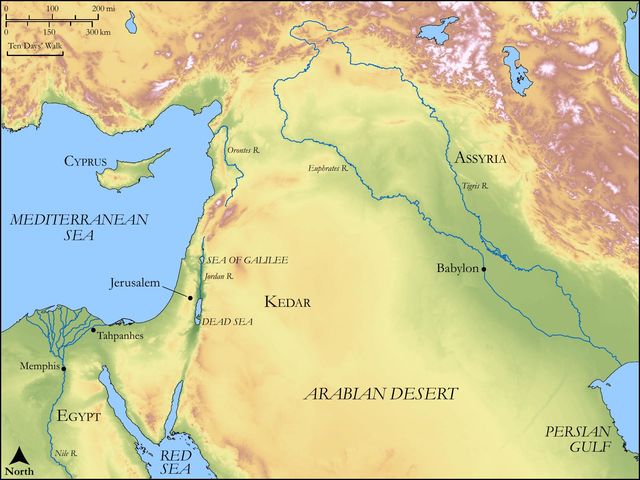
See on the biblical-era map
Study this verse
Public-domain commentary
Matthew Henry
From his Commentary on the Whole Bible. Henry comments on passages, not single verses — this entry covers Jeremiah 2:9–13. His three-level outline is real structure in the source text, so it is rendered as structure.
The prophet, having shown their base ingratitude in forsaking God, here shows their unparalleled fickleness and folly (Jer 2:9): I will yet plead with you. Note, Before God punishes sinners he pleads with them, to bring them to repentance. Note, further, When much has been said of the evil of sin, still there is more to be said; when one article of the charge is made good, there is another to be urged; when we have said a great deal, still we have yet to speak on God's behalf, Job 36:2. Those that deal with sinners, for their conviction, must urge a variety of arguments and follow their blow. God had before pleaded with their fathers, and asked why they walked after vanity and became vain, Jer 2:5. Now he pleads with those who persisted in that vain conversation received by tradition from their fathers, and with their children's children, that is, with all that in every age tread in their steps. Let those that forsake God know that he is willing to argue the case fairly with them, that he may be justified when he speaks. He pleads that with us which we should plead with ourselves.
I.He shows that they acted contrary to the usage of all nations.
Their neighbours were more firm and faithful to their false gods than they were to the true God. They were ambitious of being like the nations, and yet in this they were unlike them. He challenges them to produce an instance of any nation that had changed their gods (Jer 2:10, Jer 2:11) or were apt to change them. Let them survey either the old records or the present state of the isles of Chittim, Greece, and the European islands, the countries that were more polite and learned, and of Kedar, that lay south-east (as the other north-west from them), which were more rude and barbarous; and they should not find an instance of a nation that had changed their gods, though they had never done them any kindness, nor could do, for they were no gods. Such a veneration had they for their gods, so good an opinion of them, and such a respect for the choice their fathers had made, that though they were gods of wood and stone they would not change them for gods of silver and gold, no, not for the living and true God. Shall we praise them for this? We praise them not. But it may well be urged, to the reproach of Israel, that they, who were the only people that had no cause to change their God, were yet the only people that had changed him. Note, Men are with difficulty brought off from that religion which they have been brought up in, though ever so absurd and grossly false. The zeal and constancy of idolaters should shame Christians out of their coldness and inconstancy.
II.He shows that they acted contrary to the dictates of common sense, in that they not only changed (it may sometimes be our duty and wisdom to do so), but that they changed for the worse, and made a bad bargain for themselves.
1.They parted from a God who was their glory, who made them truly glorious and every way put honour upon them, one whom they might with a humble confidence glory in as theirs, who is himself a glorious God and the glory of those whose God he is; he was particularly the glory of his people Israel, for his glory had often appeared on their tabernacle.
2.They closed with gods that could do them no good, gods that do not profit their worshippers. Idolaters change God's glory into shame (Rom 1:23) and so they do their own; in dishonouring him, they disgrace and disparage themselves, and are enemies to their own interest. Note, Whatever those turn to who forsake God, it will never do them any good; it will flatter them and please them, but it cannot profit them. Heaven itself is here called upon to stand amazed at the sin and folly of these apostates from God (Jer 2:12, Jer 2:13): Be astonished, O you heavens! at this. The earth is so universally corrupt that it will take no notice of it; but let the heavens and heavenly bodies be astonished at it. Let the sun blush to see such ingratitude and be afraid to shine upon such ungrateful wretches. Those that forsook God worshipped the host of heaven, the sun, moon, and stars; but these, instead of being pleased with the adorations that were paid to them, were astonished and horribly afraid; and would rather have been very desolate, utterly exhausted (as the word is) and deprived of their light, than that it should have given occasion to any to worship them. Some refer it to the angels of heaven; if they rejoice at the return of souls to God, we may suppose that they are astonished and horribly afraid at the revolt of souls from him. The meaning is that the conduct of this people towards God was,
(1.)Such as we may well be astonished and wonder at, that ever men, who pretend to reason, should do a thing so very absurd.
(2.)Such as we ought to have a holy indignation at as impious, and a high affront to our Maker, whose honour every good man is jealous for.
(3.)Such as we may tremble to think of the consequences of. What will be in the end hereof? Be horribly afraid to think of the wrath and curse which will be the portion of those who thus throw themselves out of God's grace and favour. Now what is it that is to be thought of with all this horror? It is this: "My people, whom I have taught and should have ruled, have committed two great evils, ingratitude and folly; they have acted contrary both to their duty and to their interest." [1.] They have affronted their God, by turning their back upon him, as if he were not worthy their notice: "They have forsaken me, the fountain of living waters, in whom they have an abundant and constant supply of all the comfort and relief they stand in need of, and have it freely." God is their fountain of life, Psa 36:9. There is in him an all-sufficiency of grace and strength; all our springs are in him and our streams from him; to forsake him is, in effect, to deny this. He has been to us a bountiful benefactor, a fountain of living waters, over-flowing, ever-flowing, in the gifts of his favour; to forsake him is to refuse to acknowledge his kindness and to withhold that tribute of love and praise which his kindness calls for. [2.] They have cheated themselves, they forsook their own mercies, but it was for lying vanities. They took a great deal of pains to hew themselves out cisterns, to dig pits or pools in the earth or rock which they would carry water to, or which should receive the rain; but they proved broken cisterns, false at the bottom, so that they could hold no water. When they came to quench their thirst there they found nothing but mud and mire, and the filthy sediments of a standing lake. Such idols were to their worshippers, and such a change did those experience who turned from God to them. If we make an idol of any creature-wealth, or pleasure, or honour, - if we place our happiness in it, and promise ourselves the comfort and satisfaction in it which are to be had in God only, - if we make it our joy and love, our hope and confidence, we shall find it a cistern, which we take a great deal of pains to hew out and fill, and at the best it will hold but a little water, and that dead and flat, and soon corrupting and becoming nauseous. Nay, it is a broken cistern, that cracks and cleaves in hot weather, so that the water is lost when we have most need of it, Job 6:15. Let us therefore with purpose of heart cleave to the Lord only, for whither else shall we go? He has the words of eternal life.
Historical interpretation
Three Centuries of Reception
21 surviving comments on this verse. Each one is dated, so this reads as a timeline rather than a list.
Select a marker to jump to its quote. Markers stagger vertically where authors wrote within a few decades of each other.
Hence also Jacob, as I remarked before, being himself a type of Christ, had married the two handmaids of his two free wives, and of them begat sons, for the purpose of indicating beforehand that Christ would receive even all those who amongst Japheth's race are descendants of Canaan, equally with the free, and would have the children fellow-heirs. And we are such; but you cannot comprehend this, because you cannot drink of the living fountain of God, but of broken cisterns which can hold no water, as the Scripture says.
Nor do we receive that useless baptism of cisterns, for it has nothing to do with this baptism of life. Wherefore also God has announced that you have forsaken Him, the living fountain, and digged for yourselves broken cisterns which can hold no water.
And our hearts are thus circumcised from evil, so that we are happy to die for the name of the good Rock, which causes living water to burst forth for the hearts of those who by Him have loved the Father of all, and which gives those who are willing to drink of the water of life. But you do not comprehend me when I speak these things; for you have not understood what it has been prophesied that Christ would do, and you do not believe us who draw your attention to what has been written. For Jeremiah thus cries: "Woe unto you! because you have forsaken the living fountain, and have digged for yourselves broken cisterns that can hold no water. Shall there be a wilderness where Mount Zion is, because I gave Jerusalem a bill of divorce in your sight?"
By reason, therefore, of this laver of repentance and knowledge of God, which has been ordained on account of the transgression of God's people, as Isaiah cries, we have believed, and testify that that very baptism which he announced is alone able to purify those who have repented; and this is the water of life. But the cisterns which you have dug for yourselves are broken and profitless to you.
This “tree” is a mystery. In ancient times, Moses sweetened the bitter water with it. The people who were perishing of thirst in the desert drank and were revived because of it. We do this, too. We were drawn out from the calamities of the world in which we were lingering, perishing with thirst (that is, deprived of the divine Word). We drank “by the faith which is on him,” the baptismal water of the “tree” of the passion of Christ. We have revived the faith from which Israel has fallen away, as foretold through Jeremiah, who says, “Send, and continue to ask whether such things have been done, whether nations will change their gods (and these are not gods!). But my people have changed their glory for that which does not profit. Be appalled at this, O heavens!”—and when were they appalled? Undoubtedly when Christ suffered—“and be shocked,” he says, “utterly desolate.”
When we were together in council, dearest brethren, we read your letter which you wrote to us concerning those who seem to be baptized by heretics and schismatics, (asking) whether, when the), come to the Catholic Church, which is one,4 they ought to be baptized. On which matter, although you yourselves hold thereupon the truth and certainty of the Catholic rule, yet since you have thought that of our mutual love we ought to be consulted, we put forward our opinion, not as a new one,5 but we join with you in equal agreement, in an opinion long since decreed by our predecessors, and observed by us,-judging, namely, and holding it for certain that no one can be baptized abroad outside the Church, since there is one baptism appointed in the holy Church. And it is written in the words of the Lord, "They have forsaken me, the fountain of living waters, and hewed them out broken cisterns, which can hold no water."
But since many heresies have existed and the people of God have been torn apart at the instigation of demons, the truth must be briefly exposed by us and placed in its own peculiar dwelling place, so that if any one shall desire to draw the water of life, he may not be born to broken cisterns that hold no water but may know the abundant fountain of God. Watered by this fountain, he may enjoy perpetual light.
Is it right to say that what is God’s offspring and proper to him exists out of nothing? Or, is it reasonable in the very idea that what is from God has accrued to him, that someone should dare to say that the Son does not always exist? For in this again the generation of the Son exceeds and transcends human thoughts, that we become parents of our own children in time, since we ourselves first did not exist and then came into being. But God, in that he always exists, is always Father of the Son. And the origination of humankind is brought home to us from parallel experiences. However, since “no one knows the Son but the Father, and no one knows the Father but the Son, and the one to whom the Son will reveal him,” therefore the sacred writers to whom the Son has revealed him have given us a certain image from things visible, saying, “Who is the brightness of his glory and the expression of his person”; and again, “For with you is the well of life, and in your light shall we see lights.” And when the Word chides Israel, he says, “You have forsaken the fountain of wisdom,” and this is the fountain that says, “They have forsaken me, the fountain of living waters.” Although the illustration is rather ordinary and vague compared with what we would like, it is still nonetheless possible from it to understand something above humanity’s nature, instead of thinking the Son’s generation is on a level with ours. For who can even imagine that the radiance of light ever did not exist so that he should dare to say that the Son has not always existed or that the Son did not exist before his generation? Or who is capable of separating the radiance from the sun or to conceive of the fountain as always void of life that he should madly say, “The Son exists from nothing,” when it is the Son who says, “I am the life”? Or, who can conceive of him as “alien to the Father’s essence,” who says, “He that has seen me, has seen the Father”? For the sacred writers, wishing us to understand things in this way, have given these illustrations. It is unseemly and truly irreligious, when Scripture contains such images, to form ideas concerning our Lord from others that are neither in Scripture nor have any religious bearing.
“He has opened a pit and dug it.” We do not find the name of “pit” ever assigned in the divine Scriptures to something good or a “well” of water to something bad. That into which Joseph was thrown by his brothers is a pit. There is a slaughter “from the firstborn of Pharaoh to the firstborn of the captive woman that was in prison.” In the Psalms, “I am counted among those who go down to the pit.” In Jeremiah it is said, “They have forsaken me, the fountain of living water, and have dug to themselves cisterns, broken cisterns that can hold no water.”
Is he not one who bewitches the sheep of our patriarch, that they may not drink from the pure water that springs up unto life everlasting but may draw down on themselves the saying of the prophet: “They have forsaken me, the fountain of living water, and have dug for themselves cisterns, broken cisterns that can hold no water”? Because they should confess that the Father is God, the Son is God and the Holy Spirit is God, as the divine Word teaches and as they who have pondered it more deeply have taught.
In fact, with us is “the living water,” the very water that gushes from Christ. But you, separated from the everlasting fountain, from where do you receive your birth? And likewise had the Holy Spirit not departed from the original mother; from which did it come to you? Of course, perhaps the Spirit has followed one who engages in strife and, having abandoned so many priests and not content with its consecrated dwelling place, has truly loved the broken cistern of an impure fountain? From where do your people possess the Spirit, those whom an anointed priest has not sealed? From where do they possess the water, those who have withdrawn from their mother’s womb? From where do they possess spiritual renewal, those who have lost the cradle of nuptial peace?
So she went down to the fountain of wisdom, whether the Church or the soul, to fill her entire vessel and to draw from the pure disciplines of wisdom that the Jews refused to draw from the flowing fountain. Who is this fountain, listen to the one saying: "They have abandoned me, the fountain of living water."
So when the whole world was parched with the drought of Gentile superstition, then came that dew of the heavenly visits on the fleece. But after that the lost sheep of the house of Israel (whom I think that the figure of the Jewish fleece foreshadowed), after that those sheep, I say, “had refused the fountain of living water,” the dew of moistening faith dried up in the breasts of the Jews and that divine Fountain turned away its course to the hearts of the Gentiles.
Still the Anomoeans have another well-rehearsed argument. What is that? Scripture says, “God is spirit.” Tell me, then, does that bring his essence to light? Will anyone accept that argument if he has even drawn a little way near to the doors of the divine Scriptures? According to that argument, God will also be fire, just as it has been written that God is spirit, so has it been written, “Our God is a consuming fire,” and again, “a fountain of living water.” Not only will God be a spirit and a fountain and a fire; he will also be a soul, a wind, a human mind, and other things far more absurd than these.
O blessed change! Once the body wept, but now laughs forevermore. Once it desired the broken cisterns of which the prophet speaks, but now it has been satisfied in the Lord, the fountain of life.
(Verses 12, 13.) Be astonished, O heavens, at this, and shudder, be utterly desolate, declares the Lord. For my people have committed two evils: they have forsaken me, the fountain of living waters, and hewed out cisterns for themselves, broken cisterns that can hold no water. LXX: The heavens were astonished at this, and were greatly alarmed, and the rest likewise. The heavens to whom it was said: Listen, O heavens, and I will speak. (Deut. 32:1): and, Hear, O earth, the words of the Lord (Isaiah 1:2), seeing that the commands of God are trampled upon, it shudders, and cannot hide its astonishment. For every creature groans and laments over the sins of men. But God's people have done two things against Him. First, they have forsaken God who is the source of life, and He gave them a commandment, saying: 'I am the Lord your God, who brought you out of the land of Egypt' (Exod. XX, 2). Second, it is written in the same place: 'You shall have no other gods before me'; for this reason they have followed demons, whom He calls broken cisterns, because they are unable to keep God's commandments. And this must be noted, that the fountain is perpetual, and it has life-giving waters. But the cisterns and lakes, either from torrents or from muddy waters, are filled with earth and rain. The gates of heaven are called those, of which it is also written in the twenty-third psalm: Lift up your heads, O gates, and the king of glory will enter. Concerning which the Septuagint translated: Lift up your gates, O princes: of which more will be said in its proper place. And what Aquila and Symmachus interpreted as 'coelos', and LXX and Theodotion as 'coelum', should not be confused. For in Hebrew, 'Samaim' is a common noun, and both the plural and singular forms are referred to as 'coeli' with the same name, just like Thebes, Athens, and Salonae.
Let him “possess his vessel in sanctification and honor,” let him drink of his own wells, not out of the dissolute cisterns of the harlots that cannot hold within them the pure waters of chastity.
The arrogance of pride, the pleasure of lust and the poison of curiosity are the motions of a dead soul. It is not that it is dead in such a way as to lack all movement; rather, it dies by “abandoning the fountain of life” and thus is taken up by the transitory world and is conformed to it.
Doubtless the heretics, who follow the teachings of demons, who think up false systems under the impulse of their spirit, who let it be known that they have seen visions that they have not seen and by their deadly arguments sow their seed in foolish and credulous hearts—doubtless these are the ones who do not hold the head, namely, Christ, the source of truth. Whatever is opposed to his teaching is without sense, and these are the “blind, leaders of the blind,” of whom I think it is said, “They have forsaken me, the fountain of living water, and have dug for themselves broken cisterns that can hold no water.”
Iniquity lies to itself either by corrupting the nature you have made and ordained or by perverting it. It lies to itself when it practices an immoderate use of things permitted or when it burns for things forbidden to that use which is against nature. It lies to itself when convicted, raging with heart and voice against you as it kicks against the goads, or when—breaking through the pale of human society—they audaciously rejoice in private cliques or divisions on the basis of whether they have been pleased or offended. These things happen whenever you are abandoned and whenever, from a self-willed pride, they choose to align themselves instead with something false that they cherish instead of you, O Fountain of life, the one, true Creator and Ruler of the universe.
Now, here he clearly reveals to us the mystery of the holy Trinity: he called the only-begotten Word of God a fountain of life. This is the name, too, remember, God personally gave himself through the prophet Jeremiah: “They have forsaken me, a fountain of living water, taken their leave and dug for themselves cracked cisterns incapable of holding water.”
Continue studying Jeremiah 2:13 across the web’s major study libraries — every link below opens this exact verse, chapter, or book on the destination site.
Read & Compare
 BibleGatewayThis verse in more than 200 translations and 70 languages.
 Bible.comThe YouVersion reader — hundreds of translations, reading plans, and highlights.
 ESV.orgCrossway's official English Standard Version reader.
 NET BibleThe NET translation with 60,000+ translators' notes on every rendering decision.
 STEP BibleTyndale House's free study tool — original text, vocabulary, and scholarly resources.
 BibliaLogos Bible Software's free web reader.
 USCCBThe New American Bible (Revised Edition) with the U.S. bishops' study notes.
Commentaries
 BibleHub CommentariesDozens of classic commentaries on this verse, gathered on one page.
 StudyLightMore than 100 commentary sets — the largest collection on the web.
 BibleRefPlain-English commentary on what this verse means, verse by verse.
 Enduring WordDavid Guzik's free commentary on this chapter, widely used by Bible teachers.
 Bible Study ToolsVerse commentary alongside Greek and Hebrew study aids.
Original Language & Research
- BibleHub InterlinearThe verse word by word — original language, transliteration, and English.
- BibleHub LexiconEvery word's original-language definition and Strong's entry.
 Blue Letter BibleDeep-study tools — Strong's numbers, concordance, and word studies.
 SefariaThe Hebrew text with Rashi and centuries of Jewish commentary.
Sermons, Hymns & Audio


TrulyRandomVerse is not affiliated with these sites and doesn’t control their content. They’re linked because they’re genuinely useful.
Summary
Jeremiah 2:13 serves as a profound divine indictment against ancient Judah, encapsulating their dual rebellion against Yahweh. Through a potent and sorrowful metaphor, God declares that His people have committed two fundamental evils: first, they have abandoned Him, the inexhaustible "fountain of living waters," who is the sole source of true life, spiritual nourishment, and divine provision; and second, in their self-reliance, they have futilely attempted to secure sustenance by "hewing out cisterns," man-made, cracked, and ultimately useless reservoirs incapable of retaining the vital water they desperately seek. This verse succinctly articulates the core message of Jeremiah's early prophecies, highlighting Israel's spiritual unfaithfulness and their misguided pursuit of human-devised solutions and false gods over their covenant Lord.
Context
ShowHideLiterary Context
Jeremiah 2 initiates a series of powerful oracles delivered by the prophet Jeremiah, likely early in his ministry during the reign of King Josiah. This chapter functions as a rib or covenant lawsuit, where God, as the wronged party, presents His case against His unfaithful covenant people, Israel (Judah). The verses immediately preceding Jeremiah 2:13 (Jeremiah 2:1-12) recount Yahweh's steadfast love and faithfulness to Israel from their youth, contrasting His unwavering devotion with their subsequent, shocking apostasy and ingratitude. Verse 13, therefore, acts as a climactic summary of their profound transgression, employing a vivid and culturally resonant metaphor to underscore the absurdity and tragedy of their actions. It sets the theological and narrative stage for the detailed accusations of idolatry, covenant breaking, and spiritual adultery that unfold throughout the remainder of the chapter and indeed, the entire prophetic book.
Historical & Cultural Context
In the arid climate of the ancient Near East, water was not merely a commodity but a symbol of life, blessing, and divine provision. Ancient Israel's survival depended heavily on natural springs, deep wells, and the collection of rainwater. "Living waters" (Hebrew: mayim chayim) specifically referred to fresh, flowing spring water, highly prized for its purity, constant supply, and inherent life-giving properties. In stark contrast, cisterns were artificial pits, typically carved into the region's prevalent limestone bedrock, designed to collect and store seasonal rainwater. While necessary for survival, cisterns were inherently limited, dependent on rainfall, prone to stagnation, and notoriously susceptible to cracking, leading to leakage and the loss of precious water. This profound cultural reality makes the metaphor in Jeremiah 2:13 intensely relatable and impactful: the people have rejected the ever-flowing, pure source of life for unreliable, self-made, and ultimately defective alternatives. This spiritual betrayal occurred against a backdrop of increasing syncretism and idolatry, as Judah adopted the worship practices and political alliances of surrounding nations, forsaking their exclusive covenant with Yahweh.
Key Themes
ShowHideJeremiah 2:13 powerfully encapsulates several overarching theological and narrative themes central to the book of Jeremiah and the broader prophetic tradition. Foremost among these is Covenant Infidelity, as Israel, God's chosen people, has demonstrably broken their sacred covenant by abandoning their divine Husband and pursuing other gods, a transgression frequently likened to spiritual adultery (a theme extensively developed in passages such as Jeremiah 3:6-10). This leads directly to the theme of Idolatry and Futility, where the "broken cisterns" represent the emptiness, unreliability, and ultimate failure of relying on anything other than God for true sustenance, security, or salvation. God's lament in this verse also underscores His Divine Grief and Unwavering Love, expressing profound sorrow and indignation over His people's foolish choices despite His constant and abundant provision. Furthermore, the imagery of God as the "fountain of living waters" emphasizes His Sufficiency and Life-Giving Nature, portraying Him as the sole, abundant, and inexhaustible source of true life, blessing, and spiritual satisfaction, a theme echoed profoundly throughout Scripture, as seen in Psalm 36:9).
Exposition and Analysis
ShowHideKey Word Analysis
ShowHideThis verb (H5800) denotes "to loosen, relinquish, permit, etc.; commit self, fail, forsake, fortify, help, leave (destitute, off), refuse." In the context of Jeremiah 2:13, it carries the profound weight of abandonment and betrayal. It is not merely a casual departure but a deliberate and active turning away from a sacred relationship, specifically the covenant bond with God. The people have consciously chosen to sever their ties with the very source of their existence, identity, and blessing, indicating a profound act of spiritual rebellion.
This noun (H4726) refers to "something dug, i.e. a (general) source (of water, even when naturally flowing; also of tears, blood... figuratively, of happiness, wisdom, progeny)." Here, it specifically denotes a natural, continuously flowing spring or wellspring, emphasizing an inherent, constant, and self-replenishing supply. When applied to God, it highlights His intrinsic nature as the origin and sustainer of all true life, joy, wisdom, and spiritual vitality, standing in stark contrast to anything man-made, finite, or dependent on external factors.
This verb (H7665) means "to burst (literally or figuratively); break (down, off, in pieces, up), broken (-hearted), crush, destroy, hurt." The description of the cisterns as "broken" is critically important. It signifies not merely an imperfection but a fundamental, irreparable defectiveness. These man-made alternatives are inherently flawed, incapable of fulfilling their intended purpose of holding water, and thus inevitably lead to disappointment, spiritual drought, and ultimate futility. The "breaking" is often a consequence of their poor construction or the nature of the material, implying the inherent worthlessness of human efforts apart from divine provision.
Verse Breakdown
ShowHide"For my people have committed two evils"
This opening declaration immediately establishes the gravity of the situation and the nature of the indictment. God, speaking through His prophet Jeremiah, identifies the transgressors as "my people," underscoring the intimate covenant relationship that has been violated. The explicit mention of "two evils" highlights a deliberate, conscious, and dual transgression, emphasizing that these are not minor infractions but foundational acts of rebellion against their divine benefactor and the very terms of their covenant.
"they have forsaken me the fountain of living waters"
This clause articulates the first and primary evil. The people have actively abandoned Yahweh, who is metaphorically depicted as an ever-flowing spring—a source of fresh, dynamic, and life-giving water. This imagery powerfully conveys God's nature as the sole, pure, and inexhaustible provider of spiritual life, sustenance, and blessing. To forsake Him is to willfully cut oneself off from the very essence of true life, satisfaction, and divine favor, a profound act of spiritual infidelity.
"[and] hewed them out cisterns, broken cisterns, that can hold no water"
This clause describes the second evil, which is a direct consequence and manifestation of the first. Having abandoned the true and living source, the people have resorted to their own futile efforts ("hewed them out cisterns") to find satisfaction and security. The repeated and emphatic phrase "broken cisterns" underscores their utter futility, inherent flaw, and ultimate unreliability. These man-made alternatives—whether idols, foreign political alliances, human wisdom, or self-reliance—are incapable of providing the spiritual nourishment and security that only God can offer. They are like cracked vessels that cannot retain water, symbolizing ultimate disappointment, spiritual barrenness, and a profound lack of true fulfillment.
Literary Devices
ShowHideJeremiah 2:13 is rich with literary artistry that profoundly amplifies its theological message. The most prominent device is Metaphor, where God is directly compared to an "fountain of living waters," and the people's misguided pursuits are vividly likened to "broken cisterns." This central metaphor is exceptionally effective, drawing on a universal human need (water for survival) to explain a deep spiritual truth about dependence on God. A powerful Antithesis or Contrast is established between the "fountain of living waters" and the "broken cisterns," highlighting the vast difference between divine, abundant provision and human, futile substitutes. The fountain represents natural, pure, constant, and life-giving sustenance, while the cisterns symbolize artificial, limited, stagnant, and ultimately ineffective alternatives. Furthermore, there is an element of Personification in God's lament, as He expresses sorrow, indignation, and disappointment over His people's foolish choices, portraying Him not as a distant deity but as a grieved benefactor. The Repetition of "cisterns" and the emphatic "broken cisterns" serves to underscore the utter worthlessness, inherent defectiveness, and hopeless nature of their self-made solutions.
Theological and Thematic Connections
ShowHideJeremiah 2:13 stands as a foundational text for understanding the nature of sin as a twofold rejection of God's perfect sufficiency and a futile pursuit of self-reliance. Theologically, it underscores God's identity as the sole, inexhaustible source of life, truth, and genuine satisfaction, contrasting His infinite provision with the inherent emptiness and ultimate disappointment of all created things when they are elevated to the status of ultimate good or relied upon for ultimate fulfillment. The "two evils" reveal humanity's universal propensity to turn away from the Creator and toward the creation, a fundamental act of idolatry that inevitably leads to spiritual barrenness, disillusionment, and a profound lack of peace. This verse also functions as a divine lament, expressing God's deep sorrow over His people's foolish and destructive choices, revealing His persistent love and covenant faithfulness even in the face of their profound unfaithfulness. It serves as a timeless challenge for believers to continually examine where they seek their deepest nourishment, security, and purpose.
Reflection and Application
ShowHideJeremiah 2:13 serves as a timeless and convicting mirror, reflecting the persistent human tendency to abandon the ultimate source of life and pursue fleeting, self-made alternatives. In our contemporary context, the "fountain of living waters" represents God Himself—His Word, His Spirit, His presence, His grace, and His perfect will—as the true, inexhaustible wellspring of spiritual vitality, peace, purpose, and eternal life. The "broken cisterns" manifest in countless forms in modern society: the relentless pursuit of material wealth and consumerism, the idolization of career success and professional achievement, the insatiable craving for social media validation and external affirmation, the reliance on human relationships for ultimate fulfillment, or the belief that personal accomplishments and self-sufficiency can secure lasting happiness and security. These are all attempts to "hew out" our own cisterns, promising satisfaction but ultimately proving incapable of holding the "water" our souls truly thirst for, leading instead to spiritual drought, anxiety, and profound emptiness. This verse calls us to a radical re-evaluation of our priorities and allegiances, urging us to recognize the inherent futility of seeking life or lasting satisfaction in anything apart from the Giver of life. It is a profound invitation to return to the inexhaustible source, to drink deeply from the fountain that never runs dry, and to find our complete and abiding satisfaction in Him alone, trusting in His boundless provision and sovereign goodness.
Questions for Reflection
ShowHideFAQ
ShowHideWhat does "living waters" mean in this context?
ShowHideIn the ancient Near East, "living waters" (Hebrew: mayim chayim) referred specifically to fresh, flowing water from a natural spring or stream, as opposed to stagnant water collected in a cistern or pool. It symbolized purity, freshness, vitality, and an inexhaustible supply. Spiritually, when God describes Himself as the "fountain of living waters" in Jeremiah 2:13, it signifies His nature as the dynamic, life-giving, and eternally self-replenishing source of all spiritual vitality, sustenance, blessing, and true satisfaction for His people. It stands in stark contrast to anything finite, stagnant, or man-made.
What are the "two evils" committed by God's people?
ShowHideAs explicitly stated in Jeremiah 2:13, the two evils committed by God's people are: 1) "they have forsaken me the fountain of living waters," meaning they abandoned God, the true and only source of life, spiritual nourishment, and divine provision. This constitutes a profound act of covenant infidelity and spiritual betrayal. 2) They "hewed them out cisterns, broken cisterns, that can hold no water." This refers to their futile and self-defeating attempts to find satisfaction, security, and sustenance in human-made alternatives, such as idols, foreign political alliances, or self-reliance. These alternatives are ultimately empty, unreliable, and inherently incapable of providing what is truly needed. These two evils are intrinsically linked: the abandonment of God inevitably leads directly to the pursuit of false and ultimately disappointing substitutes.
Christ-Centered Fulfillment
ShowHideThe vivid imagery of God as the "fountain of living waters" in Jeremiah 2:13 finds its ultimate, most glorious, and redemptive fulfillment in the person and work of Jesus Christ. While the Old Testament reveals God as the life-giving source, the New Testament reveals that this divine life flows uniquely and perfectly through Christ. Jesus Himself declared, "If anyone thirsts, let him come to me and drink. Whoever believes in me, as the Scripture has said, 'Out of his heart will flow rivers of living water'" (John 7:37-38), a promise understood to refer to the Holy Spirit given through Him. He offered the Samaritan woman at the well "living water," promising that whoever drinks of it "will never be thirsty again. The water that I will give him will become in him a spring of water welling up to eternal life" (John 4:10-14). Thus, the "fountain of living waters" that Israel forsook is perfectly embodied in Christ, who is the Way, the Truth, and the Life (John 14:6). His sacrificial death on the cross provides the ultimate cleansing and spiritual sustenance, making it possible for humanity to return to the life-giving source. The "broken cisterns" of human effort, self-reliance, and false gods are utterly exposed and rendered obsolete by the perfect and complete provision found in Him, for in Christ "are hidden all the treasures of wisdom and knowledge" (Colossians 2:3) and "in him all the fullness of God was pleased to dwell" (Colossians 1:19). He is the true and unfailing wellspring of eternal life, grace, and truth, inviting all who thirst to come and drink freely, finding in Him the only lasting satisfaction.