


Isaiah 12:4
Bible text: King James Version (1769 Blayney text) · Public domain
Bible text: King James Version with Strong's numbers · Public domain
Bible text: Berean Standard Bible · Public domain
Bible text: American Standard Version (1901) · Public domain
Bible text: World English Bible, Messianic edition · Public domain
Bible text: Geneva Bible (1599) · Public domain
Bible text: Young's Literal Translation · Public domain
- וַאֲמַרְתֶּםva·'a·mar·Temand you will sayH559Conj-w ¦ V-Qal-ConsecPerf-2mpVerb Qal Consecutive Perfect 2nd Plural Masculineוַandאֲמַרְתֶּםyou will say
- בַּיּוֹםbai·Yomin the dayH3117Prep-b ¦ N-msNoun Singular Masculine Absoluteבַּin theיּוֹםday
- הַהוּאha·Hu'<the> thatH1931Art ¦ Pro-3msPronoun Personal 3rd Singular Masculineהַ<the>הוּאthat
- הוֹדוּho·Dugive thanksH3034V-Hiphil-Imp-2mpVerb Hiphil Imperative 2nd Plural Masculine
- לַיהוָהla·Yah·wehto YahwehH3068Prep-l ¦ N-properNoun Proper TitleלַtoיהוָהYahweh
- קִרְאוּkir·'UcallH7121V-Qal-Imp-2mpVerb Qal Imperative 2nd Plural Masculine
- בִשְׁמוֹvish·Moon his nameH8034Prep-b ¦ N-msc ¦ 3msNoun Singular Masculine Constructבִonשְׁמnameוֹhis
- הוֹדִיעוּho·Di·'umake knownH3045V-Hiphil-Imp-2mpVerb Hiphil Imperative 2nd Plural Masculine
- בָעַמִּיםva·'a·Mimamong the peoplesH5971Prep-b ¦ N-mpNoun Plural Masculine Absoluteבָamong theעַמִּיםpeoples
- עֲלִילֹתָיו'a·li·lo·Tavhis deedsH5949N-fpc ¦ 3msNoun Plural Feminine Constructעֲלִילֹתָיdeedsוhis
- הַזְכִּירוּhaz·Ki·rubring to remembranceH2142V-Hiphil-Imp-2mpVerb Hiphil Imperative 2nd Plural Masculine
- כִּיkithatH3588PrtParticle Conditional
- נִשְׂגָּבnis·Gav[is] exaltedH7682V-Niphal-Prtcpl-msVerb Niphal Participle Singular Masculine Absolute
- שְׁמוֹshe·Mohis nameH8034N-msc ¦ 3msNoun Singular Masculine Constructשְׁמnameוֹhis
English is a literal word-by-word gloss of the Hebrew, not the KJV's wording. Why?
This is the original text the KJV's translators worked from — each Hebrew word with its own literal English meaning in this verse, prepared by scholars at Tyndale House, Cambridge. The KJV translates whole sentences, not word by word, so its wording differs: one Hebrew word can become several English words, and the KJV may choose “the LORD” where the gloss reads “Yahweh”. Both are faithful — they answer different questions. For the KJV's own rendering, switch to the KJV text.
Details
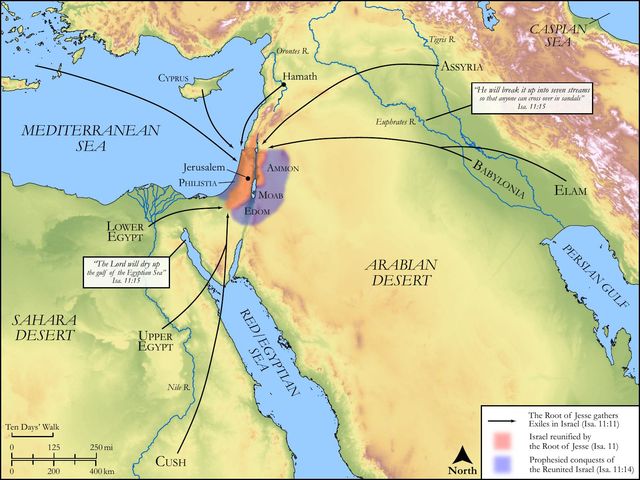
See on the biblical-era map
Study this verse
Public-domain commentary
Matthew Henry
From his Commentary on the Whole Bible. Henry comments on passages, not single verses — this entry covers Isaiah 12:4–6. His two-level outline is real structure in the source text, so it is rendered as structure.
This is the second part of this evangelical song, and to the same purport with the former; there believers stir up themselves to praise God, here they invite and encourage one another to do it, and are contriving to spread his praise and draw in others to join with them in it. Observe,
I.Who are here called upon to praise God - the inhabitants of Zion and Jerusalem, whom God had in a particular manner protected from Sennacherib's violence, Isa 12:6. Those that have received distinguishing favours from God ought to be most forward and zealous in praising him. The gospel church is Zion. Christ is Zion's King. Those that have a place and a name in the church should lay out themselves to diffuse the knowledge of Christ and to bring many to him. Thou inhabitress of Zion; the word is feminine. Let the weaker sex be strong in the Lord, and out of their mouth praise shall be perfected.
II.How they must praise the Lord.
1.By prayer: Call upon his name. As giving thanks for former mercy is a decent way of begging further mercy, so begging further mercy is graciously accepted as a thankful acknowledgment of the mercies we have received. In calling upon God's name we give unto him some of the glory that is due to his name as our powerful and bountiful benefactor.
2.By preaching and writing. We must not only speak to God, but speak to others concerning him, not only call upon his name, but (as the margin reads it) proclaim his name; let others know something more from us than they did before concerning God, and those things whereby he has made himself known. Declare his doings, his counsels (so some read it); the work of redemption is according to the counsel of his will, and in that and other wonderful works that he has done we must take notice of his thoughts which are to us-ward, Psa 40:5. Declare these among the people, among the heathen, that they may be brought into communion with Israel and the God of Israel. When the apostles preached the gospel to all nations, beginning at Jerusalem, then this scripture was fulfilled, that his doings should be declared among the people and that what he has done should be known in all the earth.
3.By a holy exultation and transport of joy: "Cry out and shout; welcome the gospel to yourselves and publish it to others with huzzas and loud acclamations, as those that shout for victory (Exo 32:18) or for the coronation of a king," Num 23:21.
III.For what they must praise the Lord.
1.Because he has glorified himself. Remember it yourselves, and make mention of it to others, that his name is exalted, has become more illustrious and more conspicuous; in this every good man rejoices.
2.Because he has magnified his people: He has done excellent things for them, which make them look great and considerable.
3.Because he is, and will be, great among them: Great is the Holy One, for he is glorious in holiness; therefore great, because holy. True goodness is true greatness. He is great as the Holy One of Israel, and in the midst of them, praised by them (Psa 76:1), manifesting himself among them, and appearing gloriously in their behalf. It is the honour and happiness of Israel that the God who is in covenant with them, and in the midst of them, is infinitely great.
Historical interpretation
Historical reception
1 surviving comment on this verse from the historical church.
(Verses 4, 5.) And you shall say on that day, confess the Lord and invoke His name: make His inventions known among the peoples: remember, for His name is exalted. Sing to the Lord, for He has done great things: announce this in all the earth. These things are commanded by the Apostles and the rest of Israel to those who believed from the Gentiles: that they alone confess the Lord, and forsaking idols, invoke His name: and proclaim all His works to the unbelievers; that they may know that He alone is exalted: to whom it is to be sung for His great deeds, and in all the earth His mercy is to be proclaimed.
Continue studying Isaiah 12:4 across the web’s major study libraries — every link below opens this exact verse, chapter, or book on the destination site.
Read & Compare
 BibleGatewayThis verse in more than 200 translations and 70 languages.
 Bible.comThe YouVersion reader — hundreds of translations, reading plans, and highlights.
 ESV.orgCrossway's official English Standard Version reader.
 NET BibleThe NET translation with 60,000+ translators' notes on every rendering decision.
 STEP BibleTyndale House's free study tool — original text, vocabulary, and scholarly resources.
 BibliaLogos Bible Software's free web reader.
 USCCBThe New American Bible (Revised Edition) with the U.S. bishops' study notes.
Commentaries
 BibleHub CommentariesDozens of classic commentaries on this verse, gathered on one page.
 StudyLightMore than 100 commentary sets — the largest collection on the web.
 BibleRefPlain-English commentary on what this verse means, verse by verse.
 Enduring WordDavid Guzik's free commentary on this chapter, widely used by Bible teachers.
 Bible Study ToolsVerse commentary alongside Greek and Hebrew study aids.
Original Language & Research
- BibleHub InterlinearThe verse word by word — original language, transliteration, and English.
- BibleHub LexiconEvery word's original-language definition and Strong's entry.
 Blue Letter BibleDeep-study tools — Strong's numbers, concordance, and word studies.
 SefariaThe Hebrew text with Rashi and centuries of Jewish commentary.
Sermons, Hymns & Audio


TrulyRandomVerse is not affiliated with these sites and doesn’t control their content. They’re linked because they’re genuinely useful.
Summary
Isaiah 12:4 is a vibrant prophetic exhortation, part of a triumphant song of salvation that anticipates a future day of divine intervention and restoration. It serves as a clarion call to God's redeemed people to engage in unreserved praise of the LORD, to invoke His name publicly, to declare His mighty deeds among all nations, and to proclaim the supreme exaltation of His character and authority. This verse encapsulates the joyful response of a people delivered by God, manifesting their faith through worship and witness to the world.
Context
ShowHideLiterary Context
Isaiah 12 concludes a significant prophetic section (chapters 7-12) often referred to as the "Book of Immanuel," which primarily focuses on God's judgment against Judah and surrounding nations, interspersed with profound promises of a coming Messiah and ultimate restoration. The phrase "in that day" is a recurring eschatological motif throughout Isaiah, pointing to a future time when God's redemptive purposes will be fully realized. Chapter 12 itself is a poetic hymn of thanksgiving, serving as a climactic response to the preceding prophecies of deliverance, particularly the promise of a remnant returning to God (Isaiah 10:20-23) and the depiction of the righteous reign of the Messiah (Isaiah 11). This song of praise, therefore, is not merely a general expression of gratitude but a specific, Spirit-inspired response to God's faithfulness in bringing about salvation.
Historical & Cultural Context
Isaiah prophesied during a tumultuous period in Judah's history, marked by the looming threat of the Assyrian Empire and the spiritual decline of the nation. The people often sought alliances with foreign powers rather than trusting in the LORD, leading to divine judgment. In this context, the call to "Praise the LORD" and "call upon his name" would have been a radical departure from idolatrous practices and a return to the covenant relationship with Yahweh. "Declaring his doings among the people" and "making mention that his name is exalted" reflects the ancient Israelite practice of recounting God's mighty acts (e.g., the Exodus) as a means of worship, teaching, and witness to both their own community and surrounding nations. This public proclamation was central to their identity as God's chosen people, distinct from the polytheistic cultures around them.
Key Themes
ShowHideIsaiah 12:4 powerfully contributes to several overarching themes in the book of Isaiah. Firstly, it underscores the theme of Divine Deliverance and Salvation, portraying the joyful response to God's saving acts, which are frequently highlighted throughout the book (e.g., Isaiah 25:9). Secondly, it emphasizes Worship and Thanksgiving as the appropriate and spontaneous human response to God's character and deeds, a motif that permeates the Psalms and prophetic literature. Thirdly, the verse highlights the theme of Universal Witness and Proclamation, calling for God's glory and works to be made known "among the people," foreshadowing the global scope of God's redemptive plan (Isaiah 49:6). Finally, it reiterates the Sovereignty and Exaltation of God's Name, asserting His supreme authority and unique holiness above all other powers and deities, a foundational truth for all of Isaiah's prophecies.
Exposition and Analysis
ShowHideKey Word Analysis
ShowHideThis primitive root literally means "to use (i.e. hold out) the hand," often implying throwing or casting. In a spiritual context, it signifies revering or worshipping with extended hands, a gesture of surrender, adoration, and thanksgiving. It also carries the nuance of public confession or giving thanks, suggesting an open and unreserved acknowledgment of God's goodness and power.
This root means "to know," but in a profound and comprehensive sense. It encompasses not just intellectual knowledge but also experiential knowledge, recognition, discernment, and the act of making something known or teaching. Here, it implies a clear, authoritative, and comprehensive making known of God's "doings" (His acts and works), rooted in a deep, experiential understanding of who He is and what He has accomplished.
A root meaning "to mark (so as to be recognized)," this word primarily means "to remember" or "to be mindful." By implication, it extends to "to mention," "to recount," or "to record." In this context, it is a command not merely to recall God's exalted name privately, but to actively and publicly bring it to remembrance, to speak of it, and to ensure its prominence and recognition among others.
Verse Breakdown
ShowHide"And in that day shall ye say"
This introductory clause sets the eschatological stage, pointing to a future, divinely appointed time of salvation and restoration. The collective "ye" indicates a communal, unified response from God's redeemed people, a spontaneous outpouring of praise.
"Praise the LORD"
This is the foundational command, an imperative to offer heartfelt and public thanksgiving and adoration to Yahweh (H3068, YHWH), the self-existent, covenant-keeping God. It calls for an active expression of gratitude for His character and His mighty acts.
"call upon his name"
This phrase signifies invoking God's presence, power, and authority through prayer, worship, and public proclamation. It implies a reliance on His character as revealed in His name and an open declaration of allegiance to Him.
"declare his doings among the people"
This is a clear mandate for witness and evangelism. "His doings" refers to God's mighty acts of salvation, judgment, and providence. "Among the people" (H5971, ʻam, referring to nations or peoples) extends the scope beyond Israel to a universal audience, compelling believers to share God's redemptive story with all humanity.
"make mention that his name is exalted"
This final imperative reinforces the theme of God's supreme sovereignty and holiness. To "make mention" is to bring to remembrance and publicly proclaim that God's "name" (representing His character, authority, and reputation) is "exalted" (H7682, sâgab, meaning high, inaccessible, strong, and lifted up above all). It is a call to acknowledge and declare God's unparalleled majesty and glory.
Literary Devices
ShowHideIsaiah 12:4 employs several potent Literary Devices to convey its urgent and triumphant message. The most prominent is the Imperative Mood, seen in the direct commands: "Praise," "call," "declare," and "make mention." This grammatical choice emphasizes the non-negotiable and active nature of the response required from the redeemed. Repetition and Parallelism are also evident, particularly in the successive calls to public proclamation ("declare his doings," "make mention that his name is exalted"), which serve to reinforce the theme of witness and amplify its importance. The phrase "in that day" functions as Anticipatory Language, creating a sense of eschatological hope and drawing the reader's attention to a pivotal future moment of divine intervention. Furthermore, the focus on God's "name" (repeated twice) is a form of Theonymic Language, where the name stands metonymically for God's entire being, character, authority, and reputation, underscoring His unique identity and supreme worthiness of worship.
Theological and Thematic Connections
ShowHideIsaiah 12:4 stands as a profound theological statement on the nature of redeemed humanity's response to God's salvation. It teaches that true deliverance inevitably leads to unreserved praise and active witness. The commands to "Praise the LORD," "call upon his name," and "declare his doings" reveal a holistic understanding of worship that encompasses both intimate communion with God and courageous proclamation to the world. This verse underscores that God's ultimate purpose in salvation is not merely to rescue individuals but to establish a people who will magnify His name and make His glory known among all nations. It connects the eschatological hope of "that day" with the present responsibility of the believer to live out their faith in active adoration and evangelistic fervor, recognizing God's absolute sovereignty and exalted status.
Reflection and Application
ShowHideIsaiah 12:4 offers a timeless blueprint for the life of a believer, calling us to a dynamic and public faith. It challenges us to move beyond passive gratitude to active, vocal praise for God's character and His mighty works in our lives and throughout history. The command to "call upon his name" reminds us of the power and rank of prayer, urging us to rely on God's revealed nature in every circumstance. Crucially, the verse compels us to be intentional witnesses, "declaring his doings among the people." This is not an optional extra but an essential outflow of a heart transformed by God's salvation. Our lives, both in word and deed, should be a testament to His goodness, His power, and His redemptive plan. Finally, the exhortation to "make mention that his name is exalted" serves as a constant reminder of God's supreme authority and majesty, fostering a spirit of humility, reverence, and unwavering trust in His sovereign control over all things.
Questions for Reflection
ShowHideFAQ
ShowHideWhat does "in that day" signify in Isaiah 12:4?
ShowHide"In that day" is a significant prophetic phrase used frequently throughout Isaiah and other prophetic books (e.g., Joel 3:18). It refers to a future, divinely appointed time when God will decisively intervene in human history. While it often encompasses judgment, in Isaiah 12:4, it specifically points to a glorious era of salvation, restoration, and ultimate deliverance for God's people. This "day" is characterized by the full realization of God's redemptive purposes, bringing about a spontaneous and universal outpouring of praise and witness.
Why is "calling upon his name" so important in this verse?
ShowHide"Calling upon his name" (Hebrew: qârâʼ H7121) is a profound act of worship and reliance. In biblical thought, a "name" (Hebrew: shêm H8034) represents the essence, character, and authority of a person. To call upon God's name is to invoke His very being, to appeal to His revealed character, and to seek His intervention based on who He is. It signifies a personal and communal act of trust, dependence, and allegiance. This phrase is deeply connected to salvation, as seen in Romans 10:13, where calling upon the Lord's name is presented as the means to salvation.
How does Isaiah 12:4 relate to the concept of evangelism?
ShowHideIsaiah 12:4 directly relates to evangelism through the commands "declare his doings among the people" and "make mention that his name is exalted." These are clear mandates for active, public proclamation of God's mighty acts and His supreme glory. "Among the people" (H5971, ʻam) implies a broad audience, including those outside the covenant community. This verse serves as an Old Testament precursor to the Great Commission, demonstrating that God's people have always been called to be witnesses to His redemptive work, sharing His story and His sovereignty with the world, inviting others to join in the praise and worship of the One True God.
Christ-Centered Fulfillment
ShowHideIsaiah 12:4, a song of future salvation and praise, finds its ultimate and most profound fulfillment in the person and work of Jesus Christ. The "day" anticipated in this verse is inaugurated through Christ's first advent and will be consummated at His second coming. It is through His perfect life, atoning death, and glorious resurrection that God's "doings" of salvation are most powerfully declared and His "name" is supremely exalted. Jesus, as Immanuel, is the very presence of God with us, the one whose coming was prophesied to bring light to those in darkness and to establish a kingdom of peace and righteousness (Isaiah 9:6-7). The New Testament church, empowered by the Holy Spirit, is the primary agent for "declaring his doings among the people," fulfilling the Great Commission to make disciples of all nations (Matthew 28:19-20). Ultimately, the command to "make mention that his name is exalted" culminates in the universal confession that Jesus Christ is Lord, to the glory of God the Father, a truth that will be fully realized when every knee bows and every tongue confesses His supreme authority in the "day" of His glorious return.