


Isaiah 12:5
Bible text: King James Version (1769 Blayney text) · Public domain
Bible text: Berean Standard Bible · Public domain
Bible text: American Standard Version (1901) · Public domain
Bible text: World English Bible, Messianic edition · Public domain
Bible text: Geneva Bible (1599) · Public domain
Bible text: Young's Literal Translation · Public domain
- זַמְּרוּza·me·Rusing praises toH2167V-Piel-Imp-2mpVerb Piel Imperative 2nd Plural Masculine
- יְהוָהYah·wehYahwehH3068N-properNoun Proper Title
- כִּיkiforH3588PrtParticle Conditional
- גֵאוּתge·'UtmajestyH1348N-fsNoun Singular Feminine Absolute
- עָשָׂה'a·Sahhe has doneH6213V-Qal-Perf-3msVerb Qal Perfect 3rd Singular Masculine
- מוּדַעַתme·yu·da·'at[is] made knownH3045V-Hophal-PassPrtcpl-fsVerb Hophal Participle Passive Singular Feminine Absolute
- זֹאתzotthisH2063PrtParticle Demonstrative
- בְּכָלbe·kholin allH3605Prep-b ¦ N-mscNoun Singular Masculine Constructבְּinכָלall
- הָאָרֶץha·'A·retzthe earthH776Art ¦ N-fsNoun Singular Feminine Absoluteהָtheאָרֶץearth
English is a literal word-by-word gloss of the Hebrew, not the KJV's wording. Why?
This is the original text the KJV's translators worked from — each Hebrew word with its own literal English meaning in this verse, prepared by scholars at Tyndale House, Cambridge. The KJV translates whole sentences, not word by word, so its wording differs: one Hebrew word can become several English words, and the KJV may choose “the LORD” where the gloss reads “Yahweh”. Both are faithful — they answer different questions. For the KJV's own rendering, switch to the KJV text.
Details
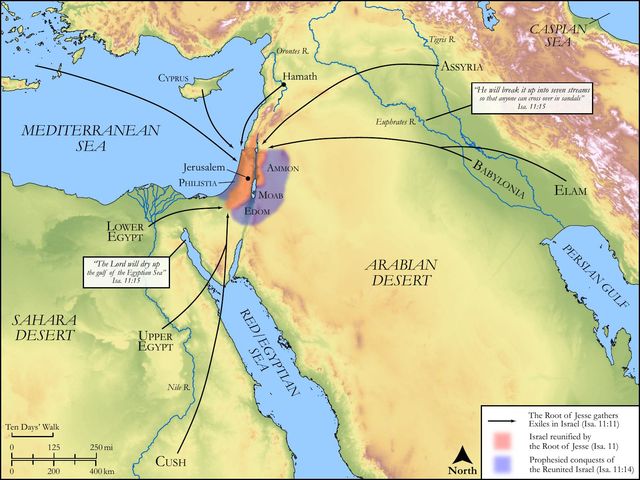
See on the biblical-era map
Study this verse
Public-domain commentary
Matthew Henry
From his Commentary on the Whole Bible. Henry comments on passages, not single verses — this entry covers Isaiah 12:4–6. His two-level outline is real structure in the source text, so it is rendered as structure.
This is the second part of this evangelical song, and to the same purport with the former; there believers stir up themselves to praise God, here they invite and encourage one another to do it, and are contriving to spread his praise and draw in others to join with them in it. Observe,
I.Who are here called upon to praise God - the inhabitants of Zion and Jerusalem, whom God had in a particular manner protected from Sennacherib's violence, Isa 12:6. Those that have received distinguishing favours from God ought to be most forward and zealous in praising him. The gospel church is Zion. Christ is Zion's King. Those that have a place and a name in the church should lay out themselves to diffuse the knowledge of Christ and to bring many to him. Thou inhabitress of Zion; the word is feminine. Let the weaker sex be strong in the Lord, and out of their mouth praise shall be perfected.
II.How they must praise the Lord.
1.By prayer: Call upon his name. As giving thanks for former mercy is a decent way of begging further mercy, so begging further mercy is graciously accepted as a thankful acknowledgment of the mercies we have received. In calling upon God's name we give unto him some of the glory that is due to his name as our powerful and bountiful benefactor.
2.By preaching and writing. We must not only speak to God, but speak to others concerning him, not only call upon his name, but (as the margin reads it) proclaim his name; let others know something more from us than they did before concerning God, and those things whereby he has made himself known. Declare his doings, his counsels (so some read it); the work of redemption is according to the counsel of his will, and in that and other wonderful works that he has done we must take notice of his thoughts which are to us-ward, Psa 40:5. Declare these among the people, among the heathen, that they may be brought into communion with Israel and the God of Israel. When the apostles preached the gospel to all nations, beginning at Jerusalem, then this scripture was fulfilled, that his doings should be declared among the people and that what he has done should be known in all the earth.
3.By a holy exultation and transport of joy: "Cry out and shout; welcome the gospel to yourselves and publish it to others with huzzas and loud acclamations, as those that shout for victory (Exo 32:18) or for the coronation of a king," Num 23:21.
III.For what they must praise the Lord.
1.Because he has glorified himself. Remember it yourselves, and make mention of it to others, that his name is exalted, has become more illustrious and more conspicuous; in this every good man rejoices.
2.Because he has magnified his people: He has done excellent things for them, which make them look great and considerable.
3.Because he is, and will be, great among them: Great is the Holy One, for he is glorious in holiness; therefore great, because holy. True goodness is true greatness. He is great as the Holy One of Israel, and in the midst of them, praised by them (Psa 76:1), manifesting himself among them, and appearing gloriously in their behalf. It is the honour and happiness of Israel that the God who is in covenant with them, and in the midst of them, is infinitely great.
Historical interpretation
Historical reception
1 surviving comment on this verse from the historical church.
(Verses 4, 5.) And you shall say on that day, confess the Lord and invoke His name: make His inventions known among the peoples: remember, for His name is exalted. Sing to the Lord, for He has done great things: announce this in all the earth. These things are commanded by the Apostles and the rest of Israel to those who believed from the Gentiles: that they alone confess the Lord, and forsaking idols, invoke His name: and proclaim all His works to the unbelievers; that they may know that He alone is exalted: to whom it is to be sung for His great deeds, and in all the earth His mercy is to be proclaimed.
Continue studying Isaiah 12:5 across the web’s major study libraries — every link below opens this exact verse, chapter, or book on the destination site.
Read & Compare
 BibleGatewayThis verse in more than 200 translations and 70 languages.
 Bible.comThe YouVersion reader — hundreds of translations, reading plans, and highlights.
 ESV.orgCrossway's official English Standard Version reader.
 NET BibleThe NET translation with 60,000+ translators' notes on every rendering decision.
 STEP BibleTyndale House's free study tool — original text, vocabulary, and scholarly resources.
 BibliaLogos Bible Software's free web reader.
 USCCBThe New American Bible (Revised Edition) with the U.S. bishops' study notes.
Commentaries
 BibleHub CommentariesDozens of classic commentaries on this verse, gathered on one page.
 StudyLightMore than 100 commentary sets — the largest collection on the web.
 BibleRefPlain-English commentary on what this verse means, verse by verse.
 Enduring WordDavid Guzik's free commentary on this chapter, widely used by Bible teachers.
 Bible Study ToolsVerse commentary alongside Greek and Hebrew study aids.
Original Language & Research
- BibleHub InterlinearThe verse word by word — original language, transliteration, and English.
- BibleHub LexiconEvery word's original-language definition and Strong's entry.
 Blue Letter BibleDeep-study tools — Strong's numbers, concordance, and word studies.
 SefariaThe Hebrew text with Rashi and centuries of Jewish commentary.
Sermons, Hymns & Audio


TrulyRandomVerse is not affiliated with these sites and doesn’t control their content. They’re linked because they’re genuinely useful.
Summary
Isaiah 12:5 issues a fervent, universal call to worship, urging all people to sing praise to the LORD. It declares that God has performed magnificent and glorious deeds, acts of unparalleled excellence that are not confined to a single nation but are universally recognized across the entire earth. This verse functions as a climactic declaration of God's sovereign power and redemptive work, anticipating a future era when His majesty will be fully acknowledged by all creation.
Context
ShowHideLiterary Context
Isaiah 12 serves as the triumphant doxological conclusion to a significant prophetic section of the book, often referred to as "The Book of Immanuel" (chapters 7-12). This section begins with the historical context of the Syro-Ephraimite War and King Ahaz's lack of faith, but quickly pivots to profound messianic prophecies. Following a series of pronouncements concerning judgment upon Judah and surrounding nations, and crucially, the profound promises of the Messiah's coming and the establishment of His righteous kingdom (e.g., the prophecy of the virgin birth in Isaiah 7:14 and the detailed descriptions of the Messiah's reign in Isaiah 9:6-7 and Isaiah 11:1-10), chapter 12 shifts entirely to a song of salvation and thanksgiving. This hymn is a prophetic response to God's promised deliverance, expressing the joy and gratitude of a redeemed people looking forward to the full realization of His salvation and peace. It marks a powerful transition from the somber tones of judgment and warning to the exultant praise for future restoration and divine faithfulness.
Historical & Cultural Context
The prophecies in Isaiah 7-12 are primarily set against the tumultuous backdrop of the Assyrian threat to Judah in the 8th century BC. King Ahaz of Judah, faced with an alliance of Aram and Israel, chose to seek help from the formidable Assyrian empire rather than trusting in the LORD, a decision that led to future subjugation and distress for Judah. Isaiah's prophetic ministry during this period consistently delivered messages of divine judgment for unfaithfulness but also unwavering hope in God's ultimate faithfulness and the coming of a righteous, Davidic king. The "song of salvation" in chapter 12, therefore, transcends the immediate historical crisis of Assyrian dominance, looking beyond the present distress to a future eschatological era when God's redemptive plan would be fully accomplished, bringing universal peace and the recognition of His glory. The call to "sing" was a common and integral form of communal worship and celebration in ancient Israel, often associated with momentous acts of deliverance and victory, echoing the triumphant songs of Moses and Miriam after the Exodus from Egypt (Exodus 15:1-21).
Key Themes
ShowHideIsaiah 12:5 powerfully contributes to several overarching themes woven throughout the book of Isaiah. Firstly, it reinforces the theme of God's Sovereignty and Mighty Deeds, emphasizing that His actions are "excellent things" (or majestic deeds), demonstrating His unparalleled power, wisdom, and righteousness in orchestrating salvation. This aligns with the broader biblical narrative of God as the active agent in history, from the initial act of creation (Isaiah 40:28) to the ultimate act of redemption. Secondly, it highlights the theme of Universal Recognition of God's Glory. The phrase "this is known in all the earth" points to a future time when the knowledge of God's glory will not be confined to Israel but will extend globally, fulfilling prophecies like Habakkuk 2:14 that speak of the earth being "filled with the knowledge of the glory of the LORD as the waters cover the sea." Thirdly, it underscores the theme of Exhortation to Praise and Thanksgiving, positioning praise as the appropriate and joyous response to God's redemptive work, a theme profoundly prevalent throughout the Psalms, such as the call to "sing a new song to the LORD" in Psalm 96:1.
Exposition and Analysis
ShowHideKey Word Analysis
ShowHideThis primitive root signifies "to touch the strings or parts of a musical instrument," and by extension, "to play upon it" or "to make music, accompanied by the voice." It encompasses the act of celebrating in song and music, specifically to "give praise" and "sing forth praises" or "psalms." In the context of Isaiah 12:5, it denotes a joyful, exuberant, and heartfelt act of worship, an emphatic command to express profound adoration.
Derived from a root meaning "to be high," this word carries the primary sense of "majesty" or "arrogance," but in this context, it refers to God's "majesty," "glory," and "splendor." It describes His actions as "magnificent, awe-inspiring deeds," implying that God's works are supremely great, noble, and worthy of universal admiration. These are not merely good deeds, but acts of unparalleled greatness and significance, demonstrating His divine character and power.
This versatile primitive root means "to know," encompassing a broad range of meanings including to ascertain by seeing, to perceive, to be aware, to acknowledge, or to make known. It implies understanding, recognition, and even intimate acquaintance. In Isaiah 12:5, it conveys the idea that God's excellent deeds are not hidden but are openly revealed and universally acknowledged, implying a profound and widespread understanding and recognition of His magnificent works and character.
Verse Breakdown
ShowHide"Sing unto the LORD;"
This clause serves as a direct, imperative command, an enthusiastic and urgent call to worship. It is an invitation and an exhortation for God's people, and by extension, all creation, to raise their voices in celebratory song and praise. The object of this praise is "the LORD" (Hebrew: Yᵉhôvâh), emphasizing His covenant faithfulness, self-existent nature, and supreme authority as the one true God.
"for he hath done excellent things:"
This clause provides the foundational and compelling reason for the command to sing. The "excellent things" (Hebrew: gêʼûwth) refer to God's mighty acts of salvation, His historical interventions (such as the Exodus and the preservation of His people), His creative power, and especially the promised future redemption through the Messiah. These are deeds of majesty, glory, and unparalleled greatness, demonstrating His divine power, wisdom, and boundless love.
"this [is] known in all the earth."
This final clause declares the universal scope and recognition of God's magnificent works. It implies that God's deeds are not hidden or confined to one nation or people group, but are openly revealed and destined to be acknowledged globally. This is a profound prophetic statement looking forward to a time when the knowledge of God's glory and His redemptive acts will permeate the entire world, establishing His renown universally and undeniably.
Literary Devices
ShowHideIsaiah 12:5 employs several potent literary devices to convey its powerful message. The most prominent is Exhortation, evident in the direct, imperative command "Sing unto the LORD," which serves as a passionate call to action and worship. This is immediately followed by a Reason/Consequence Clause ("for he hath done excellent things"), providing the theological justification for the commanded praise, linking divine action directly to human response. The phrase "excellent things" functions as a form of Hyperbole or Intensification, emphasizing the extraordinary, unparalleled, and majestic nature of God's deeds, transcending mere goodness to reach a level of divine splendor and awe. Finally, the statement "this is known in all the earth" utilizes Universalism or Hyperbole to convey the global and pervasive recognition of God's glory, projecting a future reality where His renown is undeniable and widespread, reaching every corner of the globe.
Theological and Thematic Connections
ShowHideIsaiah 12:5 stands as a profound theological statement, affirming God's active involvement in history and His ultimate redemptive purpose for all creation. It emphasizes that the proper and natural response to God's magnificent deeds is unreserved praise and worship. The "excellent things" God has done encompass not only His past acts of creation and deliverance for Israel but also His ongoing work in the present and His future, ultimate salvation for all humanity. The universal recognition of these deeds points to God's desire for all humanity to acknowledge His sovereignty and glory, fulfilling His global redemptive plan. This verse serves as a powerful reminder that God's character and actions are inherently worthy of universal adoration, prompting a joyful and grateful response from His people.
Reflection and Application
ShowHideIsaiah 12:5 is a timeless invitation to cultivate a heart of worship and profound gratitude. In a world often consumed by self-focus, anxiety, or despair, this verse powerfully redirects our gaze to the magnificent works of God. It challenges us to pause and reflect deeply on the "excellent things" He has done, both in the grand sweep of redemptive history—from creation to the cross—and in the intimate, often overlooked, details of our personal lives. This recognition should naturally overflow into spontaneous and authentic praise, not as a burdensome duty, but as a joyous response to His character and actions. Furthermore, the verse reminds us of our sacred call to participate in making God's glory "known in all the earth." Our lives, our words, and our collective witness become powerful conduits through which His excellent deeds are proclaimed, inviting others to join in the universal chorus of praise. It encourages us to live with a constant awareness of God's active presence and to joyfully declare His greatness to a world desperately in need of knowing Him.
Questions for Reflection
ShowHideFAQ
ShowHideWhat are the "excellent things" God has done, as mentioned in Isaiah 12:5?
ShowHideThe "excellent things" (Hebrew: gêʼûwth, meaning majesty, glory, or magnificent deeds) refer to God's unparalleled acts of power, wisdom, and love throughout history and in His overarching redemptive plan. In the immediate prophetic context of Isaiah, these include His unwavering covenant faithfulness, His sovereign control over nations, His miraculous deliverance of Israel from oppression, and most significantly, the promise of the coming Messiah and the establishment of His righteous, eternal kingdom (as detailed in the messianic prophecies of Isaiah 9 and Isaiah 11). Broadly, these "excellent things" encompass creation itself, the miraculous Exodus from Egypt, the giving of the Law, and ultimately, the entire comprehensive plan of salvation culminating in the person and work of Jesus Christ.
Christ-Centered Fulfillment
ShowHideIsaiah 12:5 finds its ultimate and most profound fulfillment in the person and redemptive work of Jesus Christ. The "excellent things" God has done are supremely and perfectly demonstrated in the incarnation, sinless life, atoning death, and glorious resurrection of His Son. The coming of the "branch from Jesse" (Isaiah 11:1)—Jesus—is the greatest of God's majestic deeds, through whom salvation is accomplished for all who believe. His atoning sacrifice on the cross and His victorious resurrection are the "excellent things" that deliver humanity from the bondage of sin and the dominion of death, establishing His eternal kingdom and reconciling humanity to God. The declaration that "this is known in all the earth" foreshadows the Great Commission, where the good news of Christ's finished work is proclaimed to every nation, tribe, people, and language (Matthew 28:19-20). Through Christ, the knowledge of God's glory and His saving power is indeed made known universally, inviting all to "sing unto the LORD" for the salvation He has so magnificently provided (Revelation 5:9-10). The joyous praise envisioned in Isaiah 12:5 is fully realized in the worship of the Lamb of God, who takes away the sin of the world (John 1:29).