


Isaiah 12:6
- צַהֲלִיtza·ha·Licry aloudH6670V-Qal-Imp-2fsVerb Qal Imperative 2nd Singular Feminine
- וָרֹנִּיva·Ro·niand cry outH7442Conj-w ¦ V-Qal-Imp-2fsVerb Qal Imperative 2nd Singular Feminineוָandרֹנִּיcry out
- יוֹשֶׁבֶתyo·She·vetO inhabitant[s] ofH3427V-Qal-Prtcpl-fsVerb Qal Participle Singular Feminine Construct
- צִיּוֹןtzi·YonZionH6726N-properNoun Proper Location
- כִּיkiforH3588PrtParticle Conditional
- גָדוֹלga·Dol[is] greatH1419Adj-msAdjective Singular Masculine Absolute
- בְּקִרְבֵּךְbe·kir·Bekhin your midstH7130Prep-b ¦ N-msc ¦ 2fsNoun Singular Masculine Constructבְּinקִרְבֵּmidstךְyour
- קְדוֹשׁke·Do·osh[the] holy [one] ofH6918Adj-mscAdjective Singular Masculine Construct
- יִשְׂרָאֵלYis·ra·'ElIsraelH3478N-properNoun Proper Location
English is a literal word-by-word gloss of the Hebrew, not the KJV's wording. Why?
This is the original text the KJV's translators worked from — each Hebrew word with its own literal English meaning in this verse, prepared by scholars at Tyndale House, Cambridge. The KJV translates whole sentences, not word by word, so its wording differs: one Hebrew word can become several English words, and the KJV may choose “the LORD” where the gloss reads “Yahweh”. Both are faithful — they answer different questions. For the KJV's own rendering, switch to the KJV text.
Details
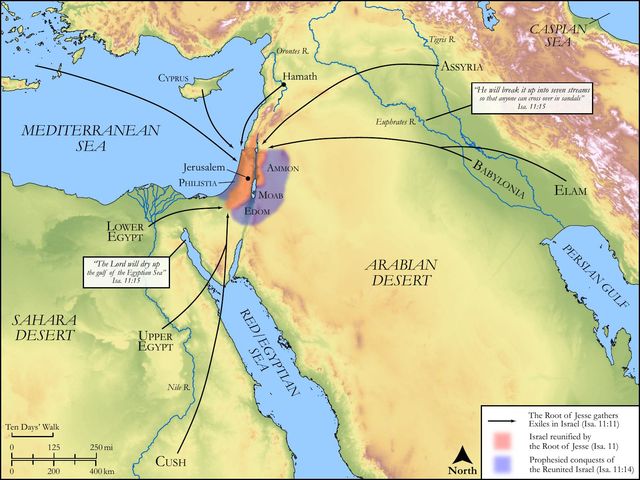
See on the biblical-era map
Study this verse
Public-domain commentary
Matthew Henry
From his Commentary on the Whole Bible. Henry comments on passages, not single verses — this entry covers Isaiah 12:4–6. His two-level outline is real structure in the source text, so it is rendered as structure.
This is the second part of this evangelical song, and to the same purport with the former; there believers stir up themselves to praise God, here they invite and encourage one another to do it, and are contriving to spread his praise and draw in others to join with them in it. Observe,
I.Who are here called upon to praise God - the inhabitants of Zion and Jerusalem, whom God had in a particular manner protected from Sennacherib's violence, Isa 12:6. Those that have received distinguishing favours from God ought to be most forward and zealous in praising him. The gospel church is Zion. Christ is Zion's King. Those that have a place and a name in the church should lay out themselves to diffuse the knowledge of Christ and to bring many to him. Thou inhabitress of Zion; the word is feminine. Let the weaker sex be strong in the Lord, and out of their mouth praise shall be perfected.
II.How they must praise the Lord.
1.By prayer: Call upon his name. As giving thanks for former mercy is a decent way of begging further mercy, so begging further mercy is graciously accepted as a thankful acknowledgment of the mercies we have received. In calling upon God's name we give unto him some of the glory that is due to his name as our powerful and bountiful benefactor.
2.By preaching and writing. We must not only speak to God, but speak to others concerning him, not only call upon his name, but (as the margin reads it) proclaim his name; let others know something more from us than they did before concerning God, and those things whereby he has made himself known. Declare his doings, his counsels (so some read it); the work of redemption is according to the counsel of his will, and in that and other wonderful works that he has done we must take notice of his thoughts which are to us-ward, Psa 40:5. Declare these among the people, among the heathen, that they may be brought into communion with Israel and the God of Israel. When the apostles preached the gospel to all nations, beginning at Jerusalem, then this scripture was fulfilled, that his doings should be declared among the people and that what he has done should be known in all the earth.
3.By a holy exultation and transport of joy: "Cry out and shout; welcome the gospel to yourselves and publish it to others with huzzas and loud acclamations, as those that shout for victory (Exo 32:18) or for the coronation of a king," Num 23:21.
III.For what they must praise the Lord.
1.Because he has glorified himself. Remember it yourselves, and make mention of it to others, that his name is exalted, has become more illustrious and more conspicuous; in this every good man rejoices.
2.Because he has magnified his people: He has done excellent things for them, which make them look great and considerable.
3.Because he is, and will be, great among them: Great is the Holy One, for he is glorious in holiness; therefore great, because holy. True goodness is true greatness. He is great as the Holy One of Israel, and in the midst of them, praised by them (Psa 76:1), manifesting himself among them, and appearing gloriously in their behalf. It is the honour and happiness of Israel that the God who is in covenant with them, and in the midst of them, is infinitely great.
Historical interpretation
Historical reception
1 surviving comment on this verse from the historical church.
(Verse 6) Rejoice and praise, O dwelling place of Zion, for the Holy One of Israel is great among you. First, it must be said according to the letter: O dwelling place of Zion, rejoice and praise your God, for He who was once considered your God and was enclosed within the narrow bounds of the land of Judaea, now fills the whole earth with His knowledge. Rising from the dead, He reigns over the nations, and the nations shall beseech Him and worship Him. However, He will add secondly His hand to possess what remains of His people, and to gather together the dispersed of Israel and the scattered of Judah from the four corners of the earth. For the seedbed of the Gospel spread forth from the fountains of Israel through the Apostles, who were from the Jews. But it is better, as the Church is interpreted as the high tower, that we interpret Zion, from which the fiftieth psalm sings: Deal gently, O Lord, in thy good will with Zion; that the walls of Jerusalem may be built up. That in her may be made acceptable to God the sacrifice of justice, oblations, and holocausts, and the calf, which the most merciful father offered to the repenting son.
Continue studying Isaiah 12:6 across the web’s major study libraries — every link below opens this exact verse, chapter, or book on the destination site.
Read & Compare
 BibleGatewayThis verse in more than 200 translations and 70 languages.
 Bible.comThe YouVersion reader — hundreds of translations, reading plans, and highlights.
 ESV.orgCrossway's official English Standard Version reader.
 NET BibleThe NET translation with 60,000+ translators' notes on every rendering decision.
 STEP BibleTyndale House's free study tool — original text, vocabulary, and scholarly resources.
 BibliaLogos Bible Software's free web reader.
 USCCBThe New American Bible (Revised Edition) with the U.S. bishops' study notes.
Commentaries
 BibleHub CommentariesDozens of classic commentaries on this verse, gathered on one page.
 StudyLightMore than 100 commentary sets — the largest collection on the web.
 BibleRefPlain-English commentary on what this verse means, verse by verse.
 Enduring WordDavid Guzik's free commentary on this chapter, widely used by Bible teachers.
 Bible Study ToolsVerse commentary alongside Greek and Hebrew study aids.
Original Language & Research
- BibleHub InterlinearThe verse word by word — original language, transliteration, and English.
- BibleHub LexiconEvery word's original-language definition and Strong's entry.
 Blue Letter BibleDeep-study tools — Strong's numbers, concordance, and word studies.
 SefariaThe Hebrew text with Rashi and centuries of Jewish commentary.
Sermons, Hymns & Audio


TrulyRandomVerse is not affiliated with these sites and doesn’t control their content. They’re linked because they’re genuinely useful.
Summary
Isaiah 12:6 serves as the triumphant crescendo of a prophetic song of thanksgiving, calling the inhabitants of Zion to an exuberant and unrestrained declaration of praise. It encapsulates the profound joy, confidence, and security found in the immediate and active presence of the "Holy One of Israel," whose incomparable greatness is the ultimate foundation for His people's exultation and hope. This verse is a powerful summons to acknowledge God's saving work and His dwelling among His people with unbridled celebration, anticipating the full realization of His redemptive plan.
Context
ShowHideLiterary Context
Isaiah 12 stands as the glorious conclusion to a significant prophetic section often referred to as "The Book of Immanuel" (Isaiah 7-12). This section begins with prophecies of judgment and warning (Isaiah 7-10), particularly against Judah and Assyria, but gradually shifts to messianic hope and promises of restoration. Chapter 11 vividly describes the coming of the Messiah, the "Branch from Jesse," who will rule with righteousness and establish a kingdom of peace and justice, gathering the scattered remnant of Israel and Judah, as detailed in Isaiah 11:1-16. Chapter 12, therefore, is a spontaneous outburst of praise and thanksgiving, a liturgical hymn that anticipates the full realization of God's salvation. It echoes themes from earlier in the book, particularly the promise of God's presence and deliverance, culminating in a communal call to worship. The preceding verses in chapter 12 speak of drawing water "out of the wells of salvation" in Isaiah 12:3, expressing trust in God's anger turning away, and acknowledging Him as strength and song in Isaiah 12:2. Verse 6 is the climactic call to action, urging the people to vocalize the joy and confidence that the preceding verses have articulated.
Historical & Cultural Context
The book of Isaiah is set against the backdrop of the Assyrian threat to Judah in the 8th century BCE. The prophecies often address the political turmoil, the spiritual apostasy of the people, and the impending judgment. However, interwoven with these warnings are profound promises of future restoration and the establishment of God's righteous kingdom. "Zion" refers primarily to Jerusalem, the capital city and the dwelling place of God's temple. It is both a literal geographical location and a symbolic representation of God's chosen people, the community of faith. The call to "cry out and shout" would have resonated deeply with a people who had experienced periods of oppression, fear, and spiritual despondency. Such public, communal expressions of joy and triumph were common in ancient Israelite worship, often accompanying military victories, festivals, or significant acts of divine deliverance. The anticipation of God's "greatness" and His presence "in the midst of thee" would have been a powerful counter-narrative to the prevailing sense of vulnerability and the worship of foreign deities, reasserting Yahweh's unique sovereignty and faithfulness to His covenant.
Key Themes
ShowHideThe central themes of Isaiah 12:6 are exuberant praise and proclamation, God's immanent presence, and His unparalleled greatness and holiness. The command to "Cry out and shout" is not a gentle suggestion but an emphatic, almost imperative, instruction for God's people to express their joy and confidence outwardly and vocally. This reflects a theology where faith is not merely an internal conviction but a public, communal declaration. The phrase "in the midst of thee" underscores God's active, intimate, and accessible presence among His people, a concept foundational to Israel's identity, from the Tabernacle in the wilderness, as commanded in Exodus 25:8, to the promise of the New Jerusalem in Revelation 21:3. The title "the Holy One of Israel" is particularly significant in Isaiah, appearing over twenty-five times. It emphasizes God's absolute moral purity, His transcendent majesty, and His unique covenant relationship with His chosen people. His "greatness" denotes His omnipotence, sovereignty, and incomparable nature, providing the ultimate and irrefutable reason for worship and praise.
Exposition and Analysis
ShowHideKey Word Analysis
ShowHideThis primitive root primarily means "to gleam," but figuratively, "to be cheerful." By transference, it refers to a clear, ringing sound, often associated with various animal or human expressions. It can denote "bellowing," "crying aloud (out)," "lifting up" one's voice, "neighing," "rejoicing," or "making to shine." In this context, it signifies a loud, clear, and uninhibited sound of exultation, often associated with triumph or joy, suggesting a vibrant and unrestrained outpouring of praise.
A primitive root meaning "to creak (or emit a stridulous sound)," which by implication means "to shout (usually for joy)." It conveys the idea of a ringing cry, often for joy, triumph, or singing aloud. Paired with tsâhal, it intensifies the command, indicating a full-throated, exuberant, and public declaration of praise, emphasizing the celebratory and vocal nature of the command.
From the root qâdash (to be sacred, set apart), this word signifies sacredness, whether ceremonially or morally. As a noun, it refers to God (by eminence), an angel, or a saint. When applied to God, particularly as "the Holy One of Israel," it emphasizes His absolute moral purity, His transcendence, His distinctness from all creation, and His unique covenant relationship with Israel. It speaks to His awe-inspiring majesty and unapproachable perfection, which paradoxically makes His immanence even more profound and wondrous.
Verse Breakdown
ShowHide"Cry out and shout, thou inhabitant of Zion:"
This is an urgent, emphatic imperative directed at the people of God, specifically those dwelling in Jerusalem (Zion), but extending to all who identify with God's covenant community. The double command, using two strong verbs of vocalization and exultation, underscores the intensity and public nature of the required response. It is a call to move beyond quiet contemplation to an overt, communal, and unrestrained expression of joy and triumph, a public declaration of faith and gratitude.
"for great is the Holy One of Israel"
This clause provides the foundational reason for the preceding command. The "Holy One of Israel" is a unique and prominent title for God in Isaiah, emphasizing His transcendent purity, His covenant faithfulness, and His distinct identity. His "greatness" encompasses His power, majesty, sovereignty, and incomparable nature. It is because of who God is—His inherent character and attributes—that His people have every reason to celebrate with such fervor.
"in the midst of thee."
This final phrase highlights God's immanent presence. It signifies that the source of their joy is not a distant, abstract deity, but a God who actively dwells among His people, intimately involved in their lives, ready to deliver, protect, and sustain them. This immanence transforms abstract theological truth into a lived reality, making the call to praise deeply personal and immediate for the "inhabitant of Zion," grounding their celebration in a tangible, present reality.
Literary Devices
ShowHideIsaiah 12:6 employs several powerful literary devices to convey its message with force and emotional resonance. It begins with a strong Exhortation through the imperative verbs "Cry out and shout," directly commanding the audience to engage in vocal praise. This is not a suggestion but an urgent summons, demanding an active, public response. The phrase "thou inhabitant of Zion" utilizes Personification by addressing the city and its people as a unified entity capable of responding to the divine command, thereby extending the call to the entire covenant community and emphasizing its communal nature. The intensity and pairing of the verbs ("cry out" and "shout") also suggest Hyperbole, emphasizing the boundless and unrestrained nature of the joy that should characterize God's people, transcending mere happiness to ecstatic celebration. Finally, the declaration that "great is the Holy One of Israel in the midst of thee" speaks powerfully to Divine Immanence, highlighting God's active and present dwelling among His people, which serves as the ultimate and compelling cause for their exuberant praise and confident hope.
Theological and Thematic Connections
ShowHideIsaiah 12:6 stands as a powerful testament to the biblical truth that God's presence among His people is the ultimate source of joy, security, and worship. This verse connects deeply with the overarching theme of God's covenant faithfulness and His redemptive plan. The call to "cry out and shout" echoes the celebratory responses seen throughout Israel's history after significant acts of divine deliverance, such as the triumphant song of Moses and Miriam after the crossing of the Red Sea in Exodus 15:1-2. It anticipates a future where God's salvation is fully realized, and His people can live in confident assurance because of His active dwelling in their midst. The title "Holy One of Israel" reinforces God's unique identity as the set-apart, transcendent, yet intimately involved Lord of His covenant people, whose greatness demands and deserves unreserved praise. This theological foundation transforms praise from a mere emotional outburst into a profound act of acknowledging God's sovereignty and His saving work, rooted in His character and His commitment to His people.
Reflection and Application
ShowHideIsaiah 12:6 is a timeless invitation to a vibrant, expressive faith. In a world often marked by anxiety, fear, and uncertainty, this verse reminds us that our ultimate security and joy are found not in fleeting circumstances, but in the unchanging character and active presence of God. The command to "cry out and shout" challenges us to consider the depth and outward expression of our praise. Is our faith a quiet, private affair, or does it lead to an uninhibited, communal declaration of God's goodness and triumph? Recognizing that the "great Holy One of Israel" is "in the midst of thee" should transform our perspective, filling us with a profound sense of awe, gratitude, and confidence. This verse calls us to live with a constant awareness of God's immanence, understanding that His presence empowers us to face any challenge with unwavering assurance. It encourages us to make our praise visible and audible, testifying to His greatness and holiness, not just in moments of triumph, but as a continuous posture of the heart that spills over into joyful, public proclamation, inviting others to witness and participate in the celebration of His saving work.
Questions for Reflection
ShowHideFAQ
ShowHideWhat is the significance of the title "Holy One of Israel" in Isaiah?
ShowHideThe title "Holy One of Israel" is a distinctive and recurring descriptor for God throughout the book of Isaiah, appearing over twenty-five times. It emphasizes several key aspects of God's character. First, "Holy One" points to God's absolute moral purity, His transcendence, and His being utterly set apart from all creation and sin. He is distinct and incomparable in His perfections. Second, the addition of "of Israel" highlights His unique covenant relationship with His chosen people. Despite their unfaithfulness and rebellion, God remains faithful to His covenant promises, demonstrating His holiness not just in His being, but in His righteous dealings with Israel. This title often appears in contexts of both judgment (because Israel has profaned His holiness through sin) and salvation (because He, the Holy One, will ultimately redeem them and restore His covenant). It underscores that Israel's hope lies solely in their unique God, whose holiness guarantees both His justice and His redemptive power, as seen in passages like Isaiah 1:4 and Isaiah 43:3.
Christ-Centered Fulfillment
ShowHideIsaiah 12:6 finds its ultimate and most profound fulfillment in the person and work of Jesus Christ. The "Holy One of Israel" who is "in the midst of thee" is perfectly embodied in Jesus, who is God incarnate, Emmanuel, "God with us," as prophesied in Matthew 1:23. The Old Testament longing for God's dwelling among His people, symbolized by the Tabernacle and Temple, reaches its zenith in Christ, who "tabernacled among us, full of grace and truth," as declared in John 1:14. His life, atoning death, and glorious resurrection represent the ultimate act of salvation, drawing water from the wells of salvation, as anticipated in Isaiah 12:3, for all who believe. Through the indwelling Holy Spirit, Christ now dwells in the hearts of believers, making the promise of God's presence "in the midst of thee" a living reality for the church, the new Zion, which is built into "a dwelling place for God by the Spirit" according to Ephesians 2:22. Therefore, the call to "cry out and shout" is amplified for New Testament believers, who celebrate not merely a promised future deliverance but a salvation already accomplished and a living Lord who reigns. Our praise is a joyful response to the "greatness" of the One who conquered sin and death, the Lamb of God who takes away the sin of the world, as proclaimed in John 1:29, and who promises His abiding presence until the end of the age in Matthew 28:20. The exuberant praise of Isaiah 12:6 thus becomes the joyful song of the redeemed, celebrating the indwelling Christ and the hope of His glorious return.