


Zephaniah 3:17
“The Lord Rejoices Over Zion”Zephaniah 3:14–20
Bible text: King James Version (1769 Blayney text) · Public domain
Bible text: King James Version with Strong's numbers · Public domain
Bible text: Berean Standard Bible · Public domain
Bible text: American Standard Version (1901) · Public domain
Bible text: World English Bible, Messianic edition · Public domain
Bible text: Geneva Bible (1599) · Public domain
Bible text: Young's Literal Translation · Public domain
- יְהוָהYah·wehYahwehH3068N-properNoun Proper Title
- אֱלֹהַיִךְ'e·lo·Ha·yikhyour GodH430N-mpc ¦ 2fsNoun Plural Masculine Construct with suffixאֱלֹהַיִGodךְyour
- בְּקִרְבֵּךbe·kir·Bekh[is] in your midstH7130Prep-b ¦ N-msc ¦ 2fsNoun Singular Masculine Construct with suffixבְּ[is] inקִרְבֵּmidstךyour
- גִּבּוֹרgi·Bora warriorH1368N-msNoun Singular Masculine Absolute
- יוֹשִׁיעַyo·Shi·a'[who] he will give victoryH3467V-Hiphil-Imperf-3msVerb Hiphil Imperfect 3rd Singular Masculine
- יָשִׂישׂya·Sishe will rejoiceH7797V-Qal-Imperf-3msVerb Qal Imperfect 3rd Singular Masculine
- עָלַיִךְ'a·La·yikhon youH5921Prep ¦ 2fsPrepositionעָלַיִonךְyou
- בְּשִׂמְחָהbe·sim·Chahwith joyH8057Prep-b ¦ N-fsNoun Singular Feminine Absoluteבְּwithשִׂמְחָהjoy
- יַחֲרִישׁya·cha·Rishhe will be silentH2790V-Hiphil-Imperf-3msVerb Hiphil Imperfect 3rd Singular Masculine
- בְּאַהֲבָתוֹbe·'A·ha·va·Toin his loveH160Prep-b ¦ N-fsc ¦ 3msNoun Singular Feminine Construct with suffixבְּinאַהֲבָתloveוֹhis
- יָגִילya·Gilhe will be gladH1523V-Qal-Imperf-3msVerb Qal Imperfect 3rd Singular Masculine
- עָלַיִךְ'a·La·yikhon youH5921Prep ¦ 2fsPrepositionעָלַיִonךְyou
- בְּרִנָּהbe·ri·Nahwith a shout of joyH7440Prep-b ¦ N-fsNoun Singular Feminine Absoluteבְּwithרִנָּהa shout of joy
English is a literal word-by-word gloss of the Hebrew, not the KJV's wording. Why?
This is the Hebrew Masoretic text, the same tradition the KJV’s translators worked from, with each word given its own literal English meaning in this verse. The word-by-word meanings were prepared by scholars at Tyndale House, Cambridge. The KJV translates whole sentences rather than single words, so its wording often differs: one Hebrew word can become several English words, and the KJV may say “the LORD” where the word-by-word meaning reads “Yahweh”. The two are made for different purposes, and both are faithful to the Hebrew. To read the KJV’s own wording, switch to the KJV text.
Words in [ ] are added by the English.
Details
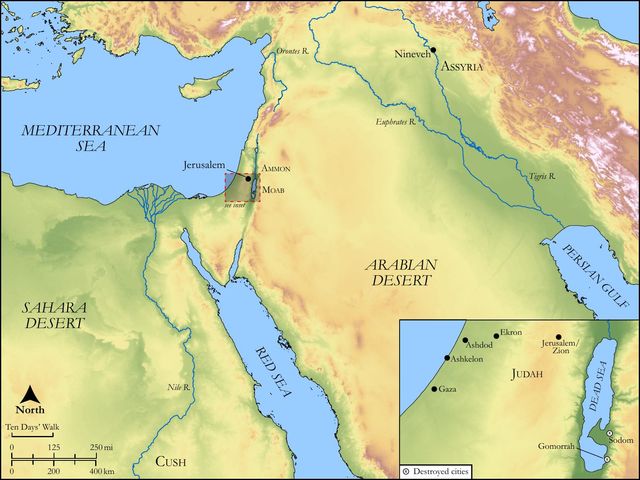
See on the biblical-era map
Study this verse
Public-domain commentary
Matthew Henry
From his Commentary on the Whole Bible. Henry wrote on whole passages, and this entry covers Zephaniah 3:14–20. He set out his notes in a three-level outline, kept here as he numbered it.
After the promises of the taking away of sin, here follow promises of the taking away of trouble; for when the cause is removed the effect will cease. What makes a people holy will make them happy of course. The precious promises here made to the purified people were to have their full accomplishment in the comforts of the gospel, in the hope, and much more in the enjoyment, of which, they are here called upon, 1. To rejoice and sing (Zephaniah 3:14): Sing, O daughter of Zion! sing for joy; Shout, O Israel! in a holy transport and exultation; be glad and rejoice with all the heart; let the joy be inward, let it be great. Those that love God with all their heart have occasion with all their heart to rejoice in him. It was promised (Zephaniah 3:13) that their sins should be mortified and their fears silenced, and then follows, Sing and rejoice. Note, Those that reform have cause to rejoice, whereas Israel cannot rejoice for joy as other people, while she goes a whoring from her God. God's promises, applied by faith, furnish the saints with constant and abundant matter for joy; they are filled with joy and peace in believing them. 2. To throw off all their discouragements (Zephaniah 3:16): In that day it shall be said to Jerusalem (God will say it by his prophets, by his providences, their neighbours shall say it, they shall say it to one another), "Fear thou not, be not disposed to fear, do not easily admit the impressions of it; when things are bad, fear not their being worse, but hope they will mend; frighten not thyself upon every occasion. Let not thy hands be slack or faint; wring not thy hands in despair; drop not thy hands in despondence; disfit not thyself for thy work and warfare by giving way to doubts and fears. Pluck up thy spirits, and, in token of that, lift up thy hands, the hands that hung down, Hebrews 12:12; Isaiah 35:3. Lift up thy hands in prayer to God; lift up thy hands to help thyself." Fear makes the hands slack, but faith and hope make them vigorous, and the joy of the Lord will be our strength both for doing and suffering.
Let us now see what these precious promises are which are here made to the people of God, for the banishing of their griefs and fears and the encouraging of their hopes and joys; and to us are these promises made as well as to them.
I.An end shall be put to all their troubles and distresses (Zephaniah 3:15):
"The Lord has taken away thy judgments, has removed all the calamities thou hast been groaning under, which were the punishments of thy sin; the noise of war shall be silenced, the reproach of famine done away, and the captivity brought back. Though some grievances remain, they shall be only afflictions, and not judgments, for sin shall be pardoned. He has cast out thy enemy, that has thrust himself into thy land, and triumphed over thee. He has swept out thy enemy" (so some read it), "as dirt is swept out of the house to the dunghill." When they sweep out their sins with the besom of reformation God will sweep out their enemies with the besom of destruction. If they should need correction, they shall fall into the hands of the Lord, whose mercies are great, and shall not again fall into the hands of man, whose tender mercies are cruel: "Thou shalt not see evil any more, not such evil days as thou hast seen." Note, The way to get clear of the evil of trouble is to keep clear from the evil of sin; and to those that do so trouble has no real evil in it.
II.God will give them the tokens of his presence with them; though he has long seemed to stand at a distance (they having provoked him to withdraw), he will make it to appear that he is with them of a truth: "The Lord is in the midst of thee, O Zion! of thee, O Jerusalem! as the sun in the centre of the universe, to diffuse his light and influence upon every part. He is in the midst of thee, to preside in all thy affairs and to take care of all thy interests." And, 1. "He is the King of Israel (Zephaniah 3:15) and is in the midst of thee as a king in the midst of his people." With an eye to this, our Lord Jesus is called the King of Israel (John 1:49); and he is, and will be, in the midst of his church always, even to the end of the world, to receive the homage of his subjects, and to give out his favours to them, even where but two or three are gathered together in his name. 2. "He is the Lord thy God, thine in covenant, and he is in the midst of thee as thy God, whom thou hast an interest in and whose own thou art. He has put himself into dear relations to thee, laid himself by promise under obligations to thee, and, that thou mayest have abundant comfort in both, he is in the midst of thee, nigh at hand to answer both." 3. "He that is in the midst of thee as thy God and King is mighty, is almighty, is able to do all that for thee that thou needest and canst desire." 4. "He has engaged his power for thy succour: He will save. He will be Jesus, will answer the name, for he will save his people from their sins."
III.God will take delight in them, and in doing them good.
The expressions of this are very lively and affecting (Zephaniah 3:17): He will rejoice over thee with joy, will not only be well pleased with thee, upon thy repentance and reformation, and take thee into favour, but will take a complacency in thee, as the bridegroom does in his bride, or the bride in her ornaments, Isaiah 62:3-5. The conversion of sinners and the consolation of saints are the joy of angels, for they are the joy of God him-self. The church should be the joy of the whole earth (Psalm 48:2), for it is the joy of the whole heaven. He will rest in his love, will be silent in his love, so the word is. "I will not rebuke thee as I have done, for thy sins; I will acquiesce in thee, and in my relation to thee." I know not where there is the like expression of Christ's love to his church, unless in that song of songs, Song of Solomon 4:9, Thou hast ravished my heart, my sister, my spouse, with one of thy eyes. O the condescensions of divine grace! The great God not only loves his saints, but he loves to love them, is pleased that he has pitched upon these objects of his love. He will joy over them with singing. He that is grieved for the sin of sinners rejoices in the graces and services of the saints, and is ready to express that joy by singing over them. The Lord takes pleasure in those that fear him, and in them Jesus Christ will shortly be glorified and admired.
IV.God will comfort Zion's mourners, who sympathize with her in her griefs, and will wipe away their tears (Zephaniah 3:18):
I will gather those who are sorrowful for the solemn assemblies, to whom the reproach of it was a burden. See,
1.Who those are whom God will rejoice in and make to rejoice. They are such as are sorrowful. Those only must expect to reap in joy that sow in tears. The sorrowful now shall be for ever joyful.
2.What is the great matter of sorrow to Zion's mourners, when Zion is in mourning. Many are her calamities. The city is ruined, and the palaces are demolished; trade is at an end, and the administration of public justice; but all these are nothing to them in comparison with the desolations of the sanctuary, the destruction of the temple and the altar, to attend on which, in solemn feasts, all Israel used to come together three times a year. It is for those sacred solemn assemblies that they are sorrowful,
(1.)Because they are dispersed; there is no temple to come up to, or, if there were, no people to come up to it; so that the solemn feasts and sabbaths are forgotten in Zion, Lamentations 2:6. Note, The restraining of public assemblies for religious worship, the scattering of them by their enemies, or the forsaking of them by their friends, so that either there are no assemblies or not solemn ones, is a very sorrowful thing to all good people. If the ways of Zion mourn, the sons of Zion mourn too. And hereby they make it to appear that they are indeed of Zion, living members of that body with the grievances of which they are so sensibly affected.
(2.)Because they are despised; the reproach of the solemn assemblies is a burden to them. It had been the lot of the solemn assemblies to lie under a great deal of reproach. Satan and his instruments having a particular spite at them, as the great support of the interest of God's kingdom among men. Black and odious characters have been put upon those assemblies; and this is a burden to all those that have a cordial concern for the glory of God and the welfare of the souls of men. They reckon that the reproaches of those who reproach the solemn assemblies fall upon them, fall foul upon them.
V.God will recover the captives out of the hands of their oppressors, and bring home the banished that seemed to be expelled, Zephaniah 3:19, Zephaniah 3:20.
1.Their enemies shall be disabled to detain them in bondage: "At that time I will undo all that afflict thee, will break their power, and blast their counsels, so that they shall be forced to surrender the prey they have taken." Conficiam - I will take them to task; "I will be doing with them shortly, and so as to make an end of them." Note, Those that abuse and oppress God's people take the ready way to undo themselves.
2.They shall be enabled to assert and recover their liberty, and all the difficulties in the way of it shall be surmounted. Is the church weak and wounded? I will save her that halts, as was promised, Micah 4:7. He will help her when she cannot help herself; even the lame shall take the prey, Isaiah 33:23. Is she dispersed, and not likely to incorporate for her common benefit? I will gather her that was driven out, and bring her again at the time that I gather her. One act of mercy and grace shall serve both to collect them out of their dispersions and to conduct them to their own land. When the people's hearts are prepared, the work will be done suddenly; and who can hinder it if God undertake to effect it? "I will turn back your captivity before your eyes, saith the Lord; you shall plainly discern the hand of God in it, and say, This is the Lord's doing."
VI.God will by all this put honour upon them and gain them respect from all about them.
Israel was at first made high above all nations in praise and fame, Deuteronomy 26:19. The reproach brought upon them was therefore one of the sorest of their grievances (nothing cuts deeper to those that are in honour than disgrace does); and therefore when God returns, in mercy, to his church, it is here promised that she shall regain her credit; all the reproach shall be for ever rolled way, as Israel's at Gilgal, Joshua 5:9. The church shall be as honourable as ever she had been despicable.
1.Even those that reproached her shall be made to respect her: "I will get them praise and fame in every land, where they have been put to shame, that the same who were the witnesses of their disgrace may see cause to change their mind concerning them." Those that said, "This is Zion whom no man looks after," shall say, "This is Zion whom the great God looks after." And she that was looked upon to be the offscouring of the earth now appears to be the darling of heaven.
2.Even those that never knew her shall be brought to honour her (Zephaniah 3:20): I will make you a name and a praise among all people of the earth. So the Jewish church was when the fear of the Jews fell upon their neighbours (Esther 8:17), and some of all nations said, we will go with you, for we have heard that God is with you, Zechariah 8:23. So the Christian church was when it was made to flourish in the world, for there is that in it which may justly recommend it to the value and esteem of all the people of the earth. And so the universal church of the firstborn will be in the great day, when the saints shall be brought together to Christ, that he may be admired and glorified in them, and they admired and glorified in him before angels and men. Then will God's Israel be made a name and a praise to eternity.
Historical interpretation
Historical reception
2 surviving comments on this verse. Each one is dated, so this reads as a timeline rather than a list.
Select a marker to jump to its quote. Markers stagger vertically where authors wrote within a few decades of each other.
(Verse 14 and following) Praise, daughter of Zion, shout for joy, Israel, rejoice and exult with all your heart, daughter of Jerusalem. The Lord has taken away your judgment, he has turned away your enemies: the Lord, the King of Israel, is in your midst, you will no longer fear evil. On that day, it will be said, Jerusalem, do not be afraid: Zion, let your hands not be weak: the Lord your God, in your midst, is mighty he will save, he will rejoice over you with gladness, he will quiet you with his love: he will exult over you with praise. I will gather those who turned away from the law, because they were from you, so that you will no longer have reproach against them. Rejoice, daughter of Zion; proclaim, daughter of Jerusalem, rejoice and delight with all your heart, daughter of Jerusalem. The Lord has taken away your iniquities, he has redeemed you from the hand of your enemies, the Lord, the king of Israel, is in your midst: you will no longer see evil. In that time, says the Lord, Jerusalem, have confidence, Zion, let your hands not be weak: the Lord your God, who is mighty, will save you, he will bring joy upon you, and renew you in his love, and he will rejoice over you with delight, as on a solemn day: I will gather your broken ones. Woe to anyone who receives reproach upon it. It does not seem strange, as we have often said, that Hebrew chapters end differently from the Greek Septuagint and the Latin. For where there is a different sense of translation, there must necessarily be different beginnings or endings. The Jews, who expect Christ to come, promise themselves all these things, which we who have received Christ have already obtained with him. Therefore, if anyone, especially among the new wise men of the Christians, whose names I will not mention in order not to appear to harm anyone, thinks that prophecy has not yet been fulfilled, let him know that he falsely bears the name of Christ and has a Jewish soul, having only the circumcision of the body. For if these things have not yet been done, but are to come, we have believed in vain in the coming of the Savior. But in vain do we understand that the mystery, which has been kept secret from eternal times, is fulfilled in us who do not believe, and is now manifested through the prophetic Scriptures and the coming of our Lord Jesus Christ. Finally, let us consider the order of the reading, and we will see that it is said to pertain not to the Jews, but to the Church of Christ. For after that which went before (My judgement concerning the nations, that they might receive kings, even unto that place where it is said: They shall call upon the name of the Lord, and shall serve him under one yoke. And I will take of my dispersed into Ethiopia, and they shall offer to me victims. And in that day there shall be no more a Pharao in the land of Egypt: but the Assyrian shall be his king, because they would not be converted. And the remnant of the house of Israel, and they that shall escape of the house of Jacob, shall lean upon the Lord, the Holy One of Israel, in truth. A remnant shall be converted, the remnant, I say, of Jacob, to the mighty God. For if thy people, O Israel, shall be as the sand of the sea, a remnant of them shall be converted. Consummation, and that determined, shall overflow justice. Because the Lord God of hosts shall make a consumption, and an abridgment in the midst of all the land. The Holy Spirit, preaching about the general consummation of the world, speaks: Rejoice, daughter of Zion, proclaim, daughter of Jerusalem, be glad and delight with all your heart, daughter of Jerusalem. For every soul of the Church, which is established on the watchtower and contemplates peace, rejoices and is glad that its iniquities have been removed and redeemed by Him who redeemed all with His precious blood. For Christ has become wisdom for us from God, and righteousness, and sanctification, and redemption (I Cor. I, 30). And the king of Israel, who dwells among us, redeemed us, saying: I and my Father will come, and we will make our abode with him (John XIV, 23); and I will dwell and walk among them (Lev. XXVI, 12): and we will no longer see evil, but only think and do virtues. In that day, says the Lord, we will see peace, and placed on high, let not your hands be dissolved, who also said through Isaiah: Strengthen the weak hands, and let your works be strong (Isaiah XXXV, 3). For the Lord is strong, against whom no one can resist: your savior, he himself will restore to you the joy that you have lost, and after casting off the old man, he will make you walk in the new, and he will do all this out of his love: not because of your merit, but because of his mercy. And he will rejoice in you, and delight in you, receiving your salvation like a rich sacrifice of your solemnity; and he himself will say to you: I will gather your contrite ones; for a contrite and humble heart, God will not despise. (Psalm 50:19); and, a crushed reed he will not break. (Isaiah 42). But for now, if we want to understand the second coming of the Savior. Moreover, because the prophet Zechariah encourages Zion and Jerusalem to similar joy, and Matthew says that this same prophecy was fulfilled in the first coming of Christ (Matt. 21), we are compelled by necessity, or rather we are led by the very order of truth, which is said in Zephaniah, not to hope for what is to come, but for what has already happened. For it is written in Zechariah: Rejoice greatly, O daughter of Zion; proclaim, O daughter of Jerusalem: behold, your king comes to you, righteous and saving: he is humble and riding on a donkey (or a colt) (Zech. 9:9). These things are said according to the Septuagint. However, according to the Hebrew, the Church is commanded to praise and Israel is commanded to rejoice, perceiving God with understanding, and to exult and be joyful with their whole heart in the place of peace, to which it was said: Peace I give to you, my peace I leave with you (John 14:27). For in the end and consummation of the world, he took away his judgment, by no means judging or reproving it, but saving it; and he turned away his enemies, the hordes of demons. The Lord God of Israel will be in its midst: it will no longer fear evil. On that day it will be said to Jerusalem: O thou free city, thou shalt no longer serve with thy sons, but thou shalt be the mother of the saints (Galatians IV). Fear not, O Zion (for thou art indeed Jerusalem): none of thy works shall be destroyed, nor shalt thou mourn for the things which thou hast done (or, shalt thou lament, Isaiah 54:9). The Lord thy God, who will save thee, is strong and mighty: he himself will dwell in the midst of thee, he will rejoice over thee with gladness and joy, and he will silence thy sins with love (or, with peace), wherewith he hath loved thee: and he will exult over thee with praise, either because thou art praiseworthy, or because thou singest praises with thine own (people). Just as the Eagle, or, as it is interpreted, the Aquila, gathers those who have strayed from you, because they were from you, that is, those who had fled from your bosom through vice and sin, and had come under the power of demons, when the state of all things is restored, they will come to you, and you will no longer allow any reproach against your lost children. Let us know that what we have said is nonsense (), in Hebrew it is the same as the Latin language, and therefore it is placed by us as it was in Hebrew: so that we may know that the Hebrew language is the mother of all languages, which is not for this time to discuss. But I marvel at Aquila and the Septuagint, because we translated them, in that place namely where we said: I will gather because they were from you: instead of, they were, they translated it as woe, or οἴ: which Aquila always puts not for lamenting, but for calling and crying out: Haja (), for the beginning of the word signifies 'they were,' the past tense in the plural number, either were or had been. I know that this will be bothersome to the reader, who, if he notices, will not accuse me of writing controversies and declamations, nor of rejoicing in commonplaces: but rather will criticize me for playing in the manner of rhetoricians, rather than blame me for dwelling in so great obscurities, as is worthy of one lingering.
I am aware that some commentators understood this [text to apply to] the return from Babylon and the renovation of Jerusalem, and I do not contradict their words: the prophecy applies also to what happened at that time. But you can find a more exact outcome after the incarnation of our Savior: then it was that he healed the oppressed in heart in the washing of regeneration, then it was that he renewed human nature, loving us so much as to give his life for us. After all, “greater love than this no one can show than for one to lay down one’s life for one’s friend,” and again, “God so loved the world as to give his only-begotten Son so that everyone believing in him might not be lost but have eternal life.”
Continue studying Zephaniah 3:17 across the web’s major study libraries — every link below opens this exact verse, chapter, or book on the destination site.
Read & Compare
 BibleGatewayThis verse in more than 200 translations and 70 languages.
 Bible.comThe YouVersion reader — hundreds of translations, reading plans, and highlights.
 ESV.orgCrossway's official English Standard Version reader.
 NET BibleThe NET translation with 60,000+ translators' notes on every rendering decision.
 STEP BibleTyndale House's free study tool — original text, vocabulary, and scholarly resources.
 BibliaLogos Bible Software's free web reader.
 USCCBThe New American Bible (Revised Edition) with the U.S. bishops' study notes.
Commentaries
 BibleHub CommentariesDozens of classic commentaries on this verse, gathered on one page.
 StudyLightMore than 100 commentary sets — the largest collection on the web.
 BibleRefPlain-English commentary on what this verse means, verse by verse.
 Enduring WordDavid Guzik's free commentary on this chapter, widely used by Bible teachers.
 Bible Study ToolsVerse commentary alongside Greek and Hebrew study aids.
Original Language & Research
- BibleHub InterlinearThe verse word by word — original language, transliteration, and English.
- BibleHub LexiconEvery word's original-language definition and Strong's entry.
 Blue Letter BibleDeep-study tools — Strong's numbers, concordance, and word studies.
 SefariaThe Hebrew text with Rashi and centuries of Jewish commentary.
Sermons, Hymns & Audio


TrulyRandomVerse is not affiliated with these sites and does not control their content.
Written with AI assistance. Always check it against Scripture.
This verse
The mighty LORD in Zion’s midst will save her, rejoice over her with joy, rest in his love and joy over her with singing.
“The LORD thy God in the midst of thee is mighty;”
The King of verse 15 is also Zion’s champion, the warrior who fights for her.
“he will save,”
His might is used for rescue.
“he will rejoice over thee with joy;”
God’s own gladness over his people, the joy of a festival.
“he will rest in his love,”
God is quiet and content in his love, his anger stilled.
“he will joy over thee with singing.”
The LORD answers his people’s song of verse 14 with a song of his own.
Passage studyZephaniah 3:14–20
The LORD Rejoices Over Zion with Singing
Summary
Zephaniah’s prophecy is mostly a warning of judgment, and at its end it breaks into song. The daughter of Zion is called to sing and shout with all her heart, because the LORD has taken away her judgments, cast out her enemy and come to live in her midst as her King. In that day Jerusalem will be told to put away fear and keep her hands strong. Then the prophet shows the LORD himself rejoicing over his people with singing, and he promises to gather those who grieved, save the lame, bring home the outcast and make his people a name and a praise among all the peoples of the earth. In seven verses we learn that God’s last word to his people after judgment is joy, and that his joy over them is the ground of theirs.
A Song at the End of a Book of Judgment
Most of Zephaniah announces the day of the LORD as a day of wrath, on Judah for its idolatry, corruption and spiritual apathy, and on the nations around it (Zephaniah 1–2). The book opens with judgment on all creation (Zephaniah 1:2–3) and the warning that the day of the LORD is at hand (Zephaniah 1:7). Chapter 3 begins by charging Jerusalem and her leaders with sin (Zephaniah 3:1–7), and the LORD’s word of coming judgment in Zephaniah 3:8 is the turning point. From there the promises begin. The LORD will purify the lips of the nations so that they call on his name, gather his dispersed people, and leave in Israel a humble and righteous remnant who speak no deceit and dwell securely (Zephaniah 3:9–13). Verse 14 answers those promises with a song, and the verses after it give the reasons for singing.
Zephaniah prophesied in the days of King Josiah, about 640 to 609 BC. Josiah led a great reform to purge idolatry and restore faithfulness to the covenant (2 Kings 22–23), but pagan worship and oppression had taken deep root under Manasseh and Amon before him, and the judgment Zephaniah foretold came in the Babylonian exile. In Israel, singing, shouting and dancing belonged to the festivals and to days of victory and deliverance, while weeping and silence marked times of national distress. So a call to sing at the end of a book like this one turns the expected response around. It recalls the joy that followed the Exodus, when Moses and Miriam sang of the LORD’s victory at the sea (Exodus 15).
This joy belongs to the remnant whom God brings through the judgment, the people Isaiah also speaks of when he tells of the remnant of Israel who return to the LORD (Isaiah 10:20–22). God brings them back into blessing and keeps his covenant promises after a time of discipline, as he does in his words of redemption to Israel in Isaiah 43:1–7. Joel tells of the same kind of reversal, when God restores what the locusts had eaten and his people know that he is in the midst of Israel (Joel 2:21–27). Isaiah gives almost the same call as Zephaniah: “Cry out and shout, thou inhabitant of Zion: for great is the Holy One of Israel in the midst of thee” (Isaiah 12:6). A psalm says, “Let Israel rejoice in him that made him: let the children of Zion be joyful in their King” (Psalm 149:1–5). Behind all of these stands the truth of Psalm 16:11, that in God’s presence is fulness of joy.
Sing, shout, be glad and rejoice
Verse 14 gives four calls to joy, one after another. “Sing” is rânan, to give a ringing cry or shout, usually for joy. “Shout” is rûwaʻ, to shout or cry out, a word also used for sounding an alarm, and Strong’s gives “to mar” as its root sense. Here it is a shout of triumph meant to be heard. “Be glad” is sâmach, which Strong’s explains as to brighten up, to be blithe or glad. “Rejoice” is ʻâlaz, to jump for joy, to exult. Together they call for joy that is heard, felt and shown.
“With all the heart” takes this joy to the centre of the person. The Hebrew lêb, heart, is used widely in Scripture for the feelings, the will and even the mind. So the joy God calls for here comes from the whole person, the mind and will as well as the feelings, and is sincere and complete.
Who are the daughter of Zion and the daughter of Jerusalem?
Both are names for Jerusalem, pictured as a daughter, and through the city they stand for her people and the whole nation. The Hebrew bath, daughter, is used in the same wide sense as other words of family relationship. Zion was first the name of the fortress within Jerusalem and came to stand for the city as the place where God dwells. Calling the city a daughter speaks of tenderness and belonging, and of a people with one shared life. The verse places “O Israel” between the two names, so the call reaches the whole nation, and the joy is the whole community’s together.
The King of Israel in the Midst of Zion
Verse 15 gives the reasons for the song. The LORD has taken away Zion’s judgments, he has cast out her enemy, he is in her midst as King, and she will see evil no more.
The word for “judgments”, mishpâṭ, means a verdict pronounced by a judge, especially a sentence or formal decree. Here it means the sentences of punishment God had brought on Judah for her sin. When he takes them away he ends the time of wrath, and he does it in mercy that satisfies his justice. God says through Isaiah that he blots out his people’s transgressions for his own sake (Isaiah 43:25), and a psalm says that he has removed our transgressions from us as far as the east is from the west (Psalm 103:10–12).
“Thine enemy” is ʼôyêb, a form of the verb “to be hostile” that is the ordinary word for an enemy. Here it covers every power that stood against God’s people, the nations outside and the forces within. Taking away the judgment and casting out the enemy belong together, because God deals both with the result of his people’s sin and with the threats around them.
At the centre of the verse stands “the king of Israel, even the LORD, is in the midst of thee.” The word for midst, qereb, means the inward part or centre. The LORD himself is Israel’s King, and he has taken his place at the centre of his city. A psalm says the same of Jerusalem: “God is in the midst of her” (Psalm 46:5). People ask how this differs from God being everywhere, since no one can flee from his presence (Psalm 139:7–10). Here the LORD is present as King among his people, using his power to protect, guide and bless them, and that is the presence this verse promises.
“Thou shalt not see evil any more” uses raʻ, a broad word for what is bad, natural or moral, which covers adversity, affliction and calamity as well as wickedness. For Israel it meant an end to the judgments and to the enemies who had oppressed them. Its fullest meaning waits for the new heaven and new earth, where God dwells with his people and wipes away every tear, and there is no more death, sorrow, crying or pain (Revelation 21:1–4). Until then, believers have tribulation in the world, as Jesus said, and he told them to be of good cheer because he has overcome the world (John 16:33). God is with his people in their suffering and works all things together for their good (Romans 8:28), and in the end evil will have no hold on them.
Fear Not, and Let Not Your Hands Be Slack
“In that day” uses yôwm, day, for the appointed time when God acts. Earlier in Zephaniah the day of the LORD meant judgment. In Zephaniah 3 it becomes the day of salvation, when God removes his people’s enemies and dwells among them.
On that day two words are spoken to the city. The first is “Fear thou not.” The verb yârêʼ means to fear, and morally to revere, and here it is the dread that freezes a person. God tells his people again and again in Scripture to put away fear, and he always grounds it in his own presence and power, as he does when he promises to strengthen and uphold his people in Isaiah 41:10. In Zephaniah the reason is the verse before: the LORD is in their midst.
The second word is “Let not thine hands be slack.” The hand, yâd, stands for a person’s power and means of acting, and râphâh means to slacken or go limp. Hands that hang limp belong to someone who has lost heart and given up. So the command is to keep working with courage. After the judgment there would be rebuilding to do, both of the city and of the people’s faithfulness, and God’s saving work calls for an answer of steady faith and effort from those he has saved. His presence is what makes that effort possible. Haggai gives the same charge to those rebuilding the temple, telling them to be strong and work (Haggai 2:4), and Hebrews tells weary believers to “lift up the hands which hang down” (Hebrews 12:12).
The LORD Rejoices Over You with Singing
Verse 17 is the height of the passage. Zion has been told to sing, and now we hear why: the LORD sings over her. “He will” comes four times in verse 17, and each time it names something God himself does.
“The LORD thy God in the midst of thee” brings back qereb, midst, from verse 15. “The LORD” is Yᵉhôvâh, God’s own covenant name, and “God” is ʼĕlôhîym. Long before, God had promised to dwell among the children of Israel and be their God (Exodus 29:45), and here that promise stands at the centre of Zion’s hope.
“Is mighty” is gibbôwr, a word for one who is powerful, and so a warrior, champion or chief. The LORD in Zion’s midst is the champion who fights for his people and overcomes everything that stands against them. Isaiah pictures the LORD going out as a mighty warrior (Isaiah 42:13).
“He will save” is yâshaʻ, whose root sense Strong’s gives as to be open, wide or free, and so to be safe, and which means to free or help. God’s might is used for his people’s rescue, as a psalm says: “Salvation belongeth unto the LORD” (Psalm 3:8).
God’s joy over his people
Then the verse turns to God’s own gladness. “He will rejoice over thee with joy” joins the verb sûws, to be bright and cheerful, to rejoice, with the noun simchâh, gladness or joy, the word used for the joy of a festival. “He will joy over thee with singing” joins gîyl, which Strong’s explains as properly to spin round under strong feeling, and so to rejoice, with rinnâh, a ringing shout of joy. The verse speaks of God’s joy twice, each time with different words, and the second time it is joy with singing. The people were told to sing in verse 14, and here the LORD answers their song with his own.
God’s salvation is something he does gladly. Jeremiah hears God say that he will rejoice over his people to do them good (Jeremiah 32:41), and Moses had promised that the LORD would again rejoice over his people for good (Deuteronomy 30:9). This delight comes to people who had failed him and been judged. It flows from God’s own character and his work of redemption, and he gives it to a people he has forgiven and restored.
People ask how God can rejoice and sing. Scripture speaks of God in human terms so that we can grasp what he is like toward us. As a parent sings over a beloved child, or a bridegroom rejoices over his bride (Isaiah 62:5), so God delights in his people, and his joy is as real as any human joy, and purer and greater. Jesus shows the same joy in the parables of the lost sheep, the lost coin and the lost son, where there is joy in heaven over one sinner who repents (Luke 15).
What does “he will rest in his love” mean?
The verb behind “rest” is chârash, which in this sense means to be silent or to keep still. Strong’s lists it with the verb that means to engrave or plough, and the lexicons treat this sense of silence as a verb of its own. So the line says that God will be quiet in his love. His love, ʼahăbâh, is the ordinary Hebrew word for love or affection. The picture is of a love so full and settled that God rests in it. The anger of the earlier chapters is stilled, and his heart toward his people is at peace. Between two lines of loud rejoicing comes this line of quiet, and both are true of God: he sings over his people, and he rests content in his love for them.
God Gathers the Sorrowful, the Lame and the Outcast
Those who mourned the appointed feasts
Verse 18 turns to a particular group. “I will gather them that are sorrowful for the solemn assembly.” The verb ʼâçaph means to gather for any purpose, to collect or bring together. Those gathered are yâgâh, grieving or afflicted, and their grief is “for the solemn assembly”. The Hebrew môwʻêd properly means an appointment, and it is used for a meeting or assembly, an appointed time and an appointed feast. Here it means the feasts and gatherings God had appointed for worship in Jerusalem. These are people who grieved because judgment, ruin or exile had cut them off from those feasts, and who longed for God’s presence among his people. Their longing is the longing of the psalms: “As the hart panteth after the water brooks, so panteth my soul after thee, O God” (Psalm 42:1–2), and the soul that faints for the courts of the LORD (Psalm 84:1–2).
“Who are of thee” places them within the city’s own people, a remnant who kept a heart for God when most had turned away. “To whom the reproach of it was a burden” tells how heavy their grief was. The word for reproach, cherpâh, means disgrace, rebuke and shame, here the shame of the nation’s sin and downfall and of the loss of its worship. “Burden” is masʼêth, whose root idea in Strong’s is a raising or lifting, and here it is a weight carried on the spirit. God promises to gather these mourners and lift the weight from them.
Jesus said, “Blessed are they that mourn: for they shall be comforted” (Matthew 5:4). Isaiah promises the garment of praise for the spirit of heaviness (Isaiah 61:3), and a psalm says that those who sow in tears shall reap in joy (Psalm 126:5–6). God’s gathering of his scattered people runs through the prophets: he will gather them from all the nations where he drove them (Jeremiah 29:14), gather his flock as a shepherd and bring them to their own land (Ezekiel 34:13), and bring his sons and daughters from the ends of the earth (Isaiah 43:5–6).
The lame and the driven out
Verse 19 opens with “Behold, at that time”, ʻêth, time. “I will undo all that afflict thee” uses ʻâsâh, the broad verb to do or make, and here God acts against all who ʻânâh his people, who press them down, humble and hurt them. He takes up their cause and deals with their oppressors.
Then God turns to the weakest. “Her that halteth” is tsâlaʻ, to limp, and it pictures the people as a lame woman. These are the weak and the stumbling, who need healing and help. “Her that was driven out” is nâdach, to push off, thrust out or banish, and it means the exiled and scattered. God will yâshaʻ, save, the lame one, the same verb as “he will save” in verse 17, and he will qâbats, gather or assemble, the one driven out. The LORD as shepherd seeks the lost, brings back what was driven away, and binds up what was broken (Ezekiel 34:16), and Moses had already promised that the LORD would gather his people from all the nations where they had been scattered and bring them home (Deuteronomy 30:3–5).
God undoes affliction in many ways. Sometimes he acts directly against oppressors or gives his people strength to overcome them. Sometimes he works through his providence and through human hands to bring justice and deliverance. The deepest undoing of affliction is the cross of Christ, which defeats sin and death, the root of human suffering, and the last is the new heavens and new earth, wherein dwelleth righteousness (2 Peter 3:13).
A Name and a Praise in Every Land
Shame turned to honour
The end of verse 19 promises that God will “get them praise and fame in every land where they have been put to shame.” The verb is sûwm, to put or set: God will set his people as a praise. “Praise” is tᵉhillâh, praise or a hymn, and “fame” is shêm, name. “Land” is ʼerets, the earth or a land. “Shame” is bôsheth, shame both as a feeling and as a condition. Defeat and exile had made Israel a byword among the nations. God promises honour in the very places where they had been disgraced, and so the people who were mocked will be praised before the same eyes. Isaiah speaks of double honour in place of shame (Isaiah 61:7).
Verse 20 repeats the promise and widens it. “Name” there is shêm again, the same word the KJV renders “fame” in verse 19, and “praise” is tᵉhillâh again. In Hebrew thought a name stood for a person’s reputation, character and identity, and to lose one’s name was to be disgraced. “I will make you a name” uses nâthan, to give, used very widely for putting, setting and making. The honour is God’s gift. Isaiah prays that God will make Jerusalem “a praise in the earth” (Isaiah 62:7). The honour points beyond the people to the God who redeemed them, the way Jesus told his disciples to let their light shine so that others glorify their Father in heaven (Matthew 5:16), and Peter tells God’s people that they were chosen to show forth his praises (1 Peter 2:9).
Brought home before their eyes
The last verse gathers up the whole passage. “Time” stands twice in verse 20, “At that time” and “in the time”, fixing the promise to God’s appointed hour. “Will I bring you again” uses bôwʼ, to come or go, here to bring home, and “gather” is qâbats again. “Turn back your captivity” joins shûwb, to turn back, with shᵉbûwth, which means exile and captives, and figuratively a former state of prosperity. So God promises to bring the captives home and to restore what they had lost. “Before your eyes” means that the people who suffered will see it happen. “Saith the LORD” seals it as his word, and the passage ends with God himself speaking: “I will” and “I gather”.
When will God turn back their captivity?
The return of the Jews from Babylon under Cyrus fulfilled part of this promise (Ezra 1–2). Yet Israel did not then become a name and a praise among all the people of the earth, and the words reach further than that return. Believers differ on the fuller fulfilment. Some hold that it includes a future gathering and restoration of Israel at the end of the age, as the prophets foretell when the Lord gathers the outcasts of Israel from the four corners of the earth (Isaiah 11:11–12) and brings his people back from all the countries where he had driven them (Jeremiah 23:7–8). Others hold that it is fulfilled in Christ, who gathers one people of Jew and Gentile from every nation, one fold under one shepherd (John 10:16), fellow citizens with the saints and built together into a dwelling place of God (Ephesians 2:19–22). On either reading, the promise is God’s own, and its last fulfilment is the day when he dwells with his people and all sorrow is gone.
Christ in the Midst of His People
The New Testament shows these promises coming true in Jesus. The LORD in the midst of Zion took flesh and dwelt among us (John 1:14), and his name is “Emmanuel, which being interpreted is, God with us” (Matthew 1:23). Nathanael said to him, “thou art the King of Israel” (John 1:49). The mighty one who will save was named Jesus, “for he shall save his people from their sins” (Matthew 1:21).
He took away the judgments against us. He is the Lamb of God, which taketh away the sin of the world (John 1:29), and God set him forth as a propitiation through faith in his blood (Romans 3:25). He cast out the enemy when he triumphed over the principalities and powers (Colossians 2:15). He bore our shame and became a curse for us (Galatians 3:13), and God has given him a name which is above every name (Philippians 2:9–11). He frees those held captive, for the Son makes us free indeed (John 8:36).
God is now in the midst of his people by his Spirit, whom Jesus promised would dwell with and in his disciples (John 14:16–17). Believers are the temple of God (1 Corinthians 3:16), and the church is Christ’s body (Ephesians 1:22–23), gathered from every nation and one in Christ, Abraham’s seed (Galatians 3:28–29). The Father’s joy over his children is the joy of adoption, for he has made us sons and heirs through Christ (Galatians 4:4–7), and his love is at rest toward us because in Christ he does not count our trespasses against us (2 Corinthians 5:19). The worship the sorrowful longed for is now offered in spirit and in truth (John 4:23–24), and all God’s promises are yea and amen in Christ (2 Corinthians 1:20).
The command against fear and slack hands comes to us from the risen Lord, who said, “lo, I am with you alway, even unto the end of the world” (Matthew 28:18–20). We run the race set before us with patience, looking unto Jesus the author and finisher of our faith (Hebrews 12:1–2).
The LORD’s Joy and Ours
This passage gives God’s people a song, and it shows us the God who sings it first. The prophet who warned of the day of wrath ends with the LORD in the midst of his people as their King and champion, glad over them, quiet in his love and singing over those he has saved. Our joy rests on what he has done: he has taken away our judgments, cast out our enemy and come to dwell with us.
The passage also shows who God gathers. He gathers those who grieve, the lame who stumble, the outcast who was driven away and the people who were put to shame, and he gives them a name and praise in the very place of their disgrace. Paul could tell believers to “Rejoice in the Lord alway” (Philippians 4:4), and Peter writes of a joy unspeakable and full of glory in the Christ we love without having seen him (1 Peter 1:8). That joy is the answer verse 14 calls for, sung with all the heart to the God who rejoices over his people with singing.
Zephaniah 3:14
“Sing, O daughter of Zion;”
The first of four calls to joy. Rânan is a ringing cry or shout, and here it is commanded, so joy is something God’s people are called to give.
“shout, O Israel;”
Rûwaʻ is used elsewhere for raising the alarm of battle, and here it becomes a shout of victory. The name Israel widens the call from the city to the whole nation.
“be glad and rejoice with all the heart,”
Gladness within and exultation shown, both from the whole heart.
“O daughter of Jerusalem.”
The verse ends where it began, with the city addressed as a daughter, the place of God’s presence and the heart of the nation.
Zephaniah 3:15
“The LORD hath taken away thy judgments,”
The sentences of punishment that Zephaniah 1 and the start of chapter 3 announced are lifted by the God who passed them.
“he hath cast out thine enemy:”
The hostile powers outside and inside the nation are cleared away.
“the king of Israel, even the LORD, is in the midst of thee:”
The LORD is named as Israel’s King, ruling from the centre of his city.
“thou shalt not see evil any more.”
Calamity and harm come to an end for the people God has restored.
Zephaniah 3:16
“In that day it shall be said to Jerusalem,”
The day that was a day of wrath earlier in the book now brings words of comfort to the city.
“Fear thou not:”
A command grounded in the LORD’s presence, declared in verse 15.
“and to Zion, Let not thine hands be slack.”
Hands that hang limp picture discouragement and idleness. The people are told to keep their strength at work, because the LORD is with them.
Zephaniah 3:17 This verse
“The LORD thy God in the midst of thee is mighty;”
The King of verse 15 is also Zion’s champion, the warrior who fights for her.
“he will save,”
His might is used for rescue.
“he will rejoice over thee with joy;”
God’s own gladness over his people, the joy of a festival.
“he will rest in his love,”
God is quiet and content in his love, his anger stilled.
“he will joy over thee with singing.”
The LORD answers his people’s song of verse 14 with a song of his own.
Zephaniah 3:18
“I will gather them that are sorrowful for the solemn assembly,”
God himself brings together those who grieved over the loss of his appointed feasts.
“who are of thee,”
They come from Zion’s own people, a faithful remnant within the nation.
“to whom the reproach of it was a burden.”
The disgrace of the nation’s ruin weighed on them, and God lifts it.
Zephaniah 3:19
“Behold, at that time I will undo all that afflict thee:”
“Behold” calls for attention. God takes up his people’s cause against their oppressors.
“and I will save her that halteth,”
The lame are saved, a picture of the weak and stumbling.
“and gather her that was driven out;”
The scattered and banished are brought back.
“and I will get them praise and fame in every land where they have been put to shame.”
Honour is given in the very places of disgrace, so the reversal is seen by all.
Zephaniah 3:20
“At that time will I bring you again, even in the time that I gather you:”
Bringing home and gathering are one act of God, at his appointed time.
“for I will make you a name and a praise among all people of the earth,”
ʻAm, people, is a people as a gathered body, and ʼerets is the whole earth. The honour reaches every nation.
“when I turn back your captivity before your eyes,”
The captives return and their losses are restored, and they see it with their own eyes.
“saith the LORD.”
The promise closes on God’s own word, which makes it sure.
Last revised