


1 Corinthians 3:16
Bible text: King James Version (1769 Blayney text) · Public domain
Bible text: Berean Standard Bible · Public domain
Bible text: American Standard Version (1901) · Public domain
Bible text: World English Bible, Messianic edition · Public domain
Bible text: Geneva Bible (1599) · Public domain
Bible text: Young's Literal Translation · Public domain
- ΟὐκOukSurelyG3756PRT-NNegative Particle Negative
- οἴδατεoidateyou knowG1492V-RAI-2PVerb Perfect Active Indicative 2nd Plural
- ὅτιhotithatG3754CONJConjunction
- ναὸςnaostempleG3485N-NSMNoun Nominative Singular Masculine
- θεοῦtheouof GodG2316N-GSM-TNoun Genitive Singular Masculine Title
- ἐστεesteyou yourselves areG1510V-PAI-2PVerb Present Active Indicative 2nd Plural
- καὶkaiandG2532CONJConjunction
- τὸtotheG3588T-NSNDefinite article Nominative Singular Neuter
- πνεῦμαpneumaSpiritG4151N-NSNNoun Nominative Singular Neuter
- τοῦtou<the>G3588T-GSMDefinite article Genitive Singular Masculine
- θεοῦtheouof GodG2316N-GSM-TNoun Genitive Singular Masculine Title
- οἰκεῖoikeidwellsG3611V-PAI-3SVerb Present Active Indicative 3rd Singular
- ἐνeninG1722PREPPreposition
- ὑμῖν;huminyouG4771P-2DPPersonal pronoun Dative 2nd Plural
English is a literal word-by-word gloss of the Greek, not the KJV's wording. Why?
This is the original text the KJV's translators worked from — each Greek word with its own literal English meaning in this verse, prepared by scholars at Tyndale House, Cambridge. The KJV translates whole sentences, not word by word, so its wording differs: one Greek word can become several English words, and the KJV may choose “charity” where the gloss reads “love”. Both are faithful — they answer different questions. For the KJV's own rendering, switch to the KJV text.
Details
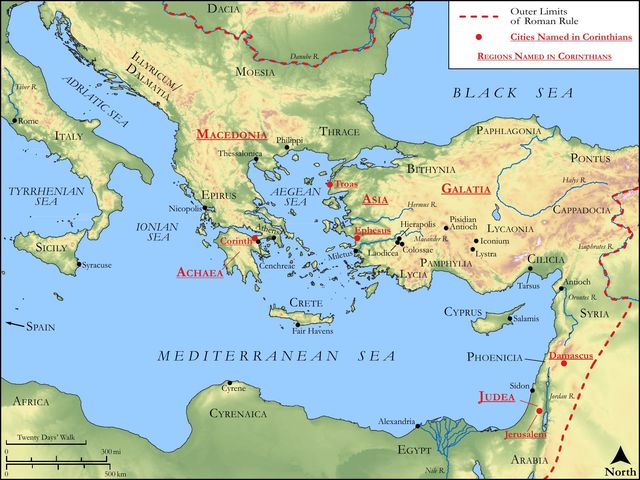
See on the biblical-era maps

Study this verse
Public-domain commentary
Matthew Henry
From his Commentary on the Whole Bible. Henry comments on passages, not single verses — this entry covers 1 Corinthians 3:16–17.
Here the apostle resumes his argument and exhortation, founding it on his former allusion, You are God's building, Co1 3:9, and here, Know you not that you are the temple of God, and the Spirit of God dwelleth in you? If any man defile (corrupt and destroy) the temple of God, him shall God destroy (the same word is in the original in both clauses); for the temple of God is holy, which temple you are. It looks from other parts of the epistle, where the apostle argues to the very same purport (see Co1 6:13-20), as if the false teachers among the Corinthians were not only loose livers, but taught licentious doctrines, and what was particularly fitted to the taste of this lewd city, on the head of fornication. Such doctrine was not to be reckoned among hay and stubble, which would be consumed while the person who laid them on the foundation escaped the burning; for it tended to corrupt, to pollute, and destroy the church, which was a building erected for God, and consecrated to him, and therefore should be kept pure and holy. Those who spread principles of this sort would provoke God to destroy them. Note, Those who spread loose principles, that have a direct tendency to pollute the church of God, and render it unholy and unclean, are likely to bring destruction on themselves. It may be understood also as an argument against their discord and factious strifes, division being the way to destruction. But what I have been mentioning seems to be the proper meaning of the passage: Know you not that you are the temple of God, and that the Spirit of God dwelleth in you? It may be understood of the church of Corinth collectively, or of every single believer among them; Christian churches are temples of God. He dwells among them by his Holy Spirit. They are built together for a habitation of God through the Spirit, Eph 2:22. Every Christian is a living temple of the living God. God dwelt in the Jewish temple, took possession of it, and resided in it, by that glorious cloud that was the token of his presence with that people. So Christ by his Spirit dwells in all true believers. The temple was devoted and consecrated to God, and set apart from every common to a holy use, to the immediate service of God. So all Christians are separated from common uses, and set apart for God and his service. They are sacred to him - a very good argument this against all fleshly lusts, and all doctrines that give countenance to them. If we are the temples of God, we must do nothing that shall alienate ourselves from him, or corrupt and pollute ourselves, and thereby unfit ourselves for his use; and we must hearken to no doctrine nor doctor that would seduce us to any such practices. Note, Christians are holy by profession, and should be pure and clean both in heart and conversation. We should heartily abhor, and carefully avoid, what will defile God's temple, and prostitute what ought to be sacred to him.
Historical interpretation
Four Centuries of Reception
17 surviving comments on this verse. Each one is dated, so this reads as a timeline rather than a list.
Select a marker to jump to its quote. Markers stagger vertically where authors wrote within a few decades of each other.
If you defile your flesh, you will also defile the Holy Spirit; and if you defile your flesh and spirit, you will not live.
For thus, according to the holy apostle, the sin of fornication is perpetrated against the body, as involving also sin against the temple of God.
Whence also he says, that this handiwork is "the temple of God "thus declaring: "Know ye not that ye are the temple of God, and that the Spirit of God dwelleth in you? If any man, therefore, will defile the temple of God, him will God destroy: for the temple of God is holy, which
What, then, shall we say of the Gnostic himself? "Know ye not "says the apostle, "that ye are the temple of God? "
In Platonic phrase, indeed, the body is a prison, but in the apostle's it is "the temple of God," because it is in Christ.
"Know ye not that ye are the temple of God, and that the Spirit of God dwelleth in you? " Now, since man is the property, and the work, and the image and likeness of the Creator, having his flesh, formed by Him of the ground, and his soul of His afflatus, it follows that Marcion's god wholly dwells in a temple which belongs to another, if so be we are not the Creator's temple.
However, let me meanwhile add that in the same passage Paul "carries about in his body the marks of the Lord Jesus; " he also forbids our body to be profaned, as being "the temple of God; " he makes our bodies "the members of Christ; " and he exhorts us to exalt and "glorify God in our body.
For since, by the introduction into an appropriation (in) us of the Holy Spirit, we are all" the temple of God," Modesty is the sacristan and priestess of that temple, who is to suffer nothing unclean or profane to be introduced (into it), for fear that the God who inhabits it should be offended, and quite forsake the polluted abode.
Or shall we "in that day" produce (our) marriage certificates before the Lord's tribunal, and allege that a marriage such as He Himself has forbidden has been duly contracted? What is prohibited (in the passage just referred to) is not "adultery; "It is not "fornication." The admission of a strange man (to your couch) less violates "the temple of God," less commingles "the members of Christ" with the members of an adulteress.
And, accordingly, why excuse it on the ground of pristine precedent? It did not bear the names of "body of Christ," of "members of Christ," of "temple of God," at the time When it used to obtain pardon for adultery.
(He it is) who even in the first (Epistle) was the first of all (the apostles) to dedicate the temple of God: "Know ye not that ye are the temple of God, and that in you the Lord dwells? " -who likewise, for the consecrating and purifying (of) that temple, wrote the law pertaining to the temple-keepers: "If any shall have marred the temple of God, him shall God mar; for the temple of God is holy, which (temple) are ye.
For inasmuch as the Apostle Paul says again, "Know ye not that ye are the temple of God, and that the Spirit of God dwelleth in you? " -even although love urged us less to bring help to the brethren, yet in this place we must have considered that it was the temples of God which were taken captive, and that we ought not by long inactivity and neglect of their suffering to allow the temples of God to be long captive, but to strive with what powers we can, and to act quickly by our obedience, to deserve well of Christ our Judge and Lord and God. For as the Apostle Paul says, "As many of you as have been baptized into Christ have put on Christ," Christ is to be contemplated in our captive brethren, and He is to be redeemed from the peril of captivity who redeemed us from the peril of death; so that He who took us out of the jaws of the devil, who abides and dwells in us, may now Himself be rescued and redeemed from the hands of barbarians by a sum of money-who redeemed us by His cross and blood-who suffers these things to happen for this reason, that our faith may be tried, whether each one of us will do for another what he would wish to be done for himself, if he himself were held captive among barbarians. For who that is mindful of humanity, and reminded of mutual love, if he be a father, will not now consider that his sons are there; if he be a husband, will not think that his wife is there kept captive, with as much grief as shame for the marriage tie? But how great is the general grief among all of us, and suffering concerning the peril of virgins who are kept there, on whose behalf we must bewail not only the loss of liberty, but of modesty; and must lament the bonds of barbarians less than the violence of seducers and abominable places, lest the members dedicated to Christ, and devoted for ever in honour of continence by modest. virtue, should be sullied by the Just and contagion of the insulter.
That even a baptized person loses the grace that he has attained, unless he keep innocency. In the Gospel according to John: "Lo, thou art made whole: sin no more, lest a worse thing happen unto thee." Also in the first Epistle of Paul to the Corinthians: "Know ye not that ye are the temple of God, and the Spirit of God abideth in you? If any one violate the temple of God, him will God destroy." Of this same thing in the Chronicles: "God is with you, while ye are with Him: if ye forsake Him, He will forsake you."
It is necessarily the case that God lives in his own temple. Note that because he says that the Spirit of God lives in us, the word God must be taken to refer to the Holy Spirit [in this verse].
"Know ye not that ye are the Temple of God?" For since he had discoursed in the section before, concerning those who were dividing the Church, he thenceforward attacks him also who had been guilty of uncleanness; not indeed as yet in plain terms but in a general way; hinting at his corrupt mode of life and enhancing the sin, by the Gift which had been already given to him. Then also he puts all the rest to shame, arguing from these very blessings which they had already: for this is what he is ever doing, either from the future or from the past, whether grievous or encouraging. First, from things future; "For the day shall declare it, because it is revealed by fire." Again, from things already come to pass; "Know ye not that ye are the Temple of God, and the Spirit of God dwelleth in you?"
The one who believes in Christ receives the Holy Spirit, who dwells in him by the washing of rebirth, and thus he is spiritual. But if such people then turn around and serve worldly passions, in that respect they are carnal. Paul says that those who have become spiritual according to their confession of faith may nevertheless still live as though they were carnal so as to become an insult to the Holy Spirit who dwells in them.
And again he says: "Know ye not that ye are the temple of God, and that the Spirit of God dwelleth in you? If any man defile the temple of God, him shall God destroy."
Continue studying 1 Corinthians 3:16 across the web’s major study libraries — every link below opens this exact verse, chapter, or book on the destination site.
Read & Compare
 BibleGatewayThis verse in more than 200 translations and 70 languages.
 Bible.comThe YouVersion reader — hundreds of translations, reading plans, and highlights.
 ESV.orgCrossway's official English Standard Version reader.
 NET BibleThe NET translation with 60,000+ translators' notes on every rendering decision.
 STEP BibleTyndale House's free study tool — original text, vocabulary, and scholarly resources.
 BibliaLogos Bible Software's free web reader.
 USCCBThe New American Bible (Revised Edition) with the U.S. bishops' study notes.
Commentaries
 BibleHub CommentariesDozens of classic commentaries on this verse, gathered on one page.
 StudyLightMore than 100 commentary sets — the largest collection on the web.
 BibleRefPlain-English commentary on what this verse means, verse by verse.
 Enduring WordDavid Guzik's free commentary on this chapter, widely used by Bible teachers.
 Bible Study ToolsVerse commentary alongside Greek and Hebrew study aids.
Original Language & Research
- BibleHub InterlinearThe verse word by word — original language, transliteration, and English.
- BibleHub LexiconEvery word's original-language definition and Strong's entry.
 Blue Letter BibleDeep-study tools — Strong's numbers, concordance, and word studies.
 CNTR CollationThe earliest Greek manuscripts of this verse, collated letter by letter.
Sermons, Hymns & Audio


TrulyRandomVerse is not affiliated with these sites and doesn’t control their content. They’re linked because they’re genuinely useful.
Summary
First Corinthians 3:16 serves as a foundational declaration of the corporate and individual identity of believers, asserting that the Christian community in Corinth, and by extension all believers, constitute the very dwelling place of God's Spirit. This profound truth underscores the sacredness of the church, calling believers to unity, holiness, and a recognition of the divine presence within them, thereby challenging the divisions and worldly wisdom that plagued the Corinthian assembly.
Context
ShowHideLiterary Context
This verse is situated within Paul's broader argument against the divisions and spiritual immaturity prevalent in the Corinthian church. In 1 Corinthians 1-3, Paul addresses the factions forming around different leaders (Paul, Apollos, Cephas), emphasizing that all ministers are merely servants through whom God works. He contrasts human wisdom with God's wisdom, which culminates in the cross. Immediately preceding 1 Corinthians 3:16, Paul uses the metaphor of building, describing himself as a master builder who laid the foundation (Christ), and others building upon it with various materials (gold, silver, costly stones, or wood, hay, straw). The fire of judgment will test each builder's work (1 Corinthians 3:10-15). Verse 16 then shifts the metaphor from individual builders to the collective church as the sacred structure itself, the "temple of God," warning against its defilement in the subsequent verse (1 Corinthians 3:17).
Historical & Cultural Context
The city of Corinth was a bustling, cosmopolitan hub known for its wealth, trade, and diverse religious practices, including numerous pagan temples dedicated to deities like Aphrodite, Apollo, and Poseidon. The concept of a "temple" as a sacred dwelling place for a god was deeply ingrained in both Greek and Jewish cultures. For Jewish converts, the Jerusalem Temple was the ultimate symbol of God's presence among His people. For Gentiles, their city was replete with physical structures believed to house their gods. Paul's declaration that "you are the temple of God" would have been revolutionary and counter-cultural. He radically redefines the locus of divine presence, shifting it from a physical edifice to the spiritual community of believers, thereby elevating their status and responsibility in a profound way. This also challenged the Corinthian tendency to compartmentalize faith from daily life, as their very bodies and community were now deemed holy.
Key Themes
ShowHideThis verse powerfully contributes to several major themes in Paul's letter and broader theology. The most prominent is the Divine Indwelling, asserting that God's Spirit literally resides within believers, both individually and corporately. This leads directly to the theme of Sacred Identity and Holiness, as the church, being God's dwelling, is inherently holy and set apart for His purposes. Paul uses this truth to address the Unity of the Church, emphasizing that divisions and immoral behavior defile this sacred temple. The verse also implicitly touches upon Spiritual Maturity, as understanding and living out this identity as God's temple is a sign of true spiritual growth, contrasting with the "carnal" behavior Paul addresses earlier in 1 Corinthians 3:1-4. Furthermore, it highlights the Corporate Nature of the Church, stressing that the collective body of believers, not just isolated individuals, constitutes this divine dwelling, though the principle extends to individual believers as seen in 1 Corinthians 6:19.
Exposition and Analysis
ShowHideKey Word Analysis
ShowHideThis primary verb, often used in past tenses, signifies not merely intellectual apprehension but a deep, experiential understanding or awareness. Paul's rhetorical question, "Know ye not?", implies that this truth should be self-evident to the Corinthians, urging them to move beyond superficial knowledge to a profound realization of their spiritual reality and its implications. It's a call to recognize an established fact.
This word specifically refers to the inner sanctuary of a temple, the most holy place where the deity was believed to dwell, as opposed to the broader temple complex or grounds (hieron). By using naós, Paul emphasizes that believers are not just part of a sacred precinct but are the very inner dwelling place of God's presence, the Holy of Holies where God Himself resides. This highlights the profound intimacy and holiness of the church's identity.
Derived from the word for "house" (oikos), this verb means "to occupy a house," "to reside," or "to inhabit." It denotes a permanent, settled presence rather than a temporary visit. The Spirit of God does not merely pass through believers but takes up permanent residence within them, signifying an enduring and intimate relationship that transforms their very being and purpose.
Verse Breakdown
ShowHide"Know ye not"
Paul begins with a rhetorical question, a common device in his letters, designed not to elicit information but to challenge the audience's lack of understanding or failure to act on what they should already know. It implies a rebuke for their spiritual ignorance or forgetfulness, given the profound truth that follows.
"that ye are the temple of God"
This is the core declaration. The plural "ye" (ὑμεῖς - hymeis) is crucial, indicating that Paul is primarily addressing the Corinthian community as a collective body, the church, as God's dwelling place. This metaphor radically redefines the concept of sacred space, moving it from a physical building to a living, spiritual community.
"and that the Spirit of God dwelleth in you?"
This clause clarifies how the church is the temple of God – through the indwelling presence of the Holy Spirit. The Spirit's permanent residence within the community of believers confirms their sacred status and provides the power for holy living and unity. This indwelling is the very essence of their identity as God's temple.
Literary Devices
ShowHidePaul masterfully employs several Literary Devices in this concise verse. The most prominent is Metaphor, where the church is directly equated with the "temple of God." This is a powerful image, transforming a familiar concept of a physical edifice into a living, spiritual reality. This metaphor carries immense theological weight, conveying the sacredness, holiness, and divine presence within the community of believers. Furthermore, Paul uses a Rhetorical Question ("Know ye not...?") to engage his audience directly and challenge their spiritual complacency. This device serves to emphasize the obviousness and foundational nature of the truth being presented, implying that their divisive behavior is inexcusable given their identity as God's dwelling. The use of the plural "ye" throughout the verse also highlights Corporate Identity, stressing that the church as a collective body is God's sacred dwelling, thereby underscoring the imperative for unity and mutual respect.
Theological and Thematic Connections
ShowHideThe declaration that believers are the temple of God, indwelt by His Spirit, is a cornerstone of New Testament theology, profoundly impacting our understanding of the church, individual holiness, and the nature of God's presence. It signifies a radical shift from the Old Covenant, where God's presence was localized in a physical temple, to the New Covenant, where His presence is spiritualized and diffused among His people. This truth elevates the status of every believer and the collective body of Christ, demanding a lifestyle commensurate with being the dwelling place of the Almighty. It underscores that the church is not merely a human organization but a divine organism, sacred and set apart for God's glory.
Reflection and Application
ShowHideRecognizing that we, as individual believers and as the collective body of Christ, are the temple of God indwelt by His Spirit, should profoundly transform our perspective and behavior. This truth calls us to a life of holiness and purity, understanding that our bodies and our interactions with fellow believers are sacred spaces where God dwells. It challenges us to examine our attitudes, words, and actions, ensuring they honor the divine presence within us and among us. Divisions, strife, and immorality within the church are not merely social problems; they are acts that defile the very temple of God. Therefore, this verse compels us to pursue unity, mutual respect, and love, striving to maintain the sanctity of the corporate body. Our lives, both individually and communally, are meant to be living testimonies to God's presence, reflecting His character and purposes to a watching world.
Questions for Reflection
ShowHideFAQ
ShowHideWhat does "ye are the temple of God" mean, and is it individual or corporate?
ShowHideThe phrase "ye are the temple of God" in 1 Corinthians 3:16 primarily refers to the corporate body of believers, the church as a whole. The Greek pronoun "ye" (ὑμεῖς - hymeis) is plural, addressing the Corinthian community. Paul is emphasizing that the collective assembly of Christians is God's dwelling place. This understanding is crucial in the context of the divisions Paul is addressing in 1 Corinthians 1-3; disunity defiles the corporate temple. However, the principle extends to individual believers as well. In 1 Corinthians 6:19, Paul explicitly states that "your body is the temple of the Holy Ghost which is in you," making it clear that individual believers are also indwelt by the Spirit. So, while the primary emphasis in 1 Corinthians 3:16 is corporate, the truth of divine indwelling applies to both the community and its individual members.
Christ-Centered Fulfillment
ShowHideThe concept of the church as the "temple of God" finds its ultimate fulfillment and meaning in Christ. In the Old Testament, the temple was the physical locus of God's presence, a shadow pointing to a greater reality. Jesus Himself declared, "Destroy this temple, and in three days I will raise it up," referring to the temple of His body (John 2:19-21). Through His death and resurrection, Christ became the true temple, the ultimate meeting place between God and humanity. It is through His finished work that the Holy Spirit is poured out, enabling God to dwell not in buildings made with hands, but in the hearts of believers (Acts 2:1-4). The church, as the body of Christ (Ephesians 1:22-23), is therefore an extension of Christ's own temple-body, built upon the foundation of the apostles and prophets, with Christ Jesus Himself as the chief cornerstone (Ephesians 2:20). Thus, the indwelling of the Spirit in believers is a direct result of Christ's redemptive work, making the church a living, spiritual temple where God's presence is manifested and His glory proclaimed, awaiting its glorious consummation in the New Jerusalem where the Lord God Almighty and the Lamb are its temple.