


Revelation 21:22
Bible text: King James Version (1769 Blayney text) · Public domain
Bible text: Berean Standard Bible · Public domain
Bible text: American Standard Version (1901) · Public domain
Bible text: World English Bible, Messianic edition · Public domain
Bible text: Geneva Bible (1599) · Public domain
Bible text: Young's Literal Translation · Public domain
- καὶkaiAndG2532CONJConjunction
- ναὸνnaontempleG3485N-ASMNoun Accusative Singular Masculine
- οὐκouknotG3756PRT-NNegative Particle Negative
- εἶδονeidonI sawG1492V-2AAI-1SVerb 2nd Aorist Active Indicative 1st Singular
- ἐνeninG1722PREPPreposition
- αὐτῇ·autēaitG846P-DSFPersonal pronoun Dative Singular Feminine
- ὁho<the>G3588T-NSMDefinite article Nominative Singular Masculine
- γὰρgarforG1063CONJConjunction
- κύριοςkuriosthe LordG2962N-NSM-TNoun Nominative Singular Masculine Title
- ὁho<the>G3588T-NSMDefinite article Nominative Singular Masculine
- θεὸςtheosGodG2316N-NSM-TNoun Nominative Singular Masculine Title
- ὁho<the>G3588T-NSMDefinite article Nominative Singular Masculine
- παντοκράτωρpantokratōrAlmightyG3841N-NSM-TNoun Nominative Singular Masculine Title
- ναὸςnaostempleG3485N-NSMNoun Nominative Singular Masculine
- αὐτῆςautēsof itG846P-GSFPersonal pronoun Genitive Singular Feminine
- ἐστινestinisG1510V-PAI-3SVerb Present Active Indicative 3rd Singular
- καὶkaiandG2532CONJConjunction
- τὸtotheG3588T-NSNDefinite article Nominative Singular Neuter
- ἀρνίονarnionLambG721N-NSNNoun Nominative Singular Neuter
English is a literal word-by-word gloss of the Greek, not the KJV's wording. Why?
This is the original text the KJV's translators worked from — each Greek word with its own literal English meaning in this verse, prepared by scholars at Tyndale House, Cambridge. The KJV translates whole sentences, not word by word, so its wording differs: one Greek word can become several English words, and the KJV may choose “charity” where the gloss reads “love”. Both are faithful — they answer different questions. For the KJV's own rendering, switch to the KJV text.
Details
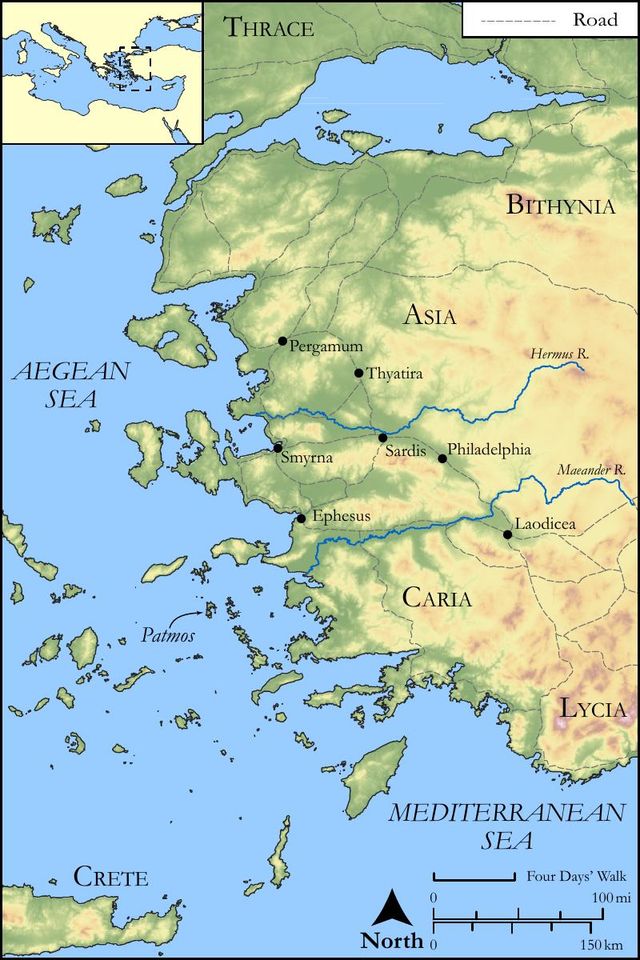
See on the biblical-era maps

Study this verse
Public-domain commentary
Matthew Henry
From his Commentary on the Whole Bible. Henry comments on passages, not single verses — this entry covers Revelation 21:9–27. His four-level outline is real structure in the source text, so it is rendered as structure.
We have already considered the introduction to the vision of the new Jerusalem in a more general idea of the heavenly state; we now come to the vision itself, where observe,
I.The person that opened the vision to the apostle - one of the seven angels, that had the seven vials full of the seven last plagues, Rev 21:9. God has a variety of work and employment for his holy angels. Sometimes they are to sound the trumpet of divine Providence, and give fair warning to a careless world; sometimes they are to pour out the vials of God's anger upon impenitent sinners; and sometimes to discover things of a heavenly nature to those that are the heirs of salvation. They readily execute every commission they receive from God; and, when this world shall be at an end, yet the angels shall be employed by the great God in proper pleasant work to all eternity.
II.The place from which the apostle had this glorious view and prospect.
He was taken, in ecstasy, into a high mountain. From such situations men usually have the most distinct views of adjacent cities. Those who would have clear views of heaven must get as near heaven as they can, into the mount of vision, the mount of meditation and faith, whence, as from the top of Pisgah, they may behold the goodly land of the heavenly Canaan.
III.The subject-matter of the vision - the bride, the Lamb's wife (Rev 21:10); that is, the church of God in her glorious, perfect, triumphant state, under the resemblance of Jerusalem, having the glory of God shining in its lustre, as uxor splendit radiis mariti - the bride comely through the comeliness put on her by her husband; glorious in her relation to Christ, in his image now perfected in her, and in his favour shining upon her. And now we have a large description of the church triumphant under the emblem of a city, far exceeding in riches and splendour all the cities of this world; and this new Jerusalem is here represented to us both in the exterior and the interior part of it.
1.The exterior part of the city - the wall and the gates, the wall for security and the gates for entrance.
(1.)The wall for security. Heaven is a safe state; those that are there are enclosed with a wall, that separates them and secures them from all evils and enemies: now here, in the account of the wall, we observe,
[1.]The height of it, which, we are told, is very high, seventy yards (Rev 21:17), sufficient both for ornament and security.
[2.]The matter of it: It was as jasper; a wall all built of the most precious stones, for firmness and lustre, Rev 21:11. This city has a wall that is impregnable as well as precious.
[3.]The form of it was very regular and uniform: It was four-square, the length as large as the breadth. In the new Jerusalem all shall be equal in purity and perfection. There shall be an absolute uniformity in the church triumphant, a thing wanted and wished for on earth, but not to be expected till we come to heaven.
[4.]The measure of the wall (Rev 21:15, Rev 21:16): Twelve thousand furlongs each way, each side, which is forty-eight thousand furlongs in the whole compass, or fifteen hundred German miles. Here is room sufficient for all the people of God - many mansions in their Father's house.
[5.]The foundation of the wall, for heaven is a city that hath her foundations (Rev 21:19); the promise and power of God, and the purchase of Christ, are the strong foundations of the church's safety and happiness. The foundations are described by their number - twelve, alluding to the twelve apostles (Rev 21:14), whose gospel doctrines are the foundations upon which the church is built, Christ himself being the chief corner-stone; and, as to the matter of these foundations, it was various and precious, set forth by twelve sorts of precious stones, denoting the variety and excellency of the doctrines of the gospel, or of the graces of the Holy Spirit, or the personal excellencies of the Lord Jesus Christ.
(2.)The gates for entrance. Heaven is not inaccessible; there is a way opened into the holiest of all; there is a free admission to all those that are sanctified; they shall not find themselves shut out. Now, as to these gates, observe,
[1.]Their number - twelve gates, answering to the twelve tribes of Israel. All the true Israel of God shall have entrance into the new Jerusalem, as every tribe had into the earthly Jerusalem.
[2.]Their guards which were placed upon them - twelve angels, to admit and receive the several tribes of the spiritual Israel and keep out others.
[3.]The inscription on the gates - the names of the twelve tribes, to show that they have a right to the tree of life, and to enter through the gates into the city.
[4.]The situation of the gates. As the city had four equal sides, answering to the four quarters of the world, east, west, north, and south, so on each side there were three gates, signifying that from all quarters of the earth there shall be some who shall get safely to heaven and be received there, and that there is as free entrance from one part of the world as from the other; for in Christ there is neither Jew nor Greek, Barbarian, Scythian, bond, nor free. Men of all nations, and languages, who believe on Christ, have by him access to God in grace here and in glory hereafter.
[5.]The materials of these gates - they were all of pearls, and yet with great variety: Every gate one pearl, either one single pearl of that vast bigness, or one single sort of pearl. Christ is the pearl of great price, and he is our way to God. There is nothing magnificent enough in this world fully to set forth the glory of heaven. Could we, in the glass of a strong imagination, contemplate such a city as is here described, even as to the exterior part of it, such a wall, and such gates, how amazing, how glorious, would the prospect be! And yet this is but a faint and dim representation of what heaven is in itself.
2.The interior part of the new Jerusalem, Rev 21:22-27. We have seen its strong wall, and stately gates, and glorious guards; now we are to be led through the gates into the city itself; and the first thing which we observe there is the street of the city, which is of pure gold, like transparent glass, Rev 21:21. The saints in heaven tread upon gold. The new Jerusalem has its several streets. There is the most exact order in heaven: every saint has his proper mansion. There is converse in heaven: the saints are then at rest, but it is not a mere passive rest; it is not a state of sleep and inactivity, but a state of delightful motion: The nations that are saved walk in the light of it. They walk with Christ in white. They have communion not only with God, but with one another; and all their steps are firm and clean. They are pure and clear as gold and transparent glass. Observe,
(1.)The temple of the new Jerusalem, which was no material temple, made with men's hands, as that of Solomon and Zerubbabel, but a temple altogether spiritual and divine; for the Lord God Almighty, and the Lamb, are the temple thereof. There the saints are above the need of ordinances, which were the means of their preparation for heaven. When the end is attained the means are no longer useful. Perfect and immediate communion with God will more than supply the place of gospel institutions.
(2.)The light of this city. Where there is no light, there can be no lustre nor pleasure. Heaven is the inheritance of the saints in light. But what is that light? There is no sun nor moon shining there, Rev 21:23. Light is sweet, and a pleasant thing it is to behold the sun. What a dismal world would this be if it were not for the light of the sun! What is there in heaven that supplies the want of it? There is no want of the light of the sun, for the glory of God lightens that city, and the Lamb is the light thereof. God in Christ will be an everlasting fountain of knowledge and joy to the saints in heaven; and, if so, there is no need of the sun or moon, any more than we here need to set up candles at noon day, when the sun shineth in its strength.
(3.)The inhabitants of this city. They are described here several ways.
[1.]By their numbers - whole nations of saved souls; some out of all nations, and many out of some nations. All those multitudes who were sealed on earth are saved in heaven.
[2.]By their dignity - some of the kings and princes of the earth: great kings. God will have some of all ranks and degrees of men to fill the heavenly mansions, high and low; and when the greatest kings come to heaven they will see all their former honour and glory swallowed up of this heavenly glory that so much excels.
[3.]Their continual accession and entrance into this city: The gates shall never be shut. There is no night, and therefore no need of shutting up the gates. Some one or other is coming in every hour and moment, and those that are sanctified always find the gates open; they have an abundant entrance into the kingdom.
(4.)The accommodations of this city: All the glory and honour of the nations shall be brought into it. Whatever is excellent and valuable in this world shall be there enjoyed in a more refined kind, and to a far greater degree - brighter crowns, a better and more enduring substance, more sweet and satisfying feasts, a more glorious attendance, a truer sense of honour and far higher posts of honour, a more glorious temper of mind, and a form and a countenance more glorious than ever were known in this world.
(5.)The unmixed purity of all who belong to the new Jerusalem, Rev 21:27.
[1.]There the saints shall have no impure thing remaining in them. In the article of death they shall be cleansed from every thing that is of a defiling nature. Now they feel a sad mixture of corruption with their graces, which hinders them in the service of God, interrupts their communion with him, and intercepts the light of his countenance; but, at their entrance into the holy of holies, they are washed in the laver of Christ's blood, and presented to the Father without spot.
[2.]There the saints shall have no impure persons admitted among them. In the earthly Jerusalem there will be a mixed communion, after all the care that can be taken. Some roots of bitterness will spring up to trouble and defile Christian societies; but in the new Jerusalem there is a society perfectly pure. First, Free from such as are openly profane. There are none admitted into heaven who work abominations. In the churches on earth sometimes abominable things are done, solemn ordinances profaned and prostituted to men openly vicious, for worldly ends; but no such abominations can have place in heaven. Secondly, Free from hypocrites, such as make lies, say they are Jews, and are not, but do lie. These will creep into the churches of Christ on earth, and may lie concealed there a long time, perhaps all their days; but they cannot intrude into the new Jerusalem, which is wholly reserved for those that are called, and chosen, and faithful, who are all written, not only in the register if the visible church, but in the Lamb's book of life.
Historical interpretation
Eight Centuries of Reception
8 surviving comments on this verse. Each one is dated, so this reads as a timeline rather than a list.
Select a marker to jump to its quote. Markers stagger vertically where authors wrote within a few decades of each other.
But we do confess that a kingdom is promised to us upon the earth, although before heaven, only in another state of existence; inasmuch as it will be after the resurrection for a thousand years in the divinely-built city of Jerusalem, "let down from heaven," [Revelation 21:2] which the apostle also calls "our mother from above;" [Galatians 4:26] and, while declaring that our πολίτευμα, or citizenship, is in heaven, he predicates of it that it is really a city in heaven. This both Ezekiel had knowledge of [Ezekiel 48:30-35] and the Apostle John beheld. [Revelation 21:10-23] And the word of the new prophecy which is a part of our belief, attests how it foretold that there would be for a sign a picture of this very city exhibited to view previous to its manifestation. This prophecy, indeed, has been very lately fulfilled in an expedition to the East. For it is evident from the testimony of even heathen witnesses, that in Judæa there was suspended in the sky a city early every morning for forty days. As the day advanced, the entire figure of its walls would wane gradually, and sometimes it would vanish instantly. We say that this city has been provided by God for receiving the saints on their resurrection, and refreshing them with the abundance of all really spiritual blessings, as a recompense for those which in the world we have either despised or lost; since it is both just and God-worthy that His servants should have their joy in the place where they have also suffered affliction for His name's sake. Of the heavenly kingdom this is the process. After its thousand years are over, within which period is completed the resurrection of the saints, who rise sooner or later according to their deserts there will ensue the destruction of the world and the conflagration of all things at the judgment: we shall then be changed in a moment into the substance of angels, even by the investiture of an incorruptible nature, and so be removed to that kingdom in heaven of which we have now been treating, just as if it had not been predicted by the Creator, and as if it were proving Christ to belong to the other god and as if he were the first and sole revealer of it.
And in that he says that the sun is not necessary in the city, he shows, evidently, that the Creator as the immaculate light shines in the midst of it, whose brightness no mind has been able to conceive, nor tongue to tell. In that he says there are three gates placed on each of the four sides, of single pearls, I think that these are the four virtues, to wit, prudence, fortitude, justice, temperance, which are associated with one another. And, being involved together, they make the number twelve. But the twelve gates we believe to be the number of the apostles, who, shining in the four virtues as precious stones, manifesting the light of their doctrine among the saints, cause it to enter the celestial city, that by intercourse with them the choir of angels may be gladdened. And that the gates cannot be shut, it is evidently shown that the doctrine of the apostles can be separated from rectitude by no tempest of contradiction. Even though the floods of the nations and the vain superstitions of heretics should revolt against their true faith, they are overcome, and shall be dissolved as the foam, because Christ is the Rock by which, and on which, the Church is founded. And thus it is overcome by no traces of maddened men.
[He saw no temple in the city] because the church is in God and God is in the church.
Just as the body consists of individual members, so is the temple constructed from precious stones. Although we are accustomed to material things, he does not want us here to think of something physical as is our habit. Therefore, relieving us from this manner of thinking, he says, “I saw in it no temple, for its temple is the Lord God Almighty and the Lamb.” For when the tares have been removed, then shall the church especially exult in the elect alone and remain consecrated in God as though she were resting completely in a temple. In this way the church may obtain a blessed habitation in him from whom she had received the origin of her existence and had come to know the gentleness of redemption. For the church’s wholeness is completed in these three things: in being, in knowing and in loving. God created her that she might be fashioned [according to his will]; having called her, he enlightened her; having elected her, he has made her blessed. God intends that when perfected [the church] will dwell in him by way of the promised glorification, when she no longer walks by way of faith but rejoices in his sight.
God established the temple so that the people gathered within the walls of the temple might call upon him whom neither the world nor the temple can contain. In this way their minds might obtain through the work of faith what cannot be seen of God. However, where he openly manifests himself to the faithful there a temple is neither desired nor existent, for he who sanctifies the temple is known in the sight of all.
For what need of a physical temple is there for one who will have God as protection and shelter, in whom we live and move and have our being? For he himself is both temple and in-dweller of the saints, dwelling in them and walking among them, as he promised. The “Lamb” is the Lamb of God who was slain for us, to whom manifestly the co-essential and life-giving Spirit is conjoined, who is mentioned a little later through [the image] of the river.
And I saw no temple in it, etc. Although, he says, I described the city as constructed with stones, yet I did not signify the rest of the saints to be in a material building, of which God himself is the only house, light, and rest.
And he says I saw no temple in it; for the Lord God Almighty and the Lamb are its temple. For what need is there of a temple when He is present and in a certain sense cohabiting with the saints of God and is seen face to face as far as possible? For the divine apostle called the present knowledge of God "through a mirror and in a riddle"; but the future, "face to face." (1 Cor. 13:12)
But naturally one might ask, what then? We have already invoked God the Almighty, and the Father of the Lord and of the Lamb, the Son of God; shall we not also recall the Holy Spirit? One must say to him: saying, "O this one," the Lord and God named the Father and the Son and the Holy Spirit, for God did so; and again saying, "the Lord God Almighty," he signified the Holy Trinity by the three names. But someone might also ask this: why, then, having been reminded of the venerable Trinity by the saying "the Lord God Almighty are its temple," is the Lamb, who is Christ, counted to us from the outside, so that we should no longer conceive a Trinity? May it not be so, I should say to him. For we are not taught so, but a memory is borne of both the Holy Trinity and of the Lamb, the sense of the statement signifying that the one who was incarnate is of the Holy Trinity, and that after the flesh the Son fills the Holy Trinity and is not now in heaven separated from the flesh. For he indicated the Son incarnate by periphrasis both by "God who is the Son," and by "the Lamb," which again is the same Christ incarnate, consubstantial with us and enlivened intelligibly; in whom the Word is united to the particular flesh according to hypostasis.
Continue studying Revelation 21:22 across the web’s major study libraries — every link below opens this exact verse, chapter, or book on the destination site.
Read & Compare
 BibleGatewayThis verse in more than 200 translations and 70 languages.
 Bible.comThe YouVersion reader — hundreds of translations, reading plans, and highlights.
 ESV.orgCrossway's official English Standard Version reader.
 NET BibleThe NET translation with 60,000+ translators' notes on every rendering decision.
 STEP BibleTyndale House's free study tool — original text, vocabulary, and scholarly resources.
 BibliaLogos Bible Software's free web reader.
 USCCBThe New American Bible (Revised Edition) with the U.S. bishops' study notes.
Commentaries
 BibleHub CommentariesDozens of classic commentaries on this verse, gathered on one page.
 StudyLightMore than 100 commentary sets — the largest collection on the web.
 BibleRefPlain-English commentary on what this verse means, verse by verse.
 Enduring WordDavid Guzik's free commentary on this chapter, widely used by Bible teachers.
 Bible Study ToolsVerse commentary alongside Greek and Hebrew study aids.
Original Language & Research
- BibleHub InterlinearThe verse word by word — original language, transliteration, and English.
- BibleHub LexiconEvery word's original-language definition and Strong's entry.
 Blue Letter BibleDeep-study tools — Strong's numbers, concordance, and word studies.
 CNTR CollationThe earliest Greek manuscripts of this verse, collated letter by letter.
Sermons, Hymns & Audio


TrulyRandomVerse is not affiliated with these sites and doesn’t control their content. They’re linked because they’re genuinely useful.
Summary
Revelation 21:22 offers a striking vision of the New Jerusalem, the eternal dwelling place of God and His redeemed people, by declaring the absence of a physical temple within it. This radical departure from previous dispensations, where a temple or tabernacle served as the central point of divine presence and worship, signifies a profound theological truth: the Lord God Almighty and the Lamb Himself constitute the temple, embodying the direct, unmediated, and pervasive presence of God among His people in the new creation.
Context
ShowHideLiterary Context
This verse is situated within John's grand prophetic vision of the new heaven and new earth, described in Revelation chapters 21 and 22. Following the final judgment and the defeat of all evil, John witnesses the descent of the New Jerusalem, "the holy city, new Jerusalem, coming down from God out of heaven, prepared as a bride adorned for her husband" (Revelation 21:2). The preceding verses emphasize God's direct dwelling with humanity, stating, "Behold, the tabernacle of God is with men, and he will dwell with them, and they shall be his people, and God himself shall be with them, and be their God" (Revelation 21:3). The absence of a temple in verse 22 serves as a powerful illustration and fulfillment of this promise of unhindered divine presence, leading directly into the description of the city's divine illumination in Revelation 21:23.
Historical & Cultural Context
Throughout the Old Testament, a physical structure served as the focal point of Israel's worship and the symbolic dwelling place of God's presence. From the portable Tabernacle in the wilderness (Exodus 25:8) to Solomon's magnificent Temple (1 Kings 6) and the subsequent Second Temple, these structures were central to Israelite identity, religious practice, and their understanding of God's immanence. The Temple in Jerusalem, specifically, represented the pinnacle of sacred space, with its various courts and the Holy of Holies, accessible only to the high priest once a year. John's vision, therefore, directly confronts and redefines this deeply ingrained concept of sacred space, transcending the need for any physical edifice. It speaks to a Jewish audience familiar with the Temple's centrality, presenting a radical new reality where the very presence of God and the Lamb fulfills and surpasses all previous forms of worship and divine encounter.
Key Themes
ShowHideThe verse significantly contributes to several overarching themes in Revelation and biblical theology. Foremost is the theme of Direct Divine Presence, emphasizing the ultimate, unmediated communion between God and His redeemed people. This is the culmination of God's covenant promise to dwell among them, fulfilling the longing expressed throughout scripture. Another key theme is Fulfillment and Consummation, as the New Jerusalem represents the eschatological reality where all shadows and types (like the earthly temple) give way to the ultimate reality of God's presence. This also highlights the Redefinition of Worship and Sacred Space, moving from localized, mediated rituals to a pervasive, unhindered, and personal encounter with the divine. Finally, the verse underscores the Sovereignty and Sufficiency of God and the Lamb, asserting that their very being is the source of all holiness, light, and life in the new creation, making any other structure superfluous.
Exposition and Analysis
ShowHideKey Word Analysis
ShowHideA primary verb meaning "to see," often implying understanding or knowing. John's declaration "And I saw no temple" is not merely a visual observation but a profound revelation, an eyewitness testimony to a fundamental truth about the new creation. It signifies a divinely granted insight into the nature of the eternal city, where traditional religious structures are rendered obsolete.
This term specifically refers to the inner sanctuary of a temple, the Holy of Holies, where the deity was believed to dwell. It is distinct from hieron, which denotes the broader temple complex including courtyards. The explicit absence of the naós emphasizes that the most sacred, innermost space is no longer a building, but is now constituted by the very presence of God and the Lamb. This highlights the ultimate accessibility of the divine.
A primary particle meaning "for," used to assign a reason or provide an explanation. In this verse, "for" introduces the profound theological justification for the absence of a physical temple: "for the Lord God Almighty and the Lamb are the temple of it." This particle establishes a direct causal link between the lack of a built structure and the pervasive, indwelling presence of the divine persons.
Verse Breakdown
ShowHide"And I saw no temple therein:"
John, the visionary, reports a striking and counter-intuitive observation within the New Jerusalem. Given the historical centrality of the Temple in Jewish worship and cosmology, its complete absence in the ultimate dwelling place of God's people is a radical statement. This immediately signals a profound redefinition of sacred space and the nature of divine presence, indicating that the new creation operates on a higher, more direct principle of communion.
"for the Lord God Almighty and the Lamb are the temple of it."
This clause provides the foundational reason for the temple's absence, revealing the ultimate reality. The very persons of God the Father ("the Lord God Almighty," Pantokrator, signifying His absolute sovereignty and power) and God the Son ("the Lamb," Arnion, emphasizing His sacrificial work and redemptive power) collectively are the temple. They do not merely reside in a temple; their omnipresent, glorious being constitutes the sacred space. This signifies an unmediated, direct, and pervasive divine presence that renders any constructed sanctuary redundant, as the holiness and accessibility of God are fully embodied in their persons.
Literary Devices
ShowHideThe verse employs several powerful literary devices to convey its profound message. Symbolism is paramount, as the "temple" itself is a potent symbol throughout biblical history, representing God's dwelling place and the locus of worship. Its absence in the New Jerusalem is a reversal of this symbol, pointing to a new, more perfect reality. This creates a striking Contrast between the earthly, temporal temples and the eternal, personal presence of God and the Lamb. The statement that "the Lord God Almighty and the Lamb are the temple" is a powerful Metaphor, equating the divine persons with the sacred space. This metaphor emphasizes the complete indwelling and pervasive holiness of God, making Him the ultimate sanctuary. The declaration of "no temple" also functions as a form of Apophasis (denial for emphasis), highlighting what is not present to draw attention to the greater reality that is present.
Theological and Thematic Connections
ShowHideRevelation 21:22 culminates the biblical narrative of God's dwelling with humanity, moving from the localized presence in the Tabernacle and Temple to an ultimate, unmediated communion. The physical temple, with its veiled Holy of Holies, was a type and shadow, pointing to the reality of God's desire for intimate fellowship. In the New Jerusalem, this desire is perfectly fulfilled, as God and the Lamb themselves become the all-encompassing sanctuary, removing all barriers and intermediaries. This signifies that the very being of God is the source of all holiness, worship, and light, making any constructed sacred space obsolete. It underscores the profound truth that true worship is not bound by location or ritual, but by direct encounter with the living God.
Reflection and Application
ShowHideThis profound vision of the New Jerusalem challenges our earthly conceptions of sacred space and worship, inviting us to embrace a deeper, more spiritual understanding of God's presence. It teaches us that our ultimate security, belonging, and capacity for worship are not dependent on physical structures, elaborate rituals, or human intermediaries, but solely on the living God and His Son, Jesus Christ. In this present age, while we gather in physical churches, the verse reminds us that the true "temple" is the body of believers, indwelt by the Holy Spirit, and that our worship is primarily a spiritual act of drawing near to God in spirit and truth. This vision offers immense comfort and hope, assuring us that in the eternal state, all barriers to divine communion will be removed, and we will experience the fullness of God's unhindered presence, where He is truly "all in all." It calls us to live now with an eternal perspective, prioritizing direct fellowship with God above all earthly constructs.
Questions for Reflection
ShowHideFAQ
ShowHideWhy is the absence of a temple in the New Jerusalem significant?
ShowHideThe absence of a physical temple in the New Jerusalem is profoundly significant because it signifies the ultimate fulfillment of God's desire to dwell directly and intimately with His people, without any need for mediating structures. Throughout salvation history, the Tabernacle and Temple served as symbolic meeting places, representing God's presence among His people and pointing forward to a greater reality. In the new creation, the need for such a building is entirely removed because God the Father ("the Lord God Almighty") and God the Son ("the Lamb") are themselves the omnipresent, all-sufficient sanctuary. This means there are no longer any veils or barriers to accessing God's presence; worship is immediate, unhindered, and pervasive throughout the entire city, as the glory of God illuminates it (compare Revelation 21:23). It represents the culmination of God's redemptive plan to restore perfect, unhindered communion with humanity.
Christ-Centered Fulfillment
ShowHideRevelation 21:22 finds its ultimate Christ-centered fulfillment in Jesus Himself, who is the true and ultimate temple. Jesus declared, "Destroy this temple, and in three days I will raise it up," referring to "the temple of his body" (John 2:19-21). Through His incarnation, God truly "tabernacled" among us (John 1:14), making His presence accessible. His sacrificial death on the cross tore the temple veil from top to bottom (Matthew 27:51), symbolizing the removal of the barrier between God and humanity and opening a new and living way into the Holy of Holies through His blood (Hebrews 10:19-22). As the Lamb, Jesus is not merely present in the New Jerusalem; He is an essential part of its very fabric, the source of its light and life (Revelation 21:23). Thus, the absence of a physical temple in the eternal city is a glorious testament to the completed work of Christ, who perfectly embodies God's presence and provides eternal, unhindered access to the Father.