


2 Chronicles 2:6
- וּמִיu·Miand who?H4310Conj-w ¦ InterrogPronoun Interrogativeוּandמִיwho?
- יַעֲצָרya·'a·tzorwill he retainH6113V-Qal-Imperf-3msVerb Qal Imperfect 3rd Singular Masculine
- כֹּחַko·achstrengthH3581N-msNoun Singular Masculine Absolute
- לִבְנוֹתLiv·notto buildH1129Prep-l ¦ V-Qal-InfVerb Qal Infinitive Constructלִtoבְנוֹתbuild
- לוֹlofor himPrep-l ¦ 3msSuffix Personal 3rd Singular Masculineלforוֹhim
- בַיִתVa·yita houseH1004N-msNoun Singular Masculine Absolute
- כִּיkiforH3588PrtParticle Conditional
- הַשָּׁמַיִםha·sha·Ma·yimthe heavensH8064Art ¦ N-mpNoun Plural Masculine Absoluteהַtheשָּׁמַיִםheavens
- וּשְׁמֵיu·she·Meiand [the] heavens ofH8064Conj-w ¦ N-mpcNoun Plural Masculine Constructוּandשְׁמֵי[the] heavens of
- הַשָּׁמַיִםha·sha·Ma·yimthe heavensH8064Art ¦ N-mpNoun Plural Masculine Absoluteהַtheשָּׁמַיִםheavens
- לֹאlo'notH3808NegParticle Negative
- יְכַלְכְּלֻהוּye·khal·ke·Lu·huthey will contain himH3557V-Piel-Imperf-3mp ¦ 3msVerb Piel Imperfect 3rd Plural Masculineיְכַלְכְּלֻthey will containהוּhim
- וּמִיu·Miand who?H4310Conj-w ¦ InterrogPronoun Interrogativeוּandמִיwho?
- אֲנִי'a·Ni[am] IH589Pro-1csPronoun Personal 1st Singular common gender
- אֲשֶׁר'a·SherthatH834RelParticle Relative
- אֶבְנֶה'ev·nehI will buildH1129V-Qal-Imperf-1csVerb Qal Imperfect 1st Singular common gender
- לּוֹlofor himPrep-l ¦ 3msSuffix Personal 3rd Singular Masculineלּforוֹhim
- בַיִתVa·yita houseH1004N-msNoun Singular Masculine Absolute
- כִּיkithatH3588PrtParticle Conditional
- אִם'imexceptH518PrtParticle Conditional
- לְהַקְטִירle·hak·Tirto make smokeH6999Prep-l ¦ V-Hiphil-InfVerb Hiphil Infinitive Constructלְtoהַקְטִירmake smoke
- לְפָנָיוle·fa·Nav<to> before himH6440Prep-l ¦ N-mpc ¦ 3msNoun Plural Masculine Constructלְ<to>פָנָיbeforeוhim
English is a literal word-by-word gloss of the Hebrew, not the KJV's wording. Why?
This is the original text the KJV's translators worked from — each Hebrew word with its own literal English meaning in this verse, prepared by scholars at Tyndale House, Cambridge. The KJV translates whole sentences, not word by word, so its wording differs: one Hebrew word can become several English words, and the KJV may choose “the LORD” where the gloss reads “Yahweh”. Both are faithful — they answer different questions. For the KJV's own rendering, switch to the KJV text.
Details
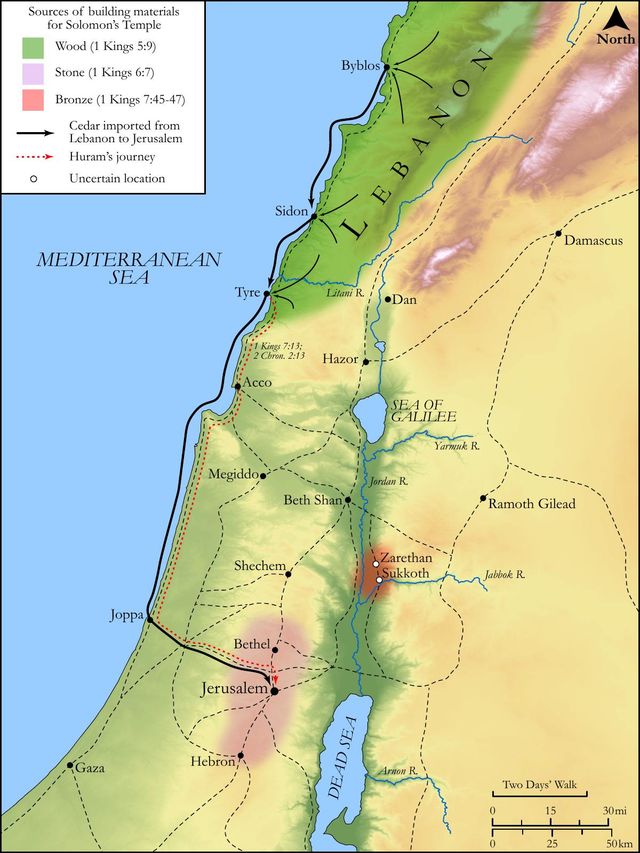
See on the biblical-era map
Study this verse
Public-domain commentary
Matthew Henry
From his Commentary on the Whole Bible. Henry comments on passages, not single verses — this entry covers 2 Chronicles 2:1–10. His three-level outline is real structure in the source text, so it is rendered as structure.
Solomon's wisdom was given him, not merely for speculation, to entertain himself (though it is indeed a princely entertainment), nor merely for conversation, to entertain his friends, but for action; and therefore to action he immediately applies himself. Observe,
I.His resolution within himself concerning his business (Ch2 2:1):
He determined to build, in the first place, a house for the name of the Lord. It is fit that he who is the first should be served - first a temple and then a palace, a house not so much for himself, or his own convenience and magnitude, as for the kingdom, for the honour of it among its neighbours and for the decent reception of the people whenever they had occasion to apply to their prince; so that in both he aimed at the public good. Those are the wisest men that lay out themselves most for the honour of the name of the Lord and the welfare of communities. We are not born for ourselves, but for God and our country.
II.His embassy to Huram, king of Tyre, to engage his assistance in the prosecution of his designs.
The purport of his errand to him is much the same here as we had it Kg1 5:2, etc., only here it is more largely set forth.
1.The reasons why he makes this application to Huram are here more fully represented, for information to Huram as well as for inducement.
(1.)He pleads his father's interest in Huram, and the kindness he had received from him (Ch2 2:3): As thou didst deal with David, so deal with me. As we must show kindness to, so we may expect kindness from, our fathers' friends, and with them should cultivate a correspondence.
(2.)He represents his design in building the temple: he intended it for a place of religious worship (Ch2 2:4), that all the offerings which God had appointed for the honour of his name might be offered up there. The house was built that it might be dedicated to God and used in his service. This we should aim at in all our business, that our havings and doings may be all to the glory of God. He mentions various particular services that were there to be performed, for the instruction of Huram. The mysteries of the true religion, unlike those of the Gentile superstition, coveted not concealment.
(3.)He endeavors to inspire Huram with very great and high thoughts of the God of Israel, by expressing the mighty veneration he had for his holy name: Great is our God above all gods, above all idols, above all princes. Idols are nothing, princes are little, and both under the control of the God of Israel; and therefore, [1.] "The house must be great; not in proportion to the greatness of that God to whom it is to be dedicated (for between finite and infinite there can be no proportion), but in some proportion to the great value and esteem we have for this God." [2.] "Yet, be it ever so great, it cannot be a habitation for the great God. Let not Huram think that the God of Israel, like the gods of the nations, dwells in temples made with hands, Act 17:24. No, the heaven of heavens cannot contain him. It is intended only for the convenience of his priests and worshippers, that they may have a fit place wherein to burn sacrifice before him." [3.] He looked upon himself, though a mighty prince, as unworthy the honour of being employed in this great work: Who am I that I should build him a house? It becomes us to go about every work for God with a due sense of our utter insufficiency for it and our incapacity to do any thing adequate to the divine perfections. It is part of the wisdom wherein we ought to walk towards those that are without carefully to guard against all misapprehension which any thing we say or do may occasion concerning God; so Solomon does here in his treaty with Huram.
2.The requests he makes to him are more particularly set down here. (1.) He desired Huram would furnish him with a good hand to work (Ch2 2:7): Send me a man. He had cunning men with him in Jerusalem and Judah, whom David provided, Ch1 22:15. Let them not think but that Jews had some among them that were artists. But "send me a man to direct them. There are ingenious men in Jerusalem, but not such engravers as are in Tyre; and therefore, since temple-work must be the best in its kind, let me have the best workmen that can be got." (2.) With good materials to work on (Ch2 2:8), cedar and other timber in abundance (Ch2 2:8, Ch2 2:9); for the house must be wonderfully great, that is, very stately and magnificent, no cost must be spared, nor any contrivance wanting in it.
3.Here is Solomon's engagement to maintain the workmen (Ch2 2:10), to give them so much wheat and barley, so much wine and oil. He did not feed his workmen with bread and water, but with plenty, and every thing of the best. Those that employ labourers ought to take care they be not only well paid, but well provided for with sufficient of that which is wholesome and fit for them. Let the rich masters do for their poor workmen as they would be done by if the tables were turned.
Continue studying 2 Chronicles 2:6 across the web’s major study libraries — every link below opens this exact verse, chapter, or book on the destination site.
Read & Compare
 BibleGatewayThis verse in more than 200 translations and 70 languages.
 Bible.comThe YouVersion reader — hundreds of translations, reading plans, and highlights.
 ESV.orgCrossway's official English Standard Version reader.
 NET BibleThe NET translation with 60,000+ translators' notes on every rendering decision.
 STEP BibleTyndale House's free study tool — original text, vocabulary, and scholarly resources.
 BibliaLogos Bible Software's free web reader.
 USCCBThe New American Bible (Revised Edition) with the U.S. bishops' study notes.
Commentaries
 BibleHub CommentariesDozens of classic commentaries on this verse, gathered on one page.
 StudyLightMore than 100 commentary sets — the largest collection on the web.
 BibleRefPlain-English commentary on what this verse means, verse by verse.
 Enduring WordDavid Guzik's free commentary on this chapter, widely used by Bible teachers.
 Bible Study ToolsVerse commentary alongside Greek and Hebrew study aids.
Original Language & Research
- BibleHub InterlinearThe verse word by word — original language, transliteration, and English.
- BibleHub LexiconEvery word's original-language definition and Strong's entry.
 Blue Letter BibleDeep-study tools — Strong's numbers, concordance, and word studies.
 SefariaThe Hebrew text with Rashi and centuries of Jewish commentary.
Sermons, Hymns & Audio


TrulyRandomVerse is not affiliated with these sites and doesn’t control their content. They’re linked because they’re genuinely useful.
Summary
King Solomon's profound declaration in 2 Chronicles 2:6 articulates the infinite majesty and uncontainable nature of God, even as he prepares to construct a magnificent Temple in Jerusalem. This verse serves as a theological anchor, acknowledging God's absolute transcendence over all creation while simultaneously clarifying the humble, worship-focused purpose of the physical structure Solomon intends to build. It underscores the vast chasm between the Creator and His creation, emphasizing that any human endeavor to honor God is an act of humble service, not an attempt to house or limit the Divine.
Context
ShowHideLiterary Context
This verse is a pivotal moment within King Solomon's communication to Hiram, King of Tyre, as he solicits aid for the monumental task of constructing the Temple for the Lord. Following the meticulous preparations and divine blueprints bequeathed by his father, King David, as detailed in 1 Chronicles 28, Solomon inherits the sacred mandate to erect a permanent sanctuary for the Ark of the Covenant and a central hub for Israelite worship. The preceding verses (2 Chronicles 2:1-5) establish Solomon's earnest intent, the immense scale of the project, and his strategic rationale for seeking Hiram's renowned expertise, particularly for cedar and cypress timber and skilled artisans. Verse 6, therefore, transcends a mere statement of humility; it functions as a profound theological preamble to his request, meticulously setting the spiritual tone for the entire enterprise and sharply distinguishing the transcendent God of Israel from the localized, immanent deities worshipped by surrounding nations.
Historical & Cultural Context
The construction of grand national temples was a ubiquitous practice in the ancient Near East, where such edifices were commonly perceived as literal residences for deities, often believed to be confined within their consecrated walls. However, Solomon's declaration in this verse fundamentally challenges and subverts this prevailing pagan concept. Israel's God, Yahweh, was uniquely understood to be omnipresent and utterly transcendent, unbound by any earthly structure. The Temple in Jerusalem, consequently, was never intended to contain God but rather to serve as a designated place for His name to dwell, where His manifest presence would graciously appear among His people, and where prescribed worship, most notably sacrifice, could be reverently offered. This crucial theological distinction was foundational to Israel's unique monotheistic identity, setting them apart from the polytheistic cultures that surrounded them. The undertaking itself represented an immense engineering and logistical feat, demanding vast material resources, highly skilled labor, and unprecedented international cooperation, reflecting the burgeoning power and wealth of Solomon's flourishing kingdom.
Key Themes
ShowHideThe central themes intricately woven into 2 Chronicles 2:6 revolve around the transcendence and omnipresence of God, the humility of humanity before the Divine, and the true, divinely ordained purpose of the Temple. Solomon's rhetorical question, "who is able to build him an house, seeing the heaven and heaven of heavens cannot contain him?", eloquently articulates God's infinite nature, a concept powerfully reiterated in Solomon's later dedication prayer found in 1 Kings 8:27. This profound understanding of God's boundlessness naturally leads to the theme of human humility, as Solomon immediately follows with the self-effacing query, "who [am] I then, that I should build him an house?" This profound self-awareness highlights the appropriate posture of reverence and awe in the presence of the Almighty. Finally, the verse precisely clarifies the Temple's essential function: "save only to burn sacrifice before him." This emphasizes that the Temple was not erected for God's need but for humanity's access to God through prescribed worship, serving as the focal point for the covenant relationship and the very heart of the nation's spiritual life, as originally envisioned by David in 1 Chronicles 22:1.
Exposition and Analysis
ShowHideKey Word Analysis
ShowHideThis word refers to the sky or heavens, often implying the visible arch where clouds move and the higher ether where celestial bodies revolve. In the phrase "heaven and heaven of heavens," it forms a superlative Hebrew idiom signifying the entire cosmos, the absolute totality of all created space, and even realms beyond human comprehension. It is an emphatic expression of infinite vastness, used to convey the utter transcendence and uncontainable nature of God, implying that His dwelling is beyond all conceivable physical or celestial boundaries.
This primitive root means "to keep in," "to measure," or figuratively, "to maintain" or "to comprehend." In this context, it speaks to the capacity or ability to encompass, enclose, or hold within limits. Solomon's rhetorical question powerfully asserts that the immense vastness of the universe itself is utterly insufficient to hold God. Therefore, a man-made building, by logical extension, is even more incapable of containing the Divine essence. This word highlights God's immeasurable nature, which transcends all spatial limitations and human capacity to grasp fully.
This primitive root specifically refers to the act of causing something to smoke, to turn into fragrance by fire, especially as an act of worship. It denotes the burning of incense or the offering of a sacrifice that ascends in smoke, rather than general burning. In this verse, "to burn sacrifice" points directly to the specific liturgical function of the Temple. It clarifies that the building's purpose is not to provide God with a dwelling He requires, but to facilitate the prescribed acts of worship, atonement, and communion for His people, emphasizing the Temple as a place of ritual encounter designed for human interaction with God according to His revealed will.
Verse Breakdown
ShowHide"But who is able to build him an house, seeing the heaven and heaven of heavens cannot contain him?"
This opening rhetorical question immediately establishes God's absolute transcendence and omnipresence. Solomon, with profound theological insight, acknowledges that no physical structure, no matter how magnificent or grand, can truly house or contain the infinite Creator and Sustainer of the universe. The phrase "the heaven and heaven of heavens" represents the entirety of the cosmos, emphasizing that even this boundless expanse is insufficient to limit God. This profound theological statement serves to humble the human builder and elevate the object of worship, sharply distinguishing Yahweh from the localized, immanent deities of pagan religions.
"who [am] I then, that I should build him an house,"
Following the declaration of God's immense and uncontainable nature, Solomon shifts to a posture of profound and appropriate humility. This rhetorical question highlights his own insignificance and finite nature in comparison to the Almighty. It reflects an appropriate awe and reverence, acknowledging that his role is not to provide God with something He needs or lacks, but rather to serve as a humble instrument in God's overarching plan. It underscores the immense privilege and solemn responsibility of participating in such a divine enterprise, rather than asserting human capability or presuming to meet a divine necessity.
"save only to burn sacrifice before him?"
This concluding clause precisely clarifies the true, humble, and practical purpose of the Temple. It is emphatically stated that the Temple is not for God's containment or comfort, but solely for the facilitation of human worship, particularly through the prescribed acts of sacrifice and offerings. The Temple serves as a designated, holy place where God's people can approach Him according to His covenant stipulations, offer atonement, express devotion, and engage in communal worship. It functions as the focal point for Israel's spiritual life, a sacred space where God's presence would manifest and where His name would dwell, enabling communion between the holy God and His covenant people.
Literary Devices
ShowHideSolomon's statement in 2 Chronicles 2:6 is profoundly enriched by its masterful use of Rhetorical Questions, which serve not to elicit an answer but to make a forceful, undeniable assertion. The initial question, "But who is able to build him an house, seeing the heaven and heaven of heavens cannot contain him?", powerfully emphasizes God's infinite nature and uncontainability, leaving no room for doubt regarding His transcendence. This is immediately followed by a second, equally potent rhetorical question, "who [am] I then, that I should build him an house?", which highlights Solomon's profound humility and acute awareness of his own finite nature in stark contrast to God's boundlessness. The use of Hyperbole is also evident in the phrase "heaven and heaven of heavens," which is a superlative expression designed to convey the absolute vastness of creation and, by extension, the even greater, incomprehensible vastness of God who utterly transcends it. This literary technique amplifies the theological truth of God's omnipresence and transcendence, making the subsequent statement of the Temple's limited, yet sacred, purpose all the more impactful and clear.
Theological and Thematic Connections
ShowHide2 Chronicles 2:6 presents a foundational theological truth about God's absolute transcendence and omnipresence, asserting unequivocally that the Creator cannot be confined or limited by anything within His creation. This understanding is utterly crucial for cultivating a proper view of worship, the nature of God, and human humility before the Divine. The Temple, therefore, is not a house for God in the sense of His needing a dwelling place, but rather a designated and holy place for humanity to encounter Him, offer worship according to His commands, and receive His covenant blessings. This profound concept resonates throughout the entirety of Scripture, continually reminding believers that while God may graciously choose to manifest His presence in specific locations or through particular rituals, His very being is beyond all spatial, temporal, and material limitations. Our acts of worship, our diligent service, and indeed our very existence are not to fulfill a divine need, but rather to express our profound reverence, our willing obedience, and our complete dependence upon the One who is infinitely greater, more glorious, and more majestic than all our finite conceptions.
Reflection and Application
ShowHideSolomon's profound declaration in 2 Chronicles 2:6 serves as a timeless and essential corrective to our often-limited and anthropocentric understanding of God. We, much like ancient peoples, can inadvertently fall into the trap of trying to "box in" God, confining Him to our church buildings, our personal experiences, our denominational traditions, or even our meticulously constructed theological systems. Solomon powerfully reminds us that God is infinitely greater, more expansive, and more mysterious than any human construct or finite comprehension. This truth calls us to cultivate a posture of profound humility, reverence, and awe, recognizing that our worship, our service, and our very existence are entirely dependent on His boundless grace and not on His need for anything from us. The true purpose of our spiritual disciplines, our communal gatherings, and even our physical places of worship is not to provide God with something He lacks, but rather to provide us with a divinely ordained means to draw near to Him, to acknowledge His rightful place as sovereign Lord, and to be profoundly transformed by His holy presence. This verse encourages us to expand our vision of God, to worship Him with an understanding of His boundless majesty, and to serve Him with a humble heart that recognizes our immense privilege in participating in His eternal, divine purposes.
Questions for Reflection
ShowHideFAQ
ShowHideWhat does "the heaven and heaven of heavens cannot contain him" truly mean?
ShowHideThis phrase is a powerful Hebrew idiom (shamayim u-sheme ha-shamayim) that denotes the entirety of the cosmos, encompassing the highest heavens and all created space. When Solomon states that even this boundless expanse cannot "contain" God, he is emphasizing God's absolute transcendence and omnipresence. It means that God is not limited by space, time, or any physical dimension. He exists beyond, above, and sustains all creation, making it impossible for any structure, no matter how vast or grand, to truly house His infinite being. This concept is echoed in other scriptures, such as Isaiah 66:1, where God declares, "Heaven is my throne, and the earth is my footstool: where is the house that ye build unto me?" It underscores that God's presence is not localized but fills all things.
Christ-Centered Fulfillment
ShowHideWhile 2 Chronicles 2:6 powerfully declares God's uncontainable nature and the Temple's purpose for sacrifice, it ultimately points forward to the ultimate and perfect fulfillment found in Jesus Christ. Solomon's profound recognition that no earthly house could truly contain God foreshadows the New Covenant reality where God's dwelling is no longer confined to a physical structure in Jerusalem, but graciously resides within His people through the indwelling Holy Spirit. As Jesus Himself declared in John 2:19-21, He was speaking of the "temple of his body," signifying that He Himself is the true, living meeting place between God and humanity. The animal sacrifices offered in Solomon's Temple, which were "only to burn sacrifice," found their perfect, final, and eternal culmination in the singular, once-for-all sacrifice of Jesus on the cross, as magnificently highlighted in Hebrews 10:10-14. Through Christ's finished work, the need for a physical temple and repeated animal sacrifices is eternally superseded, for He is the ultimate High Priest and the Lamb of God who takes away the sin of the world (John 1:29). Thus, Solomon's humble acknowledgment of God's transcendence and the Temple's sacrificial function ultimately directs our gaze to the One who perfectly embodies God's presence and offers the perfect, eternal atonement, making us, His redeemed people, the living temples of the Holy Spirit (1 Corinthians 6:19).