


2 Chronicles 2:9
- וּלְהָכִיןu·le·ha·Khinand to prepareH3559Conj-w ¦ Prep-l ¦ V-Hiphil-InfVerb Hiphil Infinitive Constructוּandלְtoהָכִיןprepare
- לִיlifor mePrep-l ¦ 1csSuffix Personal 1st Singular common genderלִforיme
- עֵצִים'e·Tzimwood<s>H6086N-mpNoun Plural Masculine Absolute
- לָרֹבla·Roto abundanceH7230Prep-l ¦ N-msNoun Singular Masculine Absoluteלָtoרֹבabundance
- כִּיkiforH3588PrtParticle Conditional
- הַבַּיִתha·Ba·yitthe houseH1004Art ¦ N-msNoun Singular Masculine Absoluteהַtheבַּיִתhouse
- אֲשֶׁר'a·SherwhichH834RelParticle Relative
- אֲנִי'a·NiIH589Pro-1csPronoun Personal 1st Singular common gender
- בוֹנֶהvo·Neh[am] about to buildH1129V-Qal-Prtcpl-msVerb Qal Participle Singular Masculine Absolute
- גָּדוֹלga·Dol[will be] greatH1419Adj-csAdjective Singular common gender Absolute
- וְהַפְלֵאve·haf·Le'and act wonderfullyH6381Conj-w ¦ V-Hiphil-InfAbsVerb Hiphil Infinitive Absoluteוְandהַפְלֵאact wonderfully
English is a literal word-by-word gloss of the Hebrew, not the KJV's wording. Why?
This is the original text the KJV's translators worked from — each Hebrew word with its own literal English meaning in this verse, prepared by scholars at Tyndale House, Cambridge. The KJV translates whole sentences, not word by word, so its wording differs: one Hebrew word can become several English words, and the KJV may choose “the LORD” where the gloss reads “Yahweh”. Both are faithful — they answer different questions. For the KJV's own rendering, switch to the KJV text.
Details
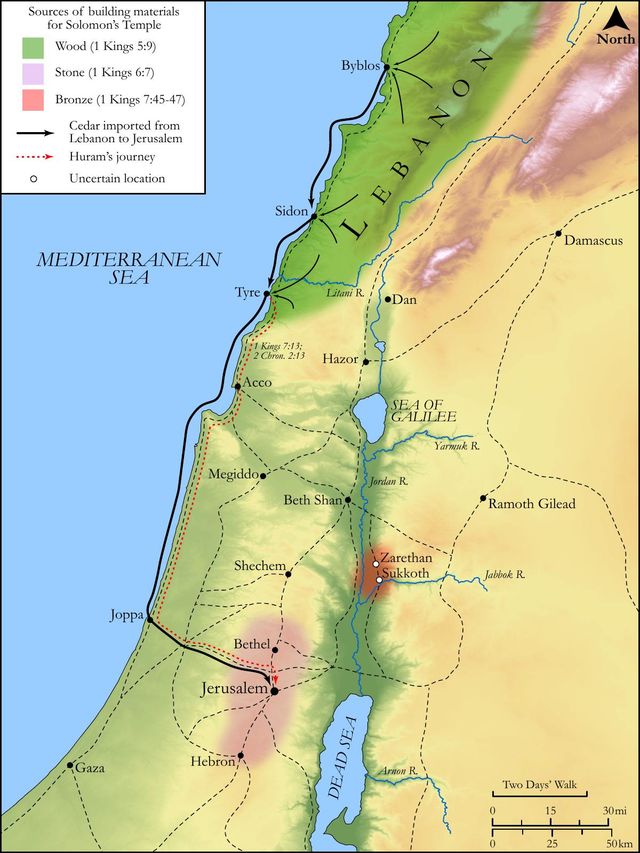
See on the biblical-era map
Study this verse
Public-domain commentary
Matthew Henry
From his Commentary on the Whole Bible. Henry comments on passages, not single verses — this entry covers 2 Chronicles 2:1–10. His three-level outline is real structure in the source text, so it is rendered as structure.
Solomon's wisdom was given him, not merely for speculation, to entertain himself (though it is indeed a princely entertainment), nor merely for conversation, to entertain his friends, but for action; and therefore to action he immediately applies himself. Observe,
I.His resolution within himself concerning his business (Ch2 2:1):
He determined to build, in the first place, a house for the name of the Lord. It is fit that he who is the first should be served - first a temple and then a palace, a house not so much for himself, or his own convenience and magnitude, as for the kingdom, for the honour of it among its neighbours and for the decent reception of the people whenever they had occasion to apply to their prince; so that in both he aimed at the public good. Those are the wisest men that lay out themselves most for the honour of the name of the Lord and the welfare of communities. We are not born for ourselves, but for God and our country.
II.His embassy to Huram, king of Tyre, to engage his assistance in the prosecution of his designs.
The purport of his errand to him is much the same here as we had it Kg1 5:2, etc., only here it is more largely set forth.
1.The reasons why he makes this application to Huram are here more fully represented, for information to Huram as well as for inducement.
(1.)He pleads his father's interest in Huram, and the kindness he had received from him (Ch2 2:3): As thou didst deal with David, so deal with me. As we must show kindness to, so we may expect kindness from, our fathers' friends, and with them should cultivate a correspondence.
(2.)He represents his design in building the temple: he intended it for a place of religious worship (Ch2 2:4), that all the offerings which God had appointed for the honour of his name might be offered up there. The house was built that it might be dedicated to God and used in his service. This we should aim at in all our business, that our havings and doings may be all to the glory of God. He mentions various particular services that were there to be performed, for the instruction of Huram. The mysteries of the true religion, unlike those of the Gentile superstition, coveted not concealment.
(3.)He endeavors to inspire Huram with very great and high thoughts of the God of Israel, by expressing the mighty veneration he had for his holy name: Great is our God above all gods, above all idols, above all princes. Idols are nothing, princes are little, and both under the control of the God of Israel; and therefore, [1.] "The house must be great; not in proportion to the greatness of that God to whom it is to be dedicated (for between finite and infinite there can be no proportion), but in some proportion to the great value and esteem we have for this God." [2.] "Yet, be it ever so great, it cannot be a habitation for the great God. Let not Huram think that the God of Israel, like the gods of the nations, dwells in temples made with hands, Act 17:24. No, the heaven of heavens cannot contain him. It is intended only for the convenience of his priests and worshippers, that they may have a fit place wherein to burn sacrifice before him." [3.] He looked upon himself, though a mighty prince, as unworthy the honour of being employed in this great work: Who am I that I should build him a house? It becomes us to go about every work for God with a due sense of our utter insufficiency for it and our incapacity to do any thing adequate to the divine perfections. It is part of the wisdom wherein we ought to walk towards those that are without carefully to guard against all misapprehension which any thing we say or do may occasion concerning God; so Solomon does here in his treaty with Huram.
2.The requests he makes to him are more particularly set down here. (1.) He desired Huram would furnish him with a good hand to work (Ch2 2:7): Send me a man. He had cunning men with him in Jerusalem and Judah, whom David provided, Ch1 22:15. Let them not think but that Jews had some among them that were artists. But "send me a man to direct them. There are ingenious men in Jerusalem, but not such engravers as are in Tyre; and therefore, since temple-work must be the best in its kind, let me have the best workmen that can be got." (2.) With good materials to work on (Ch2 2:8), cedar and other timber in abundance (Ch2 2:8, Ch2 2:9); for the house must be wonderfully great, that is, very stately and magnificent, no cost must be spared, nor any contrivance wanting in it.
3.Here is Solomon's engagement to maintain the workmen (Ch2 2:10), to give them so much wheat and barley, so much wine and oil. He did not feed his workmen with bread and water, but with plenty, and every thing of the best. Those that employ labourers ought to take care they be not only well paid, but well provided for with sufficient of that which is wholesome and fit for them. Let the rich masters do for their poor workmen as they would be done by if the tables were turned.
Continue studying 2 Chronicles 2:9 across the web’s major study libraries — every link below opens this exact verse, chapter, or book on the destination site.
Read & Compare
 BibleGatewayThis verse in more than 200 translations and 70 languages.
 Bible.comThe YouVersion reader — hundreds of translations, reading plans, and highlights.
 ESV.orgCrossway's official English Standard Version reader.
 NET BibleThe NET translation with 60,000+ translators' notes on every rendering decision.
 STEP BibleTyndale House's free study tool — original text, vocabulary, and scholarly resources.
 BibliaLogos Bible Software's free web reader.
 USCCBThe New American Bible (Revised Edition) with the U.S. bishops' study notes.
Commentaries
 BibleHub CommentariesDozens of classic commentaries on this verse, gathered on one page.
 StudyLightMore than 100 commentary sets — the largest collection on the web.
 BibleRefPlain-English commentary on what this verse means, verse by verse.
 Enduring WordDavid Guzik's free commentary on this chapter, widely used by Bible teachers.
 Bible Study ToolsVerse commentary alongside Greek and Hebrew study aids.
Original Language & Research
- BibleHub InterlinearThe verse word by word — original language, transliteration, and English.
- BibleHub LexiconEvery word's original-language definition and Strong's entry.
 Blue Letter BibleDeep-study tools — Strong's numbers, concordance, and word studies.
 SefariaThe Hebrew text with Rashi and centuries of Jewish commentary.
Sermons, Hymns & Audio


TrulyRandomVerse is not affiliated with these sites and doesn’t control their content. They’re linked because they’re genuinely useful.
Summary
King Solomon, in his communication with Hiram, King of Tyre, articulates the immense scale and profound significance of the Temple he is commissioned to build for the Lord in Jerusalem. This verse specifically highlights Solomon's request for "timber in abundance," justifying the vast quantity and quality of materials by declaring that the edifice dedicated to God "shall be wonderful great," emphasizing its unparalleled grandeur and majesty as a testament to the divine glory it is intended to house.
Context
ShowHideLiterary Context
This verse is an integral part of King Solomon's detailed letter to King Hiram of Tyre, a crucial diplomatic overture seeking assistance for the monumental task of constructing the Temple. The preceding verses, specifically 2 Chronicles 2:1-8, establish Solomon's unwavering resolve to build a "house for the name of the Lord his God" (2 Chronicles 2:1). He explicitly states that "the house which I build is great: for great is our God above all gods" (2 Chronicles 2:5), setting the theological and architectural precedent for the project. This declaration directly leads to the specific request in 2 Chronicles 2:9, where the need for abundant timber is justified by the Temple's intended "wonderful great" scale. The subsequent verses, 2 Chronicles 2:10-16, detail the specific provisions Solomon offers Hiram's workers and Hiram's affirmative and praising response, underscoring the vast international cooperation and resources involved in this divinely ordained enterprise.
Historical & Cultural Context
The construction of the Temple during Solomon's reign (c. 970-931 BC) marked a pivotal moment in ancient Israelite history, transitioning from the portable Tabernacle to a permanent, central place of worship in Jerusalem. This era was a golden age for Israel, characterized by unprecedented peace, prosperity, and expanding international influence. Tyre, a prominent Phoenician city-state, was renowned throughout the ancient Near East for its exceptional craftsmen, particularly in stonemasonry, metalwork, and timber processing, and for its vast cedar forests. The long-standing alliance between Israel and Tyre, initially established during David's reign (as seen in 2 Samuel 5:11) and solidified under Solomon (1 Kings 5:1), was indispensable for acquiring the specialized labor and high-quality materials not readily available within Israel. The sheer scale of the Temple project, implied by its description as "wonderful great," would have been a profound testament to Israel's elevated geopolitical status and a significant architectural marvel for the entire ancient world.
Key Themes
ShowHide2 Chronicles 2:9 significantly contributes to several overarching themes within the book of 2 Chronicles and the broader biblical narrative. Firstly, it underscores the theme of Divine Magnificence and Honor, emphasizing that the Temple's unparalleled grandeur was not merely an architectural feat but a direct reflection of the glory, supremacy, and uniqueness of the God of Israel. Solomon's commitment to building a "wonderful great" house demonstrates the human desire to offer the absolute best to the Almighty, echoing the call for excellence in worship found throughout the Old Testament, such as in the detailed instructions for the Tabernacle in Exodus 25. Secondly, the verse highlights Solomon's Vision and Leadership, portraying him as a proactive, wise, and ambitious king who fully grasped the spiritual and national significance of the Temple. His detailed request for "timber in abundance" showcases his foresight in securing the necessary resources and expertise for such a monumental undertaking. Lastly, the verse touches upon the theme of Abundance and Divine Provision, illustrating how God provides for His purposes, often through human collaboration and even international alliances, as seen in the vast quantities of materials and skilled labor supplied by Hiram. This foreshadows the immense wealth and wisdom God would grant Solomon throughout his reign, enabling him to complete this extraordinary project (compare with 1 Kings 10:23-25).
Exposition and Analysis
ShowHideKey Word Analysis
ShowHideThis primitive root properly means "to be erect," implying "to set up." Causatively, it signifies "to establish, fix, prepare, apply." In this context, "prepare" goes beyond mere gathering; it denotes the meticulous arrangement, fashioning, and making ready of the timber for its specific purpose in the Temple's construction. It conveys a sense of careful planning, precision, and establishing something firmly and properly for a significant undertaking.
This term primarily means "a house" but carries a vast range of applications, including family, household, palace, and notably, "temple." Here, it specifically refers to the Temple in Jerusalem, which was to be the permanent dwelling place for the Name of the Lord. The choice of "house" emphasizes its function as a dwelling, a place of residence for God's presence among His people, yet one of unparalleled significance and sanctity.
This primitive root means "to separate, distinguish," and by implication, "to be (causatively, make) great, difficult, wonderful." It describes something that is extraordinary, miraculous, or beyond human comprehension and expectation. When applied to the Temple, "wonderful" signifies not merely impressive size but a structure that evokes awe, astonishment, and a sense of the divine, setting it apart as a unique manifestation of God's glory and power.
Verse Breakdown
ShowHide"Even to prepare me timber in abundance:"
This clause expresses Solomon's specific and urgent request to King Hiram. The verb "prepare" (H3559, kûwn) implies not just the supply but the readying and fitting of the materials for construction. The phrase "timber in abundance" (H6086, ‘êts and H7230, rôb) underscores the monumental scale of the Temple project, indicating a need for vast quantities of wood, particularly the valuable cedar, fir, and algum wood mentioned elsewhere in the chapter (2 Chronicles 2:8). This highlights Solomon's meticulous planning and the immense resources required for such a sacred undertaking.
"for the house which I am about to build [shall be] wonderful great."
This clause provides the compelling justification for the extensive request. "The house which I am about to build" (H1004, bayith and H1129, bânâh) refers directly to the Temple, the central focus of Solomon's reign and the fulfillment of David's desire. The declaration that it "shall be wonderful great" (H6381, pâlâʼ and H1419, gâdôwl) serves as the ultimate rationale for seeking extraordinary resources and skilled labor. It signifies that the Temple's grandeur will be unparalleled, reflecting the supreme greatness and glory of the God to whom it is dedicated, thus demanding the finest and most abundant materials possible to evoke awe and reverence.
Literary Devices
ShowHideThe verse employs several powerful literary devices to convey its profound message. Hyperbole is evident in the phrase "wonderful great," which emphasizes the Temple's extraordinary scale and magnificence beyond typical human constructions. This exaggeration serves to highlight the divine recipient of the building and the unparalleled honor intended for Him, ensuring the structure would be truly awe-inspiring. Emphasis is achieved through the direct statement of the Temple's grandeur as the explicit reason for the request for "timber in abundance," creating a strong cause-and-effect relationship that underscores the project's immense spiritual significance. Furthermore, the verse uses Foreshadowing, as Solomon's declaration of a "wonderful great" house anticipates the actual splendor and renown of the completed Temple, which would indeed become a marvel of the ancient world and a powerful symbol of God's tangible presence among His people.
Theological and Thematic Connections
ShowHide2 Chronicles 2:9 powerfully articulates the principle that God's dwelling place, whether a physical structure or the spiritual community of believers, should reflect His supreme greatness and be built with utmost dedication and excellence. Solomon's vision for a "wonderful great" Temple was not born of human pride but of a profound understanding of God's majesty and the desire to honor Him appropriately. This commitment to excellence in service and worship is a recurring biblical theme, reminding us that our offerings to God, whether material, spiritual, or vocational, should be our very best, reflecting His worthiness. The abundance of materials sought also speaks to God's boundless provision for His purposes, often working through human cooperation and the resources of the world, demonstrating His ability to bring about His will through diverse means.
Reflection and Application
ShowHideSolomon's unwavering commitment to building a "wonderful great" house for the Lord serves as a profound challenge and inspiration for believers today. While we no longer construct physical temples in the same manner, the underlying principle of giving our absolute best to God remains eternally relevant. This verse beckons us to examine the quality of our devotion, the sincerity of our worship, and the excellence of our service. Are we offering God our leftovers, or are we, like Solomon, striving to dedicate our finest talents, resources, and efforts to His kingdom? It calls us to cultivate a grand vision for God's work in and through our lives, understanding that our God is "wonderful great" and deserves nothing less than our wholehearted pursuit of His glory. Just as the Temple was a focal point for God's presence, our lives, as temples of the Holy Spirit, should be built up in such a way that they reflect His magnificent character and draw others to His awe-inspiring presence, becoming living testimonies to His "wonderful great" nature.
Questions for Reflection
ShowHideFAQ
ShowHideWhy was it so important for the Temple to be "wonderful great"?
ShowHideThe Temple's "wonderful great" scale and magnificence were crucial for several profound reasons. Firstly, it was intended to reflect the supreme greatness and glory of the God of Israel, who is "above all gods" (2 Chronicles 2:5). A grand structure visually communicated God's unparalleled majesty, His transcendent nature, and His worthiness of the highest honor and reverence from His people. Secondly, it served as the central place of worship and national identity for Israel, symbolizing God's covenant presence among His people and His faithfulness to His promises. The grandeur would inspire awe and reverence, reinforcing the sanctity of the space and the seriousness of approaching a holy God. Finally, it was a fulfillment of God's promise to David and a testament to Solomon's wisdom and the prosperity of his reign, demonstrating God's blessing upon His chosen king and nation, and serving as a beacon of divine favor in the ancient world.
Christ-Centered Fulfillment
ShowHideWhile 2 Chronicles 2:9 describes a physical structure of unparalleled grandeur, its ultimate and most profound fulfillment is found in Jesus Christ. The Temple, for all its "wonderful great" glory, was merely a shadow pointing to the true dwelling place of God among humanity. Jesus Himself declared, "Destroy this temple, and in three days I will raise it up" (John 2:19), explicitly referring to the temple of His own body. He is the ultimate "wonderful great" Temple, the perfect embodiment of God's presence and glory on earth, in whom "all the fullness of God was pleased to dwell" (Colossians 1:19) and in whom "the whole fullness of deity dwells bodily" (Colossians 2:9). Through His sacrificial death and glorious resurrection, Christ not only rebuilt the "temple" of His body but also established a new spiritual Temple, the church, composed of believers, where God's Holy Spirit now permanently resides (1 Corinthians 3:16). Thus, the vision of a "wonderful great" house for God is fully realized in Christ, who is the cornerstone of this new spiritual edifice (Ephesians 2:20-22), and in His body, the Church, which continues to grow into a holy temple in the Lord, reflecting His glory to the world until His return.