


1 Chronicles 22:15
Bible text: King James Version (1769 Blayney text) · Public domain
Bible text: Berean Standard Bible · Public domain
Bible text: American Standard Version (1901) · Public domain
Bible text: World English Bible, Messianic edition · Public domain
Bible text: Geneva Bible (1599) · Public domain
Bible text: Young's Literal Translation · Public domain
- וְעִמְּךָve·'i·me·Khaand [are] with youH5973Conj-w ¦ Prep ¦ 2msPrepositionוְandעִמְּ[are] withךָyou
- לָרֹבla·Roto abundanceH7230Prep-l ¦ N-msNoun Singular Masculine Absoluteלָtoרֹבabundance
- עֹשֵׂי'o·Seidoers ofH6213V-Qal-Prtcpl-mpVerb Qal Participle Plural Masculine Construct
- מְלָאכָהme·la·KhahworkH4399N-fsNoun Singular Feminine Absolute
- חֹצְבִיםcho·tze·Vimstone cuttersH2672V-Qal-Prtcpl-mpVerb Qal Participle Plural Masculine Absolute
- וְחָרָשֵׁיve·cha·ra·Sheiand craftsmen ofH2796Conj-w ¦ N-mpcNoun Plural Masculine Constructוְandחָרָשֵׁיcraftsmen of
- אֶבֶן'E·venstoneH68N-fsNoun Singular Feminine Absolute
- וָעֵץva·'Etzand woodH6086Conj-w ¦ N-msNoun Singular Masculine Absoluteוָandעֵץwood
- וְכָלve·kholand everyH3605Conj-w ¦ N-mscNoun Singular Masculine Constructוְandכָלevery
- חָכָםcha·Khamskillful [person]H2450Adj-msAdjective Singular Masculine Absolute
- בְּכָלbe·kholin everyH3605Prep-b ¦ N-mscNoun Singular Masculine Constructבְּinכָלevery
- מְלָאכָהme·la·KhahworkH4399N-fsNoun Singular Feminine Absolute
English is a literal word-by-word gloss of the Hebrew, not the KJV's wording. Why?
This is the original text the KJV's translators worked from — each Hebrew word with its own literal English meaning in this verse, prepared by scholars at Tyndale House, Cambridge. The KJV translates whole sentences, not word by word, so its wording differs: one Hebrew word can become several English words, and the KJV may choose “the LORD” where the gloss reads “Yahweh”. Both are faithful — they answer different questions. For the KJV's own rendering, switch to the KJV text.
Details
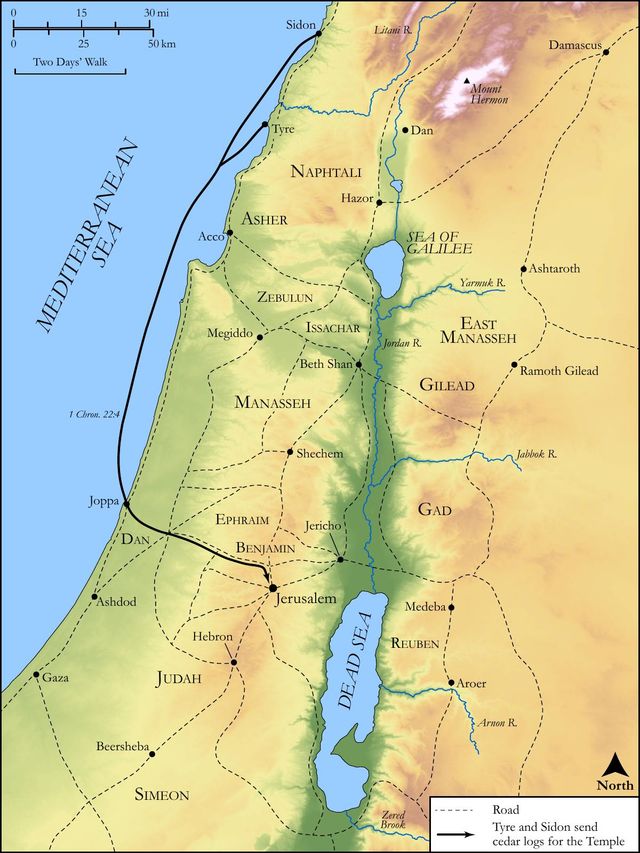
See on the biblical-era map
Study this verse
Public-domain commentary
Matthew Henry
From his Commentary on the Whole Bible. Henry comments on passages, not single verses — this entry covers 1 Chronicles 22:6–16. His two-level outline is real structure in the source text, so it is rendered as structure.
Though Solomon was young and tender, he was capable of receiving instructions, which his father accordingly gave him, concerning the work for which he was designed. When David came to the throne he had many things to do, for the foundations were all out of course; but Solomon had only one thing in charge, and that was to build a house for the Lord God of Israel, Ch1 22:6. Now,
I.David tells him why he did not do it himself.
It was in his mind to do it (Ch1 22:7), but God forbade him, because he had shed much blood, Ch1 22:8. Some think this refers to the blood of Uriah, which fastened such a reproach upon him as rendered him unworthy the honour of building the temple: but that honour was forbidden him before he had shed that blood; therefore it must be meant, as it is here explained, of the blood he shed in his wars (for he had been a man of war from his youth), which, though shed very justly and honourably in the service of God and Israel, yet made him unfit to be employed in this service, or rather less fit than another that had never been called to such bloody work. God, by assigning this as the reason of laying David aside from this work, showed how precious human life is to him, and intended a type of him who should build the gospel temple, not by destroying men's lives, but by saving them, Luk 9:56.
II.He gives him the reason why he imposed this task upon him.
1.Because God had designed him for it, nominated him as the man that should do it: A son shall be born to thee, that shall be called Solomon, and he shall build a house for my name, Ch1 22:9, Ch1 22:10. Nothing is more powerful to engage us to any service for God, and encourage us in it, than to know that hereunto we are appointed.
2.Because he would have leisure and opportunity to do it. He should be a man of rest, and therefore should not have his time, or thoughts, or wealth, diverted from this business. He should have rest from his enemies abroad (none of them should invade or threaten him, or give him provocation), and he should have peace and quietness at home; and therefore let him build the house. Note, Where God gives rest he expects work.
3.Because God had promised to establish his kingdom. Let this encourage him to honour God, that God had honour in store for him; let him build up God's house, and God will build up his throne. Note, God's gracious promises should quicken and invigorate our religious service.
III.He delivers him an account of the vast preparations he had made for this building (Ch1 22:14), not in a way of pride and vain glory (he speaks of it as a poor thing - I have, in my poverty, prepared, margin), but as an encouragement to Solomon to engage cheerfully in the work, for which so solid a foundation was laid. The treasure here mentioned of the 100,000 talents of gold, and 1,000,000 talents of silver, amounts to such an incredible sum that most interpreters either allow an error in the copy or think the talent here signifies no more than a plate or piece: ingots we call them. I am inclined to suppose that a certain number is here put for an uncertain, because it is said (Ch1 22:16) that of the gold and silver, as well as of the brass and iron, there was no number, and that David here includes all the dedicated things (Ch1 18:11) which he designed for the house of the Lord, that is, not only for the building of it, but for the treasure of it; and putting all together, it might come pretty near what is here spoken of. Hundreds and thousands are numbers which we often use to express that which is very much, when yet we would not be understood strictly.
IV.He charges them to keep God's commandments and to take heed to his duty in every thing, Ch1 22:13.
He must not think by building the temple to purchase a dispensation to sin; no, on the contrary, his doing that would not be accepted, nor accounted of, if he did not take heed to fulfil the statutes which the Lord charged Moses with, Ch1 22:13. Though he was to be king of Israel, he must always remember that he was a subject to the God of Israel.
V.He encourages him to go about this great work, and to go on in it (Ch1 22:13):
"Be strong, and of good courage, Though it is a vast undertaking, thou needest not fear coming under the reproach of the foolish builder, who began to build and was not able to finish it; it is God's work, and it shall come to perfection. Dread not, nor be dismayed." In our spiritual work, as well as in our spiritual warfare, we have need of courage and resolution.
VI.He quickens him not to rest in the preparations he had made, but to add thereto, Ch1 22:14.
Those that enter into the labours of others, and build upon their advantages, must still be improving.
VII.He prays for him:
The Lord give thee wisdom and understanding, and give thee charge concerning Israel, Ch1 22:12. Whatever charge we have, if we see God giving us the charge and calling us to it, we may hope he will give us wisdom for the discharge of it. Perhaps Solomon had an eye to this prayer of his father for him, in the prayer he offered for himself: Lord, give me a wise and understanding heart. He concludes (Ch1 22:16), Up, and be doing, and the Lord be with thee. Hope of God's presence must not slacken our endeavours. Though the Lord be with us, we must rise and be doing, and, if we do this, we have reason to believe he is and will be with us. Work out your salvation, and God will work in you.
Continue studying 1 Chronicles 22:15 across the web’s major study libraries — every link below opens this exact verse, chapter, or book on the destination site.
Read & Compare
 BibleGatewayThis verse in more than 200 translations and 70 languages.
 Bible.comThe YouVersion reader — hundreds of translations, reading plans, and highlights.
 ESV.orgCrossway's official English Standard Version reader.
 NET BibleThe NET translation with 60,000+ translators' notes on every rendering decision.
 STEP BibleTyndale House's free study tool — original text, vocabulary, and scholarly resources.
 BibliaLogos Bible Software's free web reader.
 USCCBThe New American Bible (Revised Edition) with the U.S. bishops' study notes.
Commentaries
 BibleHub CommentariesDozens of classic commentaries on this verse, gathered on one page.
 StudyLightMore than 100 commentary sets — the largest collection on the web.
 BibleRefPlain-English commentary on what this verse means, verse by verse.
 Enduring WordDavid Guzik's free commentary on this chapter, widely used by Bible teachers.
 Bible Study ToolsVerse commentary alongside Greek and Hebrew study aids.
Original Language & Research
- BibleHub InterlinearThe verse word by word — original language, transliteration, and English.
- BibleHub LexiconEvery word's original-language definition and Strong's entry.
 Blue Letter BibleDeep-study tools — Strong's numbers, concordance, and word studies.
 SefariaThe Hebrew text with Rashi and centuries of Jewish commentary.
Sermons, Hymns & Audio


TrulyRandomVerse is not affiliated with these sites and doesn’t control their content. They’re linked because they’re genuinely useful.
Summary
1 Chronicles 22:15 details King David's profound assurance to his son Solomon, confirming that an abundant and diverse workforce, including both general laborers and highly skilled artisans, stands prepared to assist in the monumental and divinely ordained task of constructing the Temple. This verse underscores David's meticulous foresight and comprehensive provision, ensuring that not only were vast material resources gathered, but also the essential human capital was fully secured, thereby setting the stage for Solomon's successful execution of God's sacred dwelling place.
Context
ShowHideLiterary Context
This verse is strategically placed within King David's final, earnest preparations and instructions concerning the building of the Temple in Jerusalem. Although David himself was divinely prohibited from undertaking this sacred construction due to his history as a man of war, as revealed in 1 Chronicles 22:8, he received the divine promise that his son, Solomon, would be the one to accomplish this significant task, a promise reiterated in 1 Chronicles 22:10. Despite his personal prohibition, David dedicated himself wholeheartedly to amassing an immense quantity of precious materials—gold, silver, bronze, iron, timber, and hewn stone—a meticulous effort detailed in 1 Chronicles 22:14. Verse 15 serves as a crucial continuation of this comprehensive preparation, assuring Solomon that beyond the raw materials, the skilled labor force required for such an intricate and grand undertaking is also abundantly available, thereby highlighting the completeness of David's provision and foresight.
Historical & Cultural Context
In Israel, the construction of the house of God, whose pattern David gave to Solomon, was an undertaking of immense scale and profound significance. Such projects were not merely architectural feats but served as powerful symbols of a nation's devotion to its deity, its economic prosperity, political power, and sophisticated organizational capabilities. These colossal endeavors demanded extraordinary resources, advanced engineering knowledge, and highly specialized craftsmanship. The mention of "hewers and workers of stone and timber" refers to the fundamental and arduous trades essential for large-scale construction, while "cunning men" denotes master artisans possessing exceptional skill in intricate work. During this period, skilled labor was a highly valued commodity, often acquired through tribute, alliances, or extensive recruitment. David's remarkable ability to gather such a diverse and numerous workforce, alongside the vast material provisions, speaks volumes about his administrative prowess and the considerable wealth of his kingdom, which he consecrated entirely to God's service. The Temple was envisioned as a permanent, magnificent structure, designed to far surpass the portable Tabernacle, signifying a new era of settled worship and solidified national identity for Israel.
Key Themes
ShowHideThis verse contributes significantly to several overarching themes woven throughout the book of Chronicles. First, it powerfully illustrates the theme of Divine Provision and Human Preparation. While God had chosen Solomon to build the Temple, David's diligent and extensive preparation demonstrates the vital role of human responsibility in partnering with divine will. God provides the vision and the ultimate means, but human effort, foresight, and stewardship are essential for the realization of His purposes. Second, the explicit mention of "hewers and workers of stone and timber, and all manner of cunning men" highlights the Value of Diverse Gifts and Skilled Labor in God's service. Every role, from the most basic and physically demanding to the most specialized and artistically refined, is presented as essential and valuable for accomplishing God's grand design. This concept deeply foreshadows the New Testament understanding of the Church as the body of Christ, where all members contribute their unique spiritual gifts and talents for the common good and the building up of the whole, as articulated in passages like 1 Corinthians 12:12-27. Finally, the phrase "workmen with thee in abundance" points to the theme of Collaboration and Communal Effort. The Temple's construction was not a solitary endeavor but a massive, collaborative project involving countless hands and varied talents, underscoring that significant spiritual undertakings often require the unified and harmonious effort of God's people.
Exposition and Analysis
ShowHideKey Word Analysis
ShowHideThis term, derived from a primitive root meaning "to do or make," refers broadly to those who perform work, laborers, or craftsmen. In this context, it emphasizes the active participation and availability of a general workforce, foundational to any large construction project. It encompasses a wide range of individuals engaged in the physical labor required for building, highlighting the comprehensive nature of David's preparation.
While the English word "cunning" can carry a negative connotation of deceit, the Hebrew word châkâm is profoundly positive. It signifies "wise," "skillful," "expert," or "ingenious." In the context of craftsmanship, it refers to individuals possessing exceptional technical skill, artistry, and profound wisdom in their trade. These were the master craftsmen, architects, designers, and highly specialized artisans capable of intricate and precise work, much like Bezaleel and Aholiab, who were filled with the Spirit of God for the Tabernacle's construction (Exodus 31:3). Their presence was crucial for the detailed, ornate, and magnificent aspects of the Temple.
This word denotes employment, occupation, or the abstract or concrete result of labor. It refers to any kind of task or project, never implying servile labor but rather purposeful activity. In this verse, "every manner of work" underscores the vast scope of the Temple project, implying that every conceivable task, from the most basic to the most complex, would be covered by the available skilled labor. It highlights the comprehensive nature of David's provision, ensuring no aspect of the Temple's construction would lack the necessary expertise.
Verse Breakdown
ShowHide"Moreover [there are] workmen with thee in abundance"
This opening clause serves as a powerful and reassuring declaration from David to his son Solomon. It emphasizes the sheer quantity and ready availability of human resources. The phrase "in abundance" (לָרֹב, lārōḇ) signifies a plentiful supply, indicating that Solomon would not face any shortage of labor. This highlights David's thoroughness in preparing not just materials, but also the necessary human capital for the monumental task ahead.
"hewers and workers of stone and timber"
This specifies the foundational and essential types of laborers required for large-scale construction. "Hewers" (חֹצְבִים, ḥōṣəḇîm) are those who cut and shape raw stone or timber, indicating the initial, preparatory, and often strenuous work. "Workers of stone and timber" (וְעֹשֵׂה אֶבֶן וָעֵץ, wə‘ōśēh 'eḇen wā‘ēṣ) refers to those who process, assemble, and construct with these primary building materials. This part of the verse details the essential, physical labor involved in laying the groundwork and erecting the main structure of the Temple.
"and all manner of cunning men for every manner of work"
This final clause expands the scope to include highly skilled artisans and specialized experts. "All manner of cunning men" (וְכָל־חָכָם לְכָל־מְלָאכָה, wəḵāl-ḥāḵām ləḵāl-məla'ḵâ) indicates a comprehensive range of experts. This includes those skilled in intricate metalwork, weaving, carving, masonry, and other detailed crafts necessary for the Temple's ornate furnishings, decorations, and precise architectural elements. The concluding phrase "for every manner of work" underscores that no detail, no specialized task, would lack the necessary expertise, ensuring the Temple's construction would be complete, of the highest quality, and aesthetically magnificent.
Literary Devices
ShowHideThe verse primarily employs Enumeration and Emphasis to convey David's comprehensive preparations. Through Enumeration, David systematically lists the various categories of workers: from the general "workmen," to the specific "hewers and workers of stone and timber," and finally, the highly specialized "all manner of cunning men." This detailed listing creates a comprehensive and reassuring picture of the available workforce. The device of Emphasis is powerfully achieved through repetition and a form of hyperbole, particularly with the phrases "in abundance" and "all manner... for every manner of work." This repetition underscores the sheer scale and completeness of the prepared resources, both human and material, and serves to reassure Solomon that every conceivable need for the Temple's construction has been meticulously anticipated and provided for. The careful detailing of the workforce highlights the organized, thorough, and divinely ordered nature of David's preparations, conveying a sense of both human diligence and divine blessing.
Theological and Thematic Connections
ShowHideThis verse beautifully illustrates the profound theological principle of divine provision coupled with human responsibility and diligent stewardship. David, though divinely forbidden to personally build the Temple, poured his heart, vast resources, and administrative genius into its meticulous preparation. This act demonstrates a profound commitment to God's house and a deep faith that God's work, when undertaken with diligence, obedience, and consecrated effort, will be fully resourced. This passage teaches us that God not only calls His people to great tasks but also provides the necessary means, including the right people with the right gifts and talents, to accomplish His purposes. It underscores the importance of valuing every role and gift within the community of faith, recognizing that all contributions, from the most foundational to the most specialized, are essential and valuable for the collective building up of God's kingdom and the fulfillment of His divine plan.
Reflection and Application
ShowHide1 Chronicles 22:15 serves as a profound and enduring reminder that God's great works are rarely, if ever, accomplished by a single individual, but rather through the collective, diverse, and abundant gifts of His people. David's foresight in preparing not just the raw materials but also a comprehensive and skilled workforce teaches us the timeless importance of valuing and mobilizing every contribution within the body of Christ. Whether one's gifts are foundational and seemingly mundane, like the "hewers" who lay the groundwork, or highly specialized and visible, like the "cunning men" who craft intricate details, all are deemed essential and indispensable for the building up of God's spiritual house. This verse encourages us to prayerfully identify our unique skills, talents, and spiritual gifts, no matter how small or specialized they may seem, and to offer them readily and joyfully for the advancement of God's kingdom. It also calls us to cultivate a deep trust in God's unfailing provision, knowing that when He calls us to a task, He will faithfully equip us and provide the necessary human and material resources, often through the willing hands and hearts of others within His community. Our sacred role is to be diligent in preparation, faithful in stewardship, and collaborative in execution, recognizing that every member plays a vital and irreplaceable part in the grand tapestry of God's redemptive plan.
Questions for Reflection
ShowHideFAQ
ShowHideWhat does "cunning men" mean in this context, and why is it important?
ShowHideIn modern English, "cunning" often implies slyness or deceit. However, in the King James Version of 1 Chronicles 22:15, the term "cunning men" translates the Hebrew word châkâm (חָכָם), which profoundly means "wise," "skillful," "expert," or "ingenious." Therefore, "cunning men" refers to highly skilled artisans, master craftsmen, and ingenious individuals capable of intricate and specialized work. Their importance lies in the fact that the Temple was not just a large building, but a magnificent, divinely designed, and highly detailed structure, requiring expertise in various crafts like metalworking, carving, textile work, and precious stone setting. Their presence ensured the quality, beauty, and precision necessary for a dwelling place dedicated to the glory of God, much like the Spirit-filled craftsmen Bezaleel and Aholiab for the Tabernacle (Exodus 31:3-5).
Why did David emphasize the "abundance" of workmen to Solomon?
ShowHideDavid emphasized the "abundance" of workmen to Solomon for several crucial reasons. Firstly, it served as a powerful reassurance. Solomon was described as young and inexperienced (1 Chronicles 22:5), and the task of building the Temple was immense and daunting. David wanted to alleviate any fear or doubt in his son's mind, demonstrating that all necessary resources, including human capital, were already secured. Secondly, it highlighted the sheer scale and complexity of the project. Building the Temple required an enormous and diverse workforce, from basic laborers to highly specialized artisans. Emphasizing "abundance" underscored that no stone would be left unturned, and no task would lack the necessary hands. Finally, it reflected David's comprehensive and meticulous preparation. He wasn't just providing materials; he was ensuring the entire ecosystem for the Temple's construction was in place, demonstrating his full commitment to God's command despite not being permitted to build it himself. This assurance was vital for Solomon to proceed with confidence and faith.
Christ-Centered Fulfillment
ShowHideThe physical Temple, meticulously planned by David and built with the hands of abundant and skilled workmen, serves as a profound type and shadow pointing to the ultimate spiritual Temple—the Church, which is the very body of Christ. Just as David painstakingly prepared for the construction of God's dwelling place on earth, God the Father, in His infinite wisdom and love, prepared for the coming of His Son, Jesus Christ, who is the true and living cornerstone of this new, spiritual edifice (Ephesians 2:20). Jesus Himself declared that He would rebuild the Temple, referring not to a stone structure but to His own body and His victorious resurrection (John 2:19-21). The "workmen in abundance" and "cunning men" of 1 Chronicles 22:15 find their ultimate fulfillment in the diverse and supernatural gifts of the Holy Spirit, which are poured out upon believers, enabling them to build up the body of Christ. Every believer, whether a "hewer" doing foundational, often unseen work, or a "cunning man" exercising highly visible and specialized spiritual gifts, is essential for the growth, maturity, and edification of the Church (1 Corinthians 12:4-11). Christ, as the ultimate Master Builder and Head of the Church, equips His people for "every manner of work" in His kingdom, ensuring that His spiritual house is built according to God's perfect design, culminating in a vibrant dwelling place where God's Spirit truly resides and is glorified (Ephesians 2:21-22).