


1 Chronicles 22:14
Bible text: King James Version (1769 Blayney text) · Public domain
Bible text: King James Version with Strong's numbers · Public domain
Bible text: Berean Standard Bible · Public domain
Bible text: American Standard Version (1901) · Public domain
Bible text: World English Bible, Messianic edition · Public domain
Bible text: Geneva Bible (1599) · Public domain
Bible text: Young's Literal Translation · Public domain
- וְהִנֵּהve·hi·Nehand here!H2009Conj-w ¦ PrtParticle Interjectionוְandהִנֵּהhere!
- בְעָנְיִיve·'a·ne·Yiin my afflictionH6040Prep-b ¦ N-msc ¦ 1csNoun Singular Masculine Constructבְinעָנְיִafflictionיmy
- הֲכִינוֹתִיha·khi·No·tiI have preparedH3559V-Hiphil-Perf-1csVerb Hiphil Perfect 1st Singular common gender
- לְבֵיתle·veitfor [the] house ofH1004Prep-l ¦ N-mscNoun Singular Masculine Constructלְforבֵית[the] house of
- יְהוָהYah·wehYahwehH3068N-properNoun Proper Title
- זָהָבza·HavgoldH2091N-msNoun Singular Masculine Absolute
- כִּכָּרִיםki·ka·RimtalentsH3603N-mpNoun Plural Masculine Absolute
- מֵאָהme·'ahone hundredH3967N-fsNoun Singular Feminine Absolute
- אֶלֶף'e·lefthousandH505N-csNoun Singular common gender Absolute
- וְכֶסֶףve·Khe·sefand silverH3701Conj-w ¦ N-msNoun Singular Masculine Absoluteוְandכֶסֶףsilver
- אֶלֶף'E·lefone thousandH505N-csNoun Singular common gender Absolute
- אֲלָפִים'a·la·Fimthousand<s>H505N-cpNoun Plural common gender Absolute
- כִּכָּרִיםki·ka·RimtalentsH3603N-mpNoun Plural Masculine Absolute
- וְלַנְּחֹשֶׁתve·la·ne·Cho·shetand [belongs] to the bronzeH5178Conj-w ¦ Prep-l ¦ N-fsNoun Singular Feminine Absoluteוְandלַ[belongs] to theנְּחֹשֶׁתbronze
- וְלַבַּרְזֶלve·la·bar·Zeland to the ironH1270Conj-w ¦ Prep-l ¦ N-msNoun Singular Masculine Absoluteוְandלַto theבַּרְזֶלiron
- אֵין'einnotH369N-mscNoun Singular Masculine Construct
- מִשְׁקָלmish·KalweightH4948N-msNoun Singular Masculine Absolute
- כִּיkiforH3588PrtParticle Conditional
- לָרֹבla·Roto abundanceH7230Prep-l ¦ N-msNoun Singular Masculine Absoluteלָtoרֹבabundance
- הָיָהha·Yahit isH1961V-Qal-Perf-3msVerb Qal Perfect 3rd Singular Masculine
- וְעֵצִיםve·'e·Tzimand wood<s>H6086Conj-w ¦ N-mpNoun Plural Masculine Absoluteוְandעֵצִיםwood<s>
- וַאֲבָנִיםva·'a·va·Nimand stone<s>H68Conj-w ¦ N-fpNoun Plural Feminine Absoluteוַandאֲבָנִיםstone<s>
- הֲכִינוֹתִיha·khi·No·tiI have preparedH3559V-Hiphil-Perf-1csVerb Hiphil Perfect 1st Singular common gender
- וַעֲלֵיהֶםva·'a·lei·Hemand to themH5921Conj-w ¦ Prep ¦ 3mpPrepositionוַandעֲלֵיtoהֶםthem
- תּוֹסִיףto·Sifyou will addH3254V-Hiphil-Imperf-2msVerb Hiphil Imperfect 2nd Singular Masculine
English is a literal word-by-word gloss of the Hebrew, not the KJV's wording. Why?
This is the original text the KJV's translators worked from — each Hebrew word with its own literal English meaning in this verse, prepared by scholars at Tyndale House, Cambridge. The KJV translates whole sentences, not word by word, so its wording differs: one Hebrew word can become several English words, and the KJV may choose “the LORD” where the gloss reads “Yahweh”. Both are faithful — they answer different questions. For the KJV's own rendering, switch to the KJV text.
Details
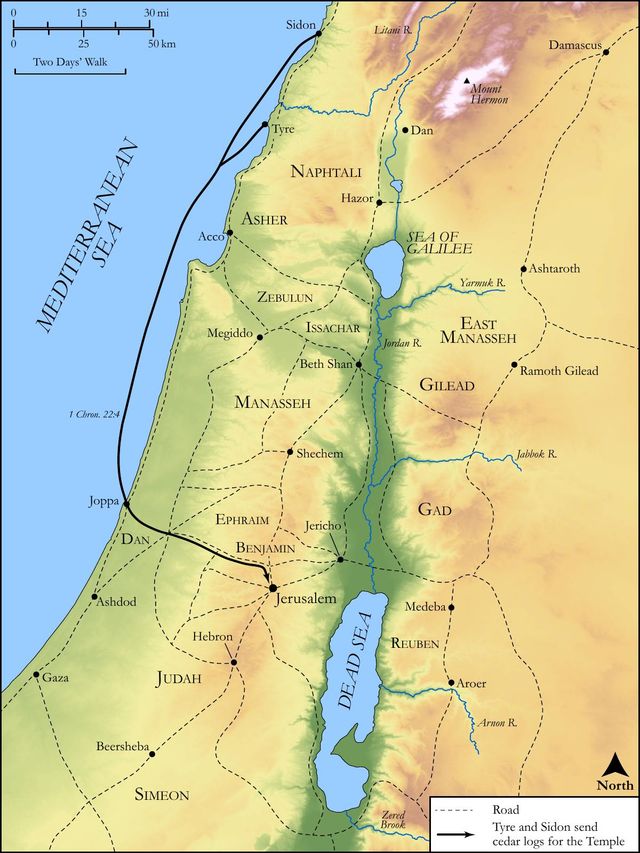
See on the biblical-era map
Study this verse
Public-domain commentary
Matthew Henry
From his Commentary on the Whole Bible. Henry comments on passages, not single verses — this entry covers 1 Chronicles 22:6–16. His two-level outline is real structure in the source text, so it is rendered as structure.
Though Solomon was young and tender, he was capable of receiving instructions, which his father accordingly gave him, concerning the work for which he was designed. When David came to the throne he had many things to do, for the foundations were all out of course; but Solomon had only one thing in charge, and that was to build a house for the Lord God of Israel, Ch1 22:6. Now,
I.David tells him why he did not do it himself.
It was in his mind to do it (Ch1 22:7), but God forbade him, because he had shed much blood, Ch1 22:8. Some think this refers to the blood of Uriah, which fastened such a reproach upon him as rendered him unworthy the honour of building the temple: but that honour was forbidden him before he had shed that blood; therefore it must be meant, as it is here explained, of the blood he shed in his wars (for he had been a man of war from his youth), which, though shed very justly and honourably in the service of God and Israel, yet made him unfit to be employed in this service, or rather less fit than another that had never been called to such bloody work. God, by assigning this as the reason of laying David aside from this work, showed how precious human life is to him, and intended a type of him who should build the gospel temple, not by destroying men's lives, but by saving them, Luk 9:56.
II.He gives him the reason why he imposed this task upon him.
1.Because God had designed him for it, nominated him as the man that should do it: A son shall be born to thee, that shall be called Solomon, and he shall build a house for my name, Ch1 22:9, Ch1 22:10. Nothing is more powerful to engage us to any service for God, and encourage us in it, than to know that hereunto we are appointed.
2.Because he would have leisure and opportunity to do it. He should be a man of rest, and therefore should not have his time, or thoughts, or wealth, diverted from this business. He should have rest from his enemies abroad (none of them should invade or threaten him, or give him provocation), and he should have peace and quietness at home; and therefore let him build the house. Note, Where God gives rest he expects work.
3.Because God had promised to establish his kingdom. Let this encourage him to honour God, that God had honour in store for him; let him build up God's house, and God will build up his throne. Note, God's gracious promises should quicken and invigorate our religious service.
III.He delivers him an account of the vast preparations he had made for this building (Ch1 22:14), not in a way of pride and vain glory (he speaks of it as a poor thing - I have, in my poverty, prepared, margin), but as an encouragement to Solomon to engage cheerfully in the work, for which so solid a foundation was laid. The treasure here mentioned of the 100,000 talents of gold, and 1,000,000 talents of silver, amounts to such an incredible sum that most interpreters either allow an error in the copy or think the talent here signifies no more than a plate or piece: ingots we call them. I am inclined to suppose that a certain number is here put for an uncertain, because it is said (Ch1 22:16) that of the gold and silver, as well as of the brass and iron, there was no number, and that David here includes all the dedicated things (Ch1 18:11) which he designed for the house of the Lord, that is, not only for the building of it, but for the treasure of it; and putting all together, it might come pretty near what is here spoken of. Hundreds and thousands are numbers which we often use to express that which is very much, when yet we would not be understood strictly.
IV.He charges them to keep God's commandments and to take heed to his duty in every thing, Ch1 22:13.
He must not think by building the temple to purchase a dispensation to sin; no, on the contrary, his doing that would not be accepted, nor accounted of, if he did not take heed to fulfil the statutes which the Lord charged Moses with, Ch1 22:13. Though he was to be king of Israel, he must always remember that he was a subject to the God of Israel.
V.He encourages him to go about this great work, and to go on in it (Ch1 22:13):
"Be strong, and of good courage, Though it is a vast undertaking, thou needest not fear coming under the reproach of the foolish builder, who began to build and was not able to finish it; it is God's work, and it shall come to perfection. Dread not, nor be dismayed." In our spiritual work, as well as in our spiritual warfare, we have need of courage and resolution.
VI.He quickens him not to rest in the preparations he had made, but to add thereto, Ch1 22:14.
Those that enter into the labours of others, and build upon their advantages, must still be improving.
VII.He prays for him:
The Lord give thee wisdom and understanding, and give thee charge concerning Israel, Ch1 22:12. Whatever charge we have, if we see God giving us the charge and calling us to it, we may hope he will give us wisdom for the discharge of it. Perhaps Solomon had an eye to this prayer of his father for him, in the prayer he offered for himself: Lord, give me a wise and understanding heart. He concludes (Ch1 22:16), Up, and be doing, and the Lord be with thee. Hope of God's presence must not slacken our endeavours. Though the Lord be with us, we must rise and be doing, and, if we do this, we have reason to believe he is and will be with us. Work out your salvation, and God will work in you.
Continue studying 1 Chronicles 22:14 across the web’s major study libraries — every link below opens this exact verse, chapter, or book on the destination site.
Read & Compare
 BibleGatewayThis verse in more than 200 translations and 70 languages.
 Bible.comThe YouVersion reader — hundreds of translations, reading plans, and highlights.
 ESV.orgCrossway's official English Standard Version reader.
 NET BibleThe NET translation with 60,000+ translators' notes on every rendering decision.
 STEP BibleTyndale House's free study tool — original text, vocabulary, and scholarly resources.
 BibliaLogos Bible Software's free web reader.
 USCCBThe New American Bible (Revised Edition) with the U.S. bishops' study notes.
Commentaries
 BibleHub CommentariesDozens of classic commentaries on this verse, gathered on one page.
 StudyLightMore than 100 commentary sets — the largest collection on the web.
 BibleRefPlain-English commentary on what this verse means, verse by verse.
 Enduring WordDavid Guzik's free commentary on this chapter, widely used by Bible teachers.
 Bible Study ToolsVerse commentary alongside Greek and Hebrew study aids.
Original Language & Research
- BibleHub InterlinearThe verse word by word — original language, transliteration, and English.
- BibleHub LexiconEvery word's original-language definition and Strong's entry.
 Blue Letter BibleDeep-study tools — Strong's numbers, concordance, and word studies.
 SefariaThe Hebrew text with Rashi and centuries of Jewish commentary.
Sermons, Hymns & Audio


TrulyRandomVerse is not affiliated with these sites and doesn’t control their content. They’re linked because they’re genuinely useful.
Summary
1 Chronicles 22:14 meticulously details King David's extraordinary and dedicated preparations for the construction of the Temple in Jerusalem. Despite being divinely prohibited from building the Temple himself due to his history as a man of war, David poured his heart, vast resources, and the accumulated wealth of his kingdom into gathering an unparalleled abundance of gold, silver, brass, iron, timber, and stone. This immense provision was meticulously prepared for his son, Solomon, who was divinely chosen to undertake the sacred and monumental task of erecting a permanent dwelling place for the Lord. The verse underscores David's unwavering devotion, strategic foresight, and profound generosity, even amidst personal and national challenges, setting the stage for one of the most significant architectural and spiritual undertakings in Israel's history.
Context
ShowHideLiterary Context
This verse is strategically positioned within David's final instructions and preparations for the Temple, a project of paramount spiritual and national significance for Israel. David had long harbored a deep desire to build a permanent dwelling place for the Ark of the Covenant and for God's presence, a desire first expressed in 2 Samuel 7. However, God, through the prophet Nathan, revealed that this honor would fall to his son, Solomon, a man of peace, because David had shed much blood in warfare (1 Chronicles 22:8). Undeterred and with remarkable humility and obedience, David dedicated the latter years of his reign to accumulating an unimaginable quantity of materials and organizing the workforce for the future Temple. The verses immediately preceding and following 1 Chronicles 22:14 detail David's charge to Solomon to "be strong and courageous" (1 Chronicles 22:13) and his command to the leaders of Israel to assist Solomon in the work (1 Chronicles 22:17-19). This entire chapter highlights David's exemplary stewardship and his unwavering commitment to God's kingdom, even when he could not personally complete the ultimate task.
Historical & Cultural Context
The construction of a central sanctuary was a pivotal undertaking in Israel, reflecting the power and devotion of the reigning monarch and the prosperity of the nation. For Israel, the Temple was not merely a grand edifice but the designated dwelling place for God's presence among His people, serving as the focal point of their worship, national identity, and covenant relationship with Yahweh. The quantities of precious metals and materials mentioned in 1 Chronicles 22:14—"an hundred thousand talents of gold, and a thousand thousand talents of silver"—represent an almost incomprehensible sum of wealth. A single talent was a massive unit of weight, approximately 75 pounds (about 34 kilograms) for gold and silver. This indicates that David amassed literally thousands of tons of these precious metals. Such immense wealth was likely accumulated through successful military campaigns, tribute from conquered nations, and rigorous taxation during David's prosperous reign. The phrase "in my trouble" (KJV) or "with great pains" (NIV) suggests that these preparations were made not in times of ease but amidst the challenges, burdens, and perhaps even personal afflictions of his reign, underscoring his deep personal sacrifice and unwavering devotion.
Key Themes
ShowHide1 Chronicles 22:14 powerfully illustrates several key themes. First, it exemplifies Unwavering Devotion and Generosity. David's commitment to preparing for the Temple, despite being unable to build it himself, showcases profound love and selfless devotion to God. His giving was not merely adequate but extravagant, reflecting a heart eager to honor the Lord with the very best. This act serves as a powerful biblical example of generosity from a willing heart. Second, it highlights Preparation for Future Generations. David's foresight and diligent work laid a crucial foundation for Solomon's success. He understood his role was to prepare the way, ensuring that the next generation could fulfill God's architectural and spiritual vision without impediment. This demonstrates wise stewardship and a commitment to intergenerational legacy, recognizing that God's work often transcends a single lifetime. Third, the sheer abundance of materials described illustrates God's Provision Through His People. The immense wealth accumulated underscores the magnitude of God's plan for His dwelling place among His people and how He works through the dedication and resources of His faithful servants. Finally, the phrase "in my trouble" emphasizes Faith Amidst Adversity. David's efforts were not made in times of ease but perhaps amidst personal or national difficulties, highlighting his steadfast faith and determination to prioritize God's house regardless of his personal circumstances, serving as an inspiration for perseverance and trust in God's overarching plan, as seen in his trust in the Lord.
Exposition and Analysis
ShowHideKey Word Analysis
ShowHideThis word (H6040), derived from the root ʿānâ, signifies depression, misery, or affliction. In the context of David's preparations, it suggests that his immense efforts were not undertaken casually or effortlessly, but rather involved significant personal exertion, sacrifice, and perhaps even distress or hardship. It underscores the depth of his commitment, implying that he prepared these vast resources not from a place of casual abundance but through diligent, strenuous, and perhaps even painful effort, highlighting the personal cost of his profound devotion to God's house.
This verb (H3559) means to be erect, to set up, establish, fix, or make ready. David's use of this word emphasizes the intentionality, thoroughness, and stability of his actions. He didn't merely gather materials; he meticulously "prepared" them, ensuring they were ready and suitable for the monumental task of building the Temple. This speaks to his foresight and his commitment to laying a firm and secure foundation for Solomon's future work, reflecting a divine ordering and establishment of resources.
A talent (H3603) was a very large unit of weight, not coinage, used for measuring precious metals. It literally means "a circle" or "round," referring to a round loaf or a large round coin/weight. As noted in the context, a single talent of gold or silver weighed approximately 75 pounds (34 kg). The mention of "an hundred thousand talents of gold" (7.5 million pounds or 3,400 metric tons) and "a thousand thousand talents of silver" (75 million pounds or 34,000 metric tons) indicates an almost unimaginable, unprecedented quantity of wealth. This hyperbole emphasizes the extraordinary scale of David's provision, far exceeding what might seem humanly possible, pointing to divine blessing and the unparalleled significance of the Temple.
Verse Breakdown
ShowHide"Now, behold, in my trouble I have prepared for the house of the LORD"
This opening clause immediately establishes David's personal, arduous, and intentional involvement in the Temple preparations. The phrase "in my trouble" emphasizes the cost and effort, indicating that his commitment was not superficial but deeply rooted in personal sacrifice and perseverance. It highlights his unwavering devotion to God's dwelling place, even when facing personal or national challenges, demonstrating a heart singularly focused on God's glory.
"an hundred thousand talents of gold, and a thousand thousand talents of silver; and of brass and iron without weight; for it is in abundance"
This segment details the staggering scale of the material provision. The specific, immense numbers for gold and silver, combined with the qualitative description "without weight" for brass and iron, convey an overwhelming, almost immeasurable quantity of resources. The concluding phrase "for it is in abundance" serves as an emphatic summary, reinforcing the unprecedented generosity and the sheer magnitude of the materials amassed, demonstrating David's desire to give God nothing less than the absolute best for His sacred dwelling.
"timber also and stone have I prepared; and thou mayest add thereto."
This final clause completes the inventory of essential building materials, ensuring that the fundamental components for construction were also abundantly supplied. The concluding instruction, "and thou mayest add thereto," is profoundly significant. It reveals David's humility and wisdom, acknowledging that while he had prepared immensely, Solomon, as the divinely appointed builder, would still have the opportunity and responsibility to contribute, complete, and even augment the work. This emphasizes continuity, collaboration, and the ongoing, generational nature of God's work, where each generation builds upon the faithfulness of the last.
Literary Devices
ShowHideThe verse employs several powerful literary devices to convey its message of immense provision and devotion. Hyperbole is prominently used in the description of the materials, particularly "an hundred thousand talents of gold, and a thousand thousand talents of silver" and "brass and iron without weight." These exaggerated quantities are not meant to be taken as precise literal figures but rather to emphasize the extraordinary, almost limitless scale of David's preparations and the immense value placed on the Temple, making the provision seem awe-inspiring and overwhelming. Symbolism is also at play; the vast quantities of precious metals and materials symbolize not only David's personal devotion and the nation's prosperity but also the intended glory, magnificence, and enduring nature of God's dwelling place among His people. The sheer abundance underscores the limitless nature of God's own provision and the honor due to Him. Furthermore, the verse functions as a form of Anticipation or Foreshadowing, as David's meticulous preparations set the stage for Solomon's successful construction of the Temple, building expectation for the fulfillment of God's architectural and spiritual vision through the next generation.
Theological and Thematic Connections
ShowHide1 Chronicles 22:14 stands as a profound testament to the principles of stewardship, selfless devotion, and intergenerational faithfulness within God's kingdom. David's meticulous and extravagant preparation for a project he would not personally complete exemplifies a deep understanding that God's work transcends individual lifetimes and personal recognition. His willingness to pour immense resources and effort into a future endeavor, even "in his trouble," underscores a faith that prioritizes God's glory above all else, demonstrating that true worship often involves costly sacrifice and diligent foresight. This act of preparation is not merely about accumulating wealth but about channeling it for sacred purposes, reflecting a heart aligned with God's desire for a dwelling place among His people. It teaches us that our contributions, whether material, spiritual, or temporal, are vital in advancing God's purposes, even if we do not see the final fruition of our efforts, trusting that God will bring His plans to completion through successive generations.
Reflection and Application
ShowHideDavid's example in 1 Chronicles 22:14 offers timeless and profound lessons for believers today. It challenges us to consider our own posture towards God's work, urging us to prepare diligently and generously for His purposes, even if we are not the ones who will see its final completion or receive direct credit. Our contributions—whether material resources, time, talents, or fervent prayers—play a vital role in the larger, unfolding plan of God's kingdom. David's "preparation in trouble" reminds us that our commitment to God's purposes should remain unwavering, even amidst personal difficulties, financial constraints, or societal challenges. It calls us to cultivate a spirit of perseverance and faith, trusting that God will use our efforts for His glory, regardless of our present circumstances. Furthermore, this verse highlights the profound importance of laying a strong foundation for future generations, enabling them to build upon our efforts for the glory of God. It compels us to consider our own legacy of faith, generosity, and stewardship, asking how we are equipping those who come after us to continue the divine work, ensuring that the spiritual inheritance is richer for their sake.
Questions for Reflection
ShowHideFAQ
ShowHideHow much wealth did David actually prepare, and is it a realistic amount?
ShowHideThe amounts mentioned in 1 Chronicles 22:14—100,000 talents of gold and 1,000,000 talents of silver—represent an almost unimaginable sum. Given that one talent is approximately 75 pounds (34 kg), this equates to about 7.5 million pounds (3,400 metric tons) of gold and 75 million pounds (34,000 metric tons) of silver. In modern valuation, this would be many billions, possibly trillions, of U.S. dollars. While the numbers are staggering and some scholars suggest they might be hyperbolic to emphasize the Temple's grandeur, they are not entirely outside the realm of possibility for a king who had successfully conquered many nations, received vast tribute, and amassed immense wealth during a prosperous reign, as described in 1 Chronicles 18-20. The phrase "without weight" for brass and iron further emphasizes an immeasurable abundance, underscoring the unprecedented scale of David's provision, reflecting both divine blessing and human dedication to God's house.
Why was David forbidden from building the Temple, and what is the significance of this?
ShowHideGod explicitly forbade David from building the Temple because David was a "man of war" and had "shed much blood" (1 Chronicles 22:8; 1 Kings 5:3). Instead, God designated David's son, Solomon, to build the Temple, emphasizing that Solomon would be a "man of rest" and that God would grant him peace from all his enemies (1 Chronicles 22:9). The significance of this prohibition lies in the symbolic nature of the Temple as a place of peace, holiness, and God's dwelling. A house built for the Lord was to be constructed by a man whose hands were not stained with the violence of war, reflecting the purity and peace associated with God's presence. This also highlights God's sovereign choice and the importance of His specific timing and appointed instruments for His work, demonstrating that God's plans unfold according to His perfect wisdom.
What is the significance of "without weight" for brass and iron in this context?
ShowHideThe phrase "without weight" (Hebrew, ʾên mišqāl, H4948) for brass and iron signifies that the quantity of these materials was so immense that it was beyond practical measurement by standard units of weight like talents. It conveys an overwhelming, immeasurable abundance, suggesting that the supply was virtually limitless. This detail underscores the unparalleled scale of David's provisions for the Temple, indicating that no expense or effort was spared in ensuring that every necessary material was available in superabundant quantities. It highlights the extraordinary generosity and thoroughness of David's preparation, emphasizing the sheer magnitude and glory intended for God's house, a testament to David's devotion and the nation's prosperity under God's blessing.
Christ-Centered Fulfillment
ShowHideDavid's zealous and sacrificial preparation for the physical Temple in Jerusalem, as described in 1 Chronicles 22:14, finds its ultimate Christ-centered fulfillment in profound ways. While David meticulously gathered materials for a dwelling place made with human hands, Jesus Christ is the true and ultimate Temple, the very dwelling place of God among humanity (John 2:19-21; Colossians 2:9). David's immense personal sacrifice and the vast wealth he prepared foreshadow the infinitely greater, immeasurable sacrifice of Christ, who, though rich, became poor for our sakes, that we through His poverty might become rich (2 Corinthians 8:9; Philippians 2:5-8). David laid a foundational abundance for Solomon to build a physical structure; Christ, as the chief cornerstone, is the foundation upon which God is building a spiritual Temple—His Church, composed of living stones (Ephesians 2:20-22; 1 Peter 2:4-5). David's provision for a physical dwelling points to Christ's completed work, which enables the Holy Spirit to dwell not in a building, but within believers, making them temples of God (1 Corinthians 3:16). Thus, David's earthly preparations, though magnificent, ultimately point to the surpassing glory of Christ's person and His redemptive work in establishing God's eternal dwelling place within humanity, a spiritual reality that far exceeds any physical structure.