


1 Chronicles 22:8
Bible text: King James Version (1769 Blayney text) · Public domain
Bible text: King James Version with Strong's numbers · Public domain
Bible text: Berean Standard Bible · Public domain
Bible text: American Standard Version (1901) · Public domain
Bible text: World English Bible, Messianic edition · Public domain
Bible text: Geneva Bible (1599) · Public domain
Bible text: Young's Literal Translation · Public domain
- וַיְהִיvay·Hiand it cameH1961Conj-w ¦ V-Qal-ConsecImperf-3msVerb Qal Consecutive Imperfect 3rd Singular Masculineוַandיְהִיit came
- עָלַי'a·Laito meH5921Prep ¦ 1csPrepositionעָלַtoיme
- דְּבַרde·var[the] word ofH1697N-mscNoun Singular Masculine Construct
- יְהוָהYah·wehYahwehH3068N-properNoun Proper Title
- לֵאמֹרle·Mor<to> sayingH559Prep-l ¦ V-Qal-InfVerb Qal Infinitive Constructלֵ<to>אמֹרsaying
- דָּםdambloodH1818N-msNoun Singular Masculine Absolute
- לָרֹבla·Roto abundanceH7230Prep-l ¦ N-msNoun Singular Masculine Absoluteלָtoרֹבabundance
- שָׁפַכְתָּsha·Fakh·tayou have shedH8210V-Qal-Perf-2msVerb Qal Perfect 2nd Singular Masculine
- וּמִלְחָמוֹתu·mil·cha·Motand warsH4421Conj-w ¦ N-fpNoun Plural Feminine Absoluteוּandמִלְחָמוֹתwars
- גְּדֹלוֹתge·do·LotgreatH1419Adj-fpAdjective Plural Feminine Absolute
- עָשִׂיתָ'a·Si·tayou have madeH6213V-Qal-Perf-2msVerb Qal Perfect 2nd Singular Masculine
- לֹאlo'notH3808NegParticle Negative
- תִבְנֶהtiv·Nehyou will buildH1129V-Qal-Imperf-2msVerb Qal Imperfect 2nd Singular Masculine
- בַיִתva·yita houseH1004N-msNoun Singular Masculine Absolute
- לִשְׁמִיlish·Mifor my nameH8034Prep-l ¦ N-msc ¦ 1csNoun Singular Masculine Constructלִforשְׁמִnameיmy
- כִּיkiforH3588PrtParticle Conditional
- דָּמִיםda·Mimblood<s>H1818N-mpNoun Plural Masculine Absolute
- רַבִּיםra·BimmuchH7227Adj-mpAdjective Plural Masculine Absolute
- שָׁפַכְתָּsha·Fakh·tayou have shedH8210V-Qal-Perf-2msVerb Qal Perfect 2nd Singular Masculine
- אַרְצָה'Ar·tzah[the] ground towardsH776N-fs ¦ SfxNoun Singular Feminine Absoluteאַרְצָ[the] groundהtowards
- לְפָנָיle·fa·Nai<to> before meH6440Prep-l ¦ N-mpc ¦ 1csNoun Plural Masculine Constructלְ<to>פָנָbeforeיme
English is a literal word-by-word gloss of the Hebrew, not the KJV's wording. Why?
This is the original text the KJV's translators worked from — each Hebrew word with its own literal English meaning in this verse, prepared by scholars at Tyndale House, Cambridge. The KJV translates whole sentences, not word by word, so its wording differs: one Hebrew word can become several English words, and the KJV may choose “the LORD” where the gloss reads “Yahweh”. Both are faithful — they answer different questions. For the KJV's own rendering, switch to the KJV text.
Details
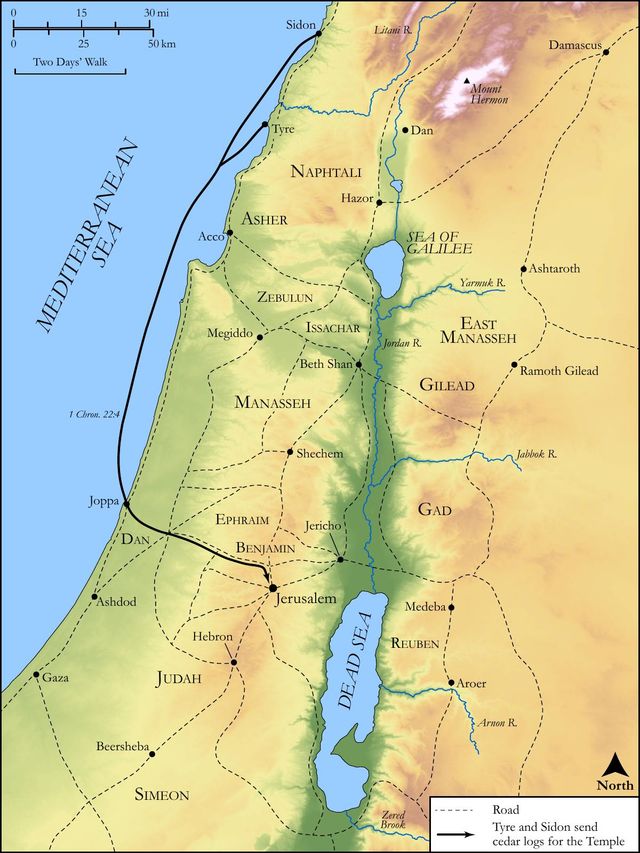
See on the biblical-era map
Study this verse
Public-domain commentary
Matthew Henry
From his Commentary on the Whole Bible. Henry comments on passages, not single verses — this entry covers 1 Chronicles 22:6–16. His two-level outline is real structure in the source text, so it is rendered as structure.
Though Solomon was young and tender, he was capable of receiving instructions, which his father accordingly gave him, concerning the work for which he was designed. When David came to the throne he had many things to do, for the foundations were all out of course; but Solomon had only one thing in charge, and that was to build a house for the Lord God of Israel, Ch1 22:6. Now,
I.David tells him why he did not do it himself.
It was in his mind to do it (Ch1 22:7), but God forbade him, because he had shed much blood, Ch1 22:8. Some think this refers to the blood of Uriah, which fastened such a reproach upon him as rendered him unworthy the honour of building the temple: but that honour was forbidden him before he had shed that blood; therefore it must be meant, as it is here explained, of the blood he shed in his wars (for he had been a man of war from his youth), which, though shed very justly and honourably in the service of God and Israel, yet made him unfit to be employed in this service, or rather less fit than another that had never been called to such bloody work. God, by assigning this as the reason of laying David aside from this work, showed how precious human life is to him, and intended a type of him who should build the gospel temple, not by destroying men's lives, but by saving them, Luk 9:56.
II.He gives him the reason why he imposed this task upon him.
1.Because God had designed him for it, nominated him as the man that should do it: A son shall be born to thee, that shall be called Solomon, and he shall build a house for my name, Ch1 22:9, Ch1 22:10. Nothing is more powerful to engage us to any service for God, and encourage us in it, than to know that hereunto we are appointed.
2.Because he would have leisure and opportunity to do it. He should be a man of rest, and therefore should not have his time, or thoughts, or wealth, diverted from this business. He should have rest from his enemies abroad (none of them should invade or threaten him, or give him provocation), and he should have peace and quietness at home; and therefore let him build the house. Note, Where God gives rest he expects work.
3.Because God had promised to establish his kingdom. Let this encourage him to honour God, that God had honour in store for him; let him build up God's house, and God will build up his throne. Note, God's gracious promises should quicken and invigorate our religious service.
III.He delivers him an account of the vast preparations he had made for this building (Ch1 22:14), not in a way of pride and vain glory (he speaks of it as a poor thing - I have, in my poverty, prepared, margin), but as an encouragement to Solomon to engage cheerfully in the work, for which so solid a foundation was laid. The treasure here mentioned of the 100,000 talents of gold, and 1,000,000 talents of silver, amounts to such an incredible sum that most interpreters either allow an error in the copy or think the talent here signifies no more than a plate or piece: ingots we call them. I am inclined to suppose that a certain number is here put for an uncertain, because it is said (Ch1 22:16) that of the gold and silver, as well as of the brass and iron, there was no number, and that David here includes all the dedicated things (Ch1 18:11) which he designed for the house of the Lord, that is, not only for the building of it, but for the treasure of it; and putting all together, it might come pretty near what is here spoken of. Hundreds and thousands are numbers which we often use to express that which is very much, when yet we would not be understood strictly.
IV.He charges them to keep God's commandments and to take heed to his duty in every thing, Ch1 22:13.
He must not think by building the temple to purchase a dispensation to sin; no, on the contrary, his doing that would not be accepted, nor accounted of, if he did not take heed to fulfil the statutes which the Lord charged Moses with, Ch1 22:13. Though he was to be king of Israel, he must always remember that he was a subject to the God of Israel.
V.He encourages him to go about this great work, and to go on in it (Ch1 22:13):
"Be strong, and of good courage, Though it is a vast undertaking, thou needest not fear coming under the reproach of the foolish builder, who began to build and was not able to finish it; it is God's work, and it shall come to perfection. Dread not, nor be dismayed." In our spiritual work, as well as in our spiritual warfare, we have need of courage and resolution.
VI.He quickens him not to rest in the preparations he had made, but to add thereto, Ch1 22:14.
Those that enter into the labours of others, and build upon their advantages, must still be improving.
VII.He prays for him:
The Lord give thee wisdom and understanding, and give thee charge concerning Israel, Ch1 22:12. Whatever charge we have, if we see God giving us the charge and calling us to it, we may hope he will give us wisdom for the discharge of it. Perhaps Solomon had an eye to this prayer of his father for him, in the prayer he offered for himself: Lord, give me a wise and understanding heart. He concludes (Ch1 22:16), Up, and be doing, and the Lord be with thee. Hope of God's presence must not slacken our endeavours. Though the Lord be with us, we must rise and be doing, and, if we do this, we have reason to believe he is and will be with us. Work out your salvation, and God will work in you.
Historical interpretation
Two Centuries of Reception
2 surviving comments on this verse. Each one is dated, so this reads as a timeline rather than a list.
Select a marker to jump to its quote. Markers stagger vertically where authors wrote within a few decades of each other.
As a man of blood, David was prevented from constructing it; he seems, at least, to have been occupied concerning the gathering of the material of the temple.
Because he was a man of blood—the reference is not, as some think, to his wars, but to the murder [of Uriah]—he was not permitted to build a temple of the Lord.
Continue studying 1 Chronicles 22:8 across the web’s major study libraries — every link below opens this exact verse, chapter, or book on the destination site.
Read & Compare
 BibleGatewayThis verse in more than 200 translations and 70 languages.
 Bible.comThe YouVersion reader — hundreds of translations, reading plans, and highlights.
 ESV.orgCrossway's official English Standard Version reader.
 NET BibleThe NET translation with 60,000+ translators' notes on every rendering decision.
 STEP BibleTyndale House's free study tool — original text, vocabulary, and scholarly resources.
 BibliaLogos Bible Software's free web reader.
 USCCBThe New American Bible (Revised Edition) with the U.S. bishops' study notes.
Commentaries
 BibleHub CommentariesDozens of classic commentaries on this verse, gathered on one page.
 StudyLightMore than 100 commentary sets — the largest collection on the web.
 BibleRefPlain-English commentary on what this verse means, verse by verse.
 Enduring WordDavid Guzik's free commentary on this chapter, widely used by Bible teachers.
 Bible Study ToolsVerse commentary alongside Greek and Hebrew study aids.
Original Language & Research
- BibleHub InterlinearThe verse word by word — original language, transliteration, and English.
- BibleHub LexiconEvery word's original-language definition and Strong's entry.
 Blue Letter BibleDeep-study tools — Strong's numbers, concordance, and word studies.
 SefariaThe Hebrew text with Rashi and centuries of Jewish commentary.
Sermons, Hymns & Audio


TrulyRandomVerse is not affiliated with these sites and doesn’t control their content. They’re linked because they’re genuinely useful.
Summary
1 Chronicles 22:8 records the divine revelation to King David, explaining why he was divinely prohibited from building the Temple for the Lord's name, despite his earnest desire. God explicitly declared that David's extensive involvement in warfare and the abundant shedding of blood rendered him unsuitable for constructing a sanctuary intended to symbolize divine peace, holiness, and the enduring presence of God among His people. This pivotal moment underscores God's sovereign selection of instruments and His meticulous plan for the dwelling place of His presence, emphasizing the symbolic purity required for such a sacred task.
Context
ShowHideLiterary Context
This verse is situated within David's final, poignant instructions and charge to his son, Solomon, regarding the monumental task of constructing the Temple in Jerusalem. David has already diligently prepared for this endeavor, amassing immense quantities of materials and resources, as detailed in 1 Chronicles 22:2-5. Following this preparation, David formally commissions Solomon for the sacred task in 1 Chronicles 22:6. The preceding verses (1 Chronicles 22:6-7) highlight David's deep-seated desire to build the Temple himself, a longing first expressed much earlier in his reign, as recounted in 2 Samuel 7:2. However, God, through the prophet Nathan, had previously revealed that David would not be the builder, but rather his son would complete the task (1 Chronicles 17:11-12). Here, in 1 Chronicles 22:8, David articulates the specific, divinely revealed reason for this prohibition, providing a personal and authoritative explanation to Solomon that reinforces the divine mandate and the continuity of God's plan.
Historical & Cultural Context
King David's reign, spanning approximately 1010-970 BC, was a foundational period for the nascent Israelite kingdom. It was an era defined by intense military expansion, strategic consolidation, and the establishment of Jerusalem as both the political and religious capital. David successfully subdued surrounding nations, secured Israel's borders, and brought the Ark of the Covenant to Jerusalem, marking a significant step towards centralizing Israelite worship. While these military campaigns were often divinely sanctioned and crucial for establishing the security and extent of God's people, they were inherently characterized by warfare and the shedding of blood. Culturally, the Temple was envisioned as the singular, central dwelling place for Yahweh, a sacred space demanding ritual purity and symbolic separation from the violence and impurity of the world. In ancient Israelite thought, the shedding of blood, even in justified warfare, carried a certain weight of ritual impurity or separation from the realm of ultimate peace and holiness. Thus, the builder of such a profoundly sacred edifice was expected to embody a character and a context aligned with the sanctuary's ultimate purpose of divine peace and unblemished presence.
Key Themes
ShowHideThis verse profoundly contributes to several overarching themes within 1 Chronicles and the broader biblical narrative. Firstly, it illuminates the theme of Divine Purity and Holiness, emphasizing that God's dwelling place must be utterly set apart, symbolizing His character, which is ultimately one of perfect peace, order, and life, not chaos, conflict, or death. The Temple, as a physical manifestation of God's presence, needed to reflect this intrinsic purity. Secondly, the verse underscores The Nature of the Builder, revealing God's meticulous and sovereign selection of individuals for specific tasks within His redemptive plan. David, the "man of war," was God's chosen instrument for establishing the kingdom through necessary conflict. However, Solomon, whose Hebrew name (Shlomo) is derived from shalom, meaning "peace," was divinely appointed to build the Temple during a period of relative tranquility and prosperity, as evidenced in 1 Kings 5:4. This divine choice powerfully illustrates that God's instruments are precisely tailored to His specific purposes, ensuring that the message conveyed by the builder's life and context aligns perfectly with the spiritual essence of the project. Finally, 1 Chronicles 22:8 powerfully demonstrates God's Sovereignty and Unfolding Plan, showing that despite David's righteous desire and fervent preparations, God's ultimate will, timing, and specific criteria prevailed. This confirms God's absolute authority over human endeavors and His perfect wisdom in orchestrating the details of His kingdom.
Exposition and Analysis
ShowHideKey Word Analysis
ShowHideThis term (H1697) signifies not merely spoken sounds but carries profound weight, encompassing a matter, thing, affair, or divine decree. Here, "the word of the LORD" emphasizes the divine origin and authoritative nature of the prohibition. It is a direct, revealed communication from God, not a human opinion or a practical suggestion, underscoring God's active involvement in the details of His covenant people's lives and His sovereign control over the Temple's construction.
Appearing twice in the verse (H1818), this word refers to the vital fluid, the very essence of life, particularly when shed, leading to death. Its repetition ("shed blood abundantly," "shed much blood") powerfully emphasizes the sheer volume and pervasive impact of David's military campaigns. In the broader biblical context, blood is intrinsically linked to life, sacrifice, and atonement, but here it is presented as a symbolic disqualifying factor for building God's sanctuary, highlighting the stark contrast between the violence of warfare and the peace and purity inherently associated with the Temple.
This word (H1004) refers to a physical structure, specifically the Temple, which was to serve as the central focal point for Israelite worship and a tangible symbol of God's presence among His people. The phrase "an house unto my name" signifies that the Temple was to be consecrated entirely to God's honor, reputation, and unique identity (H8034, shêm). It was not merely a building but a sacred space where God's character and covenant faithfulness were invoked, honored, and made manifest.
Verse Breakdown
ShowHide"But the word of the LORD came to me, saying"
This opening clause immediately establishes the divine origin and absolute authority of the subsequent prohibition. David is not expressing a personal preference or an arbitrary decision; rather, he is relaying a direct, unambiguous revelation from Yahweh. This highlights God's active and sovereign involvement in the details of His people's lives and His ultimate control over the sacred project of the Temple's construction.
"Thou hast shed blood abundantly, and hast made great wars"
This is God's factual and direct assessment of David's extensive reign. It acknowledges David's long and successful military career, which, while often divinely sanctioned and necessary for the establishment and protection of the nascent kingdom of Israel, inevitably resulted in significant loss of life. The terms "abundantly" (H7230, rôb) and "great wars" (H1419, gâdôwl and H4421, milchâmâh) underscore the sheer magnitude and pervasive nature of David's involvement in conflict and bloodshed.
"thou shalt not build an house unto my name"
This is the explicit and unequivocal divine prohibition. Despite David's commendable desire, his fervent preparations, and his righteous heart, God directly forbids him from constructing the Temple. The phrase "an house unto my name" (H1004, bayith and H8034, shêm) reiterates the sacred purpose and profound theological significance of the structure, emphasizing the high standard of symbolic purity and divine alignment God requires for its builder.
"because thou hast shed much blood upon the earth in my sight"
This final clause provides the precise and non-negotiable reason for the prohibition. It is not an indictment of David's character as inherently sinful, nor a condemnation of his wars as unrighteous (as many were divinely commanded). Instead, it functions as a symbolic disqualification based on the sheer volume of bloodshed associated with his reign. The Temple, as a paramount symbol of peace, purity, and God's holy presence, required a builder whose hands were not so extensively marked by the violence of war, even if that violence was justified. God's "sight" (H6440, pânîym) implies His perfect knowledge, moral discernment, and ultimate judgment regarding the symbolic fitness for such a sacred task.
Literary Devices
ShowHideThe verse employs several impactful literary devices that enhance its theological weight and communicative power. Repetition is prominently featured with the phrase "shed blood abundantly" and "shed much blood," which serves to underscore the primary, divinely stated reason for the prohibition. This repetition emphasizes the sheer volume and pervasive nature of warfare during David's reign, creating a sense of gravitas and finality regarding God's decision. Divine Fiat is powerfully evident in the direct declaration from the Lord ("But the word of the LORD came to me, saying... thou shalt not build"), highlighting God's absolute sovereignty and the unchallengeable nature of His decree. Furthermore, there is a profound element of Symbolism, where the "house unto my name" represents not merely a physical structure but God's holy, peaceful presence, contrasting sharply with the "shed blood" that characterized David's reign. This contrast between David's military achievements and the peaceful nature required for the Temple's builder creates a powerful Juxtaposition, underscoring the distinct roles God assigns to different individuals in His overarching redemptive plan. The verse also implicitly uses Metonymy, where "shed blood" stands for the entire activity and consequence of warfare.
Theological and Thematic Connections
ShowHideThis verse profoundly illustrates God's meticulous care for the symbolic integrity of His dwelling place and the character of those whom He chooses to serve in His kingdom. It is crucial to understand that this prohibition was not an indictment of David's righteousness or a condemnation of his wars as sinful; indeed, David was a "man after God's own heart," and his military campaigns were often divinely sanctioned for the establishment and defense of Israel. Rather, the verse speaks to a deeper theological principle: the Temple, as a physical representation of God's holy presence and a sacred space of peace, reconciliation, and worship, required a builder whose hands were not so intimately associated with bloodshed, even if that bloodshed was righteous in warfare. This emphasizes God's intrinsic desire for purity, peace, and order in His sanctuary, foreshadowing the ultimate peace and reconciliation that would come through the Messiah. It also powerfully highlights God's sovereign choice of instruments, demonstrating that different individuals are uniquely prepared, gifted, and called for distinct phases and purposes within His grand redemptive plan, ensuring that the message of the builder aligns with the essence of the divine project.
Reflection and Application
ShowHide1 Chronicles 22:8 offers profound and enduring lessons for believers today, challenging our assumptions about divine service and personal calling. It reminds us that even our most noble, fervent, and divinely inspired desires must ultimately align with God's specific will, timing, and unique criteria for execution. David's passionate desire to build the Temple was undeniably commendable, born of a pure heart and deep devotion, yet God had a different, more fitting plan for its actual construction. This teaches us vital lessons in humility, submission to God's sovereign design, and the wisdom to recognize that our "good intentions" do not automatically equate to God's "perfect will" for our lives or specific tasks. Furthermore, the verse highlights that God meticulously prepares individuals for distinct purposes and seasons. David was called to establish and secure the kingdom through necessary conflict, while Solomon was called to consolidate it through a reign characterized by peace and wisdom. This encourages us to discern our unique gifts, embrace our specific calling, and faithfully steward the particular role God has prepared for us, understanding that not every task is for every person, and each role, when divinely appointed, contributes to the greater whole of God's kingdom. Finally, the emphasis on peace as a prerequisite for the Temple's builder underscores God's ultimate desire for harmony, shalom, and unblemished holiness in His presence and among His people, challenging us, as followers of Christ, to actively be agents of peace, reconciliation, and purity in a world often marked by conflict and brokenness.
Questions for Reflection
ShowHideFAQ
ShowHideWas David considered unrighteous or sinful for shedding blood in warfare?
ShowHideNo, David was absolutely not considered unrighteous or sinful for shedding blood in the context of his wars. Many of David's military campaigns were divinely commanded, sanctioned, or even led by God Himself for the establishment, defense, and expansion of Israel's kingdom, as clearly seen in passages like 2 Samuel 5:17-25. The prohibition in 1 Chronicles 22:8 was not a condemnation of David's character, his obedience, or his actions as inherently sinful. Rather, it was a symbolic distinction rooted in the nature of the Temple itself. The Temple was to be a place of ultimate peace, holiness, and divine presence, and its builder needed to reflect that symbolic purity. David, as the great warrior king, was God's chosen instrument for securing the nation and establishing its borders. However, the sacred task of building God's peaceful dwelling was reserved for his son, Solomon, whose reign was characterized by widespread peace. It was a matter of divine symbolism, purpose, and the appropriate alignment of the builder's context with the sanctuary's spiritual essence, not a judgment of David's personal sinfulness.
Why was Solomon chosen to build the Temple instead of David?
ShowHideSolomon was chosen to build the Temple primarily because his reign was characterized by an era of profound peace, a quality that symbolically and practically aligned perfectly with the nature of the Temple as a dwelling place for God's holy and peaceful presence. His very name, "Solomon" (Hebrew: Shlomo), is derived from the Hebrew word shalom, meaning "peace" or "completeness." While David was the "man of war" who established the kingdom through necessary conquest and conflict, Solomon was the "man of peace" who consolidated the kingdom and ushered in a period of unprecedented tranquility and prosperity. God explicitly stated that David had shed "much blood," making him symbolically unsuitable for the task of constructing a sanctuary dedicated to peace (1 Chronicles 22:8). In stark contrast, 1 Kings 5:4 records Solomon's own testimony: "the LORD my God has given me rest on every side; there is neither adversary nor misfortune." This divinely granted peace allowed Solomon to dedicate his resources, focus, and energy entirely on the Temple's construction, fulfilling God's specific plan for His sacred sanctuary without the distractions of war.
Christ-Centered Fulfillment
ShowHideThe narrative of King David's divine prohibition from building the Temple due to his shedding of blood finds its profound and ultimate Christ-centered fulfillment in Jesus, the promised "Prince of Peace" (Isaiah 9:6). Unlike David, whose hands were stained by the necessary violence of establishing an earthly kingdom through military conquest, Jesus inaugurates a spiritual kingdom not by earthly warfare or the shedding of others' blood, but by sacrificial love and the voluntary shedding of His own precious blood. It is this blood, shed on the cross, that brings ultimate atonement, reconciliation, and peace between God and humanity (Colossians 1:20). Jesus, the spotless "Lamb of God, who takes away the sin of the world!" (John 1:29), is the one whose blood cleanses and purifies, enabling direct access to God's holy presence. He is the true and perfect builder of God's spiritual house, the Church, a living temple composed of all believers (Ephesians 2:19-22 and 1 Peter 2:5). This spiritual edifice is not built by human hands, nor through earthly conflict or violence, but by the transformative power of the Holy Spirit, through Christ's perfect and once-for-all sacrifice, establishing a kingdom characterized by righteousness, peace, and joy in the Holy Spirit (Romans 14:17). Thus, what was symbolically foreshadowed in Solomon's peaceful construction of the physical Temple is fully and eternally realized in Christ, who builds an eternal, spiritual dwelling where true peace with God and among His people reigns supreme.