


1 Chronicles 22:12
Bible text: King James Version (1769 Blayney text) · Public domain
Bible text: Berean Standard Bible · Public domain
Bible text: American Standard Version (1901) · Public domain
Bible text: World English Bible, Messianic edition · Public domain
Bible text: Geneva Bible (1599) · Public domain
Bible text: Young's Literal Translation · Public domain
- אַךְ'akhonlyH389AdvAdverb
- יִתֶּןyi·tenmay he giveH5414V-Qal-Imperf-3msVerb Qal Imperfect 3rd Singular Masculine
- לְּךָle·Khato youPrep-l ¦ 2msSuffix Personal 2nd Singular Masculineלְּtoךָyou
- יְהוָהYah·wehYahwehH3068N-properNoun Proper Title
- שֵׂכֶלSe·khelinsightH7922N-msNoun Singular Masculine Absolute
- וּבִינָהu·vi·Nahand understandingH998Conj-w ¦ N-fsNoun Singular Feminine Absoluteוּandבִינָהunderstanding
- וִיצַוְּךָvi·tza·ve·Khaand he will appoint youH6680Conj-w ¦ V-Piel-ConjImperf-3ms ¦ 2msVerb Piel Conjunction+Imperfect 3rd Singular Masculineוִandיצַוְּhe will appointךָyou
- עַל'aloverH5921PrepPreposition
- יִשְׂרָאֵלYis·ra·'ElIsraelH3478N-properNoun Proper Location
- וְלִשְׁמוֹרve·lish·Morand to keepH8104Conj-w ¦ Prep-l ¦ V-Qal-InfVerb Qal Infinitive Constructוְandלִtoשְׁמוֹרkeep
- אֶת'et<obj.>H853DirObjMParticle Object Indicator
- תּוֹרַתto·Rat[the] law ofH8451N-fscNoun Singular Feminine Construct
- יְהוָהYah·wehYahwehH3068N-properNoun Proper Title
- אֱלֹהֶיךָ'e·lo·Hei·khayour GodH430N-mpc ¦ 2msNoun Plural Masculine ConstructאֱלֹהֶיGodךָyour
English is a literal word-by-word gloss of the Hebrew, not the KJV's wording. Why?
This is the original text the KJV's translators worked from — each Hebrew word with its own literal English meaning in this verse, prepared by scholars at Tyndale House, Cambridge. The KJV translates whole sentences, not word by word, so its wording differs: one Hebrew word can become several English words, and the KJV may choose “the LORD” where the gloss reads “Yahweh”. Both are faithful — they answer different questions. For the KJV's own rendering, switch to the KJV text.
Details
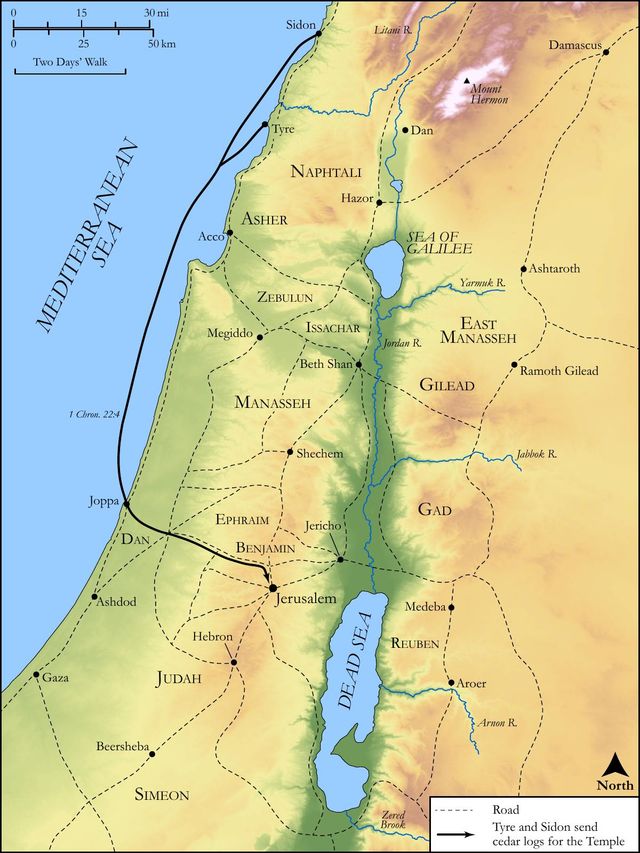
See on the biblical-era map
Study this verse
Public-domain commentary
Matthew Henry
From his Commentary on the Whole Bible. Henry comments on passages, not single verses — this entry covers 1 Chronicles 22:6–16. His two-level outline is real structure in the source text, so it is rendered as structure.
Though Solomon was young and tender, he was capable of receiving instructions, which his father accordingly gave him, concerning the work for which he was designed. When David came to the throne he had many things to do, for the foundations were all out of course; but Solomon had only one thing in charge, and that was to build a house for the Lord God of Israel, Ch1 22:6. Now,
I.David tells him why he did not do it himself.
It was in his mind to do it (Ch1 22:7), but God forbade him, because he had shed much blood, Ch1 22:8. Some think this refers to the blood of Uriah, which fastened such a reproach upon him as rendered him unworthy the honour of building the temple: but that honour was forbidden him before he had shed that blood; therefore it must be meant, as it is here explained, of the blood he shed in his wars (for he had been a man of war from his youth), which, though shed very justly and honourably in the service of God and Israel, yet made him unfit to be employed in this service, or rather less fit than another that had never been called to such bloody work. God, by assigning this as the reason of laying David aside from this work, showed how precious human life is to him, and intended a type of him who should build the gospel temple, not by destroying men's lives, but by saving them, Luk 9:56.
II.He gives him the reason why he imposed this task upon him.
1.Because God had designed him for it, nominated him as the man that should do it: A son shall be born to thee, that shall be called Solomon, and he shall build a house for my name, Ch1 22:9, Ch1 22:10. Nothing is more powerful to engage us to any service for God, and encourage us in it, than to know that hereunto we are appointed.
2.Because he would have leisure and opportunity to do it. He should be a man of rest, and therefore should not have his time, or thoughts, or wealth, diverted from this business. He should have rest from his enemies abroad (none of them should invade or threaten him, or give him provocation), and he should have peace and quietness at home; and therefore let him build the house. Note, Where God gives rest he expects work.
3.Because God had promised to establish his kingdom. Let this encourage him to honour God, that God had honour in store for him; let him build up God's house, and God will build up his throne. Note, God's gracious promises should quicken and invigorate our religious service.
III.He delivers him an account of the vast preparations he had made for this building (Ch1 22:14), not in a way of pride and vain glory (he speaks of it as a poor thing - I have, in my poverty, prepared, margin), but as an encouragement to Solomon to engage cheerfully in the work, for which so solid a foundation was laid. The treasure here mentioned of the 100,000 talents of gold, and 1,000,000 talents of silver, amounts to such an incredible sum that most interpreters either allow an error in the copy or think the talent here signifies no more than a plate or piece: ingots we call them. I am inclined to suppose that a certain number is here put for an uncertain, because it is said (Ch1 22:16) that of the gold and silver, as well as of the brass and iron, there was no number, and that David here includes all the dedicated things (Ch1 18:11) which he designed for the house of the Lord, that is, not only for the building of it, but for the treasure of it; and putting all together, it might come pretty near what is here spoken of. Hundreds and thousands are numbers which we often use to express that which is very much, when yet we would not be understood strictly.
IV.He charges them to keep God's commandments and to take heed to his duty in every thing, Ch1 22:13.
He must not think by building the temple to purchase a dispensation to sin; no, on the contrary, his doing that would not be accepted, nor accounted of, if he did not take heed to fulfil the statutes which the Lord charged Moses with, Ch1 22:13. Though he was to be king of Israel, he must always remember that he was a subject to the God of Israel.
V.He encourages him to go about this great work, and to go on in it (Ch1 22:13):
"Be strong, and of good courage, Though it is a vast undertaking, thou needest not fear coming under the reproach of the foolish builder, who began to build and was not able to finish it; it is God's work, and it shall come to perfection. Dread not, nor be dismayed." In our spiritual work, as well as in our spiritual warfare, we have need of courage and resolution.
VI.He quickens him not to rest in the preparations he had made, but to add thereto, Ch1 22:14.
Those that enter into the labours of others, and build upon their advantages, must still be improving.
VII.He prays for him:
The Lord give thee wisdom and understanding, and give thee charge concerning Israel, Ch1 22:12. Whatever charge we have, if we see God giving us the charge and calling us to it, we may hope he will give us wisdom for the discharge of it. Perhaps Solomon had an eye to this prayer of his father for him, in the prayer he offered for himself: Lord, give me a wise and understanding heart. He concludes (Ch1 22:16), Up, and be doing, and the Lord be with thee. Hope of God's presence must not slacken our endeavours. Though the Lord be with us, we must rise and be doing, and, if we do this, we have reason to believe he is and will be with us. Work out your salvation, and God will work in you.
Continue studying 1 Chronicles 22:12 across the web’s major study libraries — every link below opens this exact verse, chapter, or book on the destination site.
Read & Compare
 BibleGatewayThis verse in more than 200 translations and 70 languages.
 Bible.comThe YouVersion reader — hundreds of translations, reading plans, and highlights.
 ESV.orgCrossway's official English Standard Version reader.
 NET BibleThe NET translation with 60,000+ translators' notes on every rendering decision.
 STEP BibleTyndale House's free study tool — original text, vocabulary, and scholarly resources.
 BibliaLogos Bible Software's free web reader.
 USCCBThe New American Bible (Revised Edition) with the U.S. bishops' study notes.
Commentaries
 BibleHub CommentariesDozens of classic commentaries on this verse, gathered on one page.
 StudyLightMore than 100 commentary sets — the largest collection on the web.
 BibleRefPlain-English commentary on what this verse means, verse by verse.
 Enduring WordDavid Guzik's free commentary on this chapter, widely used by Bible teachers.
 Bible Study ToolsVerse commentary alongside Greek and Hebrew study aids.
Original Language & Research
- BibleHub InterlinearThe verse word by word — original language, transliteration, and English.
- BibleHub LexiconEvery word's original-language definition and Strong's entry.
 Blue Letter BibleDeep-study tools — Strong's numbers, concordance, and word studies.
 SefariaThe Hebrew text with Rashi and centuries of Jewish commentary.
Sermons, Hymns & Audio


TrulyRandomVerse is not affiliated with these sites and doesn’t control their content. They’re linked because they’re genuinely useful.
Summary
1 Chronicles 22:12 records King David's earnest prayer and profound charge to his son Solomon, who was divinely chosen to succeed him and undertake the monumental task of building the Temple. This verse encapsulates David's deepest aspirations for Solomon's reign: that it would be characterized by God-given wisdom and discerning understanding, righteous leadership over the nation of Israel, and unwavering faithfulness to the Law of the LORD, thereby ensuring the stability, prosperity, and spiritual blessing of the kingdom.
Context
ShowHideLiterary Context
This verse is strategically placed within a pivotal chapter that details King David's meticulous preparations for the construction of the Temple in Jerusalem. Although David deeply desired to build a permanent dwelling for the LORD, God had revealed that this sacred task was reserved for his son, Solomon, a man of peace (1 Chronicles 22:7-8). Having diligently amassed vast quantities of materials—gold, silver, iron, bronze, timber, and hewn stones—and organized the necessary workforce (1 Chronicles 22:2-5), David now shifts his focus from material provisions to the spiritual and moral qualifications essential for his successor. Chapter 22 serves as a crucial transition, bridging David's military conquests and kingdom consolidation with the preparations for the central place of worship. David's charge and prayer for Solomon here are immediately followed by his exhortation to the leaders of Israel, urging them to assist Solomon in this divinely appointed and sacred endeavor (1 Chronicles 22:17-19).
Historical & Cultural Context
The setting is the twilight of David's illustrious reign, a critical period during which the united monarchy of Israel was transitioning from its foundational king to his chosen heir, Solomon. The construction of a permanent Temple in Jerusalem was not merely an architectural feat; it was a monumental theological and national undertaking. It symbolized the establishment of a central, enduring place for Israel's worship and God's manifest presence among His people, moving beyond the portable Tabernacle. Among the nations round about, a monarch's success was often attributed to divine favor, and for Israel, this favor was uniquely contingent upon the king's adherence to the covenant and the Law of Yahweh. David's profound emphasis on God-given wisdom and unwavering obedience reflects the distinctive nature of Israelite kingship, where the king was not an absolute sovereign but a servant under God's ultimate authority, tasked with upholding the divine law for the nation's spiritual and temporal well-being, as explicitly prescribed in the Deuteronomic instructions for kings (Deuteronomy 17:18-20).
Key Themes
ShowHideSeveral profound theological and narrative themes converge and are powerfully articulated in this single verse. Firstly, the theme of Divine Appointment and Succession is preeminent, as Solomon is clearly designated by God to build the Temple and to rule, ensuring the continuity of God's covenant promises to the Davidic line. Secondly, Divine Wisdom and Understanding are presented as absolutely indispensable for righteous and effective governance. David profoundly recognizes that human intellect, skill, or political acumen alone are utterly insufficient for leading God's chosen people and fulfilling His divine purposes. This anticipates and echoes the later narrative of Solomon's famous prayer for an understanding heart to govern Israel, a prayer that God abundantly answered. Thirdly, the verse powerfully underscores the immense Responsibility of Leadership, highlighting that Solomon's "charge concerning Israel" involves far more than merely constructing a magnificent building; it encompasses the sacred duty of shepherding a nation in justice, righteousness, and faithfulness to God. Finally, and most crucially, the ultimate goal and condition for these divine gifts and responsibilities is Obedience to God's Law. For David, and indeed throughout the entirety of Old Testament theology, national blessing, individual success, and the very stability of the covenant relationship were directly and inextricably tied to faithful adherence to God's commandments, a foundational principle for God's people, as vividly illustrated in Joshua 1:8.
Exposition and Analysis
ShowHideKey Word Analysis
ShowHideDerived from a root meaning "to be wise" or "to be prudent," sekel (H7922) refers to intelligence, sound judgment, and discretion. It implies the practical ability to discern, to act prudently, and to manage affairs successfully. For a king, this is the sagacity needed to govern effectively, make discerning decisions, and administer justice with insight.
This term (H998) denotes deep insight, comprehension, and the capacity to discern and distinguish between matters. It signifies a profound grasp of meaning and the ability to perceive underlying truths, essential for a ruler to navigate complex situations and make righteous judgments. Often paired with wisdom, it represents a comprehensive intellectual and spiritual capacity.
This verb (H6680) signifies to command, to enjoin, or to appoint. In this context, it refers to the divine mandate or authoritative instruction given to Solomon concerning his rule over Israel. It emphasizes the solemn responsibility and the specific duties he is commanded to undertake as God's chosen leader, implying a divine entrustment with the care and well-being of God's people.
Verse Breakdown
ShowHide"Only the LORD give thee wisdom and understanding"
This opening phrase immediately establishes the divine origin of true wisdom and understanding. David's fervent prayer acknowledges that these essential qualities for righteous and effective governance are not innate human attributes or acquired solely through education or experience, but are supernatural gifts bestowed directly by God. It underscores Solomon's absolute dependence on divine enablement for his kingly duties and the monumental task ahead.
"and give thee charge concerning Israel"
This clause highlights the immense weight of responsibility and the sacred nature of the office placed upon Solomon. The "charge concerning Israel" signifies his divine appointment as king and shepherd of God's covenant people. It implies a sacred trust to lead, protect, administer justice, and ensure the spiritual well-being of the nation, demanding accountability to God for his stewardship.
"that thou mayest keep the law of the LORD thy God"
This final clause articulates the ultimate purpose and foundational condition for the preceding divine gifts and responsibilities. The wisdom, understanding, and the charge of leadership are all given so that Solomon may faithfully obey God's revealed will. It establishes a direct and unbreakable link between divine enablement, righteous leadership, and covenant faithfulness, making obedience to the Law the bedrock upon which the success, blessing, and very stability of his reign, and indeed the entire nation, would rest.
Literary Devices
ShowHideThe verse employs several significant literary devices, enhancing its profound message. It functions primarily as a Prayer and a Paternal Blessing/Charge, demonstrating King David's deep spiritual concern for his son's future reign and the enduring welfare of Israel. The emphatic phrase "Only the LORD give thee..." highlights the Divine Source of all true wisdom, authority, and enablement, underscoring God's absolute sovereignty over human affairs and the necessity of His intervention for success. The structure of the verse also contains a clear Purpose Clause ("that thou mayest keep the law"), which establishes a direct correlation between divine enablement (wisdom, understanding, and charge) and human responsibility (obedience). This implies that the gifts are bestowed for a specific, righteous purpose. Furthermore, the pairing of "wisdom and understanding" is a classic example of Merism or Parallelism, a common feature in biblical wisdom literature, signifying a comprehensive intellectual and spiritual capacity for discernment and righteous living.
Theological and Thematic Connections
ShowHide1 Chronicles 22:12 stands as a profound theological statement on the nature of leadership within God's covenant people. It asserts unequivocally that true authority, effectiveness, and lasting success do not stem from human charisma, military prowess, political shrewdness, or inherited power, but fundamentally from divine enablement. The emphasis on God-given wisdom and understanding, explicitly for the purpose of keeping God's law, powerfully echoes the Deuteronomic vision of kingship, where the monarch is to be a diligent student and faithful practitioner of the Torah, rather than its master or a law unto himself. This principle transcends the specific historical context of the Israelite monarchy, speaking to the universal truth that all stewardship, particularly spiritual leadership, requires an absolute reliance on divine guidance and an unwavering commitment to obedience to God's revealed will. The success of any endeavor, especially one dedicated to God's glory like the building of the Temple, is predicated on faithfulness to His commands and the divine wisdom to execute them.
Reflection and Application
ShowHideDavid's heartfelt prayer for Solomon offers timeless and profoundly relevant lessons for all believers, particularly those entrusted with any form of leadership, whether in family, church, community, or professional spheres. It challenges us to recognize that genuine success, lasting impact, and true flourishing in any God-honoring endeavor flow not primarily from human effort, natural talent, or strategic planning, but from divine enablement. We are called to constantly and humbly seek God's wisdom and understanding through fervent prayer, diligent study of His Word, and unwavering reliance on the Holy Spirit, acknowledging that our own intellect and capabilities are utterly insufficient for navigating the complexities of life and ministry. Furthermore, the verse powerfully reminds us that any authority, influence, or responsibility we possess is a sacred trust, a stewardship given not for personal gain, self-aggrandizement, or worldly glory, but for the selfless service of others and, ultimately, for the supreme glory of God and the upholding of His righteous principles. Our ultimate purpose in receiving divine gifts and responsibilities is to live in faithful obedience to God's Word, which is the unshakeable bedrock for blessed, effective, and spiritually fruitful living.
Questions for Reflection
ShowHideFAQ
ShowHideWhy does David emphasize wisdom so much for Solomon?
ShowHideDavid emphasizes wisdom so strongly for Solomon because he understands that governing God's people and building His Temple are not merely administrative, political, or architectural tasks; they are profoundly spiritual endeavors requiring supernatural insight and divine discernment. Human cleverness, political acumen, or inherited authority alone would be utterly insufficient. True wisdom, as understood in the biblical sense, is far more than mere intelligence; it is the ability to apply God's truth to life, to discern His will in complex situations, and to rule justly in accordance with His covenant. Without this divine wisdom, Solomon would be unable to lead Israel in a way that truly honors God and maintains the nation's unique covenant relationship, potentially leading to spiritual and national decline. David knew that the success and enduring blessing of the kingdom and the sacred Temple project depended entirely on Solomon's alignment with God's purposes, which only God-given wisdom could ensure.
What is the significance of "keeping the law of the LORD thy God" in this context?
ShowHide"Keeping the law of the LORD thy God" is the ultimate purpose and non-negotiable condition for which wisdom, understanding, and leadership are granted to Solomon. In the Old Testament, the Law (Torah) was the foundational covenant document that defined Israel's unique relationship with Yahweh, their God. For the king, adherence to the Law was paramount, as he was meant to be the chief exemplar of covenant faithfulness for the entire nation. National blessing, prosperity, peace, and security were directly contingent upon the king and the people obeying God's commandments, as repeatedly emphasized throughout Deuteronomy and the historical books. For Solomon, keeping the Law meant ruling justly, maintaining proper worship, administering righteous judgment, and leading the people in spiritual integrity. It was the true measure of his wisdom and the prescribed path to fulfilling his divine calling and securing God's continued blessing upon his reign and the sacred Temple project.
Christ-Centered Fulfillment
ShowHide1 Chronicles 22:12 finds its ultimate and perfect fulfillment in the person and work of Jesus Christ. While Solomon was endowed with wisdom and understanding to build a physical temple and rule a temporal kingdom, Jesus is the very embodiment of divine wisdom itself, in whom "are hidden all the treasures of wisdom and knowledge" (Colossians 2:3). He is the true and greater Solomon, not merely receiving wisdom as a gift, but being wisdom incarnate, the very Word of God made flesh. Furthermore, Jesus perfectly fulfilled the "charge concerning Israel" and indeed all creation, exercising perfect, righteous, and compassionate leadership as the King of kings and Lord of lords, whose dominion is eternal (Revelation 19:16). Unlike any earthly king, He perfectly kept "the law of the LORD His God," living a sinless life and fulfilling every righteous requirement of the Torah, not to abolish it but to complete and bring it to its intended purpose (Matthew 5:17). Moreover, Jesus declared Himself to be the true Temple, the ultimate dwelling place of God among humanity, whose body, once destroyed, would be raised in three days (John 2:19-21). Through His perfect obedience, sacrificial death, and glorious resurrection, Christ has opened the way for all believers to receive true wisdom from God (James 1:5) and to be empowered by His Spirit to live in obedience to God's will, becoming living stones in the spiritual temple that is His church, built upon Him as the cornerstone (1 Peter 2:5).