


1 Chronicles 22:13
- אָז'azthenH227AdvAdverb
- תַּצְלִיחַtatz·Li·achyou will be successfulH6743V-Hiphil-Imperf-2msVerb Hiphil Imperfect 2nd Singular Masculine
- אִם'imifH518PrtParticle Conditional
- תִּשְׁמוֹרtish·Moryou will take careH8104V-Qal-Imperf-2msVerb Qal Imperfect 2nd Singular Masculine
- לַעֲשׂוֹתla·'a·sOtto observeH6213Prep-l ¦ V-Qal-InfVerb Qal Infinitive Constructלַtoעֲשׂוֹתobserve
- אֶת'et<obj.>H853DirObjMParticle Object Indicator
- הַחֻקִּיםha·chu·Kimthe statutesH2706Art ¦ N-mpNoun Plural Masculine Absoluteהַtheחֻקִּיםstatutes
- וְאֶתve·'Etand <obj.>H853Conj-w ¦ DirObjMParticle Object Indicatorוְandאֶת<obj.>
- הַמִּשְׁפָּטִיםha·mish·pa·Timthe judgmentsH4941Art ¦ N-mpNoun Plural Masculine Absoluteהַtheמִּשְׁפָּטִיםjudgments
- אֲשֶׁר'a·SherwhichH834RelParticle Relative
- צִוָּהtzi·Vahhe commandedH6680V-Piel-Perf-3msVerb Piel Perfect 3rd Singular Masculine
- יְהוָהYah·wehYahwehH3068N-properNoun Proper Title
- אֶת'et<obj.>H853DirObjMParticle Object Indicator
- מֹשֶׁהmo·ShehMosesH4872N-proper-mNoun Proper Masculine
- עַל'alonH5921PrepPreposition
- יִשְׂרָאֵלYis·ra·'ElIsraelH3478N-properNoun Proper Location
- חֲזַקcha·Zakbe strongH2388V-Qal-Imp-2msVerb Qal Imperative 2nd Singular Masculine
- וֶאֱמָץve·'e·Matzand be courageousH553Conj-w ¦ V-Qal-Imp-2msVerb Qal Imperative 2nd Singular Masculineוֶandאֱמָץbe courageous
- אַל'almay notH408NegParticle Negative
- תִּירָאti·Ra'you be afraidH3372V-Qal-Imperf-2msVerb Qal Imperfect 2nd Singular Masculine
- וְאַלve·'aland may notH408Conj-w ¦ NegParticle Negativeוְandאַלmay not
- תֵּחָתte·Chatyou be dismayedH2865V-Niphal-Imperf-2msVerb Niphal Imperfect 2nd Singular Masculine
English is a literal word-by-word gloss of the Hebrew, not the KJV's wording. Why?
This is the original text the KJV's translators worked from — each Hebrew word with its own literal English meaning in this verse, prepared by scholars at Tyndale House, Cambridge. The KJV translates whole sentences, not word by word, so its wording differs: one Hebrew word can become several English words, and the KJV may choose “the LORD” where the gloss reads “Yahweh”. Both are faithful — they answer different questions. For the KJV's own rendering, switch to the KJV text.
Details
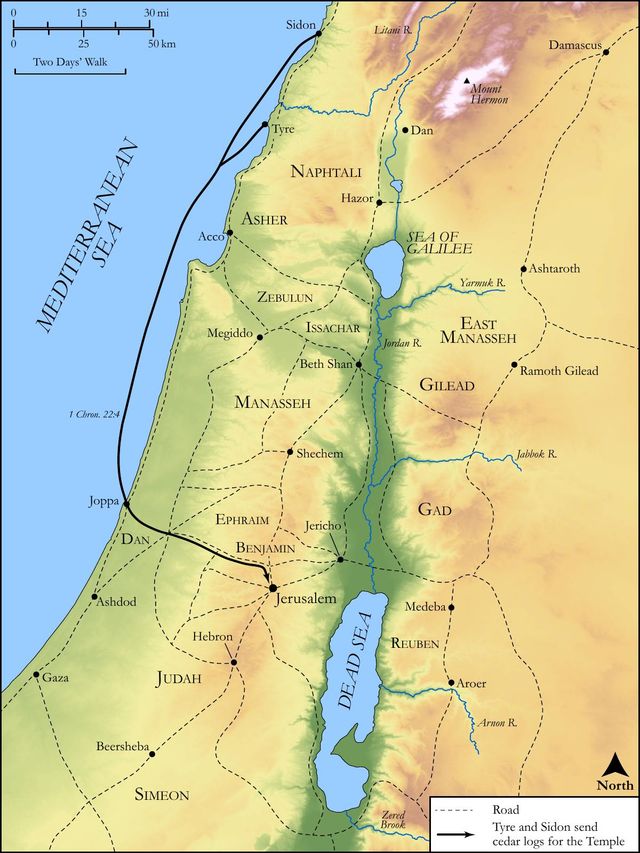
See on the biblical-era map
Study this verse
Public-domain commentary
Matthew Henry
From his Commentary on the Whole Bible. Henry comments on passages, not single verses — this entry covers 1 Chronicles 22:6–16. His two-level outline is real structure in the source text, so it is rendered as structure.
Though Solomon was young and tender, he was capable of receiving instructions, which his father accordingly gave him, concerning the work for which he was designed. When David came to the throne he had many things to do, for the foundations were all out of course; but Solomon had only one thing in charge, and that was to build a house for the Lord God of Israel, Ch1 22:6. Now,
I.David tells him why he did not do it himself.
It was in his mind to do it (Ch1 22:7), but God forbade him, because he had shed much blood, Ch1 22:8. Some think this refers to the blood of Uriah, which fastened such a reproach upon him as rendered him unworthy the honour of building the temple: but that honour was forbidden him before he had shed that blood; therefore it must be meant, as it is here explained, of the blood he shed in his wars (for he had been a man of war from his youth), which, though shed very justly and honourably in the service of God and Israel, yet made him unfit to be employed in this service, or rather less fit than another that had never been called to such bloody work. God, by assigning this as the reason of laying David aside from this work, showed how precious human life is to him, and intended a type of him who should build the gospel temple, not by destroying men's lives, but by saving them, Luk 9:56.
II.He gives him the reason why he imposed this task upon him.
1.Because God had designed him for it, nominated him as the man that should do it: A son shall be born to thee, that shall be called Solomon, and he shall build a house for my name, Ch1 22:9, Ch1 22:10. Nothing is more powerful to engage us to any service for God, and encourage us in it, than to know that hereunto we are appointed.
2.Because he would have leisure and opportunity to do it. He should be a man of rest, and therefore should not have his time, or thoughts, or wealth, diverted from this business. He should have rest from his enemies abroad (none of them should invade or threaten him, or give him provocation), and he should have peace and quietness at home; and therefore let him build the house. Note, Where God gives rest he expects work.
3.Because God had promised to establish his kingdom. Let this encourage him to honour God, that God had honour in store for him; let him build up God's house, and God will build up his throne. Note, God's gracious promises should quicken and invigorate our religious service.
III.He delivers him an account of the vast preparations he had made for this building (Ch1 22:14), not in a way of pride and vain glory (he speaks of it as a poor thing - I have, in my poverty, prepared, margin), but as an encouragement to Solomon to engage cheerfully in the work, for which so solid a foundation was laid. The treasure here mentioned of the 100,000 talents of gold, and 1,000,000 talents of silver, amounts to such an incredible sum that most interpreters either allow an error in the copy or think the talent here signifies no more than a plate or piece: ingots we call them. I am inclined to suppose that a certain number is here put for an uncertain, because it is said (Ch1 22:16) that of the gold and silver, as well as of the brass and iron, there was no number, and that David here includes all the dedicated things (Ch1 18:11) which he designed for the house of the Lord, that is, not only for the building of it, but for the treasure of it; and putting all together, it might come pretty near what is here spoken of. Hundreds and thousands are numbers which we often use to express that which is very much, when yet we would not be understood strictly.
IV.He charges them to keep God's commandments and to take heed to his duty in every thing, Ch1 22:13.
He must not think by building the temple to purchase a dispensation to sin; no, on the contrary, his doing that would not be accepted, nor accounted of, if he did not take heed to fulfil the statutes which the Lord charged Moses with, Ch1 22:13. Though he was to be king of Israel, he must always remember that he was a subject to the God of Israel.
V.He encourages him to go about this great work, and to go on in it (Ch1 22:13):
"Be strong, and of good courage, Though it is a vast undertaking, thou needest not fear coming under the reproach of the foolish builder, who began to build and was not able to finish it; it is God's work, and it shall come to perfection. Dread not, nor be dismayed." In our spiritual work, as well as in our spiritual warfare, we have need of courage and resolution.
VI.He quickens him not to rest in the preparations he had made, but to add thereto, Ch1 22:14.
Those that enter into the labours of others, and build upon their advantages, must still be improving.
VII.He prays for him:
The Lord give thee wisdom and understanding, and give thee charge concerning Israel, Ch1 22:12. Whatever charge we have, if we see God giving us the charge and calling us to it, we may hope he will give us wisdom for the discharge of it. Perhaps Solomon had an eye to this prayer of his father for him, in the prayer he offered for himself: Lord, give me a wise and understanding heart. He concludes (Ch1 22:16), Up, and be doing, and the Lord be with thee. Hope of God's presence must not slacken our endeavours. Though the Lord be with us, we must rise and be doing, and, if we do this, we have reason to believe he is and will be with us. Work out your salvation, and God will work in you.
Continue studying 1 Chronicles 22:13 across the web’s major study libraries — every link below opens this exact verse, chapter, or book on the destination site.
Read & Compare
 BibleGatewayThis verse in more than 200 translations and 70 languages.
 Bible.comThe YouVersion reader — hundreds of translations, reading plans, and highlights.
 ESV.orgCrossway's official English Standard Version reader.
 NET BibleThe NET translation with 60,000+ translators' notes on every rendering decision.
 STEP BibleTyndale House's free study tool — original text, vocabulary, and scholarly resources.
 BibliaLogos Bible Software's free web reader.
 USCCBThe New American Bible (Revised Edition) with the U.S. bishops' study notes.
Commentaries
 BibleHub CommentariesDozens of classic commentaries on this verse, gathered on one page.
 StudyLightMore than 100 commentary sets — the largest collection on the web.
 BibleRefPlain-English commentary on what this verse means, verse by verse.
 Enduring WordDavid Guzik's free commentary on this chapter, widely used by Bible teachers.
 Bible Study ToolsVerse commentary alongside Greek and Hebrew study aids.
Original Language & Research
- BibleHub InterlinearThe verse word by word — original language, transliteration, and English.
- BibleHub LexiconEvery word's original-language definition and Strong's entry.
 Blue Letter BibleDeep-study tools — Strong's numbers, concordance, and word studies.
 SefariaThe Hebrew text with Rashi and centuries of Jewish commentary.
Sermons, Hymns & Audio


TrulyRandomVerse is not affiliated with these sites and doesn’t control their content. They’re linked because they’re genuinely useful.
Summary
1 Chronicles 22:13 encapsulates King David's profound charge to his son Solomon, outlining the essential principles for a prosperous and divinely favored reign, particularly concerning the monumental task of building the Temple. It presents a clear conditional promise of success and flourishing, directly linking it to Solomon's diligent and faithful obedience to the Mosaic Law. Concurrently, it serves as a powerful and urgent exhortation for Solomon to cultivate unwavering strength, courage, and freedom from fear, recognizing the immense spiritual, practical, and leadership challenges inherent in his God-given assignment for the nation of Israel.
Context
ShowHideLiterary Context
This verse is strategically placed within David's final, poignant instructions to Solomon concerning the construction of the Temple. Having been divinely prohibited from building the Temple himself due to his extensive involvement in warfare, as revealed in 1 Chronicles 22:8, David meticulously gathered an abundance of resources and now formally commissions his young son for this sacred undertaking. The preceding verses in 1 Chronicles 22 detail David's extensive preparations and his initial charge not only to Solomon but also to the leaders of Israel, emphasizing the spiritual gravity and collaborative nature of the project. Verse 13, in particular, distills David's accumulated wisdom, shifting focus to the internal character and external conduct required for true success in God's work. It functions as a deeply personal, heartfelt admonition from a seasoned king to his successor, underscoring the spiritual prerequisites for effective leadership.
Historical & Cultural Context
Solomon ascended to the throne at a relatively young age, inheriting a newly unified kingdom and the colossal responsibility of establishing a permanent dwelling place for the Ark of the Covenant, the tangible symbol of God's presence among His people. In the ancient Near Eastern world, the king often served as the primary mediator between the divine and the human realms. For Israel, this meant the king was expected to be the chief guardian and upholder of the Mosaic Covenant, leading the nation in righteousness and adherence to God's laws. The "statutes and judgments which the LORD charged Moses with concerning Israel" refer to the comprehensive legal, moral, and ceremonial framework delivered at Sinai, which governed every facet of Israelite life. Obedience to this covenant was universally understood as the foundational basis for national well-being, military triumph, and divine favor, a principle powerfully articulated in passages such as Deuteronomy 28. The task of building the Temple was far more than an architectural achievement; it was a profound theological statement, demanding immense spiritual fortitude, unwavering commitment to God's revealed will, and a deep understanding of Israel's covenant identity.
Key Themes
ShowHideThis verse powerfully encapsulates several enduring biblical themes. Foremost is the theme of Conditional Prosperity through Obedience, where divine favor and success ("prosper") are directly contingent upon diligent adherence to God's revealed will ("fulfil the statutes and judgments"). This principle is a cornerstone of the Old Covenant, where Israel's national flourishing was inextricably linked to its faithfulness to the Mosaic Law. For Solomon, this meant governing justly, maintaining pure worship, and leading the nation in covenant faithfulness. Secondly, it highlights the theme of Divine Mandate and Human Responsibility, illustrating that while God gives the task and the promise, its successful execution requires human diligence, moral uprightness, and active participation. Finally, the potent exhortation to "be strong, and of good courage; dread not, nor be dismayed" underscores the theme of Courage and Steadfastness in Leadership. This is a recurrent motif in biblical leadership narratives, most notably echoing God's own charge to Joshua as he prepared to lead Israel into the Promised Land. It emphasizes that daunting tasks, especially those divinely ordained, necessitate a resolute spirit free from paralyzing fear and debilitating discouragement, rooted in profound trust in God's enabling presence.
Exposition and Analysis
ShowHideKey Word Analysis
ShowHideThe Hebrew verb צָלַח (tsâlach), translated "prosper," signifies moving forward, breaking out, being successful, or making progress. It implies a flourishing that comes from divine enablement, leading to favorable outcomes and the successful accomplishment of a task. It is not merely about material gain but about achieving the intended purpose, particularly in the context of God's will.
The verb חָזַק (châzaq) means "to be strong, firm, bold, courageous." It denotes an inner resolve, tenacity, and the ability to hold fast or be resolute in the face of challenges. It's an imperative to be unwavering, to reinforce oneself, and to act with fortitude, implying both physical and moral strength.
The verb חָתַת (châthath) means "to be prostrated, broken down, terrified, or dismayed." It describes a state of being utterly disheartened, discouraged, or overwhelmed to the point of emotional or spiritual collapse. The negative command here is against allowing circumstances, fear, or the enormity of the task to crush one's spirit or cause one to lose hope and give up.
Verse Breakdown
ShowHide"Then shalt thou prosper, if thou takest heed to fulfil the statutes and judgments which the LORD charged Moses with concerning Israel:"
This opening clause establishes a clear and foundational conditional promise. "Prosper" (tsâlach) indicates that Solomon's success, wise leadership, and the flourishing of his reign are directly contingent upon his diligent attention ("takest heed") and active, faithful obedience ("fulfil") to the comprehensive body of divine laws given through Moses. These "statutes and judgments" formed the covenant foundation of Israel's relationship with God, encompassing moral, civil, and ceremonial laws. David emphasizes that true and lasting success for the king and the nation is not found in human strength, military might, or political cunning alone, but in unwavering adherence to God's revealed will and the principles of His covenant.
"be strong, and of good courage;"
This constitutes a powerful, dual imperative, urging Solomon to cultivate profound inner fortitude and resolve. "Be strong" (châzaq) and "of good courage" ('âmats) are frequently paired in scripture to convey a call for deep, unwavering resolve, resilience, and boldness. This is not merely an emotional state but a conscious decision and an active cultivation of a spirit that stands firm, remains resilient, and acts with conviction despite the enormity of the task, potential opposition, or personal inadequacy. It is a command to possess mental, spiritual, and moral toughness.
"dread not, nor be dismayed."
These are crucial negative imperatives, serving as a direct counterpoint and complement to the positive commands for strength and courage. "Dread not" (yârêʼ) warns against succumbing to paralyzing fear, terror, or intimidation, which could prevent Solomon from fulfilling his divinely appointed duties. "Nor be dismayed" (châthath) cautions against allowing discouragement, despair, or being overwhelmed by the task to break his spirit, cause him to lose hope, or lead to spiritual collapse. Together, these phrases emphasize the critical need for a fearless, hopeful, and resilient disposition, rooted in unwavering trust in God's presence, power, and faithfulness to overcome any obstacle.
Literary Devices
ShowHideThe verse employs several impactful literary devices that amplify its message. A prominent feature is the Conditional Clause ("if... then..."), which clearly establishes a cause-and-effect relationship between Solomon's obedience and his prosperity. This grammatical structure highlights the covenantal nature of God's dealings with Israel, where blessings are tied to faithfulness. The pervasive use of the Imperative Mood ("be strong," "dread not") provides direct, forceful commands, underscoring the urgency, authority, and non-negotiable nature of David's exhortation. Furthermore, the phrase "dread not, nor be dismayed" utilizes a form of Merism, where two contrasting or complementary terms are used to express a totality – in this case, encompassing all forms of fear, anxiety, discouragement, and spiritual collapse. Finally, the entire exhortation, particularly the iconic pairing of "be strong, and of good courage," functions as a powerful Allusion or Echo to earlier significant biblical passages, most notably God's charge to Joshua in Joshua 1:6-9, linking Solomon's leadership to a venerable lineage of divinely appointed, courageous leaders who faced daunting tasks with divine backing.
Theological and Thematic Connections
ShowHide1 Chronicles 22:13 profoundly articulates the enduring biblical principle that genuine flourishing, effective leadership, and true success are inextricably linked to faithful obedience to God's commands. It underscores the covenantal relationship between God and His people, where divine blessings and enablement are contingent upon adherence to His revealed will. Beyond mere legalism, this obedience is presented as the pathway to wisdom, prudent conduct, and true prosperity, enabling one to navigate complex challenges with divine favor. The verse also emphasizes the indispensable necessity of spiritual fortitude; the call to "be strong, and of good courage" is not a command to self-reliance, but an exhortation to cultivate a resilient spirit rooted in profound trust in God's enabling presence, thereby dispelling paralyzing fear and debilitating discouragement in the face of daunting, God-given tasks.
Reflection and Application
ShowHideWhile initially addressed to a king undertaking a monumental national project, the timeless principles embedded in 1 Chronicles 22:13 resonate deeply with believers today, regardless of their specific calling or circumstances. We are called to live lives of faithful obedience to God's Word, understanding that our "prosperity" in God's kingdom is not solely material but encompasses spiritual flourishing, profound wisdom, and the ultimate fulfillment of our divine purpose. Just as Solomon faced the daunting task of building the Temple, we too are given various "God-given assignments"—whether in our families, workplaces, communities, or ministries—that may at times seem overwhelming or beyond our capabilities. This verse powerfully reminds us that we are to approach these tasks not with fear or dismay, but with the strength and courage that comes from trusting in God's unwavering presence and abundant provision. It challenges us to actively combat the anxieties, discouragements, and doubts that threaten to paralyze us, choosing instead to lean into God's empowering Spirit and remain steadfast in His revealed Word. Our obedience is not a burdensome legalistic duty but a joyful pathway to experiencing God's profound blessing, discerning His will, and effectively fulfilling His unique calling for our lives.
Questions for Reflection
ShowHideFAQ
ShowHideWhat does "prosper" mean in this context, and how does it apply to believers today?
ShowHideIn 1 Chronicles 22:13, "prosper" (Hebrew: tsâlach) signifies more than just material wealth; it refers to holistic success, acting wisely, achieving favorable outcomes through prudent conduct, and experiencing divine favor in fulfilling God's purposes. For Solomon, it meant successful leadership, wise governance, and the completion of the Temple. For believers today, while we live under the New Covenant of grace, the underlying principle remains: walking in obedience to God's Word, which is a profound expression of our love for Him (John 14:15), leads to spiritual flourishing, wisdom, peace, and the effective fulfillment of our God-given callings. This "prosperity" is often seen in spiritual growth, inner peace, a sense of divine purpose, and effectiveness in advancing God's kingdom, rather than solely in worldly metrics of success.
How does the command to "be strong, and of good courage; dread not, nor be dismayed" relate to the Christian life, given that we are saved by grace?
ShowHideWhile salvation is indeed by grace through faith, the Christian life is an active, dynamic journey, not a passive one. The command to "be strong and of good courage" is a timeless exhortation for anyone undertaking a God-given task, regardless of covenant. It acknowledges the inherently daunting nature of living faithfully in a fallen world and serving God's purposes amidst opposition. For Christians, this strength and courage do not originate from self-effort or human resolve alone, but from the indwelling Holy Spirit and our complete reliance on Christ (Philippians 4:13). The instruction to "dread not, nor be dismayed" is a powerful antidote to anxiety, fear, and discouragement, reminding us to fix our eyes on Jesus, the author and perfecter of our faith, and to trust in His sovereignty and provision, even when facing overwhelming challenges or spiritual opposition (Hebrews 12:1-2). It is a profound call to courageous faith in action, empowered by God.
Christ-Centered Fulfillment
ShowHide1 Chronicles 22:13, though given to Solomon under the Old Covenant, finds its ultimate and most profound fulfillment in the person and work of Jesus Christ. Solomon's conditional prosperity through diligent obedience to the Mosaic Law points forward to Christ, who perfectly fulfilled all righteousness and every "statute and judgment" of the Law, not for His own prosperity, but for the redemption and spiritual flourishing of humanity (Matthew 5:17). He is the true and greater Son of David, the ultimate builder of God's eternal Temple, which is His own body, the Church, built upon the foundation of the apostles and prophets with Christ Himself as the cornerstone (Ephesians 2:19-22). Furthermore, the call to "be strong, and of good courage; dread not, nor be dismayed" finds its perfect embodiment in Jesus. He faced the ultimate daunting task—bearing the sin of the world, enduring the cross, and conquering death—with unwavering resolve, never dreading nor being dismayed, looking to the joy set before Him (Hebrews 12:2). In Christ, believers receive not only imputed righteousness but also the very Spirit of strength and courage, enabling us to obey God not out of legalistic duty but out of profound love for Him (John 14:15) and to face our own God-given assignments with the unwavering assurance that He is with us, empowering us to overcome fear and discouragement through His victorious life within us (Romans 8:37-39).