


1 Kings 2:3
Bible text: King James Version (1769 Blayney text) · Public domain
Bible text: King James Version with Strong's numbers · Public domain
Bible text: Berean Standard Bible · Public domain
Bible text: American Standard Version (1901) · Public domain
Bible text: World English Bible, Messianic edition · Public domain
Bible text: Geneva Bible (1599) · Public domain
Bible text: Young's Literal Translation · Public domain
- וְשָׁמַרְתָּve·sha·mar·Taand you will keepH8104Conj-w ¦ V-Qal-ConsecPerf-2msVerb Qal Consecutive Perfect 2nd Singular Masculineוְandשָׁמַרְתָּyou will keep
- אֶת'et<obj.>H853DirObjMParticle Object Indicator
- מִשְׁמֶרֶתmish·Me·ret[the] charge ofH4931N-fscNoun Singular Feminine Construct
- יְהוָהYah·wehYahwehH3068N-properNoun Proper Title
- אֱלֹהֶיךָ'e·lo·Hei·khayour GodH430N-mpc ¦ 2msNoun Plural Masculine ConstructאֱלֹהֶיGodךָyour
- לָלֶכֶתla·Le·khetto walkH1980Prep-l ¦ V-Qal-InfVerb Qal Infinitive Constructלָtoלֶכֶתwalk
- בִּדְרָכָיוbid·ra·Khavin his waysH1870Prep-b ¦ N-mpc ¦ 3msNoun Plural Masculine Constructבִּinדְרָכָיwaysוhis
- לִשְׁמֹרlish·Morto keepH8104Prep-l ¦ V-Qal-InfVerb Qal Infinitive Constructלִtoשְׁמֹרkeep
- חֻקֹּתָיוchu·ko·Tavhis statutesH2708N-fpc ¦ 3msNoun Plural Feminine Constructחֻקֹּתָיstatutesוhis
- מִצְוֹתָיוmitz·vo·Tavhis commandmentsH4687N-fpc ¦ 3msNoun Plural Feminine Constructמִצְוֹתָיcommandmentsוhis
- וּמִשְׁפָּטָיוu·mish·pa·Tavand his judgmentsH4941Conj-w ¦ N-mpc ¦ 3msNoun Plural Masculine Constructוּandמִשְׁפָּטָיjudgmentsוhis
- וְעֵדְוֹתָיוve·'e·de·vo·Tavand his testimoniesH5715Conj-w ¦ N-fpc ¦ 3msNoun Plural Feminine Constructוְandעֵדְוֹתָיtestimoniesוhis
- כַּכָּתוּבka·ka·Tuvaccording to <the> [what] is writtenH3789Prep-k ¦ V-Qal-PassPrtcpl-msVerb Qal Participle Passive Singular Masculine Absoluteכַּaccording to <the>כָּתוּב[what] is written
- בְּתוֹרַתbe·to·Ratin [the] law ofH8451Prep-b ¦ N-fscNoun Singular Feminine Constructבְּinתוֹרַת[the] law of
- מֹשֶׁהmo·ShehMosesH4872N-proper-mNoun Proper Masculine
- לְמַעַןle·Ma·'anso thatH4616PrtParticle Conditional
- תַּשְׂכִּילtas·Kilyou may cause to prosperH7919V-Hiphil-Imperf-2msVerb Hiphil Imperfect 2nd Singular Masculine
- אֵת'et<obj.>H853DirObjMParticle Object Indicator
- כָּלkolallH3605N-msNoun Singular Masculine Absolute
- אֲשֶׁר'a·SherthatH834RelParticle Relative
- תַּעֲשֶׂהta·'a·Sehyou will doH6213V-Qal-Imperf-2msVerb Qal Imperfect 2nd Singular Masculine
- וְאֵתve·'Etand <obj.>H853Conj-w ¦ DirObjMParticle Object Indicatorוְandאֵת<obj.>
- כָּלkoleveryH3605N-msNoun Singular Masculine Absolute
- אֲשֶׁר'a·SherwhereH834RelParticle Relative
- תִּפְנֶהtif·Nehyou will turnH6437V-Qal-Imperf-2msVerb Qal Imperfect 2nd Singular Masculine
- שָׁםShamthereH8033AdvAdverb
English is a literal word-by-word gloss of the Hebrew, not the KJV's wording. Why?
This is the original text the KJV's translators worked from — each Hebrew word with its own literal English meaning in this verse, prepared by scholars at Tyndale House, Cambridge. The KJV translates whole sentences, not word by word, so its wording differs: one Hebrew word can become several English words, and the KJV may choose “the LORD” where the gloss reads “Yahweh”. Both are faithful — they answer different questions. For the KJV's own rendering, switch to the KJV text.
Details
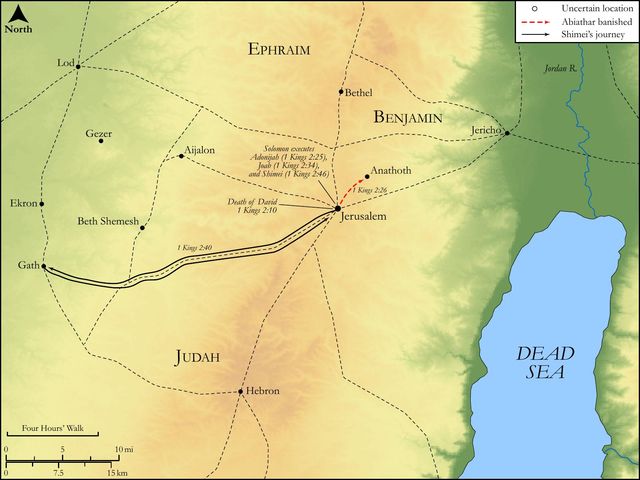
See on the biblical-era maps

Study this verse
Continue studying 1 Kings 2:3 across the web’s major study libraries — every link below opens this exact verse, chapter, or book on the destination site.
Read & Compare
 BibleGatewayThis verse in more than 200 translations and 70 languages.
 Bible.comThe YouVersion reader — hundreds of translations, reading plans, and highlights.
 ESV.orgCrossway's official English Standard Version reader.
 NET BibleThe NET translation with 60,000+ translators' notes on every rendering decision.
 STEP BibleTyndale House's free study tool — original text, vocabulary, and scholarly resources.
 BibliaLogos Bible Software's free web reader.
 USCCBThe New American Bible (Revised Edition) with the U.S. bishops' study notes.
Commentaries
 BibleHub CommentariesDozens of classic commentaries on this verse, gathered on one page.
 StudyLightMore than 100 commentary sets — the largest collection on the web.
 BibleRefPlain-English commentary on what this verse means, verse by verse.
 Enduring WordDavid Guzik's free commentary on this chapter, widely used by Bible teachers.
 Bible Study ToolsVerse commentary alongside Greek and Hebrew study aids.
Original Language & Research
- BibleHub InterlinearThe verse word by word — original language, transliteration, and English.
- BibleHub LexiconEvery word's original-language definition and Strong's entry.
 Blue Letter BibleDeep-study tools — Strong's numbers, concordance, and word studies.
 SefariaThe Hebrew text with Rashi and centuries of Jewish commentary.
Sermons, Hymns & Audio


TrulyRandomVerse is not affiliated with these sites and doesn’t control their content. They’re linked because they’re genuinely useful.
Summary
King David's dying charge to his son Solomon in 1 Kings 2:3 encapsulates the foundational principle for successful leadership and personal well-being in the eyes of God. This pivotal instruction emphasizes that diligent adherence to divine instruction, as comprehensively revealed in the Law of Moses, is the indispensable pathway to true prosperity and flourishing in all endeavors, thereby establishing a covenantal framework for the future of the Israelite monarchy and the nation.
Context
ShowHideLiterary Context
This verse serves as a crucial component of David's final, solemn instructions to his son Solomon, delivered shortly before David's death, marking a significant transition in the narrative of 1 Kings 2. Having reigned for forty years, David is passing the torch of leadership and the immense responsibility of the united kingdom of Israel to his young and relatively inexperienced son. The preceding verses 1 Kings 2:1-2 set the scene, with David acknowledging his impending death and urging Solomon to "be strong, therefore, and show yourself a man." This charge to "keep the charge of the LORD" immediately follows, establishing the spiritual foundation upon which Solomon's entire reign and the stability of the kingdom must rest. It is a spiritual legacy, not merely political advice, underscoring that the blessing and endurance of the Davidic dynasty and the nation itself are entirely conditional upon faithful adherence to God's covenant. The subsequent narrative of Solomon's reign, including the building of the Temple and the nation's unparalleled prosperity, is presented as directly contingent upon his personal and national obedience to the Lord, making this verse a programmatic statement for the rest of the book of 1 Kings.
Historical & Cultural Context
David's reign (c. 1010-970 BC) marked a period of significant consolidation and expansion for Israel, establishing Jerusalem as its capital and centralizing worship. Solomon inherited a relatively stable and prosperous kingdom, but also one with internal tensions and external threats that would test his leadership. Among the patriarchs, a dying man's last words, as when Jacob called his sons together before he died, were considered exceptionally potent and binding, often serving as a testament or covenantal will. For Israel, this took on an added dimension due to their unique covenant relationship with Yahweh. The "Law of Moses" refers to the Torah, the foundational divine revelation given at Sinai, which governed all aspects of Israelite life—religious, civil, and moral. Kings were not above this law but were expected to be its primary custodians and exemplars, as explicitly outlined in Deuteronomy 17:18-20. The concept of "prosperity" (Hebrew: sakal or tsalach) in this context was holistic, encompassing not just material wealth but also success in leadership, military victory, wisdom, and overall well-being, all seen as direct results of divine favor and covenant faithfulness.
Key Themes
ShowHide1 Kings 2:3 powerfully articulates several enduring themes central to the Old Testament narrative. Firstly, Obedience to God's Will is paramount, presented as the core of true leadership and personal success. David's instruction to "keep the charge of the LORD thy God" by walking in His ways and keeping His laws underscores that human wisdom or strength alone are insufficient; submission to divine authority is essential for the king and the nation. Secondly, the verse highlights The Authority and Sufficiency of the Law of Moses. By explicitly directing Solomon to adhere to "the law of Moses," David affirms the Torah as the unchanging, comprehensive standard for life and governance, encompassing "statutes, commandments, judgments, and testimonies." This reinforces the idea that God's revealed word is the ultimate guide for all actions and the foundation of Israelite society. Thirdly, the verse establishes a clear principle of Conditional Prosperity and Blessing. The promise "that thou mayest prosper in all that thou doest, and whithersoever thou turnest thyself" directly links obedience with divine favor and success. This is a recurring theme throughout the Old Testament, particularly prominent in the covenant blessings and curses outlined in Deuteronomy 28 and echoed in wisdom literature like Psalm 1.
Exposition and Analysis
ShowHideKey Word Analysis
ShowHideFrom the root meaning "to hedge about (as with thorns)," this verb signifies to guard, protect, attend to, observe, or preserve. In this context, it implies not merely a passive acknowledgment but an active, diligent, and protective adherence to God's commands, treating them as a sacred trust. It denotes vigilance, faithfulness, and a conscious commitment to uphold and live by divine instructions.
This primitive root literally means "to go" or "to walk," but metaphorically, it refers to one's conduct, lifestyle, or course of life. To "walk in his ways" is an idiomatic expression signifying a consistent pattern of behavior that aligns with God's character, principles, and commands. It implies a journey of life lived in perpetual conformity to divine standards, rather than a single act of obedience.
This verb means "to be (causatively, make or act) circumspect and hence, intelligent." It often carries the nuance of acting wisely, having insight, or showing prudence, which then leads to success or good fortune. It suggests that obedience to God's law is not a blind following but an intelligent, discerning path that results in true flourishing, both in practical endeavors and in overall well-being, implying success that stems from wisdom and right conduct.
Verse Breakdown
ShowHide"And keep the charge of the LORD thy God,"
This opening clause is the overarching imperative, setting the tone for David's final instruction to Solomon. "The charge" (מִשְׁמֶרֶת, mishmeret) refers to a duty, obligation, or sacred trust. David is entrusting Solomon with the profound responsibility of maintaining fidelity to God's covenant and His revealed will. It profoundly underscores that Solomon's kingship is not autonomous but is fundamentally subservient to God's ultimate authority and divine mandate.
"to walk in his ways, to keep his statutes, and his commandments, and his judgments, and his testimonies,"
This clause meticulously elaborates on what "keeping the charge" practically entails. "To walk in his ways" describes the consistent lifestyle of obedience and moral conduct. The subsequent four terms—"statutes" (חֻקּוֹת, chuqqot, fixed decrees or ordinances), "commandments" (מִצְוֹת, mitzvot, direct injunctions or precepts), "judgments" (מִשְׁפָּטִים, mishpatim, legal rulings, civil laws, or ethical decisions), and "testimonies" (עֵדֹת, edot, covenant stipulations or divine witnesses)—function as a comprehensive merism. They collectively refer to the entire, multifaceted body of God's revealed law given through Moses, covering every aspect of moral, civil, and ceremonial life, emphasizing its comprehensive and binding nature.
"as it is written in the law of Moses,"
This crucial phrase explicitly grounds the divine charge in the authoritative, immutable, and written revelation of God. It highlights the immutability and reliability of God's word as the unchanging standard for Solomon's conduct and reign. It also serves as a potent reminder that the king, too, is under the supreme authority of the Torah, not above it, and must govern according to its precepts.
"that thou mayest prosper in all that thou doest, and whithersoever thou turnest thyself:"
This final clause presents the powerful, conditional promise inextricably linked to obedience. "Prosper" (שָׂכַל, sakal) here implies not just material success, but also wisdom, insight, good fortune, and overall flourishing. The expansive phrase "in all that thou doest, and whithersoever thou turnest thyself" is an expression of totality, indicating that God's blessing for obedience extends to every area of life and every endeavor, ensuring comprehensive well-being, success in leadership, and divine favor in all undertakings.
Literary Devices
ShowHide1 Kings 2:3 employs several significant literary devices to convey its profound message. The most prominent is Hortatory Tone, as David's words are a direct, earnest, and solemn exhortation to his son, urging him towards a specific and vital course of action. There is clear Parallelism in the listing of the various terms for God's law ("statutes, commandments, judgments, and testimonies"), which functions as a Merism, encompassing the entirety and comprehensive scope of the Mosaic Law. The repetition of the verb "keep" (implied in "keep the charge" and explicit in "to keep his statutes") creates Emphasis, highlighting the critical importance of active, diligent, and continuous obedience. The verse also functions as a Conditional Promise, clearly stating that prosperity and success are directly contingent upon faithful adherence to God's commands. This structure is inherently didactic, serving to instruct Solomon (and by extension, the reader) on the fundamental principle of covenant faithfulness and the divine basis for true flourishing.
Theological and Thematic Connections
ShowHide1 Kings 2:3 is deeply rooted in the Old Testament's covenant theology, particularly the Mosaic Covenant. It reiterates the foundational principle that Israel's well-being and the success of its leadership are directly tied to its fidelity to God's revealed will. This is not merely a legalistic demand but an invitation to live in harmony with the divine order, where God's commands are understood as the pathway to true life and holistic flourishing. The promise of prosperity, while encompassing material and political success for a king in ancient Israel, ultimately points to the comprehensive concept of shalom—peace, wholeness, and well-being—that comes from walking in right relationship with God. This verse serves as a microcosm of the Deuteronomic theology, where obedience leads to blessing and disobedience to curse, establishing a moral universe where divine justice and faithfulness are paramount for both individual and national destiny.
Reflection and Application
ShowHideWhile believers today are under the New Covenant in Christ, the core principle of 1 Kings 2:3 remains profoundly relevant and spiritually nourishing. God desires our obedience not as a burdensome legalism, but as a pathway to genuine flourishing and a life aligned with His good purposes. Just as Solomon's prosperity was tied to his adherence to the Mosaic Law, our spiritual and often temporal well-being is intrinsically connected to our obedience to God's revealed will in Christ, illuminated and empowered by the Holy Spirit. This includes living by His commands to love God and neighbor, walking in the Spirit, and diligently applying the wisdom of Scripture to our daily lives. Our "prosperity" may not always manifest as material wealth, but it certainly includes spiritual abundance, inner peace, purpose, and the transformative fruit of the Spirit. This verse reminds us that true success, in God's eyes, is found in a life committed to following Him, trusting in His wisdom above our own. It calls us to cultivate a posture of humility and active submission to God's word in every sphere of our lives, recognizing that true wisdom begins with the fear of the Lord and is perfected in Christ.
Questions for Reflection
ShowHideFAQ
ShowHideWhat is the significance of David's emphasis on "the law of Moses" for Solomon?
ShowHideDavid's explicit reference to "the law of Moses" (the Torah) underscores its foundational and enduring authority for the kingdom of Israel, even under the monarchy. It signifies that the king, despite his immense power, was not above God's law but was expected to be its chief steward and exemplar. This emphasis ensured that Solomon understood his rule was a covenantal responsibility, not an absolute human prerogative. It rooted the stability and legitimacy of his reign in divine revelation rather than human wisdom or military might, reminding him that true success derived from faithfulness to God's established standards, as detailed in passages like Deuteronomy 17:18-20. This principle highlights that even the highest human authority is accountable to divine law.
Does the promise of "prosperity" in this verse guarantee material wealth for believers today?
ShowHideThe promise of "prosperity" in 1 Kings 2:3 for Solomon, while certainly encompassing material and political success for an ancient king in a specific covenantal context, should be understood holistically and within its broader biblical framework. In the Old Testament, material blessings were often tangible signs of God's favor for national obedience. For New Covenant believers, "prosperity" takes on a deeper, spiritual dimension, though God may also bless materially according to His sovereign will. Our ultimate "prosperity" is found in spiritual flourishing, peace, purpose, and the abundance of life in Christ, as described in John 10:10. While God does bless obedience, the New Testament emphasizes that our primary treasure is spiritual and eternal, and our "success" is measured by faithfulness to Christ, even amidst trials, as seen in Romans 8:28. The focus shifts from a purely temporal, earthly prosperity to an eternal, spiritual one.
Christ-Centered Fulfillment
ShowHide1 Kings 2:3 finds its ultimate and perfect fulfillment in Jesus Christ, the true and greater Son of David. While Solomon was charged to "keep the charge of the LORD" and walk in His ways, he ultimately failed in perfect obedience, leading to the division and decline of his kingdom. Jesus, however, perfectly "kept the charge of the LORD" in every aspect of His life. He perfectly fulfilled "the law of Moses," not by abolishing it, but by living it out in its entirety and deepest spiritual meaning, declaring that He came "not to abolish the Law or the Prophets... but to fulfill them" (Matthew 5:17). His life was the epitome of "walking in His ways," demonstrating complete and unwavering submission to the Father's will, even unto death on the cross (Philippians 2:8). Through His perfect obedience, Christ secured not a temporal, conditional prosperity for a kingdom, but eternal spiritual life and true flourishing for all who believe in Him. He is the one in whom all the promises of God are "Yes" and "Amen," guaranteeing their fulfillment for His people (2 Corinthians 1:20). Our "prosperity" in Christ is not contingent on our flawed obedience, but on His perfect obedience imputed to us, enabling us by the Holy Spirit to walk in newness of life (Romans 6:4) and experience true spiritual abundance that transcends earthly circumstances.