


1 Kings 2:4
Bible text: King James Version (1769 Blayney text) · Public domain
Bible text: King James Version with Strong's numbers · Public domain
Bible text: Berean Standard Bible · Public domain
Bible text: American Standard Version (1901) · Public domain
Bible text: World English Bible, Messianic edition · Public domain
Bible text: Geneva Bible (1599) · Public domain
Bible text: Young's Literal Translation · Public domain
- לְמַעַןle·ma·'Anso thatH4616PrtParticle Conditional
- יָקִיםya·Kimhe may establishH6965V-Hiphil-Imperf-3msVerb Hiphil Imperfect 3rd Singular Masculine
- יְהוָהYah·wehYahwehH3068N-properNoun Proper Title
- אֶת'et<obj.>H853DirObjMParticle Object Indicator
- דְּבָרוֹde·va·Rohis wordH1697N-msc ¦ 3msNoun Singular Masculine Constructדְּבָרwordוֹhis
- אֲשֶׁר'a·SherwhichH834RelParticle Relative
- דִּבֶּרdi·Berhe spokeH1696V-Piel-Perf-3msVerb Piel Perfect 3rd Singular Masculine
- עָלַי'a·Laion meH5921Prep ¦ 1csPrepositionעָלַonיme
- לֵאמֹרle·Mor<to> sayingH559Prep-l ¦ V-Qal-InfVerb Qal Infinitive Constructלֵ<to>אמֹרsaying
- אִם'imifH518PrtParticle Conditional
- יִשְׁמְרוּyish·me·Ruthey will guardH8104V-Qal-Imperf-3mpVerb Qal Imperfect 3rd Plural Masculine
- בָנֶיךָva·Nei·khayour descendantsH1121N-mpc ¦ 2msNoun Plural Masculine Constructבָנֶיdescendantsךָyour
- אֶת'et<obj.>H853DirObjMParticle Object Indicator
- דַּרְכָּםdar·Kamtheir wayH1870N-csc ¦ 3mpNoun Singular common gender Constructדַּרְכָּwayםtheir
- לָלֶכֶתla·Le·khetto walkH1980Prep-l ¦ V-Qal-InfVerb Qal Infinitive Constructלָtoלֶכֶתwalk
- לְפָנַיle·fa·Nai<to> before meH6440Prep-l ¦ N-mpc ¦ 1csNoun Plural Masculine Constructלְ<to>פָנַbeforeיme
- בֶּאֱמֶתbe·'e·Metin faithfulnessH571Prep-b ¦ N-fsNoun Singular Feminine Absoluteבֶּinאֱמֶתfaithfulness
- בְּכָלbe·kholwith allH3605Prep-b ¦ N-mscNoun Singular Masculine Constructבְּwithכָלall
- לְבָבָםle·va·Vamtheir heartH3824N-msc ¦ 3mpNoun Singular Masculine Constructלְבָבָheartםtheir
- וּבְכָלu·ve·Kholand with allH3605Conj-w ¦ Prep-b ¦ N-mscNoun Singular Masculine Constructוּandבְwithכָלall
- נַפְשָׁםnaf·Shamtheir beingH5315N-fsc ¦ 3mpNoun Singular Feminine Constructנַפְשָׁbeingםtheir
- לֵאמֹרle·Mor<to> sayingH559Prep-l ¦ V-Qal-InfVerb Qal Infinitive Constructלֵ<to>אמֹרsaying
- לֹאlo'notH3808NegParticle Negative
- יִכָּרֵתyi·ka·Retit will be cut offH3772V-Niphal-Imperf-3msVerb Niphal Imperfect 3rd Singular Masculine
- לְךָle·Khato youPrep-l ¦ 2msSuffix Personal 2nd Singular Masculineלְtoךָyou
- אִישׁ'Isha manH376N-msNoun Singular Masculine Absolute
- מֵעַלme·'Alfrom onH5921Prep-m ¦ PrepPrepositionמֵfromעַלon
- כִּסֵּאki·Se'[the] throne ofH3678N-mscNoun Singular Masculine Construct
- יִשְׂרָאֵלYis·ra·'ElIsraelH3478N-properNoun Proper Location
English is a literal word-by-word gloss of the Hebrew, not the KJV's wording. Why?
This is the original text the KJV's translators worked from — each Hebrew word with its own literal English meaning in this verse, prepared by scholars at Tyndale House, Cambridge. The KJV translates whole sentences, not word by word, so its wording differs: one Hebrew word can become several English words, and the KJV may choose “the LORD” where the gloss reads “Yahweh”. Both are faithful — they answer different questions. For the KJV's own rendering, switch to the KJV text.
Details
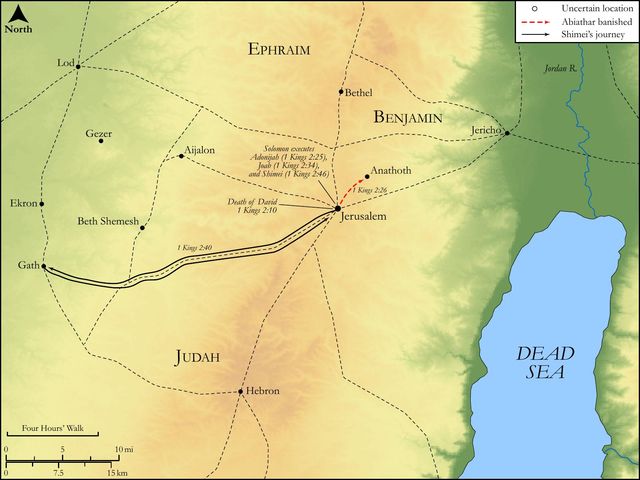
See on the biblical-era maps

Study this verse
Continue studying 1 Kings 2:4 across the web’s major study libraries — every link below opens this exact verse, chapter, or book on the destination site.
Read & Compare
 BibleGatewayThis verse in more than 200 translations and 70 languages.
 Bible.comThe YouVersion reader — hundreds of translations, reading plans, and highlights.
 ESV.orgCrossway's official English Standard Version reader.
 NET BibleThe NET translation with 60,000+ translators' notes on every rendering decision.
 STEP BibleTyndale House's free study tool — original text, vocabulary, and scholarly resources.
 BibliaLogos Bible Software's free web reader.
 USCCBThe New American Bible (Revised Edition) with the U.S. bishops' study notes.
Commentaries
 BibleHub CommentariesDozens of classic commentaries on this verse, gathered on one page.
 StudyLightMore than 100 commentary sets — the largest collection on the web.
 BibleRefPlain-English commentary on what this verse means, verse by verse.
 Enduring WordDavid Guzik's free commentary on this chapter, widely used by Bible teachers.
 Bible Study ToolsVerse commentary alongside Greek and Hebrew study aids.
Original Language & Research
- BibleHub InterlinearThe verse word by word — original language, transliteration, and English.
- BibleHub LexiconEvery word's original-language definition and Strong's entry.
 Blue Letter BibleDeep-study tools — Strong's numbers, concordance, and word studies.
 SefariaThe Hebrew text with Rashi and centuries of Jewish commentary.
Sermons, Hymns & Audio


TrulyRandomVerse is not affiliated with these sites and doesn’t control their content. They’re linked because they’re genuinely useful.
Summary
King David, in his final charge to his son Solomon, articulates a profound truth about the continuation of God's covenant promises to his dynasty. This verse underscores that while God's ultimate commitment to David's lineage was unconditional, the immediate, practical manifestation of a continuous Davidic presence on the throne of Israel was contingent upon the unwavering, wholehearted obedience and integrity of David's descendants. It establishes a critical moral and spiritual framework for the monarchy, emphasizing that the stability and longevity of the kingdom were directly tied to the kings' faithfulness to the Lord.
Context
ShowHideLiterary Context
This verse is an integral part of David's deathbed instructions to his son and successor, Solomon, found in 1 Kings 2. Following David's establishment of Solomon as king and his counsel regarding various political figures, he transitions to a solemn spiritual charge. David exhorts Solomon to "be strong, therefore, and show yourself a man" (1 Kings 2:2) and to "keep the charge of the LORD your God, to walk in His ways, to keep His statutes, His commandments, His ordinances, and His testimonies" (1 Kings 2:3). Verse 4 then provides the divine rationale and promised outcome for such obedience, explicitly linking the enduring presence of a Davidic king on the throne to the future kings' fidelity. This foundational instruction sets the theological lens through which the subsequent narratives of Israel's monarchy in 1 and 2 Kings are to be understood, highlighting the successes and failures of kings in light of this very covenantal expectation.
Historical & Cultural Context
Among the kings of that day, dynastic succession was frequently precarious, often characterized by power struggles, assassinations, and the rise of new, unrelated ruling families. David's charge to Solomon, therefore, was not merely personal advice but a crucial blueprint for the stability and legitimacy of the nascent united monarchy of Israel. The covenant of the LORD with Israel, binding the people to His commandments under blessings and curses, was central to Israelite society. While God had previously established an unconditional covenant with David in 2 Samuel 7, promising an eternal house and kingdom, 1 Kings 2:4 introduces a vital nuance. It clarifies that the immediate, practical, and uninterrupted continuation of a Davidic king reigning on the throne was conditional upon the obedience of each successive monarch. This reflects the broader Deuteronomic theology, which consistently emphasized that the blessings of the land and the prosperity of the kingdom were contingent upon Israel's faithful adherence to God's covenant stipulations, as vividly outlined in Deuteronomy 28.
Key Themes
ShowHideThis verse powerfully encapsulates several pivotal theological and narrative themes that resonate throughout the Old Testament. Firstly, it highlights the conditional outworking of God's promises within the framework of the broader, unconditional Davidic covenant. While God's ultimate commitment to David's lineage was secure, the day-to-day experience of that promise, particularly the stability and prosperity of the throne, was directly tied to human obedience. Secondly, it emphasizes wholehearted obedience and integrity as the indispensable foundation for righteous leadership and divine favor. The call for David's descendants to "walk before me in truth with all their heart and with all their soul" echoes the foundational command to love God with total devotion, as articulated in the Shema (Deuteronomy 6:5). This signifies that genuine faith is not merely external conformity but an internal, sincere, and comprehensive commitment that permeates one's entire being. Lastly, the verse underscores the vital link between dynastic succession, national stability, and divine favor. The promise that "there shall not fail thee... a man on the throne of Israel" directly connects the longevity and well-being of the Davidic monarchy to the spiritual fidelity of its kings, setting the stage for the unfolding narrative of kingship that dominates 1 and 2 Kings.
Exposition and Analysis
ShowHideKey Word Analysis
ShowHideFrom a primitive root meaning "to hedge about (as with thorns), i.e. guard." It implies a careful, vigilant, and protective attention to one's conduct. To "take heed to their way" means to diligently observe, watch over, and preserve their actions and decisions, ensuring they align with God's standards. It suggests a conscious, intentional effort to guard against deviation from the path of righteousness.
From a root meaning "to tread," this word literally refers to a road or path. Figuratively, as used here, it signifies a course of life, a mode of action, or one's conduct and moral character. To "take heed to their way" means to carefully consider and direct their entire life's journey and behavioral patterns according to God's will, rather than drifting aimlessly or following ungodly influences.
Contracted from a root meaning "to be firm," this word denotes stability, certainty, trustworthiness, and faithfulness. It encompasses more than mere factual accuracy; it speaks to integrity, sincerity, and reliability of character. To walk "in truth" means to live with genuine devotion, honesty, and consistency, reflecting an inner commitment that translates into dependable and righteous actions, in contrast to hypocrisy or superficial adherence.
Verse Breakdown
ShowHide"That the LORD may continue his word which he spake concerning me, saying"
David's profound concern is for the enduring fulfillment of God's divine promise, the covenant established with him. He understands that the blessings promised to his lineage are foundational, and his desire is for them to be fully realized through the generations. This clause highlights David's deep respect for the divine word and his earnest prayer for his family to remain within the sphere of God's favor and covenantal blessing.
"If thy children take heed to their way, to walk before me in truth with all their heart and with all their soul"
This is the pivotal conditional clause, placing the responsibility for the practical continuation of the dynastic promise squarely on the shoulders of future Davidic kings. "Taking heed to their way" implies a diligent, intentional scrutiny of their conduct and choices. The subsequent phrases define the essence of this "way": a life lived consciously in God's presence ("walk before me"), characterized by integrity and faithfulness ("in truth"), and marked by complete, unreserved devotion of their entire being ("with all their heart and with all their soul"). This is a profound call for genuine, internal righteousness, not merely outward compliance or ritualistic observance.
"there shall not fail thee (said he) a man on the throne of Israel"
This is the promised outcome, the specific blessing directly contingent upon the preceding condition. It refers to the uninterrupted succession of David's descendants reigning on the throne of Israel. The parenthetical "(said he)" serves as a powerful reiteration that this is not merely David's wish, but God's own solemn promise, underscoring its divine origin, authority, and certainty—provided the condition is met. It signifies political stability, dynastic continuity, and the ongoing fulfillment of God's plan for Israel through the Davidic line, contingent upon the kings' faithfulness.
Literary Devices
ShowHideThe verse prominently employs Conditional Language ("If... then...") to establish a clear and direct cause-and-effect relationship between human obedience and divine blessing. This is a fundamental characteristic of covenant theology throughout the Old Testament, particularly evident in Deuteronomic literature, where blessings are tied to faithfulness. The phrase "walk before me" functions as an Idiom, a common biblical expression signifying a life lived in God's presence, according to His will, and in a manner pleasing to Him, implying accountability, intimacy, and a consistent pursuit of divine approval. Furthermore, the repetition of "with all their heart and with all their soul" is an example of Merism, a literary device where two contrasting or complementary parts are used to represent a whole. In this context, "heart" (the seat of intellect, will, and emotion) and "soul" (the life force, the very essence of a person) combine to emphasize the totality and comprehensiveness of the required devotion, underscoring the demand for absolute, undivided loyalty to God from David's successors.
Theological and Thematic Connections
ShowHideThis verse serves as a crucial theological bridge, explaining the practical outworking of God's unconditional covenant with David, as established in 2 Samuel 7, within the lived experience of his descendants. While God unequivocally promised an "eternal house" for David, 1 Kings 2:4 clarifies that the immediate, continuous presence of a Davidic king on the throne was conditional upon the obedience of each successive ruler. This highlights the dynamic tension between God's sovereign faithfulness and human responsibility within the covenant. The subsequent history of Israel's monarchy, meticulously recounted in 1 and 2 Kings, tragically illustrates the devastating consequences of failing to meet this condition, leading to the division of the kingdom, periods of instability, and ultimately the Babylonian exile. Yet, even in judgment, God's ultimate faithfulness ensured that the unconditional aspect of the covenant—the promise of a future, eternal Davidic King—would remain secure and eventually be fulfilled.
Reflection and Application
ShowHide1 Kings 2:4 offers a profound and timeless lesson: while God's promises are ultimately steadfast and rooted in His character, our experience of their ongoing benefits often hinges on our responsiveness and obedience. For Solomon, and indeed for every leader and individual throughout history, this verse underscores the non-negotiable link between spiritual integrity and sustained blessing. It challenges us to deeply examine the nature of our own commitment to God: do we truly "walk before Him in truth with all our heart and with all our soul," or is our faith merely a superficial, external adherence? Our actions, stemming from the depth of our inner devotion, carry significant consequences, not only for our personal well-being but also potentially for our families, communities, and future generations. This verse calls us to a life of genuine, wholehearted faithfulness, reminding us that true flourishing—whether personal, familial, or communal—is inextricably rooted in a sincere, obedient, and devoted relationship with God.
Questions for Reflection
ShowHideFAQ
ShowHideDoes this verse mean God's promise to David was entirely conditional, contradicting 2 Samuel 7?
ShowHideNo, this verse does not contradict 2 Samuel 7 but rather clarifies its practical outworking within the historical context of the monarchy. In 2 Samuel 7:12-16, God makes an unconditional promise to David concerning an eternal house, kingdom, and throne. This ultimate, overarching promise of a perpetual dynasty would be fulfilled regardless of human faithfulness, ultimately finding its perfect realization in Jesus Christ. However, 1 Kings 2:4 introduces a conditional element concerning the immediate, continuous presence of a Davidic king on the throne in Jerusalem. It means that while the Davidic line would never be completely cut off (the unconditional aspect), the uninterrupted succession, prosperity, and stability of the kingdom in each generation were contingent upon the obedience of the kings. When kings failed to "walk before me in truth with all their heart and with all their soul," the kingdom suffered, was divided, or went into exile, but the promise of a future, eternal Davidic King remained intact.
Christ-Centered Fulfillment
ShowHideWhile 1 Kings 2:4 highlights the conditional nature of the Davidic throne's immediate continuity, it ultimately points forward to the unconditional and perfect fulfillment of God's promise in Jesus Christ. The long and often tragic history of Israel's kings, marked by repeated failures to "walk before me in truth with all their heart and with all their soul," demonstrated humanity's inherent inability to perfectly uphold this divine standard. Even Solomon himself, despite his unparalleled wisdom, eventually turned his heart from the Lord (1 Kings 11:4), leading to the division of the kingdom. Yet, God's ultimate covenant with David, promising an eternal king, found its perfect and final realization in Jesus. He is the true Son of David who perfectly fulfilled the condition of walking "in truth with all His heart and with all His soul," living a life of absolute and unwavering obedience to the Father (Hebrews 4:15). Unlike the earthly kings whose reigns were temporary and flawed, Jesus' "kingdom will have no end" (Luke 1:32-33). He is the "man on the throne of Israel" who will never fail, whose reign is eternal, righteous, and established not on the fleeting obedience of sinful humanity, but on His own perfect sacrifice and glorious resurrection (Acts 2:30-36). Thus, 1 Kings 2:4, through its emphasis on a condition that no human king could perfectly meet, implicitly magnifies the grace and faithfulness of God in providing the perfect, eternal King in Christ, whose reign secures the Davidic covenant forever.