


1 Kings 2:5
Bible text: King James Version (1769 Blayney text) · Public domain
Bible text: King James Version with Strong's numbers · Public domain
Bible text: Berean Standard Bible · Public domain
Bible text: American Standard Version (1901) · Public domain
Bible text: World English Bible, Messianic edition · Public domain
Bible text: Geneva Bible (1599) · Public domain
Bible text: Young's Literal Translation · Public domain
- וְגַםve·Gamand alsoH1571Conj-w ¦ AdvAdverbוְandגַםalso
- אַתָּה'a·TahyouH859Pro-2msPronoun Personal 2nd Singular Masculine
- יָדַעְתָּya·Da'·tayou knowH3045V-Qal-Perf-2msVerb Qal Perfect 2nd Singular Masculine
- אֵת'et<obj.>H853DirObjMParticle Object Indicator
- אֲשֶׁר'a·Sher[that] whichH834RelParticle Relative
- עָשָׂה'A·sahhe didH6213V-Qal-Perf-3msVerb Qal Perfect 3rd Singular Masculine
- לִיlito mePrep-l ¦ 1csSuffix Personal 1st Singular common genderלִtoיme
- יוֹאָבyo·'AvJoabH3097N-proper-mNoun Proper Masculine
- בֶּןben[the] son ofH1121N-mscNoun Singular Masculine Construct
- צְרוּיָהtze·ru·YahZeruiahH6870N-proper-fNoun Proper Feminine
- אֲשֶׁר'a·Sher[that] whichH834RelParticle Relative
- עָשָׂה'a·Sahhe didH6213V-Qal-Perf-3msVerb Qal Perfect 3rd Singular Masculine
- לִשְׁנֵיlish·neito [the] twoH8147Prep-l ¦ N-cdcNoun Dual common gender Constructלִtoשְׁנֵי[the] two
- שָׂרֵיsa·Rei[the] commanders ofH8269N-mpcNoun Plural Masculine Construct
- צִבְאוֹתtziv·'ot[the] armies ofH6635N-fpcNoun Plural Feminine Construct
- יִשְׂרָאֵלYis·ra·'elIsraelH3478N-properNoun Proper Location
- לְאַבְנֵרle·'av·Nerto AbnerH74Prep-l ¦ N-proper-mNoun Proper MasculineלְtoאַבְנֵרAbner
- בֶּןben[the] son ofH1121N-mscNoun Singular Masculine Construct
- נֵרnerNerH5369N-proper-mNoun Proper Masculine
- וְלַעֲמָשָׂאve·la·'a·ma·Sa'and to AmasaH6021Conj-w ¦ Prep-l ¦ N-proper-mNoun Proper MasculineוְandלַtoעֲמָשָׂאAmasa
- בֶןven[the] son ofH1121N-mscNoun Singular Masculine Construct
- יֶתֶרye·terJetherH3500N-proper-mNoun Proper Masculine
- וַיַּהַרְגֵםvai·Ya·har·Gemand he killed themH2026Conj-w ¦ V-Qal-ConsecImperf-3ms ¦ 3mpVerb Qal Consecutive Imperfect 3rd Singular Masculineוַandיַּהַרְגֵhe killedםthem
- וַיָּשֶׂםvai·Ya·semand he putH7760Conj-w ¦ V-Qal-ConsecImperf-3msVerb Qal Consecutive Imperfect 3rd Singular Masculineוַandיָּשֶׂםhe put
- דְּמֵיde·meiblood<s> ofH1818N-mpcNoun Plural Masculine Construct
- מִלְחָמָהmil·cha·MahwarH4421N-fsNoun Singular Feminine Absolute
- בְּשָׁלֹםbe·sha·Lomin peaceH7965Prep-b ¦ N-msNoun Singular Masculine Absoluteבְּinשָׁלֹםpeace
- וַיִּתֵּןvai·yi·Tenand he putH5414Conj-w ¦ V-Qal-ConsecImperf-3msVerb Qal Consecutive Imperfect 3rd Singular Masculineוַandיִּתֵּןhe put
- דְּמֵיde·Meiblood<s> ofH1818N-mpcNoun Plural Masculine Construct
- מִלְחָמָהmil·cha·MahwarH4421N-fsNoun Singular Feminine Absolute
- בַּחֲגֹרָתוֹba·cha·go·ra·Toon his beltH2290Prep-b ¦ N-fsc ¦ 3msNoun Singular Feminine Constructבַּonחֲגֹרָתbeltוֹhis
- אֲשֶׁר'a·SherwhichH834RelParticle Relative
- בְּמָתְנָיוbe·ma·te·Nav[was] on his loinsH4975Prep-b ¦ N-mdc ¦ 3msNoun Dual Masculine Constructבְּ[was] onמָתְנָיloinsוhis
- וּבְנַעֲלוֹu·ve·na·'a·Loand on his sandal[s]H5275Conj-w ¦ Prep-b ¦ N-fsc ¦ 3msNoun Singular Feminine Constructוּandבְonנַעֲלsandal[s]וֹhis
- אֲשֶׁר'a·SherwhichH834RelParticle Relative
- בְּרַגְלָיוbe·rag·Lav[was] on his feetH7272Prep-b ¦ N-fdc ¦ 3msNoun Dual Feminine Constructבְּ[was] onרַגְלָיfeetוhis
English is a literal word-by-word gloss of the Hebrew, not the KJV's wording. Why?
This is the original text the KJV's translators worked from — each Hebrew word with its own literal English meaning in this verse, prepared by scholars at Tyndale House, Cambridge. The KJV translates whole sentences, not word by word, so its wording differs: one Hebrew word can become several English words, and the KJV may choose “the LORD” where the gloss reads “Yahweh”. Both are faithful — they answer different questions. For the KJV's own rendering, switch to the KJV text.
Details
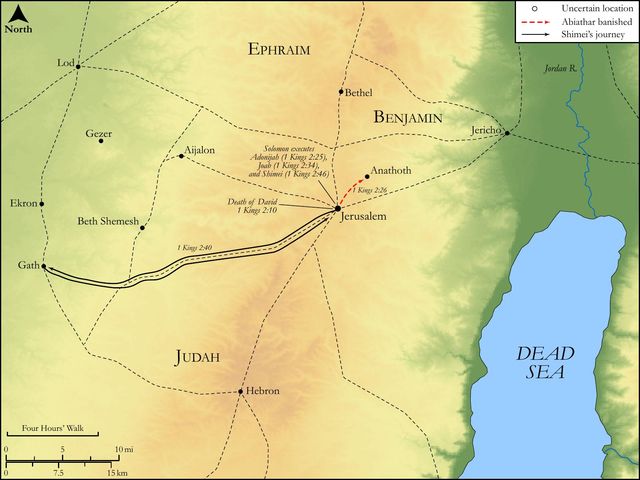
See on the biblical-era maps

Study this verse
Historical interpretation
Nine Centuries of Reception
2 surviving comments on this verse. Each one is dated, so this reads as a timeline rather than a list.
Select a marker to jump to its quote. Markers stagger vertically where authors wrote within a few decades of each other.
[David] orders Solomon to punish [Joab], not out of viciousness or hatred for him but because he knew that he was wicked and that, if he had acted with hostility against him who was a mature man, he would act even worse against a young man, so that the kingdom would become unstable, and the house would not be firmly established. Therefore he entrusts his son with the revenge against him who had offended him, in order that, after the killing of that evil man by the hand of the new king, he might be feared by everyone, and no revolt might ever occur.
Joab: These instructions given by David to his son, with relation to Joab and Semei, proceeded not from any rancour of heart, or private pique; but from a zeal for justice, that crimes so public and heinous might not pass unpunished.
Continue studying 1 Kings 2:5 across the web’s major study libraries — every link below opens this exact verse, chapter, or book on the destination site.
Read & Compare
 BibleGatewayThis verse in more than 200 translations and 70 languages.
 Bible.comThe YouVersion reader — hundreds of translations, reading plans, and highlights.
 ESV.orgCrossway's official English Standard Version reader.
 NET BibleThe NET translation with 60,000+ translators' notes on every rendering decision.
 STEP BibleTyndale House's free study tool — original text, vocabulary, and scholarly resources.
 BibliaLogos Bible Software's free web reader.
 USCCBThe New American Bible (Revised Edition) with the U.S. bishops' study notes.
Commentaries
 BibleHub CommentariesDozens of classic commentaries on this verse, gathered on one page.
 StudyLightMore than 100 commentary sets — the largest collection on the web.
 BibleRefPlain-English commentary on what this verse means, verse by verse.
 Enduring WordDavid Guzik's free commentary on this chapter, widely used by Bible teachers.
 Bible Study ToolsVerse commentary alongside Greek and Hebrew study aids.
Original Language & Research
- BibleHub InterlinearThe verse word by word — original language, transliteration, and English.
- BibleHub LexiconEvery word's original-language definition and Strong's entry.
 Blue Letter BibleDeep-study tools — Strong's numbers, concordance, and word studies.
 SefariaThe Hebrew text with Rashi and centuries of Jewish commentary.
Sermons, Hymns & Audio


TrulyRandomVerse is not affiliated with these sites and doesn’t control their content. They’re linked because they’re genuinely useful.
Summary
In his poignant final directives to his son Solomon, King David lays bare the unaddressed transgressions of Joab, his powerful but morally compromised army commander. David specifically recounts Joab's treacherous assassinations of two esteemed Israelite military leaders, Abner and Amasa, emphasizing that these acts were committed not in open combat but deceitfully in times of peace. This deliberate shedding of innocent blood left an indelible stain of bloodguilt upon Joab's very person, a defilement David charges Solomon to rectify, thereby establishing a righteous and stable reign free from the lingering moral compromises of his own rule.
Context
ShowHideLiterary Context
This verse is strategically placed within David's deathbed instructions to Solomon, marking the very beginning of Solomon's reign in 1 Kings 2. Following a general charge to walk in God's ways and obey His commands to ensure the perpetuity of his dynasty (1 Kings 2:1-4), David transitions to specific, practical counsel regarding key individuals. He advises Solomon to show kindness to the sons of Barzillai the Gileadite for their loyalty (1 Kings 2:7) and to deal decisively with Shimei son of Gera for his past curses and current threat (1 Kings 2:8-9). However, the most urgent and detailed instruction concerns Joab, highlighting the profound gravity of his past actions and the critical necessity for Solomon to bring a definitive end to Joab's unchecked power and the bloodguilt he represents. This command directly sets the stage for Joab's swift execution later in the chapter (1 Kings 2:34), marking a pivotal moment in the establishment of Solomon's authority.
Historical & Cultural Context
Joab served as David's loyal but often ruthless and insubordinate commander-in-chief for decades. His actions, particularly the murders of Abner and Amasa, were not legitimate acts of war but treacherous assassinations committed under the guise of peace or reconciliation. In Israel, such acts were considered particularly heinous, violating sacred covenants of hospitality, trust, and the sanctity of life outside declared combat. The concept of "bloodguilt" (Hebrew: damim) was profoundly significant; unpunished bloodshed was believed to pollute the land, defile the community, and invite divine judgment upon the kingdom or the ruling house (Numbers 35:33-34). David, despite his deep distress over Joab's actions (e.g., his lament in 2 Samuel 3:28-39), had been unable or unwilling to directly confront Joab due to Joab's immense power, his unwavering loyalty in other contexts, and perhaps David's own moral compromises (such as the Uriah affair in 2 Samuel 11). By entrusting this difficult task to Solomon, David ensures that his successor begins his reign by establishing justice and cleansing the kingdom of lingering bloodguilt, thereby securing the stability, divine favor, and moral integrity of his nascent dynasty.
Key Themes
ShowHideThis verse powerfully contributes to several overarching themes within 1 Kings and the broader Deuteronomistic History. Justice and Accountability are paramount, as David insists that even a figure as powerful and historically loyal as Joab must face consequences for his heinous deeds, underscoring that no one, not even the king's most trusted general, is above the law or divine judgment. The theme of the Consequences of Sin is vividly illustrated, as Joab's past actions, though long unaddressed by David, now demand a reckoning, demonstrating that sins, especially those involving bloodshed and treachery, carry lasting repercussions that must eventually be settled. It highlights the Burden of Leadership, as David passes on the morally complex and politically dangerous task of dealing with a dangerous but historically loyal servant to Solomon, emphasizing the king's ultimate responsibility to uphold righteousness, maintain order, and ensure the well-being of the kingdom. Finally, the vivid imagery of "shed the blood of war in peace" and "put the blood of war upon his girdle... and in his shoes" underscores the profound theme of Bloodguilt, portraying it as an inescapable, defiling stain that clings to the perpetrator, polluting both the individual and the land until divine and human justice is served.
Exposition and Analysis
ShowHideKey Word Analysis
ShowHideThis term refers to "blood (as that which when shed causes death) of man or an animal." In this context, it specifically denotes "bloodshed," emphasizing the life-taking act. Figuratively, especially in the plural, it signifies "bloodguiltiness" or the moral culpability associated with unlawful killing. David's use of "blood of war" highlights that this was not mere accidental shedding but a deliberate, violent act.
This primitive root means "to smite with deadly intent; destroy, out of hand, kill, murder(-er), put to (death), make (slaughter), slay(-er)." It conveys the intentionality and finality of Joab's actions, emphasizing that these were not accidental deaths but premeditated murders, precisely what makes them so egregious.
This term refers to "a belt (for the waist)." The girdle was a fundamental part of ancient attire, used to secure clothing, hold weapons, and symbolize readiness or strength. For blood to be "upon his girdle" signifies that the guilt of these murders was intimately connected to Joab's person, his strength, and his very identity as a warrior. It was an inescapable, public, and personal mark of his defilement.
Verse Breakdown
ShowHide"Moreover thou knowest also what Joab the son of Zeruiah did to me"
David begins by appealing to Solomon's existing knowledge, implying that Joab's actions were not only publicly known but also personally offensive and distressing to David. While the text doesn't explicitly detail every offense against David, this likely refers to Joab's repeated insubordination, such as his role in the death of Absalom (2 Samuel 18:14-15) against David's direct command, and his general independent and ruthless nature that often caused David profound moral distress.
"and what he did to the two captains of the hosts of Israel, unto Abner the son of Ner, and unto Amasa the son of Jether"
David then specifies the most egregious and publicly scandalous of Joab's crimes: the assassinations of two highly respected and influential military leaders. Abner, Saul's former commander, had made peace with David and was integrating into David's kingdom (2 Samuel 3:20-21) before Joab murdered him in revenge for his brother Asahel's death (2 Samuel 3:27). Amasa, David's cousin and briefly commander of David's army, was murdered by Joab out of jealousy and a desire to consolidate his own power (2 Samuel 20:9-10).
"whom he slew, and shed the blood of war in peace"
This clause emphasizes the utterly treacherous and morally reprehensible nature of these killings. They were not legitimate acts of war, self-defense, or judicial execution, but premeditated murders committed under the guise of peaceful interaction or truce. This violation of trust and the sanctity of peace made them particularly heinous and a profound offense against both human and divine law.
"and put the blood of war upon his girdle that [was] about his loins, and in his shoes that [were] on his feet"
This vivid and powerful imagery serves as a metaphor for Joab's indelible and pervasive guilt. The blood of his victims is portrayed as literally clinging to his most intimate attire—his belt (symbolizing his strength, readiness, and public identity) and his shoes (symbolizing his walk, journey, and daily activities). This signifies that his bloodguilt was personal, inescapable, and pervasive, staining his very being and accompanying him everywhere he went. It underscores the profound moral defilement that Joab carried, which could not be washed away by time or distance.
Literary Devices
ShowHideThe verse employs several potent Literary Devices to convey its message with striking force. Imagery is particularly vivid and central to the verse's impact, especially in the description of Joab's bloodguilt: "put the blood of war upon his girdle... and in his shoes." This visceral depiction paints a picture of an indelible stain, suggesting that the guilt of his treacherous murders clung to him physically and inescapably, permeating his very being and actions. The Repetition of the phrase "blood of war" emphasizes the nature of the crime—not mere bloodshed, but a profound violation of the sanctity of peace through wartime violence, highlighting the incongruity and moral outrage. There is also an element of Foreshadowing, as David's explicit command regarding Joab sets the stage for Joab's ultimate demise later in the chapter, indicating that justice, though delayed, will eventually be served under Solomon's reign. Furthermore, David's opening statement, "thou knowest also what Joab... did to me," functions as a subtle Understatement or Euphemism, hinting at Joab's broader pattern of insubordination and defiance against David without needing to explicitly detail every instance, relying on Solomon's intimate knowledge of the court's dynamics and Joab's character.
Theological and Thematic Connections
ShowHide1 Kings 2:5 profoundly illustrates the biblical principle that unpunished bloodshed pollutes the land and demands a reckoning. David's charge to Solomon is not merely a personal vendetta or a political maneuver but a theological imperative to cleanse the kingdom of the moral stain left by Joab's treacherous acts. It underscores God's unwavering demand for justice, particularly for the sanctity of human life, which is created in His image. While God is merciful and extends grace, His righteousness also requires that sin, especially grievous sin like premeditated murder, be addressed and its consequences faced. This passage reminds us that actions have profound and lasting consequences, and even if human justice is delayed, the moral ledger remains open, ultimately requiring resolution to ensure the well-being and divine blessing upon the community and its leadership.
Reflection and Application
ShowHideThis passage from David's final counsel to Solomon offers profound lessons for contemporary believers regarding justice, accountability, and the pervasive consequences of sin. It challenges us to consider that while forgiveness is a cornerstone of our faith and a divine imperative, there are also times when justice must be upheld, especially by those in positions of authority, to ensure moral order, prevent the perpetuation of harm, and maintain the integrity of a community. We are reminded that unaddressed wrongs, particularly those involving violence, treachery, or profound betrayal, can leave a lasting stain, not only on individuals but also on communities and institutions, hindering their flourishing and divine favor. For leaders, it underscores the difficult but necessary task of confronting injustice, even when it involves powerful or historically loyal figures, for the sake of integrity, righteousness, and the holistic well-being of those under their care. Personally, the vivid imagery of bloodguilt clinging to Joab's "girdle" and "shoes" prompts us to examine our own lives: are there "unresolved issues" or "bloodguilt" we carry—unconfessed sins, unforgiveness, or past actions that continue to defile our inner being and hinder our "walk" with God? The passage implicitly calls for a reckoning, whether through repentance, confession, restitution, or seeking reconciliation, to find true peace and freedom from lingering burdens that impede our spiritual journey.
Questions for Reflection
ShowHideFAQ
ShowHideWhy did David wait so long to deal with Joab, only addressing it on his deathbed?
ShowHideDavid's delay in dealing with Joab's egregious acts, despite his evident distress (e.g., 2 Samuel 3:39), is a complex issue rooted in political pragmatism, Joab's immense power, and possibly David's own moral compromises. Joab was a fiercely loyal and highly effective military commander, indispensable to David's early successes and the consolidation of his kingdom. He commanded the army's unwavering loyalty, making any direct confrontation by David extremely risky and potentially destabilizing for the nascent kingdom. Furthermore, David himself was not without significant sin (e.g., the Bathsheba and Uriah affair, 2 Samuel 11), which may have compromised his moral authority to act decisively against Joab. By entrusting the task to Solomon, David ensured that the necessary justice would be carried out by a new, unburdened king, allowing Solomon to establish his reign on a foundation of righteousness and order, free from the lingering compromises and bloodguilt of the previous era.
What does "shed the blood of war in peace" specifically mean, and why is it so significant?
ShowHideThe phrase "shed the blood of war in peace" refers to the act of committing murder treacherously, not in open, declared warfare, but under the guise of peace, truce, or even friendly interaction. It signifies a profound betrayal of trust and a severe violation of the established norms of conflict and hospitality in Israel. Joab's killings of Abner and Amasa were not legitimate acts of combat where lives are taken in the heat of battle; instead, they were premeditated assassinations carried out deceitfully. Abner was killed after he had made peace with David and was returning from a peaceful meeting (2 Samuel 3:27), and Amasa was murdered while Joab feigned a kiss of greeting (2 Samuel 20:9-10). This made these acts particularly heinous, as they violated the sanctity of peace and the trust inherent in personal interaction, leaving an indelible stain of bloodguilt that demanded divine and human justice.
Christ-Centered Fulfillment
ShowHideThe profound demand for justice against Joab's bloodguilt in 1 Kings 2:5 points forward to the ultimate and perfect justice embodied in Jesus Christ. Joab's blood-stained girdle and shoes symbolize an inescapable defilement, a burden of sin that human efforts or even a powerful king like David could not fully cleanse. This human inability to perfectly execute justice or fully remove the stain of sin highlights the desperate need for a divine solution. Christ, as the true King and perfect High Priest, confronts not merely the bloodguilt of individual murders but the pervasive sin and spiritual death that stains all humanity. Unlike Joab, whose hands were stained with the blood of others, Jesus, the Lamb of God who takes away the sin of the world, shed His own innocent blood, not in treachery, but as a perfect atoning sacrifice on the cross. His sacrifice cleanses us from all unrighteousness (1 John 1:7), providing a peace that surpasses all understanding (Philippians 4:7)—a peace that Joab's treacherous acts utterly violated. In Christ, the ultimate Judge, all accounts are perfectly settled: sin is either atoned for by His blood or justly condemned, establishing a kingdom of righteousness where true peace and justice finally reign.